The Limits of Disempowerment

realistic_female_fps_anthropy_02

Ian here—

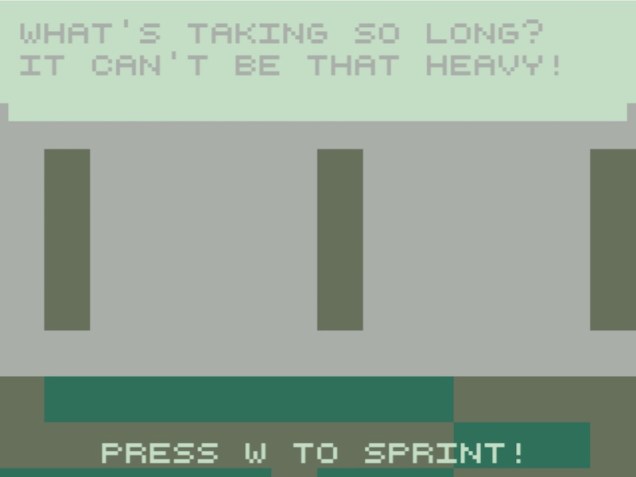
For years, I didn’t know what to do with Anna Anthropy’s Realistic Female First-Person Shooter (2012).

It is, shall we say, a “minor Anthropy.” It’s not one of the games that she includes on her itch.io storefront. If you want to play it, you have to head over here. (It is, unfortunately, Windows-only, although Mac users should feel free to look at this video of the game in action on YouTube).

But despite its somewhat tossed-off status, it is a game I was serious considering including in my article on fumblecore games. There was just one problem: it seemed completely incompatible with my argument. So I swept it under the rug, but kept it in my memory, blinking in the back of my brain, challenging me, keeping me honest.

I think I’ve finally figured out what I want to say about it now, and it’s mostly thanks to the students in my “Frames, Claims, and Videogames” class. I didn’t even teach Realistic Female First-Person Shooter in that class. Instead, my thoughts began crystalizing as students reacted of Alyson Macdonald’s Twine game Female Experience Simulator (2013), one of the most contentious games we played in the course.
Continue reading

A Hodology of Videogames: Miasmata

miasmata_screenshot_05

Ian here—

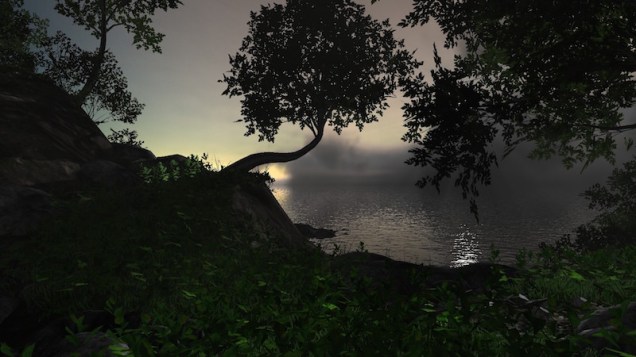
Welcome to the second of a series of posts I’ll be doing on hodological space in games. “Hodological space” refers to the space that humans inhabit: not a space made up of strict coordinates, but a thicket of preferred paths, affected by factors such as interest, distraction, fatigue, and urgency. It’s a term that originated in the writings of psychologist Kurt Lewin, and which traveled by way of Sartre into the realm of phenomenology.

Up today: the survival simulation game Misasmata (IonFX, 2012). Accepted onto the Steam storefront in October 2012 as part of Valve’s second batch of games approved through the now-defunct Greenlight submission process, one of Miasmata‘s most notable traits was being on the leading edge of the “goodness, there are too many indie games than one could ever keep up with” moment we are currently in. Miasmata, though, is worth remembering for more than that. It also possesses a genuinely innovative movement system, one that, in its own weird way, serves as a nice counterpoint to the subject of my previous entry in this seriesThe Legend of Zelda: Breath of the Wild (Nintendo EDP, 2017).

Continue reading

The Coming of Age in Metal Gear Solid IV

MGS4_Old_Snake_01

Ian here—

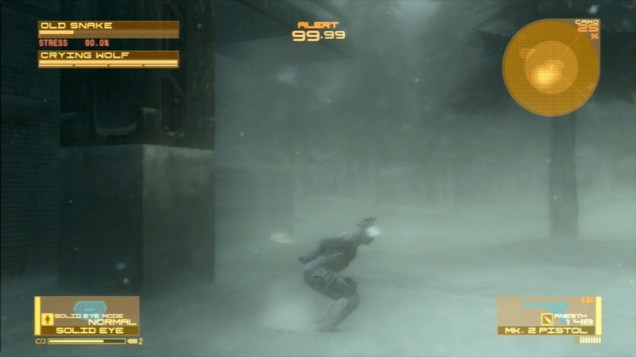
The level “Twin Suns” in Metal Gear Solid IV (Kojima Productions, 2008) ranks as one of my favorite videogame levels of all time. Smack dab in the middle of a game with more than its share of problems—the usual problems of unconscionably long cut-scenes and unconscionably short periods of genuine interactivity, plus new problems such as an inexplicably drab grey-green color scheme—comes something so conceptually audacious that I’m simply floored.

“Twin Suns” takes two of Metal Gear Solid IV‘s central themes, aging and the fear of obsolescence, and distills them into their most undiluted form. In Metal Gear Solid IV, series protagonist Solid Snake is old. (In fact, he’s so old that he’s given a new moniker, Old Snake.) This is used to greater or lesser effect throughout the entire game, but it really comes to the fore in “Liquid Sun,” which sees Snake returning to Shadow Moses, the location he infiltrated in Metal Gear Solid, a game released a decade prior. Given that series creator Hideo Kojima is well-known for using each sequel as a means of interogating the game industry’s lust for sequels, it should come as no surprise that this re-visit is in part a mediation on the way the franchise has aged. What is surprising is that this predictably modernist streak is shot through with something that approaches genuine pathos, and a fairly sincere investigation of what it means for an action hero to age.

(The title of my post pays homage to Simone de Beauvoir’s La Vieillesse, from which I’ll be quoting from sporadically. Although the Patrick O’Brian English translation I’ll be quoting from is actually titled Old Age, I much prefer the English language rendition The Coming of Age.)

Continue reading

Lewis Klahr’s Sixty Six

Klahr_sixty_six

Ian here—

The University of Chicago’s Film Studies Center has been having a fantastic year so far when it comes to experimental cinema. Hot on the heels (-ish) of their “Troubling the Image” series, last night they booked Lewis Klahr’s twelve-part, feature-length Sixty Six (2015), for what is I believe its Chicago debut.

Klahr was there in attendance, taking part in a very animated Q&A after the screening. I don’t think I’ve ever attended a Q&A with such an extreme questions-asked-to-time-filmmaker-talked ratio, and while some might have accused Klahr of self-indulgent rambling, I really rather enjoyed his tangents, and found that he had quite a lot of fascinating points to make about his process.

Continue reading

Inscrutability in Game Design: Perils and Possibilites

rooftop_cop_screenshot_01

Ian here—

Earlier this week, I sat down with some friends to play David OReilly’s Everything (2017). We were all suitably hyped, and ready for an evening of being different things while chuckling over the political indefensibility of object-oriented ontology. (Yes, really. We’re those people.)

But our evening hit a snag. Somewhere along the line, in our first playthrough, beginning as a cougar, we encountered a weird bug. One of the little “gain a new ability” thought bubbles failed to pop up in the environment. No matter how far we traveled, or how many objects’ thoughts we listened to, we simply could not unlock the ability to scale up or down into bigger or smaller entities. We were doomed to be a cougar. (Or, cougars, rather. We were able to expand our ranks, and become about a dozen cougars, rolling across the rocky landscape. But being a dozen rolling cougars is small consolation in a game that promises that you can be, well, everything.) For 75 minutes, we wailed at the screen. “I thought you could be lint particles and galaxies and stuff!”

We tried, to no avail, to look up walkthroughs for Everything. Everywhere we looked, we found glowing reviews of how chill the game was, how it allowed you to sit back and let the experience of being everything wash over you. We couldn’t fathom how we got stuck in a game with no real objectives. To pour salt in the wound, the game seemed to be actively mocking us. “As long as you keep moving, in any direction you choose,” thought a tree, “that will take you where you need to go.” “Over time,” thought a rock, “you might find there’s no right or wrong path to take here.” We were seriously stuck, and the only feedback we were getting were Zen aphorisms that told us to take it easy and not worry so much.

Eventually, we deleted our save file and started over. Thankfully, this solved the problem, and we spent the rest of the evening enraptured. But it did get me thinking about the trickiness presented by purposefully inscrutable game design.

Continue reading

A Hodology of Videogames: Breath of the Wild

Breath_of_the_Wild_hodology

Ian here—

“Hodology” is, according to its Greek roots, the study of paths. These days, its primary associations seem to be with neuroscience. But I want to resurrect an older, more literal use of it: the study of how people move throughout a landscape, the ways in which they chart routes that are particular to the human body, human perception, and human culture.

This sense of the term “hodology” owes much to the psychologist Kurt Lewin. In his 1934 essay “Der Richtungsbegriff in der Psychologie. Der spezielle und allgemeine Hodologische Raum” (a mouthful, I know), Lewin coined the term hodological space to refer to the unique characteristics that landscapes take on when perceived by, and navigated by, human beings.[i] Lewin’s original essay remains untranslated into English after all these decades, but its influence was widespread. Jean-Paul Sartre took up Lewin’s term “hodological space” in Being and Nothingness, and from there it spread to a number of humanistic geographers interested in phenomenology, including Christian Norberg-Schulz and O.F. Bollnow. Norberg-Schulz offers a pithy English-language explanation of Lewin’s contribution:

Rather than straight lines, hodological space contains ‘preferred paths’ which represent a compromise between several domains such as ‘short distance,’ ‘security’, ‘minimal work’, ‘maximum experience’ etc. The demands are determined in relation to the topographical conditions.[ii]

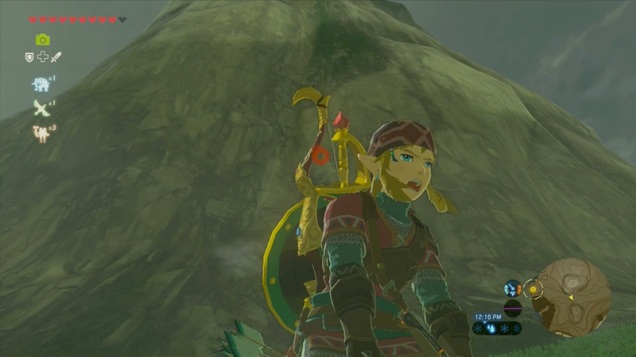
I’ve often thought that preferred paths are an interesting lens through which to look at videogame space, and so I’m inaugurating a series of posts that deal with them. What better to do the honors than one of the most talked-about games of the moment, The Legend of Zelda: Breath of the Wild (Nintendo EDP, 2017)?
Continue reading

Personal Puzzles

sym_screenshot_header_image.jpg

Ian here—

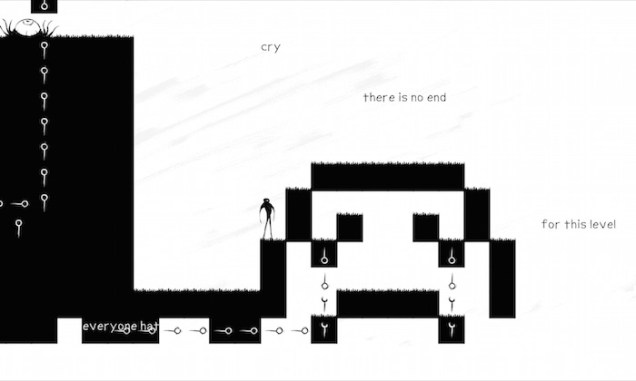
When you first start playing Eli Piilonen’s The Company of Myself (2DArray, 2009), it feels as if someone found a way to perfectly weld together a diary entry with a puzzle platformer. This was back in the heady days in the wake of Jonathan Blow’s Braid (Number None, 2008), when the public at large was still reeling over the idea that puzzle mechanics could mean something. And, at first glance, The Company of Myself seems to take this trend and go somewhere quite confessional with it. Its central mechanic of cloning yourself to solve puzzles stood as a perfect expression of feelings of self-reliance. And not just any self-reliance, either, but rather that specifically incorrigible mode of self-reliance that emerges when one is a bit too much of an unreconstructed introvert, refusing even the most basic forms of assistance because you desperately wish to not bother, or to be bothered by, anybody.

The “cloning” mechanic has popped up elsewhere in games—for instance The Misadventures of P.B. Winterbottom (The Odd Gentleman, 2010)—but The Company of Myself was more ambitious, wedding the mechanic with a personal story of interior life. Or, at least, it seems to do this, until you realize the whole thing is bullshit. The story takes an eleventh-hour delve into the lurid, revealing itself as an over-the-top fiction, rather than a form of sincere self-expression on the part of its creator.

The Company of Myself takes the easy way out, tacking on an over-dramatic denouement that destroys its potential as a diary-game. But … what if it didn’t? Could one actually use puzzles to communicate the intricacies of internal lived experience, in an emotionally sincere way? In this entry, I’ll be looking at two games that try: Liz Ryerson’s intimate and beguiling Problem Attic (2013), and Atrax Media’s more slick and straightforward Sym (2015). Along the way, I’ll also be dipping a bit into Braid, just because it’s hard to talk about contemporary puzzle platformers without doing so.

Continue reading

I’ve Been Everything, Man

you_are_mountain.jpg

Ian here—

2017 marks the year of animator David OReilly’s return to to the medium of videogames, following up on his strange and serene digital-art-toy-screensaver-thing Mountain (2014). His new game, Everything, released on PS4 on March 21st, and releases on Windows, Mac and Linux this Friday.

The game’s title, Everything, is also the game’s premise: It is a game about everything. Specifically, it is a game in which players can be everything, switching at will from trees to koalas to rocks to quarks and back. I haven’t had a chance to sit down with it yet—I suspect I’ll make time for it once it’s out for PC—but I did want to take the advent of its multi-platform release as an opportunity to muse on this premise’s history in gaming.

Everything may be the first game that explicitly promises to allow us to be everything, but games have previously offered the ability for us to step into the role of quite a lot of things, including a surprising range of inanimate objects. “The child plays at being not only a shopkeeper or teacher,” wrote Walter Benjamin, “but also a windmill and a train.”[i] Games have proved to be a continuing outlet for this childhood animist fantasy—why, in just a couple weeks’ time, we’re going to be able to play as a coffee mug!

Join me, won’t you, in a breezy tour of some of the stranger things games have let us be.

Continue reading

Five Questions About We Are Chicago

we_are_chicago_screenshot_02

Ian here—

Wow, okay, so, deep breaths. Let me repeat the mantra: “I critique, because I care.”

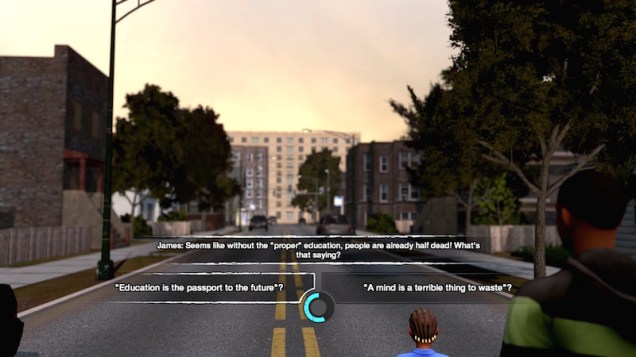
We Are Chicago (Culture Shock Games, 2017) arrives at very particular time for me. I just finished up with a panel on Chicago game cultures for SCMS 2017, and I have also been working through some ideas on the limits of the concept of “empathy” in games.

Given these two facts, there’s no real way I could get away with not playing it, and not taking a couple of moments to try an translate my thoughts on it into some coherent writing. This task, though, is one that needs to be approached with care. In order to be fair, an acknowledgment of the commendable intentions of Culture Shock games must be balanced with a corresponding acknowledgment of the very real shortcomings of their final product. It does nobody any good to mince words, and to pretend that intention can overcome execution.

So, buckle up. I have five questions to ask about We Are Chicago.

Continue reading

Let’s Study Virginia … some more!

Ian here—

It’s done! The second part of my “Let’s Study Virginia” video is now live on YouTube.

If you just want to watch the second part, click the embedded video above. If you want to watch the whole thing from the beginning, click here. (I have also updated my original post so that the embedded video there autoplays the second part.)

Time will tell if I make more of these “Let’s Study” videos. Building up an archive of them could have real pedagogical benefits. The best option when teaching games is, of course, always to have students play things themselves. But one must consider the realities of constraints on access to specific platforms. If students playing a game is a logistical impossibility, it is undoubtedly a better to be able to say, “here, watch this video I uploaded onto YouTube that precisely demonstrates exactly the relevant points of this game,” than it is to say, “go find some footage of it on YouTube recorded by some random let’s play-er.” A strong case can be made that this sort of video essay work is the next best thing to having students play things on their own.

As before, full script below the fold, if for whatever reason that interests you.

Continue reading