Joana Pimenta’s An Aviation Field

an_aviation_field.jpg

Ian here—

So I’ve done a couple dispatches now from the University of Chicago Film Studies Center’s “Troubling the Image” series. I’ve especially like the recent material that Julia Gibbs and Patrick Friel have pulled together from filmmakers and video artists around the world. As it turns out, 2016 was an especially good year for experimental cinema.

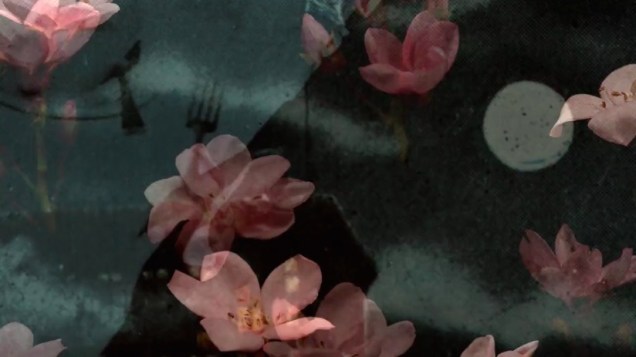
In fact, although there’s a truly embarrassing array of films I need to catch up on from 2016 (been playing too many games …), I think it’s likely the case that my favorite film from 2016 will be an experimental short: Portuguese-American filmmaker Joana Pimenta’s video An Aviation Field.

Continue reading

Let’s Study Virginia

Ian here—

So, awhile back I promised further thoughts on Virginia. After mulling it over, I decided to put them in video form. The end result is a sort of let’s play/video essay hybrid, which I’m calling a “let’s study.” (This sounded less presumptuous than “let’s analyze,” which I didn’t want to use because this video isn’t particularly academic. At the same time, though, it sounded more sturdy than “let’s think about,” or some other wishy-washy formation.)

This video is slightly under an hour, and it’s only the first half of what I’m planning on making into a two-video sequence. I’ll update the embedded video above so that it plays the whole playlist rather than just the first video once I’ve finished the second one. [UPDATE 2017-02-28: I’ve updated the embedded video! If it doesn’t auto-play the entire sequence, it should at the very least recommend the second after you finish the first.]

Full transcript of the script below the fold, for those of you who prefer reading things.

Continue reading

Cursory Knoweldge

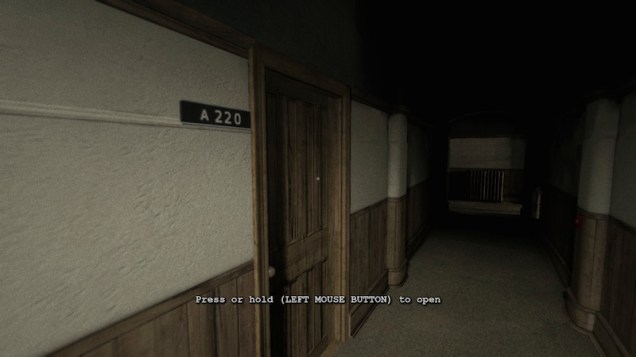
outlast-screenshot-01

Ian here—

If I had to sum up a significant portion of the writing I do on videogames, I would offer the following formulation as a précis: The establishment of character in videogames isn’t achieved solely through writing. It is also established through user interface design.

Sometimes, something as simple as how a cursor behaves can tell us a lot about a character. Be forewarned—the breezy tour through the issue below contains significant spoilers for Firewatch (Campo Santo, 2016).

Continue reading

The Process Genre in Videogames: Sunset

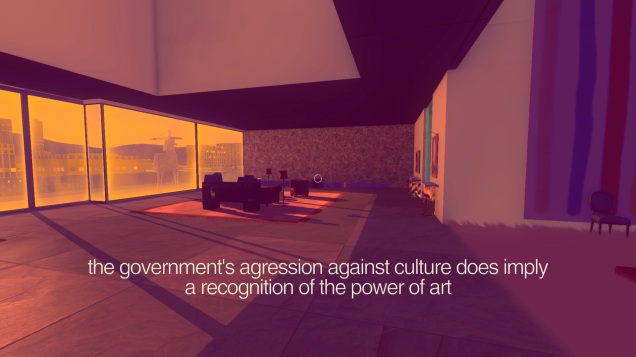
sunset_screenshot_header_image
In all seriousness, call your elected representatives and tell them to oppose defunding the NEA and NEH.

Ian here—

This post is part of a series that borrows the term process genre from Salomé Aguilera Skvirsky’s work in cinema studies, and explores its utility for videogame analysis. A quick definition: “process genre” films are films about labor, films that focus on processes of doing and making, that are fascinated with seeing tasks through to their completion. They are deliberately paced, meditative, and often political, in that they cast a penetrating eye on labor conditions. Are there games that the same chords? Posts in the series so far can be seen here.

I reserve the right to sporadically post future entries in this series, but with Sunset (Tale of Tales, 2015), it really does feel as if things have come full circle. As I laid out in the first post in this series, the process genre finds its most archetypal manifestation in Belgian filmmaker Chantal Akerman’s Jeanne Dielman, 23 Commerce Quay, 1080 Brussels (1975), and Skvirsky has been tracking its development in contemporary Latin American cinema. Sunset was created by Belgian artist duo Auriea Harvey and Michaël Samyn, and is about the daily life of a housekeeper in a (fictional) Latin American country. The parallels are easily drawn, but there’s also more going on here than this brief description suggests.

Continue reading

Arash Nassiri’s Darwin Darwah

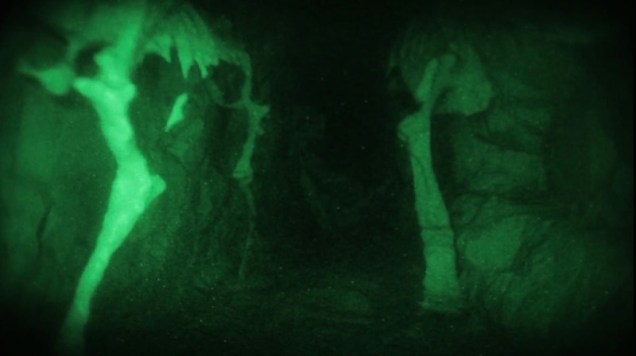
darwin_darwah-frame_grab

Ian here—

Another quick reflection on something screened for the Film Studies Center’s so-far excellent “Troubling the Image” series. This time, Arash Nassiri’s video Darwin Darwah (2016), screened as part of their “Tales of Sound and Vision” night, last Friday. The screening was full of great stuff—including The Inner World of Aphasia (Edward R. Feil, 1958), which I would recommend to anyone who always wished Sam Fuller and Owen Land had made a film together—but Nassiri’s piece left me with the most coherent thoughts.

Continue reading

Misty-eyed Modernism

Ian here—

In 1982, longtime Village Voice film critic J. Hoberman penned a famous essay entitled “Vulgar Modernism.” In it, he pointed out that medium-specific reflexivity—the use of “art to call attention to art” that Clement Greenberg proposed as the defining feature of modernist painting—was, in fact, everywhere in American mass culture in the 1940s and 1950s.[i] It was in Tex Avery and Chuck Jones’ Daffy Duck cartoons, chock to the brim with distanciation jokes and forthright acknowledgements of film form. It was in Bill Elder’s Mad Magazine cartoons, parodies that sometimes literally broke through their own frame. Hoberman coined the term vulgar modernism to name this “popular, ironic, somewhat dehumanized mode reflexively concerned with the specific properties of its medium or the conditions of its making.”[ii] Vulgar modernist works hold no pretensions toward being anything other than mass culture, but they demonstrate an astute awareness of the history of their own medium, and puckishly call attention to its conventions.

Hoberman’s essay is a helpful reminder that artistic devices don’t come pre-packaged with aesthetic aims. Greenberg observed painters embracing flatness, brushstrokes, and the properties of pigment, and considered such medium-consciousness as a crucial element of modernism in the fine arts. Hoberman observed similar devices employed by Warner Bros. and Mad, bent toward parody rather than Kantian self-criticism.

I offer this opening excursus because I’ve noticed a growing popularity of “modernist” devices in videogames. As in Hoberman’s case studies, these devices aren’t offered up in the spirit of intellectualized self-criticism. Rather, they constitute what I’ll call misty-eyed modernism: reflexive devices used to emphasize the vulnerability of a fictional character, a foregrounding of the specific properties of a medium for the purposes of empathy or tear-jerking.

About a month ago, I professed to not having played enough games from 2016 to name any as among my “favorites.” I have taken decadent advantage of the past 30 days, however, and I’m in a position where, yes, I can actually count the two discussed below as among my “favorite.” And, wouldn’t you know it, they both share misty-eyed modernist tendencies. Significant spoilers for both Oxenfree (Night School Studio, 2016) and OneShot (Team OneShot, 2016) below. If you’re spoiler-averse, then you should just take these above-the-fold recommendations and do with them as you see fit. If you don’t mind spoilers (of if you’ve already played the games in question), continue … but don’t say I didn’t warn you.

Continue reading

The Process Genre in Videogames: In the Shadow of Papers, Please

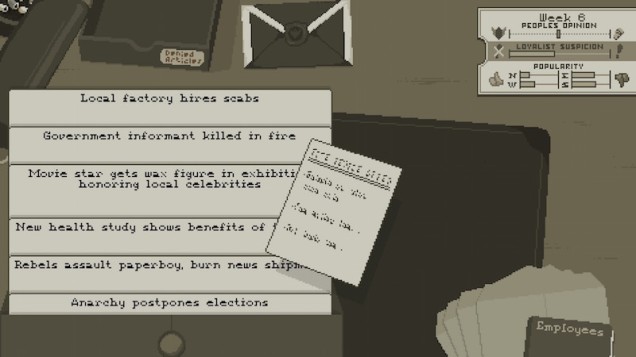
westport_independent-screenshot-01
The Westport Independent (Double Zero One Zero, 2016)

Ian here—

This post is part of a series that borrows the term process genre from Salomé Aguilera Skvirsky’s work in cinema studies, and explores its utility for videogame analysis. A quick definition: “process genre” films are films about labor, films that focus on processes of doing and making, that are fascinated with seeing tasks through to its completion. They are deliberately paced, meditative, and often political, in that they cast a penetrating eye on labor conditions. Are there games that strike the same notes? Posts in the series so far can be seen here.

In this entry, I turn not to one game, but to a whole slew of them. Particularly, I will be looking at games that have popped up in the wake of Lucas Pope’s lauded Papers, Please (3909, 2013), which I considered earlier in the series, here.

Continue reading

The Process Genre in Videogames: Skulljhabit

skulljhabit-screenshot_header_image

Ian here—

This post is part of a series that borrows the term process genre from Salomé Aguilera Skvirsky’s work in cinema studies, and explores its utility for videogame analysis. A quick definition: “process genre” films are films about labor, films that focus on processes of doing and making, that are fascinated with seeing tasks through to their completion. They are deliberately paced, meditative, and often political, in that they cast a penetrating eye on labor conditions. Are there games that the same chords? Posts in the series so far can be seen here.

The games that I have dealt with so far in this series—ShenmuePapers, Please, and Cart Lifeall enforce some sort of time pressure on their players. They don’t operate in any sort of 1:1 “real time” (their workdays last in the range of 5–45 minutes), but they do have their own internal ticking clocks, enforcing a certain pace. Cart Life‘s accelerated workday doesn’t even go so far as to pause while players are navigating its menu screens.

Skulljhabit (Porpentine, 2014) breaks this trend. It was made in the interactive fiction platform Twine, so player activity consists of clicking on hyperlinks, sans any ticking clock. It is bound, in this way, to the constraints of its platform. But what Porpentine achieves within those constraints is nevertheless quite remarkable, pointing toward the outer limits of how we can think about labor in videogames.

Continue reading

The Process Genre in Videogames: Cart Life

cart_life-screenshot_header_image

Ian here—

This post is part of a series that borrows the term process genre from Salomé Aguilera Skvirsky’s work in cinema studies, and explores its utility for videogame analysis. A quick definition: “process genre” films are films about labor, films that focus on processes of doing and making, that are fascinated with seeing tasks through to their completion. They are deliberately paced, meditative, and often political, in that they cast a penetrating eye on labor conditions. Are there games that the same chords? Posts in the series so far can be seen here.

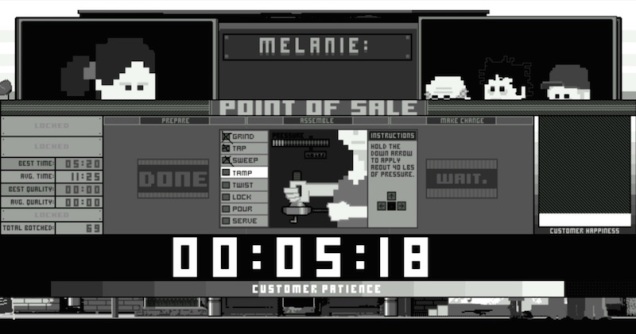
Cart Life (Richard Hofmeier, 2011) was part of the opening volley of what would eventually be termed “personal games.” Although some of the best known games slotted under this designation told stories of queer lives—for instance Dys4ia (Anna Anthropy, 2012), Consensual Torture Simulator (merritt kopas, 2013), and Gone Home (The Fullbright Company, 2013)—this is far from a requirement. Hofmeier’s game pursues an alternate tactic, telling the personal stories of characters whose lives might normally be overlooked, considered too humdrum for the purposes of mass entertainment. If you squint, you can see Hofmeier importing aspects of cinema’s neorealist tradition to the medium of videogames, in the game’s focus on the working class lives, on the effects of financially precarity on family relations, and even its use of black-and-white imagery. There is one major difference, though: The neorealist tradition in the Cesare Zavattini mold was often devoted to slow pacing, using empty moments to model the often-incident-free rhythm of everyday life. (Contemporary films in the process genre continue this tradition, hyperbolizing it beyond anything found in 1940s-era neoralist cinema.) Hofmeier, by contrast, enforces a frantic pace. In Cart Life‘s version of working class life, there is no time for idleness. When you’re trying to prove to a judge that you’re financially stable enough to have custody of your daughter, or trying to save up enough for a security deposit on an apartment so that you can move out of a hotel, every minute counts.

Continue reading

Janie Geiser’s Flowers of the Sky

janie_geiser_flowers-frame_grab-02

Ian here—

Any occasion to see a new film by Janie Geiser is a happy one, but I am especially lucky in that the context in which I saw Flowers of the Sky (2016) was during the inaugural screening of “Troubling the Image,” a series of recent (or recently-restored) avant-garde/experimental films being put on at the University of Chicago’s Film Studies Center. Programmed by Julia Gibbs and Patrick Friel, the series promises to be a stream of delights, and I’m hoping to post some more dispatches from it in the future.

There was plenty of great work on display in this first screening, entitled “Color My World.” (I was especially glad to see more videos from T. Marie, whose work I had fallen behind on in recent years. 2014’s Panchromes I-III certainly did not disappoint, together forming one of the greatest examples of “cinema as painting” that I can think of.) But I’ve decided to limit my thoughts here to Geiser, and Flowers of the Sky.

Continue reading