A Practical Guide to Problem Attic

problem_attic_header_image

Ian here—

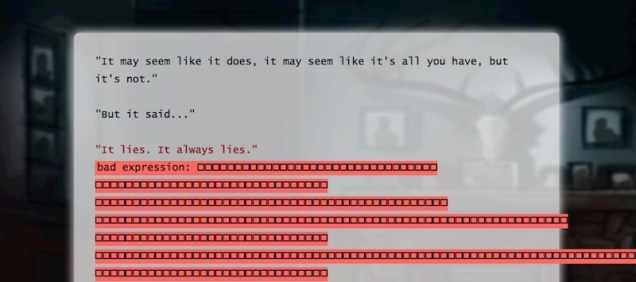
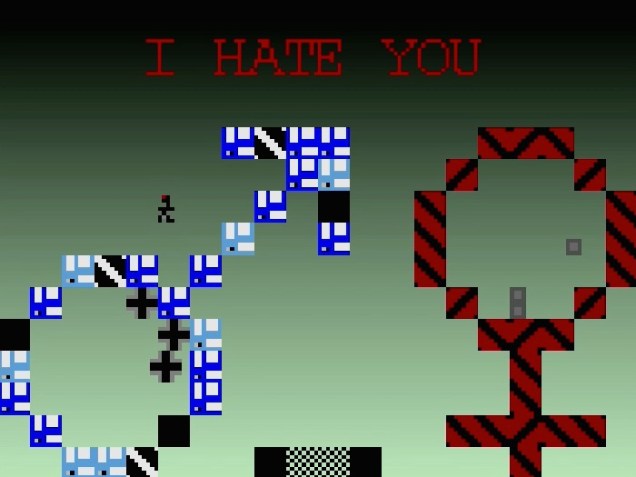
Liz Ryerson’s Problem Attic (2013) is a classic of the personal games movement. It is also notoriously difficult, for a number of overlapping reasons. I have come to realize that there are no real walkthroughs of it online, to help players that might be interested in examining Ryerson’s game and seriously considering its themes, but simply cannot get through an especially tricky area without help. I have decided to rectify this, before I teach the game for a class.

If you are looking for pedagogical notes or analysis, be forewarned: there will be none of that in in this post. This is a walkthrough, pure and simple. I’m planning on posting something more genuinely analytical on this game in the weeks ahead, but first I thought I’d do the world a public service. (If only making walkthroughs was something one could put on a CV…)

Continue reading

Discussion: Bill Brown’s The Other Side

bill_brown_other_side_screenshot_04

Ian here—

My teaching style for my “Avant-Garde Film and Video Art” first-year seminar course at the School of the Art Institute this semester has been relatively hands-off. I show students things in class, give a short 10-20 minute lecture, have students give presentations (you can see their handiwork here!), and then launch into discussion.

One way to conduct class discussion is to have a very specific set of interpretive moves you want to make, and to tailor your questions in order to guide your students through your own thought process. Sometimes I’ll do this type of in-class discussion. (My lesson plan on Bruce Conner’s A Movie details a lot of the points I like to hit up when discussing that film). I’m drifting away from that, though, in this particular class. I give students more work to do, in the form of blog posts and presentations. Likewise, I’m more fully embracing the seminar format in class discussions, allowing conversation to be guided by students’ interests, instead of carefully crafting questions to serve a particular road map.

This has lead to some really wonderful in-class moments that I wanted to report back on. I bristled at the thought of calling these “lesson plans,” given that such language gives me too much credit, and my students too little. Instead, they’re best thought of as the collaborative results of loosely-planned conversations, that hold within them the potential to become future, more strictly-planned lessons.

Up today: some points made while my students and I discussed Bill Brown’s essay film The Other Side (2006). If you haven’t seen it, the entire film is available on Brown’s Vimeo page, here.

Continue reading

Alternative History of Visual Music

Lola Dement Myers

Sound and film have been ubiquitously grouped together since the development of sound in cinema in the mid 1920s. Last week, we covered what sound and music are in relation to film, how sound aids or detracts from visual cinema, and the differences between sound and music. Sound, in relation to picture, usually comes second in the process of making a film. In traditional cinema, the sound of the film is often determined by the visuals. But what happens when an artist creates a film where sound is the dominant medium? When sound determines the visuals of an avant-garde film, Visual Music is created. This type of film includes work by Mary Ellen Bute, Oskar Fischinger, Norman Mclaren, and Stan Brakhage.

Continue reading

The Presence of The Hand in Alternative Animation

Alexander Popejoy

When looking at a garment, one of the first things one might notice is the presence or absence of “the hand.” Are the seams perfectly sewn and pressed, or do we see some threads unraveling at the finishes, some hand stitching? When we see the absence of the human hand as a force of creative work, there are instant connotations that come with this. Some connotations could be considered positive, such as refinement or perfection, but others not so much, such as anonymous labour and mindless production. While watching the material for Week 11’s topic of alternative animation, the presence or absence of the hand as a mark making tool was something that really struck me as important. The following paragraphs are my thoughts on the videos we will watch in class through this lens, with the exception of Night Hunter by Stacey Steers.

Continue reading

Five Questions About We Are Chicago

we_are_chicago_screenshot_02

Ian here—

Wow, okay, so, deep breaths. Let me repeat the mantra: “I critique, because I care.”

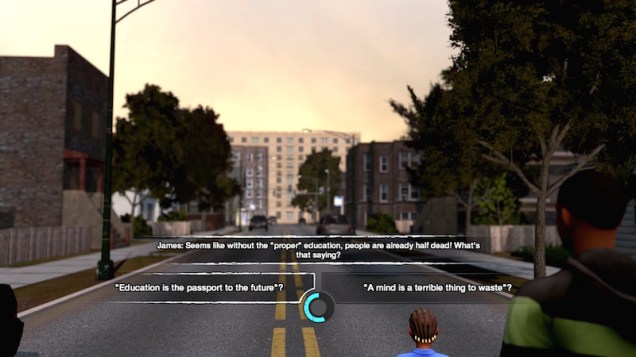
We Are Chicago (Culture Shock Games, 2017) arrives at very particular time for me. I just finished up with a panel on Chicago game cultures for SCMS 2017, and I have also been working through some ideas on the limits of the concept of “empathy” in games.

Given these two facts, there’s no real way I could get away with not playing it, and not taking a couple of moments to try an translate my thoughts on it into some coherent writing. This task, though, is one that needs to be approached with care. In order to be fair, an acknowledgment of the commendable intentions of Culture Shock games must be balanced with a corresponding acknowledgment of the very real shortcomings of their final product. It does nobody any good to mince words, and to pretend that intention can overcome execution.

So, buckle up. I have five questions to ask about We Are Chicago.

Continue reading

Dissynchronicity in Sound and Film Art

deserter

Izzy Adams

Soviet filmmakers spent their lives defining and redefining montage film. Montage is the central genre in experimental film in Soviet Russia. Earlier in the course we discussed and read S.M. Eisenstein’s theories on montage. Precisely, he defines the genre as such: “montage is an idea that arises from the collision of independent shots.” Montage revolves entirely around editing, and when the soviets coined the term they introduced a new kind of cinema to the film world which would greatly affect the future of narrative filmmaking and filmmaking in general.

In their essay titled “A Statement,” S.M. Eisenstein, V. I. Pudovkin and G. V. Alexandrov discuss the introduction of sound to the art of film and its merits and possible detriment it could bring to the medium. Throughout, they seem to go back and forth on what good they think sound can do for film.

Continue reading

Soviets and Their Theories Around Sound in Experimental Film

deserter4

Aspen Stanley

The idea of montage is heavily explained, and defended by early soviet film-makers such as Eisenstein, Pudovkin, and Alexandrov. They would discuss theories in the construction and purpose of montage. When the introduction of sound into the cinematic experience, sure enough, the same soviets had much to say about the way sound should exist and interact with the montage.

The Soviets introduce a few possibilities for how sound can serve a purpose in montage, and also how sound could be the detriment of the piece. In attempts to stray away from the theater and grow into the potential film has apart from it use to capture theatrics, rather as a medium of constructing montage, the automatic adherence of sound to film is what is could be the driving detriment of a film. A “backing track”, so to speak, is what these thinkers are referring to: the purpose of adding sound for the sake of adding sound. This addition of a “backing track” to film is curious in early film because, often the music added to a film was being performed by a live orchestra in the cinema. In order to avoid “destroying the culture of the montage” a few applications for sound in film are introduced.

Continue reading

Feeling Through Computers: Videogames and the Bleeding Edge of Empathy

feeling_through_computers_header_image_GIF

Ian here—

What follows is an invited talk I gave last month at a university that will remain unnamed. Here, things get a little awkward: the talk in question was actually a job talk, and I am technically still waiting to hear back on the school’s final decision. Hence, the location of the talk remaining unnamed.

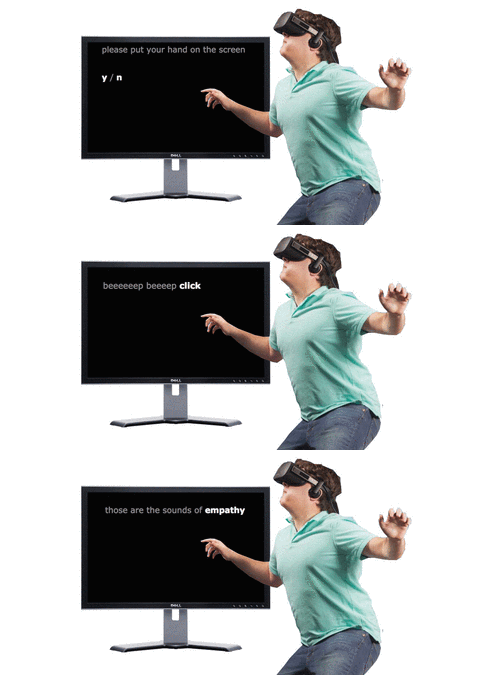
Originally, I was going to wait to post this talk until I had heard official word back on the status of the position (whether that news was good, or bad). I’ve decided to post it now, though, mostly because I attended an excellent panel at SCMS 2017, “Video Games and Queer Affect,” chaired by Bonnie Ruberg (an old compatriot of mine from Bard College) with papers by Whitney Pow (with whom I co-organized this conference) and Diana Pozo. Bonnie and Diana’s papers, especially, shared considerable overlap with the trends outlined here, down to including some of same case studies. It seems, then, that this material is very “of the moment,” and I didn’t want to let the opportunity to make is publicly available pass. I’m planning on moving this material forward into an article in the coming months. It’s exciting to be part of a community of peers who finds it as interesting as I do, and I’m definitely going to alter the direction and focus of aspects of this piece in response to the work I saw happening on the panel.

Continue reading

Playbor in the Loop: eSports and Athletic Scholarships in Chicago Education

scms_2017_prezi_screengrab_02

Ian here—

What follows is my talk from SCMS 2017 in Chicago, IL. It was part of the panel I organized, “Gaming’s Midway Point: Games and Game Culture in Chicago“—and I’d like to thank Julianne GrassoDaniel Johnson, and Chris Carloy for contributing papers and making that panel the success that it was.  You can follow along with my visual presentation here.

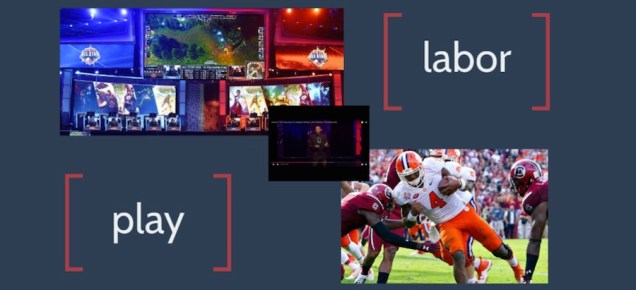
This is the website of Collegiate Starleague, a league for competitive, professional-level videogaming, or eSports, on college campuses. Collegiate Starleague holds tournaments for college players of games such as League of Legends (Riot Games, 2009) and Dota 2 (Valve, 2013), two enormously popular games in the Multiplayer Online Battle Arena genre, which has dominated eSports in recent years, as well as the first-person shooters Overwatch (Blizzard, 2016) and Couter-Strike: Global Offensive (Valve, 2012), and the digital collectable card game Hearthstone (Blizzard, 2014).

Continue reading

Lesson Plans: The Definitions and Expectations We Have of Games

uncle_nintendo_screenshot.jpg

Ian here—

This post serves as a little mini-postmortem on two difficult class sessions in my “Frames, Claims, and Videogames” course. There are multiple overlapping reasons why these class sessions were difficult for me. One is that my lesson had to pivot strangely from seemingly-academic debates on the definition of games to a sudden dive into matters of harassment in game culture. Harassment itself is, needless to say, a difficult thing to discuss in class. It becomes exponentially more difficult when one is teaching  a class with a high percentage of international students, many of whom (thanks to the registration realities of late-scheduled courses) have no particular interest in games, and who simply cannot fathom the cultural forces that align to drive a certain subset of American men to use things like changing conceptions of videogames (videogames!) as an opportunity to harass women online. I mean, how do you explain this, really—to anyone at all, let alone someone completely on the outside of American “gamer” culture?

I won’t go so far as to claim that my approach to this material was entirely successful. (The class did not, for instance, become a platform for thoughtful discussion in the same way my unexpectedly post-Trump-election lesson on the politics of American comedy did.) It was, though, a learning experience for me, so it’s worth sharing some details.

Continue reading