Here on My Side of the Screen

Hate_Plus_screenshot_02

(I’m officially retiring my usual “Ian here” greeting, as, in the absence of student posts, there will be no one but me posting on this blog for the foreseeable future.)

Early in his book Pilgrim in the Microworld, a phenomenological account of videogame expertise that stands as landmark work of first-person game criticism, David Sudnow attempts to describe, to a presumably completely ignorant reader, the experience of playing Breakout (Atari, 1972). “There’s that world space over there, this one over here,” he writes, “and we traverse the wired gap with motions that make us nonetheless feel in a balanced extending touch with things.”[i]

Today, the term “wired gap” is archaic—we sit comfortably in the age of wireless game controllers. But the general logic of this gap, and how it is traversed, nonetheless persists. On the one side, we have the electronic world represented on the screen. On the other side, we have ourselves, cordoned off from the world of the game by virtue of being flesh-and-blood. If we act upon that other world from our side of the screen, it must be by virtue of some sort of electronic input device: keyboard and mouse, DualShock 4, Wii Remote, Jungle Beat bongo drum, what have you. Wired or not, the relationship we have with that world on the other side of the screen is necessarily mediated by technology: sever that particular link, and our involvement with it ceases.

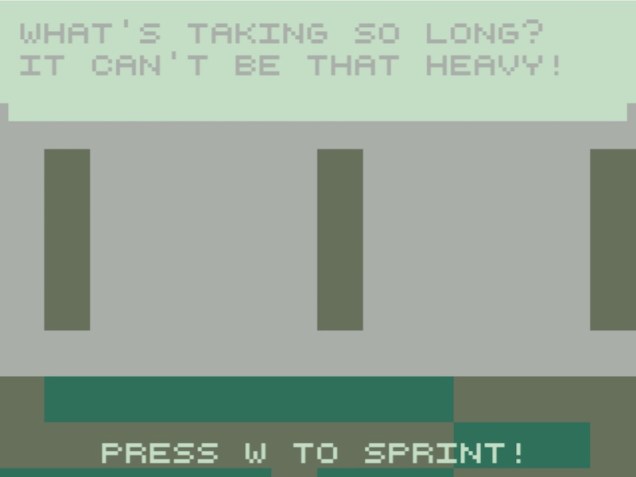
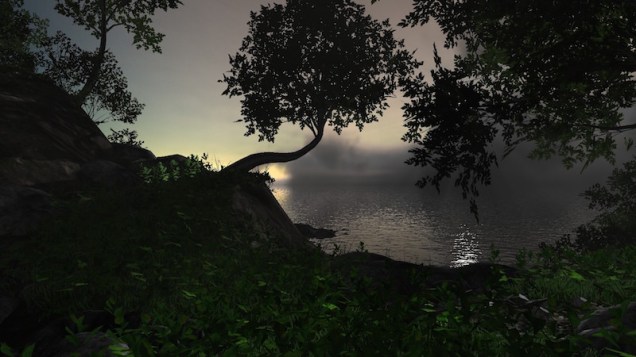
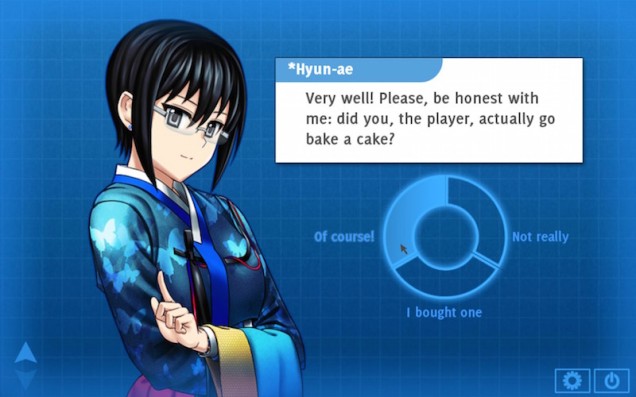
Not all games follow this logic, however. In this post, I’ll be looking at three games, all of which came out around 2012–2014, that ask you to do more, as a player, than simply manipulate an electronic interface. These games have a different sort of contract with their player. They ask you agree to more wide-ranging sets of behaviors over on your side of the screen, which, by their very nature, cannot be regulated in strict procedural terms. These are games that re-map the points of contact between our fleshy, spacious realm and the realm of bits and pixels.
Continue reading

Videogame Cat of the Week: Hidden Village Cats

twilight_princess_hidden_village_cats_07.jpg

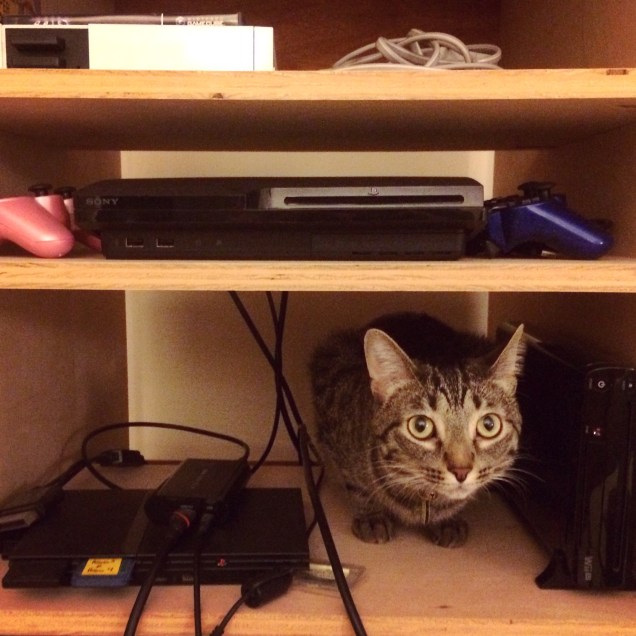
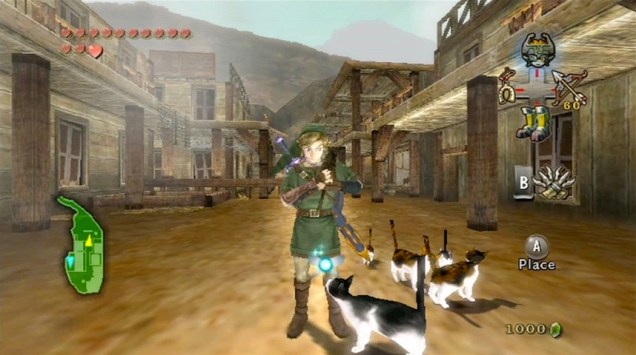
Among home consoles, the library of the Wii is not particularly well-regarded. I consider it to be underrated in several respects. This is especially true in regards to cats. Judged purely on the quality of the cats it offers, the Wii is probably the greatest home console in history.

I’ve chosen three titles from its library as my next three cats of the week. Up first: launch title The Legend of Zelda: Twilight Princess (Nintendo EAD, 2006).

Continue reading

Videogame Cat of the Week: Mr. Glembovski

cats_in_videogames_cart_life_gif

If you want to read my serious thoughts on Richard Hofmeier’s Cart Life (2011), you should go here. For now, though, let us consider Mr. Glembovski, the cat that Andrus keeps in his hotel room, against the wishes of the management.

As a secret cat, Mr. Glembovski’s life is cruelly constrained, consisting of nothing more than a small room, and sometimes even less than that. But, as the GIF above shows, there is clearly so much love between these two. The nose-touching shows that Andrus knows just how to treat a cat. And who couldn’t love Mr. Glembovski, with his adorably desynchronized blinks and affectionate ways?

Don’t be a monster. If you ever play Cart Life, be sure to feed Mr. Glembovski. I don’t know what happens if you don’t (far be it for me to play that way), but I’m sure it’s awful.

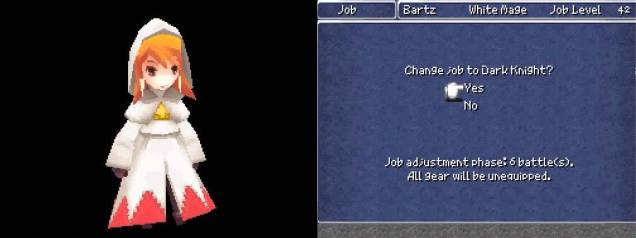
Job Change

ffiii_change_job

Ian here—

This week, I began a new job as a writer for the University of Chicago’s Center for Interdisciplinary Inquiry and Innovation. In that capacity, I will be writing grants and papers to help fund and publicize the work of its three constituent labs: the Game Changer Chicago Design Lab, the Transmedia Storytelling Lab, and the Design Thinking Lab. I’ve worked with Game Changer before, but this full-time position will represent a fairly significant shift in my career focus.

This will inevitably bring some changes to this site. Originally, it served two purposes: as a way for students to post work for classes, and as an online extension of my teaching portfolio. Since I don’t have any plans to teach in the immediate future, nor to re-enter the academic job market in the fall of 2017, those functions are no longer a priority for me. I am not going to remove anything from the site, but I will likely be re-organizing it a bit, so that the parts of it that highlight my work as a faculty member (and as an academic job applicant) are less prominent.

I’ll also be posting somewhat less. This is my ninety-first post since I first decided to buff up the teaching portfolio aspect of this site and posted my first lesson plan last September. I’ve averaged just under one post every three days, which I am rather happy with. I can’t, however, keep up this pace once I subtract posts that reflect on my teaching. Without classroom experiences to reflect back on, I won’t be able to keep up the same volume.

We’ll see what this actually means in the coming months. If nothing else, I’m going to continue posting my silly little videogame cat of the week posts, to help stave off extended dry spells. Given that I’ll be spending 40 hours a week writing, I might also try to skew blog content further in the direction of video essays, as a way of giving myself some variety in my modes of expression. (I do have a couple planned for the summer.)

Thanks a bunch to everyone who has supported me over these past couple of years adjuncting, whether support has taken the form of reading my work, coming to conference presentations, attending mock job talks, or sharing content from this very site. (My practical pedagogical notes on games have gotten a fair amount of hits!) It’s been a wild ride, and I am happy to have shared it with you.

Double Blind

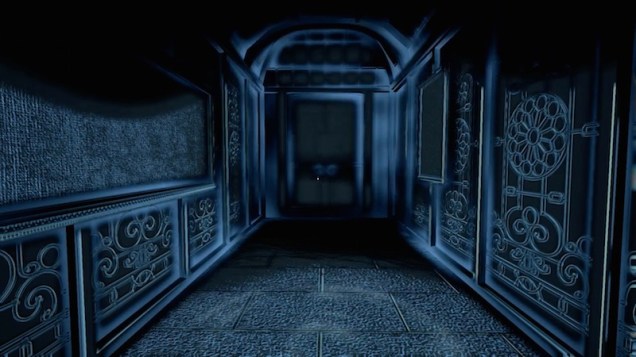
perception_screenshot_01.jpg

Ian here—

I’ve written about synesthetic interfaces before: that is, interfaces that perform a sensory substitution, translating the information normally associated with one sense modality into the phenomenal forms normally associated with another. In my previous work, I’ve usually focused on forms of nonhuman perception and certain modes of perceptual expertise. The release of Perception (The Deep End Games, 2017) yesterday, however, gives me an opportunity to dip into a new topic: disability.

Perception is a horror game about a blind woman exploring a haunted house. Unlike a game such as Papa Sangre (Somethin’ Else, 2010), however—an experiment in audio-only digital game design that has sadly been taken off of the iOS App Store as of this writing—Perception doesn’t court blind and other low-vision players. Rather than featuring robust, binaural sound localization simulation, Perception re-imagines the auditory perception of its blind protagonist Cassie as a kind of sonar vision, thrown up on the player’s screen in spooky, warbly monochrome.

This isn’t the first time games nominally about blindness have been served up to sighted players. In this post, I take up a comparative investigation of Perception alongside Beyond Eyes (Tiger and Squid / Team17 Digital Ltd, 2015), which drops the horror angle in favor of child-friendly, colorful adventure.

Continue reading

Prolegomena to a History of Cats in Videogames

cats_in_videogames.jpg
As opposed to cats among videogames. That is an altogether separate matter. Apologies for the confusing header image.

Ian here—

By now, every right-thinking person on the internet knows that omgcatrevolution is the most essential Tumblr in existence. (Perhaps even the greatest site, bar none, on the internet.) But although it is an ever-more-exhaustive archive of cats in mainstream cinema, cats in experimental cinema, cats in animation, cats on television, cats in music videos, and cats in porn, there one crucial bit of moving-image culture that remains its blind spot: cats in videogames. I am swooping in to rectify this.

In all seriousness, the summer has hit, classes are over, and I have some big things brewing on my horizon. I’m determined to still post regularly, though, so I’m trying to design some sort of mechanism that forces me to update on a set schedule. It is for this reason that I now announce a new feature on this blog: videogame cat of the week.

Yes, really.

Continue reading

A Hodology of Videogames: Proteus

proteus_screenshot_01

Ian here—

Welcome to the third of a series of posts I’ll be doing on hodological space in games. “Hodological space” refers to the space that humans inhabit: not a space made up of strict coordinates, but a thicket of preferred paths, affected by factors such as interest, distraction, fatigue, and urgency. It’s a term that originated in the writings of psychologist Kurt Lewin, and which traveled by way of Sartre into the realm of phenomenology.

If, as Jean-Luc Godard once famously said, all you need to make a movie is a girl and a gun, than all you need to make a videogame is an island.

The island-game gave us Myst (Cyan, 1993), and it gave us last year’s The Witness (Thekla, Inc., 2016). It has also already made an appearance in this very series, with Miasmata (IonFX, 2012). But my favorite island game of all time might be Proteus (Ed Key and David Kanaga, 2013). And to really talk about what it gets right, we have to dip into issues of genre. So, buckle up: it’s going to be a bumpy ride.

Continue reading

Postmortem: Frames, Claims, and Videogames

Journey_in_class_play_session

Ian here—

Well, it’s that time of the semester. Grades for the School of the Art Institute of Chicago’s Spring 2017 semester were due Sunday, so it seems that it’s time to offer up a postmortem.

Last time around, I opted to do a postmortem on “Comedy and the Moving Image,” as I felt that it was my most successful course of the Fall 2016 semester. This time, I’m choosing to go with “Frames, Claims, and Videogames.” It must be said that this was not my most successful course of the Spring 2017 semester. That honor would go to “Avant-Garde Film and Video Art“—a fact that is of little surprise, given that it’s now the third time I have taught that class. “Frames, Claims, and Videogames,” by contrast, was a learning experience. It was the first time I’ve helmed a course solely focused on games, without any dependence on a cinema studies context, and it wasn’t taught under ideal circumstances. (As I have mentioned before, it was a late addition to the course roster, which meant that my students didn’t have a very good heads-up about what the course’s material would actually be before they set foot in the classroom.) One could say that it was a trial-by-fire situation, of sorts.

And, in this sense, it was quite effective. To start things off, here are four different lessons I learned over the course of the class:

Continue reading

The Limits of Disempowerment

realistic_female_fps_anthropy_02

Ian here—

For years, I didn’t know what to do with Anna Anthropy’s Realistic Female First-Person Shooter (2012).

It is, shall we say, a “minor Anthropy.” It’s not one of the games that she includes on her itch.io storefront. If you want to play it, you have to head over here. (It is, unfortunately, Windows-only, although Mac users should feel free to look at this video of the game in action on YouTube).

But despite its somewhat tossed-off status, it is a game I was serious considering including in my article on fumblecore games. There was just one problem: it seemed completely incompatible with my argument. So I swept it under the rug, but kept it in my memory, blinking in the back of my brain, challenging me, keeping me honest.

I think I’ve finally figured out what I want to say about it now, and it’s mostly thanks to the students in my “Frames, Claims, and Videogames” class. I didn’t even teach Realistic Female First-Person Shooter in that class. Instead, my thoughts began crystalizing as students reacted of Alyson Macdonald’s Twine game Female Experience Simulator (2013), one of the most contentious games we played in the course.

Continue reading

A Hodology of Videogames: Miasmata

miasmata_screenshot_05

Ian here—

Welcome to the second of a series of posts I’ll be doing on hodological space in games. “Hodological space” refers to the space that humans inhabit: not a space made up of strict coordinates, but a thicket of preferred paths, affected by factors such as interest, distraction, fatigue, and urgency. It’s a term that originated in the writings of psychologist Kurt Lewin, and which traveled by way of Sartre into the realm of phenomenology.

Up today: the survival simulation game Misasmata (IonFX, 2012). Accepted onto the Steam storefront in October 2012 as part of Valve’s second batch of games approved through the now-defunct Greenlight submission process, one of Miasmata‘s most notable traits was being on the leading edge of the “goodness, there are too many indie games than one could ever keep up with” moment we are currently in. Miasmata, though, is worth remembering for more than that. It also possesses a genuinely innovative movement system, one that, in its own weird way, serves as a nice counterpoint to the subject of my previous entry in this seriesThe Legend of Zelda: Breath of the Wild (Nintendo EDP, 2017).

Continue reading