A Hodology of Videogames: Proteus

proteus_screenshot_01

Ian here—

Welcome to the third of a series of posts I’ll be doing on hodological space in games. “Hodological space” refers to the space that humans inhabit: not a space made up of strict coordinates, but a thicket of preferred paths, affected by factors such as interest, distraction, fatigue, and urgency. It’s a term that originated in the writings of psychologist Kurt Lewin, and which traveled by way of Sartre into the realm of phenomenology.

If, as Jean-Luc Godard once famously said, all you need to make a movie is a girl and a gun, than all you need to make a videogame is an island.

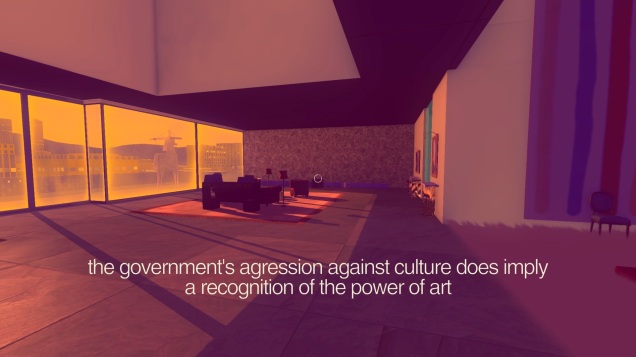
The island-game gave us Myst (Cyan, 1993), and it gave us last year’s The Witness (Thekla, Inc., 2016). It has also already made an appearance in this very series, with Miasmata (IonFX, 2012). But my favorite island game of all time might be Proteus (Ed Key and David Kanaga, 2013). And to really talk about what it gets right, we have to dip into issues of genre. So, buckle up: it’s going to be a bumpy ride.
Continue reading →

The Limits of Disempowerment

realistic_female_fps_anthropy_02

Ian here—

For years, I didn’t know what to do with Anna Anthropy’s Realistic Female First-Person Shooter (2012).

It is, shall we say, a “minor Anthropy.” It’s not one of the games that she includes on her itch.io storefront. If you want to play it, you have to head over here. (It is, unfortunately, Windows-only, although Mac users should feel free to look at this video of the game in action on YouTube).

But despite its somewhat tossed-off status, it is a game I was serious considering including in my article on fumblecore games. There was just one problem: it seemed completely incompatible with my argument. So I swept it under the rug, but kept it in my memory, blinking in the back of my brain, challenging me, keeping me honest.

I think I’ve finally figured out what I want to say about it now, and it’s mostly thanks to the students in my “Frames, Claims, and Videogames” class. I didn’t even teach Realistic Female First-Person Shooter in that class. Instead, my thoughts began crystalizing as students reacted of Alyson Macdonald’s Twine game Female Experience Simulator (2013), one of the most contentious games we played in the course.

Continue reading →

A Hodology of Videogames: Miasmata

miasmata_screenshot_05

Ian here—

Welcome to the second of a series of posts I’ll be doing on hodological space in games. “Hodological space” refers to the space that humans inhabit: not a space made up of strict coordinates, but a thicket of preferred paths, affected by factors such as interest, distraction, fatigue, and urgency. It’s a term that originated in the writings of psychologist Kurt Lewin, and which traveled by way of Sartre into the realm of phenomenology.

Up today: the survival simulation game Misasmata (IonFX, 2012). Accepted onto the Steam storefront in October 2012 as part of Valve’s second batch of games approved through the now-defunct Greenlight submission process, one of Miasmata‘s most notable traits was being on the leading edge of the “goodness, there are too many indie games than one could ever keep up with” moment we are currently in. Miasmata, though, is worth remembering for more than that. It also possesses a genuinely innovative movement system, one that, in its own weird way, serves as a nice counterpoint to the subject of my previous entry in this series, The Legend of Zelda: Breath of the Wild (Nintendo EDP, 2017).

Continue reading →

The Process Genre in Videogames: Sunset

sunset_screenshot_header_image
In all seriousness, call your elected representatives and tell them to oppose defunding the NEA and NEH.

Ian here—

This post is part of a series that borrows the term process genre from Salomé Aguilera Skvirsky’s work in cinema studies, and explores its utility for videogame analysis. A quick definition: “process genre” films are films about labor, films that focus on processes of doing and making, that are fascinated with seeing tasks through to their completion. They are deliberately paced, meditative, and often political, in that they cast a penetrating eye on labor conditions. Are there games that the same chords? Posts in the series so far can be seen here.

I reserve the right to sporadically post future entries in this series, but with Sunset (Tale of Tales, 2015), it really does feel as if things have come full circle. As I laid out in the first post in this series, the process genre finds its most archetypal manifestation in Belgian filmmaker Chantal Akerman’s Jeanne Dielman, 23 Commerce Quay, 1080 Brussels (1975), and Skvirsky has been tracking its development in contemporary Latin American cinema. Sunset was created by Belgian artist duo Auriea Harvey and Michaël Samyn, and is about the daily life of a housekeeper in a (fictional) Latin American country. The parallels are easily drawn, but there’s also more going on here than this brief description suggests.

Continue reading →

The Process Genre in Videogames: In the Shadow of Papers, Please

westport_independent-screenshot-01
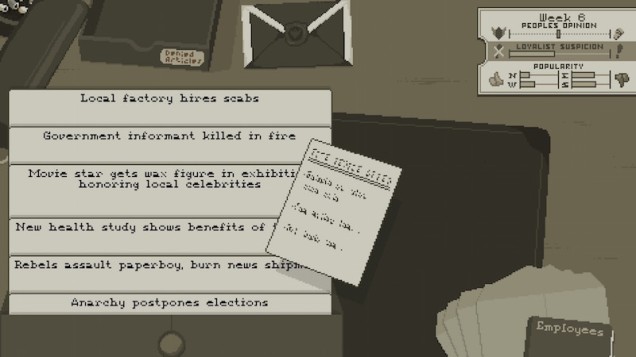
The Westport Independent (Double Zero One Zero, 2016)

Ian here—

This post is part of a series that borrows the term process genre from Salomé Aguilera Skvirsky’s work in cinema studies, and explores its utility for videogame analysis. A quick definition: “process genre” films are films about labor, films that focus on processes of doing and making, that are fascinated with seeing tasks through to its completion. They are deliberately paced, meditative, and often political, in that they cast a penetrating eye on labor conditions. Are there games that strike the same notes? Posts in the series so far can be seen here.

In this entry, I turn not to one game, but to a whole slew of them. Particularly, I will be looking at games that have popped up in the wake of Lucas Pope’s lauded Papers, Please (3909, 2013), which I considered earlier in the series, here.

Continue reading →

The Process Genre in Videogames: Skulljhabit

skulljhabit-screenshot_header_image

Ian here—

This post is part of a series that borrows the term process genre from Salomé Aguilera Skvirsky’s work in cinema studies, and explores its utility for videogame analysis. A quick definition: “process genre” films are films about labor, films that focus on processes of doing and making, that are fascinated with seeing tasks through to their completion. They are deliberately paced, meditative, and often political, in that they cast a penetrating eye on labor conditions. Are there games that the same chords? Posts in the series so far can be seen here.

The games that I have dealt with so far in this series—Shenmue, Papers, Please, and Cart Life—all enforce some sort of time pressure on their players. They don’t operate in any sort of 1:1 “real time” (their workdays last in the range of 5–45 minutes), but they do have their own internal ticking clocks, enforcing a certain pace. Cart Life‘s accelerated workday doesn’t even go so far as to pause while players are navigating its menu screens.

Skulljhabit (Porpentine, 2014) breaks this trend. It was made in the interactive fiction platform Twine, so player activity consists of clicking on hyperlinks, sans any ticking clock. It is bound, in this way, to the constraints of its platform. But what Porpentine achieves within those constraints is nevertheless quite remarkable, pointing toward the outer limits of how we can think about labor in videogames.

Continue reading →

The Process Genre in Videogames: Cart Life

cart_life-screenshot_header_image

Ian here—

This post is part of a series that borrows the term process genre from Salomé Aguilera Skvirsky’s work in cinema studies, and explores its utility for videogame analysis. A quick definition: “process genre” films are films about labor, films that focus on processes of doing and making, that are fascinated with seeing tasks through to their completion. They are deliberately paced, meditative, and often political, in that they cast a penetrating eye on labor conditions. Are there games that the same chords? Posts in the series so far can be seen here.

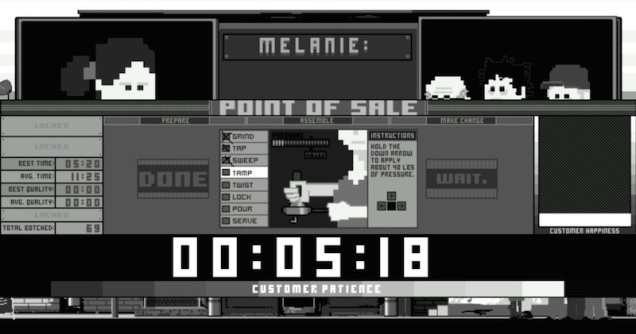
Cart Life (Richard Hofmeier, 2011) was part of the opening volley of what would eventually be termed “personal games.” Although some of the best known games slotted under this designation told stories of queer lives—for instance Dys4ia (Anna Anthropy, 2012), Consensual Torture Simulator (merritt kopas, 2013), and Gone Home (The Fullbright Company, 2013)—this is far from a requirement. Hofmeier’s game pursues an alternate tactic, telling the personal stories of characters whose lives might normally be overlooked, considered too humdrum for the purposes of mass entertainment. If you squint, you can see Hofmeier importing aspects of cinema’s neorealist tradition to the medium of videogames, in the game’s focus on the working class lives, on the effects of financially precarity on family relations, and even its use of black-and-white imagery. There is one major difference, though: The neorealist tradition in the Cesare Zavattini mold was often devoted to slow pacing, using empty moments to model the often-incident-free rhythm of everyday life. (Contemporary films in the process genre continue this tradition, hyperbolizing it beyond anything found in 1940s-era neoralist cinema.) Hofmeier, by contrast, enforces a frantic pace. In Cart Life‘s version of working class life, there is no time for idleness. When you’re trying to prove to a judge that you’re financially stable enough to have custody of your daughter, or trying to save up enough for a security deposit on an apartment so that you can move out of a hotel, every minute counts.

Continue reading →

The Process Genre in Videogames: Papers, Please

papers_please-screenshot-01

Ian here—

This post is part of a series that borrows the term process genre from Salomé Aguilera Skvirsky’s work in cinema studies, and explores its utility for videogame analysis. A quick definition: “process genre” films are films about labor, films that focus on processes of doing and making, that are fascinated with seeing tasks through to their completion. They are deliberately paced, meditative, and often political, in that they cast a penetrating eye on labor conditions. Are there games that the same chords? Posts in the series so far can be seen here.

On the docket for today: Lucas Pope’s Papers, Please (3909, 2013), a simulation of being a border guard in the fictional Soviet-bloc-style nation of Arstotzka in 1982. As you scrutinize people’s documents, weeding out the undesirables, stamping the passports of some travelers and detaining others, there is plenty of opportunity for political drama—in particular, do you do your best as a servant of your obviously oppressive government, or do you quietly aid rebel factions? But there’s also just the matter of making enough money to keep your house heated, your son fed, and getting medication for your elderly uncle. Since you’re paid by the number of entrants you correctly service, this means being good at your job: memorizing the bureaucratic rules, getting good at both quickly and carefully examining documents, and keeping your desk clean and orderly. It is, all things considered, as much a game about a desk as it is about a family, or a nation.

Continue reading →

Series: The Process Genre in Videogames

shenmue_docks_job_screenshot_04

Ian here—

This post inaugurates a series of posts, of as-yet indeterminate length. All of them riff on a term developed by Salomé Aguilera Skvirsky, a scholar who I’ve had the privilege of knowing (if only on a casual basis) the past few years.

The term in question is the “process genre.” Films in the process genre are films about labor—and not in an abstract thematic sense, in the way that Godard’s Tout va bien (1972) is about labor. Rather, process genre films are very specifically about watching the stages of a production process, from its beginning to its ending. There most salient characteristic is what Skvirsky describes as “careful attention to processes of doing and making.”[i]

We see the roots of the process genre all the way back in things like Robert Flaherty’s Man of Aran (UK, 1934), and the genre finds perhaps its most emblematic manifestation in Jeanne Dielman, 23 Commerce Quay, 1080 Brussels (Chantal Akerman, Belgium, 1975), with its lengthy and hypnotic food preparation scenes. Latin American cinema—Skvirsky’s own special focus—gives us more examples. Araya (Margot Benacerraf, Venezuela, 1959) is about the processes of mining salt by hand. Aruanda (Linduarte Noronha, Brazil, 1960), is about the processes of cotton-harvesting and ceramic-making. Quilombo (Vladimir Carvalho, Brazil, 1975) is about the process of making quince marmalade. Much more recently, Parque vía (Enrique Rivero, Mexico, 2008) is about the processes of custodial work and groundskeeping. Some of these films are documentaries; others present fictional narratives. What binds them all together is a rapt fascination with the way humans busy themselves, and produce things.

Continue reading →

Shattered Memories Scattered Thoughts, Pt 2

shattered_memories-screenshot_01

Ian here—

Welcome to part 2 of a 2-part post on Silent Hill: Shattered Memories (Climax Studios, 2009). I’ll admit to a bit of wordplay here. In my first post, “scattered thoughts” referred to my own train of thought, since I’ll be the first to admit that my thoughts in that post weren’t guided by a single, coherent thesis. This post, however, does have a coherent guiding line: it is about how Shattered Memories itself uses distraction and split attention to heighten anxiety. So, the “scattered thoughts” in question here are the player’s.

Continue reading →