Return of the Obra Dinn Commentary and Critique

The slow march of my video series on detective games continues with this, its fifth entry. For awhile I was afraid there was no reason to do this one, as I wouldn’t be able to top my students’ posts and videos on this game after I taught it last spring. In the end, I went with sheer length as my own particular angle.

Script below the jump.

Continue reading →

The Revolutionary Power of Clues in Return of the Obra Dinn

group project submission, created by group co-leader Kellie
University of Chicago MADD 25630: Games, Rules, Stories, Genres
Spring 2020

Return of the Obra Dinn is a distillation of the mystery genre that manages to make a player a true detective while adding its own intimate flair. Unlike many detective games that give the player god-like powers or modes to highlight clues and select the correct choice from a pre-written plot, the player must investigate environments without hand-holding. And it does this well. Many players comment on the way that the game makes them feel empowered, and this is the key to which Obra Dinn revolutionizes the mystery game genre.

How does the game do this? Roger Caillois states that the pleasure of reading a mystery novel is “not that of listening to a story, but rather that of watching a “magic” trick which the magician immediately explains. The author has set everything up in advance. The story opens on a rigged set; we do not even see the main event, but only its disturbing consequences” (4).

This is what Obra Dinn does well: rather than a single scene set up with clues whose mystery is resolved immediately, the vignette format lets players see the same characters in different settings and contexts, allowing them to build theories and confidence. Game tools of multiple formats, like the passengers’ log and the sketches, allow players to track and cross-reference clues. The stage is set. The player’s job is to make the journey from impossible to possible through deductive guessing; the player decides what is impossible in order to guess what is possible in a manner similar to Sudoku.

This is how the game creates a procedural system where players discover what they are “allowed” by the game to use as a clue. (Hint: almost everything.) Language can be used as a clue; dress is a good indicator of status, and is consistent; in fact, the hammocks’ number tags are also clues; these people who walk together often are probably related in status; the person who stands at the head of the seamen is not necessarily a seaman.

Clues are resources. As players discover more types of clues, they unlock increasing arsenal of resources, like a player character in another game might unlock new weapons or tools. This becomes a core loop of gameplay: finding dead bodies unlocks more dead bodies; finding clues to determine fates reframes the realm of possibility for the rest of the characters, so that clues in this new frame can be used to determine the fates of more characters.

Ultimately, this clue system celebrates not the cleverness of a pre-written plot or of sets of mechanics, but of players—your own cleverness. The satisfaction of the game is not to roleplay as a godlike detective who has special access to clues, but to become a detective whose powers unfold and grow as you as a player construct your sets of clues. If this were where Return of the Obra Dinn finished exerting its powers, it would still be a technically inspiring game, and a revolution for the genre. But it goes beyond: its clues serve for more than the mechanical, explicitly game-driven benefit of finding more clues and completing fates.

Clues and searching for clues give insight into the relationships, emotions, and attitudes of characters aboard the ship, which drive players’ emotional investment. With the fate of the midshipmen, we learn that the three of them were young officers-in-training who all died heroic deaths. Charles Hershtik throws up when he sees blood in his first vignette and another midshipman teases him, but he eventually sacrifices his life to kill a crab-riding sea monster. As Thomas is dying, his mind goes to his fellow midshipman Peter’s fate—Thomas tried to save Peter from being grabbed by the Kraken, but the powder Peter held exploded and killed him. The premise of the game creates a compelling tragic genre: tragedy is about the how, and what was accomplished along the way. The midshipmen grew from teasing boys to young men who cared about the lives of the crewmen and of each other.

To solve fates through finding small clues of why/how characters died leads to finding more about their characters leads to the larger narrative of the chronological order of events in the Obra Dinn. Seeing different characters in different situations grows our intimate understandings of them and reinforces our desire to learn their fate by exploring more vignettes. Clues in Return of the Obra Dinn form a game loop that keeps players motivated to return to the game to understand its tragic story. Finally, once players complete the game, there is not much replay value if they have determined all the fates. Yet, the emotional power of the game make players want to return to the Obra Dinn, and that is the lasting power of a compelling mystery game: it is not just a revolution of genre, but also a revolutionary experience.

See a separate post for more details about the mechanics of clues.

Get a Clue: Clues and Obra Dinn

group project submission, created by group co-leader Albert
University of Chicago MADD 25630: Games, Rules, Stories, Genres
Spring 2020

“The contradiction? Elementary.” I say, before submitting every possible piece of evidence from the court record in a pathetic attempt to convince Ace Attorney I’ve been paying attention.

The difference between the puzzle of a traditional detective story, and the puzzle of a game floating loosely in that genre, is fundamentally set around the question of the audience’s relationship to the method of solution; the clue. In the traditional form of the puzzling story, the primary work expected of the audience is in interpretation. This is of course, because the story medium doesn’t allow the reader to discover things on their own. You can never truly see the scene of the crime as Holmes does.

Obra Dinn reverses this work. In the case of the gameified version of detection, the audience’s primary work is in that mechanism of discovery. The primary job of the player is to collect the information. Booking everything together and naming the crew is simply the end result of that identification process.

At an abstract level, Obra Dinn breaks its clues into two categories: Ludic clues, and given clues. These categories relate to the way that the information is presented to the player. By ludic, I mean information presented in wholly diegetic ways. This information is not explicitly discretized and given to the player, but is instead observed within the world. In broad strokes, the still sequences and audio presented through the Memento Mortem are examples of ludic clues. It is the job of the player to sort through those sequences to extract meaningful information. On the other hand, the information filled into the log book that the player is able to reference are “given”. This kind of clue exists to contextualize the scene. In a way, these given clues are the scaffolding on which ludic clues are built.

In broad strokes, the form of clues in Obra Dinn can be split between the world as presented in first person to the player, and information as is discretized and presented through the logbook. Ludic clues then, can take any number of more abstract forms. The way one character refers to another, the directions they face, their clothing, and other physical traits are all things that can provide information that is meaningful towards the end goal of identifying the members of the crew. Given clues are information that could not be obtained by mere observation. The player only accesses this information because the game gives it to them. It’s interesting to note that these given clues are necessary to allow for deduction even in the traditional form of the genre. Sherlock Holmes knows the basic details of a crime scene when he walks into it, and similarly the logbook allows the player to know basic details of each scene they observe. There is then a certain level of information that is expected of the game that cannot reasonably be gleaned simply through exploration of the environment. A more explicit example of these givens are in the glossary at the back of the logbook. Because you are asked to step into the role of someone who presumably has an understanding of how a ship’s crew would be organized, there is an expectation that certain information, like what exactly a midshipman is, be provided.

Most of the given clues examined previously are of the type that could sit comfortably in a more traditional representation of the genre as well. There are however forms of given clues that are specific to the gameified version of the genre that Obra Dinn represents. When you’ve gathered enough information to identify a member of the crew, the image of their face will become visible in image. This change in state is itself a clue, as it provides a context for the information that’s already been gathered, drastically narrowing down the total number of possibilities. This information set is an artifact of the need to par down the amount of information that the player and audience can reasonably be expected to deal with.

As a personal aside, I think that it’s interesting that, given how easily accessible information like the sort provided in the glossary is, it would be possible to create a solvable deduction based game that lacks context clues. It certainly wouldn’t be fun to constantly cross reference the internet to find relevant information, but it would be interesting.

The clues in Obra Dinn also serve a very strong narrative purpose. Piecing together the circumstances of death for each person aboard the ship in turn pieces together the larger narrative of the events that occurred on and to the ship itself. The player is never taken aside and explained at, the progression of the narrative is instead a product and function of the core gameplay loop.

By offloading the detective work onto the audience, or in this case the player, Obra Dinn is also able to unload a majority of the fluffwork that occurs in more traditional forms of the genre. Obra Dinn doesn’t need an extraordinary Sherlock figure to create intrigue because it has the time and space it needs to create a compelling history for each of the sixty people on board. This is true in terms of the larger narrative as well. Each time the player puts a name and cause of death to a face, they take another step towards answering the question of what exactly happened on the Obra Dinn.

I’d like to turn a bit towards the readings. Much of the above abstraction is hinged lovingly on Haycraft’s Rules of the Game, namely in how the shift in medium applies to them. The systems of Obra Dinn ask the player to step into the role of the deductive protagonist, and by extension give the audience access to precisely the information set that is typically only accessible to actors within the fictional world of the case. This also necessarily changes the way that clues are revealed. The traditional detective, abiding by the rules, can only present information that is in some way relevant to the problem of the story. Rodell says that “a good clue, then, is one which does in fact point in the right direction, but which seems at first to point in the wrong direction.” This misdirection happens because the audience’s interpretation of the clue is very heavily a product of the musings and deductions of the actors in the worldspace of the fiction. Without the ability to personally check against the scene, those deductions and assumptions become fact.

By giving the player access to the environment, this concept of a good clue isn’t entirely removed, but is instead slightly twisted. Misdirection isn’t applied through mal-deduction, but through the fact that the person who now sits in the deductive role probably doesn’t solve crimes for a living. In Obra Dinn, as has been stated, there is now the additional work of determining what information is meaningful, ergo a clue, and what information isn’t. In this case, the good clue is one that is hidden comfortably alongside other deductive noise.

As a final, tangential name drop (and space filler), I’d like to offer an opinion, that the form of clues in an interactive space is what allows the interactive, gameified version of the genre to transcend other traditional forms. Callois’ conception of the detective story as a game is harried by the fact of the distance traditional mediums put between their audience and their worlds. The clue is, in the traditional medium, a function of the cleverness of the plot. It is a challenge and puzzle to the reader, sure, but the readers job is not to deduce the solution to the case, but to try and put together the deductions presented by the plot before having it revealed to them. Obra Dinn reverses this. The player is the intellectual foundation of Obra Dinn, and the source from which clues and information stem. The traditional form of work purported by the detective story still exists, but it is layered on top of another subset of puzzling labor. While the reader is given the information they need to solve the case, the player is asked to first find the relevant clues on their own, and then piece those clues together.

To come back to the original topic, the function of clues in Obra Dinn is the same as any other form of the deductive narrative. Clues exist to piece together other forms of information, either a final conclusion or another clue. What is interesting then, is the form that clues take in Obra Dinn. Rather than points of intrigued marked by a third party, be it detective or say a button prompt, they take the form of physical information that the player must observe, sense, and interpret, taking on the role of the deductive protagonist who searches for information rather than backseating a godlike deductive figure a la Sherlock Holmes.

Final unrelated point, it was very clever of Lucas Pope to make us work in threes. Made it significantly harder for me to just guess things and I really didn’t appreciate it.

I hope next Lucas Pope makes a game where you have to do taxes.

Interesting Games of 2018: A Belated Wrap-Up

{

I fell behind on 2018 games thanks to my “Let’s Study Horror Games” series. Things kind of worked out in the end, though, because 2018 ended up being not quite as supersaturated with games as 2017. To be sure, it was a year of big releases, both on the mainstream AAA front and on the indie front. But it didn’t have the sheer firehose volume of 2017.

Since my mid-year post handled January through June, I was originally intending this post to mostly cover games that came out from July 1st onward. It turned out there were plenty of stragglers I missed in the previous post, so that organizational scheme ended up going out the window. A jumble of things below the jump.

Continue reading →

Games of the Decade: Stakes

games_of_the_decade_talos_principle_02

It has become a set of dual clichés: in videogames, you either save the princess, or you save the world. Those are the only sets of storytelling stakes offered. The only things that can imbue our actions with importance is to tie our success or failure to the fate of humankind, or the fate of a particular monarchic lineage.

Which is, frankly, alarmingly dumb. By way of contrast, here are some of the resolutions of the great works of cinema: A boy loses respect for his father after the father resorts to thievery. A group of reporters trying to decipher a newspaper tycoon’s last words ponder whether it’s truly possible to know and understand another person. A man and his dying wife are struck by the kindness of their widowed daughter-in-law. The fate of the world does not hang in the balance in any of these scenarios. The stakes in play are emotional, familial, and cultural.

So, whenever a game comes along that gives you a different motivation for caring about its central conflict, that is something to be savored and celebrated. The games listed here all roundly reject tired “save the princess/save the world” narrative stakes. Instead, they offer up goals, character motivations, and resoultions that are more personal, more intimate, or more philosophical. There is, if it can be said, much more at stake in these games than the fate of the world.

Continue reading →

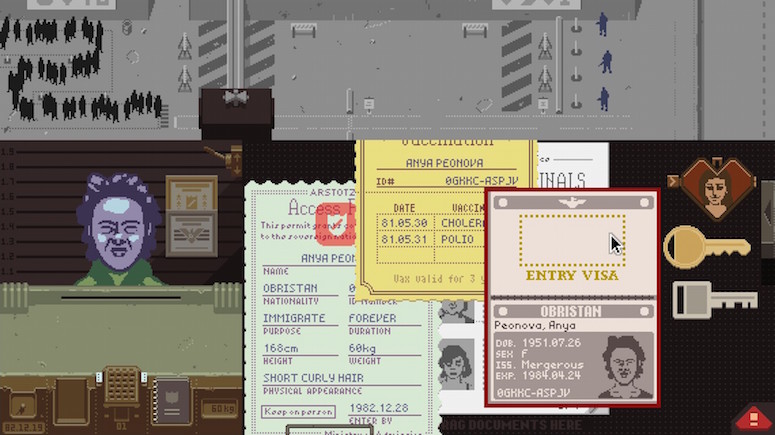
The Process Genre in Videogames: Papers, Please

papers_please-screenshot-01

Ian here—

This post is part of a series that borrows the term process genre from Salomé Aguilera Skvirsky’s work in cinema studies, and explores its utility for videogame analysis. A quick definition: “process genre” films are films about labor, films that focus on processes of doing and making, that are fascinated with seeing tasks through to their completion. They are deliberately paced, meditative, and often political, in that they cast a penetrating eye on labor conditions. Are there games that the same chords? Posts in the series so far can be seen here.

On the docket for today: Lucas Pope’s Papers, Please (3909, 2013), a simulation of being a border guard in the fictional Soviet-bloc-style nation of Arstotzka in 1982. As you scrutinize people’s documents, weeding out the undesirables, stamping the passports of some travelers and detaining others, there is plenty of opportunity for political drama—in particular, do you do your best as a servant of your obviously oppressive government, or do you quietly aid rebel factions? But there’s also just the matter of making enough money to keep your house heated, your son fed, and getting medication for your elderly uncle. Since you’re paid by the number of entrants you correctly service, this means being good at your job: memorizing the bureaucratic rules, getting good at both quickly and carefully examining documents, and keeping your desk clean and orderly. It is, all things considered, as much a game about a desk as it is about a family, or a nation.

Continue reading →