It’s Just the End of the World: Feeling Helpless in Umurangi Generation (2020)

By Amanda Chacón

My first thought upon opening the first level of Umurangi Generation was: “Oh no.” This was because my eye had immediately gone to the timer at the top left corner of the screen, telling me I had ten minutes to fulfill multiple objectives. Even within quick-paced combat games, I am a slow and careful player, so how would I be able to fulfill these objectives in time? Short answer: there was no way. But it would take me very little time to realize that this was on purpose.

Umurangi Generation is a Māori game developed and released in 2020 by Origame Digital. The game takes place in a cyberpunk Tauranga, New Zealand, after a mysterious cataclysmic event. The protagonist, a nameless Māori photographer, is tasked with taking and delivering photos of a particular area with a digital camera. As mentioned, the protagonist must take pictures of the required objectives within ten minutes. Fulfilling these objectives in time allows the player to move to the next level and introduces the protagonist to a new mechanic related to the camera, from different lenses to new sliders for picture editing. There are also bonus objectives, which can be fulfilled before delivering the photos for additional camera tools. As for the plot—the player is given no context for the world they have been dropped in. The only way to understand what is happening is to explore this world.

Going back to my experience with the timing mechanic, I had immediately accepted that I would not be able to take all of the necessary pictures in time because I had no idea where the objectives were. I decided to move forward by trying to ignore the timer, instead looking around the setting and searching for “two boomboxes” and a “Union Jack.” While focusing on my surroundings, I began to pick up interesting elements of the landscape. United Nations paraphernalia was everywhere, even in gigantic walls that guarded Tauranga from presumably the ocean beyond. It was through this exploration that I was able to understand the post-apocalyptic nature of the world, and the graffiti everywhere told of a constant feeling of depression and frustration. This environmental storytelling presented, in the terminology of Henry Jenkins, “embedded narratives” suggesting a much larger story beyond the protagonist’s mission to take and deliver pictures. If I had not slowed down to look around, I would not have been able to read the graffiti or question why particular objects were lying around. My experience, as well as those of my classmates, leads me to believe that the impossibility of the time objective is necessary. Once the player accepts that they cannot do everything in time without investigating first, they allow themselves to slow down and take in the embedded narratives.

The apocalyptic environment of Umurangi Generation is emphasized in the fifth available level, named “Contact.” In “Contact” the player is dropped in the middle of a war, taking place in the same area explored in the second level. Even though there is gunfire and dead bodies, the player is given the same timer and set of objectives. Some objectives even match those from the second level to emphasize the destruction the player is witnessing, while others bleakly point to the ongoing tragedy (such as “two body bags”). By looking around, the player is able to make out a gigantic blue jellyfish as the agent of devastation. Bluebottles had been forbidden as a subject of photography at the start of the game—and the player is finally able to understand why. Umurangi Generation is a game that is mechanically based on letting the player interact with their surroundings; it is by moving around and using camera equipment that one is able to take the perfect required picture. Yet, regardless of the ability to fully observe this world, one can’t do anything to stop the active apocalypse. They can’t even help the soldier bleeding out in front of them. “Contact” informs the player that it does not matter if they are equipped with a fancy camera—they are still helpless.

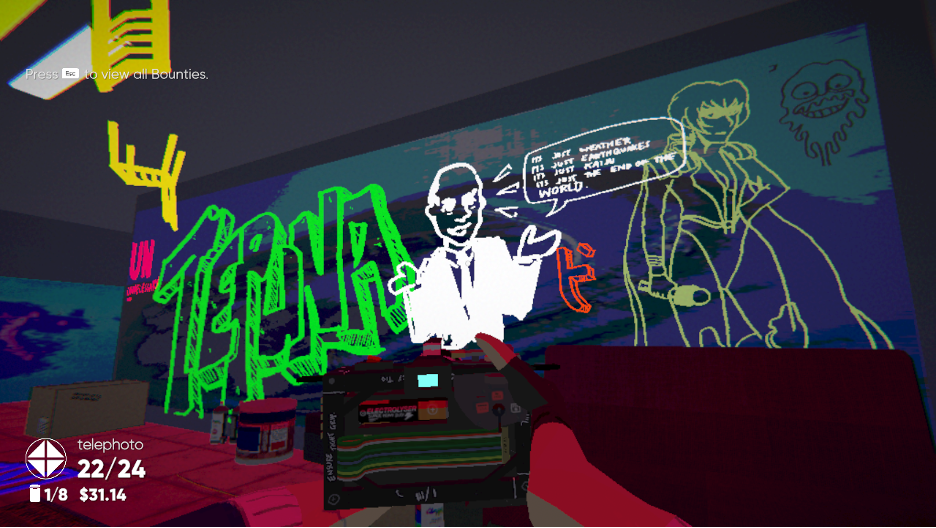
In an interview with The Indie Game Website, main developer Naphtali “Veselekov” Faulkner spoke to this theme of helplessness as inspired by the state of the world in 2020: particularly in the face of the Australian government’s handling of its bush fires and COVID-19 crises. Something that struck me in reading this interview was the idea of normalization. Government attitudes and propaganda take crises and force complacency by adopting the rhetoric of “the new normal.” This message is spray painted all over the game: from the blue bottles (that one is forbidden from acknowledging) to the caricature of a politician saying, “ITS JUST WEATHER/ITS JUST EARTHQUAKES/ITS JUST KAIJU/ITS JUST THE END OF THE WORLD.” As the photographer forced to bear witness to the active ending of the world, the player can only progress if they accept this “new normal” and complete the objectives. The mechanical inability to interact with the plot of Umurangi Generation is thus an intentional critique of neoliberal inertia.

As we discussed in class with Umurangi Generation alongside the other games of the week (Gone Home, Norwood Suite, and Unpacking), limited agency is an important theme in Digital Narratives that enable the player to navigate through a provided space. The ability to move is something the player is allowed to control, so they control what they see. By controlling what one can see, they can control what they understand. This is exemplified by my approach in slowing down and absorbing the embedded narratives in Umurangi Generation. A player can choose to breeze from objective to objective (perhaps after reading or watching a walkthrough) and will likely understand far less about the plot, meaning that they can control how much they can deduce about the story. However, what the player can’t control is the space they inhabit. The world is ending, and the only thing one can do in response is take pictures.
A Hodology of Videogames: Silent Hill

silent_hill_screenshot_01

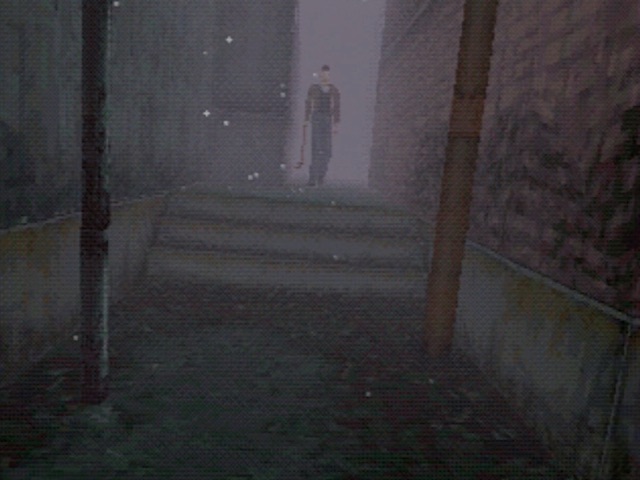
I have wanted to write about the original Silent Hill (Konami Computer Entertainment Tokyo “Team Silent,” 1999) for a very long time. But it has been difficult to find a “way in.” Unlike its pseudo-remake, Silent Hill: Shattered Memories (Climax, 2009), which I have successfully gotten around to writing aboutSilent Hill doesn’t have much in the way of interesting flaws to pick apart. It has flaws, to be sure. But its flaws are banal. It falls prey to the “let’s belatedly explain our incoherent story via some back-loaded cutscenes” problem so typical of games of the original PlayStation era, especially those produced in Japan that I have only ever experienced in English translation. Its successes, meanwhile, are numerous. But I’ve never found a way to approach them with intellectual rigor. My reaction to the game is a primal one, and I have struggled to conjure critical thoughts beyond, “my, it really is surprising how effectively scary this game still is, despite the limitations of its visual style.”

But, what the hell: I’m going to give it a shot, in the form of one of my “hodology of videogames” series of posts. Since it’s been awhile, here’s a quick refresher on the ground rules: “Hodological space” refers to the space that humans inhabit: not a space made up of strict coordinates, but a thicket of preferred paths, affected by factors such as interest, distraction, fatigue, and urgency. It’s a term that originated in the writings of psychologist Kurt Lewin, and which traveled by way of Sartre into the realm of phenomenology. Today, I’ll be thinking about the paths players take through the town of Silent Hill.

Continue reading

A Hodology of Videogames: Proteus

proteus_screenshot_01

Ian here—

Welcome to the third of a series of posts I’ll be doing on hodological space in games. “Hodological space” refers to the space that humans inhabit: not a space made up of strict coordinates, but a thicket of preferred paths, affected by factors such as interest, distraction, fatigue, and urgency. It’s a term that originated in the writings of psychologist Kurt Lewin, and which traveled by way of Sartre into the realm of phenomenology.

If, as Jean-Luc Godard once famously said, all you need to make a movie is a girl and a gun, than all you need to make a videogame is an island.

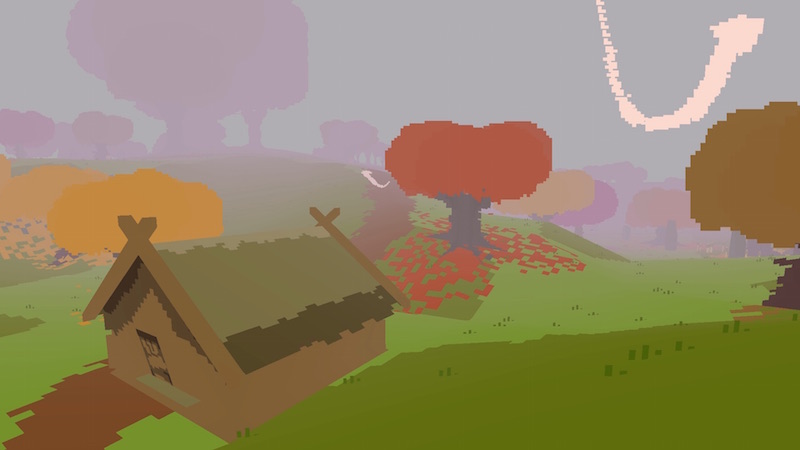
The island-game gave us Myst (Cyan, 1993), and it gave us last year’s The Witness (Thekla, Inc., 2016). It has also already made an appearance in this very series, with Miasmata (IonFX, 2012). But my favorite island game of all time might be Proteus (Ed Key and David Kanaga, 2013). And to really talk about what it gets right, we have to dip into issues of genre. So, buckle up: it’s going to be a bumpy ride.

Continue reading

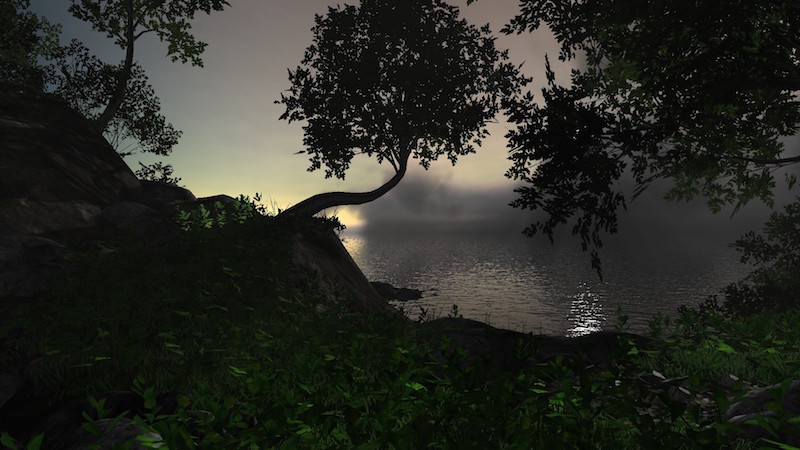
A Hodology of Videogames: Miasmata

miasmata_screenshot_05

Ian here—

Welcome to the second of a series of posts I’ll be doing on hodological space in games. “Hodological space” refers to the space that humans inhabit: not a space made up of strict coordinates, but a thicket of preferred paths, affected by factors such as interest, distraction, fatigue, and urgency. It’s a term that originated in the writings of psychologist Kurt Lewin, and which traveled by way of Sartre into the realm of phenomenology.

Up today: the survival simulation game Misasmata (IonFX, 2012). Accepted onto the Steam storefront in October 2012 as part of Valve’s second batch of games approved through the now-defunct Greenlight submission process, one of Miasmata‘s most notable traits was being on the leading edge of the “goodness, there are too many indie games than one could ever keep up with” moment we are currently in. Miasmata, though, is worth remembering for more than that. It also possesses a genuinely innovative movement system, one that, in its own weird way, serves as a nice counterpoint to the subject of my previous entry in this seriesThe Legend of Zelda: Breath of the Wild (Nintendo EDP, 2017).

Continue reading

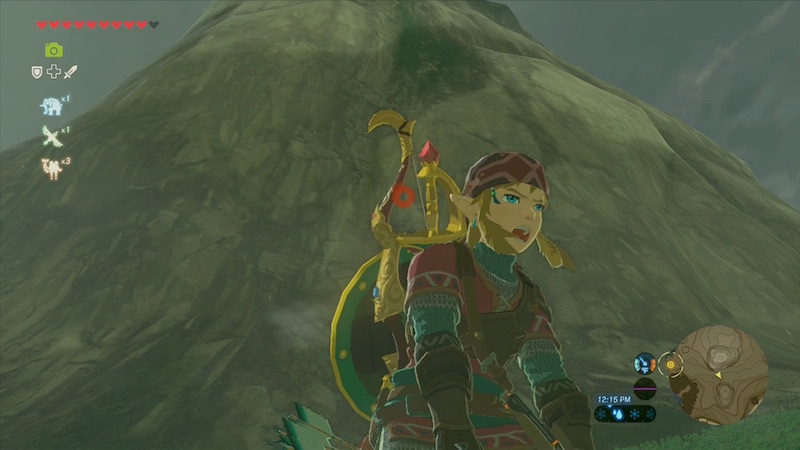
A Hodology of Videogames: Breath of the Wild

Breath_of_the_Wild_hodology

Ian here—

“Hodology” is, according to its Greek roots, the study of paths. These days, its primary associations seem to be with neuroscience. But I want to resurrect an older, more literal use of it: the study of how people move throughout a landscape, the ways in which they chart routes that are particular to the human body, human perception, and human culture.

This sense of the term “hodology” owes much to the psychologist Kurt Lewin. In his 1934 essay “Der Richtungsbegriff in der Psychologie. Der spezielle und allgemeine Hodologische Raum” (a mouthful, I know), Lewin coined the term hodological space to refer to the unique characteristics that landscapes take on when perceived by, and navigated by, human beings.[i] Lewin’s original essay remains untranslated into English after all these decades, but its influence was widespread. Jean-Paul Sartre took up Lewin’s term “hodological space” in Being and Nothingness, and from there it spread to a number of humanistic geographers interested in phenomenology, including Christian Norberg-Schulz and O.F. Bollnow. Norberg-Schulz offers a pithy English-language explanation of Lewin’s contribution:

Rather than straight lines, hodological space contains ‘preferred paths’ which represent a compromise between several domains such as ‘short distance,’ ‘security’, ‘minimal work’, ‘maximum experience’ etc. The demands are determined in relation to the topographical conditions.[ii]

I’ve often thought that preferred paths are an interesting lens through which to look at videogame space, and so I’m inaugurating a series of posts that deal with them. What better to do the honors than one of the most talked-about games of the moment, The Legend of Zelda: Breath of the Wild (Nintendo EDP, 2017)?
Continue reading

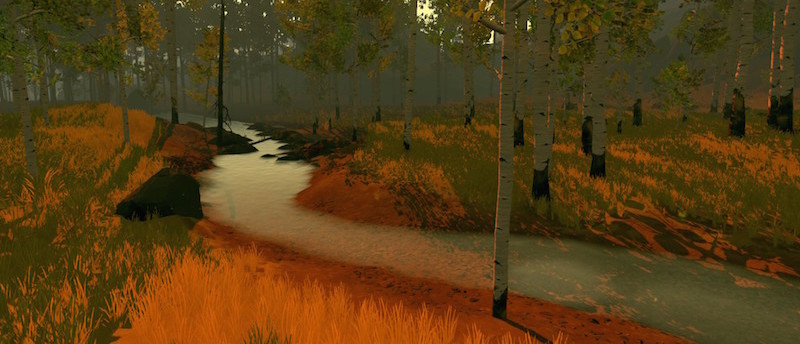
Stream Pools: Space and Narrative Pacing in Games

Firewatch_stream_pools_header_image.jpg

Ian here—

I spent the first week of 2017 catching up on things I hadn’t played from 2016. But all play and no work makes Ian a dull boy, so it’s time to get back to writing, even if it’s of the casual sort.

Fair warning: In this post I’m going to dip into some unapologetic formalism as a way of best expressing some otherwise entirely subjective reactions. Obviously, there are pitfalls to this. Formalism puts off some. Unabashedly subjective attempts at criticism puts off others. But, whatever—this is my blog, and sometimes I like to post things that aren’t lesson plans. (Also, a note: I’m going to have fewer of those posted in the foreseeable future. I’ve posted most of my best lessons from past courses at this point, and I’m only teaching one class this term, one I’ve taught before.)

Below the fold, I play with some vocabulary, and offer thoughts on three more interesting games of 2016. These are short takes, and it is quite likely that I will be writing more on some of these in the near future.

Continue reading