Energy and the American Landscape

Stratman, Deborah - Energy Country (USA, 2003).mp4 2017-04-26 17-12-35

Grant Fryc

As humans, we rely on the land we live on. Though we might not always respect it or take care of it the way we should, it is the most important thing…ever. The landscape of a given area and the way it is treated can tell you a lot about the people who live in that area. The underlying theme of this week’s films, with the exception of Ito Takashi’s Spacey (1981) is the American landscape and the relationship between the land and its occupants.

Deborah Stratman comments quite directly on this relationship in her film Energy Country (2003). Energy Country paints a harsh portrait of southeastern Texas and the oil industry that resides there. As the oil industry and American nationalism often go hand & hand, Stratman critiques US involvement in the middle east using a combination of both documentary and experimental film techniques. Visually, the film has the cues of the typical avant garde film in the way that the shots are composed and strung together; sonically, Energy Country takes a more  experimental approach than a typical documentary in some instances Stratman layers several audio tracks upon one another to create a chaotic effect. Clips of oil refineries and energy production facilities are layered on top of each other interspersed with clips of bombs dropping while found audio clips from christian radio play in the background. The voices playing over the fiery imagery speak of god and how he loves america. They speak of Islam and how threatening the religion is to the American way of life, mentioning that for the president to say that Islam is a peaceful religion is to “jeopardize all of the free world and America.” All the while Stratman is  showing us American bombs being dropped on a landscape below. Energy Country raises questions about  the ethicacy of the oil industry and the landscapes it affects. Internationally, the destruction caused by the American pursuit of foreign oil is disgusting. Domestically, though the destruction isn’t caused by the dropping of bombs, the effects of the polluting of American landscape by the oil industry are nauseating. This film focuses mainly on the domestic side of the industry and its effects on the landscape of Texas, but Stratman doesn’t shy away from the international issues surrounding energy.

Continue reading

The Influence of Time in Architectural Spaces

Screen Shot 2017-04-25 at 11.07.49 PM.png

Claire Bentley

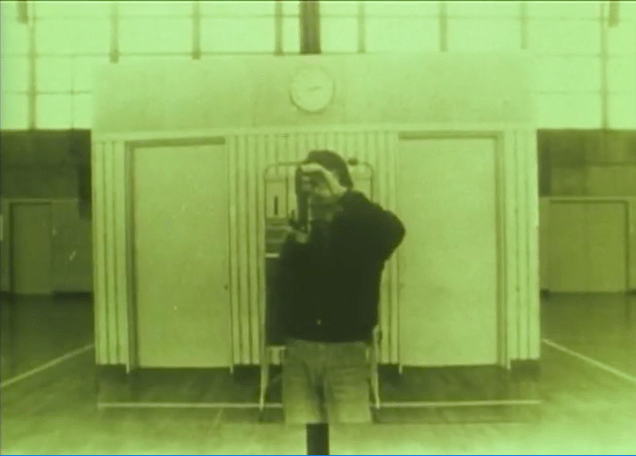
It is simple enough to begin with the fact that all films have some sort of setting. Whether avant-garde or not, films take the viewers somewhere. It might be just one place; a classroom, a wall, or a high school gym. It might be of many places; a hundred different areas of a metropolis, the path of a freight train or an array of factory buildings. Where and how the filmmakers choose to take us is just as important as other components of filmmaking – storyline or lack thereof, background/context and subjects. In four different films made in a period extending from the 1960s to early 2000s, Go, Go, Go! (1964) by Marie Menkin, Spacy (1981) by Ito Takashi, Energy Country (2003) by Deborah Stratman, and Castro Street (1966) by Bruce Baillie, filmmakers tamper with different methods of effect to change our perspective on setting and architectural space, as well as elicit the importance of place in avant-garde film.

Continue reading

Architectural Kaleidoscope

Screen Shot 2017-04-25 at 7.08.51 PM.png

Manon Piernot

The following films explore the disappearance of nature and the taking over of the natural world by humans. Architectural kaleidoscope films show images of industrialized cities and portray them as somewhat dangerous and sinister. In Deborah Stratman’s film Energy Country, she shows energy companies in Texas fenced off with warning signs as eerie music plays in the background. Images of industrial buildings letting out smoke into the atmosphere feels toxic and unnatural. The mood of this film is rather melancholic. The point of these films seems to be exposing what mankind has done to our Earth. Bruce Baillie’s Castro Street shows scenes of flower fields interrupted by a train making loud industrial sounds. It feels unnatural to simply look at the train going through the field as an aesthetic choice, it instead gives off the impression that the train is disturbing this natural scenery.

Continue reading

Personal Puzzles

sym_screenshot_header_image.jpg

Ian here—

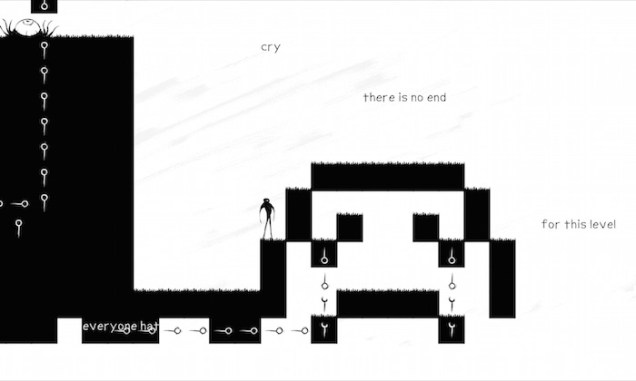
When you first start playing Eli Piilonen’s The Company of Myself (2DArray, 2009), it feels as if someone found a way to perfectly weld together a diary entry with a puzzle platformer. This was back in the heady days in the wake of Jonathan Blow’s Braid (Number None, 2008), when the public at large was still reeling over the idea that puzzle mechanics could mean something. And, at first glance, The Company of Myself seems to take this trend and go somewhere quite confessional with it. Its central mechanic of cloning yourself to solve puzzles stood as a perfect expression of feelings of self-reliance. And not just any self-reliance, either, but rather that specifically incorrigible mode of self-reliance that emerges when one is a bit too much of an unreconstructed introvert, refusing even the most basic forms of assistance because you desperately wish to not bother, or to be bothered by, anybody.

The “cloning” mechanic has popped up elsewhere in games—for instance The Misadventures of P.B. Winterbottom (The Odd Gentleman, 2010)—but The Company of Myself was more ambitious, wedding the mechanic with a personal story of interior life. Or, at least, it seems to do this, until you realize the whole thing is bullshit. The story takes an eleventh-hour delve into the lurid, revealing itself as an over-the-top fiction, rather than a form of sincere self-expression on the part of its creator.

The Company of Myself takes the easy way out, tacking on an over-dramatic denouement that destroys its potential as a diary-game. But … what if it didn’t? Could one actually use puzzles to communicate the intricacies of internal lived experience, in an emotionally sincere way? In this entry, I’ll be looking at two games that try: Liz Ryerson’s intimate and beguiling Problem Attic (2013), and Atrax Media’s more slick and straightforward Sym (2015). Along the way, I’ll also be dipping a bit into Braid, just because it’s hard to talk about contemporary puzzle platformers without doing so.

Continue reading

What Went Wrong?

Screen Shot 2017-04-18 at 10.36.09 PM

JB Fry

The avant-garde, experimental films of the late 1960s put their audience in the darkness of the theater with radical images and speculative subjects. The viewers were left to wonder “What am I watching,” “Why is this happening,” and ultimately “What went wrong?” Which is the same question that Blonde Cobra presents at the end of its duration. Naturally, we question the intentions of artists in this movement. Blonde Cobra flaunts its awareness of failure to unravel film and identity. It reminds us the world is not a spectacle easily observed but a reminder that we are cinema. We are no longer bought into the heteronormative conventions in the mainstream of Hollywood. Thus we begin to realize our position as spectator in relation to what is being viewed. In the “Introduction (to Flesh Cinema)” by Ara Osterweil, we are immersed into the ideas behind Ken Jacobs’ Blonde Cobra of embracing failure and queering the image in the corporeal turn of the avant-garde.

“Failing” is pivotal in the films of the American underground cinema. “Losing, forgetting, unmaking, un­doing, unbecoming, not knowing may offer more creative, more cooperative, more surprising ways of being in the world” is what Judith Halberstam has manifested in the ‘queer art of failure.’ Osterweil introduces us to the platform in which Jack Smith performs for Jacobs’ Blonde Cobra. Described as “the worst film ever made” by critic David James, Blonde Cobra is the composite of Bob Fleischner’s parody films of Blonde Venus (1932) and Cobra Woman (1944) with the narration of a live radio. Jacobs deconstructs the fictional world that lives in cinema by taking away the image, playing the audio throughout the theater opposed to speakers behind the image. The blackout of the image, a persistent feature in the film, is the instance of what could’ve been a mistake. Rather its failures are key and used to queer cinema from heteronormative commerciality that is capitalism.

Continue reading

The Reality of Failure

blonde_cobra_ken_jacobs_550x238-detail-main

Daniel Champion

One theme that seems to have come up consistently throughout this semester, is the idea that the avant-garde film makes the viewer aware of the medium of film itself.  This quality can make a film like Stan Brakhage’s material inspired “Mothlight” modern under Greenberg’s definition of modern art that we looked at in the reading “Modern Painting.”  A realist painting tries to seduce the viewer into giving in to the illusion of the scene while a work of modern art is fully aware of it’s position as an object in a gallery.  In his article for Film Comment “Bad Movies”, J. Hoberman takes on this abstract push and pull between the modern and the classic view of art and puts these ideas into the context of mainstream film in the 20th Century.

With film, it seems, the relationship between art and reality becomes slightly more confusing than it is with painting for example, due to the nature of the medium.  With painting the original goal was to capture reality and try to render three dimensional objects on a two dimensional surface.  A film camera however, is always capturing some piece of reality, no matter what it is pointed at.  For many commercial films today, the film maker’s goal is also to capture a piece of reality, but one that is not the actual reality of the people the camera is pointed at and is instead a fictional space that is created when the people in front of the camera pretend to exist in that fictional space.

Continue reading

I’ve Been Everything, Man

you_are_mountain.jpg

Ian here—

2017 marks the year of animator David OReilly’s return to to the medium of videogames, following up on his strange and serene digital-art-toy-screensaver-thing Mountain (2014). His new game, Everything, released on PS4 on March 21st, and releases on Windows, Mac and Linux this Friday.

The game’s title, Everything, is also the game’s premise: It is a game about everything. Specifically, it is a game in which players can be everything, switching at will from trees to koalas to rocks to quarks and back. I haven’t had a chance to sit down with it yet—I suspect I’ll make time for it once it’s out for PC—but I did want to take the advent of its multi-platform release as an opportunity to muse on this premise’s history in gaming.

Everything may be the first game that explicitly promises to allow us to be everything, but games have previously offered the ability for us to step into the role of quite a lot of things, including a surprising range of inanimate objects. “The child plays at being not only a shopkeeper or teacher,” wrote Walter Benjamin, “but also a windmill and a train.”[i] Games have proved to be a continuing outlet for this childhood animist fantasy—why, in just a couple weeks’ time, we’re going to be able to play as a coffee mug!

Join me, won’t you, in a breezy tour of some of the stranger things games have let us be.

Continue reading

Discussion: Robert Breer’s Recreation and Jodie Mack’s The Saddest Song in the World

Ian here—

As I mentioned in a previous post, I’m hesitating to call write-ups of classes in the section of “Avant-Garde Film and Video Art” I’m teaching this semester “lesson plans.” The course discussion I’m reporting back on often proceeds more from my students’ on-point engagement with the films than it does from any carefully-planned questions on my part. I still want to post some details on this blog, though, because I’m certainly learning a lot about how to tackle these subjects in the future, and would love to share.

Up today: two animated films, one of which unexpectedly became one of the most contentious things I’ve shown so far in any class.

Continue reading

Migration and the Poor Image

how_not_to_be_seen_screenshots.jpg

Ramona Beattie

In this time of mass information, of the digital bureaucracy of the internet mirroring the real almost entirely, systems are built for fracture; instability of systems becomes the rule, and not the exception. Across the board, mistrust of those in positions of power, and in the nature of these positions in the first place. As frantic, constant, in-flux response, makeshift environments of fear and deterrence are pinned up in order to maintain control of individuals. If everyone’s gonna get crushed, something’s gotta splash out from the sides of the shoe. If we think of stomping as the mechanism of control, and the guts flying out of the sides are those who are pushed to the edges: those who are marginalized, degraded, sent into exile. And in a time of mass dissociation and mass frantic control, the realest experience is that of these individuals, traditions, objects and symbols. The imprint of the real chaos and cruelty and stomping of the world is all too heavy on the exiled.

Continue reading

A Practical Guide to Gone Home

Gone_Home_header_image_family_portrait.jpg

Ian here—

Two weeks ago, I taught Gone Home (The Fullbright Company, 2013) for my “Frames, Claims and Videogames” course. I hadn’t played the game in quite some time, so, in the run-up to the course, I re-played it, searching through the house exhaustively, reminding myself of where every last note and prop was, re-acquainting myself with the ins and outs of everyone’s story. Taking some notes, it occurred to me that it would be nice if there was a guide to it online. Not just a guide to picking up all of the items that give you achievements, or something like that—there are plenty of those online, already. Rather, a guide to the stories Gone Home tells, and where exactly you can find the environmental elements that move those stories forward, and flesh it out.

Well, I guess it falls to me to create what I’m looking for. Again.

My guide to Liz Ryerson’s Problem Attic (2013) was just a walkthrough. This is a bit more, as I have specifically designed it to aid in things like class prep and analysis. It isn’t, by itself, analysis, but tends closer to that direction than the Problem Attic one does. (I’d place it roughly in the realm of my Virginia videos.) Enjoy!

Continue reading