The Limits of Disempowerment

realistic_female_fps_anthropy_02

Ian here—

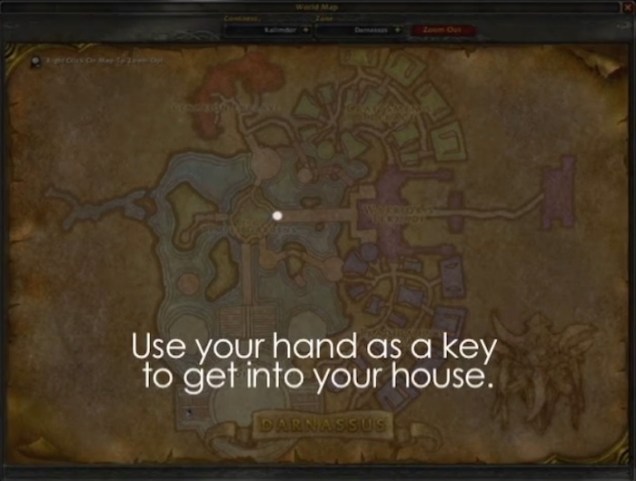
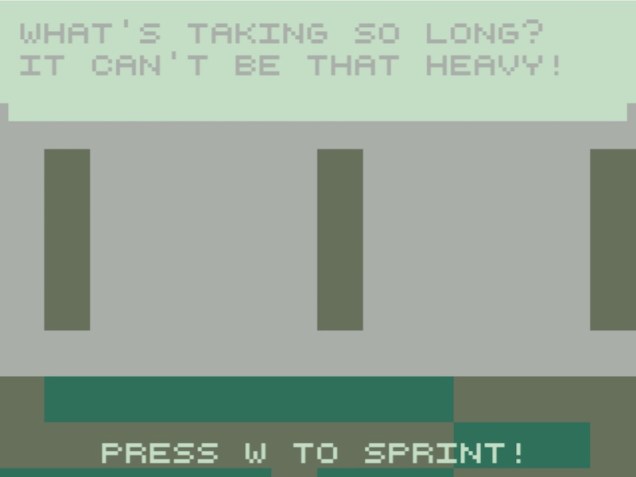
For years, I didn’t know what to do with Anna Anthropy’s Realistic Female First-Person Shooter (2012).

It is, shall we say, a “minor Anthropy.” It’s not one of the games that she includes on her itch.io storefront. If you want to play it, you have to head over here. (It is, unfortunately, Windows-only, although Mac users should feel free to look at this video of the game in action on YouTube).

But despite its somewhat tossed-off status, it is a game I was serious considering including in my article on fumblecore games. There was just one problem: it seemed completely incompatible with my argument. So I swept it under the rug, but kept it in my memory, blinking in the back of my brain, challenging me, keeping me honest.

I think I’ve finally figured out what I want to say about it now, and it’s mostly thanks to the students in my “Frames, Claims, and Videogames” class. I didn’t even teach Realistic Female First-Person Shooter in that class. Instead, my thoughts began crystalizing as students reacted of Alyson Macdonald’s Twine game Female Experience Simulator (2013), one of the most contentious games we played in the course.
Continue reading

A Hodology of Videogames: Miasmata

miasmata_screenshot_05

Ian here—

Welcome to the second of a series of posts I’ll be doing on hodological space in games. “Hodological space” refers to the space that humans inhabit: not a space made up of strict coordinates, but a thicket of preferred paths, affected by factors such as interest, distraction, fatigue, and urgency. It’s a term that originated in the writings of psychologist Kurt Lewin, and which traveled by way of Sartre into the realm of phenomenology.

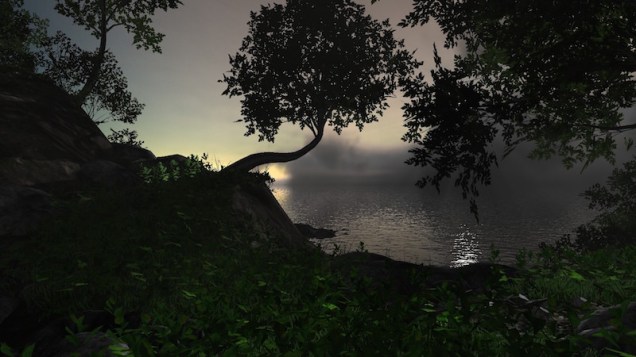
Up today: the survival simulation game Misasmata (IonFX, 2012). Accepted onto the Steam storefront in October 2012 as part of Valve’s second batch of games approved through the now-defunct Greenlight submission process, one of Miasmata‘s most notable traits was being on the leading edge of the “goodness, there are too many indie games than one could ever keep up with” moment we are currently in. Miasmata, though, is worth remembering for more than that. It also possesses a genuinely innovative movement system, one that, in its own weird way, serves as a nice counterpoint to the subject of my previous entry in this seriesThe Legend of Zelda: Breath of the Wild (Nintendo EDP, 2017).

Continue reading

The Coming of Age in Metal Gear Solid IV

MGS4_Old_Snake_01

Ian here—

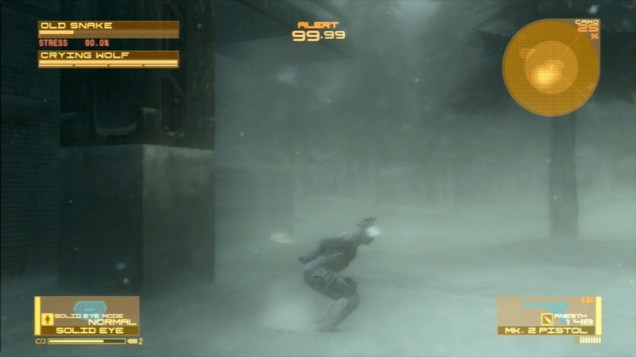
The level “Twin Suns” in Metal Gear Solid IV (Kojima Productions, 2008) ranks as one of my favorite videogame levels of all time. Smack dab in the middle of a game with more than its share of problems—the usual problems of unconscionably long cut-scenes and unconscionably short periods of genuine interactivity, plus new problems such as an inexplicably drab grey-green color scheme—comes something so conceptually audacious that I’m simply floored.

“Twin Suns” takes two of Metal Gear Solid IV‘s central themes, aging and the fear of obsolescence, and distills them into their most undiluted form. In Metal Gear Solid IV, series protagonist Solid Snake is old. (In fact, he’s so old that he’s given a new moniker, Old Snake.) This is used to greater or lesser effect throughout the entire game, but it really comes to the fore in “Liquid Sun,” which sees Snake returning to Shadow Moses, the location he infiltrated in Metal Gear Solid, a game released a decade prior. Given that series creator Hideo Kojima is well-known for using each sequel as a means of interogating the game industry’s lust for sequels, it should come as no surprise that this re-visit is in part a mediation on the way the franchise has aged. What is surprising is that this predictably modernist streak is shot through with something that approaches genuine pathos, and a fairly sincere investigation of what it means for an action hero to age.

(The title of my post pays homage to Simone de Beauvoir’s La Vieillesse, from which I’ll be quoting from sporadically. Although the Patrick O’Brian English translation I’ll be quoting from is actually titled Old Age, I much prefer the English language rendition The Coming of Age.)

Continue reading

Adobe Plug-ins in 2017: A Tale of Five Browsers (on two operating systems)

plugins_flash_blocked.jpg

Ian here—

Some of this material used to be over in the “Practical Pedagogical Notes on Games” section of the site. I’ve decided to migrate it to a blog post, however, for logistical reasons.

It’s an HTML5 world out there. The plug-ins that used to define the landscape of the internet—Flash, in particular—are a dying breed.

If those previous two sentences don’t mean anything to do: Congratulations! You are like most people. This guide is for you. It is a practical, logistical resource to take a peek at when a browser-based game doesn’t work.

Continue reading

Lewis Klahr’s Sixty Six

Klahr_sixty_six

Ian here—

The University of Chicago’s Film Studies Center has been having a fantastic year so far when it comes to experimental cinema. Hot on the heels (-ish) of their “Troubling the Image” series, last night they booked Lewis Klahr’s twelve-part, feature-length Sixty Six (2015), for what is I believe its Chicago debut.

Klahr was there in attendance, taking part in a very animated Q&A after the screening. I don’t think I’ve ever attended a Q&A with such an extreme questions-asked-to-time-filmmaker-talked ratio, and while some might have accused Klahr of self-indulgent rambling, I really rather enjoyed his tangents, and found that he had quite a lot of fascinating points to make about his process.

Continue reading

Inscrutability in Game Design: Perils and Possibilites

rooftop_cop_screenshot_01

Ian here—

Earlier this week, I sat down with some friends to play David OReilly’s Everything (2017). We were all suitably hyped, and ready for an evening of being different things while chuckling over the political indefensibility of object-oriented ontology. (Yes, really. We’re those people.)

But our evening hit a snag. Somewhere along the line, in our first playthrough, beginning as a cougar, we encountered a weird bug. One of the little “gain a new ability” thought bubbles failed to pop up in the environment. No matter how far we traveled, or how many objects’ thoughts we listened to, we simply could not unlock the ability to scale up or down into bigger or smaller entities. We were doomed to be a cougar. (Or, cougars, rather. We were able to expand our ranks, and become about a dozen cougars, rolling across the rocky landscape. But being a dozen rolling cougars is small consolation in a game that promises that you can be, well, everything.) For 75 minutes, we wailed at the screen. “I thought you could be lint particles and galaxies and stuff!”

We tried, to no avail, to look up walkthroughs for Everything. Everywhere we looked, we found glowing reviews of how chill the game was, how it allowed you to sit back and let the experience of being everything wash over you. We couldn’t fathom how we got stuck in a game with no real objectives. To pour salt in the wound, the game seemed to be actively mocking us. “As long as you keep moving, in any direction you choose,” thought a tree, “that will take you where you need to go.” “Over time,” thought a rock, “you might find there’s no right or wrong path to take here.” We were seriously stuck, and the only feedback we were getting were Zen aphorisms that told us to take it easy and not worry so much.

Eventually, we deleted our save file and started over. Thankfully, this solved the problem, and we spent the rest of the evening enraptured. But it did get me thinking about the trickiness presented by purposefully inscrutable game design.

Continue reading

A Hodology of Videogames: Breath of the Wild

Breath_of_the_Wild_hodology

Ian here—

“Hodology” is, according to its Greek roots, the study of paths. These days, its primary associations seem to be with neuroscience. But I want to resurrect an older, more literal use of it: the study of how people move throughout a landscape, the ways in which they chart routes that are particular to the human body, human perception, and human culture.

This sense of the term “hodology” owes much to the psychologist Kurt Lewin. In his 1934 essay “Der Richtungsbegriff in der Psychologie. Der spezielle und allgemeine Hodologische Raum” (a mouthful, I know), Lewin coined the term hodological space to refer to the unique characteristics that landscapes take on when perceived by, and navigated by, human beings.[i] Lewin’s original essay remains untranslated into English after all these decades, but its influence was widespread. Jean-Paul Sartre took up Lewin’s term “hodological space” in Being and Nothingness, and from there it spread to a number of humanistic geographers interested in phenomenology, including Christian Norberg-Schulz and O.F. Bollnow. Norberg-Schulz offers a pithy English-language explanation of Lewin’s contribution:

Rather than straight lines, hodological space contains ‘preferred paths’ which represent a compromise between several domains such as ‘short distance,’ ‘security’, ‘minimal work’, ‘maximum experience’ etc. The demands are determined in relation to the topographical conditions.[ii]

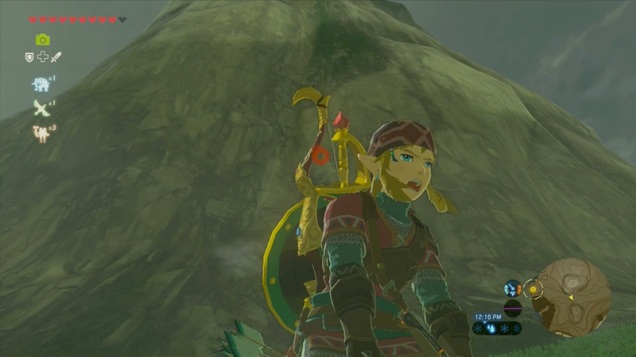
I’ve often thought that preferred paths are an interesting lens through which to look at videogame space, and so I’m inaugurating a series of posts that deal with them. What better to do the honors than one of the most talked-about games of the moment, The Legend of Zelda: Breath of the Wild (Nintendo EDP, 2017)?
Continue reading

The Line of Innocence in Context

Screen Shot 2017-05-04 at 12.18.18 AM.png

Genevieve Andrews

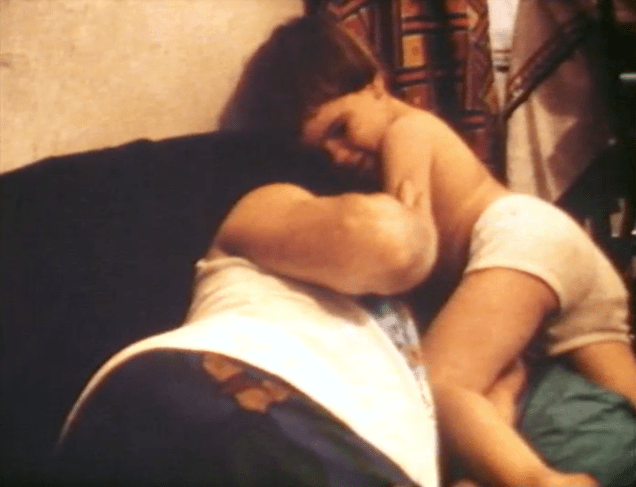
The execution of creating a reality through the consideration of film strategies is one of the many expertise a good filmmaker possesses. Their capability in provoking feelings through manipulation of editing is a talent and a skill. But, keeping attention on the point they are making is of the utmost importance for their final production. Immediately, rendering the ideas of childhood and sexual intimacy in unison tends to make even the strongest of stomach feel uneasy. However, in our culture there is a common widespread sexualization of innocence, and misunderstanding of family related interactions. While this varies in severity, Peggy Awesh, the 63 year old experimental filmmaker, calls this to our attention with no escape of the elephant in the room.  Her careful curation of the film “Martina’s Playhouse” (1988)  is a twenty minute film, recorded on a super 8 then blown up to 16mm.

Continue reading

The Degradation of Carolee Schneemann’s Fuses

Screen Shot 2017-05-02 at 8.24.58 PM

Isabella Blewett-Raby

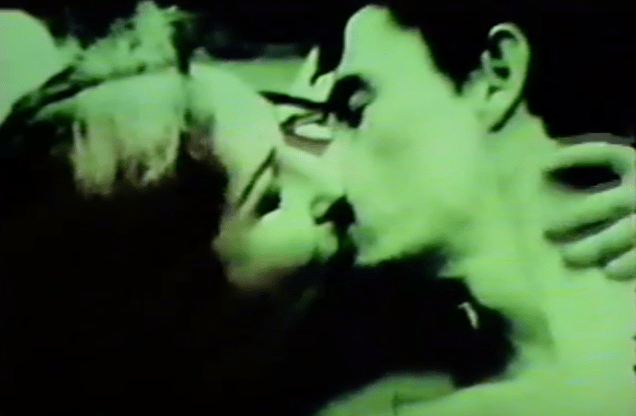
When discussing any piece of art it is very likely that the artist will become a part of the conversation. However, many artists do not wish this upon the viewer. The artist as a not to be acknowledged entity has been around long before avant-garde cinema. The male-dominated realm of avant-garde cinema participates in this trope and wishes for the work to speak for itself. However, when it comes to Carolee Schneemann you will find she comes attached with her work. In Fuses, her first of three films created in 1967, Schneemann inserts herself physically into the film by including shots of her having sex with James Tenney. The film also consists of close shots of her vulva and his penis, shots of her cat, them kissing, as well as the outdoors. It becomes very obvious why for many people Schneemann appears too connected to her art, and for this supposed reason she was rejected from the avant-garde cinema community. Scott McDonald shares his perspective on the reason men in avant-garde cinema shied away from Fuses, “In a culture where men still tend to be trained to deny their emotions, the assumption that the making of ‘serious’ art must involve detachment implicitly promotes art produced by males” (135).  McDonald makes a good point about detachment as a product of the patriarchy, however, I do not see Schneemann’s marginalization as so polite.  To me, this was just an excuse for dismissing a confident woman who has chosen to provide a reality many people have lost sight of. As a result of making men uncomfortable, Fuses was unfairly cast towards the genre of pornography. This begs the question, was Schneemann’s Fuses marginalized because it was not detached from its artist or because it was made by a woman who refuses to be a prisoner of sexual standards created by men?

Continue reading

Lesson Plan: Borders, Boundary Crossings, and Subaltern Images

goss_stranger_comes_to_town_screenshot_01

Ian here—

Well, you can’t win ’em all. Over-ambition gets to the best of us, and sometimes a somewhat incoherent lesson is the result. Consider this post to be less of a how-to guide, and more of a postmortem on what is clearly still a work-in-progress.

Migration is a topic that, from the beginning, I knew I wanted to tackle in my Avant-Garde Film and Video Art course this term. US immigration reared its head quite explicitly in my week spent on Bill Brown’s The Other Side, but I also wanted to try out some more conceptually far-flung approaches to the topic. Key here were two texts: Hito Steyerl’s article “In Defense of the Poor Image,” which re-casts image quality as an image of global politics, turning a close eye on how media objects circulate around the world in the current neoliberal order, and Jacqueline Goss’ video Stranger Comes to Town (2007), which tells tales of entry into the US that have been metaphorized into World of Warcraft machinima.

I thought I could draw out some sort of grand theme from this material, about how the circulation of images maps on to the migration of people in our contemporary political regime. It turns out I wasn’t really up to this task. And it’s a shame, too, because I dearly love the videos I assembled for this week, and wish I could have done better by them.

[Update: I asked for feedback in the last day of class, and it turns out that several students actually really liked this class session. They thought its sketched-out argument left them room to think, and really appreciated having to fill in the blanks themselves. Apparently, for some students, it was perfect seminar material. Their only real complaint was that I could have expanded this material, and stretched it out over several weeks! So take the self-criticism in this post with a grain of salt, I guess.]

Continue reading