Filmmaking, experimental cinema and video art

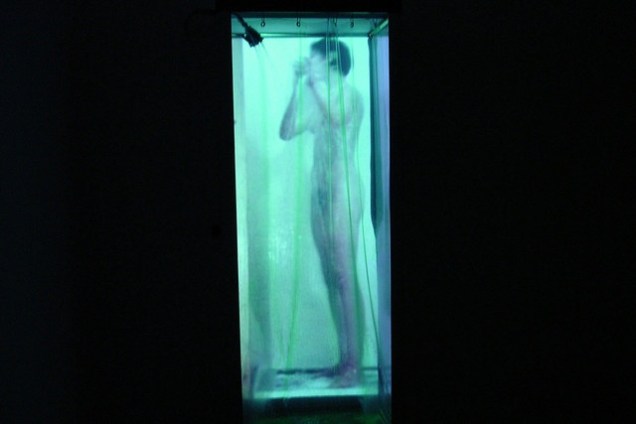
robert whitman shower
Shower, Robert Whitman

Yilin She

The author Eamon Christopher discusses the temporality and the multidisciplinarity of art is important to explore the relationship between film and video art. “Happening”, a term coined by the Fluxus artist Dick Higgins, mainly refers to performance art and is valued by its temporality in time. In Fluxus, experimental actions and the multidisciplinary aspect are important. The methods that are used in the filmmaking lead to the formation of the experimental cinema and the video art.

Christopher starts by stating that Jackson Pollock’s drip painting is a Happening, to explain that Pollock’s involvement of his body action in his drip painting allows the artist and the audiences to experience the same feeling in the same work. This method gets Allan Kaprow thinking. By the time Kaprow admired Pollock’s method, John Cage influences Kaprow on the time-based, recordable, and projectable medium of film. Cage creates 4’33’’, which contains a repetition of creating music through an unconventional way. Later, he makes Theatre Piece No.1, which allows the audiences to be a part of the film by using their own actions to fill up the time of the film. Cage’s use of multidisciplinarity in his music makes Kaprow bring connections to his thinking of film.
Continue reading

Valie EXPORT

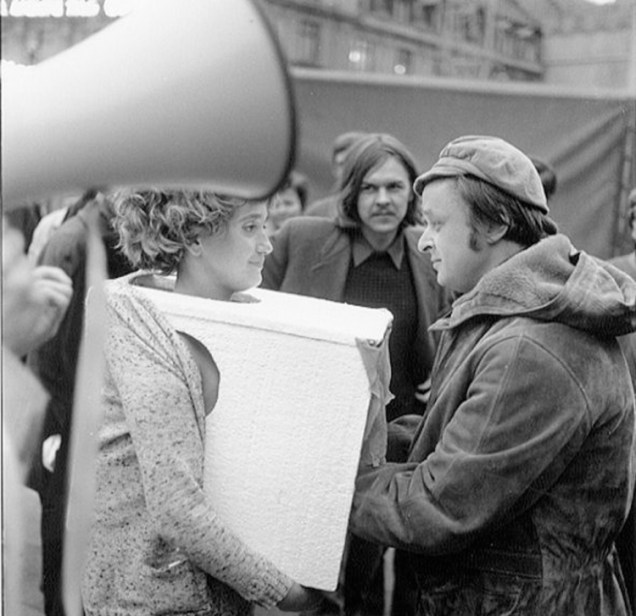
ValieExporttapandtouchcinema1968.jpg?

Katie Wittenberg

As one of the only known female Actionists, Viennese filmmaker Valie EXPORT explored the possibilities of experimentation in cinema during the late 1960’s- early 70’s.

Prior to her work, names such as Stan Brakhage and Michael Snow held major influence in New American Cinema (1960’s). Both artists were known for their work in Structuralism Film making. Film’s of this genre mainly consisted of an emphasis on the material aspects of the film, or qualities found in the film itself. Snow’s film Wavelength 1967, is one such example. In this film, a stationary camera focuses closer and closer on a particular section of a studio apartment over the course of 45 minutes. The area in focus, and even the room are not the subject. Snow chooses to demonstrate the act of “zooming in” as the main initiative, making the actions caused by the camera the primary staple of the film.

Work of Valie EXPORT and other Vinnese filmmakers took the polar opposite approach from both American and European Structuralism. Approaches to their films formed from encounters with Viennese Actionists. These Actionists held “Ritualistic Performances”, often using mud and bodily fluids on and around their bodies to show relations. The idea of incorporating “temporality”, starting first with both the Happenings and the Fluxus, was used as well. The mixing of genres (music, movement, sculpture, etc.) coupled nicely with their intentions of infusing work with interactivity.

Continue reading

Strategies to Achieve Genre Satire in Wes Craven’s Scream

Vladimir Surganov

It is odd to think of Wes Craven’s 1996 film Scream as a comedy, when it is so utterly frightening. However, upon closer inspection, it is most evident that the film is a spoof of the 1980’s “slasher” films like another Wes Craven film A Nightmare on Elm Street (1984) or Friday the 13th (1981). Scream achieves a level of satire from the very beginning scene, the scene that I will be discussing throughout this paper. With strategic staging, canted camera angles, over-the-top acting/writing, low key lighting, and a plethora of movie references, the film appears to be more tongue-in-cheek than it would first appear upon the first viewing.

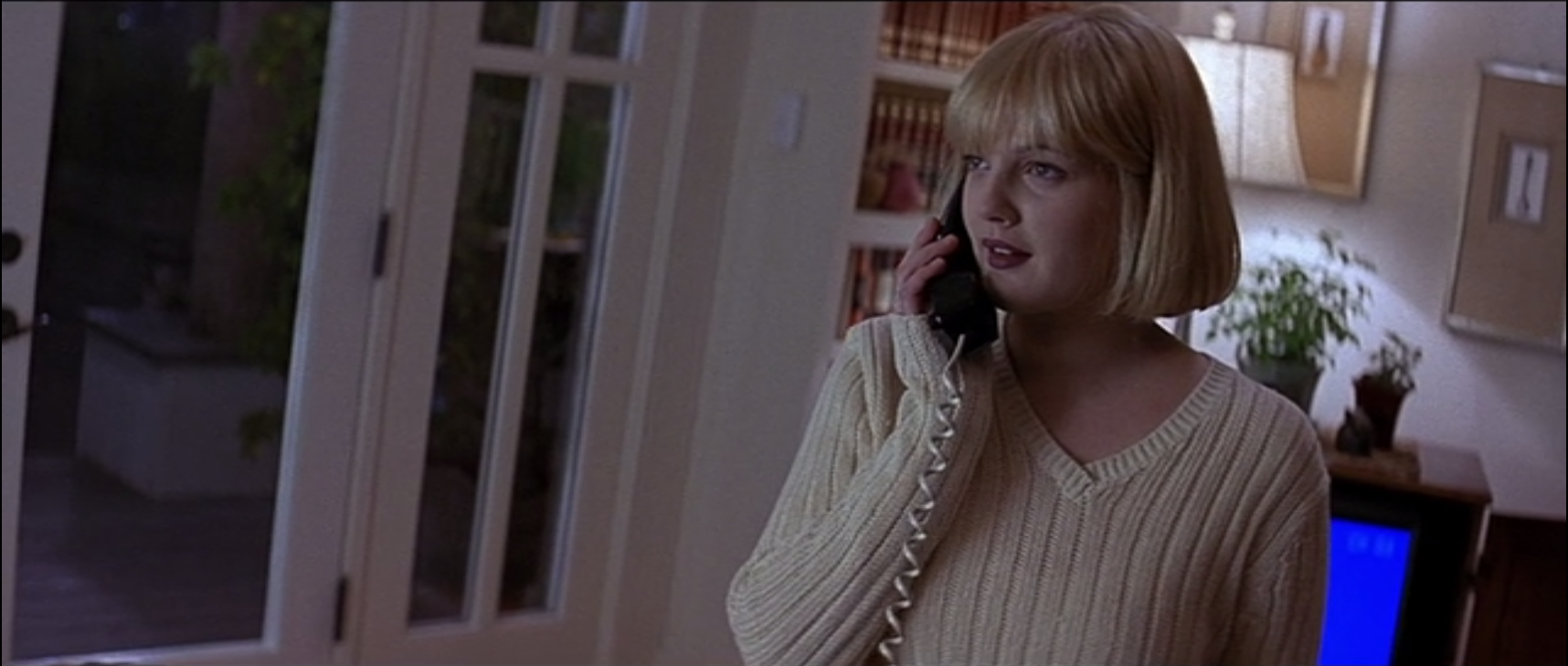
Canted angle frames in film generally signals psychological distress. However, when used over and over again the effect diminishes and actually appears to be more comedic that psychologically unsteadying. One of the first instances of a canted angle is when Drew Barrymore’s character Casey Becker picks up the phone the second time when Ghostface calls.

Untitled

Continue reading

Sprayed: A Video Essay on The Subconscious Art of Graffiti Removal

Terry Hines

Terry Hines and Luke White are two UChicago students who take an adventure through Hyde Park to investigate the sunconscious artisitc merits of graffiti removal. Inspired by the 1990s documentary, White and Hines venture into the urban streets of Chicago to discern for themselves what really matters when judging art in the world.

Scream: Subverted Subversion

Justin Bibler

Wes Craven’s 1996 film Scream is something of an anomaly, effectively satirizing the typical American slasher film, but at the same time still completely belonging to the genre. The same cannot be said of the flood of “________ Movie”s that followed its release, which were completely comedy centered and wanted little to do with horror, or rom-coms, or whatever genre they were meant to parody. But just how does Craven allow this film to achieve full, very comedic self-awareness without sacrificing its membership of the slasher genre?

Both the comedy of the film and its thrills often come from the same general mechanism: a subversion of one’s subverted expectations. That is, exactly what one would expect – and exactly what the characters say will happen – is often what occurs. Screenwriter Kevin Williamson created characters who are somehow all horror movie buffs, as they constantly make allusions to other horror movies and their tropes, often saying things such as, “If this were a horror movie…”. Additionally, one character (Randy Meeks) works at a video rental store and is even more aware of horror movie tropes than the others. In fact, at one point, he outlines the three major rules that dictate who survives a horror movie:

Continue reading

Memories to Reality

image007

Ambrose Iu

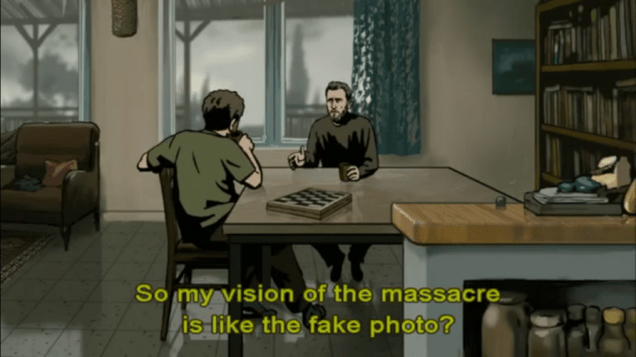
Waltz with Bashir, an animation directed by Ari Folman, depicts Ari Folman, a soldier in the Isreal defense forces and his quest, inspired by a recurring dream, to find out what had happened on the night of the Sabra and Shatile Massacre. Throughout the film, the audience sees Folman revisiting and interviewing former comrades and participants in the war. In the final 50 seconds of the film, the viewers are bombarded, thrown into the aftermath of the Sabra and Shatile Massacre by footage filmed at that time.

Continue reading

The Binaries in Waltz with Bashir

Heather Choi

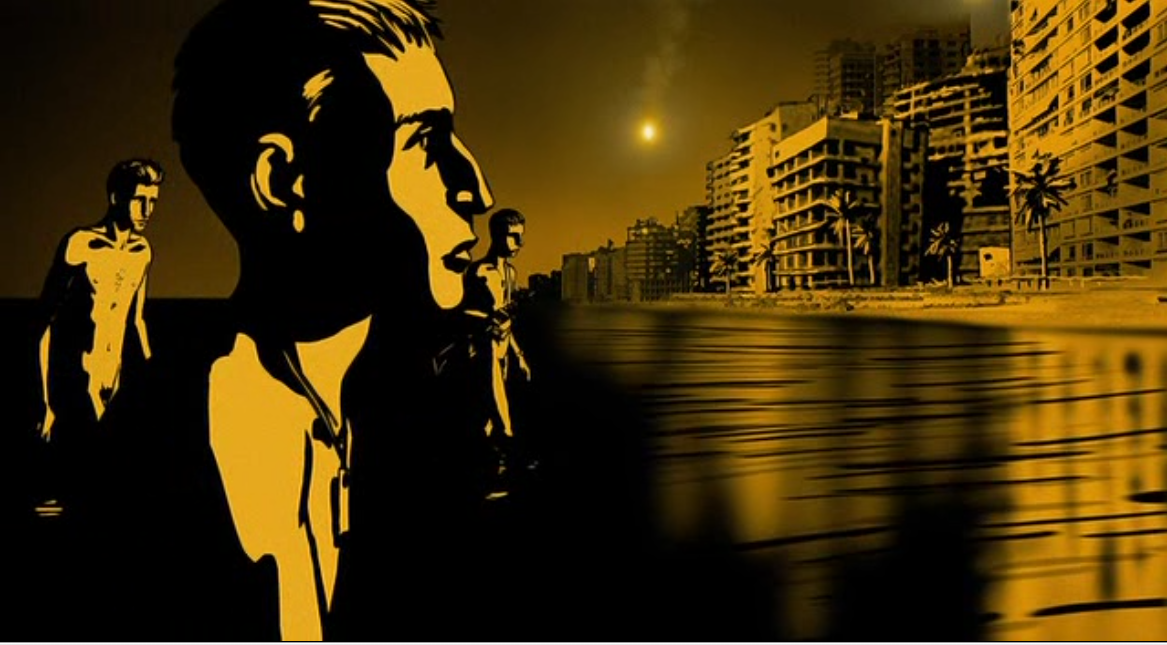
As the first ever feature-length animated documentary, Waltz with Bashir (2008) recounts director Ari Folman’s quest to uncover his memories of the role he played 20 years prior in the 1982 Lebanon War. Plagued by his inability to recall any of the events from the time he spent as an Israeli soldier, Folman enlists the help of his old military friends to discover the truth. During his journey, he faces many obstacles that take a toll on his mental state (primarily his memory). Aside from these narrative setbacks, the movie grapples with some greater problems that come in the form of binaries: between the real and the surreal, truth and fabrication, and guilt and innocence. Throughout the film, Waltz with Bashir walks a fine line, dancing back and forth between these conflicting themes. However, the message ultimately becomes clear that the correct path lies in reality, truth and acceptance of one’s own guilt, and the film – in its creation, script, mise en scene, and overall artistic aesthetic – serves as an analogous representation that enhances this viewpoint.

The three main binaries in this film are all interwoven, yet function in distinctive ways. The real versus surreal binary contrasts the events that occurred in real life to the idealized version of reality displayed in the movie, since the latter manages to mask many of the horrors of war through its medium of animation. Instead of using more live footage or making a documentary composed solely of found materials, Folman makes the cinematic choice to romanticize events and blur the distinction between facts and imagination by creating a visual consistency for both reality and fantasy.

Screen Shot 2015-06-09 at 7.44.28 AMScreen Shot 2015-06-09 at 7.46.22 AM

Continue reading

Silhouettes, Shadows, & Smoke: Lighting in In the Mood for Love

Screen Shot 2015-06-09 at 12.09.27 PM

Sherlock Ziauddin

Wong Kar-wei’s In the Mood For Love depicts the story of a man (Chow) and a woman (Su) who, both suspecting that their spouses are involved in extramarital affairs, become close companions to each other in their loneliness. As the story progresses, however, their platonic friendship spills over and they begin to fall in love.

Their story unfolds in carefully controlled sequences that are almost dreamlike in nature as, together, they fabricate a fantasy world for themselves in which they pretend to be in love as their spouses are – and then continue, even when the façade of romantic affection becomes a reality. One of the most obvious visual cues in the mise-en-scène that indicate the portrayal of these moments is in the lighting. In all of these sequences, the lighting is more dramatic: it is low-key, sharp, and almost always artificial, as these scenes overwhelmingly take place under cover of night. This type of lighting is fundamental in setting the mood in these sequences; the subtle expression of emotion and the tension of physical bodies is highlighted, literally, by its use.

Continue reading

Breaking the Glass: Engaging With Space in Playtime

Julia Huang

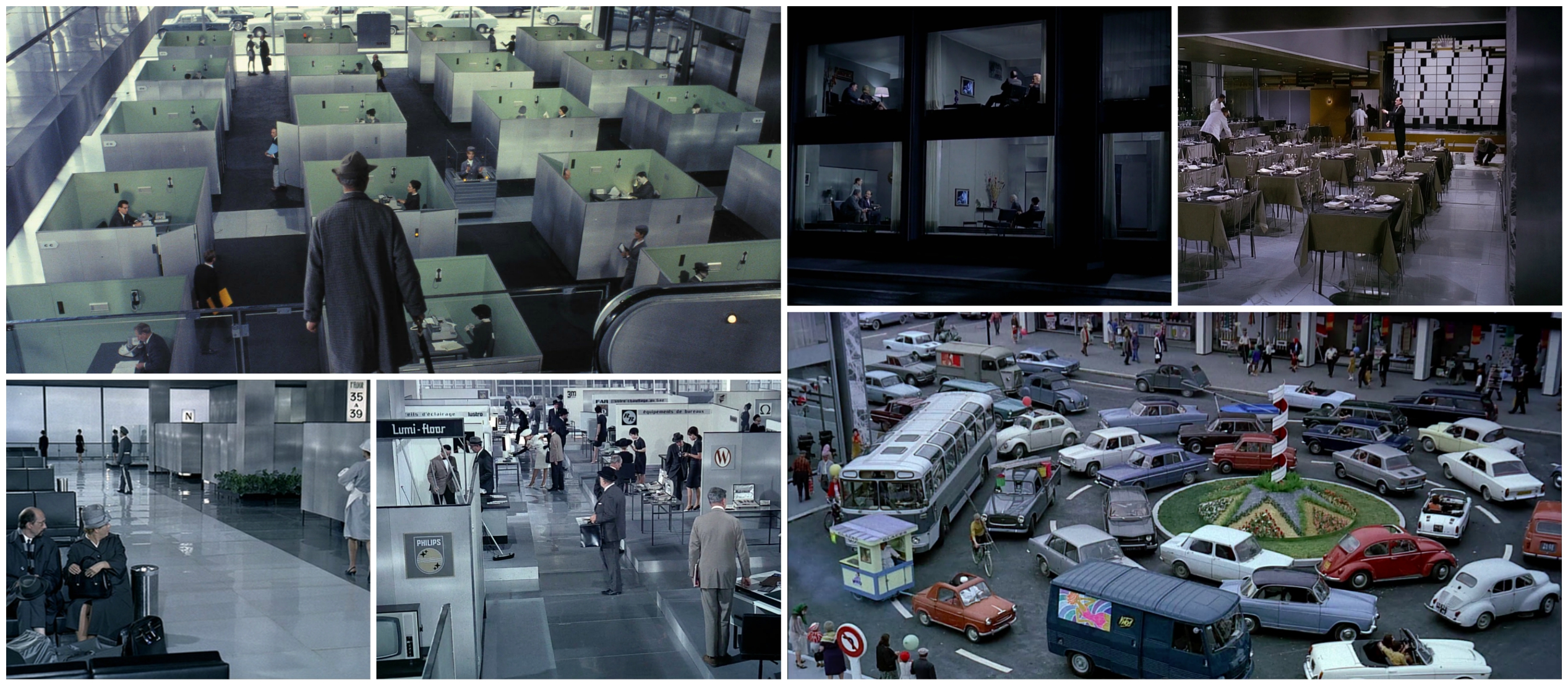
Jacques Tati often liked to say that the only real star of his film Playtime (1967) was the set itself. With his brilliant manipulation of its mise en scène, those words hold to be quite true. The minimally dialogued, loosely plot-based film is mainly structured around the changing of settings. As the movie goes on, an apparent pattern emerges among the scenery—it almost entirely consists of grey, pristine buildings, from the steely Orly Airport to the shiny new Royal Garden restaurant. Tati establishes this foundation in order to build up and play with the dichotomy of public and private space. Throughout the film, he juxtaposes these two ideas and questions the boundary that divides them.

The only moment of private space we see in Playtime is when Monsieur Hulot’s acquaintance from the army invites him into his recently bought apartment. However, Tati takes this scene and challenges the extent to which the space could be deemed personal. First off, the design of the apartment complex remains consistent with the public buildings that we have previously seen—grid-like, silver, and clean-cut. In the below collage of the six main scenes in the movie, the apartment (middle picture of the top row) blends right in with the other buildings of this ultra-modern world. By making the aesthetics of families’ homes parallel that of public locations, the distinction between them becomes slightly blurred, for our expectations of how the two different spaces should look are challenged. Tati creates a disturbance in what we think we know—if we are not certain of how a private space should appear, do we even know how they function?

collage of scenes

Continue reading

Waltz with Bashir and the Sea as Protector

Domitille Colin

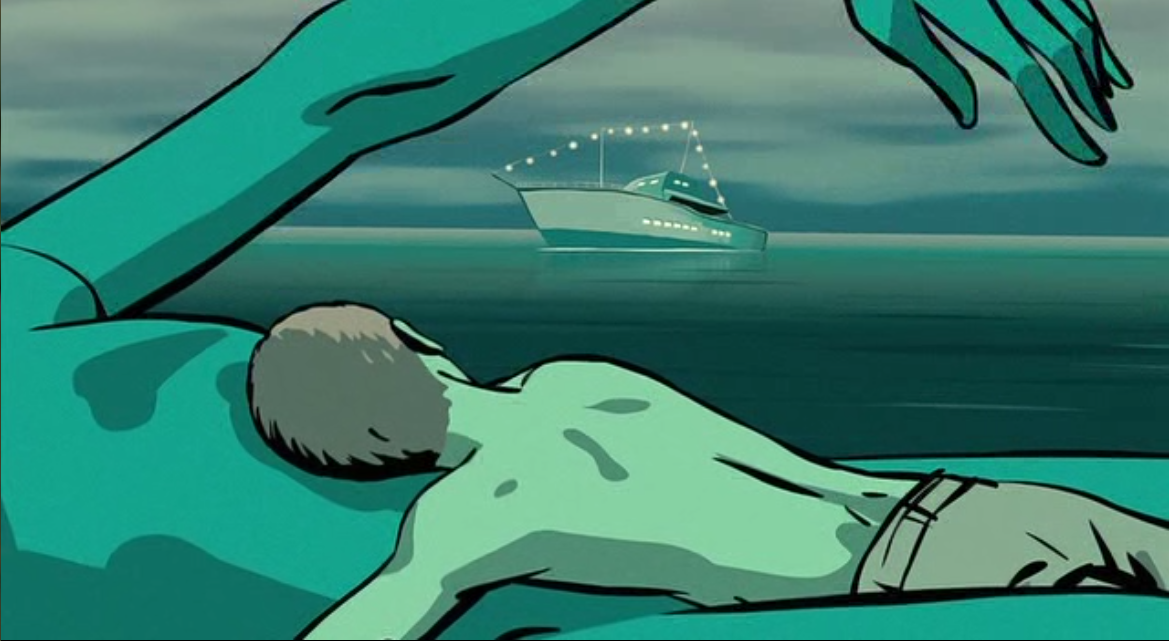
Ari Folman’s Waltz with Bashir first stands out to us because of its use of animation despite its identification as a documentary film– how can a non-fiction narrative be justly portrayed using highly stylised illustration? Yet it is evident by the end that the medium of animation not only allows the viewer to easily cross over any visual and temporal boundaries but also turns around and forces the boundary to be redrawn in a harsh awakening. Thus the documentary footage, hallucinations and flashbacks can all be presented on the same visual plane, that is, until the film’s final clip. Similarly, the characters themselves are enveloped in their own safety nets of self-induced amnesia and coping mechanisms that at once shield them from PTSD symptoms but also help to propagate them.

An essential manifestation of these protective mechanisms are the hallucinations that plague many of the characters and exist in a halfway point between memory and dreamscape. Among these hallucinations is the reoccurring motif of the sea and its role as a protection from enemies and a shield from reality. The sea manifests itself in three key scenes, Ari Folman’s first hallucination of the beach, Carmi Cna’an’s dream of the woman, and Ronny Dayag’s escape at sea. These three all reveal the sea to be a place of escape and protection, as Dayag states, a place of “fear [and] feelings.”

Continue reading