Since the unexpected and shocking death of my friend Hannah Frank last week, I have been thinking a lot about the Black Mirror episode “Be Right Back” (Series 2, Episode 1, dir. Owen Harris, 2013). Since the time I first saw it, I’ve thought it was a very good slice of speculative fiction, but it was not until the past week that its insights into 21st century psychology truly hit me.
I began this series as a lark, inspired by my friend Hannah Frank’s Tumblr omgcatrevolution. I linked to her Tumblr here, she reciprocated by posting some of this material over there. We chuckled about trading some of the meager traffic our endeavors attract; it gave us a chance to chat. A chance to chat with Hannah was always welcome.
Today, omgcatrevolution posted its final post. This morning, at 1 AM, Hannah Frank passed away from a sudden illness. Her death has come as an utter shock to her friends.
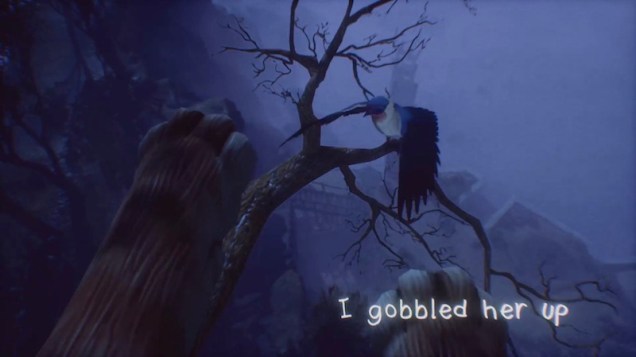
Last week, I promised another “sad cat tale” in this Monday’s spot. I had planned to reserve this spot for Jonas and Verena Kyratzes’ The Fabulous Screech (2012), a point-and-click tearjerker about a cat’s adventures through heaven and hell, and eventual decline into old age.
I cannot, at the moment, bring myself to write about The Fabulous Screech. But I think I will leave the screenshots in, and leave the title of the post as it was (with a new acknowledgement). I can think of plenty of people who wouldn’t want to be eulogized in a blog post about a cartoon cat. Hannah Frank was not one of those people. And so that is where I have decided to take this post.
Way back in January, I promised that I would write some further thoughts on 35MM (Sergei Nosgov, 2016). The more I tried to pull my thoughts together, though, it became clear that, as much as I like that game, I was lacking in concrete ideas about it. In place of the concrete, 35MM left me with nebulous impressions, feelings, and half-formed memories. My quest to craft a container for these impressions led to something that is not quite a video essay. The embedded video here is really more of a piece of meditative, impressionistic experimental machinima than it is an analytical work.
This video encapsulates my fascination with the prevalence of abandoned or poorly-maintained railroads and rail stations in post-apocalyptic games coming out of former Eastern Bloc countries. Sometimes, there is a clear lineage on display here, as when the Ukrainian studio 4A Games adapts the Russian science fiction author Dmitri Glukhovsky’s Metro books into the complementary Metro game series. More diffuse influences envelope these games as well, though. Some go back to the Soviet era. In the video, I pick out Andrei Tarkovsky’s Stalker (USSR, 1979) as a distinct visual reference point. Although the S.T.A.L.K.E.R. series developed by Ukrainian team GSC Gameworld hews much closer to the atmosphere of the Strugatsky novel Roadside Picnic on which Stalker is based, I think it’s undeniable that Tarkovsky’s film left a visual mark on post-Soviet apocalyptic fiction. (He was doing “ruin porn” before it was cool.)
As to why, exactly, the decaying rail line has become such a staple of former Eastern Bloc post-apocalyptic fiction … I have no answer. But that’s one of the things you can get away with when choosing this sort of video work over the written word.
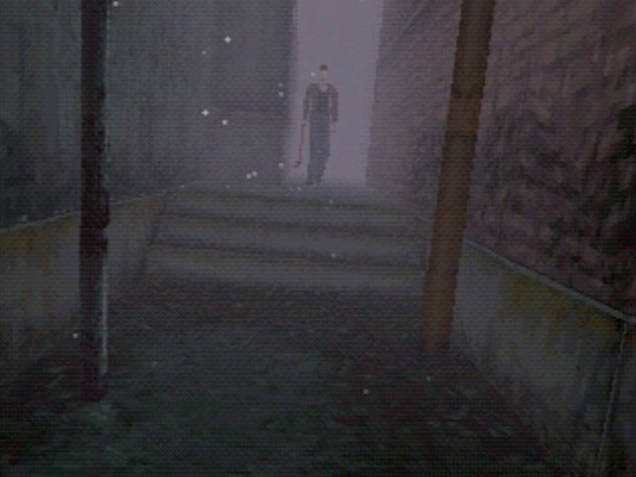
I have wanted to write about the original Silent Hill (Konami Computer Entertainment Tokyo “Team Silent,” 1999) for a very long time. But it has been difficult to find a “way in.” Unlike its pseudo-remake, Silent Hill: Shattered Memories (Climax, 2009), which I have successfully gotten around to writing about, Silent Hill doesn’t have much in the way of interesting flaws to pick apart. It has flaws, to be sure. But its flaws are banal. It falls prey to the “let’s belatedly explain our incoherent story via some back-loaded cutscenes” problem so typical of games of the original PlayStation era, especially those produced in Japan that I have only ever experienced in English translation. Its successes, meanwhile, are numerous. But I’ve never found a way to approach them with intellectual rigor. My reaction to the game is a primal one, and I have struggled to conjure critical thoughts beyond, “my, it really is surprising how effectively scary this game still is, despite the limitations of its visual style.”
But, what the hell: I’m going to give it a shot, in the form of one of my “hodology of videogames” series of posts. Since it’s been awhile, here’s a quick refresher on the ground rules: “Hodological space” refers to the space that humans inhabit: not a space made up of strict coordinates, but a thicket of preferred paths, affected by factors such as interest, distraction, fatigue, and urgency. It’s a term that originated in the writings of psychologist Kurt Lewin, and which traveled by way of Sartre into the realm of phenomenology. Today, I’ll be thinking about the paths players take through the town of Silent Hill.
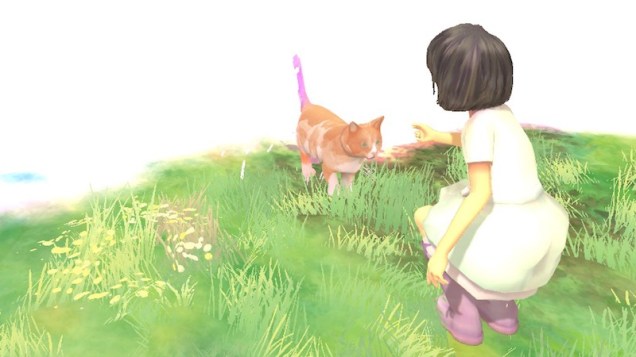
I have written about Beyond Eyes (Tiger and Squid / Team17 Digital Ltd, 2015) before, and mentioned briefly that it is about a blind girl searching for a stray cat that hasn’t come by her home recently, named Nani. What I didn’t mention was that Beyond Eyes has one of the most arbitrarily cruel endings in the history of storytelling.
Surprising, right? The game’s art style—which resembles what The Legend of Zelda: Skyward Sword (Nintendo EAD, 2011) might look like if pumped up into gorgeous HD—suggests a kid-friendly aesthetic, as does its gentle, generally challenge-free exploratory mechanics. But man, that ending is brutal. And not just in a sad, Old Yeller sort of way. The ending of Beyond Eyes is thoroughly rotten with nihilism. I can’t resist: I’m going to spoil it thoroughly below the fold.
This past March, at SCMS, I walked out on a paper being delivered by Oscar Moralde on The Witness (Thekla, Inc, 2016). I did so not out of disinterest. (I’ve enjoyed Moralde’s papers in the past.) Nor did I do so out of rudeness. Rather, I did it because of spoilers. Moralde was kind enough to warn ahead of time that his paper would spoil a small portion of the joy of teasing out the behaviors of The Witness’ world, and advised those who hadn’t played it to leave, lest they deny themselves a rich intellectual—and some would even say emotional—experience of personal discovery. And, in my eternal shame, as of March of 2017, I still had not played The Witness. Even though it had been sitting right there in my Steam library for months. (Ashlyn Sparrow and Whitney Pow can attest to the truth of this story.)
Moralde’s paper was a wake-up call to me that I needed to get better about my gaming backlog, if for none other than purely academic reasons. And I think I’ve done a pretty good job of keeping up on things in real-time since that moment. (I played Tacoma, already!) I offer this story, though, not (strictly) as a chance to to advertise my newfound dedication to keeping up with recent releases, but also as a warning. Basically, the heads-up Moralde offered in front of his talk also applies here. The pleasures of The Witness are the pleasures of discovering puzzle mechanics, and you will deny yourself a small portion of those if you watch this new video essay I’ve whipped together.
That said, if you don’t mind spoiling such things, or if you’ve played The Witness already, go ahead and dash right in. This video is considerably shorter and more focused than my previous experiments in the “Let’s Study” format. It focuses on the pedagogical aspects of the game’s puzzle design, in particular its fondness for safe failure. Whether it’s encouraging assumptions about its mechanics that quickly get proved wrong, or setting up perceptual bad habits only to nip them in the bud, Jonathan Blow’s puzzle design in the best portions of The Witness front-load failure, so as to hammer home lessons. I hope you enjoy my short tour through this technique!
As before, a full transcript of my narration is below the fold. (I’d love to eventually add these as subtitles to the YouTube upload for accessibility reasons, but that is beyond my abilities, at the moment.)
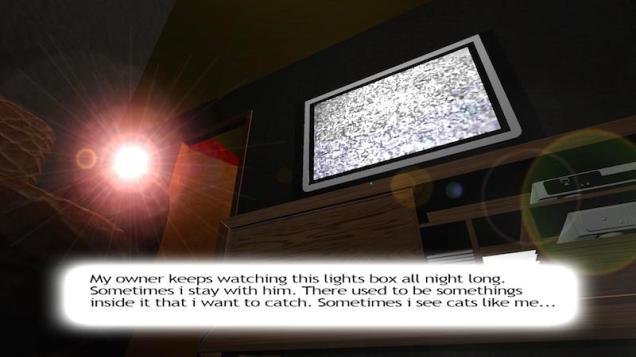
It’s hard to take good screenshots of A Purr Tale (Matias Selzer, 2014), because the cat never appears. You are the cat, in first person, for one. And, on top of this, you never catch even the slightest glimpse of a paw or a tail.
It’s also hard to take good screenshots of A Purr Tale because, frankly, it doesn’t look all that good. Its assets are low quality, and its lighting is muddied by needless effects. Also, its sound effects are bad. Its English translation could use some edits. And the signposting for what you’re supposed to do is horrendous. (Sometimes the correct thing to do is to slip right through the level geometry.) Basically, A Purr Tale isn’t very good, at all. And that’s too bad, because its serious subject matter (content warning for suicide, if you actually play the thing) deserved a more gentle and polished touch.
Ah, well. At the very least, this personal game is loads more ambitious than most things you can find made with pre-existing Unity assets floating around online.
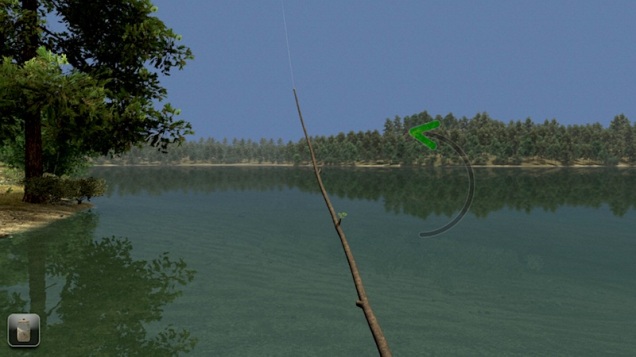
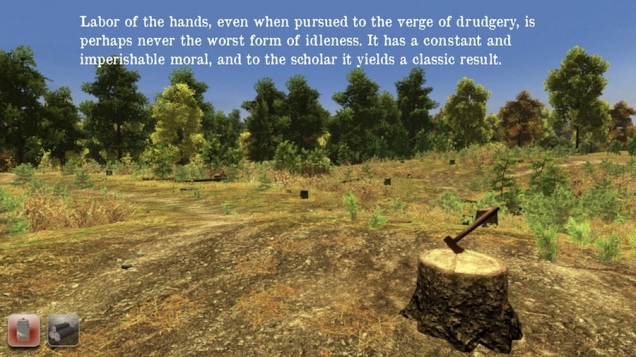
Today marks the 163rd anniversary of the publication of Henry David Thoreau’s Walden; or, Life in the Woods. I am celebrating the occasion by resurrecting my old “Process Genre in Videogames” blog post series, and turning an eye toward the USC Game Innovation Lab’s recently-released Walden, a game, across two posts.
In this series, I borrow the term process genre from Salomé Aguilera Skvirsky’s work in cinema studies. According to Skvirsky’s definition, “process genre” films are films about labor, films that focus on processes of doing and making, that are fascinated with seeing tasks through to their completion. They are deliberately paced, meditative, and often political. In this series of posts (you can see them all here), I examine games that strike some of the same chords.
Tomorrow marks the 163rd anniversary of the publication of Henry David Thoreau’s Walden; or, Life in the Woods. I have decided to celebrate the occasion by resurrecting my old “Process Genre in Videogames” blog post series, turning an eye toward the USC Game Innovation Lab’s recently-released Walden, a game. I ended up having too a bit too much to say about it to fit into a single blog post, so I’ve split up my thoughts across two days.
Just a quick refresher: in this series, I borrow the term process genre from Salomé Aguilera Skvirsky’s work in cinema studies. According to Skvirsky’s definition, “process genre” films are films about labor, films that focus on processes of doing and making, that are fascinated with seeing tasks through to their completion. They are deliberately paced, meditative, and often political. In this series of posts (you can see them all here), I examine games that strike some of the same chords. Today, that means turning to the life and work of everybody’s favorite environmentalist pseudo-hermit, Henry David Thoreau.
The itch.io page for Walden, a game claims that the game is the product of a “very small core team” at the USC Game Innovation Lab working on the project for “the past ten years.” I first became aware of it in November 2011, when Tracy Fullerton sat down and had a wonderful talk with students during a session of the University of Chicago’s New Media Workshop. Back then, Fullerton described the project as a difficult balancing act, balancing the quantitative and systems-heavy “gamey” aspects of games—which are actually right there in Thoreau’s text, making this entire project of adaptation especially tempting—with the need to present nature, and the labor one does when living in it, as a source of unpredictable inspiration, worthy of our respect and wonder.
So, at one moment in What Remains of Edith Finch (Giant Sparrow, 2017) you play as a girl named Molly, who suddenly finds that she can inhabit a cat.
The moment happens fairly early on, but I still don’t want to share much about it, since surprise and novelty are such essential parts of Edith Finch‘s toolbox. The above screenshot is about all I’m willing to post. Any further description of this act of possession, and where it leads, would qualify as a spoiler for one of the game’s most hallucinatory and delightful moments. So, I’ll just leave it at this.

 Intermittent Mechanism