TikTok: The Loopiest App of All Time

by Lyssa A
University of Chicago MADD 15300: The Loop as Form
Spring 2023

In my class presentation, I talked broadly about how TikTok uses loops in a variety of ways. Here, I want to do a close reading of one video in particular; one that embodies the variety of ways that TikTok utilizes loops. 

In “Please Duet This: Collaborative Music Making Lockdown on Tiktok” D. Bondy Valdovinos Kaye talks about the duetting scene on TikTok, primarily by citing the ways that duetting can produce collaborative results, especially in the music scene. Admittedly I am not on JazzTok or even MusicTok in general, however everyone once in a while, a video that traditionally only circulates within a small subset of people becomes circulated outside of the circles. One example I can think of is the chronically stuck-in-my-head interaction between Megan thee Stallion and Keke Palmer at the 2022 Met Gala. You can click here to watch it.

This duet encapsulates loops in the way that all duetting does: it uses footage already created. Just like experimental videographers who use found footage or music that samples past songs, duetting draws on someone’s original work and the ability to modify it. In this case, the comparison to reusing footage is even more poignant as neither Palmer nor thee Stallion asked for people to “Duet this,” they simply conducted an interview, and other people modified it. Much like Report by Bruce Conner- he uses news footage that wasn’t meant to be changed, didn’t ask for people to modify it.  

But TikTok presents loops in more ways than the duetting that Kaye explores. The first way I’ll talk about is in relation to “sounds.” Sounds on TikTok are what they sound like- a sound that goes over the visual (and sometimes audio-visual) portion of a video. People most often engage with sounds by lip-syncing to them, or can simply let them play in the background. The Megan\Keke sound became a meme in the way that sounds often do on TikTok. People put the sound over their videos to make a joke about not seeing someone in a long time, or as the inverse to give that original meaning an ironic twist by making a joke about seeing someone you see often. Tangentially related is also the way that people used the sound to make a joke about someone who would traditionally be an other in a group.

In these ways, the loop in this video becomes more than just the way that duetting presents loops: it also does it with sound. The sound is widely circulated and shared, a sort of collaboration in itself. Someone sets the standard for how the sound ought to be used, and other people engage with it similarly, making small deviations where they see fit. They create their own versions of the same meme over and over. But these variations are also important: the minor sense of agency that comes with using the same sound and the same video structure but attaching a different meaning- by adding an ironic twist to a meme that possibly didn’t begin that way or by adding a different meaning. And then that meaning is additionally circulated. While I only gave one example of each way the sound was used, there are a little over 190,000 posts under the sound, the sound is used multiple times in all of these categories. 

This breadth of sound and video is my next point: there are loops with the way TikTok is set up itself. Once you like one video with this sound you will see more videos with this sound. Even if one just looks at the comments of a video with this sound one will hear this sound more and more. Megan thee Stallion begets Megan thee Stallion. The ever-present loop of TikTok gets even more complicated when one thinks about the ways that the app insists that when a trend happens it becomes a trend. The only reason that trends happen is because TikTok’s algorithm makes possible a user’s engagement with a sound they’ve engaged with multiple times.  Someone who is engaged with the app is aware of a number of videos related to a trend because the FYP cycles through them until the trend cycle is over.

This all leads me to my main point: these loops assist in making TikTok “the zone.” As Natasha Dow Schüll defines it in Addiction by Design: “a state of ongoing, undiminished possibility that came to trump the finite reward of a win.” (Schüll,97). Although there is no “winning” TikTok there is a state of ongoing, undiminished possibility. The knowledge that as long as one scrolls there will always be something new to watch and engage with. TikTok’s algorithm will continue to take what a user had already watched and use that to shape what they believe a user will also enjoy. At the same time, TikTok uses the looping sounds to help curate the zone as well. The video it suggests may be familiar because sounds often cycle through, but even those videos–with their everchanging meanings and new variations–will be different enough to be engaging. 

Tiktok’s curation of “the zone” is even more obvious when confronted with the fact that no other social media that I’ve been on has needed a piece of media to interject all the other media one is consuming to tell people to take a break. When someone has been scrolling on TikTok longer than a consecutive hour a video will pop up on their FYP telling them that they may want to take a break. The captivatingness of the app–perpetuated by its use of loops–necessitates the app intervening so people don’t get too invested. In this way, TikTok is a social media site that is immersed in loops. 
Life on the Inside: Living in a Post-Skinner World

by Steven H
University of Chicago MADD 15300: The Loop as Form
Spring 2023

B.F. Skinner was an incredibly influential psychologist from Harvard who made massive strides in the field of behavioral psychology. His most famous experiments involved animals inside deprivation chambers having access to seemingly innocuous levers or buttons that would cause some kind of change in the animals’ environment. However, the conditions under which a change would occur were controlled by Skinner. For instance, he could make a rat pull a level ten times before receiving one food pellet, or he could make a rat wait until the first lever pull after an hour to receive the same reward.

His work is especially notable, particularly in our modern world, for its definition of learning. Skinner defines learning as a multistep process, beginning with an environmental stimulus, followed by a response, and then tail-ended by feedback from the environment. As this cycle repeats, it will become clearer with every iteration which behaviors lead to desirable outcomes and which lead to unfavorable outcomes. For example, if someone notices that the forecast says it will rain and they don’t bring an umbrella, the displeasure created by getting rained on will motivate them to try a different response. So the next time it rains, the person decides to bring a metal rod taller than all of the objects in the surrounding area. As you can imagine, the result of that really will disincentivize that particular behavior. When this individual finally settles on a beneficial response, like bringing an umbrella, they will be happy, on some level, with their current situation, which motivates them to continue to bring their umbrella in the future.

Now, what does this mean for us as individuals in the modern era? More specifically, what does this mean for us as individuals with constant access to devices that provide stimulus and feedback? As a further complication, all of these devices that we have access to and that respond to us and get us to do tasks were sold by a company for profit and host apps that elicit money from users. In summation, we are constantly holding a device created for extracting profit at the point of purchase and throughout its use that can make us react and can also provide feedback conducive to the profit motive. We all own devices that interact with us in a way that fits Skinner’s definition of learning—namely, we are prompted by our phones to do things, we pick a response, and then are given a type of feedback as a result—and they train us to make money for them.

For example, an app like Instagram shows us things that we may enjoy. If we decide to engage with this content, we get more of it. The same is true of things like YouTube, TikTok, and Facebook. In order to maximize user enjoyment, an important modification has been made to Skinner’s original design. That is, there is no response on the part of the user that will lead to negative feedback from the app itself. Every engagement is positive to the app, and the feelings you get from seeing more of the things that you like, as well as having people like your posts, will have you coming back for more. The consistent user base created who become increasingly dependent on these positive feelings equates to a consistent stream of data for advertisers and a platform that is guaranteed to have an audience for advertisers to market to.

Mobile games are another opportunity for some old-fashioned newly-fashioned learning experiences. As we discussed earlier the rate at which feedback is administered is highly adjustable and can lead to different results. In recent years, as it relates to games, researchers have found a variable schedule of feedback distribution to lead to the most player engagement. Consequently, many games such as Candy Crush makes players wait for powerups or even additional chances to play the game for variable intervals of time. This conditions users to acquire their happiness in bursts, as just like in the Instagram example, the negative feedback element has been removed, although here the penalty for waiting is definitely harmful to players’ enjoyment. To circumvent this problem that they created, these games typically provide cash-based get-out-of-jail-free cards, which allows the companies to be quite forward in their profit-seeking. The “apt” among mobile gamers may download many of these kinds of games and schedule their playtime in such a way that they never have a time in which they are locked out of at least one of their games, but this is akin to thwarting McDonald’s by ordering a Whopper Junior, Dave’s Single, and a Famous Star With Cheese, in addition to a Big Mac; the more of their product that you consume, the more you are going to want to partake, and the more you partake, the more data you provide, and the more exposure you give to the app.

This positive feedback loop in particular is not something to take lightly. Other corporations are stuck with much longer wait times between engagement with products, regardless of how enticing they make them. For instance, no matter how beautifully you craft a hotel experience, it is unlikely that consumers will stay in a hotel unless the need arises. Additionally, unless one has an infinite amount of money, one cannot stay forever. In fact, even if getting a hotel room had been previously pleasurable if one were to purchase one while under tight financial constraints, the stress created may completely outweigh any of the luxuries the hotel can offer, ultimately damaging one’s view of hotels, at least for a little while.

The same kind of refractory period does not exist for those who spend most of their time in apps or online; there exists an endless amount of interesting content and most of it is readily accessible for free. The consequences for engaging with that content in a serious fashion long-term are not yet socially accepted, usually being alluded to as something that everyone experiences but accepts as a part of life. However, stripping away one’s sense of consequence in terms of actions harms interpersonal relationships, work ethic, motivation, and mental health overall, potentially, to an alarming degree. By teaching users that fun things should be repeated as much as one desires, as that repetition actually will make things more fun, companies are steadily increasing your reliance on their products for their own gain, regardless of how it may affect your personal life and ability to function. The scariest part about seeing parallels to the behavior of rats within ourselves is seeing the parallels between their cages and the way that we live. Ultimately, we must disengage from such content. Despite the short-term negative consequences of doing so, it is never too late to enjoy a life outside of the box. Out there, as opposed to in here, pleasure is derived from making the best of unpredictability and accepting hardship, which provides a greater sense of being than anything appealing to our lowest instincts can provide.

Mourning a Lost Feed

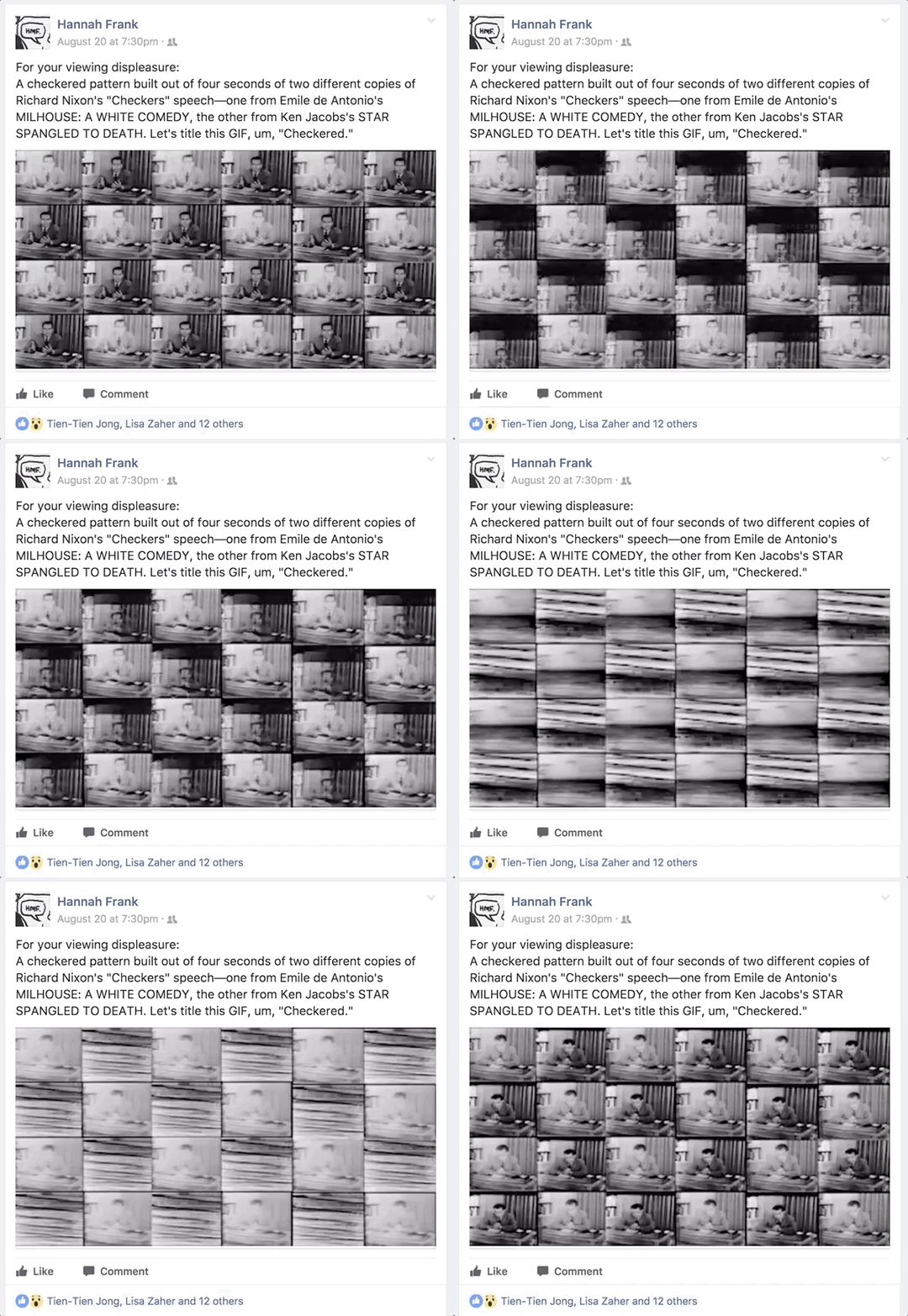
hannah_frank_facebook_post_2017-08-20

Since the unexpected and shocking death of my friend Hannah Frank last week, I have been thinking a lot about the Black Mirror episode “Be Right Back” (Series 2, Episode 1, dir. Owen Harris, 2013). Since the time I first saw it, I’ve thought it was a very good slice of speculative fiction, but it was not until the past week that its insights into 21st century psychology truly hit me.

Continue reading →