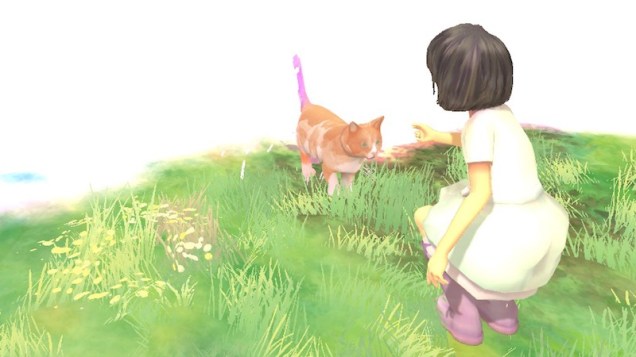
I have written about Beyond Eyes (Tiger and Squid / Team17 Digital Ltd, 2015) before, and mentioned briefly that it is about a blind girl searching for a stray cat that hasn’t come by her home recently, named Nani. What I didn’t mention was that Beyond Eyes has one of the most arbitrarily cruel endings in the history of storytelling.
Surprising, right? The game’s art style—which resembles what The Legend of Zelda: Skyward Sword (Nintendo EAD, 2011) might look like if pumped up into gorgeous HD—suggests a kid-friendly aesthetic, as does its gentle, generally challenge-free exploratory mechanics. But man, that ending is brutal. And not just in a sad, Old Yeller sort of way. The ending of Beyond Eyes is thoroughly rotten with nihilism. I can’t resist: I’m going to spoil it thoroughly below the fold.
This past March, at SCMS, I walked out on a paper being delivered by Oscar Moralde on The Witness (Thekla, Inc, 2016). I did so not out of disinterest. (I’ve enjoyed Moralde’s papers in the past.) Nor did I do so out of rudeness. Rather, I did it because of spoilers. Moralde was kind enough to warn ahead of time that his paper would spoil a small portion of the joy of teasing out the behaviors of The Witness’ world, and advised those who hadn’t played it to leave, lest they deny themselves a rich intellectual—and some would even say emotional—experience of personal discovery. And, in my eternal shame, as of March of 2017, I still had not played The Witness. Even though it had been sitting right there in my Steam library for months. (Ashlyn Sparrow and Whitney Pow can attest to the truth of this story.)
Moralde’s paper was a wake-up call to me that I needed to get better about my gaming backlog, if for none other than purely academic reasons. And I think I’ve done a pretty good job of keeping up on things in real-time since that moment. (I played Tacoma, already!) I offer this story, though, not (strictly) as a chance to to advertise my newfound dedication to keeping up with recent releases, but also as a warning. Basically, the heads-up Moralde offered in front of his talk also applies here. The pleasures of The Witness are the pleasures of discovering puzzle mechanics, and you will deny yourself a small portion of those if you watch this new video essay I’ve whipped together.
That said, if you don’t mind spoiling such things, or if you’ve played The Witness already, go ahead and dash right in. This video is considerably shorter and more focused than my previous experiments in the “Let’s Study” format. It focuses on the pedagogical aspects of the game’s puzzle design, in particular its fondness for safe failure. Whether it’s encouraging assumptions about its mechanics that quickly get proved wrong, or setting up perceptual bad habits only to nip them in the bud, Jonathan Blow’s puzzle design in the best portions of The Witness front-load failure, so as to hammer home lessons. I hope you enjoy my short tour through this technique!
As before, a full transcript of my narration is below the fold. (I’d love to eventually add these as subtitles to the YouTube upload for accessibility reasons, but that is beyond my abilities, at the moment.)
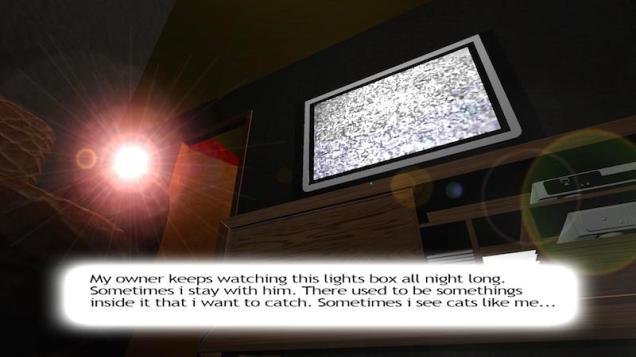
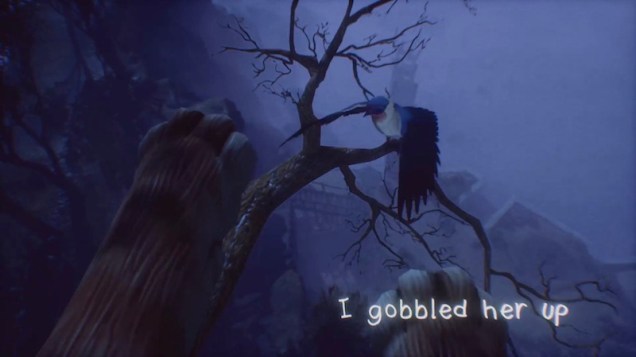
It’s hard to take good screenshots of A Purr Tale (Matias Selzer, 2014), because the cat never appears. You are the cat, in first person, for one. And, on top of this, you never catch even the slightest glimpse of a paw or a tail.
It’s also hard to take good screenshots of A Purr Tale because, frankly, it doesn’t look all that good. Its assets are low quality, and its lighting is muddied by needless effects. Also, its sound effects are bad. Its English translation could use some edits. And the signposting for what you’re supposed to do is horrendous. (Sometimes the correct thing to do is to slip right through the level geometry.) Basically, A Purr Tale isn’t very good, at all. And that’s too bad, because its serious subject matter (content warning for suicide, if you actually play the thing) deserved a more gentle and polished touch.
Ah, well. At the very least, this personal game is loads more ambitious than most things you can find made with pre-existing Unity assets floating around online.
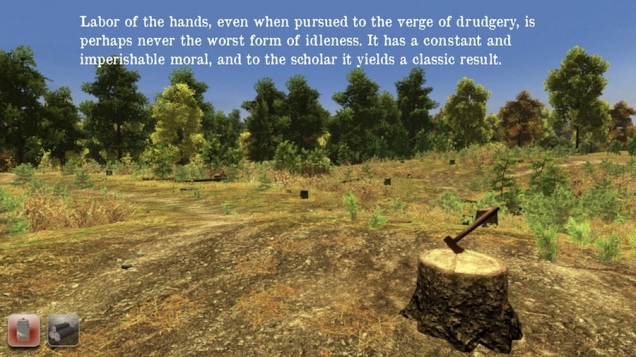
Today marks the 163rd anniversary of the publication of Henry David Thoreau’s Walden; or, Life in the Woods. I am celebrating the occasion by resurrecting my old “Process Genre in Videogames” blog post series, and turning an eye toward the USC Game Innovation Lab’s recently-released Walden, a game, across two posts.
In this series, I borrow the term process genre from Salomé Aguilera Skvirsky’s work in cinema studies. According to Skvirsky’s definition, “process genre” films are films about labor, films that focus on processes of doing and making, that are fascinated with seeing tasks through to their completion. They are deliberately paced, meditative, and often political. In this series of posts (you can see them all here), I examine games that strike some of the same chords.
Tomorrow marks the 163rd anniversary of the publication of Henry David Thoreau’s Walden; or, Life in the Woods. I have decided to celebrate the occasion by resurrecting my old “Process Genre in Videogames” blog post series, turning an eye toward the USC Game Innovation Lab’s recently-released Walden, a game. I ended up having too a bit too much to say about it to fit into a single blog post, so I’ve split up my thoughts across two days.
Just a quick refresher: in this series, I borrow the term process genre from Salomé Aguilera Skvirsky’s work in cinema studies. According to Skvirsky’s definition, “process genre” films are films about labor, films that focus on processes of doing and making, that are fascinated with seeing tasks through to their completion. They are deliberately paced, meditative, and often political. In this series of posts (you can see them all here), I examine games that strike some of the same chords. Today, that means turning to the life and work of everybody’s favorite environmentalist pseudo-hermit, Henry David Thoreau.
The itch.io page for Walden, a game claims that the game is the product of a “very small core team” at the USC Game Innovation Lab working on the project for “the past ten years.” I first became aware of it in November 2011, when Tracy Fullerton sat down and had a wonderful talk with students during a session of the University of Chicago’s New Media Workshop. Back then, Fullerton described the project as a difficult balancing act, balancing the quantitative and systems-heavy “gamey” aspects of games—which are actually right there in Thoreau’s text, making this entire project of adaptation especially tempting—with the need to present nature, and the labor one does when living in it, as a source of unpredictable inspiration, worthy of our respect and wonder.
So, at one moment in What Remains of Edith Finch (Giant Sparrow, 2017) you play as a girl named Molly, who suddenly finds that she can inhabit a cat.
The moment happens fairly early on, but I still don’t want to share much about it, since surprise and novelty are such essential parts of Edith Finch‘s toolbox. The above screenshot is about all I’m willing to post. Any further description of this act of possession, and where it leads, would qualify as a spoiler for one of the game’s most hallucinatory and delightful moments. So, I’ll just leave it at this.
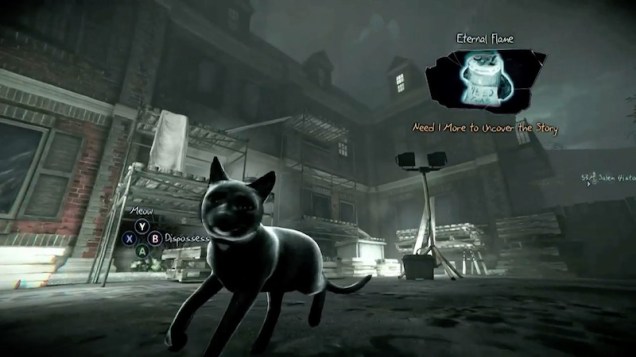
Okay, so technically the name of the cat you play as in Murdered: Soul Suspect (Airtight Games, 2014) isn’t Ronan O’Connor. I don’t know what the cat’s name is. Ronan O’Connor is the name of the man whose ghost you’re playing as, who can possess local cats at will. This is necessary, because cats can do cat parkour, which makes them more mobile than ghosts.
Yes, there is cat parkour in Murdered: Soul Suspect. There is also a dedicated “meow” button, which sadly Ronan doesn’t have when he’s in his human-shaped ghost form, for some reason. Video of some lithe Ronan-possessed cat parkour action below the fold.
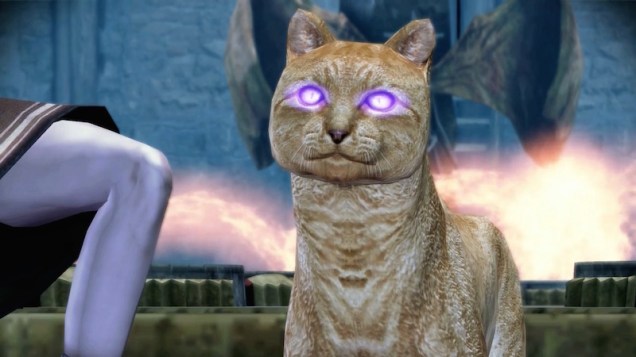
If you’re lucky enough to play The Stone Prisoner DLC for Dragon Age: Origins (BioWare, 2009), you’ll meet Kitty. Kitty is a cat. A cat who can talk. Wouldn’t Kitty’s ability to talk indicate she’s not actually a cat? Nonsense. Kitty is a cat, really. The reason she can talk is that she’s the best cat. A beautiful cat. The most amazing cat in the history of the world.
Some anonymous sources say that Kitty is not a cat at all, but a desire demon, mimicking the form of a cat. But that’s just FAKE NEWS. The single greatest witch hunt of a cat in Thedosian history. No cat in history—and I say this with great surety—has been treated worse, or more unfairly.
For Kitty’s own words on the matter, peek below the fold.
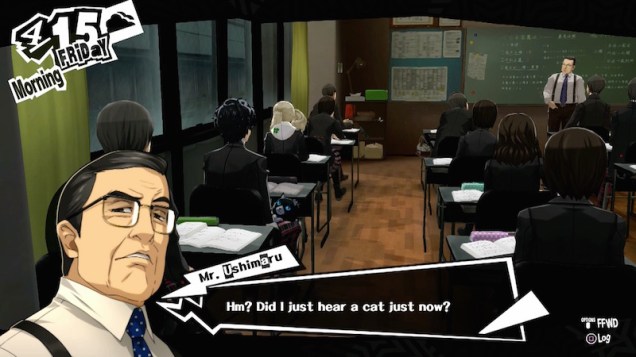
As I mentioned last week, Atlus has so far developed two games released on eighth generation consoles: Tokyo Mirage Sessions ♯FE (2015) on the Wii U, and Persona 5 (2016) on the PS4. Both are set in Tokyo, with certain locations—such as Shibuya and its landmarks—featured prominently. And both have a cat.
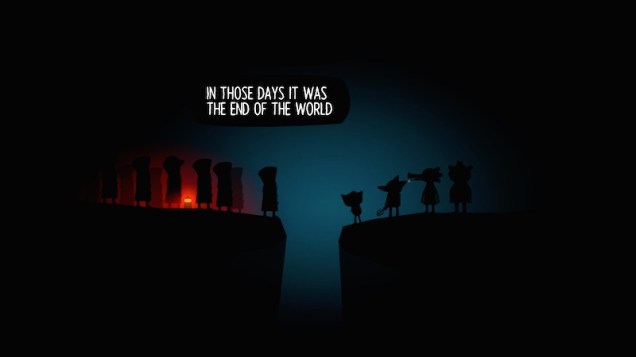
Night in the Woods tells the most vital story of any game in 2017. We’re only halfway through the year, but I doubt very much that it will be bested in this regard. Find out why below the fold, but beware of spoilers if you haven’t played it yet, and plan to. I will be discussing how this very important game’s themes resonate all the way to its ending.
 Intermittent Mechanism