Lesson Plan: Point of View, Staging, and Guidance in Cinema & Videogames

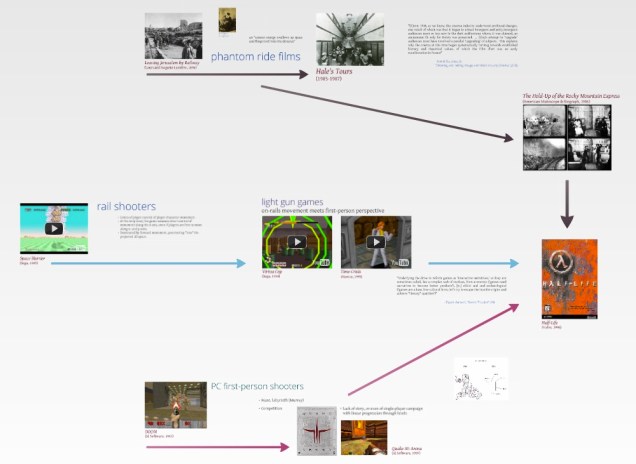
prezi_screenshot-phantom_ride_1_full

Ian here—

What follows is a two-part post, combining lesson plans from two separate days of my course “Comparative Media Poetics: Cinema and Videogames,” which together formed a week I referred to on the syllabus as “Point of View, Staging, and Guidance.”

There are many different entrance points for a class organized around the relationship between cinema and videogames. Contemporary popular genres are an obvious choice—and one that, in fact, formed the backbone of many weeks of the course. This week, though, I stretched past those boundaries, and crafted a lesson plan that was grounded more in a comparative look at each medium’s history.

The first of these lessons is primarily a lecture, which sets up a course screening/play session. The second lesson is a post-play-session discussion.
Continue reading

Interfacing Intuition, or, the GUIness of the Detective’s Gaze

minority-report-screenshot
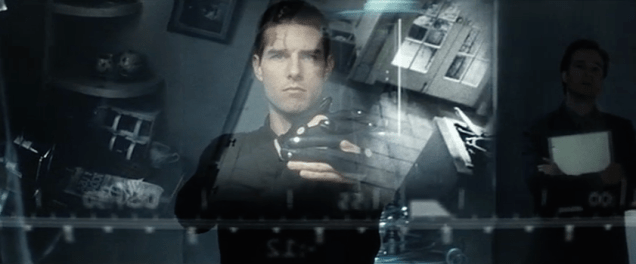
Minority Report (Steven Spielberg, 2002)

Ian here—

What follows is my talk from SCMS 2016 in Atlanta, GA. You can follow along with the visual presentation here.

The moving image and the graphical user interface: they are often regarded as two separate forms, with their own unique histories, and with resulting divergent aesthetics. Recent years, however, have seen this division beginning to break down, as the GUI has gradually invaded moving-image storytelling.

Representations of the graphical user interface have a long history in science-fiction, from the augmented reality elements that clutter the cyborg’s point-of-view to the fantastic potentials of human-machine interfaces. Continue reading

Lesson Plan: Film Scores and Synesthesia

synesthesia_header_image

Ian here—

Spending one week on sound in an Introduction to Film course can be a daunting task. So much vocabulary, and so many new issues to discuss, with only a class or two to dwell on them. What to do?

I like to take this week to introduce the concept of synesthesia—the “bleeding” of one sense into another that results in sensations in one sensory modality being interpreted as impressions in another. It’s a phenomenon that has been studied from the era of classical Greek philosophy up through modern neuroscience, and it has provided inspiration to artists for nearly as long. For understandable reasons, it was something that was on a lot of filmmaker’s minds during the transition to sound cinema. Turning to this topic allows us to rope in stalwarts of classical film theory such as Eisenstein and Vertov, and to freely intermingle experiments in feature filmmaking with more radical experiments in the avant-garde.

In this particular lesson, I focus on music. If one’s spending two days on sound, this leaves another class for sound effects, if one so desires. Continue reading

Lesson Plan: Bruce Conner’s A Movie

bruce_conner-a_movie_the_end

Ian here—

Bruce Conner’s A Movie is one of my favorite films to teach. I’ve taught it while covering theories of editing in an Introduction to Film course, I’ve taught it for a course on cinematic rhetoric, and I’ve taught it in courses on the history of American avant-garde cinema. I’ve been lucky enough to teach at a school that had a good-quality 16mm print of it in its collection, and since then I’ve made frequent use of a MPEG-4 rip of a VHS copy of that print (formats upon formats!). It’s less than ideal, but the poor image quality never seems to diminish students’ fascination with it.

Continue reading