Video lecture for week 4 of CMST 10100, “Introduction to Film Analysis.”
Intro to Film
Camera Dynamics in Chungking Express (1994)
by Gabriela Horwath, Wyn Veiga, Tomas Pacheco, Mimi Taylor, Joon Choi
Focus Blur – Gabriela:
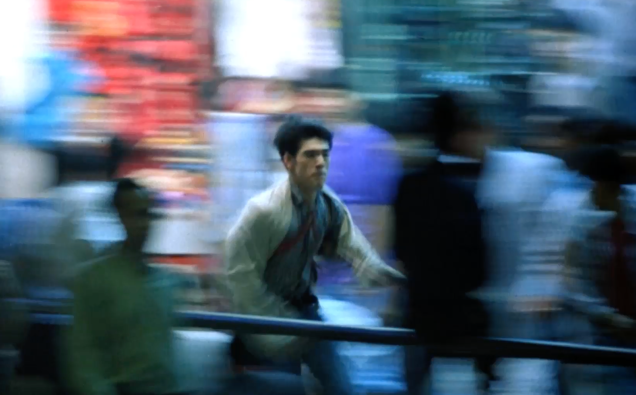
Specifically analyzing the first that appears blurry to the audience, the use of pan, tilt, and zoom creates a fast paced shot that allows the film to achieve a dramaticized appearance of the characters in action. In one of the first shots of the film where He Qiwu is chasing an assailant, the image produced by the movements of the camera are shown as blurry. When He Qiwu is first walking through a crowd, the skillful panning tracks him and shows the crowd around him passing by; this further highlights that it is a busy shot. In addition, pan is used as the camera moves alongside He Qiwu while he is running. This effect puts an emphasis on how fast he is running as well as the distance he is traveling.
The Expiration of Time and Love: Analyzing Speed of Motion in Wong Kar-Wai’s Chungking Express
by Meagan Johnson, Emily Nagler, Dylan Kanaan, Joalda Morancy, and Haina Lu
California Dreamin’-The Mama’s and the Papa’s (to supplement your reading)
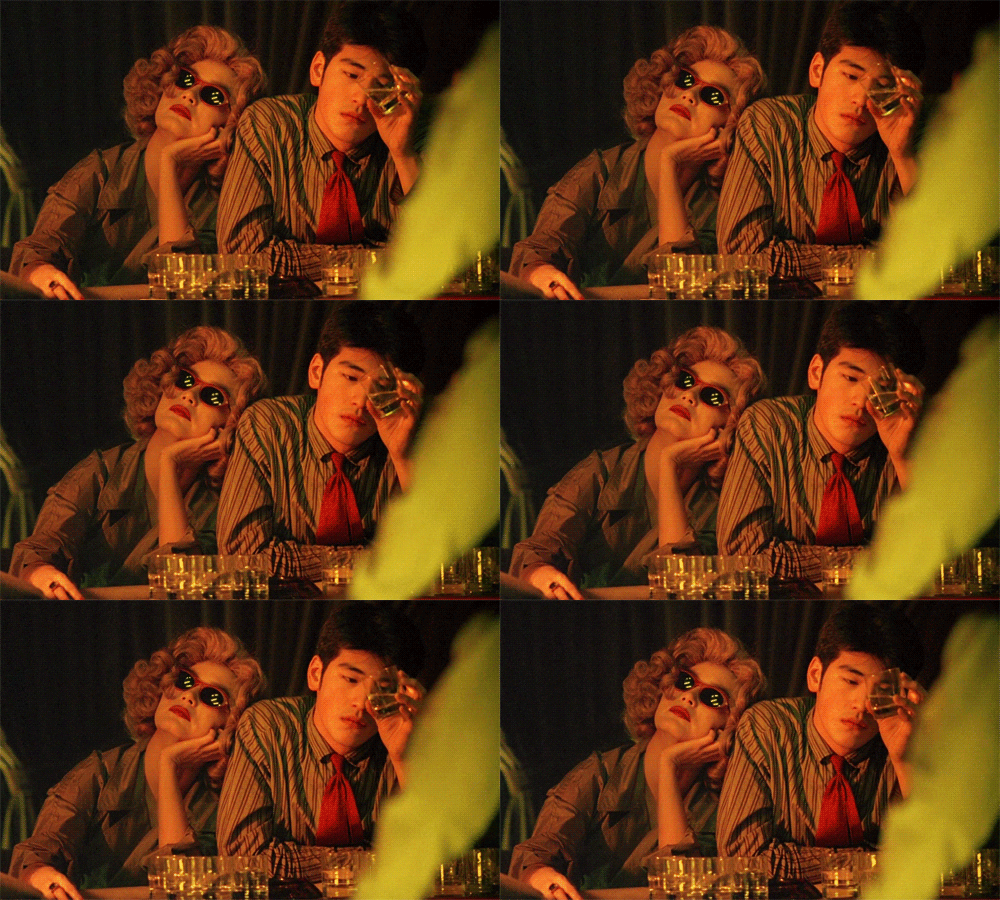
The context in which Wong Kar-Wai actually made Chungking Express is interesting to note as it relates to the techniques he uses to alter speed of motion in the film. According to Quentin Tarantino, Wong Kar-Wai was actually working on a different/epic movie, he had been editing for multiple years but had felt stalled in the process. Just as a writer needs to take breaks at times to look at their work with an objective lense, he felt he needed to step away for a bit, and decided to use the time to put out a quickly produced / quick hitting film, which would become Chungking Express. The context in which he made the film – moving from editing a film that was long, slower paced in time, to producing a film that was quick paced in time, and then returning back to the slower paced one – is in various ways actually reflected in his treatment of time in Chungking Express. As the remainder of this post will discuss in different ways, Wong Kar-Wai manipulates time through film techniques that alter the speed of motion. This manipulation of time is not meaningless however, the ways in which he does so is to reflect how time moves differently for different characters/situations, connecting us closer to their stories– instilling empathy in many respects. While Hong Kong films, at least at the time, were known for their fast paced approach, Wong Kar-Wai created a film in Chungking Express that is both fast and slow. And perhaps, his approach and reason to this was in-part to reflect how he perceives time as moving at different speeds within his own career.
Intro to Film Week 3 Video Lecture: Cinematography
Video lecture for week 3 of CMST 10100, “Introduction to Film Analysis.”
A Look Into Parasite’s Decor

by Zach Cogan, Meagan Johnson, Dylan Kanaan, Gabriela Horwath, and Alan Countess
Position of the Houses: How it Reflects a Class Struggle
Kim House
The Kim house is below ground in a busy and cluttered area of poor families with people disrespecting their home (including a couple of drunk men peeing on the property). Their house itself has very poor lighting and really the only pieces of technology are outdated, insufficient for their daily lives, and are in very bad shape. Their house has a very unorthodox structure to it, yet it can also be said that the Kims are very good at using what they have in order to make it work, regardless of the clutter that it creates in their home (E.g. socks drying on a ceiling fan and trying to latch onto any wifi possible). They have supplies for work (pizza boxes) stacked everywhere and store clutter in every room. Even the toilet is in a strange place, sitting on top of a ledge. There appears to be no beds in the home. In the opening scenes of the film, we see the patriarch of the Kim family resting his eyes and lying in a fetal position atop a thin rug. This layout shows how they manage to scrape by using what they have in the most efficient way possible. The family has this massive window that they have to look up to see out of. This could be a metaphor for the family wanting to climb up the socioeconomic ladder and take on a world that they don’t feel is theirs. On the outside of the window, it looks almost as if it is barred. This again shows how they are locked away from the rest of the world, unable to succeed and advance up the socioeconomic ladder.
Intro to Film Week 2 Video Lecture: Mise-en-scène
The first full video lecture for CMST 10100 “Introduction to Film Analysis,” on the topic of mise-en-scène.
Intro to Film: Preliminary mini-lecture
A preliminary mini-lecture for CMST 10100 “Introduction to Film Analysis,” in advance of our first official full video lecture.
Lesson Plan: Basic Terms of Cinema Studies + Their Relevance for Avant-Garde Cinema
Ian here—
I suspect that every cinema studies teacher has their own favorite examples to use when teaching key vocabulary terms, and I would not be so presumptuous as to prescribe my own favorites! Nevertheless, though, it’s an important part of the job, so I wanted to share my own approach here.
Over the past couple of years, I have gotten used to teaching these terms in a very specific context. At the School of the Art Institute, I teach first-year seminar courses. They are courses designed so that all students have some basis in college-level writing as they go through their time at SAIC. Instructors are given enormous freedom to teach whatever they like. This makes it a great venue for testing out new and interesting course ideas, but the flip side of that is that your courses never have prerequisites, and there’s no telling the level of expertise students who enroll will actually have.
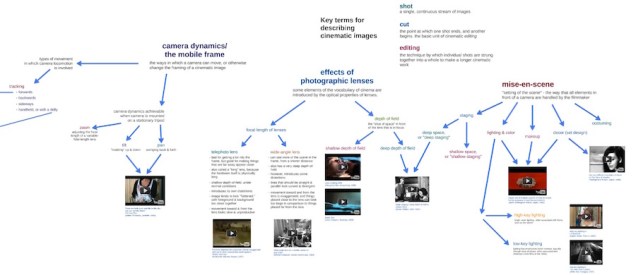
What I do, then, is devote one day early on in the semester to a quick-and-dirty Intro to Film in a single lecture. I take a lot of the examples and explanations I first started using when I taught Intro to Film at U Chicago in 2015, but I condense them down into something that can fit into an hour or so. It’s potent stuff.
You can access my go-to presentation here. I’ve set the privacy and sharing settings to their most open, so if you’re a Prezi user you should feel free to copy it if you like it, subbing in your own preferred definitions and clips as you feel necessary! I’m here to share, and not here to impose.
Five Ways to Look Smart while Teaching PlayTime
Ian here—
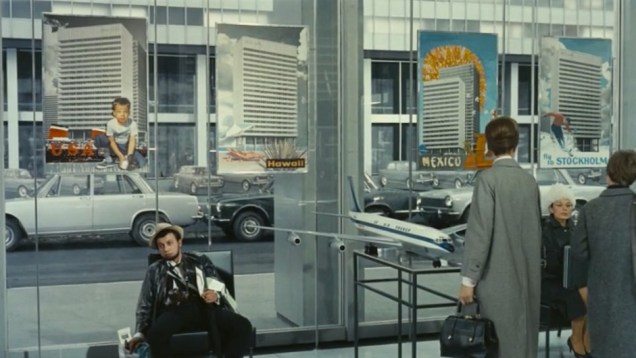
So, this isn’t a proper lesson plan. It’s just a quick cheat sheet. When teaching PlayTime, I pair it with Kristin Thompson’s chapter “Play Time: Comedy n the Edge of Perception” in her book Breaking the Glass Armor. (I consider myself incredibly lucky that I can pair one of my favorite films with a piece of writing that I consider to be one of the more astute and persuasive pieces of academic film criticism ever written.) My lesson, therefore, largely revolves around the conclusions of Thompsons’ analysis: that “the comic and the non-comic become indistinguishable” in PlayTime, and that the way the film “forces us into new viewing procedures” holds the potential to “successfully transform our perception in general.”[i] To view PlayTime, in other words, is to encounter a new way of seeing the world, one that might persist beyond the theater.
How do you successfully persuade students that PlayTime requires specific viewing procedures from its audience, ones unlike those we use when viewing a more traditional narrative film? My tactic is pretty simple: I pull student attention to moments that reward close viewing. Thompson herself lists a bunch of these in her chapter. I like to point to additional, different ones, so that I can show students new, unexpected visual rewards—therefore making both me and Tati seem smarter than we otherwise would! Please feel free to steal these.
Lesson Plan: Film Scores Addendum
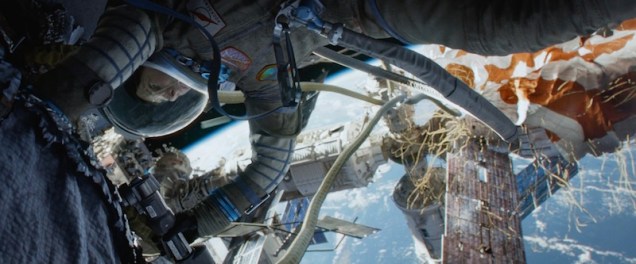
Ian here—
This is just a quick addendum to my music-themed lesson on Alfonso Cuarón’s Gravity (2013) from my Intro to Film course, which I posted earlier. This bit doesn’t have as much to do with synesthesia, which is why I separated it out, but it is something that I incorporated into the same lesson.
 Intermittent Mechanism