The Individuality of Mystery House and the Effects of Femininity in Digital Storytelling

By: Bernadette Broscius

Roberta and Ken Williams (creators of Mystery House)

Individuality/Femininity: Compared to the features and abilities of text-based games like Zork and Adventure there is a distinct difference in Mystery House that goes beyond its visuals. Though it is important to note that this adventure game was one of the first to include computer graphics and expand user interaction in new ways, I find that the origin story of this game to also be a major point of interest. In the 1980’s, married couple Roberta and Ken Williams began working on Mystery House based on Roberta’s inspiration and additionally, her love for mystery games/books. I found it important that this game was inspired by a mystery novel (And Then There Were None), as almost every form of storytelling, even the digital/visual forms can find its roots in written or oral forms of literature. It made me consider the influence that Roberta had not only on the mass video game market, but on women in the later 1980’s. The Nooney reading tells us that “Roberta also knew that games existed on computers prior to playing ADVENT, but she was typically uninterested despite her marginal familiarity with computing…23 ADVENT, however, was something other than the statistical or randomized play scenarios common to mainframe games, and Roberta Williams found herself deeply engaged” (81). With Roberta’s female point of view and understanding that women were hesitant to take part in digital storytelling and gaming, she took these conventional/standard stories that were already popular, and added a twist to it. I think the fact that she recognized the importance of the female market and creating a game that women not only feel comfortable playing, but are interested in was a turning point in the allocation of games such as these. This goes back to my point that the visuals were not the only unique factor about this computer game – the popularity had much to do with “its distribution and its multiplicity, its spread” (Nooney, 78). 

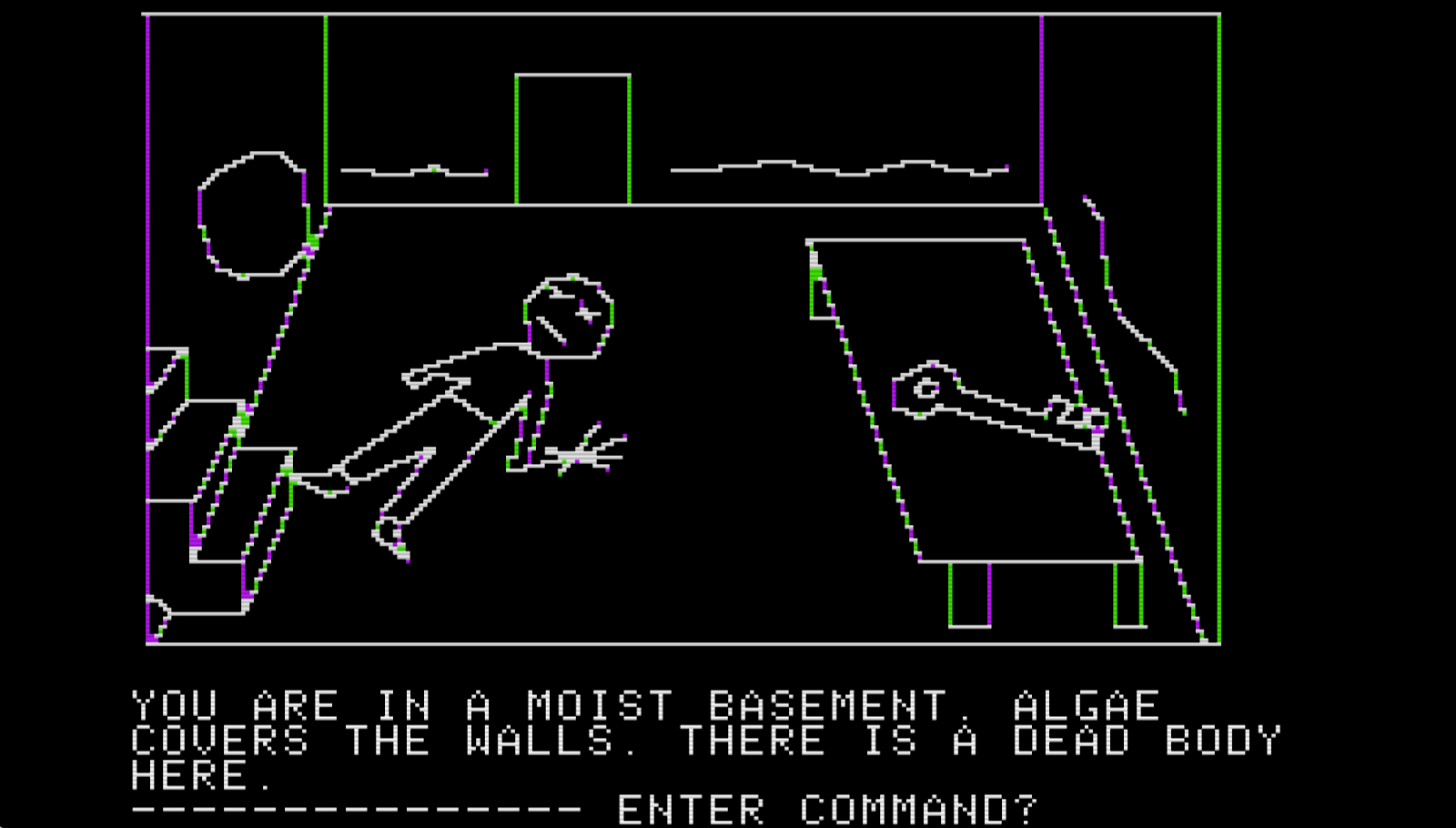
Universal Strengths and Defects: The ability of this game to reach larger audiences due to Roberta and Ken’s teamwork in manufacturing and shipping product, along with the multiple forms of artistic appeal (text, visual, and approachable content) were what made this “novelty.” However, when considering the new and impressive feats that this game introduced, the limitations should also be considered as influences of future works and games. While leading the animation on Mystery House last Wednesday, it was brought up by multiple classmates that the graphics in the game, on occasion, would mislead their game. For example, there is a point in Mystery House where the player encounters a candle. Even so, in my own experience and those of my classmates, we had quite a bit of trouble identifying this object that ultimately becomes necessary for success (the game gets dark and you need a candle). With the limited points that Ken was able to code in each room, the visuals can seem a bit crude or rudimentary. In turn, when a misunderstanding in visuals ensues, the game can be held up for indefinite periods of time, which is profitable for the game, but frustrating for the player. In my case, I ended up having to look up a run-through in order to figure out the specific commands that the text-parser would accept so that I could progress in small ways. Because of my access to technology, I was able to get answers to questions about the mystery that were not initially available at the original release, which positively reinforced my interest in the game. On the other hand, for players that were interminably stuck at a certain point due to the simple text parser and lack of understanding (in terms of the graphics), this might have deterred players from finishing or continuing at all. Even so, at the time, this mystery inspired game drew in a large audience and expanded demographics, despite these shortcomings that I have mentioned, largely due to the rapid progression technology has undergone in the past forty years. 

Influence: Another topic worth expanding on that was mentioned in the discussion board, is the influence that this game had on the gaming space today. I found there to be an easy and clear correlation between video games we know now, such as Among Us and Minecraft, as there is a story attached to each of these games that can only be fully understood in addition to the visuals. In newer games, we see that the evolution of graphics has reached new heights and expanded to a point in which the player can see their own character, and see their bodies moving. In class we talked a little bit about how in Mystery House, the navigational experience was limited as you couldn’t physically see your character move, it would just appear in a new room, which made it easy for the player to lose concept of their position. I think that as players began to get used to these simple visuals, it became a next step to introduce the concept of seeing your own character to completely immerse the person behind the screen into the digital world. With this being said, I view Mystery House, with all its originality and its drawbacks, as a great inspiration for new gaming programmers, but also for the player’s interest in digital narratives and machinery. It is also important to consider the female agency included in the storyline of Mystery House (with the killer being a woman named Daisy) that is included because of Roberta’s self-determination and creativity. This game, while it revolutionized computer games in a visual sense, can also be recognized as a reflection of the changes in gender dynamics within the gaming space. Roberta acknowledged that there is space for everyone in the gaming world and was able to do this with such great subtlety that it is only clear when looking at her and Ken’s history.
A Murder Mystery and The Foundations of Adventure Game Graphics

By Priscilla Bermudez

Background 

Mystery House, originally known as Hi-Res Adventure #1: Mystery House, was released in 1980 by Ken and Roberta Williams. The game is known as a foundational adventure game due to being one of the first adventure games to include computer graphics and introducing the great potential gaming with graphics could have on Apple II software. Roberta Williams revolutionized the genre of adventure games with this creation. Before Mystery House, all interactive games were text-based. The creation of Mystery House was inspired by the first text-based adventure game called ADVENT, also known as Adventure or Colossal Cave. Both Ken and Roberta played the game, but Roberta was deeply engaged with the game which caused her to be passionate about the adventure game genre. Once she ran out of games to play, she decided to make Mystery House. The game would be based on the board game Clue and Agatha Christie’s And Then There Were None. An aspect that sticks out to me of the game’s history and origin is the important role a woman plays in its creation. At the time when computers and video games were left to men who had access to computers and in elite college spaces that men dominated, a woman was the one to create a foundational video game. I find this important because it shows how women can break through and accomplish important work in male-dominated spaces. 

The plot of the game revolves around a player being locked inside an abandoned Victorian house with seven other non-playable characters. There the player finds a note that says that there are jewels hidden in the house and whoever finds them gets to keep them. As the player searches the house for the jewels, dead bodies begin to appear in the different rooms. So now on top of finding the jewels, the player needs to find the killer before the killer kills them. 

Impressions


Upon playing for the first time, I was shocked by how much the game still relies on text for the player to understand their surroundings. In hindsight, with Mystery House being the first adventure game to introduce graphics, the graphics play a more complementary role to the text rather than guiding the game. Coming into the game with the mentality of modern games, I expected the graphics to have more details, whether it be details in the room or with the different characters. Many times the game’s text included descriptions of what the rooms consisted of in case it was unclear or sometimes. Once I got over that concept in my head, I could understand would become an aspect that complements the text and becomes visually appealing rather than encompassing the text. I still had a bit of trouble navigating the game due to its use of cardinal directions to guide the players through the house. It was a bit easier for me to go to the locations I wanted in Mystery House due to its use of graphics, so I could visualize more clearly that I was headed towards the kitchen for example, or the study. This is an aspect I find interesting in text-adventure games. The player has to make a mental picture of the locations in regards to world-building and in a way keep a map of the locations they have gone. While in Mystery House, you still have to keep track of the locations you have already been to, the graphics help keep it all visually organized.

On the topic of directions, providing the text parser with directions at times became a point of frustration for me in the game. The game provides you with a set of rules of what directions can be given to the game; two-word commands containing a verb and a noun. It provides a list of example actions one can give the system but if one provides a command that the system is not prepared for, it just says it does not understand and does not provide you with options on how to move forward.

Another thing that made playing slightly difficult for me was the lack of a list of objectives and items required of the player. It is very cool in the game to keep an inventory of the objects one picks up in different rooms and be able to use them later on in the game. Since the game does not provide a list of items to find, one may overlook an item in a room and that would lead to their death later on. 

Characters


The function of the other characters in the game Mystery House also intrigued me in comparison to present day. While in a modern game, the characters may play a more active and detailed role in the adventure, in a game like this all we know of the characters is what is provided in the instructions. It caused me to think about modern adventure games like “Detroit: Become Human” where how a player chooses to interact with certain characters is what ultimately determines the path and ending the player will experience. Additionally, it was interesting how on-the-nose the hints found on or near the dead bodies were since one does not have the option to interact and interview with the characters. (SPOILERS) Each dead body that was found had to be specified by the text and since the graphics themselves were not very distinguishable. The hints found on the dead body like blonde hair and a daisy in a body’s hand, made it easy to discern Daisy as the killer once the other blonde characters turned up dead. Meanwhile, to keep using the example of Detriot: Become Human, technology has made the characters in the game look so detailed and realistic that for example the character Markus resembles very closely its voice actor, Jesse Williams and this happens similarly with the rest of the cast. In terms of the characters, I see how including different characters with differing occupations and identities would become popular in later games and how Mystery House begins to establish its purpose. 

Overall Thoughts
Overall, I did enjoy playing the game and gained a new sense of appreciation for how detailed and immersive games have become nowadays. The advertising for Mystery House itself demonstrates how the game’s main selling point was its graphics and natural language commands, “Through the use of over a hundred Hi-Res pictures you play and see your adventure. You communicate with Hi-Res in plain english (it understands over 300 words!)” (Nooney, p.88)  Currently games advertise the world-building aspects of the games and the paths and actions of the characters have heightened in complexity. Returning to the in-class discussion of the return of providing natural language as a mode of input, I do not see this method of input as making a comeback, especially with how AI has begun to understand more complex commands. I do think it is very important to look back on games like Mystery House to see how far technology has come to create the method we interact with games now and experience these heavily text-based adventure games.

Sources:

Nooney, Laine. Sierra On-Line and the Origins of the Graphical Adventure.American Journal of Play, vol. 10, 1. (2017)

Playthrough: https://www.youtube.com/watch?v=kiwHwPvIHBs 

Text-Based Games and the Trouble of Simplicity

Article by Matt Brennan

Last week, I played through the game Colossal Cave Adventure for class, and in my playthrough and the subsequent discussion we had as a class, one specific topic popped up with regularity: the text parser. The text parser was no small innovation for its time, but returning to it nearly 50 years later was an exercise in frustration. The parser was extremely simple, as it had to be for its time, and thus only accepted a very small—and very specific—list of inputs. This confused every player, myself included, and led to the game becoming a tug-of-war between the player and the controls, with the game itself, while never quite becoming secondary, taking a very clear back seat to the struggle to play at all.

For movement, the parser of Adventure accepts cardinal directions (though not the command to “go” or “move” in these directions), as well as up and down. Everything else gets more arcane from there, as the parser allows for “get” and “take” but not “use” or “investigate.” “Look” is allowed but only gives a description of the room around the player character, and “throw” does the same thing as “drop,” preventing any chance at lobbing objects at enemies as weapons. Eventually, it occurs to the player that their best bet at succeeding is to input only the exact thing they want to interact with and no other words, and allow the game to fill in the rest of the data. This works more often than not, which is its own issue. In a game like Dungeons and Dragons, which was brought up in discussion and was a clear inspiration for Colossal Cave Adventure and every other early text adventure of the day, it’s a reflex for the players to describe what they do in great detail so that the game’s adjudicator, its Dungeon Master, knows exactly what the players want to attempt and how to judge them on the fly. That level of detail, necessary in D&D, becomes an active hindrance in Adventure, and the player must rely on simple, often one word, inputs to move the game forward.

The important distinction between a game like Dungeons and Dragons and a game like Adventure is the level of freedom in both. D&D is nearly pure improv; the players work together and keep each other focused and up to speed on how the game is working at any given moment, but nothing is set in stone in terms of story, and anything can change on a whim or an unexpected die roll. Adventure, for how much it’s inspired by D&D, is nearly the exact opposite; the single player is completely alone, has to figure everything out themselves, and is working to advance the single plot down its defined tracks until it reaches the ending, which is always the same. If the plot of a D&D campaign is an adventure, the plot of Adventure is a train ride with a sticky handbrake. There are interesting and clever moments—for instance, the player needs to keep their inventory clear, but if they don’t set down a porcelain vase in the same room where they set down a decorative pillow, the vase will fall and shatter—but those are hard-coded into the game, not the result of a clever piece of judging by another person. The mechanics can be interesting, but there’s a certain attempt to make Adventure something it isn’t, and the text parser makes this abundantly and uncomfortably clear.

Not to say I didn’t enjoy playing Adventure. I thought it was a very solid game for its age, and the fact that the most frustrating thing about a game over twice as old as I am was that its controls were counterintuitive does say a lot of good things about the game. A lot of it holds up really well, but at every turn when I played, the text parser became a more and more pressing issue. Thankfully there were a handful of passwords to skip most of the long walking sections (where the game has the most chances to screw up and dump the player somewhere in an endless forest), but that was only a workaround, hardly a solution. A text-based MUD I have some experience with, Discworld MUD, also uses a text parser to control the game, but this parser is much more sophisticated and, more importantly, flexible than the parser used in Adventure, and as a result the game experience feels much more akin to D&D and other roleplaying games than to the old text-based adventures we played for class. While this is certainly an unfair comparison between the two, I find it fascinating how far the technology for text-based games has developed even amidst the advent and growth of graphical games. It’s a far fairer comparison between the two, I think, to bring up how beloved and propulsive for the genre both games have been.

Chatbot AI and Humanity

I have separated my understanding of the chatbot ai phenomenon into two philosophical and conceptual frameworks; information and connection, or to put it another way chat gpt and character ai. In class, I asked the question, how is digital media evolving what we understand being human to mean? And, in regards to digital media, especially artistic media, this question becomes increasingly important as we must also interrogate and define art. This is an interesting corner that we have been figuratively forced into by the rapid evolution of ai. Art is a concept that is notoriously difficult to define, what makes art what it is, and more deeply what signifies quality in art remains elusive. However, a principle that seems to go without saying is that it is created and consumed by humans. We value the sweat upon one’s brow, the wavering of a voice in song. It is the small idiosyncrasies and laborious nature of art, the emotion and intentionality of a piece, that must be and is based on its distinctly human nature. In other words, it is the subjectivity of human creation that makes it art, or at least that is how we as a society have subconsciously regarded it. We know that a piece of art is a piece of art because someone made it. The same can be said for how we communicate with one another. We know that real “authentic” communication is occurring because it is happening with another living being who can respond and understand and insert their own subjective experience into what is otherwise a one-sided non-exchange. So then, with ai, we seem to be seeking this out when we create digital minds that are capable of mimicking this connection as I have described it as above. So then, art is a form of communication, however broad and intangible it may be, and communication is the human means of connection. If we are to understand the creation of ai under these lenses, to serve either to connect us or streamline information, then we must then understand why ai takes the shape and form it does, in the most literal sense. Why do we imagine the most advanced AI as taking the rudimentary form of the human body, and able to speak as fluidly as another person. Why must it speak to us at all, and have a “human” voice. Similarly, why do we have character ai that simulates conversing with the president, or a mob boss? On the one hand, it is an appeal to the senses. What digital media intrinsically lacks is the ability to stimulate us on any level beyond 2-dimensional pixels. This is why so much software and hardware is now dedicated to advancing technology on the fronts of sound and sight. This is the reason a “meta” wishes to completely immerse us in sight and sound to the virtual spaces, and attempt to simulate a 3-dimensional world. So then, what humanity is importantly defined by in this new digital age, and what much of digital media attempts to do is arrest our attention on the most fundamental levels of human senses. Though, what else might be the reason for the way that AI chatbots are designed, and the way that robotic forms as well as certain digital media are crafted. We create these forms of intelligence in our image, and to meet the conscious and subconscious desire for these artificial intelligence to transcend their limitations as we too attempt to. In the question of transhumanism, it would seem to me that just as humans create AI and other technological advancements to transcend our organic limitations, we are simultaneously pushing AI to transcend its mechanized limitations. Though we imagine it to be for the purpose of serving humans. So then, an almost existential question comes to mind. We are attempting to reach the complexity of the human mind, by artificial means, in order to serve us. It would seem then, that human needs and wants are only satiated through the intensive labor of other humans, or human-like performance. Other questions I have considered for this topic were more on the side of AI art. What makes an original idea? It is the matter of the amalgamations and originality of a piece. AI is requiring us to bring the abstract of these artistic processes into focus. Art AI artists “real” artists? This uncanny valley of creation and whether or not this thin thread of “human intervention” is enough to keep us protected from AI manufacturing human talents in the next few years, possibly months. It is a question of utility and ethics. We have yet to form shared ethics around ai, and how it is best to perform with these tools under the contexts of information and connection. What values should we have underpinning those ethics? To what degree can these AI be utilized safely and objectively? How do we ensure that prejudices are separated from AI?

SHAPE UP!: Un-cozy Games

Ian here—

This will be my last post of year year, slipping in the third episode of my Shape Up! video essay series before 2023 comes to a close.

Any longtime readers of the blog will know that I have a longstanding interest in what Salomé Aguilera Skvirsky has dubbed “the process genre,” applying her concept to games well before her book on the subject even came out. This is my first video essay to dabble in the subject, with a suite of all-new examples to chew over. (Be prepared for a surprisingly lengthy introduction about the historical reception of Jeanne Dielman for a video nominally about videogames.)

Full script below the jump. Happy (almost) new year, everyone!

Continue reading

SHAPE UP!: Ironic Communication and Its Limits

Ian here—

This is the second episode of my Shape Up! series of video essays about form, structure, and pacing in games. This time my primary focus is on Else Heart.Break(), which is one of the most ambitious games I’ve ever played, but also has what is probably the worst opening act of any game I’ve ever played. Bit of a meandering structure to this one, as I spend the first twelve minutes finding common ground with my dad’s frustrations playing games, and also dive into the varieties of irony games can use when conveying instructions to players—and the dangers of using it sloppily.

Full script below the jump.

Continue reading

SHAPE UP!: Possibility Space

Ian here—

Here is the first real episode of my new Shape Up! series of video essays about form, structure, and pacing in games. My central case study is Skeleton Business’ 2019 game Vignettes, although before I get there I spend a whole lot of time placing it in the context of what Joel Goodwin has termed “secret box games” or “himitsu-bako games.” This has been a topic I’ve written quite a few blog posts on. For years, I wanted to coalesce some of those disparate ideas and game appreciations into a video essay, but I never found the proper way to do that until I inaugurated this series.

Script below the jump.

Continue reading

Introducing: SHAPE UP!

Ian here—

Almost a year ago I offhandedly mentioned that I was planning all-new series of videos for 2023. The start date is later than I had anticipated, but I’ll still be sneaking a few in by the end of the year.

It is my pleasure to introduce Shape Up!, a new series of video essays about form, structure, and pacing in games. It is the fruit of a whole lot of academic work I’ve done in the past year, including two different courses I taught about shape and form in art (narrative and otherwise).

Episode one is uploading as I type this. In the meantime, as we wait, the script to this introductory video is below the jump.

Continue reading

The Evolutions of Sampling

Calahan Smith

In its infancy, the art of sampling mainly referred to the looping of drum breaks. However, as technology advanced beyond turntables and the genre spread across the world, sampling took many new forms. There are three subgenres in specific which I would like to go over in terms of their effects and appeal, those being Memphis rap and vaporwave.

Starting with Memphis rap, the genre was perhaps most popular in the 90’s, with groups such as Three 6 Mafia taking front stage for the style of music. Characterized by dark lyrics, lofi aesthetics, and eerie beats, Memphis rap was one of the progenitors of the horrorcore genre.

When it comes to sampling, however, Memphis rap has some rather unique components which differentiate it from other sample-based genres. For one, Memphis producers often did not sample drum breaks. Rather, they would create their own artificial drums using electronic drum machines. This was rather unique in hip-hop at the time and has been widely adopted since then by other producers who do not wish to source their drums from already-existing songs. In lue of sampling drums, then, Memphis producers mainly sampled melodies, either from jazz and R&B (which was incredibly popular at the time) or often from horror movies. An example which comes to mind is Body Parts, by Three 6 Mafia, which samples John Carpenter’s classic soundtrack to his 1978 film Halloween.

Perhaps the most unique aspect of Memphis production is its sampling of hip-hop, namely Memphis rap itself. Producers, instead of having rap artists sing hooks or choruses for their songs, would simply loop a vocal sample of a previous song for a few bars. Often this vocal sample would consist of a small snippet of one of another song’s verse, however this simple repetition of a phrase was massively popular and influential. It is a hallmark of Memphis and one of the immediate identifiers that the song you are listening to came in some way or another from the region.

All of these factors come together to form the moody, eerie atmosphere that is riddled throughout Memphis rap. It is evidence of the hopelessness that these artists felt from their environments. Feelings of being trapped in a horror film, that you’ve heard these voices before over and over, are focal points of the genre, and it is the height of awful irony that many of these artists have been demonized for the nature of their lyrics when what they are truly expressing is their lack of agency and control over their situation.

Vaporwave, sonically speaking, is a fairly different genre. Popularized in the late 2000’s/early 2010’s by artists such as Daniel Lopatin and Ramona Xavier, the genre is known for its slow, looping, hypnagogic melodies and recontextualization of popular music.

Similar to the drumless movement in hip-hop, in which added drums were foregone to prioritize the natural percussion of the sample, vaporwave is one of the most purely sample-based genres out there. Inspired heavily by the work of DJ Screw, who would slow down and remix hip hop songs, vaporwave producers will take a portion of a song, slow it down and loop it. This creates a rather hazy and psychedelic environment where no sound can really be nailed down, as it echoes throughout your head repeatedly, similar to the phenomena of only being able to remember a portion of a song you heard on the radio. It is a rather simplistic, yet effective, formula, and has been majorly influential upon remixing and TikTok culture today.

Another very important aspect of vaporwave is the nostalgia attached to it. It has been very common, especially in the genre’s infancy, for producers to sample very popular radio hits of the past, or even elevator jingles which everyone is familiar with. Through this looping, hazy recontextualization, the genre was able to turn songs which were seen as soulless pop or guilty pleasures into “high art.”

I mentioned earlier the concept of remembering only part of a song you heard on the radio, and vaporwave’s appeal for many is at the heart of this idea that memories erode, that the past cannot be fully experienced as it was, and that everything one once had attachment to will fade with time. Vaporwave thus places subtext where there was emptiness before, hence being able to turn a generic pop hit of the 1980s into something which people appreciate on a greater level. And while the genre is not as overtly horror-themed as that of Memphis rap, it is this deeper level of nostalgia and the unrelenting and uncontrollable passage of time which I find to be rather similar to the feeling of hopelessness and fear which is so closely integrated into Memphis rap.

To conclude, this post-modern recontextualization of existing music is evident of the times in which we live. The things of the past are gone, the hope of a happy ending is a childhood fantasy for many, and life will simply go on, leaving us behind, and repeating the same thing to the new generations.

Generational Cycles in Outer Wilds

by Josephine Markin

The ending of Outer Wilds is an impactful, overwhelming sequence of revisiting the many stories you encountered in your journeys throughout the solar system. The instruments of the Outer Wilds Ventures explorers you have met are joined by the music of the Nomai civilization in a hauntingly beautiful song, and the universe collapses into the smoke of a familiar campfire until you leap into the infinite possibilities of the future. The final screen shows a new universe born from the death of yours, painted with some familiar images as well as some entirely new creatures and elements. All of existence has begun a new cycle, and from all you have learned about the Eye of the Universe and the patterns of time, you can surmise that this was how your world was born as well. By giving you the willing decision at the end to move into the future, the game reinforces the message that its entire ending conveys: your life, and the universe you lived in, is passed on as part of the existence the new generation inherits. Your time is over, and the stories to come will both carry the familiar strains of your legacy and entirely new ones.

Although this message comes together cohesively in the ending sequence, the entirety of the game leading up to the end cultivates this theme, building on a time-loop mechanic and a narrative of generational knowledge and legacy. The player starts the game at a campfire, and for the rest of their Outer Wilds experience they will find themselves returning to this campfire over and over to begin a new iteration of their loop – the same campfire, significantly, features in the ending screen image. In the approximately twenty minutes following their awakening at the campfire, the player can explore the solar system and do anything they want on any planet; however, they will inevitably die and awaken once again at the campfire where they started from. The loop is not entirely self-contained, however: there are some actions which can carry on between cycles. These include collectable information like the launch codes; new dialogue options reflecting the experiences the player has had in a previous iteration; the rumors which are permanently recorded on the map; and even small reflections of the particulars of the previous loop, like the player making different gasping sounds when they wake up depending on how they died in the previous loop. In the case of the dialogue options, rumors, and collectable information, these reflect a growing compendium of useful knowledge the player is giving to their next iteration as they explore the world. Diegetically, the player is passing on knowledge to their “next” self through the method of the Nomai memory transfer statues and the Ash Twin Project; this technology itself is also a symbol of passed-on knowledge, as it comes from a long-dead civilization from which the Hearthians have inherited much. The awakening gasp which reflects the previous death is a more natural, subtle nod to this inheritance, because it is not useful, permanent, or discrete information. Instead it is an involuntary sign of the previous loop’s role in the birth of the new one: however the player died in the last iteration is how they were born in their new iteration, just like the way in which their universe dies is how the next one is born.

The Hearthians and Nomai themselves are another iteration of the passage between generations. The player is told in the beginning that they are the newest generation of Outer Wilds Ventures explorers, and in Timber Hearth and then in dialogue with Hearthian explorers off-world they inherit knowledge and skills from their fellow Hearthians. The Nomai, however, provide the structure of the core of gameplay: uncovering new knowledge from long-past Nomai writings and structures. By scanning spirals; tracing the paths of the actions of the Nomai who ended up in their solar system long ago; examining skeletal remains and collapsed space suits; and utilizing the left-behind Nomai technology, the player learns about a past iteration of life in their universe. However, this knowledge is not useless history: the actions and discoveries of the Nomai have ripples that continue to shape the path of the universe as the Hearthians inhabit it. The connections between Nomai and Hearthians are closely traced: notes unveil that the Nomai discovered the evolutionary ancestors of the Hearthians long ago, while Hearthian exploration technology is founded on the devices left by the long-dead wayfarer species. The doom that the system faces is (at first glance) because of the experiments of the Nomai, while the project which revives the player with memories of a different iteration of themselves was built by the Nomai. Outer Wilds explores this connection further by creating a Nomai character who is still alive: Solanum, an explorer residing on the Quantum Moon. Solanum, as she tells you herself, is likely both dead and alive: because time operates strangely on the Quantum Moon, her bones can be found in some places, but a timeless version of her lives on and can be encountered. The interaction between the player and Solanum provides a concrete bridge between the two civilizations, even more explicit than other connections, and the two can exchange a variety of information in their conversation. However, because Solanum cannot understand the player as well as the player can understand Solanum, the exchange is mostly a passing-down of Solanum’s knowledge to the player; the player cannot tell Solanum anything in return. In this way, the generational cycle is reinforced, and the Nomai continue to have a legacy on the Hearthians but cannot ever come back. 

Outer Wilds masterfully uses both a narrative of generations and a time-loop mechanic to create a powerful theme of the forward march of time into new and unique iterations of life that inherit and add to a legacy from past civilizations. The very malleability of time in the game is used to deeply explore the connections between two generations of existence, while the inevitable rebirth of the process and the ending which follows the creation of yet another universe emphasize the unending loop of death, birth, and change. The player finds themselves in a unique position to truly understand and be a part of this generational exchange, and while their story must come to an end, its end is just another beginning.