Did We Invite the Voyeur?

Whether or not the man across the way, Lars Thorwald, actually killed his wife is, in my opinion, the least interesting point of consideration within Rear Window.

For one, consider our protagonist, L. B. Jefferies: he’s a photographer who was injured in pursuit of a magnificent shot and has no other source of amusement for the last week of his confinement due to that injury except watching the various apartments nearby. Conveniently, a heat wave has struck, prompting all of those apartments to open the blinds and windows in hope of a cool breeze. Watching as Jefferies, an adult man, watched the ballerina he named “Miss Torso” brought a sense of perverseness to his voyeurism that I realized I would not have felt if the protagonist were, say, a noisy housewife or bored child. And his occupation as a photographer in turn made his observations less creepy, as he had naturally made a career of such observations and could likely turn the habit off no more than a critic observing a movie, and more, as he then should surely be aware of the boundaries of professionalism.

An important thing to note here is that he has been confined to his wheelchair and apartment for six weeks already, with one more go, and he explicitly states “Listen – if you don’t pull me out of this swamp of boredom, I’ll do something drastic.” such as get married. Later his attending nurse, Stella, remarks “I shoulda been a Gypsy fortune teller, instead of an insurance company nurse. I got a nose for trouble – can smell it ten miles away.” before claiming to have predicted the Great Depression. And the last of our trio of amateur detectives, Lisa Fremont, who wishes to be with Jefferies whether he stays with her or she travels with him, argues that people can change and wants to prove that she can survive the tough and sometimes dangerous job of being a photographer and chasing leads. All three are then predisposed to find trouble, even if there isn’t any.

And the film is aware of how skeptical their claims of murder are, as shown through the detective Thomas J. Doyle’s responses to being repeatedly called in for “new evidence”. Towards the end of the film, convinced that Thorwald has murdered both his wife and a dog, our intrepid trio send concerning, if not threatening, unsigned notes and calls to his address, lure him away, dig up his flowers in search of what the dog was executed for uncovering (where they found nothing), break into his home, and steal his wife’s wedding ring. That he physically apprehends Fremont before her arrest and then attempts to murder Jefferies after noticing and confirming his involvement is perhaps the most damning evidence of the fact that he did, apparently, kill his wife, but at the time of watching, when I fully believed he was likely innocent, I just saw it as a man snapping from the stress of repeated harassment on top of whatever was going on with his wife, whether that be legal separation, the advancement of her illness, or something else.

All of this, combined with the class on security and privacy I happen to also be taking at the moment, made me think about the privacy and security implications of these events. Consider the many people using their windows as intended, by opening them in search of a breeze on a hot day, and the insight into their life it gives anyone who decides to pay attention. One could argue that if they actually wanted privacy, they would just not open their curtains. And yet, especially for those living above the ground level, isn’t there a reasonable expectation of some amount of privacy? At least to the extent that people aren’t cataloging all their movements in an attempt to prove some wrongdoing? Is suffering in the stifling dark heat of their apartment the only way they should be allowed to have privacy? But then again, is Jefferies wrong to have just happened to see activity he considered suspicious? And given that a crime was actually committed, is the means of scrutiny justified for the end of catching a criminal? When Fremont broke into Thorwald’s house, was he to blame for leaving the window open such that if he didn’t want someone breaking into his apartment (off the ground floor, mind you), he should have closed it? And is Fremont justified in doing so because Thorwald was “acting suspiciously” or retroactively justified because he had actually killed his wife?

Think about this as a metaphor for modern internet use: if one uses social media as intended and posts about their life, they are making information about themselves public to potentially anyone else who uses the internet. On one hand, we as users do have a responsibility to be aware of what we post and the potential consequences it could have, but this is generally based on reasonable expectations of risk. Normally, posts are seen by family, friends, and online mutuals and we post about things we’ve done or are thinking about, which are generally of very little interest to those outside of our circles. And yet at any time, anyone could be scrutinizing our activity like Jefferies did Thorwald’s, cataloging details that seem innocuous to us but give away more information or a different impression than we intended when put together. If someone considers our activity “suspicious”, are they justified in stalking us, anonymously contacting us online, or by phone, at school, work, or our homes, if they discover that information somehow? Is it our fault for opening the door for them to get that impression or deduce that information, no matter how careful we are? What about if they send the police after us? If they keep going, keep harassing us, keep trying to find evidence of our crimes even when we’re apparently innocent? And if they do actually find something eventually, does that make this sort of behavior okay? One could argue that if you never want to be subject to this, you should just never use social media at all, even if it’s a good way to stay in contact with those you care about, meet new friends, and engage in communities.

To return to Rear Window, I, myself, keep coming back to the various other storylines playing out in the other windows. I think of the musician struggling with his music, the newlywed couple, the couple with the dog that slept outside, the sculptor, the ballerina “Miss Torso”, and the declining mental health of “Miss Lonelyhearts”. They all had their own story going on largely unbeknownst to us; any of them could have been the focus of a more innocuous story. Even further, we could have just as easily imagined any sort of wrongdoing being committed by them all, keeping watch and provoking them to gather evidence. And yet they remained peripheral. Even as “Miss Lonelyhearts” is driven to commit suicide before Jefferies’ eyes, she remains secondary to the investigation of Thorwald; we see her pain, but don’t reach out, barely acknowledging her beyond a footnote in the Thorwald Affair™. It’s arbitrary what catches our attention, just like it’s arbitrary whether we’ll catch the attention of others; life nevertheless goes on. But imagine if one of the windows we saw were shut tightly, with the curtains drawn and never opened; imagine someone alone in the privacy of their hotbox apartment in an attempt to avoid even the potential of scrutiny; and imagine all of the theories about them Jefferies and even we would have come up with anyway just to amuse ourselves.

-Corian
The Problem of Watson in “A Case of Identity:” Sherlock Cheats

by Sean

Narration plays a crucial role in properly situating the reader in their role as a player in the “game” of the detective story. Tell them too little, and they might lack some of the critical clues needed to deduce the culprit. Tell them too much, and you rob the reader of the chance to solve the mystery on their own. In “A Case of Identity,” Watson’s first-person perspective firmly places us, as the reader, into the former category—we are far from being on an even playing field with Holmes.

A “Watson” can indeed be a very useful mechanism for keeping the reader abreast of the investigation while also keeping the detective’s internal deductions secret. This is one way of setting up the detective story “game,” by allowing the reader to “play along” with the detective as though they were a sort of secondary, passive detective. However, seeing through Watson’s eyes doesn’t just mean not being privy to Holmes’s deductions: we also miss out on Holmes’s famously (or perhaps infamously) near-supernatural powers of observation. In “A Case of Identity,” we can see more clearly than ever just how hopelessly outmatched Watson is, when faced with the powerhouse of observation that is Holmes. How can we hope to deduce the culprit when our only viewpoint is one that, according to Holmes, “misse[s] everything of importance” (Doyle 37) when initially describing Mary Sutherland’s appearance?

Admittedly, we do learn all of the important clues having to do with Miss Sutherland’s appearance right away: Holmes does us the favor of boldly accusing her of shortsightedness (32) in his typical fashion, sans evidence. This information permits us to deduce how she might have been able to mistake a very familiar face in her beloved Mr. Angel. But we are nonetheless stripped of the chance to deduce her shortsightedness on our own, since Watson simply does not notice or provide us with the necessary visual details.

The above can perhaps be excused as a matter of Doyle’s style. We are most likely meant to simply be amazed at Sherlock’s ability to draw shocking conclusions from women’s sleeves or men’s trouser-knees (37). Perhaps the “fair play” comes after, once super-observer Holmes has had the chance to provide all his impossibly obscure insights. However, at least in “A Case of Identity,” this isn’t quite the case either.

Granted, according to the “rules” of fair play, the reader is certainly given ample evidence with which to suspect Hosmer Angel’s true identity. Miss Sutherland’s shortsightedness, along with Mr. Angel’s gentle voice and tinted glasses (34) hint strongly that Mr. Angel is someone she knows in disguise. And according to one popular mystery rule, as articulated by S. S. Van Dine, the culprit “must turn out to be a person who has played a more or less prominent part in the story” (Van Dine, “Twenty Rules,” 191). Combined with her stepfather, James Windibank’s, conveniently timed business trips to France, as well as Windibank’s clear financial incentive to keep Mary unmarried, the rules of the detective story very smoothly guide the reader to a clear picture of whodunit and whydunit.

But the reader is somewhat lacking in non-circumstantial evidence to pin the deception on Windibank—it’s almost as if some small piece of the puzzle is still missing when Windibank arrives at Baker Street for the final confrontation with Sherlock. That’s when, suddenly, at the end of the story, Holmes brings forward sixteen “slight defects” in the typewritten letter from Windibank, which match up exactly with the defects present in Mr. Angel’s letters to Miss Sutherland, providing the first direct link between Mary’s stepfather and her missing lover. This point, arguably, is where Watson’s point of view, combined with Sherlock’s observational prowess, reveals itself as a true problem. It’s quite common—and perfectly “fair play”—for the culprit to only be fully implicated in the final part of the story, through the discovery of some conclusive clue by the detective. But Watson has simply shielded us from information that was plain to Sherlock from the moment he opened Hosmer’s letters: we were never told anything about the individuality of typewriters’ defects, and we had no reason to suspect that such a piece of evidence could be used in implicating Windibank. Imagine if, at the very end of a detective story, the detective were to miraculously produce from his coat a set of fingerprints which he claims matches those of the culprit. This is the very definition of withheld evidence, and thus, the antithesis of fair play. Marie Rodell, writing about the proper use of mystery clues with respect to fair play, argues that technical findings based on forensic clues—e.g., the results of fingerprint analysis—“must be reported to the reader, on which reader and detective will base their conclusion” (Rodell, “Clues,” 52). But what makes this example especially egregious is that the reader isn’t even prepared with the knowledge that typewriters might possess such a “fingerprint”—unlike Sherlock, who has “devoted some little attention” to the forensic analysis of typewriters and even considers “writing another little monograph” on the topic (Doyle 39). The reader cannot hope to compete with Holmes’ vast technical knowledge nor his powers of observation, especially when situated in the viewpoint of poor Watson.

Fortunately, these “sins” may very well have been necessary first steps in guiding the genre toward a more even playing field for the reader. As we’ve seen, some authors’ proposed “don’ts” of detective storytelling sound eerily similar to some of Sherlock’s most beloved tricks. And even as early as “The Adventure of the Speckled Band,” Doyle’s withholding of clues is arguably much less egregious (although Sherlock’s reticence and seeming leaps in logic are perhaps just as frustrating).

Naming History & Tracking Characters in And Then There Were None

Ten Little Soldier Boys…

After reading the initial four chapters and deciding what I was going to write on, I, like many amateur researchers, looked up And Then There Were None on Wikipedia. What I found was quite shocking and recontextualized a lot of the content of the novel. Originally, both the title of the book, the island, and the nursery rhyme contained within was referring to black people using the n-word, and varied between using that or “indian” depending on where it was published. Eventually, it was published using “soldier boy” as is present in my copy. As it notes on the publishing details page, “This title was previously published as Ten Little Indians” but makes no note of its older, original name. Even the Author’s Note appears to have edited out the original name of the novel, with an otherwise-identical quote from Christie’s autobiography appearing on wikipedia as well.

While upon first reading, Philip Lombard’s heavily Anti-Semitic introduction (Chapter 1, section III) may appear to be originating from a racist character (giving old writers the benefit of the doubt when it comes to racism is often a fool’s errand), with this contextualization that does not seem to be the case. We explored this briefly in class, but there is clearly something to be said about the usage of caricatures and stereotypes within investigative fiction – with rampant orientalism, racism, and the usage of phrenology. This leads me to a paradigm within these works that people are just a puzzle piece within the larger mystery that, just like say, a bloody dagger, have information to be extracted in order to progress the plot. Rather than a complex, illogical, multi-motivated being with free will, these characters have a very specific part to play and have no use outside of that. This outlook can be found in a variety of detective rules, such as the condemnation of romances (Rule 3, Van Dine). Being able to reduce someone’s existence to a prescribed innate pathology is incredibly convenient for the logicality of a murder mystery, and racism was the easiest way to do so – so much so that it became a trope of the “Chinaman” who is “over-equipped in the matter of brains, and under-equipped in the matter of morals”(Rule V, Knox). Notably the problem that Knox describes is not one of appalling racism, but rather that this invocation makes the character’s evil motivations all too clear. I’d be interested in exploring more in this regard, particularly as the field of psychology and criminology begin to pick up steam, and with the emergence of serial killers.

That’s A Lot!!!

As we’ve explored in class, much has been written on the challenge of a good murder mystery, with many a rule to be broken or followed. However, Christie in this novel has a different challenge – the presentation of ten characters all converging at one location. On the one hand, introducing ten characters introduces ripe territory for tough but fair misdirection or obfuscation (Rule 1 of 2:The Detective Story must play fair according to Haycraft) however that very same strength causes a challenge with the story’s composition in that creating and distinguishing those characters is difficult (Rule 2 of 2: It must be readable). There is consideration for this challenge, particularly the usage of section numberings. Chapter 1 is split into 8 sections, each of which introduces a different character. Their name is always given in the first sentence, which is useful for identification, however not every character is given one of these sections, and the characters are thrown together before we even meet everyone. On this note, a Dramatis Personae list would have been extremely useful.

For every way And Then There Were None innovated in this regard, I found that it struggled more with this tension. Certainly, a lot of this can be chalked up to cultural shifts since its writing. For instance, Vera Claythorne is implied by her introduction to be a sort of nanny, or potentially a teacher for young children, which blended in my mind with the domestic work that Ms. Rogers does as well. It seems as the time, however, that these were probably very distinct roles, whereas nowadays these roles are often fulfilled by the same individual. Most of the characters are briefly introduced to us through a strange third-person in-their-head narration, but we then need to remember them from their outwards appearance, which is something that is not given in their introduction because we are seeing the world through their lens. Due to the style of narration, there’s then a character description through the lens of a different character which complicates things even more and causes tracking issues for me. On top of that, Mr. Blore is quickly re-introduced as Mr. Davis, only to be discovered to be Mr. Blore. I have found this tracking to be pretty difficult, but expect it to become easier as I become more acquainted with the characters (and they continue to die off.) Overall, I am intrigued by the first four chapters of And Then There Were None, but that intrigue comes with a heavy amount of disappointment as well.

– Bruno Pasquinelli

SHAPE UP!: No Exit

Ian here—

A quick break from the regular flow of student blog posts to announce that the fifth episode of the Shape Up! series is posted. It is on Save the Date and Elsinore, both games that I have taught before but never written about myself on the blog before, despite them being favorites of mine. More videos in this series are forthcoming, although it will be awhile before I can return to the one-a-month schedule.

Full script below the jump.

Continue reading

Investigating Adaptation: From Board Game to Movie

While 1985’s Clue is a remarkably funny and engaging movie, perhaps what is most intriguing about it is encapsulated in its single-word title: the fact that this movie is derived from a classic board game. Despite its recognizability, Clue is not a natural choice for adaptation to the screen—it has little narrative or role-playing capacity, and the mystery it presents is quite literally randomized and must be deduced by trial-and-error (and thus, would be unsatisfying by most metrics). However, in a world where pirate theme park rides spawn beloved movie franchises, it isn’t too surprising that Clue was as successful as it was—but it can illustrate the adaptational differences between games and film, and the affordances and drawbacks mysteries face in either medium.

Clue naturally has much in common with its source material, from the names of its protagonists, the weapons they use, and even the broad layout of the mansion itself. The setting and premise are also borrowed from the board game— the Clue movie is a locked-house murder mystery set in a sprawling mansion, which must be investigated to discover who the murderer was. Unalike the board game, however, the movie’s characters have personalities and backstories (while some editions of Clue include backstory, there is no role-playing element and no incentive for players to utilize or even take note of this information), as well as motives. There are also multiple murders which take place in the movie, while in the game, the players are tasked with solving only one. What’s more, the inclusion of a motive also sheds light on one of the more strange (and perhaps unintended) narrative elements of Clue as a game—the identity of the killer.

In Clue, the killer is randomly selected from the pool of playable characters at the beginning of the game. Unlike social deduction games like Werewolf or Mafia or a certain other unnamed game, the killer does not have the objective of tricking the other players—in fact, the killer does not know they are the killer, and still wins the game by proving themselves guilty. Happening to be the murderer has no bearing on your role from a gameplay perspective, but this dissonant experience erodes possibilities for role-play and narrative (for how can one role-play if they do not even know they are the killer?) In the Clue movie, however, each killer is aware of their own actions and is attempting to deceive the other investigators.

This is, I believe, the single biggest difference between the focuses of a ludic-forward medium like a board game and a narrative-forward medium like a film, and the widest adaptational gap between the two properties. The Clue movie had to create a killer with a motive and knowledge of their actions, because this is expected for a narrative to unfold (and without the interactivity of a board game,  a compelling story is necessary for the audience’s investment). S. S. Van  Dine writes in Twenty Rules for Writing Detective Stories that “the culprit must turn out to be a person who has played a more or less prominent part in the story”, and that “the motives for all crimes in detective stories should be personal.” Similarly, Rodell writes in Mystery Fiction: Theory and Technique that “clues to the basic character traits are clues to motive… (and) indicate the suspect’s probable attitude toward the victim… it is from the actions and words of the suspects, and their behavior toward other characters in the story, that the detective and the reader deduce the probability of motive in the suspect.” In a board game, the why doesn’t necessarily matter in the same way that backstories can be ignored—the gameplay is engaging enough. Players of Clue will be occupied by strategy—observing other players, planning their movements, and marking their sheet. This is enough internal motivation for a game to be engaging, as every player wants to win. A typical movie, however, does not have the benefit of interactivity (as a form of engagement) or the desire to win as internal motivation—it must produce characters an audience wants to watch, who are characterized by motivated action.

Ultimately, Clue the movie takes on a comedic and parodic tone to mirror that of the original game. While the subject matter of the board game is not inherently farcical, its lack of narrative stakes and punny naming conventions (such as the victim being named Mr. Boddy) are what make it into a casual family board game despite the grisly murder involved. Once broken down, Clue is a deeply illogical experience—it is a game where a murderer can win by proving themselves guilty, where a group of people trapped in a house with a murderer have the all the necessary information to deduce who it was but refuse to share what they know until prompted by an incorrect guess, and where those people can only guess at a room being involved if they’re standing in the room itself. This last point is even the source of one of the movie’s comedic moments, where the butler Wadsworth rushes from each room to the other while explaining how the murders took place, with the pointless movement mirroring a strange convention of the board game.

However, the strangeness of these circumstances are not immediately apparent in the game itself—when I played the game with our classmates last week, despite having many new players, they did not seem alarmed by these bizarre limitations, only remaking upon them after the fact. During the game itself, they were as natural as the convention of only being able to purchase property you are standing on. This tonal discrepancy is a defining difference between film and board games—board games are assumed to be inherently abstract and somewhat ridiculous. If one questions why a dog can purchase a boardwalk property, or what Sorry is even supposed to represent, they are admonished for ruining the fun. While board games certainly can tell compelling stories, they are most often played for the ludic elements themselves, and are assumed to be light-hearted experiences. Film, however, is markedly different. Particularly in live-action, the capacity for pristine visuals (as opposed to theater, where the stage and its effects are always clearly visible, or novels, which have no visuals and rely on imagination) provoke a sense of internal consistency and an attempt at realism. Similarly, the conventions of film that permit visual closeness (such as the close-up) create a sense of subtlety that is not possible in theater, where performances must reach the back row. Therefore, the same genre conventions accepted in a board game would seem ludicrous and distracting in a medium such as film. Clue, therefore, both had to be a comedy, foregrounding its own ridiculousness and embracing the strange qualities of the game it originated from, and had to create realized, motivated characters to compensate for the lack of interaction.  

By Nicole

Get a Clue: The Boundary of Narrative and Game Within the Clue Film

By Lia

Perhaps one distinction between the boundaries of the detective story as a game and a more narrative literary or cinematic structure is the emphasis on the criminal psychology as well as the puzzle, leading to the most important question: Why? Games and puzzles often have limited descriptions of the setting and background leading into what you are playing, basically enough of a why to make pursuing the solution worthwhile. But, by nature of iterative gameplay, it is difficult to change the outcome each time, keep audiences engaged and willing to play multiple times, and construct a narrative that works for every situation, which includes crucial plot points like motive. Games and narrative fiction have different strategies to keep audiences engaged and coming back to the media object. Namely, games have set rules with enough iteration for varying physical gameplay experiences per situation, thus not needing much plot, and films/literature have more narrative depth, so the emotional impact varies among viewings, creating interest in the set story. The Clue film does a great job of adapting the board game’s whimsical premise and style of deduction while also adding necessary details to make detective fiction satisfying—the impactful Why? behind the repetitive puzzle.

Clue is one of my favorite murder mystery media objects because it has all the classic tropes of the mystery genre: personal deduction, a closed-room drama, a seemingly impossible murder, but also playfulness that takes the edge off of intense violent crime. Clue (1985) especially brings out this whimsy with its well-portrayed archetypal characters, owing to those of the board game and falling in line with Sayers future prediction of “credible and lively [characters]; not conventional, but, on the other hand, not too profoundly studied-people who live more or less on the Punch level of emotion,” further compounded with the slapstick humor that ensues as they attempt to solve the murder of Mr. Boddy (105). The overall film captures the essence of the gameplay for the Clue board game, with each character wandering around the manor, picking up suspected murder weapons, eyeing suspects, and navigating secret passages to solve the dinner party murder mystery. However, because it is a narrative film, Clue (1985) must go beyond the limited gameplay information, extending the plotline to explain why all the characters are here, what their motives may be, and how they could have accomplished such a feat. 

Firstly, Clue (1985) flushes out the background, staying true to the game and bringing out the mystery aspects of the genre. The game already has all the elements of a closed-room who-dun-it but lacks the explicit Why? So, the first thing the film addresses after introducing the characters/suspects is why they are all at this dinner party, claiming they are being blackmailed by their host with political secrets within DC. Now each character has a valid motive for the murder, adding to the drama of being a suspect. The film also includes other characters, the butler, maid, and chef, as suspects, at least until they are killed, which is equally as likely in a mystery story but left out of the game. This adds further believable complexity to the mystery of equally shared guilt and clears up inconsistencies such as how one person could accomplish so many murders, like in the Ms. Scarlet ending where Yvette helps. Then, in the spirit of the game, a player announces that they have solved the case, once again laying out the who, what, and where, but also, more importantly, the how and why. Most interestingly, like the game, there are multiple endings. Current viewing options show all filmed endings, but the original intention had different endings shown depending on the theater. So while you may have sneaking suspicions from the beginning or think you already know the answer because it’s like something else you’ve already seen, heard, or read, they flip expectations within the know the structure with the possibility of a different permutation every time. Maybe the formula gets repetitive, but the thrill of solving the mystery is always there, like the game.

Narratively, the game has some holes that cannot be resolved due to the gameplay, which makes the farce a great way to handle the more ridiculous game points in a satisfying way. For example, if they know there is a murder because they found the body, it is absurd and illogical to keep open the idea that the victim could have been killed in any room with any weapon, especially since blunt force trauma looks dramatically different from gunshot or stab wounds and the body would have been found in or close to that room. The farce gets past this by creating even more absurd events to cover up the game’s issues, like Yvette screaming to bring everyone to the other room, so Mr. Boddy’s location actually becomes a mystery. Another anomaly is the killer should know if they murdered Mr. Boddy, which would factor into how they reveal clues toward the group goal of solving the murder. It is odd and unexplained why, even if your character did it, you have to find out through play, just like everyone else, that it was you. As Haycraft notes for detective stories, “the culprit ‘must not be any one whose thoughts the reader has been permitted to follow,’ ” which makes sense because then the reader would know the culprit before the solution is revealed. The board game attempts to avoid this by making the conclusion random, but it also comes at odds with this notion because the player sometimes falls into the paradox of not knowing they are the culprit while essentially being their mind. The film clears this up by not having the audience as a character within the story but as an observer. The equal opportunity for every suspect, weapon, and room to be involved in the crime is a great concept that could lead to creating fun ideas about why Mrs. Peacock’s weapon of choice is a lead pipe that somehow ended up in the ballroom, but placing the game into the real, logical world loses some of its believability without the farce to explain away ridiculousness. Thus, while the film should go beyond the scope of the gameplay to craft a more flushed-out narrative, it is also successful in bringing the proper spirit of the game with its questioning and over exaggeration of tropes through comedy. 

While Sayers claims the mystery genre comes from horror and deduction, Clue takes a much different approach than Edgar Allen Poe or Sir Arthur Conan Doyle by leaning into comedy. The film is not afraid to make fun of itself in the tropes and general ridiculousness of the premise, which, to an audience, is refreshing and fitting instead of a dark, twisted mystery. If one stops to think, it is hilarious that the corpse was purposefully named Mr. Boddy before he died, and that everyone else has an equally odd pseudonym. The film brushes away the game’s inconsistencies with emotive satisfaction through comedy and the Why, bringing life into a game about murder. That is what the mystery genre does, it creates an adventure with conclusions that reach beyond the finality of death.

Mystery House and the Trouble with Parsers

by Matt Brennan

Mystery House, an Apple II mystery game that roughly follows the plot of Agatha Christie’s groundbreaking 1939 murder mystery novel And Then There Were None, is an interesting hybrid of the many concepts of contemporary video games that were being thrown around at the time of the game’s development and release in 1980. The game is ostensibly a text adventure in nature, relying on the player to input commands via a text parser as in text adventures like Adventure or Zork, but with primitive graphics similar to those seen on Atari 2600 systems of the time. This was a great feat for game development, and doubtless Mystery House has its place among the original cornerstone video games that shaped the medium into what it is today. However, it does not hold up in any real regard when returned to in the present day.

Mystery House is at its core a balancing act. Its developers deserve their flowers for what they were able to accomplish with it, combining graphics and story-driving text into a single product, but at its core is a balancing act between these two main components. The text and image don’t operate independently of each other, but they don’t always work together either and can create some nasty overlaps that affect the player’s experience. In addition to this is the text parser, which is regularly a hindrance to the player and nearly impossible to move around with, let alone solve a string of murders.

The game’s ambition and scale is obvious from the start, and the inventive use of graphics puts these qualities on full display, but that just makes it all the more frustrating when the player is stuck wrestling with the parser for minutes on end just to accomplish the slightest interaction with the world of Mystery House. Whether it’s inspecting a crime scene, picking something up, moving between rooms (and even just walking forwards is a challenge), or most infamously attempting to turn on the water, the terrible text parser will find ways to rebel at every turn and turn an experience that should be awe-inspiring for its accomplishments into a downright miserable slog due to its shortcomings. (Worse still, according to the game’s guide on the microm8 emulator, the way I experienced Mystery House, the inept text parser was packaged as a feature of the game rather than a bug as it should have; the game pats itself on the back for its immense difficulty, neglecting the fact that so much of the difficulty with the game is artificial and a result of Mystery House’s chief misuse of the adventure form.)

From a technological standpoint and a development perspective, Mystery House is still a triumph in every sense of the word. While this does make the glaring issues that make the game a difficulty to play more glaring and somewhat ironic, but the game succeeds in its strange marriage of text-based game design and graphics in a way that would ultimately set off a whole genre of adventure games after itself. While Adventure and contemporary adventure games could describe the cave or the dungeon using its words, Mystery House was alone in its capability to take the plot of an adventure and show it directly to the player as a picture.

However, again, the parser comes back to center stage, the only way to control the player character fighting the player every chance it gets. Mystery House doesn’t have many places in which it falls short. The display is often perfectly fine, and while having text block the action on the screen can be a pain, it’s easy to fix. The graphics are excellent for their time, especially when deployed on the scale that they are in Mystery House; the fact that they were able to create such stellar graphics for a game that was for all intents and purposes text-based and make it work deserves commendation. The story itself is excellent, a loose take-off of Agatha Christie’s And Then There Were None that plays to its strengths to create an air of mystery and danger within the game that gets genuinely tense as the bodies start to pile up. The only significant issue with the game is the controls, the text parser—but that’s a backbreaking issue considering how crucial the parser is to the game experience.

Mystery House is a fascinating game on a truly ambitious scale for its time and level of sophistication, sunk by one single fatal flaw. Looking at the game around this flaw shows that all elements are clearly there for an excellent adventure, as the game has a lot of good ideas and executes them all well. Sadly, and let this be a lesson to aspiring game developers everywhere, the player’s experience is quickly derailed by a control parser that regularly feels unfinished and unable to handle the demands of the game.

Detective Genre Degradation in Clue’s Simulacra

In the tabletop board game Clue (1943), players individually attempt to solve a murder by ascertaining the killer, location, and weapon. The game asks players to assume that a crime has been committed, there is indeed a solution, and all they must do is figure it out. However, gameplay structure and lack of narrative lend themselves toward a semiotics analysis informed by Baudrillard. Supposed characters can be understood as signs which actually signify nothing, catalyzing self-alienation and cognitive dissonance among players. The experience of playing Clue is thus sharply distinct from that of engaging with other detective media; whereas a fully-realized narrative, individual characters, and investigative/interpretive analysis are considered central to the genre, Clue lacks all three.

As a general rule, for all crimes in all detective stories, there must be a perpetrator. Indeed, in Clue, there is, but only in name. The killer (as well as the victim) is not playable as such; he is technically always one of the characters, but that status is unbeknownst by its player. Not only is it possible that the killer could be anybody, it could also be oneself. This premise of mutual suspicion pits each player against each other in competition. Such a dynamic, however, is only present because it is accepted and practiced. In actuality, playing as the character who perpetrated the crime has no material effect on the course of the game; Clue situates the crime in the perpetual past, foreclosing any component where the killer could actively create change. Because nobody plays in capacity as the killer, it is impossible to play against the killer. Thus, everyone is simultaneously treated as the killer while none of the players actually really are.

In this sense, the killer is relegated to a realm of non-existence. His actions are not material, there is no motive, no narrative, no means, he is simply not real. This lack of both agency and characterization, emphasized by the fact that the killer changes randomly between rounds, reveals a troublesome emptiness. He is a sign which signifies nothing, and Clue makes no effort to hide the utter absence of any underlying reality. Similarly, there is no information of note to be gleaned about the life or personality of the victim, Mr. Boddy, who isn’t even a playable character. Though he is present in the Clue film adaptation, the game predates it by over four decades, and in-game characterization is virtually absent. He, too, is an empty sign like the killer. Such a lack of narrative and identity regarding the two parties involved in the crime precludes the possibility of emotional investment in a story. The game has no genuine inner world, existing only in the moment it is played, entirely reconstituted from round to round.

Given that Clue offers little more than ‘there is a murder to be solved,’ why does anyone play it? While perhaps there is something intrinsically enjoyable in low-stakes competition, the game specifically fills its vacancy by relying on its players’ propensity to project meaning. It glorifies its game tokens to present them as ‘characters,’ but Colonel Mustard, Mrs. Peacock, Professor Plum and their ilk are signs just as empty as Mr. Boddy; their names are merely a pretentious way to refer to colored pips. There is no tangible difference in gameplay between any of them, and objectively, Clue would not change at all if it removed character names. Alternatively, on a subjective level, there is an important psychical effect from the sense that one is temporarily stepping outside of oneself to embody a character. Players ultimately think, reason, and act as they naturally do, but they displace their decisions onto a phantasy realm, engaging in a form of self-alienation.

Clue generates cognitive dissonance under the pretense of play-acting, insofar as players suppose they are pretending, but really are solely themselves. In the context of all its empty signs, the game is the epitome of simulacra: there is nothing permanent, truthful, or real in the game world, and it never tries to obscure this quality. As it deconstructs the dichotomy between real and fake, Clue presents itself as neither, deferring entirely to the player to project or derive something from it. Here, there is an absolute degradation of meaning-making. Every element of the game is a sign with nothing behind it, which it cares not to conceal—and yet, in its open emptiness, it troubles the assumption that a profound reality exists, even in fiction, causing a psychical rupture. Players compensate for their inability to accept hyperreality by splitting their consciousness, artificially separating the ‘real self’ from the game character, though they are truly one and the same.

There is an argument to be made that this is the point, that maybe Clue’s psychical effects through simulacra are geared toward an environment where players can process fear. As with the horror and crime genres, detective stories often reflect anxieties of the time and allow catharsis through balanced immersion/remove. The key distinction here is that there is never a story in Clue. Beyond the empty character signifiers, the clue cards further degrade any semblance of narrative. The perpetrator, location, and weapon are changed every round at complete random and afforded no explanatory justification. The cards players possess are random as well, devoid of any reason their character might hold that knowledge. Clue’s premise of “solving” a crime is completely pretend: it’s just repetitive guess-and-check directed toward a process of elimination. Players are asked to deduce a supposed answer from the absence of information rather than derive meaning form its presence. This method is at significant odds with the detective work of novels, films, and even other interactive games.

Here, Clue diverges from other media in the detective genre across multiple axes. Players don’t practice any analytic thinking; they only engage in logic and pattern recognition, and there is no interpretation or investigation. Unlike a detective novel, Clue does not let anyone examine a body, genuinely search a room, interview witnesses, or source outside counsel, and even consideration of a potential motive has no merit. The game forces its players into inescapable passivity while simultaneously removing any collaborative possibility. Neither the cards nor the people who hold them change in a single round, all available information is controlled by others, and the ability to access it depends upon the very players one competes against. Such gameplay mechanics introduce an unfortunate element of luck. Indeed, when a guess is made, the revelation of conflicting clues progresses clockwise; what if the player directly to one’s right holds the card necessary to confirm a final guess? Even something as arbitrary as seating arrangement influences a player’s chances of winning—and yet, legitimate analysis is impossible under the game’s constraints.

Were the purging of anxiety Clue’s goal, lack of agency in the game would completely undermine it. In the detective novel or film, though the audience cannot take action in the fictional world, the detective character (and others) can; this suggests the existence of agency in the event of a legitimate real-world crime and relieves the audience. Clue players are afforded no such catharsis because the game has no bearing on reality. Killer and victim are empty signs, characters are vessels for projection, luck matters more than intellect, genuine action is not allowed, and satisfaction from a narrative conclusion is denied.

As a simulacra, Clue is evil. It is an affront to the detective genre and a perversion of tabletop games. Its mere presence in the world accelerates the death of reality and the catastrophic loss of truth on the basest of levels: even the certainty of the self comes into question and is fractured. Whereas Descartes posited dubito, ergo cogito, ergo sum, Clue players transfigure their doubt of reality into a decimation of the self, not an affirmation. When the mind, as the last safe vestige of truth, of faith in existence, is conquered,

hyperreality has prevailed.

Written by Sage

On Tale Spin, and the Tail Spin That Followed

My presentation focused on Tale-Spin, a game that has become a blueprint chiefly because it was bad. To summarize — the player inputs which characters they would like; they receive the characters, along with settings; to start the simulation, they pick which character to focus on and which problem they want to “solve.” From there, whether the user attains their goal depends on a combination of personal choices (i.e., whether they believe a character they must persuade is telling the truth), luck (i.e., whether said character is, in fact, deceptive), and game performance (i.e., dodging glitches that trap your character in a loop). Noah Wardrip-Fruin, responsible for our reading the week of my presentation, illustrated the game’s fallibility through the tale produced by another scholar — the hunger of Arthur the Bear, whose optimism (decided through the player) gets him deceived (decided through the RNG) by George the Bird, culminating in zero food.

I also asked a series of questions, some of which we didn’t discuss. For the remainder of this blog post, I’ll provide my own thoughts on the questions I posed, beginning with this:

“No simulation will ever perfectly mirror human behavior (Wardrip-Fruin). Even so, Tale-Spin tends to oversimplify characters’ motives; whether George answers you is based not on mood, social skills, or opinion, but solely on kindness. (147) Should a game want to achieve greater realism, which elements should be based on multiple variables?”

In retrospect, I worded this quite ambiguously. Games can be at once realistic and not realistic, incorporating similar natural laws as Earth yet having entirely different creatures, customs, and countries. (The Super Mario Bros franchise, while by no means a realistic game, requires a realistic rule — gravity. Otherwise, the playthrough would be significantly harder.) For this blog post, I am confining “realism” to character motivations. I am assuming that many games wish to have richer character development or, at least, enough development that the reader finds the events plausible.

The problem with Tale-Spin, I believe, resides in its clumsiness. When you create a game asking an animal to cure its primitive urges — hunger, tiredness, thirst, lust — you expect the character to act primitive in turn. If not, there should be a very legitimate reason. Where Tail-Spin (in my mind) falters at this juncture is failing to consider alternate explanations like a lack of trust. (While trust eventually comes into play, this occurs at a different moment.) The singularity of kindness may also prompt a reader to anticipate some moralization by the end, but such moralization never happens. In fact, the randomness of the simulation makes it so moralization is near-impossible; whether George truly assists you is determined by luck. In this sense, a realistic microcosm of the anthropomorphic animal world does not require complexity, but, rather, requires single-variable decisions selected intelligently. 

Then again, single-variable decisions — incredibly rare, if not nonexistent, in situations asking a person to determine with whom and how to socialize — might actually hinder a pursuit of realism. As is, the game is operating without a narrative because it is operating without a plot. While single-variable decisions can make the game’s purpose feel tidier, life, itself, is not always tidy, able to be readily condensed into chapters and plot points. In this regard, too many intelligent single-variable decisions can result in too many life lessons, making a story more fiction than no. For a game like Tale-Spin, of which glimmers of narrative feel unintentional, perhaps eliminating single-variable choices entirely would have rendered it more lifelike. (Although the game centers around anthropomorphic animals, so efforts to achieve realism could prove futile.)

Another question I asked related to how Tale-Spin was coded.

“To what degree does a game require [eleven primitive acts]?” (e.g., does a cooking simulator with no human customers require Delta-Know?)

I originally anticipated that this question would not elicit many responses. It’s not a particularly contentious issue worthy of debate; no major authors, to my understanding, found the eleven-act structure inherently flawed. Post-presentation, I also realized I made my question quite narrow in scope. Understanding Tale-Spin’s inner mechanics won’t help us “read” games on a platform like Twine, in which the computer’s text is entirely spoonfed from one human. As such, I’d like to amend what I asked. When does removing one of these eleven acts in general improve or detract from a game, and how so?

Consider the removal of Speak — defined, by the author, as “[the ability to] produce a sound.” (Wardrip-Fruin 125) Tale-Spin surely would become more complicated, Arthur’s search for honey thwarted by his inability to communicate (assuming that, being a bear, Arthur cannot scribe.) This would be far from an isolated incident — most of the games we have discussed beyond Tale-Spin would be in trouble. Elsinore in its current state would easily fall apart, as the path to any ending requires overhearing conversations. Immortality would become a silent film. There Ought To Be A Word would remain untouched, its plot progressing through the author’s speechless conversations on OKCupid, but Aegis-Wing would require an overhaul beginning with the early mentions of voice-chat. 

Certainly, in many instances, this seems negative. However, this also presents an opportunity for experimenting with characters. A mute person inhabiting a mute world, for example, would work around the seemingly essential feature. The degree to which a game feels such an impact would also likely depend on how it fits the requirement of a game. Sacrilege’s click-through poetry at certain points, as well as the student’s interactive poetry referenced in Hamlet on the Holodeck, do not require spoken dialogue to succeed. Tale-Spin’s eleven primitive acts serve a significant role in moving the plot forward for numerous stories, but they are not always the only means to moving it.

I entered the Tale-Spin saga with the belief that high-quality games are inclined to use minimalism or complexity equally, depending on the occasion. In writing this, I reached a different conclusion — games aiming for richness often need to be correspondingly rich in their mechanics. While Tale-Spin was a flop in critics’ eyes, if nothing else, it wanted to represent something larger than itself.

Navigating “Choices” in Love & Sex Through Twine

by Katie Fraser

One of Twine’s most unique features is its low barrier to access, both for game creators and users. Making a game is so simple that even I, someone with no programming or game development experience, can operate Twine game creation with ease—all you need to know how to do is type and use the “[[]]” feature, which allows you to create a new branch. By dissolving the barriers to entry that exist in almost all other areas of game development, Twine games have created a more inclusive gaming space for communities who often feel their voices aren’t being heard (or even expressed) in the gaming sphere: namely women, the LGBTQ+ community, and racial minorities. Moreover, playing games on Twine is as easy as clicking your mouse… literally: all you have to do to progress in the game is either click or roll your cursor over a link (depending on the game). Thus, both users and creators of these games don’t need to be experts in the gaming world; instead, these experiences are open to everybody.

This low barrier to entry is an especially critical component of narrative games surrounding love and sex. Since the corporate video game industry is dependent upon public appeal to make money, many games that end up being funded affirm and reinforce heteronormative and societally acceptable narration and perspectives. Twine presents a different opportunity for game users and creators: given the absence of monetization, Twine game creators are free to explore topics considered to be “taboo” to today’s modern society. In deviating from societal norms, a few topics are continually brought to the table: queerness and sexual intimacy. Through games such as Queers in Love at the End of the World, players can experience queer love; meanwhile, games like Fuck That Guy offer an exploration of the taboo in sex, drawing a focus on graphic descriptions of gay sex and often including elements of BDSM. These gaming experiences allow for new understandings of communities that often go unheard or misrepresented in mainstream media, fostering empathy and acceptance among players.

Even Cowgirls Bleed (Christine Love, 2013)

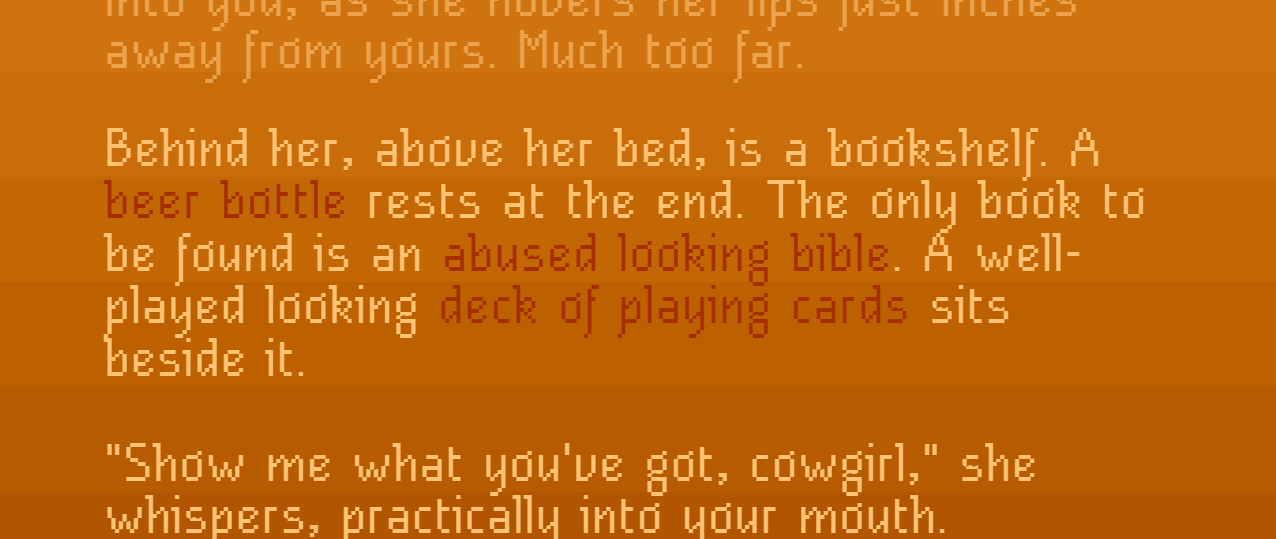
Even Cowgirls Bleed, ironically released on Valentine’s Day of 2013, is a second-person narrative game where you play a queer city girl moving out West to San Francisco. Instead of the normal mouse cursor, your cursor transforms into a crosshair of a gun, and players make choices by scrolling over, not clicking, different options. This represents both the trigger-happy nature of the protagonist, as well as the choices users can make throughout the game—all of them involving the protagonist’s gun.

Players are able to progress in the game through one of two choices: shooting (or at least attempting to shoot) at whatever the text is highlighting or putting your gun in your holster. Oftentimes, only one of these two choices is available for players, and they’re forced into an option. For example, at one point in the game, the protagonist is describing her transportation to San Francisco. The repetitive action of putting the gun in the holster, from left to right over and over again, uses the game mechanisms to transfer the impatience that the protagonist experiences to the player.

This lack of genuine choice that appears over and over again throughout the game may serve as a source of frustration for players, especially given the role that heightened autonomy often has in Twine games. This frustration is only exaggerated by the game’s conscious use of second-person narration: the game explicitly states that you are the character making the choices, but doesn’t allow you to actually choose. Even in circumstances where you may not want to shoot, your choice is made for you. One prominent example of this is a pivotal moment in the game: you’ve met a cowgirl who you’re genuinely interested in and she’s asking you to give her the gun. It seems as if this option is available—in the middle of other objects you can shoot, the text “Hand over the gun” is highlighted. However, you can’t access this choice. First of all, since it’s surrounded by the other decisions, you have to scroll over those to even get close to giving the gun to the cowgirl. Moreover, even if you think of the loophole of right-clicking your cursor to scroll over the other options without setting them off, your gun ends up going off while you attempt to give it to the cowgirl. Even when autonomy is seemingly offered, it’s then swiftly taken away.

Moreover, the game always ends in the same way: the protagonist scares her potential love interest away, shoots her own foot, and begins to bleed as the background turns red. No matter what choices you make, the outcome is always the same.

While this limited user autonomy does make for some irritation while playing the game, it also has a thematic purpose within a game: to situate players in the helplessness that many queer individuals experience. Queer individuals often face societal discrimination, marginalization, and a lack of control over their own narratives. Thus, the restricted agency in the game serves to parallel the broader challenges and power dynamics that many queer individuals encounter in their lives, where choices may feel constrained or overridden by external forces. In this way, Twine utilizes its unique game characteristics for a deeper portrayal of the queer experience.

Queers in Love at the End of the World (Anna Anthropy, 2013)

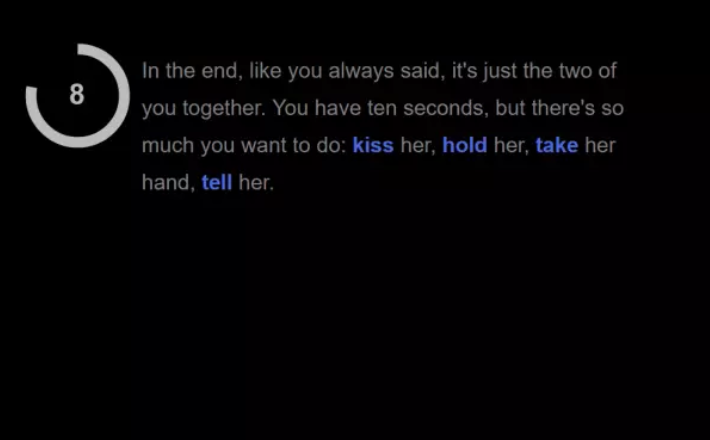
Queers in Love at the End of the World features a ten-second narrative, equipped with a timer on the left side of the user’s screen. During this time, players are faced with how to interact with their partner before “everything is wiped away.”

Through a huge variety of branching options, all starting with the choices of “kiss her,” “hold her,” “take her hand,” or “tell her,” players must navigate what they can truly do in this limited time frame.

The first time I played this game, I was barely able to finish reading the first page’s text before the game ended. The second time, I immediately clicked an option and was faced with the same problem—I couldn’t even finish reading before the game was over.

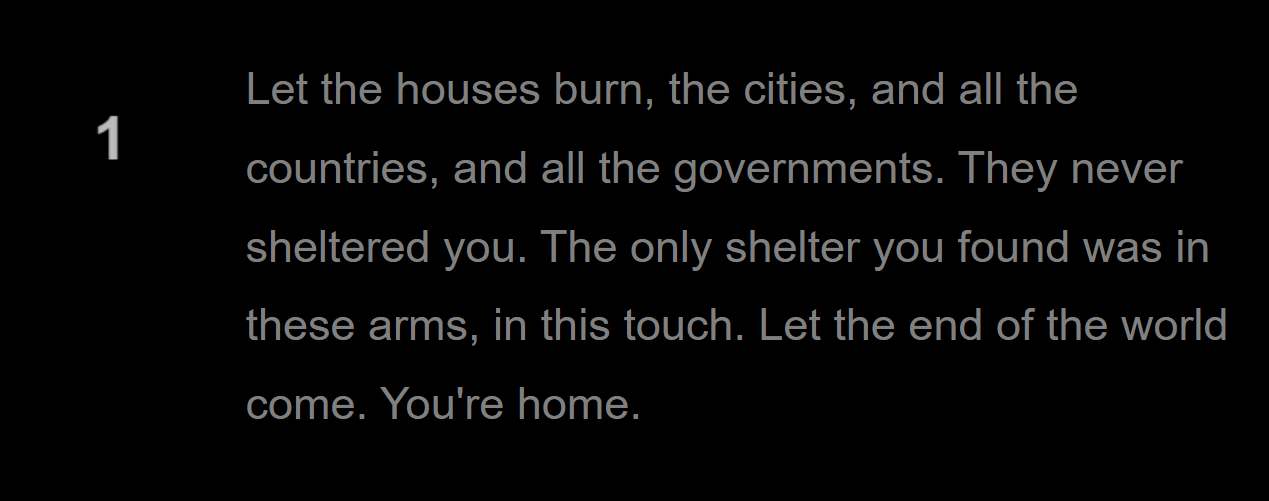
The ending remains the same no matter what you choose: it’s the end of the world and “everything gets wiped away.” However, while this may seem to take away autonomy from the user since they can’t affect the outcome, some sense of autonomy comes with the multitude of options offered. Each path seemed endless, and many times I couldn’t find a stopping point for a branch before the game was finished. Therefore, even though the game’s world will always end, players can make their own choices about how to interact with the protagonist’s partner in those final seconds, expressing their own feelings and desires through the game’s narrative. The game doesn’t allow players to change the world’s end, but it does give them the opportunity to shape the emotional connection the protagonist has with their partner.


These games show how the unique mechanisms of Twine allow love and sex-focused games to serve as powerful tools for challenging societal norms and promoting inclusivity within the gaming community and beyond.