Shattered Memories Scattered Thoughts, Pt 1

Shattered_Memories-Screenshot_02.jpg

Ian here—

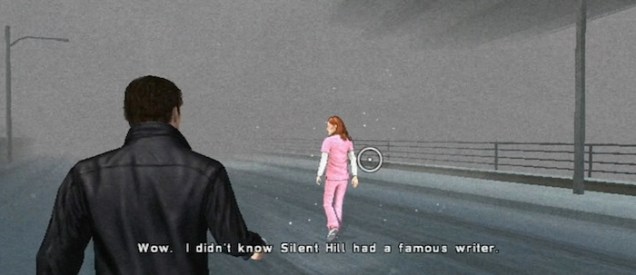
It is 2016. Sam Barlow is widely appreciated today for revitalizing the full-motion video adventure game with HER STORY (2015). Why, then, return to Silent Hill: Shattered Memories (Climax Studios, 2009), which Barlow served as writer and lead designer of, which released seven years ago today? Am I prepared to claim that it is a lost masterpiece, a testament to Barlow’s skill at expanding the narrative possibilities of the videogame medium? No, I am not. Shattered Memories is certainly interesting. But it’s also flawed in too many ways to be considered a masterpiece.

Why these critical musings, then? Well, a bit of biographical detail: Silent Hill: Shattered Memories is the reason I bought a Wii. I had no prior interest in the console until word of this title started leaking out in mid-2009. I had played the first three Silent Hill games (all earlier that year, in fact) and loved them, but skipped the most recent iterations due to a seeming consensus that the series had subsequently lagged, especially following the departure of the original Team Silent. But here was something new: a game that actually seemed as if the designers were using the Wii remote in interesting ways, a game that seemed like it had a shot at leveraging the bodily engagement of the Wii platform in the service of horror, a game that was promising to rescue the survival horror genre from its seemingly inexorable slide into the action genre. In 2009, all three of these things seemed like breaths of fresh air.

So I have a personal attachment to this game, even if my feelings on it are complicated. What follows, as the title of this post suggests, are somewhat messy thoughts—although I’m planning to post a more organized follow-up soon.
Continue reading

Assignment: Brendon Chung’s Thirty Flights of Loving and Cinematic Language

Thirty_Flights-Screenshot-01.jpg

Ian here—

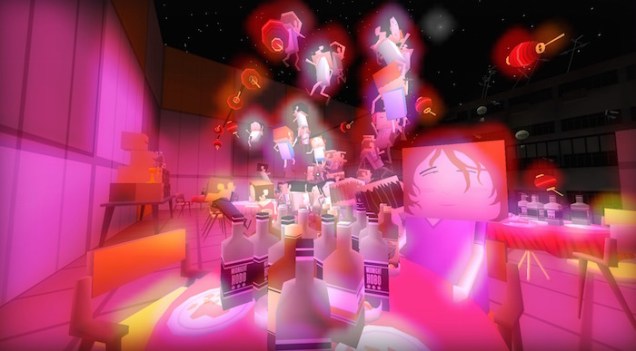
Playing like a pint-sized mashup of Wong Kar-wai’s Fallen Angels and Gaspar Noë’s Enter the Void, Bendon Chung’s Thirty Flights of Loving (Blendo Games, 2012) packs more scintillating and beguiling details about its characters and their world into its hallucinatory, hyper-concentrated ten minutes of gameplay than most games manage in 30 hours. Bootleggers, an airport, a rooftop party, shootouts, memories, regrets, a violent end … or several? A love affair … a betrayal? All of this and much more (including a highly educational demonstration of Bernoulli’s principle) jostle together wildly in this tantalizing gem of a short.

Okay, I’ll step out of “breathless, enraptured critic” mode. Thirty Flights of Loving is an interesting game for many reasons. One of these reasons is that it steals quite a lot cinematic language—including some very interesting and unusual applications of the forms of cinema, like first-person cutting. Quick example of what this actually looks like below the jump:

Continue reading

Knowing More Than We Can Tell

knowing_more_than_we_can_tell_header_image

Ian here—

What follows are three quick case studies on a favorite topic of mine: the knowledge differential, or epistemic gap that can sometimes open up within the player-avatar relation. I find all three of them fascinating for the questions they raise about narration in videogames, as well as the alignment between player and player-character.

What follows does not yet qualify as analysis. This is simply a critical appreciation of a few moments that have made me think. Perhaps it will act as a prolegomena to further, more properly analytical, writing.

Continue reading

Lesson Plan: Mattie Brice’s Mainichi and Jason Rohrer’s Gravitation

mainichi_gravitation_header_image

Ian here—

Consider this another addendum, this time to my previous post on teaching the concept of procedural representation. These are two more of my favorite case studies to use for that topic—ones that, however, fall outside the designation of “games about squares.” As with the games outlined in my previous post, I teach these via small group work, assigning students to first play these games, and then present to their classmates on them. For these presentations, I direct students to not simply say “this game is about x topic,” but instead say things like “when you do y in this game, z happens.” My aim is to get them to specifically lay out how rules shape player behavior, and provide consequences for that behavior, and how this combination of rules/behavior/consequence can make claims about the how the world works.

Continue reading

Lesson Plan: Film Scores Addendum

gravit_screenshot-01-for-second-post

Ian here—

This is just a quick addendum to my music-themed lesson on Alfonso Cuarón’s Gravity (2013) from my Intro to Film course, which I posted earlier. This bit doesn’t have as much to do with synesthesia, which is why I separated it out, but it is something that I incorporated into the same lesson.

Continue reading

Lesson Plan: Lying Narration in Cinema and Videogames

Heavy_Rain_Scott_Shelby_load_face.jpg

Ian here—

In my 2013 “Comparative Media Poetics: Cinema and Videogames” course, I devoted a week to the genres of mystery and suspense. In this first class of this week, we discussed theory. Students read a portion of David Bordwell’s Narration in the Fiction Film, in which he discusses the concept of communicativeness of narration, and the specific ways communicativeness is clamped down in the detective genre. We also discussed the ways in which mysteries play with time, using the formalist conceits of fabula and syuzhet that Bordwell draws from. This dovetailed with our second reading, Jesper Juul’s 2004 article “Introduction to Game Time,” in which he expresses skepticism that videogames could ever pull off a flashback-based story structure.

The screening for this week included the entirety of Alfred Hitchcock’s Stage Fright (1950), as well as selected chapters of Heavy Rain (Quantic Dream, 2010), which I had students play live, and discuss. We re-convened during the next class session for a discussion on unreliable narration and the relative “fairness” of twists. Readings included Kristin Thompson’s chapter on Stage Fright in Breaking the Glass Armor, and Emily Short’s writings on Heavy Rain. Spoilers on the (potentially unfair) twists of both texts below.

Continue reading

Lesson Plan: Popular Music, Gender Representation, and Media Effects

fifth_harmon_video-screenshot
Fifth Harmony feat. Kid Ink, “Worth It” (2015, music video directed by Cameron Duddy)

Ian here—

For three quarters in a row, I used Stanley J. Baran’s Introduction to Mass Communication textbook for my Mass Communication course. However, during that time, I drifted away from assigning Baran’s chapter on media effects. I was very upfront to students about the reasons why: I find it dull, and dry. It provides a thorough historical overview of various theories of media effects, from the Frankfurt School to George Gerbner’s “cultivation analysis,” but it doesn’t provide meaty examples of studies of effects in action. So, instead, I decided to turn my media effects week into a feminism week, and use Susan J. Douglas‘ wonderful observations on popular music and its effect on perceptions of gender roles in her book Where the Girls Are: Growing up Female with the Mass Media. The book’s breezy, first-person style is far removed from the distanced overview of sociological theories found in Baran, and a good model for the types first-person observations and analysis I hope to provoke when teaching this material.

Continue reading

Lesson Plan: Su Friedrich’s Sink or Swim

sink_or_swim-screenshot-03

Ian here—

Back on Halloween, I posted a fitting lesson plan. For Thanksgiving, I guess I’ll go with a perverse one.

I taught Sink or Swim (Su Friedrich, 1990) in a week in my course “Avant-Garde Film and Video Art” devoted to the use of biography as argumentative grounds in film criticism. Since this course served as a writing seminar, one of my learning objectives this week was to get students to consider how they could marshal biographical details of an artist’s life into an analysis, without falling prey to the intentional fallacy by assigning the artist’s views and experiences too much weight. To this end, we watched some Joyce Wieland films, and I had students read Lauren Rabinovitz’s chapter on Wieland in Points of Resistance: Women, Power, and Politics in the New York Avant-garde Cinema, 1943–71. My plan here was threefold: 1) I wanted students to enunciate the specific sorts of arguments we could make about the films when we drew upon knowledge of Wieland’s status as a Canadian artist living and working in the US, her political commitments, and her status as a woman artist too often playing second-fiddle to her more-famous husband. 2) I wanted the students to acknowledge the scope and limits of what we can learn from these things, and to understand that a work of art’s meanings are not entirely determined by the artist’s biography. 3) I wanted students to recognize the difference between acknowledging biography when dealing with a filmmaker like Wieland, versus acknowledging biography when dealing with a filmmaker like Friedrich, whose work tilts further into the genres of personal essay film and diary film. While one could imagine an analysis of Wieland’s Patriotism (1964) that doesn’t dwell on issues of Wieland’s biography, it is impossible to imagine and analysis of Sink or Swim that doesn’t acknowledge Friedrich’s biography. It belongs to a genre in which acknowledgement of the filmmaker’s lived experience is absolutely essential.

Continue reading

Swimming in the Valley of the Moon

peter-hutton_merchant-marines1

Ian here—

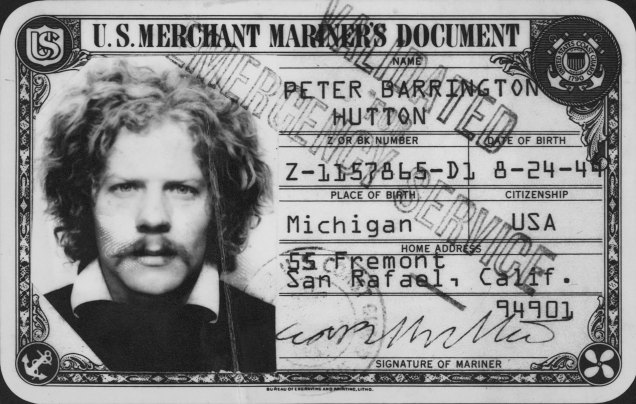
Peter Hutton died on June 25, 2016. I could tell anecdotes here about having him for a professor across three courses at Bard College, about things he said to his students, places he took his students, and the impact he had on me as a young film student. I’ll spare you that, though, for now. For now, I’ll just say that I am extraordinarily grateful to Jesse Malmed and Patrick Friel for programming White Light Cinema and The Nightingale’s retrospective of Hutton’s work this past Sunday. It is, if I’m not mistaken, the first time Peter’s work has shown in Chicago since I first arrived here in 2008. It was wonderful to revisit it, and I am saddened that it took Peter’s death for this to happen.

What follows isn’t analysis, just some impressions, as a way of expressing gratitude to the programmers. I make such extensive use of visual aids normally in my writing that it can be reinvigorating to write about films that are only distributed on 16mm, and actually rely on the author to describe their experience. (I apologize if I’m out of practice!)

Continue reading

New Post Category: Critical Musings

thats_just_like_your_opinon_man

When I first set up this blog, I intended it to be used for student projects. Over the last couple of months, I’ve been posting my own material with greater regularity: lesson plans, and the odd conference paper.

I have enjoyed being able to share material in this way, and as of now I’m going to be adding a new category to my posts: critical musings. These will be moments where this blog becomes, well, bloggier: serving more as a critic’s journal than an academic’s lesson plan folder.

Although some of these posts will intersect with my academic interests, in general they’ll be less theory-bound and more evaluative. I’m not sure that I entirely agree with Noël Carroll’s position that the primary task of criticism is evaluation, but I do find it disheartening that the evaluative dimensions of criticism are so often squelched out of academic writing.[i] In private conversation, academics constantly offer well-reasoned, evaluative opinions on the artistic merits of a film to each other. It’s always seemed strange to me that when we get up to a podium to deliver a talk, this particular critical impulse drains away, and we treat our objects as mere delivery mechanisms for theory.

So: posts arriving under this category will be a place to acknowledge that I have opinions about things, and occasionally just want to expound upon them.

[i]. Carroll, Noël. On Criticism. New York: Routledge, 2009. (Look at me here, adding citations on my post announcing more casual writing. Typical.)