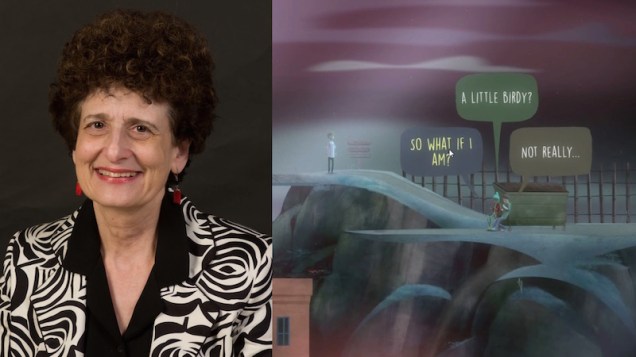
Lesson Plan: Janet Murray, Damn Fine Futurist

murray_diptych

Ian here—

The first half of my “Frames, Claims, and Videogames” course is devoted to five major debates that have hovered around games over the past couple of decades. Some of these are legal, some have occurred in the art world, some have occurred in the sphere of popular discourse, and others are academic. For the first academic debate, I pitted Janet Murray‘s ideas about the storytelling potentials of new media agains the hard-core ludologists.

When prepping for this lesson, I found re-reading the ludologists in 2017 to be an unpleasant experience. Looking back at the early-2000s era writing of folks like Espen Aarseth and Markku Eskelinen, it’s pretty clear that they were the academic precursors of the game police. And not the snarky, tongue-in-cheek Game Police parody twitter account that arose in 2013. I mean the angry young men, who would later become Gamergate, but who already, in 2012–2013, were barking back at “corrupt” journalists praising games they didn’t see as games: games that told stories, rather than let you shoot things. These young men took it upon themselves to politicize the term game, to define its boundaries and beef up its border security. A “videogame” became a medium you couldn’t freely pass into until you showed your papers, and proved that everything was in order. The most vigilant among these enforcement agents, the Joe Arpaios of gamer culture, enjoyed a wide jurisdiction and acted at their own discretion, with great impunity. (Is it really any wonder that this burgeoning culture of alt-right gamer trolls would evolve into one of Donald Trump’s key blocks of support?)

As I said, it is tough re-reading, let alone teaching, the ludologists in 2017. As a consolation, though, it is a delight teaching Janet Murray. Time has proved her to be an exceptionally good predictor of the future, meaning that reading her twenty-year old Hamlet on the Holodeck is a surprisingly exciting experience.

Continue reading →

New Resource: Pedagogical Notes on Games

Sea_Will_Claim_Everything_Screenshot_01.jpg

Ian here—

I am very pleased to announce a new page I’ve added to the “Teaching” section of this site: “Practical Pedagogical Notes on Games.”

Let’s assume, for a moment, that you are an educator. You’d like to introduce videogames into the class you’re teaching. Perhaps it’s a course on new media, or digital storytelling; perhaps you’d like to include a section on games in an Intro to Film course, or an Intro to Mass Communication course. Whatever the case, you find yourself faced with practical matters. What games should you assign, and how should you prepare students to play them as part of their coursework?

Perhaps the relevant scholarship on games you are familiar with all came out some time between 2004–2011. You’re not sure if the games discussed in those readings are still readily available, and if they’ll work on your students’ newly-purchased computers. Who has time to troubleshoot such things while lesson planning? Perhaps you’re looking for tips on games students can play for free, or games they can play without installing anything on their computers. Perhaps you’re looking for tips on how many games you can assign as a week’s worth of homework. Just how long do games take to play, anyway? Has anyone reliably timed such things? And what about content warnings? Everybody seems to want those, these days …

Well, fret no more! The “Practical Pedagogical Notes on Games” section of this site now provides my guide for answering such questions.

Continue reading →

Lesson Plan: Cinematic Editing—from Bricks to Collisions to Un-linkage

k_stew_mosjoukine_diptych

Ian here—

When teaching cinema studies at a whirlwind pace, my next stop after the lesson plan on basic terms I posted a few weeks ago is to devote a class to montage. The particular lesson plan here is one I used in my Avant-Garde Film and Video Art class, so it’s geared toward giving students a vocabulary for digesting for some of the more striking forms of associative cutting we’ll see over the course of the class.

This particular permutation on my usual lecture occurred following a screening rich with films composed either in whole or in part from found footage: Take the 5:10 to Dreamland (Bruce Conner, 1976), The Exquisite Hour (Phil Solomon, 1994) and Is This What You Were Born For?, pt 7: Mercy (Abigail Child, 1989). The readings I had students do were “Montage as the Foundation of Cinematography,” a chapter from Lev Kuleshov’s The Art of Cinema, Sergei Eisenstein’s “The Cinematographic Principle and the Ideogram,” and Abigail Child’s “Locales” interview with Michael Amnasan, reproduced in her book This Is Called Moving: A Critical Poetics of Film.

Continue reading →

Lesson Plans: SEE YOU IN COURT (or, SCOTUS ponders whether the medium is the message)

see_you_in_court_image_diptych

Ian here—

In this post I’m going to be mashing together several lesson plans from two very different courses: my Intro to Mass Communication course at DePaul University, and the course “Frames, Claims, and Videogames,” which I’m currently teaching at the School of the Art Institute right now. Despite their different origins, these lessons speak to common themes, and in fact they could be productively combined in the future. At issue in all of them: the US Supreme Court’s shifting views on various media, their potential for socially valuable expression, and their first amendment protections (or lack thereof). We could call it a vernacular legal theory of medium specificity, moments in which those whose job it is to interpret the law dip their toes into defining the specific affordances and dangers of a given medium.

What is our country coming to when a so-called judge can define a medium’s potential as a mode of expression?  THE DEFINITIONS OF OUR MEDIA ARE AT STAKE.

Continue reading →

Lesson Plan: Basic Terms of Cinema Studies + Their Relevance for Avant-Garde Cinema

prezi_screenshot-key_terms_header_image

Ian here—

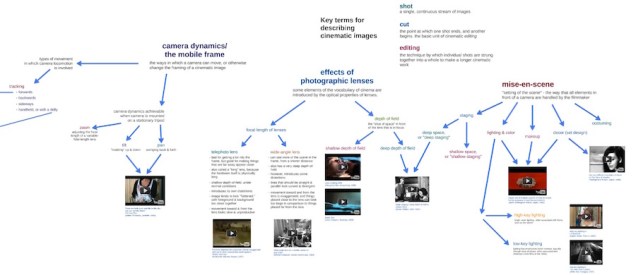
I suspect that every cinema studies teacher has their own favorite examples to use when teaching key vocabulary terms, and I would not be so presumptuous as to prescribe my own favorites! Nevertheless, though, it’s an important part of the job, so I wanted to share my own approach here.

Over the past couple of years, I have gotten used to teaching these terms in a very specific context. At the School of the Art Institute, I teach first-year seminar courses. They are courses designed so that all students have some basis in college-level writing as they go through their time at SAIC. Instructors are given enormous freedom to teach whatever they like. This makes it a great venue for testing out new and interesting course ideas, but the flip side of that is that your courses never have prerequisites, and there’s no telling the level of expertise students who enroll will actually have.

What I do, then, is devote one day early on in the semester to a quick-and-dirty Intro to Film in a single lecture. I take a lot of the examples and explanations I first started using when I taught Intro to Film at U Chicago in 2015, but I condense them down into something that can fit into an hour or so. It’s potent stuff.

You can access my go-to presentation here. I’ve set the privacy and sharing settings to their most open, so if you’re a Prezi user you should feel free to copy it if you like it, subbing in your own preferred definitions and clips as you feel necessary! I’m here to share, and not here to impose.

Continue reading →

Lesson Plan: Deren, Anger, and Their Films Today

maya_deren

Ian here—

This is not a full lesson plan. It is only a few remarks, which I made at the beginning of my class before moving on to the lesson proper, which was much more discussion-based.

I consider these remarks to be necessary in the current moment, and I plan to continue delivering such remarks during future lessons. Many filmmakers associated with North American avant-garde cinema are wild fabulators, building up grand mythologies for themselves and their careers. The figures examined here are certainly no exception. However, it is important that, as instructors, we do not get too caught up in telling these stories. These filmmakers were not just Great Geniuses. They were people, human beings living in a particularly historically-situated time, within the realities of a certain political regime. Acknowledging this reality is crucial, as it helps us better understand our own era.

It is useful to keep the following things in mind, and to repeat them whenever possible:

Meshes of the Afternoon (Maya Deren with Alexander Hackenshmied, 1943), often considered the precipitating film of American avant-garde cinema, was made by two immigrants.

Continue reading →

Preview: Frames, Claims, and Videogames

porp_ultra_business_tycoon_header_image.jpg

Ian here—

So I got an email last Saturday from the Liberal Arts Department at the School of the Art Institute, saying they’re short one First-Year Seminar I instructor, and asking me if I could sub in. I agreed.

I’ve already taught First-Year Seminar I at SAIC three times, and have three separate courses ready to go for it. So, of course I did what any sane person would do.

I designed an entirely new course, basically from scratch, in five days.

And it was such a pleasure! Up until now, I’ve never taught any course entirely on videogames. I’ve taught courses that were about half-and-half cinema and videogames, and I’ve thrown short modules on games into just about every course I’ve ever taught, from U Chicago’s Media Aesthetics to DePaul’s Intro to Mass Communication. I had somehow gone my entire teaching career without devoting an entire class to games, though. It seemed high time to rectify that.

Continue reading →

Preview: Avant-Garde Cinema and Video Art

avant-garde_spring_2017_header_image

Ian here—

The School of the Art Institute spring 2017 semester begins tomorrow, and I wanted to take a moment this week to introduce this term’s classes, as you will likely be seeing posts related to these classes in the near future. First up: the section I’m teaching for SAIC’s First-Year Seminar II course, “Avant-Garde Film and Video Art.”

Now, I’ve taught this course before, and in fact this blog is littered with previous lesson plans I’ve used for it. But I decided to shuffle my syllabus up considerably this time around.

Continue reading →

Postmortem: Comedy and the Moving Image

prezi_screenshot-comedy_postmortem-header_image
An attempt to capture everything that was written on the chalkboard after class discussion in week 13 of the course. (I can’t promise that this isn’t a glimpse into madness.)

Ian here—

Grades for the School of the Art Institute of Chicago’s Fall 2016 semester were due today, and I wanted to take the occasion to do a quick postmortem on “Comedy and the Moving Image,” which I consider to be the most successful course I taught this term—as well as one of my most fun and productive courses ever taught. I’ve posted several lesson plans from this course already throughout the past couple of months. Links to those will be provided below, as I sketch out a skeletal version of the course’s themes, and some of its most interesting surprises.

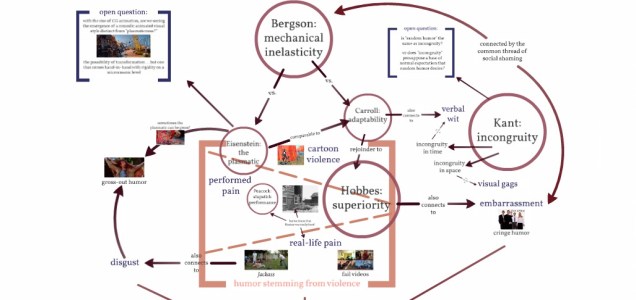
I put this visual presentation together for our final class meeting. You should feel free to follow along with it … although I admit that, as you can see from the above image, it gets increasingly messy as you click through.

Continue reading →

Five Ways to Look Smart while Teaching PlayTime

playtime_screenshot_00-43-04
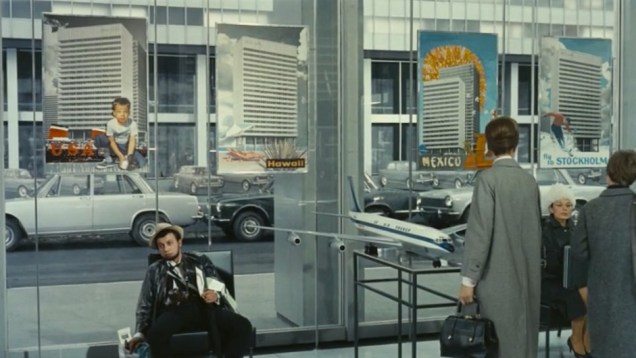
The travel posters are the obvious gag. But can you spot the fake cars?

Ian here—

So, this isn’t a proper lesson plan. It’s just a quick cheat sheet. When teaching PlayTime, I pair it with Kristin Thompson’s chapter “Play Time: Comedy n the Edge of Perception” in her book Breaking the Glass Armor. (I consider myself incredibly lucky that I can pair one of my favorite films with a piece of writing that I consider to be one of the more astute and persuasive pieces of academic film criticism ever written.) My lesson, therefore, largely revolves around the conclusions of Thompsons’ analysis: that “the comic and the non-comic become indistinguishable” in PlayTime, and that the way the film “forces us into new viewing procedures” holds the potential to “successfully transform our perception in general.”[i] To view PlayTime, in other words, is to encounter a new way of seeing the world, one that might persist beyond the theater.

How do you successfully persuade students that PlayTime requires specific viewing procedures from its audience, ones unlike those we use when viewing a more traditional narrative film? My tactic is pretty simple: I pull student attention to moments that reward close viewing. Thompson herself lists a bunch of these in her chapter. I like to point to additional, different ones, so that I can show students new, unexpected visual rewards—therefore making both me and Tati seem smarter than we otherwise would! Please feel free to steal these.

Continue reading →