Camera Dynamics in Chungking Express (1994)

by Gabriela Horwath, Wyn Veiga, Tomas Pacheco, Mimi Taylor, Joon Choi

Focus Blur – Gabriela: 

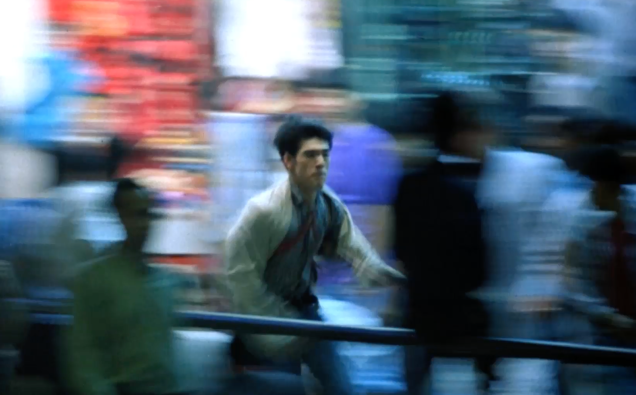
Specifically analyzing the first that appears blurry to the audience, the use of pan, tilt, and zoom creates a fast paced shot that allows the film to achieve a dramaticized appearance of the characters in action. In one of the first shots of the film where He Qiwu is chasing an assailant, the image produced by the movements of the camera are shown as blurry. When He Qiwu is first walking through a crowd, the skillful panning tracks him and shows the crowd around him passing by; this further highlights that it is a busy shot. In addition, pan is used as the camera moves alongside He Qiwu while he is running. This effect puts an emphasis on how fast he is running as well as the distance he is traveling.
Screen Shot 2020-04-23 at 12.04.23 AM

Continue reading

The Expiration of Time and Love: Analyzing Speed of Motion in Wong Kar-Wai’s Chungking Express

intro

by Meagan Johnson, Emily Nagler, Dylan Kanaan, Joalda Morancy, and Haina Lu

California Dreamin’-The Mama’s and the Papa’s (to supplement your reading)

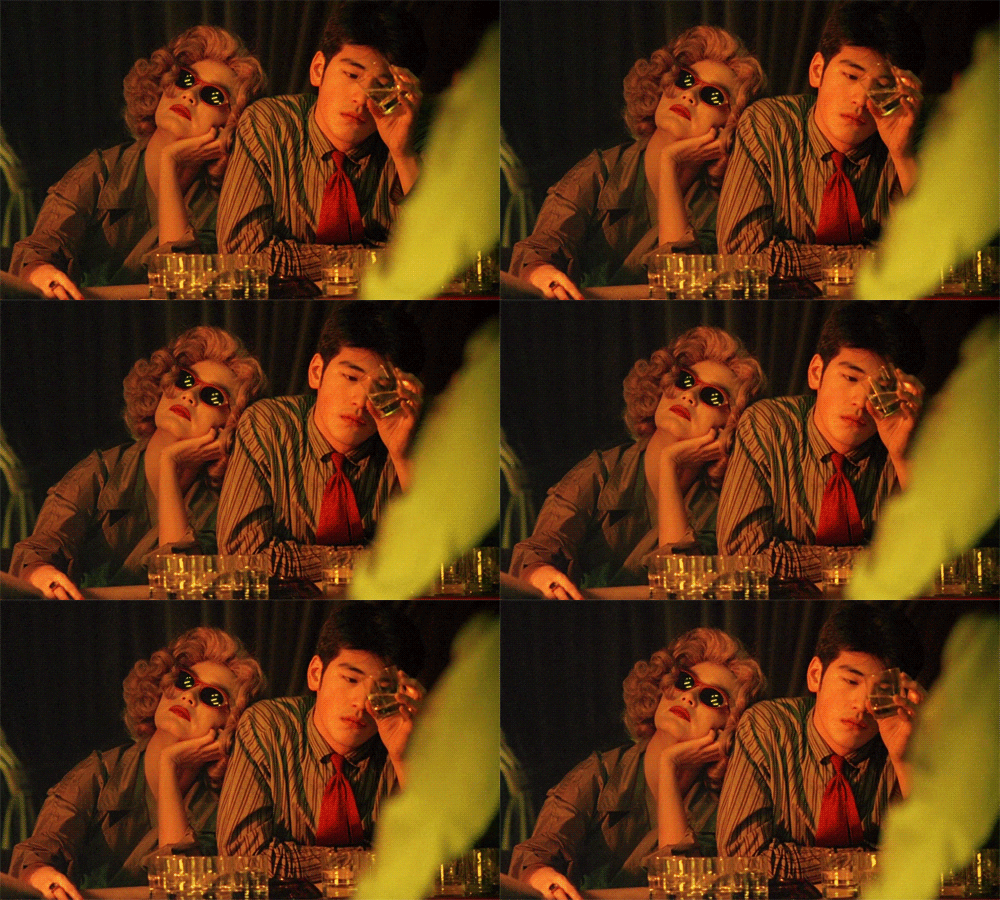
The context in which Wong Kar-Wai actually made Chungking Express is interesting to note as it relates to the techniques he uses to alter speed of motion in the film. According to Quentin Tarantino, Wong Kar-Wai was actually working on a different/epic movie, he had been editing for multiple years but had felt stalled in the process. Just as a writer needs to take breaks at times to look at their work with an objective lense, he felt he needed to step away for a bit, and decided to use the time to put out a quickly produced / quick hitting film, which would become Chungking Express. The context in which he made the film – moving from editing a film that was long, slower paced in time, to producing a film that was quick paced in time, and then returning back to the slower paced one – is in various ways actually reflected in his treatment of time in Chungking Express. As the remainder of this post will discuss in different ways, Wong Kar-Wai manipulates time through film techniques that alter the speed of motion. This manipulation of time is not meaningless however, the ways in which he does so is to reflect how time moves differently for different characters/situations, connecting us closer to their stories– instilling empathy in many respects. While Hong Kong films, at least at the time, were known for their fast paced approach, Wong Kar-Wai created a film in Chungking Express that is both fast and slow. And perhaps, his approach and reason to this was in-part to reflect how he perceives time as moving at different speeds within his own career.

Continue reading

Siren: Tension, Frustration and Visibility

Group project summary, by leader John Churay

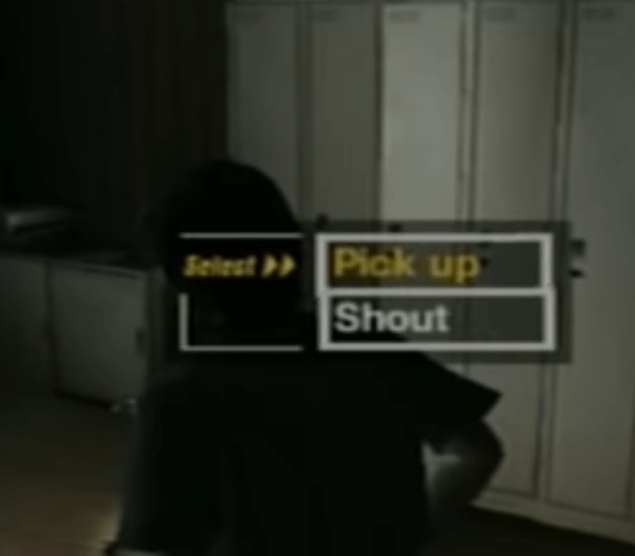
Siren is a survival horror/stealth game developed by Sony Computer Entertainment Japan Studio. The game takes a third-person over the shoulder point of view. Movement in the game uses tank controls, so left and right on the movement stick rotate the character instead of moving them. Unlike more traditional third-person viewpoints, the camera does not move around your avatar. Moving the right stick can change the camera’s orientation, but it is stuck squarely behind your character. The game consists of levels that often revolve around moving from one spot on a map to another. Along the way, you pick up items, defeat enemies known as “Shibito,” and escort AI companions. To pick up items, you must open a menu using triangle and select to pick up that item.

Screen Shot 2020-04-16 at 11.12.31 PM.png(Image credit: exceeding09 at https://www.youtube.com/watch?v=A7zmvKPlC8g)

You use this process to interact with almost all objects in the game, including unlocking doors and entering specific key locations. In the reboot Siren: Blood Curse, this process is streamlined to pressing the X button. However, using the flashlight in the remake requires using a menu, which is not the case in the original. In each level, you can access a map of the area. In the remake only, this is decorated with your position and the locations you need to visit to accomplish tasks. There are multiple characters who you will play as throughout the game; however, there is no choice on who you play in any given level.

Continue reading

A Look Into Parasite’s Decor

making_of_parasite_-_publicity_-_splash_-2019

by Zach Cogan, Meagan Johnson, Dylan Kanaan, Gabriela Horwath, and Alan Countess

Position of the Houses: How it Reflects a Class Struggle

Kim House

The Kim house is below ground in a busy and cluttered area of poor families with people disrespecting their home (including a couple of drunk men peeing on the property). Their house itself has very poor lighting and really the only pieces of technology are outdated, insufficient for their daily lives, and are in very bad shape. Their house has a very unorthodox structure to it, yet it can also be said that the Kims are very good at using what they have in order to make it work, regardless of the clutter that it creates in their home (E.g. socks drying on a ceiling fan and trying to latch onto any wifi possible). They have supplies for work (pizza boxes) stacked everywhere and store clutter in every room. Even the toilet is in a strange place, sitting on top of a ledge. There appears to be no beds in the home. In the opening scenes of the film, we see the patriarch of the Kim family resting his eyes and lying in a fetal position atop a thin rug. This layout shows how they manage to scrape by using what they have in the most efficient way possible. The family has this massive window that they have to look up to see out of. This could be a metaphor for the family wanting to climb up the socioeconomic ladder and take on a world that they don’t feel is theirs. On the outside of the window, it looks almost as if it is barred. This again shows how they are locked away from the rest of the world, unable to succeed and advance up the socioeconomic ladder. 

Continue reading

Videogames and Genre Storytelling Week 2 Video Lecture: Special Topics in Horror and Character Alignment

Please find some time to view this 22-minute video lecture between now and our Zoom conference call, which will convene at the normal time. You can expect our Zoom conference call to be shorter and more discussion-based as a result.

Blog Re-organization for Online Teaching

Fire_Emblem_Three_Houses-begin_lesson_plan

Ian here—

Just a quick heads-up that I’m doing some minor re-organization to this blog in response to the shift to remote learning this quarter at U Chicago. It’s not exactly unusual to see student posts on this blog, but now they’ll be accompanied by a swath of asynchronous video lectures I’ve been putting together. It’s going to be a real firehose of activity, making up for a dry spell over here since December.

If you’d just like to see the usual announcements about general-audience video essays and things like that, click the helpful “Posts by Ian” tab to clear out the online teaching material.