The Legacy of Der müde Tod in Last Day of June: Creating Tragedy in Games

Group project summary, by leader Leo Alvarez

Tragedy is hard to pull off in video games, a medium so driven by the player’s desire to accomplish tasks and achieve the goals set forth by the game designers. What’s more, joining the formerly separated roles of the viewer and the on-screen character into one presents unique challenges in terms of creating motivation and working with the newly bridged psychical distance to create an effective tragedy. With all of these obstacles in its way, how can a game like Last Day of June possibly hold a candle to a tragic film like Der müde Tod? In its use of an episodic structure, a “retry narrative” and a final sacrifice, Last Day of June carries and builds on the legacy of Fritz Lang’s silent film Der müde Tod, ushering the death-defying romantic tragedy template into the era of video-games, and exemplifying how tragedy can be possible in a game.
Continue reading

Camera Dynamics in Chungking Express (1994)

by Gabriela Horwath, Wyn Veiga, Tomas Pacheco, Mimi Taylor, Joon Choi

Focus Blur – Gabriela: 

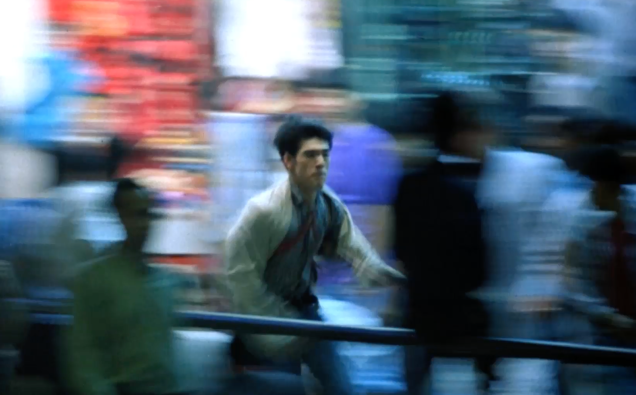
Specifically analyzing the first that appears blurry to the audience, the use of pan, tilt, and zoom creates a fast paced shot that allows the film to achieve a dramaticized appearance of the characters in action. In one of the first shots of the film where He Qiwu is chasing an assailant, the image produced by the movements of the camera are shown as blurry. When He Qiwu is first walking through a crowd, the skillful panning tracks him and shows the crowd around him passing by; this further highlights that it is a busy shot. In addition, pan is used as the camera moves alongside He Qiwu while he is running. This effect puts an emphasis on how fast he is running as well as the distance he is traveling.

Screen Shot 2020-04-23 at 12.04.23 AM

Continue reading

The Expiration of Time and Love: Analyzing Speed of Motion in Wong Kar-Wai’s Chungking Express

intro

by Meagan Johnson, Emily Nagler, Dylan Kanaan, Joalda Morancy, and Haina Lu

California Dreamin’-The Mama’s and the Papa’s (to supplement your reading)

The context in which Wong Kar-Wai actually made Chungking Express is interesting to note as it relates to the techniques he uses to alter speed of motion in the film. According to Quentin Tarantino, Wong Kar-Wai was actually working on a different/epic movie, he had been editing for multiple years but had felt stalled in the process. Just as a writer needs to take breaks at times to look at their work with an objective lense, he felt he needed to step away for a bit, and decided to use the time to put out a quickly produced / quick hitting film, which would become Chungking Express. The context in which he made the film – moving from editing a film that was long, slower paced in time, to producing a film that was quick paced in time, and then returning back to the slower paced one – is in various ways actually reflected in his treatment of time in Chungking Express. As the remainder of this post will discuss in different ways, Wong Kar-Wai manipulates time through film techniques that alter the speed of motion. This manipulation of time is not meaningless however, the ways in which he does so is to reflect how time moves differently for different characters/situations, connecting us closer to their stories– instilling empathy in many respects. While Hong Kong films, at least at the time, were known for their fast paced approach, Wong Kar-Wai created a film in Chungking Express that is both fast and slow. And perhaps, his approach and reason to this was in-part to reflect how he perceives time as moving at different speeds within his own career.

Continue reading

Siren: Tension, Frustration and Visibility

Group project summary, by leader John Churay

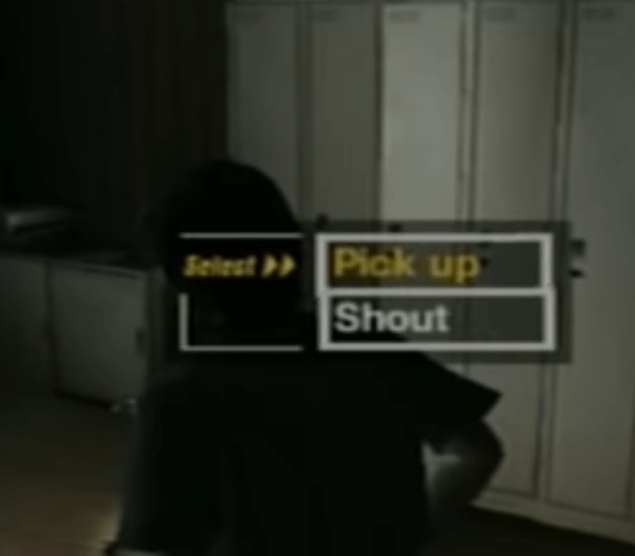
Siren is a survival horror/stealth game developed by Sony Computer Entertainment Japan Studio. The game takes a third-person over the shoulder point of view. Movement in the game uses tank controls, so left and right on the movement stick rotate the character instead of moving them. Unlike more traditional third-person viewpoints, the camera does not move around your avatar. Moving the right stick can change the camera’s orientation, but it is stuck squarely behind your character. The game consists of levels that often revolve around moving from one spot on a map to another. Along the way, you pick up items, defeat enemies known as “Shibito,” and escort AI companions. To pick up items, you must open a menu using triangle and select to pick up that item.

Screen Shot 2020-04-16 at 11.12.31 PM.png(Image credit: exceeding09 at https://www.youtube.com/watch?v=A7zmvKPlC8g)

You use this process to interact with almost all objects in the game, including unlocking doors and entering specific key locations. In the reboot Siren: Blood Curse, this process is streamlined to pressing the X button. However, using the flashlight in the remake requires using a menu, which is not the case in the original. In each level, you can access a map of the area. In the remake only, this is decorated with your position and the locations you need to visit to accomplish tasks. There are multiple characters who you will play as throughout the game; however, there is no choice on who you play in any given level.

Continue reading

A Look Into Parasite’s Decor

making_of_parasite_-_publicity_-_splash_-2019

by Zach Cogan, Meagan Johnson, Dylan Kanaan, Gabriela Horwath, and Alan Countess

Position of the Houses: How it Reflects a Class Struggle

Kim House

The Kim house is below ground in a busy and cluttered area of poor families with people disrespecting their home (including a couple of drunk men peeing on the property). Their house itself has very poor lighting and really the only pieces of technology are outdated, insufficient for their daily lives, and are in very bad shape. Their house has a very unorthodox structure to it, yet it can also be said that the Kims are very good at using what they have in order to make it work, regardless of the clutter that it creates in their home (E.g. socks drying on a ceiling fan and trying to latch onto any wifi possible). They have supplies for work (pizza boxes) stacked everywhere and store clutter in every room. Even the toilet is in a strange place, sitting on top of a ledge. There appears to be no beds in the home. In the opening scenes of the film, we see the patriarch of the Kim family resting his eyes and lying in a fetal position atop a thin rug. This layout shows how they manage to scrape by using what they have in the most efficient way possible. The family has this massive window that they have to look up to see out of. This could be a metaphor for the family wanting to climb up the socioeconomic ladder and take on a world that they don’t feel is theirs. On the outside of the window, it looks almost as if it is barred. This again shows how they are locked away from the rest of the world, unable to succeed and advance up the socioeconomic ladder. 

Continue reading

Animation as a Tool for Expression: Examining the Original and Live Action Lion King

By Charlie Donnelly

Prominent film theorists and filmmakers disagree about the role of animation in cinema, with the philosopher Stanley Cavell claiming that “cartoons are not movies” (Frank 24), a stark contrast with educator Hannah Frank’s conjecture that “all works of celluloid animation [are] photographic in origin” (Frank 23). While we’ve discussed the role of animation in cinema in class with varying opinions, there are certainly instances when animation possesses an expressive quality lacking in traditional photographic cinema, especially seen in the differences between the original 1994 animated version of The Lion King and the 2019 live action remake. Although some feel that live action possesses the most varied capabilities as a mode of cinema, I will argue that animation has unique powers of expression in creating vivid and recognizable characters, establishing connotation and theme, as well as creating heavily stylized worlds with their own distinct visual iconography.

Continue reading

Inside Bresson’s Truth – Cinematic Life In A Man Escaped (1956)

hero_EB20111121REVIEWS08111129995AR

by Ben Ratchford

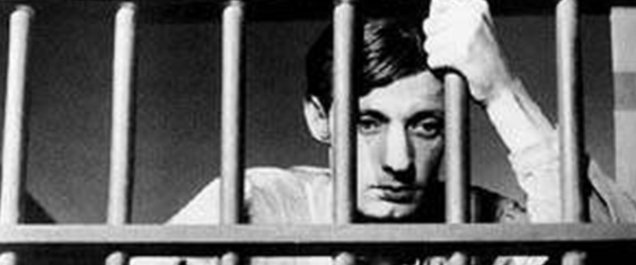
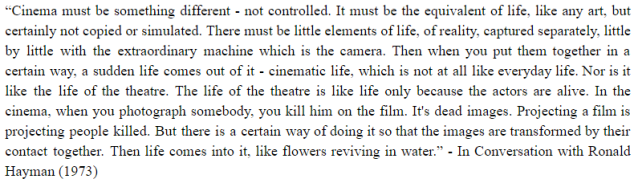
It is often said of Bresson that his films, through their mechanical nature, their minimalist approach to their presentation of human emotion and experience, portray more passion and depth than could be achieved by “showier” directors. Bresson  expresses this as one of his goals in filmmaking in an interview from 1973.

BressonQuote

Continue reading

Color in Spider-man: Into the Spiderverse

Screen Shot 2019-12-12 at 7.59.40 PM

by Nick Nowicki

Spiderman: Into the Spiderverse is a superhero film that tries to emulate the experience of reading a superhero comic book. The film moves away from the live-action superhero paradigm and fills the screen with bold colors, halftoned graphics, and word-boxes that one would see in the comics. Color in particular plays a variety of roles in establishing character traits and developments throughout the film. This post analyzes three main uses of color in the film. First, I will examine how color is used to establish good and evil figures in the film. Next, I will focus on how color is used to emphasize the emotions of characters and the overall tone of a scene. Finally, I analyze the role that color plays in signifying turning points in the narrative arc and various character arcs.

Background on Comic Book Color

Four colors serve as the basis for most of the colors we see in early comic book prints and Into the Spiderverse: cyan, magenta, yellow, and black. The CMYK color model (K being a “key” color, black) stands in contrast to the RGB model, as cyan, yellow, and magenta subtract red, blue, and green from white light, respectively. So, instead of white being the sum of our basis colors, as is the case in RGB, combining cyan, magenta and yellow produces black. It was of course cheaper to simply print pure black instead of combining all three inks.

Screen Shot 2019-12-12 at 10.12.23 PM

Continue reading

Chiron’s Male and Female Relationships in Moonlight

giphy

by Tomi Kolapo

Introduction

Moonlight by Barry Jenkins is a film seen through the point of view of the main character, Chiron. The film remains in Chiron’s perspective even as the character grows to be a teen and young adult. Over this time, the viewer gets to see Chiron interact with the people around him. Underlying these interactions is the fact that Jenkins makes sure to characterize as a shy, emotionally scarred individual. Thus, it is notable that he is able to form deep connections with some people. Among, the people he interacts with the most, Juan, Kevin, Paula, and Theresa, there appears to be a gender divide in the level of intimacy he has with these individuals. Aspects like the amount of contact, type of contact and color of the scene indicate the connection level difference between male and female. This serves as an indicator of Chiron’s sexuality.

Continue reading

Spider-Man: Into the Spider-Verse, A Masterclass in the Intersection of Sound and Animation

SPIDER-MAN: INTO THE SPIDER-VERSE

by Aditya Tandon

Spider-Man: Into the Spider Verse hit cinemas with a storm in late 2018 as movie-goers of all ages came together to watch a new kind of Spider-Man film; not just because of the biracial protagonist, the presence of multiple spider-(wo)men, or the flawless comic-book styled animation, but because of how seamlessly all these pieces came together. It was a movie of many firsts, and it surpassed all expectations, later going on to win the Academy Award for Best Animated Film. I must confess, however, the first time I heard about the film and all the fanfare around it, I assumed it was just another super-hero movie being propped up by a loyal fanbase. It was only upon finally watching it that I realized how grossly mistaken I was; I noticed the enormous detail that went into both the animation as well as the plot, and how much the film was able to achieve through the intersection of animation and sound. All of this comes together in what is perhaps one of the most iconic scenes of the film, Miles’ “Leap of Faith,” embedded in full below.

Continue reading