Lesson Plan: Animation Week

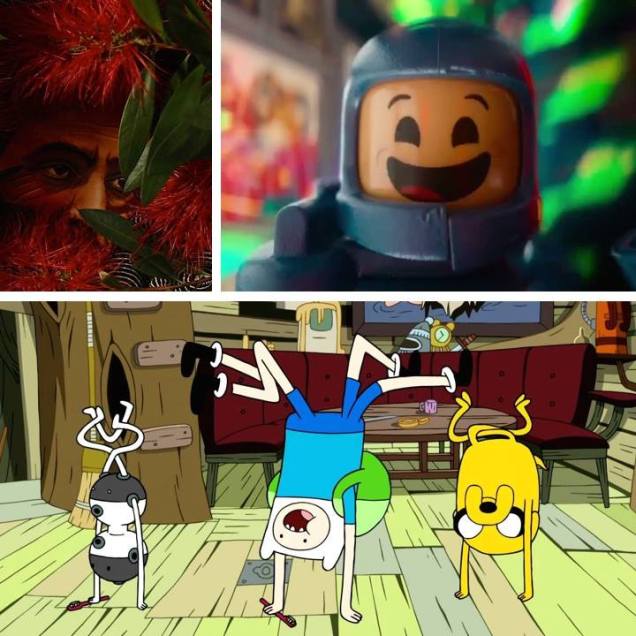
animation_week_mosiac

Ian here—

It is a shame to only teach one week on animation in an Intro to Film class, but I bowed to departmental tradition when I taught Intro to Film in spring 2015 and devoted only my final week of class to it. My screening for this week included Hummingbird Wars (Janie Geiser, 2014)Adventure Time S1E6, “The Jiggler” (Larry Leichliter, 2010), and The Lego Movie (Phil Lord and Christopher Miller, 2014).

This lesson preceded that screening, and pursued the following learning objectives: 1) I wanted students to understand that animators can work with individual frames of cinema, which can lead to the illusion of movement, but doesn’t have to. This would prep them for the flicker effects and broken motion of Geiser’s Hummingbird Wars. 2) I wanted to direct student attention to the salient aspects of Eisenstein’s theory of the “plasmatic” potential of animation, which finds expression in the Adventure Time episode. 3) I wanted students to be able to express some key aesthetic differences between hand-drawn and computer generated animation—specifically, that while hand-drawn animation excels at fulfilling Eisenstein’s “plasmatic” potential, CG animation excels at accurately simulating the physics of our everyday world.

Continue reading

Lesson Plan: Film Scores and Synesthesia

synesthesia_header_image

Ian here—

Spending one week on sound in an Introduction to Film course can be a daunting task. So much vocabulary, and so many new issues to discuss, with only a class or two to dwell on them. What to do?

I like to take this week to introduce the concept of synesthesia—the “bleeding” of one sense into another that results in sensations in one sensory modality being interpreted as impressions in another. It’s a phenomenon that has been studied from the era of classical Greek philosophy up through modern neuroscience, and it has provided inspiration to artists for nearly as long. For understandable reasons, it was something that was on a lot of filmmaker’s minds during the transition to sound cinema. Turning to this topic allows us to rope in stalwarts of classical film theory such as Eisenstein and Vertov, and to freely intermingle experiments in feature filmmaking with more radical experiments in the avant-garde.

In this particular lesson, I focus on music. If one’s spending two days on sound, this leaves another class for sound effects, if one so desires. Continue reading

Lesson Plan: Bruce Conner’s A Movie

bruce_conner-a_movie_the_end

Ian here—

Bruce Conner’s A Movie is one of my favorite films to teach. I’ve taught it while covering theories of editing in an Introduction to Film course, I’ve taught it for a course on cinematic rhetoric, and I’ve taught it in courses on the history of American avant-garde cinema. I’ve been lucky enough to teach at a school that had a good-quality 16mm print of it in its collection, and since then I’ve made frequent use of a MPEG-4 rip of a VHS copy of that print (formats upon formats!). It’s less than ideal, but the poor image quality never seems to diminish students’ fascination with it.

Continue reading