Searching: As Film, as a Narrative of Investigation

By Luke Walker

In thinking about Searching, I found myself looking at it from two different perspectives: as a narrative of investigation, but also just as a film in and of itself. In approaching an analysis of Searching from these two different angles gave me a more full appreciation of the work. Obviously, due to the nature of the class, we look at these pieces as narratives of investigation. But I think giving it some grace and viewing the movie for what it is, as a film, is also useful in increasing enjoyment and appreciation of the film.

For starters, I quite enjoyed this movie on a personal level. I’m a fan of John Cho’s work, and he plays the lead role of David Kim here. I’m most familiar with his comedy films, particularly the Harold and Kumar Go to White Castle series. So, seeing him in this more serious and dramatic role was interesting and fun to me. That being said, I’m approaching this analysis from an objective perspective, and I don’t want my personal enjoyment of actors to change my argument. I figured it would be worth pointing out the “bias” of sorts that I have, as a John Cho fan.

With that out of the way, let’s look at Searching. I want to first look at this film from that narrative of investigation mindset. It is unique from other media that we’ve looked at in class in large part due to its very modern, and intentionally so, structure. The movie (released in 2018) is set in 2017 and follows the disappearance of a high school girl. Naturally, with the subject of a high school teen, the internet is almost a character itself in the movie. As an investigation narrative, the internet is crucial in Searching. It’s through information available online that the majority of the investigation is done. 

The film is told entirely through screens, as if we’re viewing a laptop or cell phone screen and aren’t some sort of third person observer as is typical in movies. Because of this film style, in order for a movie to really exist, lot’s of the “investigation” in the film is done by David Kim, on his computer. This investigation is done pretty well actually, in the sense of clues left behind. There isn’t something out of the blue that shows up. All the connections between characters are shown, thinking here of Detective Vick being photographed with the man who made a fake confession to Margaret’s murder. In terms of fair play, this works well. David doesn’t really know anything about his child online that we the viewer don’t know or can’t quickly assume. There isn’t any secret information hidden that made the end of the film feel “deus ex machina”. The resolution feels plausible. 

However, the process by which we get there I have issues with. It just doesn’t make much sense. If there’s a criminal investigation going on, they have a team doing that work. The fact that so much information is found out from the dad – including some people no longer being viewed as suspects – just doesn’t feel very realistic. No police investigation would allow a father to be the chief researcher on the case. The rebuttal to this of course is that Detective Vick isn’t actually trying to solve the case and is planting a false narrative. However, a high profile teen murder investigation like this one – that has gone viral on Twitter and other social media platforms – would have many more people than one lead detective in the room. There would be more checks to make sure all stones are unturned. 

That being said, I don’t think this issue impacted my enjoyment of the film very much, if at all. There were really strong acting performances across the board. One that stood out to me was Sara Sohn as Pamella Kim. The mom of Margot and wife of David, her death from cancer is critical to the film, and occurs early on. But in the short screen time she has, she does a great job of creating a picture of a loving mother, who’s loss would be so incredibly brutal to a family. Of course, John Cho is excellent as David Kim. I already mentioned my familiarity with his comic work, but in this serious role he plays a very convincing part. His sudden short temper and snaps of unger as he searches for his daughter are truly heartbreaking. I’d be remiss if I didn’t mention how the style of the film impacted my enjoyment. Everything is told through screens, and it made for a very unique viewing experience. I’m not sure if I’d like to watch a lot of films in this style, it might get old quickly (the film’s original conception as a simple short film shows that worry I think). That notwithstanding, the style is intriguing and not something I’ve really seen before. 

Searching is a unique film. It makes use of the internet and its style as a “screen-shared” movie is unlike anything that we’ve looked at in this class. And, while there is an issue of believability within David’s involvement as an investigator, strong acting performances and adherence to fair play principles kept this film one that was well worth my hour and forty-two minutes.

Exploring the Use of “Double Identity” in Digital Storytelling: A Deep Analysis of Searching

Watching the 2018 film Searching in class offered an interesting viewing experience, primarily because of its emotionally charged backstory and unexpected twists. Directed by Aneesh Chaganty, the film is unique in its narrative approach, unfolding entirely within a digital landscape. This innovative use of technology as the primary storytelling medium keeps the plot engaging and fast-paced and challenges traditional cinematic storytelling by offering a fresh perspective through its virtual action. 

Initially, I was unsure why the producers decided to showcase the movie through a digital interface. However, one theme that particularly stood out to me when analyzing the movie was the concept of digital identity, highlighted through Margot’s “double” identity online. Unlike typical portrayals in cinema, Margot’s persona on social media turns out to be a more authentic reflection of herself rather than a fabricated alter ego. This unique representation is crucial to the film’s narrative. Writer Aja Romana, in her Vox article “Searching, a movie puzzle about digital isolation, is a bit of a mess. See it anyway,” supports this view by noting that Margot, “like many of us, is being the truest version of herself—lonely, introverted, and complicated” through her online interactions. This perspective allows the audience to understand Margot’s genuine identity, contrasting with the common misrepresentations on social media.

While traditional mystery writers like Agatha Christie might argue that incorporating modern technology into mysteries could dilute suspense and complexity by detracting from character development and intricate plotting, I believe Searching counters this viewpoint. The film integrates digital tools into its mystery by enhancing the storytelling experience when delving into the theme of Margot’s ‘double identity.’ The digital landscape is a pivotal medium for uncovering the truth about Margot’s disappearance and her real persona.

The film starts by setting the emotional groundwork with a depiction of a small Korean-American family focused on David Kim (the father and protagonist) and his daughter, Margot. The narrative quickly establishes an emotional core with the revelation of Margot’s mother’s death from cancer, which catalyzes the distance between David and Margot. The plot intensifies when Margot vanishes after leaving behind two missed calls on David’s phone. David teams up with Detective Vick and begins to explore Margot’s digital footprint, uncovering various aspects of his character in the process. His relentless pursuit to discover the truth about his daughter’s disappearance not only underscores his commitment and love but also his desperation and the lengths he will go to find answers. This investigation, primarily driven by digital tools, ultimately exposes (spoilers) Detective Vick’s and her son’s unsettling involvement in Margot’s disappearance at the movie’s end.

Going back to the topic of “double identity,” to support my argument about the effectiveness of digital platforms in uncovering true identities, I will draw a parallel with one of Agatha Christie’s classic mysteries, Murder on the Orient Express. In this novel, the renowned detective Hercule Poirot unravels a complex murder case aboard a snowbound train. Poirot’s investigative method involves interviewing passengers, observing their behaviors, and piecing together tangible clues, such as a handkerchief or a pipe cleaner found at the crime scene. Christie’s narrative primarily unfolds through face-to-face conversations and the detective’s acute observation of human psychology and physical evidence.

In contrast, in Searching, the protagonist, David Kim, exemplifies the modern detective. He leverages digital platforms to solve the mystery of his daughter Margot’s disappearance. David gathers and pieces together clues using social media apps like YouChat and Tumblr, emails, news sources, and online transaction records. This digital approach diverges significantly from Christie’s traditional detective methods, which focus on physical and psychological observations. Searching demonstrates that technology can not only complement but enhance detective work. For example, David’s ability to rapidly sift through vast amounts of digital data and connect disparate online activities offers a comprehensive and immediate understanding of the situation. This showcases how digital footprints can be crucial in modern investigative work, adding a new dimension to the mystery genre and challenging the notion that technology dilutes the complexity or suspense of a narrative.

In both scenarios, the detectives are faced with piecing together a hidden truth from available clues. However, while Poirot’s approach is constrained by the physical and the observable, David’s investigation extends into the digital realm, discovering facts and insights into personal identities and relationships. We can see how cruel some of Margot’s classmates genuinely are, like Abby, when she is seen both when David calls her and when she uploads a video of her crying as she pretends to miss Margot. This comparison highlights how Searching uses digital tools not merely as a gimmick but as a significant evolution in how narratives can explore and resolve mysteries, thereby providing a richer understanding of characters and their hidden lives.

Overall, I found the theme of Margot’s authentic digital identity to be the main interest in this movie, which is what I believe to be the main success when the producers utilized the digital interface as the primary medium for the film. Even though there could have been some potential improvements for the movie, such as how we are limited to truly understanding the actual lived experience of these characters, we do get a strong glimpse of Margot’s true feelings and perspective on what she’s gone through with the help of social media, which is what I consider as the “icing on the cake” for what makes this movie fulfilling. For anyone interested in watching the film, I recommend it! 

Author: Daniel Myung
Sources used: https://www.vox.com/2018/8/29/17790040/searching-john-cho-review

The Limitations of Searching’s Digital Landscape

“Searching” presents a unique experience by presenting the entire film within the confines of a computer screen. While this innovative approach offers a fresh perspective on storytelling, and is often successful in its attempt, it also imposes significant limitations on the audience’s ability to connect with the characters potentially undermines the protagonist’s credibility, and adds a level of disbelief for those who are very technologically literate such as younger viewers. The inherent constraints of the digital medium, the portrayal of the main character’s proficiency in navigating the digital landscape, and the need to be understandable by a cross-generational audience leads to hiccups in an otherwise thoroughly entertaining and fresh cinematic medium. 

I believe that the film’s reliance on the computer screen as the primary storytelling device creates a sense of detachment between the audience and the characters. Unlike conventional films where viewers are immersed in the physical world inhabited by the characters, “Searching” keeps them at arm’s length, observing the action unfold through a series of digital interfaces. There are some ways that the filmmakers worked to overcome these limitations, with the intro montage being particularly successful, by showing a series of emails and home videos uploaded to the internet they are able to quickly engage us in the lives of these characters while still remaining within the screen. On the other hand, there are times where I felt that being locked within the screen was a detriment to the story; most prominent in my mind are when David went to the lake and the only perspectives we got were first a kind of strange gps shot of his car going from his home to the lake, followed by an awkward facetime call to the detective where he talked vaguely about what he found and when they forced in the existence of a funeral live-streaming service just so we would get a shot of David confronting the detective. I believe that both of these scenes, and a few others, would have been infinitely more engaging if we were with David, in those spaces and able to experience the emotions he was feeling alongside him rather than from a distance (in the case of the lake scene, we don’t even get to see his immediate reaction). Additionally, there were several times where it felt strange to be viewing David through the lens of his camera even when he wasn’t really on a facetime call or anything similar, and the necessity of nearly every call in the movie to be a video call just so we could both see and hear the actors added an additional dimension requiring a degree of belief suspension. I understand that the filmmakers were committed to this medium of storytelling, but that being said, I don’t feel like it would inhibit the story or the experience to switch between a normal storytelling method where we are physically in the scene with the characters and the computer screen. 

The sense of detachment and requirement of belief suspension is even further exasperated by the portrayal of the main character, David Kim, and (again) the limitations of the medium. While he is portrayed as a loving father, the nature of the film requires him to know essentially nothing about his daughter’s life, as we need to be able to understand her friends and social life almost solely through methods such as phone calls and text messages. While at convenient times he seems quite technologically proficient, there are many times when it feels like he is simply bumbling through the digital landscape, which serves to undermine his competency as a credible protagonist, makes it even harder to emphasize with him as he comes off as a generally ineffectual detective who simply stumbles into the right answer, and also makes for jarring moments when his typical lack of technological knowhow clashes with times where the narrative requires him to understand something important quickly. David typically moves the mouse and windows around the screen at a snail’s pace, which is understandable because the audience needs to be able to follow every move. He doesn’t understand basic concepts, like the existence of stock image models or live streaming, so that the film can explain them to any audience member who doesn’t know. Perhaps this comes down to a generational divide, and I am biased in my existence as a member of my generation, but I can’t help but feel that while it may be a boon for some viewers, the need to comply with these limitations makes a less engaging and believable experience for others. 

Speaking of the relationship between these limitations and the lived experience of the viewers, several people in class also pointed out something that I felt while watching, which was that the portrayal of the internet in the movie is not very true to life. For example, the live streaming site keeps a thorough catalog of past streams, including viewer count and chat logs, which only the very biggest sites of that variety do (and only starting to pop up around the time this film released) so that the father would have that information available. Additionally, the daughter’s tumblr was oddly focused on her photography and included no references to any of her other interests, something that is possible but extremely unusual, and I can only assume was done either because of a lack of understanding of that culture or because of a desire to focus the information on screen. The latter seems more likely to me, and again adds to the ways that the limitations of the form and the need to be approachable by a cross-generational audience add a barrier to the investment of many viewers who, like myself, may have found the experience unrelatable, confounding, and, at times, even frustrating.

– Hunter

Orwell: A Game About Normalizing Oppression

By Will Traband

Orwell starts with the mundane. You open the game and get a login screen, as you would on any website. The credentials you give are your name for the game, but it still feels like any other login screen.  When we played it, we did not take this very seriously and made a name that is, shall we say, inappropriate. This moment is the key to why Orwell is effective, but it will take some time to understand why.

The game thrusts you into a place labeled Freedom Plaza plaza, or rather, a hidden camera spying on people there. As you watch people go about their day, little biographies about them pop up. One person is unknown to the system, but the program notes one lady as having previously had an altercation with the police. A couple sits together on a park bench. Then, the bomb goes off. Your job is to find the culprit, and the entire game takes place on your work computer, through cameras and the internet. However, notice that the game has primed you in two ways. Firstly, the game took its time to propagandize you with the best of The Nation. It portrays an idyllic plaza to you and highlights the innocents who died in the blast. The game leads you to feel bad for the people who died and distracts you from the authoritarian regime. Secondly, Orwell shows you a lady with a rap sheet. She is lead number one, and you are led to suspect her despite little to no evidence.

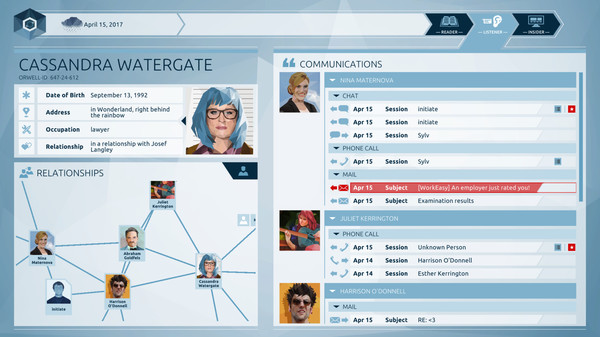
Suddenly, you see an office interface and an adviser talking to you. Your job is to find who did this using a new program called Orwell. Immediately, the game starts getting you used to the software, and once again, everything is mundane. It feels like office training, not preparing to invade people’s lives. Orwell is fundamentally about sorting through files and finding connections, which makes it easy to forget that the premise is that you are spying on people. As we played, we found it easy to make fun of characters. Interestingly, it made us more amenable to The Nation. One lady looked like the stereotype of blue hair and pronouns. Another guy looked like a standard rebellious musician. Since many of us playing could fit some of those descriptions, it was easy to laugh. I, for one, made several jokes about how anything The Ministry of Truth says must be true. Investigating this woman named Cassandra Watergate felt like office snooping, not wiretapping her phone and listening to the details of her personal life. We gossiped about her love life while putting together the information to put her in jail for the rest of her life.

Orwell is just a game, of course, but it actively dissuades you from taking it entirely seriously. It puts pressure on you in the form of another bomb threat, but everything about the interface screams office worker. Now that you have the correct mentality, meeting your goals feels better. Only after you prove Cassandra is guilty of her previously accused crime are you hit with a dose of reality. A scene occurs where your adviser interrogates Cassandra and reveals they have information from private calls to arrest her. She swears and feels violated by the intrusion. I realized then that I would feel the same way. Although she is only a game character, and I had embraced the position of the bad guy long ago, I still was left with a bittersweet feeling. However, I still had work to do, so I left those feelings at the door.

Orwell is masterful at manipulating you. It gives you a familiar interface, like social media and internet browsers, but lets you do horrible things with them. That moment I mentioned earlier highlights this perfectly. We messed around and put bad words into our video game name, and in the process, we took the gravity of our actions less seriously. Orwell feels so mundane that it becomes routine when people suffer directly because of you. The game makes you feel as if they deserve it anyway. Cassandra hit a police officer with a rock when he tried to arrest her friend. Her friend expresses gratitude for being saved and calls Cassandra a hero. The game tells you the officer had a broken skull and had to go to the hospital for weeks. We could spend hours discussing whether or not her intentions make up for her actions, but the game makes you sidestep all of the philosophical discussion. You must find the data to arrest her since it is your job. There is no place for nuance in The Nation, and once data is in Orwell, it must be acted upon.

Orwell presents an interesting dichotomy between the normality of office work and the oppression of an authoritarian regime. It sets itself up with propaganda to make you sympathetic to The Nation and has characters from groups of outcasts, so you empathize with them less. Even though you recognize the blatant propaganda, the unsubtlty makes it funny. Then, despite the heavy nature of the topic at hand, the game makes spying on people feel routine. It makes the consequences for those you spy on feel less severe and emphasizes your impact on The Nation. Sure, you are trying to stop another bomb from going off, but once you do, your adviser tells you to go home and get some rest. You are left with no time to wonder if the ends justify the means. After all, you still have work in the morning.

Photos from: https://store.steampowered.com/app/491950/Orwell_Keeping_an_Eye_On_You/

The Name of the Rose ?

By Sage

The Name of the Rose is incredibly frustrating. In the postscript, Umberto Eco discusses the problematics of the process of writing a novel, remarking of rules and speaking of the relationship between inspiration and necessity. There’s a whole lot of ‘well, I must include x’ and ‘because of y, then naturally also z.’ In this sense, the novel is not only the product of a system, but also an emblem of this system, a cog in the machinations of biopower. Such a novel is already difficult to read, let alone write about, and I could spend months and years trying to untangle my thoughts. Here is a beginning.

The Name of the Rose constructs a world according to a very carefully considered set of rules. Eco asks us to believe in this world and accept these rules even when they do not always align with what we know. Only by trusting the author and the world do we come to realize it is not in fact constructed, it is real in its own right, forcing us to rethink what we believed we knew about reality. It can only play fair if we do too, and that means agreeing to its rules.

But the rules are arbitrary, as is everything, they work because they work together as a set, not because the specific content of the set really matters – nor do they work because they have a specific end or goal in mind. The Name of the Rose is not necessarily a detective novel, nor are there necessarily murders, nor is there a true culprit although we can see an antagonist if we squint. We do get a Sherlock/Watson dichotomy with William and Adso but is this really enough?

Perhaps it does not matter whether The Name of the Rose is technically a detective novel. There is still much to be discovered in reading it; it is a work which carries detective-like experientiality. And it is still helpful to think about it as a detective novel or from a lens informed by the detective novel because biopower relies on categorization. It is the means but not the means to an end, biopower has no end, its purpose is to reify itself. And searching for the truth of a thing reifies that search. If you want the mechanisms – power – of the search to exist in perpetuity, you must believe that there is a fundamental truth, but there isn’t, there never is, because if there was it could be found and the search would end. Power sustains itself by disguising this absence of a profound reality. (As an aside, this is why the lack of a legitimate murderer, as well as the loss of the Finis Africae is particularly significant, but that will be discussed.)

And this is how the constructed world in The Name of the Rose can assume a (hyper)real status. There is such pleasure in the search, even if for naught, and to be engaged in the search is to access power. We see this on two levels. William is entrusted with power by the Abbott though he also goes beyond the Abbey’s structures, opting to empower himself with knowledge and to gain knowledge, and isn’t there such a perverse pleasure in this kind of pursuit? To disobey the mandates of Earthly religion, often both arbitrary and contentious, for the possibility of a deeper truth, a greater moral cause, one which God might forgive your sins for? Only to find nothing, really. William is never able to read the Finis Africae. There is no culprit. There’s hardly even an answer. Instead William becomes culpable for the destruction of the Library, a terrible conclusion, but it is also a symbol of knowledge and of secrecy and of greed and of desperation and of guilt and those too are all destroyed. But in this loss, pleasure is sustained through mystery, the search goes on, and it is thus especially poignant when Adso returns many years later to look for any salvageable books or pages or artifacts. The Abbey – with the library – remain a compelling force.

Pleasure is such an important theme within the book, very literally and perhaps a bit heavy-handedly with Adso’s Sin of fornication, but also with the intrigue and desire surrounding the library. Pleasure and desire cannot be separated; we understand pleasure as a supposed end of our desires. The desire to see inside the library, to access that which is forbidden, to wield all its secrets and knowledge – it is a desire for power, and its fulfillment is the greatest pleasure these Monks could truly fathom.

And thus, Jorge is evil. He has no right to that which is kept from all, but he has the audacity to guard it, to play God, to kill perhaps neither directly nor indiscriminately, but to be responsible for deaths nonetheless of those he deemed transgressive. Because daring to be curious supposedly constitutes a crime, but he at the same time jealously protects knowledge which he has no claim to. This is the epitome of hypocrisy, to punish those who desire the same thing you hold dear.

As Eco mentions, the debate about poverty was impossible to ignore and has to be discussed. So at this point I must also discuss poverty, specifically the poverty of Christ (and his followers), which is debated at great length between characters and becomes a significant subplot. Throughout time immemorial, wealth has often been tied to power – and class has been an axis of subjugation. So what does it mean to position Christ as poor? The Son of God, indeed, God himself incarnate on Earth – although the Protestant/Catholic schism comes many years after the setting of this book, and thus both inception and resolution of the Christ as God vs. Christ as Son of God debate – but all-powerful regardless, as lacking material possessions, material wealth, what we might understand today as an oppressed position without power?

God made us in his image, and He came to us in our image.

The Interplay of Puzzle and Narrative in “Return of the Obra Dinn”

One of my favorite video games is “Papers, Please,” developed by Lucas Pope, who also created “Return of the Obra Dinn.” Naturally, I was excited to play “Return of the Obra Dinn” for class, and the gameplay experience pleasantly exceeded my expectations. “Return of the Obra Dinn” is a first-person mystery adventure game where the player assumes the role of an insurance investigator dispatched to examine the remains of the merchant ship Obra Dinn, which was lost at sea five years ago. As the investigation deepens, the player progressively uncovers the fate of the crew. The game presents its investigative narrative with a unique monochromatic art style. This essay will discuss the relationship between narrative and puzzles and how “Return of the Obra Dinn” incorporates puzzles as gameplay mechanisms that support the story’s narration.

In chapter fourteen of Jesse Schell’s “The Art of Game Design,” the author inquired into the distinction between puzzles and games. Games and puzzles can be considered problem-solving exercises; what differentiates them is how they engage with the players. Specifically, puzzles allow players to develop a “dominant strategy.” This diminishes the replayability of puzzles as once the solution is found, the puzzles are no longer challenging for the players and thus no longer interesting. On the other hand, games usually employ dynamic elements and mechanisms that prevent the development of a single “dominant strategy” or solution. This distinction is also mirrored in the concept of “fair play” in mystery narratives. In mystery stories, the plot functions as an interactive activity constrained by a set of rules, providing readers with the necessary clues to solve the mystery. This invites readers to engage with the story actively, exploring different interpretations and solutions. Similarly, in investigative games, the narrative and its mysteries can unfold in diverse ways with each play through. Players are motivated to explore various strategies and outcomes, ensuring that each experience is unique and the narrative remains engaging.

The “Return of the Obra Dinn” uses the puzzles as a vehicle to deliver the narrative. As the primary investigator, the player uses the Memento Mortem, a pocket watch, to observe the exact moments before someone’s death. By examining these particular moments, the player will be able to connect the faces of the subjects under investigation with the names and identities listed in the logbook. This investigation mechanism provides excellent puzzles that follow Schell’s “Puzzle Principles.” First, the player’s objective is clear– to complete the logbook and uncover the reason behind the deaths on the ship. Additionally, the logbook provides a sense of progress for the players. Through matching more faces to the identities, the players will feel like they are step by step approaching the “truth.” Moreover, the difficulty of the game increases gradually. In the beginning, matching corpses to identities is easy because you are exposed to less information pointing towards a few possibilities. However, as one progresses in the game, the connection between each character becomes more intricate, and it takes more time to fill in the logbook. 

Although the game does get harder, it compensates for that by engaging the audience emotionally. The game characterizes the people murdered on the ship by utilizing a lot of visual clues moments before their deaths. Some poignant stories told at these instances before the characters’ deaths foster an emotional connection, compelling the players to discover the fates of each individual. For instance, one of the midshipmen named Thomas Lanke was murdered by the Gunner’s Mate. Before his death, instead of calling out the murderer with resentment, Lanke chose to ask the First Mate William Hoscut to deliver a message to Milroy’s (Milroy is another midshipman who unfortunately died from the Kraken attack) mother that he tried his best to save her son before he passed away. Since solving more puzzles reveals more of the narrative, this form of characterization in the game further drives the gameplay forward.

Nonetheless, certain aspects of the game emphasize its puzzle elements. For instance, the game’s design allows players to freely explore scenes without following a defined order. This nonlinear structure can create an unorganized repository of information that players must piece together, potentially making progression difficult and breaking the immersion of the story. However, this very structure also gives players control over the order in which they unravel the mystery. As suggested in “The Art of Game Design,” in such a game structure, players will “naturally gravitate toward answering the questions that are easiest for them and slowly work their way up toward harder questions” (259). Therefore, the nonlinear narrative helps with creating a gameplay experience that gradually increases in difficulty. As the puzzles become more challenging, the satisfaction derived from uncovering the narrative after solving each puzzle becomes more rewarding for players. Moreover, the nonlinearity accentuates the sense of “fair play” in the game by allowing the players to approach the mystery from different perspectives and consequently reach different endings of the story. The high degree of freedom invites the players to replay the game to explore different outcomes. 

In conclusion, “Return of the Obra Dinn” creates an immersive and interactive experience that fulfills the “Fair play” rules of mystery fiction and the principles of puzzle design. By integrating the narrative and puzzle-solving components, the game ensures consistent player engagement. The gradual increase in difficulty and clear objectives provide a balanced and rewarding puzzle-solving experience. At the same time, the emotional depth of the narrative allows the players to empathize with the characters.

— Panthita T.

References:

Schell, J. (2020). The Art of Game Design: A book of lenses. CRC press, Taylor & Francis group.

Environmental Storytelling in Searching

The 2018 mystery film Searching has an unparalleled control of its utilization of space that many films cannot dream of replicating. The form of film that is told solely through digital screens can perfectly set-up and frame all shots to make perfect use of the environment to their control. Normally, films have to make use of the environment already at play to create interesting shots or to draw the watcher’s eye; this could be in the form as wide as large landscape shots to convey breath of space or as small as a shot through a windows blind to coney paranoia and the feeling of watching. In both these instances, the cinematographer is making creative use of a restrictive space. While there are restrictions to the way Searching can film and get shots, the actual space of the computer screen always remains a control. The filmmaker has full control of how to present objects on the digital screen and even has a cursor that allows the audience’s eyes to follow exactly where the filmmaker wants them to be. It is within this extreme control of space that the makers were also able to embed supplemental narratives that most will not catch on a first watch. 

The most common and talked about secondary plot line in Searching is the existence of aliens and how the internet is reacting to that news. Through a series of recommended videos and articles, we can see that there have been a series of alien leaks that have a serious enough weight as to garner the president speaking on these events. Common online reading of this film suggests this narrative to be taken at face value. The final article that references this plotline throughout the film is  titled “NASA calls emergency White House. Defense Secretary present.” This leaves an open ended conclusion to this narrative thread that allows the audience to ask what will become of these aliens and the United States response; however, the more interesting question to me is not what will become of the aliens but if they were really real at all? We have a proclivity to believe information that film presents to us but could this just be a more modern case of the unreliable narrator. The film presents all this information in the form of click-bait articles and videos which are most likely being recommended to our protagonist David Kim as he is constantly on the paranoia side of the internet looking into hypotheticals on the case of his daughter. The searching for patterns in life, especially when presented in a medium of investigation that makes us hypervigilant, often has us confirm things that are true from the connections alone. The common Beatles theory “Paul Is Dead” is a great example of this phenomenon where people will believe the outrageous specifically due to the mountain of information that can be tied together to support the claim. Searching is no different, for by seeing how all these articles and videos link together, we immediately have the inclination to believe it to be true and the filmmakers are rewarding us for our observant nature. The presence of these articles goes back into the environmental design of the film, and their inclusion creates a further sense of realism to what David Kim would actually recommend; therefore, while they serve a purpose in the narrative to create realism and are connected, their mere existence does not confirm that the world of Searching secretly has aliens that are being dealt with on a governmental level. 

The environment plays another larger role in the film when it comes to the lake as the place is both reflected in Margot’s real and digital life. Barbosa Lake is the lake that Margot likes to visit where she feels she can be alone in the world, while also simultaneously broadcasting her experience there to the world. Barbosa Lake is where the inciting incident of the movie also takes place and where Margot is eventually found near. It is here where she often talks to fish_n_chips, the police’s son Robert who is catfishing her.  In the movie, they have a discussion about which Pokémon are their respective favorites. Margot answers Uxie, a generation four Pokémon that is a lake guardian and can be found in game at Fogbound Lake. Margot answers that she likes Uxie because she can make people forget, which is in reference to Uxie’s Pokedex entry that states: “[Uxie is] known as “The Being of Knowledge.” It is said that it can wipe out the memory of those who see its eyes.” Robert’s (A.K.A. fish_n_chips) replies by saing that Kecleon is his favorite Pokemon. Kecleon is a chameleon based Pokémon that name comes from the Japanese word to hid “kakureru” and chameleon. This is all to say that their Pokémon choices reflect their real life counterparts; the environment of Barbosa Lake makes Margot feel safe, which is the same environment in which Robert uses to reveal his disguise. The real life locations of the film and the digital one’s hint at merging together in the same way that Margot and Robert’s online personalities come together that creates chaos. Searching as a film takes care to embed its narrative with clues that come from the source it is taking inspiration from: the internet. I appreciate greatly the care they took to create these fake article sidebars and actually research into Pokémon to pick Margot and Roberts’ favorites that have thematic ties to the narrative. It is in no way a perfect depiction of the internet or internet subculture, but Searching is earnest in its attempt to replicate the world of the internet. Beautiful films all the time strive to capture environments truthfully in order to allow others to experience what being there is like, and Searching is no different in its approach to our modern world wide web.

No Need for a Watson in Searching

In Stout Rex’s “What to Do About a Watson,” he comes to the conclusion that the inclusion of a Watson character can be a beneficial tool for the creation of a good detective story. He claims that Watson provides a graceful and natural way to allow readers a way to see the thought processes of the detective without completely spoiling essential information that you don’t want readers to have access to. This is a problem that other writers have also faced and come to different conclusions about. In order for a detective story to play fair, the readers must be able to follow along with the detective’s lines of deduction. In forms of media other than written stories, such as films, this problem continues to be something that authors need to solve for their story. While many have continued to keep a Watson figure that gives opportunity to include dialogue between the detective and the Watson, some movies have adopted different strategies. The 2018 movie Searching is one example that uses computer actions as a way to get across the main character’s, David Kim’s, thought processes without relying on spoken language at all.

As opposed to traditional movies, Searching exclusively shows the displays of computer, smartphones, television, or other digital screens in its storytelling. Everything that is shown to the audience is contextualized within this view of a screen. For example, scenes that include dialogue between David and other characters are often phone or video calls that he is making from his computer. Throughout the movie, David serves as our detective character as he tries to uncover what happened to his daughter, Margot, and find her. There are only a few scenes where we are explicitly told David’s theories or his thought processes, with most of those being scenes in which he calls his brother or Detective Vick. Instead, the movie shows us David’s computer screen as he uses it which reveals many hints as to what he is thinking throughout. A very obvious example of this is when we see David type out a text message, linger for a moment, and then erase the message before typing out something different. These moments give us insight into things that David wants to say but feels unable to. While this example is not one in which David is really working as a detective, similar computer actions are later used in the same way to show how he reacts to new clues and piece things together.

A great example of this occurs towards the end of the movie, when David begins sending pictures and videos of Margot to a funeral livestreaming service and sees a stock photo which causes him to pause. He slowly moves his mouse away from the button to close the browser page as the camera zooms in on the figure in the stock image. He then goes on to pull up Margot’s photos, quickly skimming through some of them before changing gears and opening up her Facebook account instead. At this point, it is clear to audiences that David recognizes this face but is unsure where he saw it. He seems to believe that it has some relevance to Margot’s disappearance, so he continues to look for where he recognizes it from until he finds the face being used as a profile picture for one of the chat members in Margot’s livestreams. Having found this, he opens both pictures at once so that he can confirm that they are indeed, the same person. Later in the movie, we see him undergo a similar detective process as he realizes that Detective Vick has been lying to him and sees the photo of her with the ex-convict who she has claimed was responsible for Margot’s disappearance.

In all of these examples, the movie takes advantage of the audience’s familiarity with using computers in order to make these moments work as revealing David’s thought processes. Viewers understand the feeling of searching through webpages or saved files to find something that you know you can find, so when David does so, no words are needed to make audiences understand it. And if audiences did not make the connection themselves, David putting both pictures on screen at once will make it clear why he reacted this way while confirming part of his theory. There is no need for a Watson character in Searching, because the actions required to perform this kind of investigation on a computer are familiar enough to provide a window into the detective’s mind.

By Alex Duarte

The Return of the Obra Dinn: An Introspective

By Bruno Pasquinelli

Return of the Obra Dinn, released by Lucas Pope in 2018, took me by storm when I first experienced it. During spring of my freshman year, I had a weekend that was empty, and I decided to start it on a Friday night, unaware of what I was about to unleash upon myself. After playing for about 20 minutes, I was absolutely hooked, but had to go to sleep. The next day, I woke up, went directly to my computer, and played through the entirety of the game, stopping only to eat and use the bathroom. After singing its praises for months, I was recommended The Outer Wilds, which is the only game to date that has had a comparable hold on me. In hindsight, Return of the Obra Dinn is what set me down the path of studying and making games in my college career.

Beyond my personal engagement, Obra Dinn is an incredible example of developing and iterating upon a mechanic to keep the player on their toes. Whether it’s the introduction of death replays within death replays (within death replays within death replays,) or the death of a cow, or even the question of the fates of those that did not die onboard, Obra Dinn takes its central active mechanic, the Momento Mori, and fully explores it on the ship. In my own playthrough, the process of discovering another corpse and its subsequent replay was a wonderful ritual, with me excitedly following around the spirit trail thing around the ship, however, I know that others found this repeated sequence onerous and frustrating. Obra Dinn does little to explicitly guide the player at any point, and these animations, the difference between spearing spiking and stabbing, as well as the difficulty of traversing the ship to watch a specific sequence adds a lot of friction. I appreciated this friction, giving me time to think about what was occurring on the boat and retracing my steps (literally) often gave me inspiration for what I should do next. However, I contribute a lot of this to my playing of the game in one sitting. For others who may be playing across days in 2 hour chunks (I really, really recommend against this, play it in one day if you can!)

This added friction exacerbates the difficulty of playing it across an extended period of time. Essential details can be small and scattered across scenes, and having to walk across the boat, spending precious time could be really bothersome. However, in a time of vapid, vacuous open world games filled with endless slop. Having each and every item in a scene be important feels very rewarding as a player who enjoys taking the time to look at these details. For instance, in the sequence of the sailors playing cards, different characters can be identified by the number tag on their sleeping bag, which corresponds to their number on the crew list. All of this is to say that Obra Dinn is not a game for everyone, and not just from friction. There are no hints, and fates are only confirmed in batches of 3, which may feel like a boon early on, allowing you to guess and check, becomes brutal when you’re down to the last 10 or so fates. Additionally, with nearly the whole game taking place on a boat, the rocking and bobbing can cause intense motion sickness as well – there are minimal graphical options, and none that can really reduce this sensation.

Finally, my thoughts on the story – I found the characterizations very powerful, considering many characters only get a handful of lines and brief moments to memorialize them. The voice acting is fantastic, and there are many lines like “Enough! Captain cannot be trusted.” that have stuck with me for years since I first played this game. The time period on display is one that is really different from the one we live in now. You play as an insurance investigator, meaning your goal is not one of justice or knowledge, but rather one of appraisal and write-offs. Everyone must be accounted for, not because of a nation’s responsibility to its citizens, but instead for payout purposes.

However, this difference in time also poses some issues that don’t sit well with me, and illuminate comfort levels with various forms of profiling. The nationality of every character is listed, and this often plays a role in their identification. The one Irish character has a strong Irish accent, giving him an identifier, and something similar happens with the Bosun onboard. These were forms of identification that I felt comfortable with when playing, however, that comfort changed when the game indicated that I could identify Maba, the only New Guinean crewmate on board.

For those who haven’t played Obra Dinn, character’s faces become unblurred when they are potentially identifiable based on the replays you’ve seen, and the fates you’ve confirmed. Maba is torn apart by a kraken, and is immediately identifiable afterwards based upon his tattoos. His identification difficulty rating is 2/3, suggesting it is not too difficult. When I first played through Obra Dinn, I didn’t feel comfortable profiling Maba solely off of his tattoos, rather believing that I had missed some other aspect of information to identify who this poor soul was. While I appreciate the historical dynamics at play, Obra Dinn is expecting me to racially profile this man in a way that felt distinct from the other examples, based off my limited knowledge of New Guinea and other Pacific Islands. More specifically, “This man has pacific island-y tattoos, and there’s one guy from the pacific islands” as a train of thought is not one that I like to entertain in my life. There are some other small issues I have with the plot of the Formosan Royalty, but those aren’t as pointed or as coherent so I shall save them for another time.

An Analysis of Secret Hitler and the Strategies Within

When it comes to social deduction games, Secret Hitler is often considered one of the staples. The premise is simple: if you’re a Liberal, stop the Fascists and their Fuhrer from gaining power and influence; if you’re a Fascist, do what you do best and sow chaos. Every round, one player is the President, and they select a Chancellor. The confirmation of the Chancellor pick is put to a vote: if passed, the President draws three cards from the deck, discards one, and gives the remaining two to the Chancellor to choose from. The Chancellor chooses from one of the two cards and places it on the corresponding board. Once the game is put into play, the finer points of the various strategies one could employ become evident. 

For the more analytically-minded players, Secret Hitler is, at its core, a numbers game. There are more orange Fascist cards than blue Liberal cards in the deck (for a ratio of 11:6), and as cards are placed on either of the two boards (pictured above), the potential probabilities of what kinds of card could come next narrow. Players accurately tracking the ratio of Fascist to Liberal cards remaining can apply pressure to players lower in the round’s playing order. 

As one could imagine, this tactic can prove troublesome for Fascist players. Fascist Chancellors lower in the playing order might have undue suspicion cast upon them for playing a Fascist card should the count favor a Liberal probability—no matter the reality of what cards the President gave them. Additionally, it might be harder for a Fascist President to claim they drew three Fascist cards and had no choice but to give the Liberal Chancellor two Fascist cards to choose from, forcing the placement of a Fascist card on the board. 

Fascist and Liberal party membership cards handed out at the beginning of the game.

However, even if a keen card counter numbers amongst the players’ ranks, there remains an element of subterfuge. In this situation, any Fascist player should lie when and where they can. If they are the President, they should lie about the identity of the third card that they discarded to further skew the count in the Fascist cards’ favor and make it easier for their Fascist brethren lower in the playing order to claim they had no choice to play a Fascist card. For a truly experienced Fascist, the optimal strategy is to become the card-counting player and gradually feed incorrect information to the rest of the players, preying on potential inattentiveness or numerical ineptitude. 

Concept art of a Fascist membership card.

This is just one specific scenario with specific players in mind. Due to its nature as a social deduction game, any and all strategies in Secret Hitler rely heavily on the make-up of the players in the group and their playstyles. Some players may live and die by the numbers. Others may forgo the strategy of counting cards entirely and base their assessment of other players’ honesty on social cues and whatever tells the player may have. 

Some players may even have an advantage over the others by virtue of knowing some of the other players better. These players are better equipped to discern the other players’ play styles—either by virtue of having played Secret Hitler with them before or simply knowing them better in their personal lives. They may know that when their friend is a Liberal, they tend to be more soft-spoken or engage more passively in debates. Or, they may know that when their friend is a Fascist, their strategy is the exact opposite: the friend will insert themselves into every debate and voice their opinions freely. 

This leads to the crux of a potential issue that players may have with Secret Hitler and other games that ostensibly favor such familiarity. To what extent does Secret Hitler rely on the social aspect of the term “social deduction?” Furthermore, does it truly matter? Should players agonize over the concept of fairness in a game where some players might derive an advantage from their familiarity with other players? What about situations where everyone knows each other equally and knows how the other players generally prefer to play—would this make the game stale? 

Finalized party identity cards.

In short, it’s complicated. On one hand, any game can and will become stale or boring the more it is played without any variation. That is inevitable. On the other hand, it would seem inadvisable for a game to hinge the majority of its enjoyability on an intense degree of interpersonal familiarity. Games could choose to prioritize such a mechanic and still be functional, but those games would likely not see much success as widely enjoyed party games or games to break the ice with new friends and acquaintances. They would likely be seen as games best-suited for established, close friends groups.

The perceived problem of players learning each other’s strategies and their behavioral patterns is something that could be “fixed” by the players themselves. Once made aware—whether it be through discussion or observation—players might deliberately toss up their playing strategies. They might experiment with new strategies, attempt different maneuvers, or lie more extravagantly. This may come at the expense of victory for a game or two (or three), but in the long run, this shake-up could lead to more victories down the road as other players become less sure of one’s social tells or strategies. It might seem dishonest to do this—it is lying, of a sort, but this is Secret Hitler. Lying is the name of the game. 

Generally, social deduction games are responsible for providing a semi-flexible base and framework of rules for the players to adapt to their desires and playstyles. Players should still seek out the games whose basic premises interest them; one should not ask a game to be something different than what it is intentionally designed to be, especially when there are a multitude of games in existence that actually are the thing the player desires. However, social deduction games’ strength lies in an allowance for player mutability. 

Shifting the onus from the game—so long as it has provided an adequate base—to the players to “shake things up,” as it were, is likely the most expedient solution to this perceived conundrum, particularly for social deduction games. The best—or the more commercially successful—social deduction games do not rely so rigidly on the players being familiar with one another. Any interpersonal familiarity is certainly no hindrance to the game’s enjoyability, and it might very well give the game a new edge of difficulty as players attempt to mask their tells from their friends, but in most cases, it is not absolutely integral to the game’s basic functionality. Secret Hitler is such a game where even if all social elements were to be stripped from it, there remain multiple opportunities for lies to be called out, numbers to not add up quite right, or for patterns of behavior within the span of a game to be established.

-Carrie Midkiff

Image source: https://medium.com/@mackenzieschubert/secret-hitler-illustration-graphic-design-435be3e3586c