Affect, Authorship, and Experience in afternoon, a story

afternoon, a story is a poetic hypertext piece about disorientation and grief. It follows a recently separated father named Peter who, after passing a car accident on the way to a meeting with his boss, begins to wonder if his ex-wife and son may have been victims in the accident. Though Peter is too afraid to check initially, he can attempt to find the answer to his fears by consulting with other characters throughout the narrative, such as the headmistress of his son’s private school, the hospital, and his therapist; though these sources are largely unhelpful and inconclusive. The text generally comes to a close at seemingly random points or begins to repeat with no certain answer, as the path to definite conclusions is obscure (and indeed, none of the students in our play session happened upon it).

Our class discussion on afternoon, a story broached many topics, including agency, clarity, authorial intent, and the emotional experience of a non-linear interactive narrative. afternoon was the most puzzling of the three digital works we discussed, with no map and little navigation available for a player to situate themselves. This aimless feeling and lack of clear directive was something many classmates brought up, as some had even managed to miss the inciting incident of the plot (the car crash). Many felt that this confusion was a key aspect of the experience, in fact, separating it from other works like patchwork girl or genres like choose-your-own-adventure stories. There are many ways to interact with afternoon, such as clicking on specific words or answering yes and no, and these interactions all provoke a response—from guiding the player to different locations and characters, to altering scenes so that characters receive different information. Yet, despite afternoon being an interactive piece of media, and the player ostensibly being in control of the narrative’s direction, many felt distinctly out of control while experiencing the story.

Not knowing how to progress, where in the narrative you are, or what you are even hoping to accomplish makes for a disorienting and even daunting experience. Some classmates noted that reading afternoon felt like reading pages or chapters of a novel out of order. The general consensus, however, was that despite these feelings of lost agency and lack of clarity, the form actually served the intended affect. The process of reading afternoon fostered a fraught emotional state which mimicked the sense of grief and trauma Peter was enduring, encouraging the reader to empathize with his situation.

An aspect of the conversation I found particularly interesting, however, was after we had moved on to another piece of hypertext fiction, and some students remarked that they felt more agency after reading the text than during. While they felt lost and tentative at the time, it was afterwards when reviewing the information and attempting to establish motives and timelines that they felt a sense of control and comprehension over the narrative. This agrees with the conclusion we had reached earlier about the form generating a certain affective experience (with this posthumous gaining of agency reflecting the experience of unpacking and resolving trauma), but it also provokes interesting questions about the role of player perception in digital narratives.

In many digital narratives the player is expected to participate and make decisions about the course of the story, but I find that players often shape the narrative even beyond their capacity to interact with game systems, driven by both creativity and the human tendency to narrativize experiences. Take ELIZA, for example—the program only functions because we imagine a linear conversation taking place, while the computer only reads one line of text at a time and is unaware of any greater context. When I interacted with it, I imagined the character ELIZA becoming increasingly annoyed with me, or learning more about my situation, but neither of these cases were true—ELIZA only scanned the previous line, and offered a fitting response, no matter if it clashed with the preceding conversation. Still, I felt the urge to apply a logic to seemingly disparate events. I have had similar experiences in more open-ended games like The Sims, attempting to connect random happenstance into a coherent narrative about the family I’m playing with—ascribing intent to random actions and so forth.

To an extent, every piece of fiction is interactive. Even if we cannot directly influence the events of a film or novel, we still must decide how to engage with it—whether to believe the narrator or to accept the story’s premises, which characters we enjoy and if we approve of their actions, or even whether or not to continue reading or watching. This is why, for example, there exists the literary theory of death of the author (a theory which argues that a reader’s interpretation, rather than the authorial intent, is the best way to derive the meaning of a work). Heightened interactivity such as in the case of afternoon and similar works only brings these questions to the forefront of a literary piece, by more directly affording authorship to a reader. In afternoon, a reader takes on an almost curatorial role, unintentionally determining the order the text will be read (and implicitly altering the context of certain moments and scenes). I find these human tendencies to raise questions about the boundaries of interactive storytelling—when player interaction is a codified aspect of the object, how far does player interpretation go? How much of the narrative does the player ultimately create, direct, or influence?

By Nicole

The Individuality of Mystery House and the Effects of Femininity in Digital Storytelling

By: Bernadette Broscius

Roberta and Ken Williams (creators of Mystery House)

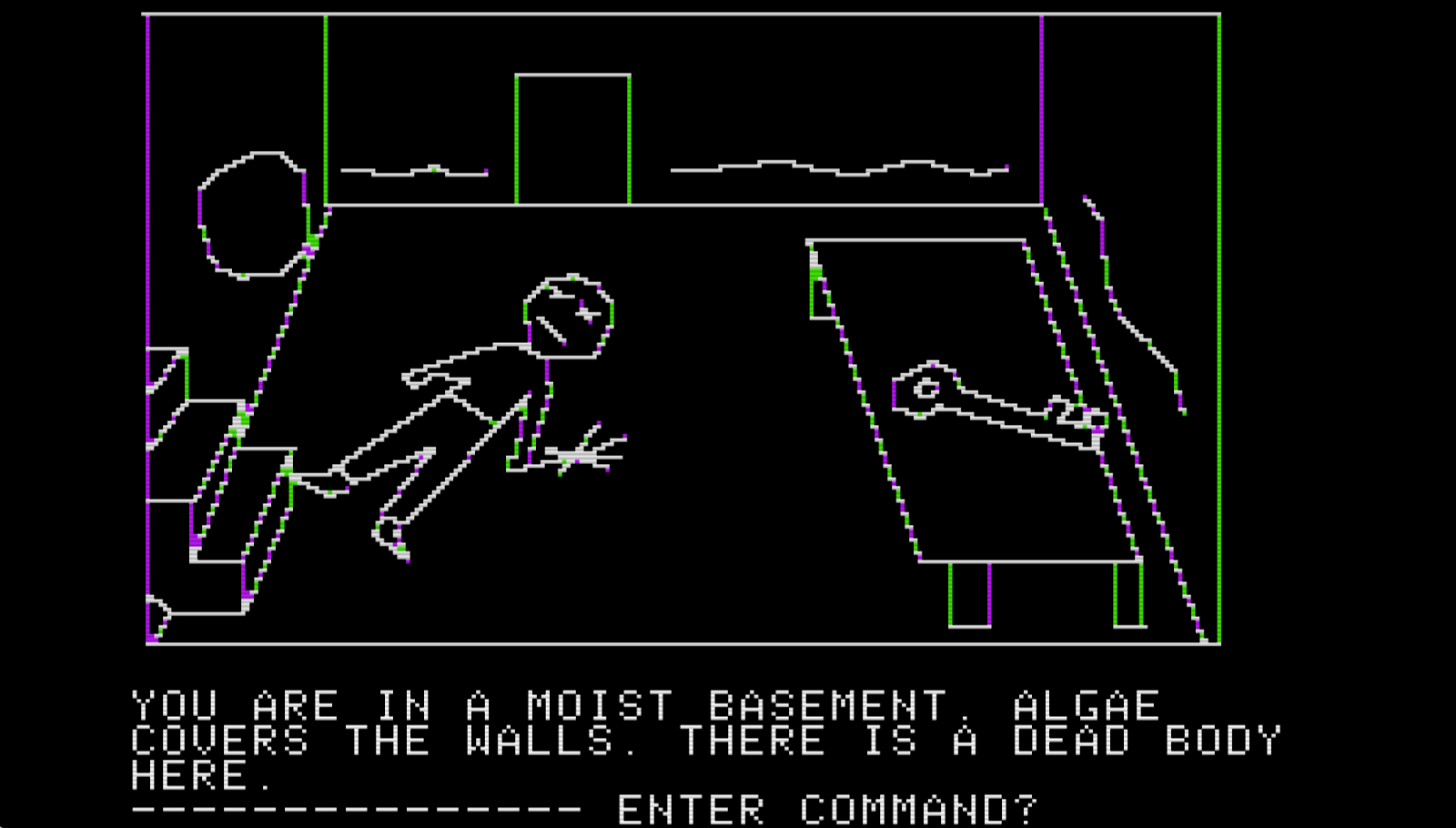
Individuality/Femininity: Compared to the features and abilities of text-based games like Zork and Adventure there is a distinct difference in Mystery House that goes beyond its visuals. Though it is important to note that this adventure game was one of the first to include computer graphics and expand user interaction in new ways, I find that the origin story of this game to also be a major point of interest. In the 1980’s, married couple Roberta and Ken Williams began working on Mystery House based on Roberta’s inspiration and additionally, her love for mystery games/books. I found it important that this game was inspired by a mystery novel (And Then There Were None), as almost every form of storytelling, even the digital/visual forms can find its roots in written or oral forms of literature. It made me consider the influence that Roberta had not only on the mass video game market, but on women in the later 1980’s. The Nooney reading tells us that “Roberta also knew that games existed on computers prior to playing ADVENT, but she was typically uninterested despite her marginal familiarity with computing…23 ADVENT, however, was something other than the statistical or randomized play scenarios common to mainframe games, and Roberta Williams found herself deeply engaged” (81). With Roberta’s female point of view and understanding that women were hesitant to take part in digital storytelling and gaming, she took these conventional/standard stories that were already popular, and added a twist to it. I think the fact that she recognized the importance of the female market and creating a game that women not only feel comfortable playing, but are interested in was a turning point in the allocation of games such as these. This goes back to my point that the visuals were not the only unique factor about this computer game – the popularity had much to do with “its distribution and its multiplicity, its spread” (Nooney, 78). 

Universal Strengths and Defects: The ability of this game to reach larger audiences due to Roberta and Ken’s teamwork in manufacturing and shipping product, along with the multiple forms of artistic appeal (text, visual, and approachable content) were what made this “novelty.” However, when considering the new and impressive feats that this game introduced, the limitations should also be considered as influences of future works and games. While leading the animation on Mystery House last Wednesday, it was brought up by multiple classmates that the graphics in the game, on occasion, would mislead their game. For example, there is a point in Mystery House where the player encounters a candle. Even so, in my own experience and those of my classmates, we had quite a bit of trouble identifying this object that ultimately becomes necessary for success (the game gets dark and you need a candle). With the limited points that Ken was able to code in each room, the visuals can seem a bit crude or rudimentary. In turn, when a misunderstanding in visuals ensues, the game can be held up for indefinite periods of time, which is profitable for the game, but frustrating for the player. In my case, I ended up having to look up a run-through in order to figure out the specific commands that the text-parser would accept so that I could progress in small ways. Because of my access to technology, I was able to get answers to questions about the mystery that were not initially available at the original release, which positively reinforced my interest in the game. On the other hand, for players that were interminably stuck at a certain point due to the simple text parser and lack of understanding (in terms of the graphics), this might have deterred players from finishing or continuing at all. Even so, at the time, this mystery inspired game drew in a large audience and expanded demographics, despite these shortcomings that I have mentioned, largely due to the rapid progression technology has undergone in the past forty years. 

Influence: Another topic worth expanding on that was mentioned in the discussion board, is the influence that this game had on the gaming space today. I found there to be an easy and clear correlation between video games we know now, such as Among Us and Minecraft, as there is a story attached to each of these games that can only be fully understood in addition to the visuals. In newer games, we see that the evolution of graphics has reached new heights and expanded to a point in which the player can see their own character, and see their bodies moving. In class we talked a little bit about how in Mystery House, the navigational experience was limited as you couldn’t physically see your character move, it would just appear in a new room, which made it easy for the player to lose concept of their position. I think that as players began to get used to these simple visuals, it became a next step to introduce the concept of seeing your own character to completely immerse the person behind the screen into the digital world. With this being said, I view Mystery House, with all its originality and its drawbacks, as a great inspiration for new gaming programmers, but also for the player’s interest in digital narratives and machinery. It is also important to consider the female agency included in the storyline of Mystery House (with the killer being a woman named Daisy) that is included because of Roberta’s self-determination and creativity. This game, while it revolutionized computer games in a visual sense, can also be recognized as a reflection of the changes in gender dynamics within the gaming space. Roberta acknowledged that there is space for everyone in the gaming world and was able to do this with such great subtlety that it is only clear when looking at her and Ken’s history.

A Murder Mystery and The Foundations of Adventure Game Graphics

By Priscilla Bermudez

Background 

Mystery House, originally known as Hi-Res Adventure #1: Mystery House, was released in 1980 by Ken and Roberta Williams. The game is known as a foundational adventure game due to being one of the first adventure games to include computer graphics and introducing the great potential gaming with graphics could have on Apple II software. Roberta Williams revolutionized the genre of adventure games with this creation. Before Mystery House, all interactive games were text-based. The creation of Mystery House was inspired by the first text-based adventure game called ADVENT, also known as Adventure or Colossal Cave. Both Ken and Roberta played the game, but Roberta was deeply engaged with the game which caused her to be passionate about the adventure game genre. Once she ran out of games to play, she decided to make Mystery House. The game would be based on the board game Clue and Agatha Christie’s And Then There Were None. An aspect that sticks out to me of the game’s history and origin is the important role a woman plays in its creation. At the time when computers and video games were left to men who had access to computers and in elite college spaces that men dominated, a woman was the one to create a foundational video game. I find this important because it shows how women can break through and accomplish important work in male-dominated spaces. 

The plot of the game revolves around a player being locked inside an abandoned Victorian house with seven other non-playable characters. There the player finds a note that says that there are jewels hidden in the house and whoever finds them gets to keep them. As the player searches the house for the jewels, dead bodies begin to appear in the different rooms. So now on top of finding the jewels, the player needs to find the killer before the killer kills them. 

Impressions


Upon playing for the first time, I was shocked by how much the game still relies on text for the player to understand their surroundings. In hindsight, with Mystery House being the first adventure game to introduce graphics, the graphics play a more complementary role to the text rather than guiding the game. Coming into the game with the mentality of modern games, I expected the graphics to have more details, whether it be details in the room or with the different characters. Many times the game’s text included descriptions of what the rooms consisted of in case it was unclear or sometimes. Once I got over that concept in my head, I could understand would become an aspect that complements the text and becomes visually appealing rather than encompassing the text. I still had a bit of trouble navigating the game due to its use of cardinal directions to guide the players through the house. It was a bit easier for me to go to the locations I wanted in Mystery House due to its use of graphics, so I could visualize more clearly that I was headed towards the kitchen for example, or the study. This is an aspect I find interesting in text-adventure games. The player has to make a mental picture of the locations in regards to world-building and in a way keep a map of the locations they have gone. While in Mystery House, you still have to keep track of the locations you have already been to, the graphics help keep it all visually organized.

On the topic of directions, providing the text parser with directions at times became a point of frustration for me in the game. The game provides you with a set of rules of what directions can be given to the game; two-word commands containing a verb and a noun. It provides a list of example actions one can give the system but if one provides a command that the system is not prepared for, it just says it does not understand and does not provide you with options on how to move forward.

Another thing that made playing slightly difficult for me was the lack of a list of objectives and items required of the player. It is very cool in the game to keep an inventory of the objects one picks up in different rooms and be able to use them later on in the game. Since the game does not provide a list of items to find, one may overlook an item in a room and that would lead to their death later on. 

Characters


The function of the other characters in the game Mystery House also intrigued me in comparison to present day. While in a modern game, the characters may play a more active and detailed role in the adventure, in a game like this all we know of the characters is what is provided in the instructions. It caused me to think about modern adventure games like “Detroit: Become Human” where how a player chooses to interact with certain characters is what ultimately determines the path and ending the player will experience. Additionally, it was interesting how on-the-nose the hints found on or near the dead bodies were since one does not have the option to interact and interview with the characters. (SPOILERS) Each dead body that was found had to be specified by the text and since the graphics themselves were not very distinguishable. The hints found on the dead body like blonde hair and a daisy in a body’s hand, made it easy to discern Daisy as the killer once the other blonde characters turned up dead. Meanwhile, to keep using the example of Detriot: Become Human, technology has made the characters in the game look so detailed and realistic that for example the character Markus resembles very closely its voice actor, Jesse Williams and this happens similarly with the rest of the cast. In terms of the characters, I see how including different characters with differing occupations and identities would become popular in later games and how Mystery House begins to establish its purpose. 

Overall Thoughts
Overall, I did enjoy playing the game and gained a new sense of appreciation for how detailed and immersive games have become nowadays. The advertising for Mystery House itself demonstrates how the game’s main selling point was its graphics and natural language commands, “Through the use of over a hundred Hi-Res pictures you play and see your adventure. You communicate with Hi-Res in plain english (it understands over 300 words!)” (Nooney, p.88)  Currently games advertise the world-building aspects of the games and the paths and actions of the characters have heightened in complexity. Returning to the in-class discussion of the return of providing natural language as a mode of input, I do not see this method of input as making a comeback, especially with how AI has begun to understand more complex commands. I do think it is very important to look back on games like Mystery House to see how far technology has come to create the method we interact with games now and experience these heavily text-based adventure games.

Sources:

Nooney, Laine. Sierra On-Line and the Origins of the Graphical Adventure.American Journal of Play, vol. 10, 1. (2017)

Playthrough: https://www.youtube.com/watch?v=kiwHwPvIHBs 

Text-Based Games and the Trouble of Simplicity

Article by Matt Brennan

Last week, I played through the game Colossal Cave Adventure for class, and in my playthrough and the subsequent discussion we had as a class, one specific topic popped up with regularity: the text parser. The text parser was no small innovation for its time, but returning to it nearly 50 years later was an exercise in frustration. The parser was extremely simple, as it had to be for its time, and thus only accepted a very small—and very specific—list of inputs. This confused every player, myself included, and led to the game becoming a tug-of-war between the player and the controls, with the game itself, while never quite becoming secondary, taking a very clear back seat to the struggle to play at all.

For movement, the parser of Adventure accepts cardinal directions (though not the command to “go” or “move” in these directions), as well as up and down. Everything else gets more arcane from there, as the parser allows for “get” and “take” but not “use” or “investigate.” “Look” is allowed but only gives a description of the room around the player character, and “throw” does the same thing as “drop,” preventing any chance at lobbing objects at enemies as weapons. Eventually, it occurs to the player that their best bet at succeeding is to input only the exact thing they want to interact with and no other words, and allow the game to fill in the rest of the data. This works more often than not, which is its own issue. In a game like Dungeons and Dragons, which was brought up in discussion and was a clear inspiration for Colossal Cave Adventure and every other early text adventure of the day, it’s a reflex for the players to describe what they do in great detail so that the game’s adjudicator, its Dungeon Master, knows exactly what the players want to attempt and how to judge them on the fly. That level of detail, necessary in D&D, becomes an active hindrance in Adventure, and the player must rely on simple, often one word, inputs to move the game forward.

The important distinction between a game like Dungeons and Dragons and a game like Adventure is the level of freedom in both. D&D is nearly pure improv; the players work together and keep each other focused and up to speed on how the game is working at any given moment, but nothing is set in stone in terms of story, and anything can change on a whim or an unexpected die roll. Adventure, for how much it’s inspired by D&D, is nearly the exact opposite; the single player is completely alone, has to figure everything out themselves, and is working to advance the single plot down its defined tracks until it reaches the ending, which is always the same. If the plot of a D&D campaign is an adventure, the plot of Adventure is a train ride with a sticky handbrake. There are interesting and clever moments—for instance, the player needs to keep their inventory clear, but if they don’t set down a porcelain vase in the same room where they set down a decorative pillow, the vase will fall and shatter—but those are hard-coded into the game, not the result of a clever piece of judging by another person. The mechanics can be interesting, but there’s a certain attempt to make Adventure something it isn’t, and the text parser makes this abundantly and uncomfortably clear.

Not to say I didn’t enjoy playing Adventure. I thought it was a very solid game for its age, and the fact that the most frustrating thing about a game over twice as old as I am was that its controls were counterintuitive does say a lot of good things about the game. A lot of it holds up really well, but at every turn when I played, the text parser became a more and more pressing issue. Thankfully there were a handful of passwords to skip most of the long walking sections (where the game has the most chances to screw up and dump the player somewhere in an endless forest), but that was only a workaround, hardly a solution. A text-based MUD I have some experience with, Discworld MUD, also uses a text parser to control the game, but this parser is much more sophisticated and, more importantly, flexible than the parser used in Adventure, and as a result the game experience feels much more akin to D&D and other roleplaying games than to the old text-based adventures we played for class. While this is certainly an unfair comparison between the two, I find it fascinating how far the technology for text-based games has developed even amidst the advent and growth of graphical games. It’s a far fairer comparison between the two, I think, to bring up how beloved and propulsive for the genre both games have been.

Chatbot AI and Humanity

I have separated my understanding of the chatbot ai phenomenon into two philosophical and conceptual frameworks; information and connection, or to put it another way chat gpt and character ai. In class, I asked the question, how is digital media evolving what we understand being human to mean? And, in regards to digital media, especially artistic media, this question becomes increasingly important as we must also interrogate and define art. This is an interesting corner that we have been figuratively forced into by the rapid evolution of ai. Art is a concept that is notoriously difficult to define, what makes art what it is, and more deeply what signifies quality in art remains elusive. However, a principle that seems to go without saying is that it is created and consumed by humans. We value the sweat upon one’s brow, the wavering of a voice in song. It is the small idiosyncrasies and laborious nature of art, the emotion and intentionality of a piece, that must be and is based on its distinctly human nature. In other words, it is the subjectivity of human creation that makes it art, or at least that is how we as a society have subconsciously regarded it. We know that a piece of art is a piece of art because someone made it. The same can be said for how we communicate with one another. We know that real “authentic” communication is occurring because it is happening with another living being who can respond and understand and insert their own subjective experience into what is otherwise a one-sided non-exchange. So then, with ai, we seem to be seeking this out when we create digital minds that are capable of mimicking this connection as I have described it as above. So then, art is a form of communication, however broad and intangible it may be, and communication is the human means of connection. If we are to understand the creation of ai under these lenses, to serve either to connect us or streamline information, then we must then understand why ai takes the shape and form it does, in the most literal sense. Why do we imagine the most advanced AI as taking the rudimentary form of the human body, and able to speak as fluidly as another person. Why must it speak to us at all, and have a “human” voice. Similarly, why do we have character ai that simulates conversing with the president, or a mob boss? On the one hand, it is an appeal to the senses. What digital media intrinsically lacks is the ability to stimulate us on any level beyond 2-dimensional pixels. This is why so much software and hardware is now dedicated to advancing technology on the fronts of sound and sight. This is the reason a “meta” wishes to completely immerse us in sight and sound to the virtual spaces, and attempt to simulate a 3-dimensional world. So then, what humanity is importantly defined by in this new digital age, and what much of digital media attempts to do is arrest our attention on the most fundamental levels of human senses. Though, what else might be the reason for the way that AI chatbots are designed, and the way that robotic forms as well as certain digital media are crafted. We create these forms of intelligence in our image, and to meet the conscious and subconscious desire for these artificial intelligence to transcend their limitations as we too attempt to. In the question of transhumanism, it would seem to me that just as humans create AI and other technological advancements to transcend our organic limitations, we are simultaneously pushing AI to transcend its mechanized limitations. Though we imagine it to be for the purpose of serving humans. So then, an almost existential question comes to mind. We are attempting to reach the complexity of the human mind, by artificial means, in order to serve us. It would seem then, that human needs and wants are only satiated through the intensive labor of other humans, or human-like performance. Other questions I have considered for this topic were more on the side of AI art. What makes an original idea? It is the matter of the amalgamations and originality of a piece. AI is requiring us to bring the abstract of these artistic processes into focus. Art AI artists “real” artists? This uncanny valley of creation and whether or not this thin thread of “human intervention” is enough to keep us protected from AI manufacturing human talents in the next few years, possibly months. It is a question of utility and ethics. We have yet to form shared ethics around ai, and how it is best to perform with these tools under the contexts of information and connection. What values should we have underpinning those ethics? To what degree can these AI be utilized safely and objectively? How do we ensure that prejudices are separated from AI?

Porpentine Twine: Shedding A Light In Dark Spaces

Written by Celeste Montgomery

If you haven’t heard by now, Twine is a pretty well-established storygame platform that houses the unique, odd and especially expressive creations of newbie and experienced game designers alike. Their creations could be described as a crossbreed between hypertext fiction (games like Patchwork Girl) and interactive fiction games (like Galatea) as is with the game designer Porpentine Charity Heartscape, who has taken advantage of Twine’s easy accessibility to people from marginalized backgrounds. Porpentine has used Twine as a stage to not only tell fantastical stories like that of an artificer who has been tasked by the Skull Empress to share their talent in the palace, but also to explore dark themes like child abuse and trauma which can be taken in by players in way not too overwhelming or direct. This is the case in many of Porpentine’s Twine games including Howling DogsUltra Business Tycoon IIISkulljhabitWith Those We Love Alive, and Love is Zero

Howling Dogs

Howling Dogs is Porpentine’s first Twine game created in 2012, written in the seven days after she started hormone-replacement therapy. Many of the themes behind Howling Dogs can be connected to mental health, as you play from the perspective of a patient in a mental hospital whose day-to-day actions are limited to simple self-care habits and a VR visor that allows the player/patient to experience realities outside of their own. 

When gameplay begins, the setting of the room you reside in is described and clickable actions are prompted through specific words that stand out on the screen. Players may first feel gravitated towards the activity room route but are thwarted when you are told you must eat and drink first. Players will come to learn that this action is habitual and necessary for each new day that the patient wakes up in order to be able to reach the VR visor which seems to be what the patient, and soon enough the player, actually wants to do. The limited actions available give players the feel that they have been admitted to a hospital where they don’t have free reign to do what they want or really any variety in their daily schedule. 

The settings and vibes of the VR environments the patient plays through vary by each day, but they usually point to greater themes of violence, death or even religion. This could be Porpentine’s way at alluding to certain struggles in humanity, whose misuse and abuse, has affected many communities today. Ideas of escapism, mental illness and coping with solitude are all touched in Howling Dogs and by playing it, players, including myself, may start to recognize the ways in which they habitually seek methods of escapism in their lives, and what the causes of wanting that disconnect may be. 

Skulljhabit

Speaking of escapism through Twine, Skulljhabit is another one of Porpentine’s creations that touches upon very similar themes like that of Howling Dogs, except the difference being that those themes are even more hidden under the narrative that players are experiencing in the gameplay.

In Skulljhabit, you play as a worker in the skull pits whose everyday tasks are limited to working by digging up skulls, visiting the village square, well and store, going to the train station, exploring the outskirts, or going home to your hut which contains a knapsack with a letter from a girl who appears mysteriously in little different ways in the game. Although at first this seems like an exhaustive list, after “days” spent waking up and having the same limited options that have no clear path of progression in the game, players may start to feel like the game’s redundancy is too dramatic. This idea of unsatisfaction while playing through the game because you are not getting what is expected through suspected endings is exactly what Porpentine seems to want players to draw their attention to. While playing Skulljhabit, one way players may think they can complete the game is by working in the skull pit and just continuing to earn as much money as possible. However, this doesn’t seem to do much but allow you to shop for items like a shovel or calendar which end up seeming to not have much of an effect on “winning” or “losing” the game. After repeated attempts of gaining more and more money and buying up everything in the store, nothing happens. 

Another route players may think to take is saving up enough money to buy a ticket in the hopes of leaving the town. After players have earned enough to buy a train ticket, the player does get to ride the train, but it just leads to the player being told that they end up walking back to the hut leaving the player to just accept the outcome once again and return to the options first prompted to them in the beginning. 

The final option I encountered while playing Skulljhabit was the path that led to the outskirts of the village. This route, like the others, took many days in the game to complete as you need to break away at a wall found in a cave day by day. After breaking this wall down, you return down this same route the next day to find a statue and get a bloody nose. You continue to go deeper and deeper in the cave until you fall in a pool and finally wake up at home. 

Players will likely attempt to play through all these routes in the game thinking it will lead to a completion of the game, when it just throws the player back in the original game opening screen. However, the game does eventually tease at a satisfactory ending when after playing through all these routes, you get offered a promotion which takes you to live in a new place. But when arriving, your everyday options are even more limited and the game mysteriously ends with a dream you have of dancing on the moon with a girl, most likely the same one who wrote the letter in your hut, and her wondering if she will find you again. 

If not clear from the description, the gameplay reveals that there is a lot of labor involved in the game that doesn’t lead to what is usually desired from a game. Again, like Howling Dogs, Porpentine created Skulljhabit to show an everyday truth in a different way. In this game, it is the everyday routine of life and the seemingly never-ending pursuit of meaning or satisfaction that is tackled through the themes of this game. 

Love is Zero

With Love is Zero, Porpentine takes a different approach compared to Howling Dogs and Skulljhabit and creates a twine that uses a lot of visual and audial effects to give players an experience similar to the vibes of the topic of the game. In Love is Zero, you are in a vampire clique at an all-girls tennis school on the moon, where you live because Earth was wired by mega corporations. According to the title screen, you’re going to live forever, and you’re extremely hot.

After the title screen, and all throughout the game, players have three options to click: Study, Play Tennis, and Bully. Every choice clicked prompts a scene that happens at the school and adds a word or phrase to your description at the top of the screen. For example, pressing bully may cause you to suck blood from someone to look good and this adds “gorgeous” to your list of words. After choosing several selections in any order you get a screen asking, if you are all the words that accumulated after all your choices. The player has no choice but to accept that they are all the above and the game ends. 

My first play through I didn’t quite appreciate the quick and vibrant energy that the game provided, but after a few run throughs you can begin to see the game’s attempts to express teenage struggle through the everyday choices of these tennis playing vampire girls who feel the same body image issues and lack of confidence as regular teenagers in the real world. I think like Skulljhabit and Howling Dogs Love is Zero does well to intermingle heavy topics like depression, and mental illness into readily accessible twine games that can reach a multitude of people and tell stories in very uniquely expressive ways.

Umurangi Generation: Photographing the End

By My-Nhi N.

Umurangi Generation is a first-person, single-player photography game, available on PC via Steam and on the Nintendo Switch. The game takes place in Tauranga, Aotearoa (traditional Maori name for New Zealand) in the “shitty future” amidst a kaiju apocalypse. As a player, you take on the role of a photo courier, taking pictures of the various scenes of this apocalypse as you travel from place to place, earning money from your photography. 

BACKGROUND.

Developed in 2020 by Naphtali Faulkner, also known online as Veselekov or “Ves”, an independent Maori developer, the game was produced within about 8-10 months. The initial idea for the game came about from Faulkner teaching his younger cousin how to use a DSLR camera, to which he likened the experience to teaching mechanics in a video game. Faulkner then first approached development of the game with the idea of creating a photography-based game. The concept and themes of the game then changed course with climate crises, including at the time the Australian bushfires, which destroyed his mother’s home, and the Australian government’s overall lack of action and willful ignorance towards the fires until they affected the wealthier neighborhoods. Completion of the game unintentionally overlapped with the very first COVID-19 outbreak, escalating the themes of the game for players. 

The game combines a low-poly art style and cyberpunk visual aesthetics to create surreal environments and frame the concept of a “shitty future”. It takes inspiration from other games such as Jet Set Radio (2000) and Death Stranding (2019) and additionally draws references from other media such as Godzilla (1954) and Neon Genesis Evangelion (1995).

GAMEPLAY.

The gameplay can be summed up as “FPS meets I-Spy”, in which the game combines FPS (first person shooter)-esque mechanics with I-Spy-esque objectives. The game itself is separated into 9 unique levels, with the expansion pack adding 4 new levels to the game. Each level has its own set of unique objectives and obtainable rewards, including bonus rewards not necessary to progress in the game.

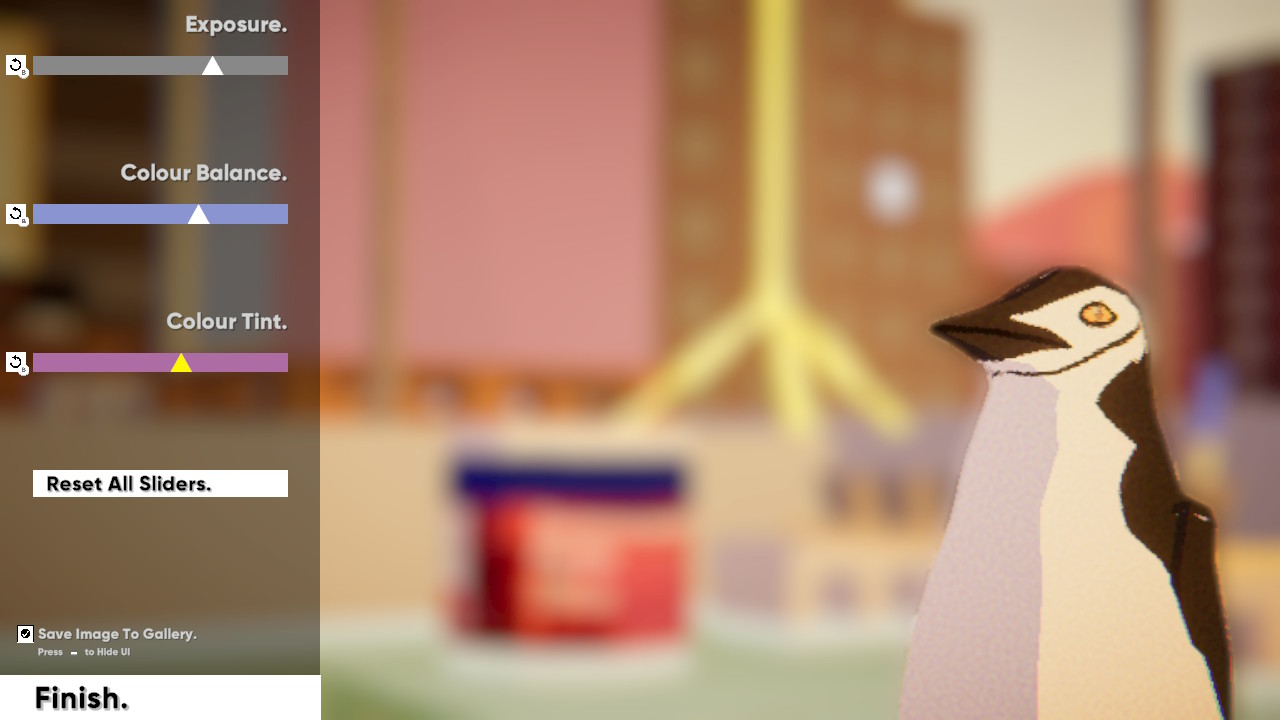
When walking around the map, the player screen takes on the look of your typical FPS game, with what would be a weapon replaced by a camera instead. When the player clicks to take a photo, the player character brings the camera to their face and the screen then imitates that of a camera display. In this screen, players are able to manipulate common camera settings such as zoom, focus, and angle or tilt. The tilt mechanic differs on the PC version and the Nintendo Switch version, the PC version utilizing keyboard controls to tilt the camera and the Nintendo Switch version allowing the player to tilt the camera by physically manipulating their Nintendo Switch device. Taking the photo moves you to a new screen in which players can edit the colors and effects of their photo. This screen also allows players to save the images they’ve taken and edited to their photo gallery. 

Photo editing screen, seen after taking a photo.

Players are allowed a lot of freedom in how they approach the gameplay of Umurangi Generation. Players are free to take pictures however they like of whatever they like within the mechanics of the game. In the game tutorial, it is made clear that there are no strict creative or composition guidelines for taking photos and that photos are graded and rewarded instead based on the amount of colors in the photo and the overall mood of the photo. Players are only ‘punished’ for photographing bluebottle jellyfish, Portuguese man o’ wars.

The game does include a ‘point system’ via money earned through taking photos, but there isn’t any explicit place to spend this currency, thus making it largely irrelevant aside from the bonus objective that can be earned in each level. This means that players are essentially allowed to photograph anything they’d like. 

EXPLORING SPACE.

Progressing through the levels of Umurangi Generation involves exploring the spaces and maps of each level, taking photos, and clearing the level-specific objectives. Each level has its own unique map that requires players to explore each time they progress. The maps do not not have any clear and distinct boundaries or edges, effectively making each space feel like a part of a larger, expansive world. Of course, the maps do still have boundaries, and when players cross this boundary or fall off the map, they will respawn back at the starting point of the map. Movement controls in the game are limited to walking, double jumping, and crouching and do not include sprinting, forcing the player to slowly explore the space. Within these controls, players are allowed to explore the space however they like, including climbing stairs and jumping to high places. 

Objectives from Level 8, depicting the the increasing difficulty of the Photo Bounties.

The objectives of each level are an incentive for players to further explore the spaces in each level. The objectives required to progress to the next level are called “Photo Bounties”. As you progress through the levels, the bounties get harder and more specific. Players have to explore the space to find specific angels to capture certain sets of things in order to clear the bounties. For example, in the first level, one of the bounties is to take a picture including 2 boomboxes, a relatively easy task. However, when we get closer to the end, players must capture a picture of something like 11 candles and 2 boomboxes, a task that requires players to explore a bit more to find a location that can capture all the objects in one frame. Additionally, each level is laced with many, many details, further driving player incentive to explore the space and discover new details.

NARRATIVE.

The story of Umurangi Generation makes use of embedded narrative. As players advance through the levels and explore more of the spaces, the narrative becomes more apparent. In each level’s map, we piece the narrative together through the various objects and messages littered throughout the map. Some of these messages are more explicit than others. For example, players are able to find news pieces in some levels showing the recent events in this world, expanding the lore, or players can find messages in graffiti.

When we view the progression of the levels and maps as a whole, we see the use of the transformation of space in aiding narrative development. We see this when objects are taken from one scene to the next or when maps recur but with a different atmosphere and context. For example, the map in Level 2 is reused in Level 5. In Level 2, the map takes on a stale, grey-toned color palette, depicting a military zone at standby. In Level 5, this map is transformed into a pitch-black kaiju warzone rimmed with blood-red lighting. Players are given hints that this is the same area through details such as graffiti and landmark objects. Similarly, in this war-ridden Level 5, players are tasked with photographing a bodybag in order to progress. In the next level, players can find the same bodybags as they explore the train on its way back from the warzone. Players can then begin to see that there is a linear narrative playing out as they progress through the levels.

Photos on the left taken from Level 2, and on the right Level 5. They depict areas taken from similar angles, showcasing the transformation of the map.

WORLD END.

“The end of Umurangi Generation is explicitly anti-cop, anti-capitalist, and anti-fascist.”

– Naphtali “Veselekov” Faulkner

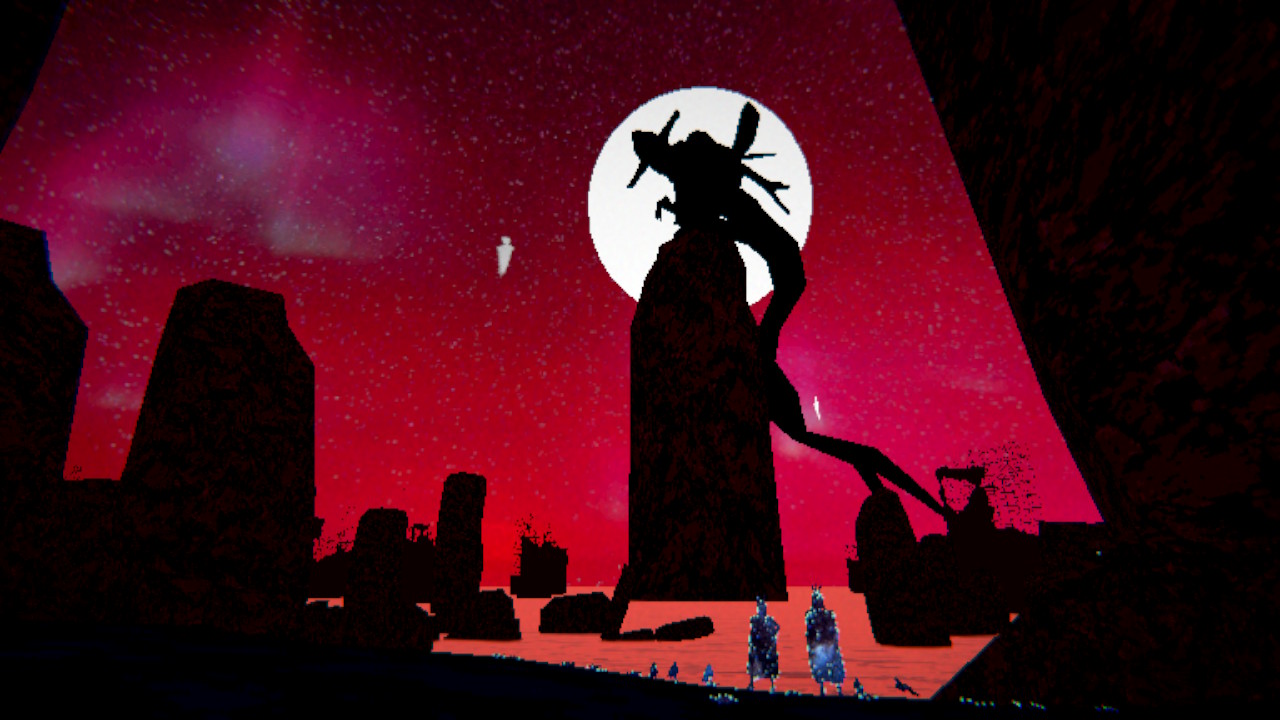
The final message of Umurangi Generation is the inevitable end of the world. The title of the game is taken from the Te Reo Maori word “umurangi”. Although the word does not have an exact translation, it directly translates to “red sky”, and its meaning akin to “witnessing the end of the world”. The word “umurangi” also makes reference to the Huia, a bird that was hunted to extinction. With Umurangi Generation, Faulkner wanted to depict a generation of people who are essentially living out the last moments of the world, the world’s inevitable end caused by the inaction of world governments in response to crises in addition to the dangers of spreading neoliberalist ideals and thought. On the game, Faulkner has said that “the end of Umurangi Generation is explicitly anti-cop, anti-capitalist, and anti-fascist.” With its seemingly free style of play and creative freedom that Umurangi Generation promotes through its gameplay, the theme then provides an interesting take on the problem of player agency against the inescapable narrative of the game. What importance does personal freedom play in a world that is doomed to end? That is the ultimate question of Umurangi Generation

A shadowy bird-like figure representing the Huia bird cloaked by the red sky.

SOURCES.

  1. https://en.wikipedia.org/wiki/Umurangi_Generation
  2. https://www.indiegamewebsite.com/2020/06/05/talking-climate-change-and-maori-culture-with-umurangi-generation/
  3. https://www.thegamer.com/umurangi-generation-interview-fascism-colonisation/
  4. https://www.vice.com/en/article/pkdvgv/how-umurangi-generation-captured-2020s-despair-and-neoliberal-decay
  5. https://medium.com/vistas-mag/the-umurangi-generation-is-asking-you-to-care-e9d02c5d2fff
  6. https://eggplant.show/76-seeing-for-yourself-with-tali-faulkner-umurangi-generation
  7. https://etao.blog/2021/06/29/podcast-112/
  8. https://www.youtube.com/watch?v=ZequjU73rBY

Before Your Eyes: A Tragic but Fulfilling Tale of Benjamin Brynn

By JJ Abu-Halimah

“So when he knew he was going to go, he was okay, because he’d already lived a great life a full life.”

Before Your Eyes is a marvelous game about Benjamin Brynn, a 12-year-old child who died young due to terminal illness. We first experience the grand life that Benny wishes that he had before reliving the dark reality that he actually faced before dying. At the game’s core is its eye-tracking system which allows players to traverse and control the narrative at their own rate to create a greatly immersive experience.

Immersive Storytelling

First Person Point-of-View and Choice

“You can’t understand someone until you’ve walked a mile in their shoes.”

We never actually see what Benny looks like in the story. We instead see Benny’s life through Benny’s eyes. This strategic form of storytelling already makes us feel as if we are Benny reliving Benny’s life, immersing us in recalling his life story. We feel more emotion and better feel how Benny’s feelings by playing this way.

One of the saddest moments that stuck with me was reading Benny’s typewriter as we see him call himself a loser and self-loathe. I instantly felt dread inside my body as I watched Benny feel and write as if he was worth nothing. Such emotion was created by living as Benny, and I do not think it could have effectively been conveyed if we didn’t play in Benny’s perspective. A great example to support this is that we didn’t know all the hardships that Chloe was feeling until we were told that her mother died. By living through a character, we better understand them, and the emotional impact of the story gets much, much more real.

To further our experience, the developers utilized another form of immersion: choice. Throughout the game, we are presented with many choices. Although they do not affect the ending, we can create our own artwork, decide to answer phone calls, choose to crumple up and throw contracts/ sheet music, and more. We even get to see the effects of some of our actions such as viewing the paintings that we created in the art gallery near the end of Benny’s idealized life. Such choice further immerses us into reliving Benny’s life, bridging choice to the narrative, making it as if WE are Benny shaping Benny’s story.

The Eye-Tracking System

The game starts us off by immediately introducing us to the eye-tracking system.

Blinking while hovering over the eye symbol on the screen will allow you to interact with objects/ take pictures, shutting your eyes while prompted to (via the shut your eyes symbol) lets you progress through and hear more parts of the story, and keeping your eyes open while the hourglass symbol appears allows you to progress while blinking inhibits you.

Forcing you to keep your eyes open such as when we had to view Benny’s dead kittens and hearing his grandfather died, allows us to better feel the horror and intense emotions that Benny experienced when he lived through those dark times. We usually had to close our eyes to listen to Benny’s parents discuss their depressing, emotional thoughts on Benny that he wasn’t supposed to hear. This made us feel more of the loss of Benny’s innocence as he was exposed to life’s cruelties.

The most prevalent eye-tracking mechanic, however, is that blinking when there is a metronome on the screen moves us to the next memory in Benny’s life, making us miss out on the rest of the game narrative from the previous memory.

One may think: but I want to see everything! Yet, the eye-tracking system hinders you from doing so – of course not so much if you hold the Guinness World Record for the longest time with your eyes kept open. However, this is a great thing narratively.  

The Ferryman tells us early on that while we may want to stay back and see all of Benny’s memories, we cannot. We watch Benny’s lives unfold before us, and the memories they hold quite literally go away in the blink of an eye. The same can be said about our lives. While we may want to stay in the present, we simply cannot and have to pursue the future. Like Benny, we cannot dwell on the great and horrible parts of our past: we must move forward.

What limiting how much we can see and hear does is make for a more real experience in that we better feel the sense of urgency that life presents to both Benny and ourselves. We get a better feel of just how fast the past goes flies away, and this immerses us in Benny’s reminiscence of his life.

Some players opt to use the mouse rather than the webcam, but this greatly reduces the immersion of the game–I know this because I had to rapidly speed through a segment of the game that I already played after the game crashed. Playing the game this way makes it feel less emotional without the feeling of life going by fast, and you miss out more on one of the most defining aspects of the game: using your eyes as a controller to see Benny’s life through Benny’s eyes.

But let’s say that you really wanted to hear everything and feel that you’d get more out of the story by using the mouse. You will reach a point where you have seen and heard everything that the game lets you, and you’ll be stuck there watching nothing new happen. This is quite boring and again reduces the immersion of quickly seeing Benny’s life flash before your eyes.

So if you ever play/replay this game; please play it using the eye-tracking system.

Efficacy of the Blink-Tracking System

While a great tool to create a more immersive experience, the eye-tracking system has both its downfalls and its strengths.

Brendan Keogh describes an “embodied literacy” in videogames where players have to adapt to the controllers/ game’s controls to better enjoy and be immersed in a videogame. While we may adapt to the eye-tracking system, it doesn’t always work smoothly. Such glitches make the game feel clunky and are distracting from the flow of the narrative by challenging our adaptation to the controls.

There are times when you may be keeping your eyes open only for the game to register it as a blink, leaving you to traverse the story much faster than you anticipated, reducing your ability to control the speed of the story. Other times, it makes it increasingly hard to get past parts where you HAVE to keep your eyes open to progress. This reduces the immersion that using your eyes as a controller aimed to initiate in the first place.

Sandy Baldwin details how eyes are “wired and directed, turned left and right” and how images and media in general “solicits my eye before I even look at it”. She says that we must “deaden” our eyes to read screens, inducing the lack of importance of our eyes and their robotic nature to just input and relay sensory information about the media we are consuming rather than playing a part in our experience, viewing the media.

However, in Before Your Eyes, we utilize our eyes as the controllers, using them to dictate the pace of the story, thus removing a barrier between our eyes and the narrative. Our eyes now become more than just machines to accept and relay sensory information to our brain as they also dictate how the media we are consuming, the game, appears to us. By doing this, the eye-tracking system greatly adds to our aesthetic and immersive gaming experience.

The Great Life of Benjamin Brynn: The End

I can’t sign off without writing about my favorite part of the game: the end.

At the end of the game, we hear Benny’s mother give him her own story of his life. Telling a depressed and dying Benny:

“So when he knew he was going to go, he was okay, because he’d already lived a great life. A full life.”

Through the Ferryman realizing that stories, especially Benny’s life, didn’t have to be grand and his mother’s story, we realize that Benny’s life, while short, was fulfilling in that he brought others hope and was thus a great life.

We are then told to close our eyes at the end of the game, overhearing Benny’s father asking, “Why is he smiling like that?”

To which his mother responds, “He must be somewhere he likes.”

Benny died at peace with himself, smiling.

This ending is beautiful. Benny reaches the afterlife, comes to terms with his life, and by closing our eyes, we are put in a position to experience Benny’s death.

This game teaches us a lot. It tells us that we don’t have to change the world or do anything else that’s grand to lead an amazing life and legacy. We can easily live a normal life and die happily even if we didn’t get to experience all the joys that life had to offer. The eye-tracking system teaches us to cherish the moments we have in the present before they go away in the blink of an eye. This ending gave me the ultimate closure I need to finish the game and apply what I learned from Benny’s life to better lead and accept my own.

References

Baldwin, S. (2016). Section 1. In The internet unconscious on the subject of electronic literature. essay, Bloomsbury Academic.

GoodbyeWorld Games. (2021). Before Your Eyes

Keogh, B. (2018). Chapter 3: With Thumbs in Mind. In A play of bodies: How we perceive videogames. essay, MIT Press.

SUPERHOT VR and the Effects of Immersion

By Ivan Messias

Immersion in Storytelling

Immersion into other worlds has been a longstanding tenet of storytelling: in order for a story to be palatable to others, the creator must immerse the audience to some degree in the world that they are presenting. The pursuit of immersion in a story was most notably expressed in The Matrix (1999), where humans are placed into a story that seemed real enough to the point of believing that it was reality. While it was used for ulterior motives within the film, the concept of a world that realistic bred, and still breeds even today, a fascination within the mind – the intriguing concept of being fully part of a world besides reality. SUPERHOT, released in early 2016, was a further extension of this – the story revolved around the player becoming more and more immersed into this world, ending with the player shooting their character in order to become part of SUPERHOT itself.

Virtual reality technology was essentially designed with the pursuit of immersion in mind, advancing immersion beyond simply sight and audio – allowing for a literal hands-on experience, with the motion of the body being the form of input into the simulated world. It represented the next leap forward in storytelling immersion – and SUPERHOT was keen to import its story into this format, with SUPERHOT VR being released later in 2016.

To my surprise, after watching a few playthroughs of SUPERHOT VR to see what I missed in the story, I discovered that what I played through myself was New Game Plus, and the story itself had already been told. The story itself proved to be as in-depth as, if not more than, the original SUPERHOT, largely due to the immersive qualities to be had in a VR environment. As such, each story scene will be dissected herein in order to define and understand SUPERHOT’s interpretation of the future of immersion.

Scene 0: piOS

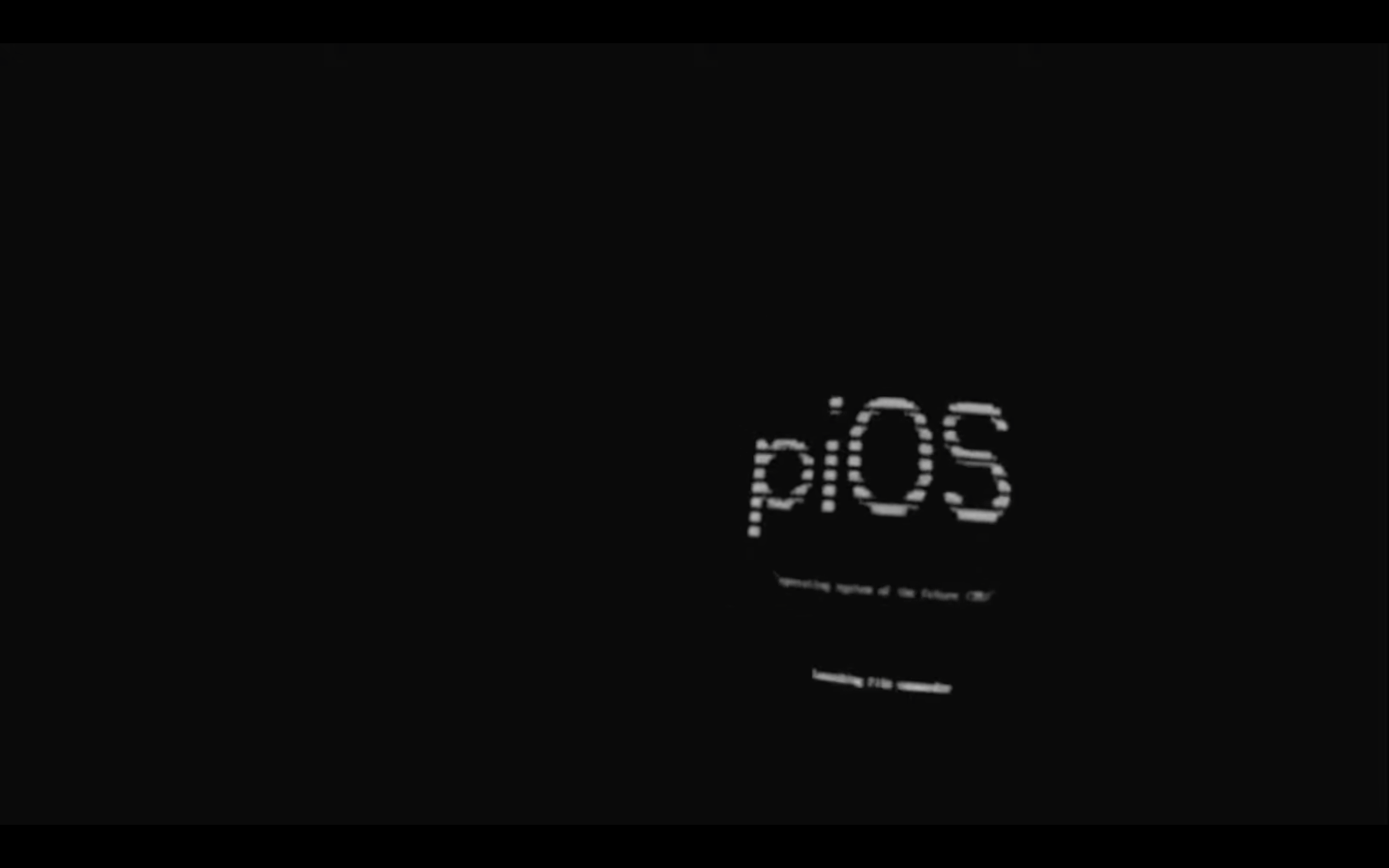
The first “scene” shown in the game is that of an operating system booting up in order to play SUPERHOT: specifically piOS, with the tagline of “operating system of the future (TM)“. This is followed by several screens in a grid being filled with static, prior to the player’s perspective being forced through the center screen and transitioning into the tutorial.

This is not so much a scene as much as it is a brief glimpse into the game’s meta-narrative. This is the first of three (possibly four*) layers of immersion, notable for being the one with zero player agency. There are no inputs required or available save for the motion of looking at the screens, with the implication that this is the player. With this in mind, the OS’s tagline serves not only as a subtle reminder that this is, indeed, a piece of science-fiction, but also as a prediction of what future technology could hold in terms of storytelling immersion.

*This is dependent on whether the person looking into the real-life headset is counted as a layer of immersion.

Scene 1: DEDICATION

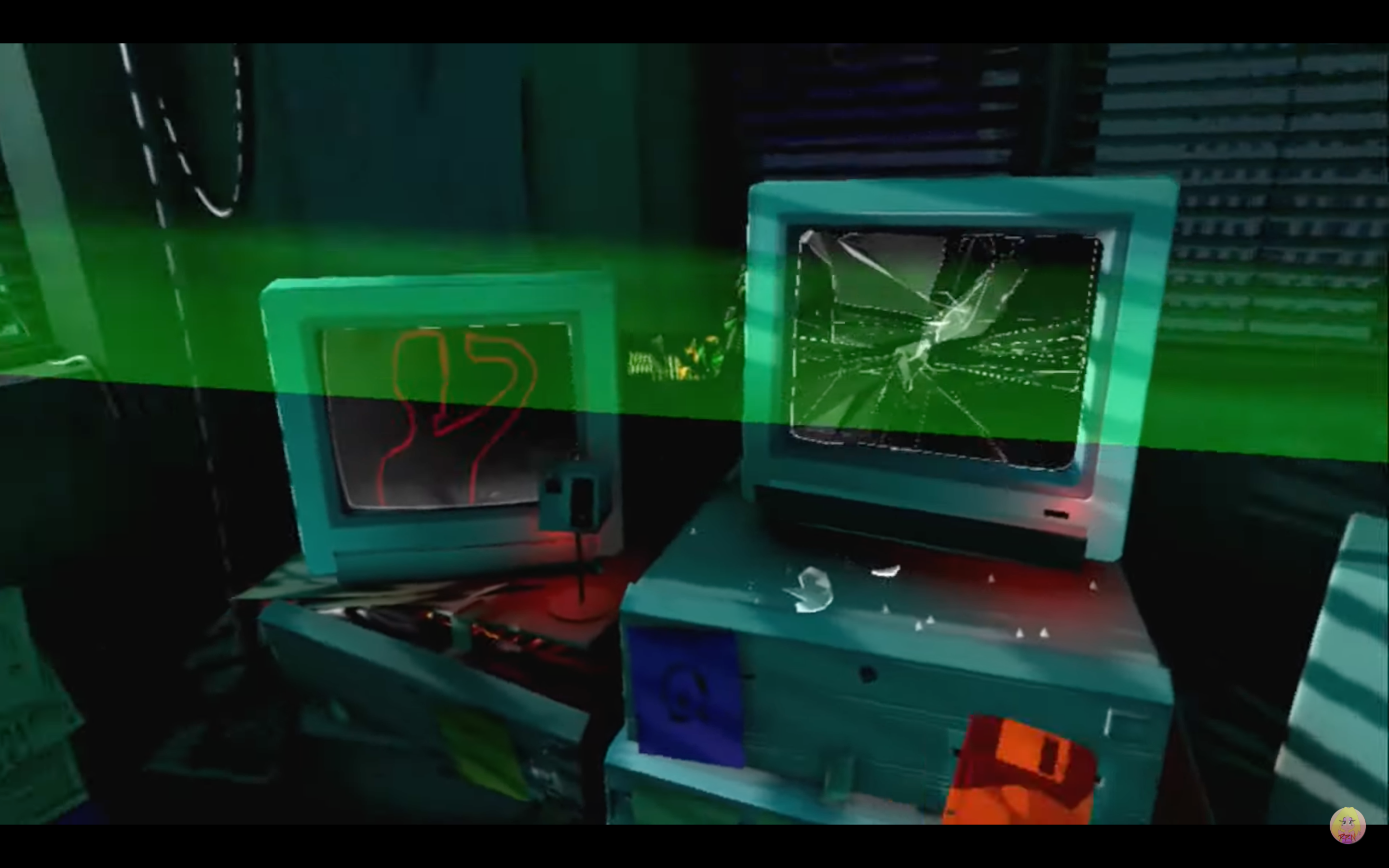
After a few levels, the player is placed in a white void, with the words “ARE YOU READY TO PLAY?” and “SHOW YOUR DEDICATION” respectively appearing in front of the player as the player is presented and picks up a gun. As the player shoots themselves in the head, the headset flies off of the person, showing a previously-unseen office space, where four computer monitors are displaying the words “SUPER” and “HOT” on a loop.

This is the first time that the player is shown a perspective outside of the core gameplay. From a gameplay point of view, there is no point to this room, and nothing to interact with save for a floppy disk that loads up more of the game. From an immersive point of view, however, it is a great help in that it presents a sort of “reality” to contrast with the surreal nature of the game up to this point. It provides a grounding point for the player, and while it may not be entirely convincing as a stand-in for real life, the reveal that so far the player has been playing in a headset in-universe does wonders in establishing a link between the body of the person and that of the actual player, using the headset as a bridging point between both forms.

Scenes 2 & 3: Hardware and Software

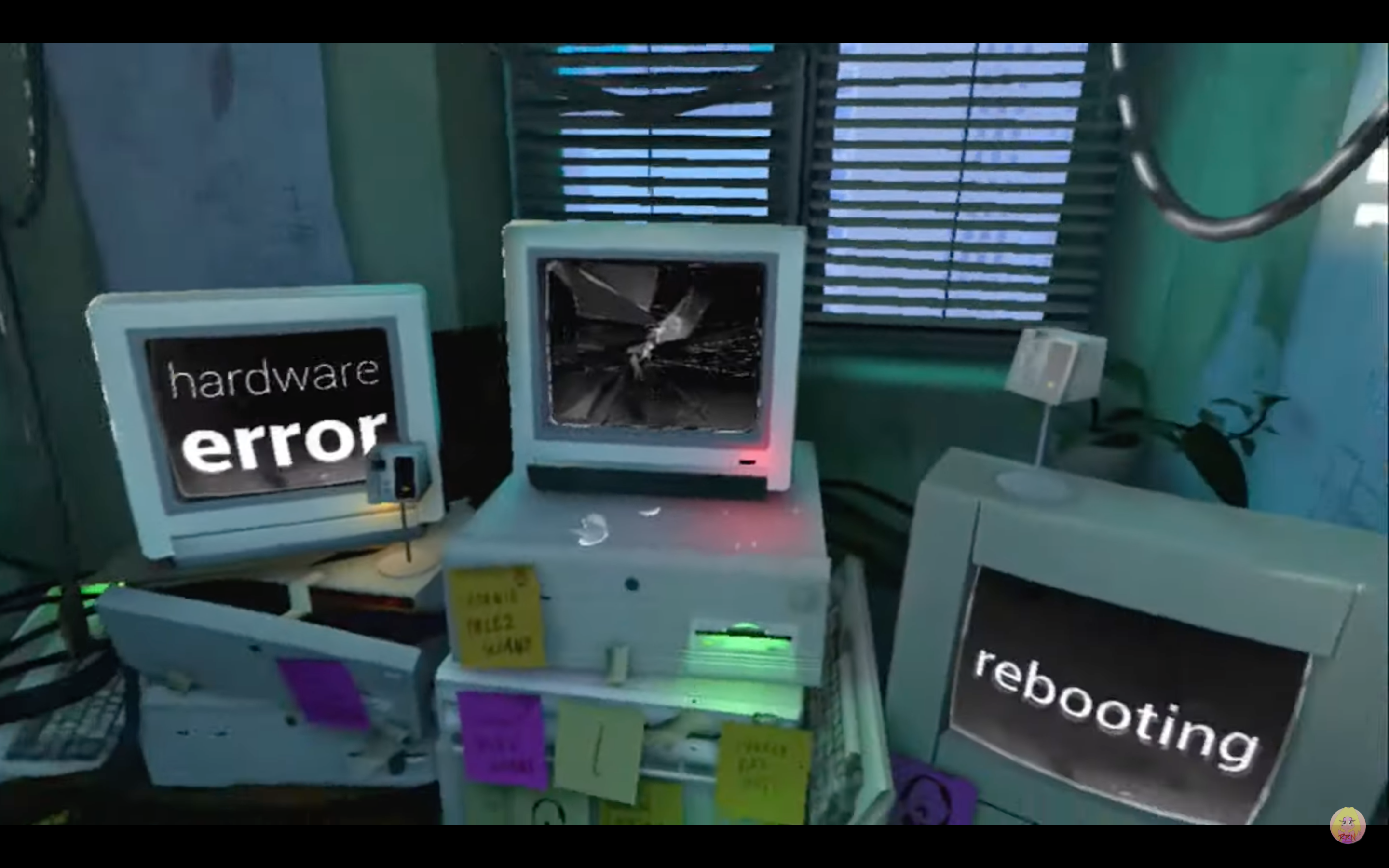
At the end of the level “Helipad”, a helicopter crashes into the player, killing them and again forcing the headset off of the person in the office. The screens in the office now say “rebooting” and “hardware error” (hardware only appearing for a brief moment).

A few more levels down the line, the player is placed at the edge of a broken window in a high-rise, with “SHOW YOUR COMMITMENT” in front of them as they look down and jump out of the building, once more resulting in the headset being forced off of the head of the person in the office. Along with some messages commending their dedication and potential, as the player grabs the floppy this time, the screens display “BODIES ARE DISPOSABLE”, “MIND IS SOFTWARE”, and the signature alternations of “SUPER” and “HOT”.

The final messages not only present the idea that the mind is transferrable, but that the previously-mentioned hardware error was a failing in the body, and each scene up to this point has reinforced this idea. In each one, the player has died, but the mind has remained to pick up another body. This also leads to the questioning of which body the player’s mind is inhabiting at any given time: is it the one that can slow down time in the levels, the one in the office, or the one currently holding two sticks to control them? The constant shifting between the second and third layers of immersion starts to break down the barrier between the mind of the player and the links to any particular body form; indeed, is not one mind controlling all three, going between them at any given moment? The notion of the mind being software leaves it free to traverse between any of them at any given time, which the player has been doing this entire time.

Scenes 4 & 5: Pyramids and Body Blending

The next two scenes are similar in nature, both featuring text urging the player to reach and destroy a pyramid, as a sign of their worth for an unspecified reward. The most significant aspect of this is how it begins to further break down the links between bodies, as the headset flies off of the office-dweller without any input or death required from the player. Furthermore, the disks gain different properties: in the first scene, one of the player’s hands becomes the disk, only briefly reappearing to put the disk inside the computer; in the second, the disk has to be inserted not into the computer, but rather into the player’s head, an action which briefly causes the office to gain the graphic simplicity of the main game and does not require the player to don the headset in order to go to the next level.

The first scene serves as more of a breakdown in what can be defined as a body, with the hand-floppy leading to a quiet contemplation of what a body has to exactly be, prior to going back into the game. The second is far more blatant, with the world of the person in the office becoming increasingly tied to that in the “game”, mirroring the blending of the perceptions held by the person in real life to that of the game world. The headset randomly popping off of the head in-game, without any requirement of input, further solidifies this, as the lack of “disposal” of the body in the game being necessary to trigger the headset disconnect makes it seem as though the office character and the game character are the same, especially as the office briefly resembles a level.

Scenes 6 & 7: SUPER HOT

Following the final level, in which the player destroys a large pyramid, the headset once more flies off of the character, and a face greets him on the monitors, saying that he did well, and ordering him to answer his knocking door. There is a small pyramid there, which opens to reveal a gun. As he says “Collect your reward”, the office character shoots himself in the head, mirroring the cause of the first true scene. There is now a black void, with “SUPER”, “HOT” flashing within. As the words stop flashing the player is transported back to the office, lit in red, with the screens saying “ONE / OF / US”, “YOU ARE NOW FREE”, “TO REPLAY SUPERHOT VR”, “FOREVER”, activating NG+. The hands in the office are now the same as the ones in the game. There are notes reminding the player that “Mind is software”.

Conclusions

SUPERHOT is a game about transhumanism, and SUPERHOT VR serves to enhance that experience for the player by allowing their own journey into this world. Instead of shooting the person in the headset, the player is the one in the headset. They are the ones that ascend and move between bodies. As they play the game, they bear witness to the disposability of bodies, and their mind is the software that moves between them.

Photo Credit

Playthrough used for screenshots: http://www.youtube.com/watch?v=QGKbGxBBDIw

Tetsuya Mizuguchi’s Problem Child

Ben Ratchford

               Child of Eden (Q Entertainment, 2011) is the brainchild of Japanese game designer Tetsuya Mizuguchi, who would be perhaps most recognizable today for his work on Tetris Effect (Q Entertainment, 2018). The game spotlights the music of his band Genki Rockets in its core gameplay and is thematically designed around the band’s (virtual) frontwoman, “Lumi.” It is not an exaggeration to say that Child of Eden is a realization of purely his artistic vision.

               To understand what Child of Eden is trying to do, then, it’s helpful to look at Mizuguchi’s history as a game designer and as an artist more broadly. Mizuguchi got his start making racing games for Sega, where his first big hit was the 3D racing game Sega Rally Championship (1995). After three years of work on this property, Mizuguchi says in an interview with the New Statesman from 2017 that he attended a party in 1998 that turned his gaze permanently to music and movement, to dance, and in particular to “synesthesia” (his word). Following this we saw the release of Mizuguchi’s first musical game in 1999, a rhythm game for the Dreamcast called Space Channel 5 (Sega). This was followed by Rez (Sega, 2001), a musical rail shooter (to which Child of Eden is the sequel), a series of puzzle games, a VR-compatible version of Rez with updated graphics titled Rez Infinite (2016), and eventually Tetris Effect in 2018.

               Mizuguchi also started Genki Rockets in 2006, a virtual band which featured Lumi, played by (then merely 13 years old) Yusada Rei as its frontwoman and lead vocalist. Like much of Mizuguchi’s work, they enjoyed a rather dedicated cult following that lasted into the 2010s. Genki Rockets concerts, Rez, Child of Eden, Tetris Effect, and even some of the lesser-known puzzle games of Mizuguchi all share a theme—synesthesia. In this case, what is meant is a multisensory experience involving the blending auditory, visual, and in some cases kinesthetic elements to create a totalizing gameplay experience.  Mizuguchi labels himself as a “futurist” or “technologist,” rather than a game designer, and claims to be interested always in bringing the height of interactivity and immersion to his works.

               Mizuguchi’s visions ultimately were realized in VR, a medium which he has strived to work in ever since it became possible to do so. This technology, it seems clear, has been most able to meet his desires for totally immersive games with broad range of opportunity for artistic freedom. Whether these are successful as synesthesia (or, for that matter, as art) is somewhat beside the point; there can be no denying the immersive power that these games have when played with a VR headset, and in my experience with, e.g., Tetris Effect, they really work as coherent and immersive audiovisual experiences. They’re fun games, in short.

               Child of Eden, on the other hand, we might treat with a slightly different attitude.

               Child of Eden was released on Xbox and Playstation, compatible with the Kinect and Playstation Move respectively. The game itself is a musical rail shooter, like Rez before it—somewhere between a rhythm game and an arcade game. The player is meant to time their attacks to the beats in the Genki Rockets tracks which comprise the game’s OST, and by doing so they may score sufficiently high to progress through the game’s six levels. If done correctly, the whole game can be completed in about an hour.

               And with the magic of the Kinect, they can do this using nothing but their hands! Mizuguchi likens the actions of the player to those of a conductor; with the right hand, the player controls a blue lock-on laser attack that is released by a (rather vigorous) flick of the wrist, and with the left hand they may aim an auto-firing purple machine gun. These two attacks share a reticle, and cannot be fired at the same time, which led to some rather frustrating moments of trying to switch from one hand to the other under the duress of timing and having the cursor snap from one side of the screen to the other as the Kinect suddenly recentered its gaze.

As mentioned, the game centers around Lumi, canonically the first human to be born in space (somewhat absurdly, on 9/11, 2019), who lives her whole life on the ISS, never setting foot on earth. Ostensibly, her consciousness and memories are preserved on the internet (redubbed “Eden” by subsequent generations) centuries into the future. This is where the game is set to take place: 22XX, Eden is beset by computer viruses that threaten to corrupt and destroy Lumi and her memories, and the player is set up as a hacker who can traverse Eden and purify it of its viruses. This is rather similar to Rez, which also positions the player as a hacker traversing a futuristic artificial intelligence named “Eden.”

The visuals in game consist of a strange blend of elements. Some enemies (or obstacles, as the case may be) are simply geometries, like in Rez, even carrying through some of the same color palate from that game—orange cubes, purple cubes, grey spheres, and the like. Some completely diverge from this scheme, however, and the game features whales, jellyfish, flowers, stingrays, worms(?), and, most prominently, Lumi herself, in the form of a live action recording of Yusada, in several of the levels, often with corresponding bright colors and full-screen movements and light-shows, all set to-time with the soundtrack.

This divergence in style can be attributed partially to the time past since Rez, and the Child of Eden team wanting to take full advantage of the suite of technology at their disposal. It’s probably also partially attributable to the production teams for each level being totally separate, with Mizuguchi being the only common factor between them.

Whether this all coheres into one singular experience is probably a matter of taste, but for me I the technology falls short of providing the intended experience somewhat. Essentially the problem is twofold: first, the Kinect is not a very good device. Second, the story is totally not fit to the gameplay.

Speaking about the Kinect, it’s useful to bring in Melanie Swalwell’s discussion of the kinaesthetic [sic] sense of gaming in her essay “Movement and Kinaesthetic Responsiveness: A Neglected Pleasure” (2008). Swalwell, in analyzing the psychological responses of gamers in a LAN hub to playing their games, correctly identifies (among other great points) the development of an embodied literacy as a key component to the enjoyment of gameplay. What is meant by this is the acquisition of skill, for one, and a corresponding kinaesthetic sense for what motion is achieved when performing the actions required by dynamic and, often, difficult gameplay. She’s referring to the natural sense that skilled gamers have for the way that their motions in interfacing with the controls for a game influence the game world—this well describes the way that a dedicated tetris player might conceive of what it is like to move the tetrominos, or what a skilled Soldier player in Valve’s Team Fortress 2 might feel as they perform a rocket jump, a technical maneuver that requires skill, practice, and a high degree of in-game awareness. In practice, this amounts to a kind of flow state, an (embodied) identification with the player character and an immersion in the diegetic world of the game.

When playing Child of Eden (as it was intended, with the Kinect), for me this flow state was simply impossible to find, and this experience was common among those who tried it. The simple answer for why this is the case is that the laggy and inaccurate Kinect response to my motion introduced an insurmountable barrier to identification of any kind with the diegetic world. This effect would have been somewhat mitigated if not for the game’s insistence on the precise timing of actions to correspond with the music (that it wasn’t totally clear when the crescendos were is beside the point here. I am not a fan of Genki Rockets, and if you are, maybe you would have a better experience here). However, as things were, I was left continually frustrated in my efforts to control the reticle with any degree of consistency, let alone elegance, and the repeated casting motion with my right arm became more of a physical strain than an integrating element.

Secondarily, there exists a rather severe ludonarrative dissonance in the presentation of the game, in which the Lumi plot, despite being consistent throughout the game, feels like an afterthought. The game would have been totally unchanged if this bit of setting were left out. Aesthetically, Mizuguchi’s creative direction leaves a lot to be desired here, and the whole thing (like Genki Rockets) reeks of new-agey end-of-history type vapidity that I simply can’t overcome. In another interview about the game, Mizuguchi declares that the central theme of his work (besides the synesthetic experience) is, simply, “happiness.” What this could possibly mean is, besides being of no interest to me, beyond the scope of this essay, but I think it is obvious from his work that his talents are best left to game design rather than storytelling.

This is not to declare Child of Eden, or Mizuguchi’s ouvre, a totally unsuccessful project; what Mizuguchi intends to do with the technology, although a failure here, is certainly an ambition worthy of our attention, and sees success in later titles. As VR games grow in number and quality, and as the tools to create these games become available to a wider field of game designers and artists of all kinds, we may look to this (frankly) funny experiment as one of many meaningful efforts into the realm of unknown that helped usher in a new paradigm of game design, the ramifications of which are truly still yet to be known to us.

References

  1. https://www.newstatesman.com/culture/2017/07/how-tetsuya-mizuguchi-reinvented-video-games-his-love-synaesthesia
  2. https://www.siliconera.com/tetsuya-mizuguchi-interview-illuminates-child-of-eden/
  3. https://www.youtube.com/watch?v=ayWV7XNRxK8
  4. https://en.wikipedia.org/wiki/Tetsuya_Mizuguchi