The Return of the Obra Dinn: An Introspective

By Bruno Pasquinelli

Return of the Obra Dinn, released by Lucas Pope in 2018, took me by storm when I first experienced it. During spring of my freshman year, I had a weekend that was empty, and I decided to start it on a Friday night, unaware of what I was about to unleash upon myself. After playing for about 20 minutes, I was absolutely hooked, but had to go to sleep. The next day, I woke up, went directly to my computer, and played through the entirety of the game, stopping only to eat and use the bathroom. After singing its praises for months, I was recommended The Outer Wilds, which is the only game to date that has had a comparable hold on me. In hindsight, Return of the Obra Dinn is what set me down the path of studying and making games in my college career.

Beyond my personal engagement, Obra Dinn is an incredible example of developing and iterating upon a mechanic to keep the player on their toes. Whether it’s the introduction of death replays within death replays (within death replays within death replays,) or the death of a cow, or even the question of the fates of those that did not die onboard, Obra Dinn takes its central active mechanic, the Momento Mori, and fully explores it on the ship. In my own playthrough, the process of discovering another corpse and its subsequent replay was a wonderful ritual, with me excitedly following around the spirit trail thing around the ship, however, I know that others found this repeated sequence onerous and frustrating. Obra Dinn does little to explicitly guide the player at any point, and these animations, the difference between spearing spiking and stabbing, as well as the difficulty of traversing the ship to watch a specific sequence adds a lot of friction. I appreciated this friction, giving me time to think about what was occurring on the boat and retracing my steps (literally) often gave me inspiration for what I should do next. However, I contribute a lot of this to my playing of the game in one sitting. For others who may be playing across days in 2 hour chunks (I really, really recommend against this, play it in one day if you can!)

This added friction exacerbates the difficulty of playing it across an extended period of time. Essential details can be small and scattered across scenes, and having to walk across the boat, spending precious time could be really bothersome. However, in a time of vapid, vacuous open world games filled with endless slop. Having each and every item in a scene be important feels very rewarding as a player who enjoys taking the time to look at these details. For instance, in the sequence of the sailors playing cards, different characters can be identified by the number tag on their sleeping bag, which corresponds to their number on the crew list. All of this is to say that Obra Dinn is not a game for everyone, and not just from friction. There are no hints, and fates are only confirmed in batches of 3, which may feel like a boon early on, allowing you to guess and check, becomes brutal when you’re down to the last 10 or so fates. Additionally, with nearly the whole game taking place on a boat, the rocking and bobbing can cause intense motion sickness as well – there are minimal graphical options, and none that can really reduce this sensation.

Finally, my thoughts on the story – I found the characterizations very powerful, considering many characters only get a handful of lines and brief moments to memorialize them. The voice acting is fantastic, and there are many lines like “Enough! Captain cannot be trusted.” that have stuck with me for years since I first played this game. The time period on display is one that is really different from the one we live in now. You play as an insurance investigator, meaning your goal is not one of justice or knowledge, but rather one of appraisal and write-offs. Everyone must be accounted for, not because of a nation’s responsibility to its citizens, but instead for payout purposes.

However, this difference in time also poses some issues that don’t sit well with me, and illuminate comfort levels with various forms of profiling. The nationality of every character is listed, and this often plays a role in their identification. The one Irish character has a strong Irish accent, giving him an identifier, and something similar happens with the Bosun onboard. These were forms of identification that I felt comfortable with when playing, however, that comfort changed when the game indicated that I could identify Maba, the only New Guinean crewmate on board.
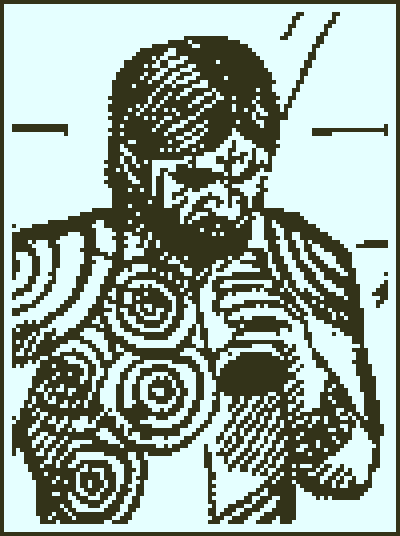
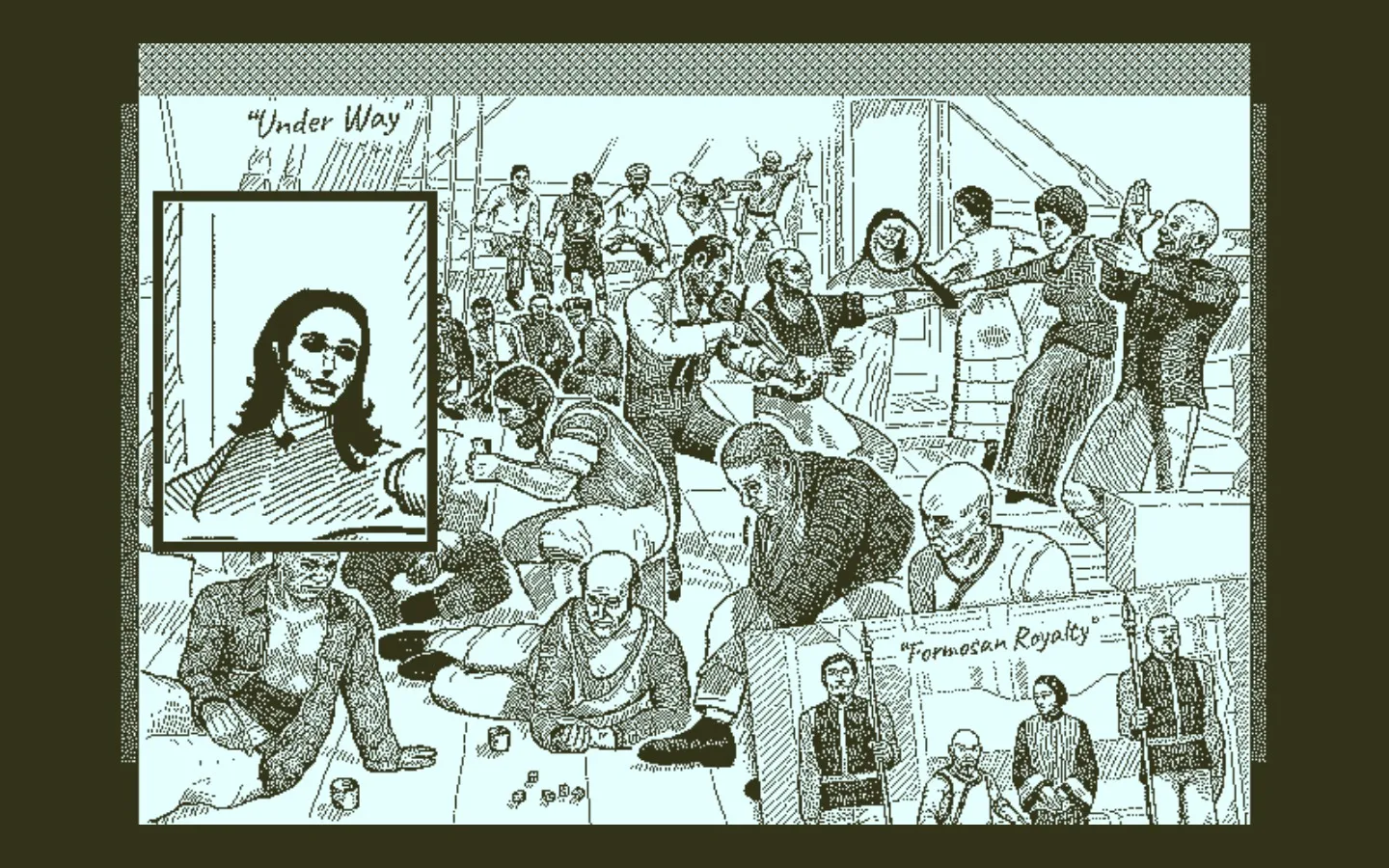
For those who haven’t played Obra Dinn, character’s faces become unblurred when they are potentially identifiable based on the replays you’ve seen, and the fates you’ve confirmed. Maba is torn apart by a kraken, and is immediately identifiable afterwards based upon his tattoos. His identification difficulty rating is 2/3, suggesting it is not too difficult. When I first played through Obra Dinn, I didn’t feel comfortable profiling Maba solely off of his tattoos, rather believing that I had missed some other aspect of information to identify who this poor soul was. While I appreciate the historical dynamics at play, Obra Dinn is expecting me to racially profile this man in a way that felt distinct from the other examples, based off my limited knowledge of New Guinea and other Pacific Islands. More specifically, “This man has pacific island-y tattoos, and there’s one guy from the pacific islands” as a train of thought is not one that I like to entertain in my life. There are some other small issues I have with the plot of the Formosan Royalty, but those aren’t as pointed or as coherent so I shall save them for another time.
Setting and Storytelling in Obra Dinn

by Jacob Wilson.

The Return of the Obra Dinn is a truly interesting game in the mystery genre. I played it for about 3 hours and enjoyed it. Set in 1807, the premise is that you, as an insurance investigator for the East India Company’s London Office, must figure out what happened to the 60-person crew of the titular ship that was declared lost at sea in 1803. Did they all die? And if yes, how?

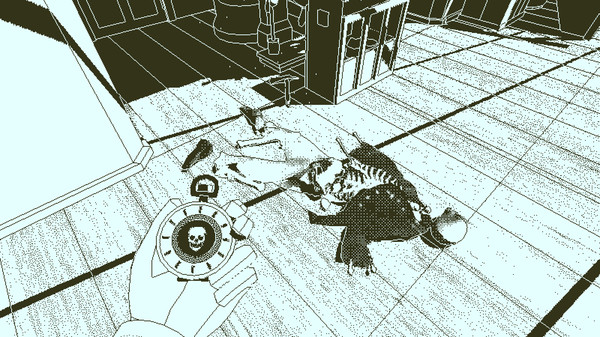
If that sounds like a daunting task, that’s because it is. Realistically, it’d be impossible, but if one finds a corpse (whether it is physically there or not) and uses a magical pocket watch, they can travel back in time to explore the exact moment when a character dies and hear some of the preceding dialogue. This device may initially seem to defy the rules of detective stories as we discussed due to its supernatural powers. In effect, though, it’s really not much different from having a third-person narrator like in And Then There Were None, wherein this style of narration was well used.

The pocket watch also quickly becomes normalized in this world once you realize that the legendary Kraken and odd spider-like creatures that shoot spikes also exist. I did not expect to find these elements in the story, but in retrospect, one could’ve expected it due to the magical watch. In its mixing of history and fantasy, the setting is thus reminiscent of Pirates of the Caribbean and quite unique in the mystery genre. Said monsters also behave consistently and do not seem to violate the laws of physics, effectively making them bizarre animals as opposed to devices that would violate the rules of detective stories by leading the player to unnatural and illogical conclusions – they are, perhaps in a twisted sense of the word, natural. One may compare this usage of animals to the snake in The Case of the Speckled Band or the orangutan in The Murders in the Rue Morgue. However, Obra Dinn’s use of animals is, rather than being the key to a puzzle that you aren’t supposed to expect, entirely unconcealed, which feels fairer to me.

The game’s way of revealing information makes for an engaging if perhaps imperfect blend of storytelling and puzzle-solving.

Players can identify the crewmates by their social standing on the ship (an expansive list of naval terms is used), their names, their appearance (clothes, facial features, tattoos, etc.), or their accents/nationality. Since you are only granted a split second of visual information, the visuals don’t give you the most exact portrayal of events, and neither does the audio, which doesn’t always tell you who exactly is speaking and at what time. This implores the player to use their imagination and pay attention to what few details they get. It makes for a fun challenge that can be solved in multiple ways, which allows for a varied player experience, but at the same time, the spread-out and sporadic pacing of revelations along with the paucity of information given in each scene made me feel that I was making very little (if any) progress. This remained true even as I binge-watched the stories of so many corpses, a process that eventually became exhausting. That said, I think Obra Dinn has an interesting way of storytelling that may only be possible in a game… the omission of so many details might seem more out-of-place in a movie or book.

The dialogue and overall narrative also suffer slightly due to the game’s structure. Some aspects of character interactions feel obligatory rather than natural, such as one crewmate addressing another as “you bloody Dane” or one of the Austrian characters saying “Verdammt.” To me, the former seems like too weak of an insult to use against the man who you think killed your brother, and the latter feels like a silly cliche equivalent to a French character in something unnecessarily saying “bonjour” and “mon dieu!” Nevertheless, I recognize that Lucas Pope had a very difficult job when trying to balance the difficulty in this game, so it’s a forgivable sin. These clues did help me pin down some identities after all.

The presentation of events out of order and with limited context also shifts the game away from properly employing the three standards of detective stories: means, motive, and opportunity. Means and opportunity naturally remain in play, perhaps only because they integral to the gameplay, but motives may remain a mystery for a long time or are stated very bluntly as in the case of that “bloody Dane.” Even if events are presented out of order, this order is thankfully indicated, unlike in Cain’s Jawbone. I could imagine myself eventually figuring out motives through playing more of the game and seeing how more of the story unfolds, but the lack of attention towards them means the story lacks the psychological depth and stakes it could otherwise have. It’s interesting enough that the first thing you see is the captain killing two crewmates and then himself at the start – it’s unexpected and also something that incites curiosity within me. Why did he do that? How did we get here? Other scenes taken out of context may arouse curiosity in this way, but after playing the game for longer, that curiosity waned due to having very few clues about people’s identities. It’s truly an interesting game and truly an interesting narrative, but it’s a bit unsatisfying in this sense.

Overall, I’d say the narrative execution of the Return of the Obra Dinn isn’t quite as solid as in other stories we have read and perhaps other games we’ve played… but don’t let my critiques detract from the fact that this is a fun game with a great, mood-enhancing soundtrack. I highly recommend it if you’re up for a challenge.

The Case of “The Case of the Golden Idol”: The Golden Idol of Puzzle Video Games by Sallie Hinkle

In the ever-evolving landscape of the gaming industry, few titles manage to strike the delicate balance between nostalgia and modern innovation as successfully as “The Case of the Golden Idol” (2022) does. With its charming blend of a 1990s video game aesthetic and an old-timey setting, this indie gem captured the hearts of players young and old and has found much commercial success. Yet, its triumph wasn’t solely rooted in sentimentality; rather, it deftly intertwined these nostalgic elements with intricately detailed technical mechanics that resonated deeply with a modern gaming audience. In this blog post, I delve into how “The Case of the Golden Idol” achieved its remarkable success by bridging the gap between past and present, offering a compelling experience that appealed to both retro enthusiasts and contemporary gamers alike.

With its glowing reviews and widespread acclaim, “The Case of the Golden Idol” stands as a testament to the enduring appeal of well-crafted video games. Yet, amidst the chorus of praise, one question echoes resoundingly: what propelled this game to such heights of success? Delving into the intricacies of its design and execution, it becomes evident that several key factors underpin its triumph. So, what precisely did the developers achieve to earn such adoration? Let’s dissect their accomplishments, categorizing them into three distinct pillars that formed the bedrock of the game’s success: Nostalgia, Narrative, and Technical mechanics.

Nostalgia – Imbued with a charmingly retro aesthetic, “The Case of the Golden Idol” harks back to the vibrant palette and pixelated graphics reminiscent of 1990s video games. Every scene is a meticulous homage to the era, brimming with intricate detail that evokes a sense of warmth and familiarity. This nostalgic allure is further amplified by the game’s immersion in the detective genre, a sphere steeped in the mystique of bygone eras, where secret societies lurk in the shadows and intrepid gentleman-sleuths unravel decades-long conspiracies.

Yet, what sets this game apart is its ability to transcend mere homage and resonate deeply with a modern audience. In an age where retro aesthetics are experiencing a renaissance across various pop culture spheres, the decision of the developers to tap into this zeitgeist proved astute. By deftly blending nostalgia with contemporary sensibilities, “The Case of the Golden Idol” strikes a delicate balance that captivates both seasoned gamers yearning for a nostalgic trip down memory lane and newer players intrigued by the allure of retro gaming. This strategic fusion undoubtedly played a pivotal role in the game’s resounding success upon its eagerly awaited release.

Narrative – The narrative in “The Case of the Golden Idol” is not only meticulously crafted but also ingeniously structured to offer players both freedom and guidance. While players have the liberty to explore and investigate at their own pace, the game subtly nudges them back on track if they veer too far off course through the use of a specific mechanic that states if their deduction is correct, slightly off, or very off (see below). This delicate balance ensures that the narrative unfolds smoothly without sacrificing the player’s autonomy, allowing them to fully immerse themselves in the narrative as an active participant.

This image depicts the “Thinking Panel” of the game. At the top of each section is a notice in green that reads “The scroll is filled in correctly.” This indicates that the player has solved the puzzle and attributed each clue to its correct deduction. Only once the scroll is complete can the player then proceed onto the next puzzle. In the event that the scroll is not filled correctly, the notice at the top will read “The scroll is filled incorrectly” in red, or “Two or less are incorrect” in yellow, indicating that the player has made some number of false deductions.

Additionally, each deduction made by the player unveils a piece of the puzzle, with optional hints available to tailor the level of challenge to individual preferences. Progression through the game is contingent upon making correct deductions, creating a sense of accomplishment and immersion. Importantly, information gleaned from earlier scenes often proves crucial in later stages, fostering a sense of continuity and depth in the storyline. This interconnectedness between scenes lays the groundwork for a larger, overarching narrative that gradually unfolds as players delve deeper into the game. As a result, the narrative becomes a tantalizing incentive for players, serving as a sweet reward that motivates them to unravel the mysteries lurking within the game’s intricate plot.

Technical Mechanics – as previously mentioned, the game makes use of a system of guidance for the players which includes both subtle nudges in the right direction and the option to engage with hints. The game developers actively discourage use of the hint system, wanting players to come to the correct conclusions on their own. One review of the game by Nicole Carpenter reads “There is a hint system that offers clues — still vague and full of riddles — designed to lead you toward answers. But the developer does caution the player from using this system without consideration; there’s no real reason given, but my best guess is that developer Color Gray wants players to take the time to consider each scene in depth, and arrive at Eureka! moments on their own.”

This hint system has received other negative reviews, overall seeming to be a point of contention within the player base. News editor Jay Peters writes “When you click the “Hints” button, the game shows a prompt, another prompt forces you to solve a puzzle, and then you can pick a hint. Even after all that, the hints themselves don’t directly give you answers; they’re just a clearer piece of information about what’s going on in the scene. It’s a clever system, and I appreciate the spirit of wanting the player to work everything out for themselves. But for the amount of work involved, I wish the hints gave clearer answers.”

Conversely, another technical aspect of the gameplay garnered significant praise—the implementation of a “disembodied” player. Instead of assuming the role of a traditional detective, players embody an omnipresent entity devoid of specific personality or appearance, preserving the game’s immersive illusion. This approach grants unrestricted access to investigation areas, eliminating the frustration typical of locked doors or undisclosed locations in other detective games. Developers balanced this omnipresence carefully, requiring players to discern which in-game characters would logically possess access to certain areas or information to arrive at correct deductions. Despite the player’s unrestricted observation, the game world remains bound by its own rules and limitations.

To end, I would like to include a quote from Nicole Carpenter that hits at the heart of why this game is so successful. In her review, Carpenter writes “The Case of the Golden Idol is a game that makes me feel like a TV detective, slapping photos on a wall and drawing red lines between them. Those strings of yarn crisscross throughout my notebook, connecting characters and murder weapons and motives. It’s easy to get sucked into small details looking for a lead, but the feeling it gives when I’ve locked in the correct answers… It’s like I’m the most brilliant person on earth — even if just for a moment. The Case of the Golden Idol, like other deep detective games, expands past its own boundaries and into the pages of my notebook, leaving me thinking about its clues long after I’ve closed the game.”

Link to Jay Peter’s Review: https://www.theverge.com/23433741/the-case-of-the-golden-idol-review-pc

Link to Nicole Carpenter’s Review: https://www.polygon.com/reviews/23433618/case-of-the-golden-idol-review-return-of-obra-dinn-detective-game