Breaking the Glass: Engaging With Space in Playtime

by Julia
University of Chicago CMST 10100, Intro to Film
Spring 2015

Jacques Tati often liked to say that the only real star of his film Playtime (1967) was the set itself. With his brilliant manipulation of its mise en scène, those words hold to be quite true. The minimally dialogued, loosely plot-based film is mainly structured around the changing of settings. As the movie goes on, an apparent pattern emerges among the scenery—it almost entirely consists of grey, pristine buildings, from the steely Orly Airport to the shiny new Royal Garden restaurant. Tati establishes this foundation in order to build up and play with the dichotomy of public and private space. Throughout the film, he juxtaposes these two ideas and questions the boundary that divides them.

The only moment of private space we see in Playtime is when Monsieur Hulot’s acquaintance from the army invites him into his recently bought apartment. However, Tati takes this scene and challenges the extent to which the space could be deemed personal. First off, the design of the apartment complex remains consistent with the public buildings that we have previously seen—grid-like, silver, and clean-cut. In the below collage of the six main scenes in the movie, the apartment (middle picture of the top row) blends right in with the other buildings of this ultra-modern world. By making the aesthetics of families’ homes parallel that of public locations, the distinction between them becomes slightly blurred, for our expectations of how the two different spaces should look are challenged. Tati creates a disturbance in what we think we know—if we are not certain of how a private space should appear, do we even know how they function?
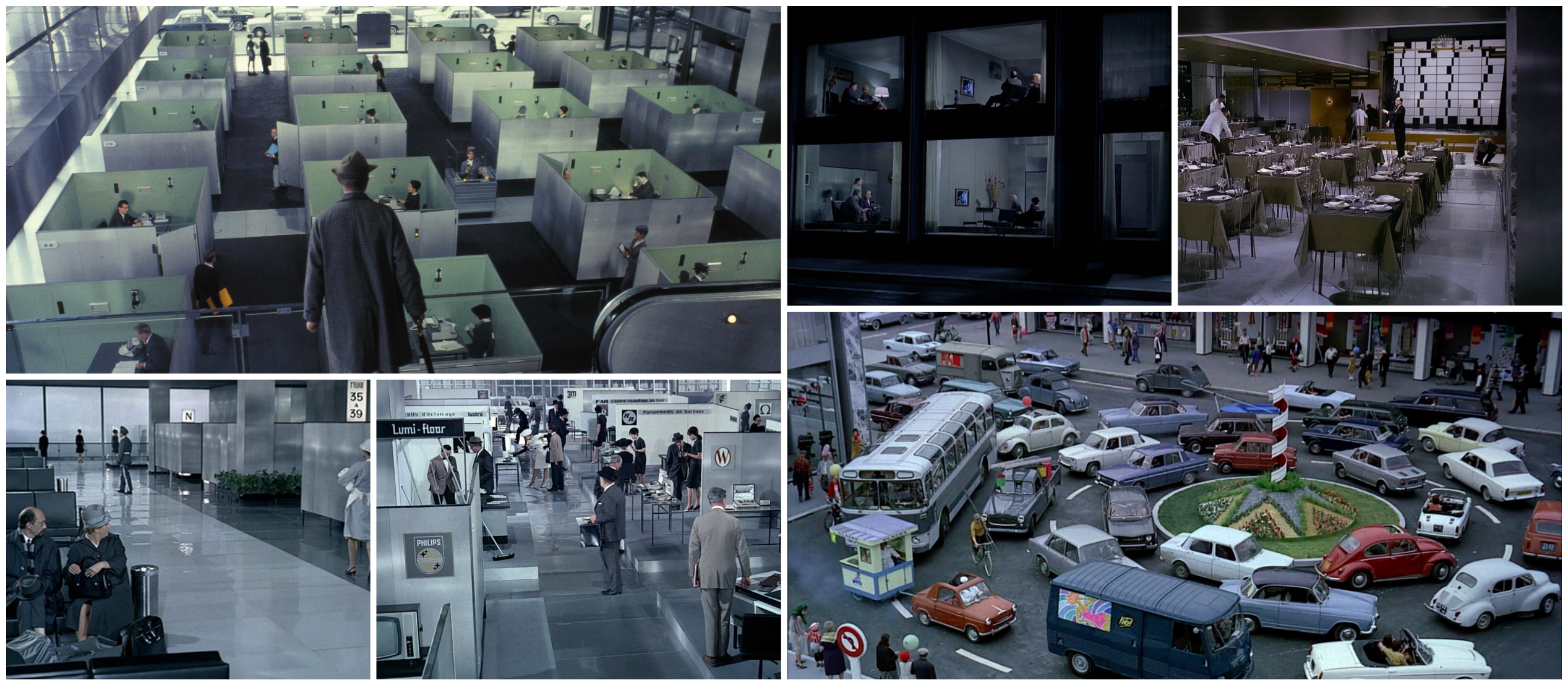
collage of scenes

As the scene unfolds, Tati continues to blur the line by showing each apartment in the complex watching TV. With each group partaking in the same form of entertainment, it appears as if they are all involved in a public activity while in their supposedly private space. A connection is established between the apartments by cutting to a zoomed-out shot revealing all four apartments in the complex. Our eyes are drawn to Hulot and his friend by the high-key lighting used on them contrasted with the remainder of the frame in dim lighting. We then witness Hulot and his friend looking up at the ceiling, as if they are looking right at the couple in the room above them. This first moment of play between the different apartments foreshadows the extended gag that is to come.

men looking up

Tati sets up the gag with two establishing shots: one angled so we can see the room with Hulot and his friend in full view, and another angled shot so we then get to see the apartment to the right of them. In doing this, it is pointed out to us that the televisions of both rooms share the same wall. The camera cuts again to focus on both rooms straight on, making them appear as if the two rooms are looking at each other. Tati then plays with this illusion, first having it look like the left room is watching the right room, with the reactions of the left timed perfectly so it seems as if they are responding to what is occurring in the room next door rather than the television. When the woman touches the man’s bruised nose, the people in the left room immediately yelp and cringe.

The gag continues in this way, such as when the man on the right begins taking off his work clothes and the parents in the left room subsequently tell their daughter to leave the room. By blending the activities of the two rooms, Tati emphasizes the overlap in what each room is doing, and thus questions their use of private space.

Other aspects of this scene further address the question, such as the choice of stationing the camera outside of the apartment complex. It is as if the viewer is respecting the privacy of the home, for we cannot hear the dialogue inside. Instead, we just overhear conversations of passersby since they are walking in a public area.

outside conversation

And yet at the same time the privacy of the space is still uncertain, considering we can still see everything that is happening inside the rooms due to the big glass windows. Even an entire group of American tourists was able to gaze into the apartment as they passed by on their bus. This scene in Playtime addressed how we define private space and whether it is all that different from the area of the public.

Screen Shot 2015-06-08 at 6.34.08 AM

The exploration of this concept continues into the scene of The Royal Garden restaurant. At this point, Tati begins to demonstrate various attempts of creating a private space within the public realm in an effort to draw attention to the arbitrariness of these distinctions. We see this being played out with the role of the doorman. Since the restaurant can only accept a certain amount of people, the doorman controls the flow of people and who is let in. However, this exclusivity is completely illusory—a physical barrier of glass is the only thing preventing the general public from entering the restaurant. When Hulot accidentally shatters this glass door, there is no longer any obligation to acknowledge the nonexistent boundary.

This point is further emphasized when a man drunkenly walks straight through the “door” and into the restaurant, despite the doorman’s efforts at creating an illusion of the door still existing. The restaurant’s attempt at privatizing a public space ended up failing, for the line that divides the two realms is not easily maintainable since the line itself is fairly ambiguous.

Another example of an endeavor of creating privacy in the public is when the American businessman, Mr. Schultz, tries to create a “VIP” area inside the restaurant by only allowing people with the chair imprint on their back into the space. Tati calls attention to the absurdity of the concept of a privatized VIP space in a public restaurant. He demonstrates this with Mr. Schultz’s humorous judgment on who makes the cut and who does not. The silly requirement that Mr. Schultz enforces pokes fun at exclusivity and what defines it. The absurdity is further exaggerated due to his chosen place, which is definitely not a VIP area. It merely consists of a corner of the restaurant that was deconstructed by the rowdy dinner guests. The blown fuse is the finishing touch for this exclusive space of the elite.

Playtime puts to question the definitions of public and private, and how they restrict the two from blending into one another. Tati challenges these restrictions by organizing humorous situations and playing around with space—both the concept of it and its physical makeup. Through this film, he teases people’s attempts at imposing distinctions between public and private spaces while at the same time distorting those divisions. Jacques Tati pulls off making a joke of this idea while he playing around with innumerable gags in this delightfully whimsical and charming film.
Everything is Aesthetic: Realism and Abstraction in The Lego Movie

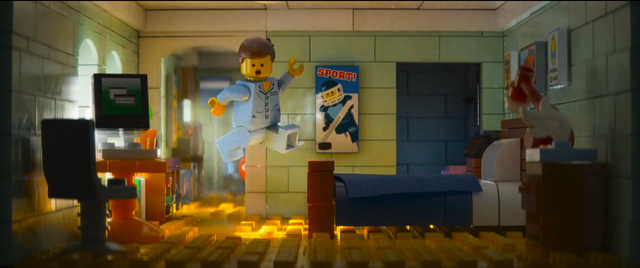
jumpingjacks

by Juho
University of Chicago CMST 10100, Intro to Film
Spring 2015

The Lego Movie (2014) is a parody on so many levels. The story follows Joseph Campbell’s The Hero with a Thousand Faces outline to a tee. Almost every character is unabashedly an archetype or parody of something, be it The Matrix, the Dark Knight trilogy, or Morgan Freeman. But it’s all intentional. The superficial plot is as contrived and derivative as a child’s imaginary adventures with plastic representations of pop culture properties are expected to be. Once The Lego Movie establishes that the story is a fabricated metaphor of deeper conflict at the heart of the film, the perpetual parody becomes meaningful and easier to swallow.

The film’s aesthetic plays a similar game. It’s a parody of stop motion animation, a computer animated film in disguise as a stop motion film, and while that in itself includes elements of realism (as stop motion consists of still photographs of real objects), a stop motion film composed entirely of Legos ultimately implies a level of absurdity and abstraction that’s unmatched by anything live action. The elaborate camera and lighting techniques, the distinct movement of its characters, and the consistency of its Lego aesthetic all indicate that The Lego Movie isn’t a movie about just Legos or even a movie made with just Legos, but a movie that is the sum of Legos and a boy’s imagination.

Realism

Several facets of The Lego Movie’s stop motion aesthetic are completely realistic, because its object of parody involves actual photographs of actual things.

focalpoint

focalpoint2

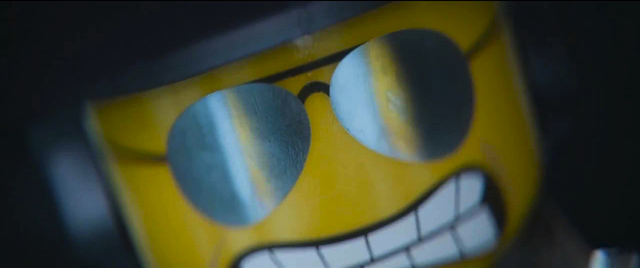
For example, it’s easy to describe the virtual camera’s lens in realistic terms. Its focal length is consistently small, usually with a narrow depth of field. This serves several purposes. For one, it enlarges the film’s scale by donning the illusion that the distances between foreground and background elements are longer than they appear. In the extreme close-up above, Bad Cop’s head (despite presumably being about a cubic centimeter in volume) appears almost life-sized, in part due to his helmet and the sides of his face being out of focus. The shot below it shows more of the questioning room and divides itself into three layers of depth, with Emmet in the foreground, Bad Cop in the middle, and gray metallic walls in the background. With only Bad Cop in focus, the shot feels deeper than it actually is. The room feels like an actual room, instead of a minuscule chamber of only a few square inches in floorspace. But more importantly, the film’s virtual lens behaves exactly like a real one.

hardlighting

Realistic analyses can also apply to the film’s lighting. The entire questioning scene is bathed in a harsh top light and the objects on-screen are illuminated as expected. Emmet’s hair and Bad Cop’s helmet reflect the light source, but they both have the surface texture of a matte plastic. The light striking the two would have to be extremely bright and concentrated to achieve such an effect. The darkness of the background as well as the shadows cast on their faces and bodies all imply hard top lighting as well.

The Stop Motion Aesthetic

However, committing to the stop motion aesthetic requires unrealistic abstractions that aren’t present in live action. For example, The Lego Movie will supplant traditional effects with Lego-only replacements wherever possible. One such effect is the motion blur, as shown below:

facechange

facechange

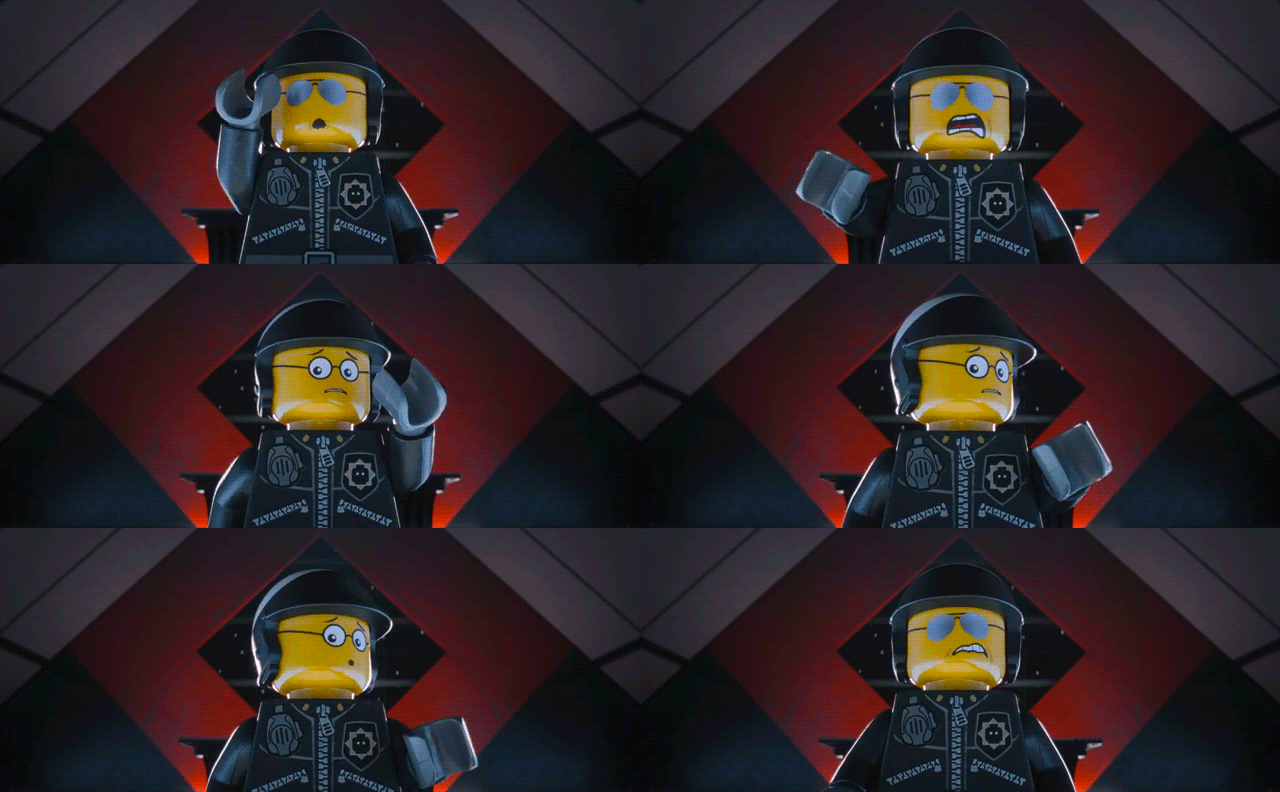
Here, Bad Cop/Good Cop alternates back and forth between his two personas, causing his head to spin quickly and erratically. While it’s hard to see in motion, a still frame of his face mid-spin shows motion lines and gestures painted on the head itself with the sharpness of a still object.

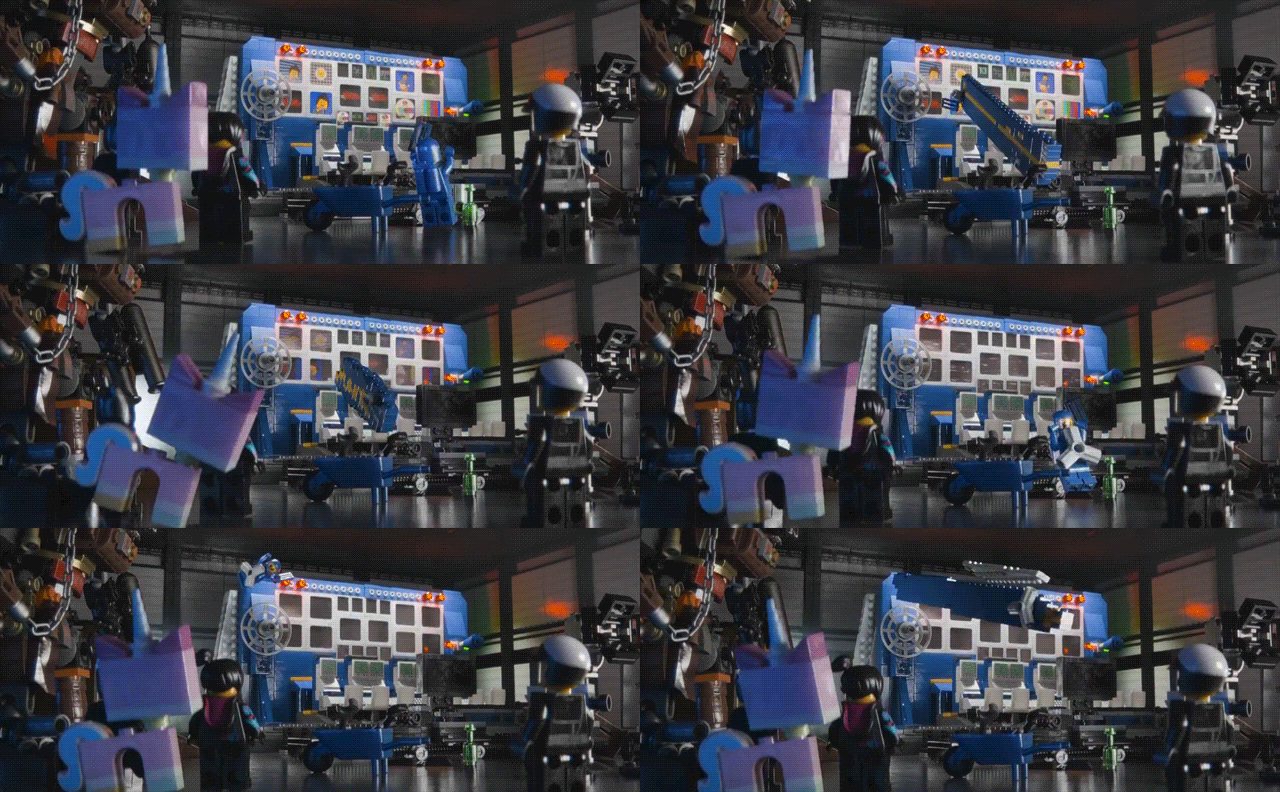
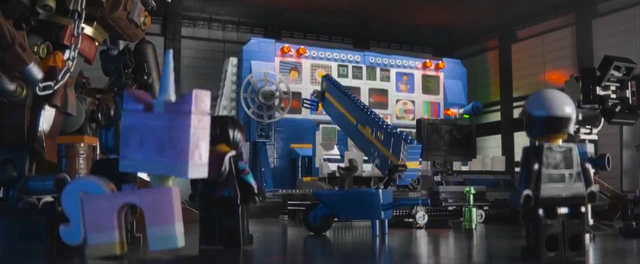
Another example is when Benny the Spaceman assembles a spaceship. Instead of his velocity translating on screen to blurry streaks, still frames show that Benny becomes a long strip of linear Lego blocks without any of the distortion indicative of motion blur.

spaceship

spaceship

So why does Bad Cop’s face change completely as he shifts personalities? Why does Benny dissolve into Lego strips as he skirts around? Once again, stop motion animation is essentially a sequence of photographs of still scenes. During the recording process, the camera never actually captures motion, like a video recorded with infinitely short shutter speed. Thus, motion blur or light streaks are rarely present. Instead, to convey speed, the animators incorporate artificial motion blur that is both motionless during capture and consistent with the Lego aesthetic.

effectsmoke

effectswater

effectsplatter

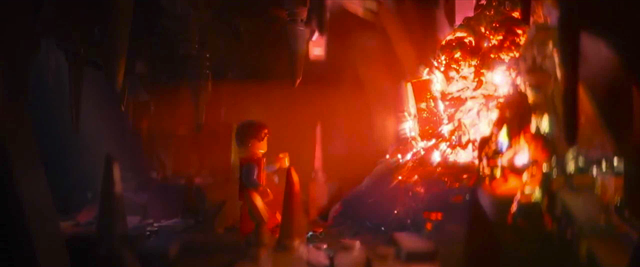
Particle effects such as smoke, water, and mud splatter are also replaced by their Lego counterparts. These aesthetic decisions stem from similar reasons as above. Effects such as smoke, running and splashing water, and splatters are rarely seen in their natural form in stop motion, as they’re impossible to manipulate frame by frame. Thus, they’re usually choppily and messily animated with alternatives such as tissue or gelatin. The Lego Movie recreates these effects with Lego for not only a more authentic stop motion aesthetic, but also a more consistent Lego world.

Computer Abstraction

sweepshot1

sweepshot2

sweepshot3

So far, all discussion of The Lego Movie’s aesthetic is consistent with that of traditional stop motion animation. However, being a computer animated film, The Lego Movie accomplishes feats that are either impossible or impossibly difficult in both traditional stop motion and live action footage. The introductory shot that sweeps around Cloud Cuckoo Land as shown above would be almost impossible to capture with a physical camera, stop motion or not, due to the irregular, airborne path of the camera track and the countless legion of onscreen characters that must be manipulated. Computer animation makes this shot—among the many other hypermobile shots in the film—possible. These shots evoke a sense of grandeur and dynamic action that rarely grace live action films, which instead rely on quick cuts and shaky camera handling to convey motion. They build the fantastic aesthetic that is characteristic of a child’s imagination.

Aesthetic and Story

robots

mancave

pieceofres

Imagine what The Lego Movie could have looked like in lazier hands. If it had been another  generic computer animated film, with each character being smoothly animated, slickly designed, polished representations of the toys that they were engineered to sell. Without the realism offered by the stop motion aesthetic to cement their identities as plastic toys, the story loses its charm and intelligence. But the larger than life abstractions of computer animation are also essential; they reinforce the creative spirit of this imaginary world, thereby validating the movie’s message of individual expression. The Lego Movie is a cheeky homage to stop motion animation that retains the cinematic grandeur of computer animation. Its aesthetic is just like its story, a stylish vehicle that portrays and enhances its themes and philosophy, and that’s exactly what an aesthetic should be.