I Wish I Can Change Sth (Or Can I) & Who Am I?

By Helen T

—My Attempt to classify time-travel stories into their own place
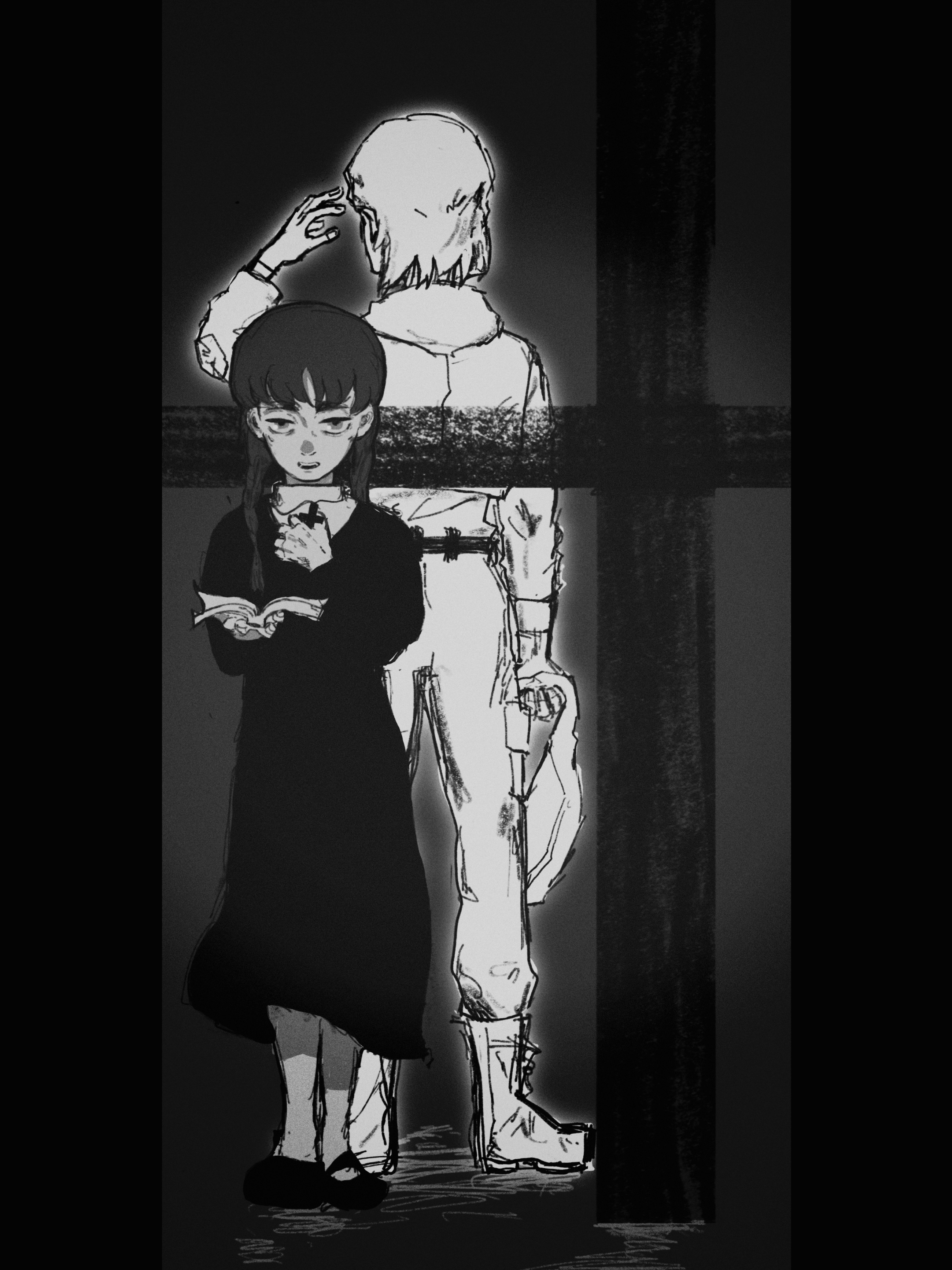
(This’s my original character in her 13 and 19) Just thought it’s cool and also consistent with the theme of time travel having multi-versions of oneself standing right next to each other ;D

Time travel has been a tantalizing and ominous topic for a long time since the explosion of all kinds of natural science and the Industrial Revolution. It seems like human beings become much stronger and more powerful everyday at an astonishing speed, but in many’s eyes another vicious process has begun, and this world is drifting into an unreturnable abyss – pollution from earth to ocean and air, war from local to global, machine gun to nuclear weapons, etc. Nietzsche said that the evolution of science and technology will eventually lead to the failure of humanity, Marx describes Capitalism as the process of dehumanization, and Arendt argues that the ultimate change of human conditions leads to an entirely different mindset. In the nostalgia of “the good old days” and the fear of the shit-like presence as well as the bleak unknown future, time travel stories as a genre were born. 

There is an interesting argument coming from Hume who argues that one cannot imagine a presence coming out from nowhere/he or she never perceived before, and he gives an example saying that a Chimera is merely composed of all different kinds of animals that exist in the real world. If we apply this idea to all kinds of fantasy and science fiction, it makes sense to argue (and I personally believe) that authors are depicting and exaggerating the present Earth in their imaginary futuristic/imaginary world, and they’re either secretly or openly embedding their own wishes into it. Either for By His Bootstraps or Man Who Met Himself, authors give more space to describe the experience and influence of time travel and the reaction of the protagonist instead of making sense of the mechanism of the time machine. However, probably because there is always a time machine existing in the story, the most common category people grant to time-travel stories is “science fiction” instead of something else. 

There are many definitions of what classifies real science fiction, one of them that I think makes the most sense is that the author is trying to use logic and scientific methodology to make sense of the imaginary setting or invention he or she adds to the top of the real world. (Eg. in Dune, although Arrakis doesn’t exist in the real world, its ecosystem still makes sense in terms of either ecology or biology and there’s a complete and delicate design of it made by the author. If we take this as the definition of science fiction, there are a few things that those two novels I mentioned above failed to fulfill: in By His Bootstrap, there is no explanation of the reason for such a weird kind of future world to occur; and in both novels, the central sci-fi concept – the time machine – ends up with few explanations. Although both authors close the logic loop in the end (the time travel trip is just a smaller loop inside a bigger one), this is still a deviation from the more authentic kind of science fiction. In fact, Via the Time Accelerator, though using a pretty awkward and weird explanation of the time accelerator at the beginning of the story, does try to make sense of the time accelerator. (This type of explanation is pretty common in the earlier stage of sci-fi, in that time era one responsibility of sci-fi is education). Therefore, those two novels emphasize the type of society, the kind of warning/wish both authors have toward the real world, and probably also some philosophical reflection, but not the science or technology itself (although the settings are certainly inspired by Einstein’s Relativity).

Another topic worth discussing is about the concept of “Me” and the manipulation of identity in time travel stories. One’s destiny is always intertwined with the history (“plot”) of the world and a major and cliche reason for someone to either travel to the future or especially back to the past is to change his/her (or his beloved’s) destination. There are usually two kinds of world settings: 1. Predestination, the whole universe from its creation to its death has already been determined, and time travel is just a slightly special smaller loop inside a bigger one; 2. multiverse/paradox, one can change the past or future, but this will usually result in a completely different new world with (sometimes) unexpected consequences due to the so-called Butterfly Effect. 

Interestingly, both kinds of settings involve multi-selves and free will. According to the two novels (belonging to the predestination category), human beings exist discretely in a slice of time and are merely connected by common memory. The thought that “this WAS me who did this” creates an illusion of a single self. Multiverse on the other hand handles this problem more gently, with a focus on the discussion on the relationship between one’s identity/personality with his or her destiny/the world he or she is living in. In terms of free will, accompanied by the close loop of logic and the paradox created by time travel, Predestination manipulates the protagonist and beats them eventually with the cruel fact that they cannot do anything. On the other hand, the multiverse does emphasize the difficulty and subtlety of changing anything that happened in the past, but also grants characters the power to change something with a time machine, and time travel is not a cruel show demonstrating the power of fate anymore. In terms of both free will and identity, the multiverse is a milder and more colorful version of the predestination time story, the loose of strict requirements of a close time loop does introduce more possibility to the plot and makes it much more interesting. And that’s probably also the reason why the second kind dominates today.

Conceptual Relativity: Time and Time Again

Science has always served as an absolute for myself. Through strict, replicable, provable guidelines I find a sense of solace in understanding the broader world around us. For me, this has meant that improper science within media and games has always altered the amount of enjoyment that I received for them. Due to that underpinning, I have often failed as a critic of media to properly analyze the underlying themes beyond the scope of the story itself, instead turning to analyze the robust, and often false, science that breaks the aforementioned immersion.

Our discussions in class regarding The Einstein Theory of Relativity and Via the Time Accelerator then helped me become aware of the broader media context I was missing, and how as a result the notion, and human fascination, with time itself was something important to be analyzed. It wasn’t the actual scientific backing that opened the door into an explorative story, it was the thematic underpinnings relating to revolutionary scientific advancements that allowed people to dare to dream. 

With this in mind, Einstein’s influence with the introduction of special and general relativity is the basis that then facilitated these imaginary gateways into scientific exploration. Sure, the science wasn’t completely sound, but it was just coherent enough that for the general population, it satisfied their need for justification.

I want to explore science fiction because the components that are central to its genre help the genre itself facilitate thematic narrative decisions. To begin, I want to generalize themes I feel are set in place with other fictitious genres, and extrapolate how their core questions influence their imparted morals.

Within the fantasy genre we see the question of “what can we imagine” – it is founded in the abstract and openly invites narratives that don’t ask for an explanation. By immersing ourselves in this genre, we step into a “magic circle” where we abide by whatever principles the author chooses to provide us. Historical fiction offers a different lens, now asking us “what could’ve been”. With a pre-established factual framework to operate within, we can explore alternate timelines that are baked into a rich, often blurry history. Realistic fiction offers us “what can be”, working within the present or near present to tell stories of everyday life, whether it is a more standard story or an abstraction of reality.

Science fiction, however, is truly an open ended question – for myself I feel that it asks “what could be”. But, in regards to the application of science, it ensures that there is a grounding in reality for its audience to springboard off of. This is important because of the affordance of plausibility, where each new discovery facilitates a broader understanding of not just the science itself, but the potential – albeit normally incorrect – trajectory of where we could go.

Now we can circle back to what we see within Via the Time Accelerator, as it is an extrapolation of Einstein’s introduced Theory of General and Special Relativity. Correctness aside, we see Frank J. Bridge craft a narrative that centers around two principles. The first is the application and explanation of relativity, and how it can be applied to facilitate time travel, namely solely introducing the theory that you can travel to time at any point. The second principle is the question of the future, and what the affordance of time travel allows people to imagine.

Bridge’s title suggests that the “Time Accelerator” itself is the facilitator of this journey, allowing Brockhurst, our main character, to take this adventure. Quoting the principles of physics, our narrator even correctly identifies the notion of a world-line, stating “A world-line is a continuous succession of point-events in a four-dimensional space; or, in other words, it is the path pursued by any particular body through space and time.” This seemingly minor inclusion has broader implications towards the audience, it given them a kernel of scientific fact to ground themselves within, so when Bridge’s continues to introduce more complex theorems, ideas, and “facts”, readers take them at face value.

Yet, moving into the second principle of future application, I feel Bridges uses the desolate city as veiled commentary towards the current world we find ourselves in. Particularly, when Brockhurst talks with The Last Man, he writes “Greed and avarice, lust for power, oppression of the weak and rebellion of the untutored – it is the same old circle over and over again. They rise, they flourish, and they fall.” As much as this serves as context to the futuristic world, it is also socially relevant commentary that Bridges chooses to elaborate on within his piece

This brings all the themes of the piece back to present, expanding upon the cyclical nature of civilization and extrapolating it within the future. Via the Time Accelerator, whether knowing it or not, incorporates loops in a variety of levels. In its application, it allows for the looping nature of time travel to facilitate its journey. In conversing with The Last Man, Brockhurst (and by extension the audience), are reminded of the cyclical, inescapable nature of civilization and humanity, one that we cannot simply seem to outrun. Back to the nature of relativity, our perspective is seemingly engrained by our experiences, and in some ways, it serves no more as the absolute truths to the patterns we see time and time again.

The application of science adds a plausibility to an abstract story within Via the Time Accelerator, however it is in the introduction of loops, whether aware of it or not, that truly imparts a truth found throughout our broader society as a whole. So, sometimes it is important to look beyond the scientific inaccuracies within literature, and instead focus on what the narrative is trying to impart with its question of “what could be”.

Katherine