Outer Wilds: Welcome to Hearth

By Eric Lujan

Synopsis

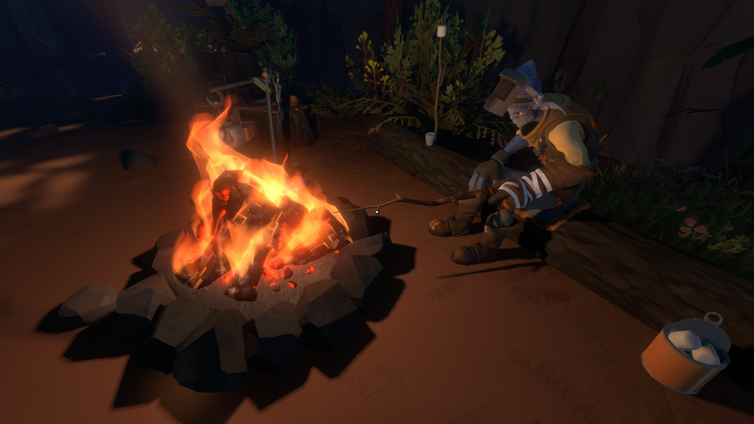
The story begins as you wake up beside a campfire on Timber Hearth, ready to set off as the newest astronaut in the Hearthian space program. Hearthians are four eyed sentient creatures that appear to have developed from aquatic ancestors. Their planet, Timber Hearth, is relatively quiet and peaceful. It boasts lots of water and trees with its main dynamic feature being geysers that can shoot you into the air (or even space). 

The home planet serves as a mini tutorial for the player but doesn’t exactly make it obvious. You interact with fellow Hearthians who remind you of some necessary gameplay mechanics but they don’t explicitly give you a step by step guide. This is done purposefully and, as you’ll see later, remains a core principle for the Outer Wilds game. If you wanted to, you could bypass all the conversations, get the launch codes, and take off without having any idea how to play. But the game does a good job at capturing the player’s attention with uniquely nostalgic music, a cozy forest setting, and a space exploration museum that hints at things to come. After you get the launch codes for your first takeoff and initiate the time loop (which I won’t spoil), you set off into space on your own with no mission or objective. Your goal is to simply explore your solar system. This could appear to be a daunting task, however, you’re not alone. On each planet you can find one of your Hearthian space exploring companions that came before you. They can give helpful tips and are worth paying multiple visits as you learn more about each planet.

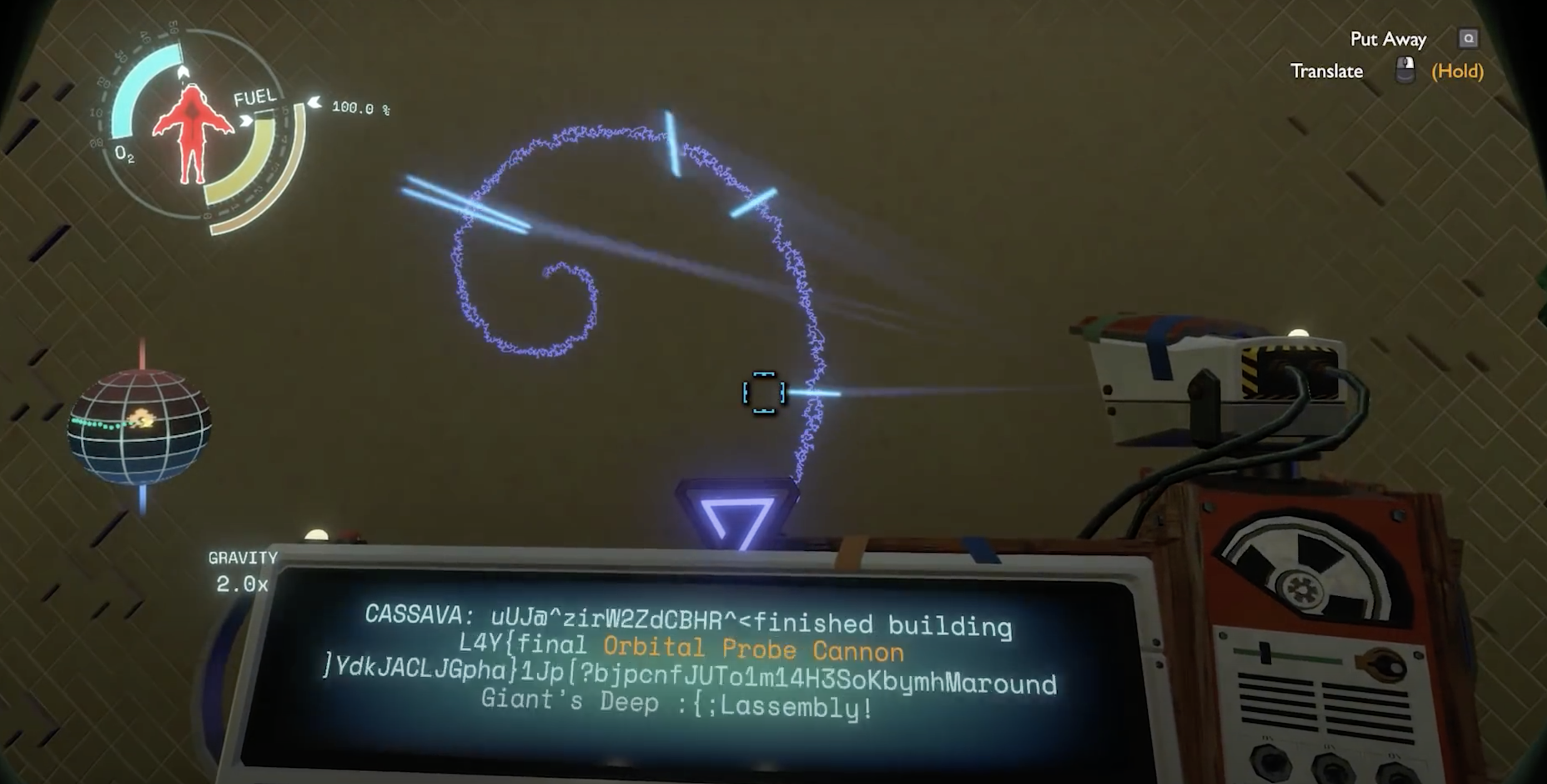
You may be wondering how the story progresses with no missions or objectives. Well, on Timber Hearth you learn of an ancient alien race known as the Nomai who lived in your solar system thousands of years prior but have since disappeared. On your travels, you learn about their lives and ultimately where they went by visiting their ancient ruins and reading Nomai texts using a newly invented Nomai translator tool. But where could such an technologically advanced alien race have gone? This serves as the narrative for Outer Wilds.
Dynamic Environments

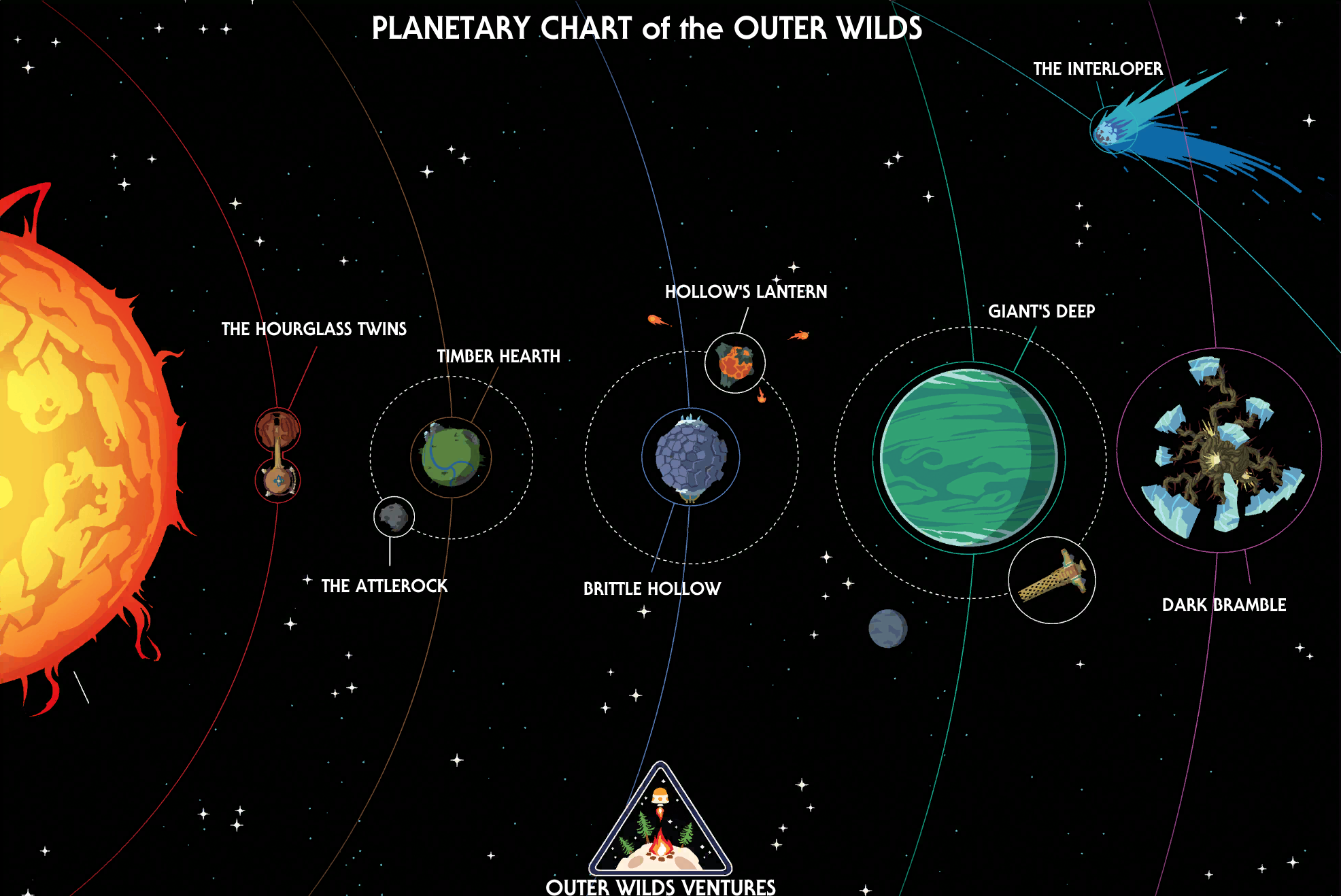
The solar system contains five planets and a comet that all orbit the sun. 

The Hourglass Twins (Ember Twin and Ash Twin) orbit one another as the sand from Ash twin fills the deep canyon that cuts around Ember twin. Once the sand fills Ember Twin completely, it reverses, hence the name “Hourglass.”

After Timber Hearth you have Brittle Hollow. This planet has an unforgivable black hole in the center that absorbs pieces of the surface as they fall apart. What causes the surface to fall apart is the volcanic moon called Hollow’s Lantern that continuously spews out fiery rocks which crash onto the surface.

The next planet, Giant’s Deep, is a gas giant with a surface that consists mostly of water with a few islands on top. This planet’s main dynamic features are the stormy weather and the cyclones that launch the islands into space. 

Lastly there’s Dark Bramble, which holds many deep and dark secrets. All I will say about this planet is that space doesn’t exactly work the same on the inside. 

With an understanding of each planet, you can see how lively the solar system is. It’s also very dangerous. The creators of this game wanted to challenge the idea that games require static environments and instead built a world that changed over time and continued to change despite whether the player was on one planet or the other. The best example of this that I can think of is when I had left my ship on an island on Giant’s Deep only to find it thrown into the air by a cyclone and having it get caught in the trees of an island. The world does not revolve around you. It, quite literally, revolves around the sun.

Gameplay

This game does an amazing job at making space travel feel scary and dangerous, whether it be from the wonky space controls that have you crashing at top speed into different planets or the different dynamic elements of each planet. And the best part is, you are going to die.

 This game features a time loop mechanic which places you right before your first launch and lasts for 22 minutes until an in-game event resets the loop for you. The reason for the time loop and it only lasting 22 minutes does have story relevance but at the same time it prevents the player from going on for hours without resetting the loop. Naturally, the time loop resets upon death. The time loop allows you the freedom to choose a different planet to explore if you get tired or frustrated on another. This can be especially helpful for progressing the story since you may get hints to solve a puzzle on one planet while exploring a different one.

As you uncover new information, your findings are stored in your ship’s computer which I found to be a very helpful feature. It keeps track of your progress which is especially helpful in this game since there is no one correct path to uncovering information. 

Along with a Nomai translator tool, you’re also equipped with a probe device and a signalscope that helps track different sounds. The probe device can detect ghost matter which can kill you but it call also illuminate a dark area or take pictures as it flies through space. The signalscope lets you pick up noise frequencies that can assist you in finding the other space travelers who each play a different instrument. These tools play significant roles in some of the puzzles.

The most important tool in your arsenal is your space ship. The ship is very difficult to fly at the beginning of the game but the more you play (and die) the better you get. Just remember where you park it and don’t let it get carried away by the dynamic environment.
A Unique Storytelling Experience

This game focuses on the optimistic side of space exploration, which equates to learning about new planets and other life in the universe rather than participating in something like space conquest. It capitalizes on this by having the story be one primed with the task of uncovering secrets and learning about the history of the Nomai in a very respectful manner.

 The game is very character driven. Each Nomai text is written by a specific character, and while these characters may never show up, they feel very real and lively. You learn about their thought processes and romantic interests as well as how they came to be and ultimately where they ended up.

What makes this game unique is that there are no conventional objectives or missions. This could prove challenging when writing a compelling narrative, however, the story functions as a puzzle with the player putting together the different pieces and having it make sense over time. So no matter which planet you choose first or which information you uncover it begins to make sense as you learn more. 

The developers used 4-5 main narrative plot points to serve as a calling to the player’s curiosity. All the information you uncover is built around them with everything pointing in their direction. All of this becomes evident on your computer as you progress throughout the story.

This game does not hold your hand, rather it peaks your curiosity and guides you with a trail of information that has many different connections to one another. The developers made sure every bit of information you could find has some amount of relevance to keep the player engaged. This directly tackles the text-as-lore gaming trope and instead treats the text as important narrative. They didn’t want to players to go searching behind every rock so they purposefully didn’t hide anything and only put content where there was something to be discovered. 

Along with only putting details where there was content, the developers did the same with music as there are different tracks that play as you discover major plot points. This makes the player feel immersed and as if they are actually progressing in the story. It also helps maintain a good rhythm within the game.

All in all, the story of the game is incredibly captivating. Its accomplishes this by focusing on a story driven narrative, enabling the player to have a genuine connection with an unseen race of aliens through the texts, and giving the player the freedom to uncover the mystery of the Nomai on their own.

Something cool about the narrative is that once you know everything and beat the game there is little to no deployability. The ending of the game can be achieved in a few steps that can be accessed right at the start of the time loop (but simply doing this won’t provide you with any understanding of the narrative).

Final Thoughts

Going into this game my expectations were relatively high given what I had heard about it but I didn’t know much about the game. I was very happy when my expectations were exceeded.

My only complaint is that some of the puzzles did not feel very intuitive and instead relied heavily on labor and luck. Sometimes you had to be in the right place at the right time or simply wait for something to happen. Either way it required a lot of trial and error. This caused me (and other players I’m sure) to search up guides on how to complete certain puzzles which ruined the immersion. But aside from that the game is difficult to critique.

I truly hope that this type of narrative structure is explored more by games in the future as it truly felt immersive and as if you were the one putting the story together rather than simply following along or playing as someone you’re not. I think the time loop mechanic lends itself very well to this type of narrative structure but finding a way to include it in the story does seem difficult. Outer Wilds is a great example of how to do this effectively.

It’s difficult to recommend this game without spoiling the story since that’s what makes it so interesting but the game is best experienced knowing as little as possible. So take my word for it. I’d recommend this game to any type of gamer, casual or experienced. And remember, the less you know the better.

Sources

Noclip – Video Game Documentaries. (2020, January 1). The Making of Outer Wilds – Documentary. YouTube. https://www.youtube.com/watch?v=LbY0mBXKKT0

Outer Wilds. Playstation 5 version, Annapurna, 2019.

Outer wilds. (2022, January 30). Wikipedia, the free encyclopedia. Retrieved February 2, 2022, from https://en.wikipedia.org/wiki/Outer_Wilds

Twelve Minutes: A Loop to the Past

Gameplay in Twelve Minutes takes place in a claustrophobic apartment.

By: Monty

The Game:

You walk out of the elevator of your apartment building, the green and red carpets and brown doors a familiar sight. You’re tired from work, and you are ready to see your wife and relax. When you enter the apartment, you are surprised to find that she has a secret to reveal to you–you’re going to be a father! Before you can enjoy the news, a knock at the door. A police officer. You let him in. He grabs your wife. You try to fight him off. He kills you.

You wake up. You just walked into your apartment.

Twelve Minutes is a game from the mind of Luis Antonio, an independent developer, published by Annapurna Interactive, a subsidiary studio of Annapurna Studios. Development for the game began in 2014, and the game would get announced at PAX East 2015. Six years after its reveal, the game would finally be released with some fanfare on XBOX and PC.

The game features a simple point-and-click gameplay loop (literally) where the player can move around with their mouse in the crowded apartment, exploring the different rooms looking for items to use to uncover more information. The game depends on a time loop that activates whenever your character is killed or about 10 in-real-life minutes pass. The time loop is the integral gameplay element, allowing your character to remember events in previous time loops, trying to incrementally solve the puzzles of the game and figure out what is happening.

The Point-and-Click Adventure Game

The adventure game genre is one of the largest genres of videogames, stemming all the way from the game ADVENT(URE) also known as Colossal Cave Adventure released in 1976 for PDP-10 mainframe computer. Since than, the burgeoning genre has come to create many exciting iterations and ideas, including the genre of the “point-and-click adventure.” In the 1980’s, the legendary King’s Quest series, described as one of the greatest series in the golden era of videogames, would put adventure games on the map.

The point-and-click adventure genre was also extremely popular in the early and late 1990’s, with many famous point-and-click adventure games appearing in this time including The Secret of Monkey Island (1990) and Grim Fandango (1998). These games would become known for their narratives, plot, and puzzles. Having played both the remasters myself, I found that they were an extremely engaging medium for storytelling, thought-provoking gameplay (though at times frustrating, we will get to that later), with a cast of interesting and compelling characters.

These games would peak in the 1990’s, as newer more exciting game genres started to appear over the horizon, such as the first-person-shooter, such as Quake (1996) and Doom (1993). It seems like the era of the point-and-click adventure game would end soon, not being able to compete with the fast-paced action, quicker narratives, and replayabiltiy of the newer titles coming out. Soon, the point-and-click adventure game, known for their slower gameplay and “once-and-done” style would soon become a distant memory.

The Problem with The Genre

Critics of the traditional point-and-click adventure game, such as Grim Fandango all seem to have one thing to say in common: some of the puzzles suck. And I mean really suck. The kind of suck that causes a player to sweat walking around the map looking for the thing they missed. The kind of suck that has a player deciding that maybe the best course of action is to reach for a guidebook or search online for a tutorial. And when that happens in a puzzle game, you’ve already lost the sauce. Puzzle games need to be difficult in some regard, it’s part of the fun. But yet there was something much more lethal about the way these point-and-click adventure games were creating this difficulty. No, it wasn’t that the puzzles were designed brilliantly in such a way that they were difficult due to the mental processes required, but rather they were seemingly being designed in such a way that these mental processes did not in fact matter. And this is where the idea of moon logic arises.

Moon logic is what it seems like, logic that would only make sense on the moon. It basically means that the logic required to solve the puzzles in these games required backwards or unintuitive thinking. And honestly, is there no bigger sin than a puzzle game that feels less like a puzzle and more like a gotcha from the developer to make you feel stupid?

I played both the remastered versions of The Secret of Monkey Island and Monkey Island 2: LeChuck’s Revenge when I was 10 years old. At the time, I was having a blast with the game. It was the perfect combination of thoughtful puzzles, fun characters, and witty dialogue that a 10 year old would like. But there was one caveat, I had the internet. And with the internet, it meant I had guides. And oh boy did I use guides. I mean, to be fair, I was 10, and I really tried my best, but in a game where the game itself is locked behind difficult puzzles, of course I am going to look at guides if that means I get to play longer. And remember, it isn’t just about difficulty, but rather that the difficulty is artificially created by unintuitive design choices.

Difficulty in Games

Difficult videogames have had somewhat of a resurgence in the 2010’s. I mean, an entire genre of difficult videogames was spawned by the release of Dark Souls (2011), known as “soulslike” games (Note: Demon Souls (2009) was technically the first in the series to have the gameplay described by a “soulslike” game, but Dark Souls is when the series really took off and became the phenomenon that we know today.) And these games are difficult, but the difficulty is part of the draw of the game. Yes, the people who play these games want the difficulty, and the developers know this, so with every subsequent game, they stick to the formula of course, but they try to add incremental features to spice up the gameplay. And due to the nature of the difficulty, players find themselves engaged not just with the narrative of the game, but with the fundamental nature of the game itself. And yes, the game can get frustrating, but some of that frustrating adds to the excitement when the player finally gets the achievement of beating that hard boss, or getting that cool upgrade.

Even older genres, such as the “roguelike,” which is almost as old as the adventure game genre, have become extremely popular. Games such as The Binding of Isaac, Dead Cells, Risk of Rain, and Enter the Gungeon have all found great success with players and a large and excited community. Roguelikes, including all these games, are known for their difficulty, with permanent death mechanics, ever increasing difficult stages, and more and more things to keep track of being common in all these games. For example, Risk of Rain keeps track of how long you have been playing on a run, and increases the difficulty the longer the game goes. That means that you could stay on level 1 theoretically forever, but expect it not to feel like level 1 after sometime. And every year, new Roguelikes are being made, like Hades, which became a hit quickly.

Satisfaction and Innovation

The things that make roguelikes and soullikes succeed while the point-and-click adventure game fail is simple. Both the roguelike and the soullike game bring innovation with each game, and satisfaction for the player who plays it. A game’s design is more than just the ideas and thoughts of the developer, but rather how it is implemented and understood by the audience. With each roguelike that comes out, each new game relies on some new gimmick or idea to try to stay fresh, and with a genre as saturated as the roguelike is, developers are pushed to innovate for that next great idea. The Binding of Isaac took the roguelike and turned it into a bullet-hell game, where your character has to constantly be dodging enemy projectiles. Slay the Spire took the roguelike into a deck-building dungeon-crawling card game. Darkest Dungeon turned the roguelike into a classic turn-based RPG. These games are known for their innovating–for pushing the genre to its limits. I mean, a card-game roguelike really? Who would want to play that?

I’ve bought it on both PC and on my phone.

The Soulslike genre has a much harder time innovating than the roguelike; the genre isn’t as open-ended. So what do the developers do? They focus on what the games are good at: difficult but satisfying gameplay. A player feels accomplished when they win, because the game feels like it is a game of skill. Even if they looked up a guide on how to beat a boss, the boss is still difficult. See where I am going?

With the point-and-click puzzle, looking up the guide is game-over. You have basically beat the game on someone else’s back. The game being to difficult means that a player either risks disliking the game, quitting the game, or cheating the game (and maybe some combination of all three).

What Twelve Minutes Does Right

Twelve Minutes is a thoughtful creation over many years, and it shows. It tries to push the genre to its limits just as much as the roguelikes do. The creation of a time-loop keeps the game fresh and entertaining. This innovation brings the entire game together, from the narrative, to the puzzles, to the dialogue, all hinge on the time-loop being satisfying and interesting.

And in my opinion, it delivers.

The game does a great job of just keeping the player so close to solving the mystery, without ever getting them there till the end of the game. Many times I found myself thinking, “Oh, I see where this is going, I have to do this the next loop.” And you want that in a puzzle game. You want the puzzle to be intuitive and interesting. I loved stealing the intruder’s phone and reading his text messages from his daughter to get more information. I loved being able to kill the intruder for no reason (and knowing that the game doesn’t end for me here, I’ll just go to the next loop!) I loved (now this sounds grotesque) being able to grab the kitchen knife and just stab my wife for no reason (I mean hey, we all wanted to try it right?). When a game’s mechanics are as simple as a point-and-click games are, the puzzles need to be intuitive.

But it isn’t all sunshine and rainbows. Even this game has a little bit of moon logic here and there. Like, why did I have to drug my wife to get her to go to the bedroom? Can’t I just convince her to go to the bedroom? Why does the light switch knock out the intruder–is it really that powerful of a shock? That seems like a crazy safety hazard–you’re telling me they never got that fixed?

By locking the game into a small space, the player becomes intimately familiar with the location of the game, a pleasant and interesting idea compared to the sprawling worlds and maps of the 90’s predecessors. In some ways, the game innovates a dying genre in just enough ways to make it fresh and exciting again.

But is it enough?

SteamSpy shows that DeathLoop, a first-person shooter game made by Arkane Studios and published by Bethesda Games, that came out the same year as Twelve Minutes in 2021 has blown Twelve Minutes sales out of the water. It is important to realize that the main innovation of both games is the time-loop mechanic. Is the point-and-click adventure game just dead on arrival if an innovative and thoughtful game such as Twelve Minutes can’t sell anywhere close to more main stream genres. Maybe, but I think that the genre still has some juice in it, if developers are willing to try to find it on Earth rather than the moon.

Edge Of Tomorrow: The Blending of Movies & Video Games

By Monica Villarreal

In today’s modern world, it’s rare to meet anyone who hasn’t either experienced watching a movie or playing a game. The vast majority of us have done both, and with that you might have a personal preference for one and it makes sense. While both mediums have been proven to be strong sources of storytelling, they are vastly different with how they present their stories and thus how immersed the consumer can feel. However, slowly there’s been a trend of taking inspiration from one another with the most interesting one being movies taking notes from video games. 

In theory, it seems easier for a video game to replicate components of film than it is the other way around. That’s because film has more constraints than video games, and this leaves video games with more expressive freedom than what can be done with a camera. 

This is not to say video games are superior to film when it comes to storytelling. Instead, what I’m trying to emphasize is the difficulties that can come to bring one medium’s way of storytelling to the other. Video games rely heavily on interactivity and input from the audience, allowing them to experience the story in their own way. This can include the idea of “resetting” as one fails at a level of the game and must restart to try again. Of course, this depends on the type of game since not all of them have this function, but nonetheless this ability to loop and learn from your mistakes is prominent in what defines video games.

As for movies, we as the audience are simply viewers; watching pre-recorded pictures on screen. Components like acting, music, camera work and so forth make this timeless medium so enjoyable and in a way easy for video games to take inspiration from and not the other way around. There’s only so much one can do to replicate the same feelings and experiences that are so unique in video games, but that’s still not stopping directors from trying.

Doug Liman’s 2014 film Edge of Tomorrow is an example of this effort. Based in a world where humans are on the brink of losing to aliens, we follow the story of Major William Cage who after a few minutes in battle gets instantly killed. However, he instantly wakes up 30 hours into the past, starting this story of time loops as Cage tries to use this new skill to humanity’s advantage.

Taking inspiration from the aforementioned video game “death loop,” it’s clear that this is an example of the potential future films can be if they continue to explore the possibilities in games. The whole “start at the beginning when you die” is parallel to the experience of many video gamers when they have to start over after receiving the infamous “Game Over” screen. However, before we can imagine such scenarios we must inspect what exactly is done in Edge of Tomorrow to recreate this effect, but most importantly if this was a successful attempt or not.

Films Prior to Edge of Tomorrow

Before delving into what Edge of Tomorrow does right or wrong, let’s look at films who have either similar aspects to the movie’s time loop or video game qualities, specifically movies before this title’s release.

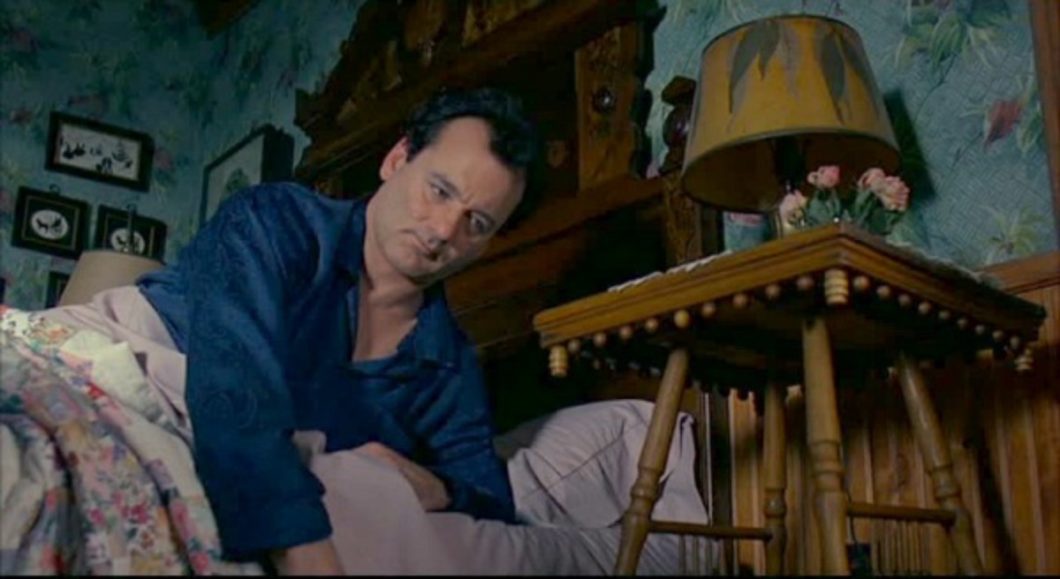
The biggest and most well-known example of a time loop based film in Western media is the 1993 film Groundhog Day, directed by Harold Ramis. This film, starring Bill Murray, revolves around a TV weatherman who, for unknown reasons, has found himself reliving the same day over and over again. No matter what he does, he wakes up to the same situation and has to relive the same normality for the entirety of the film up until the end when this loop stops. 

Our protagonist Phil finds himself waking up to the same situation in Groundhog Day.

Unlike Edge of Tomorrow, this film is more focused on the comedic aspects of such predicament and places our main character in humorous situations to keep the audience entertained and invested. In addition, although it’s not really inspired by any video game, the way it executed the idea of “looping” still plays a crucial role when we come to examine Edge of Tomorrow. 

Basically, Groundhog Day was a blueprint on how time loops could be used in film through a series of repetitive visuals, careful pacing, and a narrative built around this function. As we’ll soon discover, Edge of Tomorrow follows some of  these aspects, but there are some tweaks so it can have this Halo-esque feeling.

While Groundhog Day centers around time loops, one film that is literally fully inspired by video games is Scott Pilgrim vs. The World. Edgar Wright’s 2010 film, based on a graphic novel of the same name, was revolutionary in the way it handled the theme of video games.

 On the surface, the story centers around titular Scott Pilgrim and his journey to defeat his girlfriend’s “seven evil exes.” However, what makes this film so outstanding is how heavily video-game inspired it is. From battling seven different bosses, collecting coins (or XP) when Pilgrim defeats an enemy, and its video game-like visuals, Scott Pilgrim feels like watching a video game. 

Titular Scott Pilgrim has learned the Power of Love, earning him the stats shown in the bottom left corner. Small details like these make this film feel so much like a game.

This movie is probably the most famous example of how movies can truly implement elements in games into film. And once again, although different from Edge of Tomorrow in story and style, we can see how it’s possible for films to borrow elements from a video game and successfully implement it to deliver something new to its audience.

Video Game Influence

Knowing there are films that can implement ideas seen in video games to this medium, it’s time to examine both how Edge of Tomorrow attempts to do so, and if by the end, it succeed. 

Firstly though, what does it mean to succeed?

For me, a film succeeds in implementing a games aspect when it provides two things. One is a brand new experience to the viewer that couldn’t have been done in any other form. What I mean by this is that by using functions seen in games, the film was capable of introducing something new and refreshing for the audience.

The second element focuses entirely on the main selling point of Edge of Tomorrow: the effectiveness of the time loop. Even though it’s repeating the same visuals, the same story points, and keeps the audience stuck along with the main character in this predicament, was it able to keep us entertained and not perhaps frustrated? After all, the vast majority of movies rely on providing new scenes and narrative points to keep the story going. We know Groundhog Day was able to do so, but it’s different with Edge of Tomorrow since this loop is directly tied to  the main character’s death. Every time he fails, we as an audience suffer the same punishment of having to start over, so one can see how this could become a problem for enjoyment.

In video games, depending on the genre, failing is part of the experience and enjoyment. From simple Tetris to “rage inducing” like Super Meat Boy or Worlds Hardest Game, the ability to lose and at the same time win is what makes the interaction with video games so unique. One game that is similar to Edge of Tomorrow includes Halo (2001) with it’s first-person shooter and main story quests. However, one game that perfectly encapsulates the feeling of trial-and-failure is Dark Souls (2011). 

Even with difficult boss battles, the reward of defeating them is what makes the challenge that is Dark Souls worth it.

This game is famous among the gaming community for being extremely difficult with the only way to progress being to simply “git gud.” However infuriating it might sound, this game succeeded because just as that catchphrase suggests, with hard work, practice, and skills players are able to advance in the game thus making the anger felt in fighting infuriating boss battles seem like nothing compared to the overwhelming feeling of accomplishment once you defeat them.

So as a result, it appears like a challenge for Edge of Tomorrow to replicate this same feeling without tiring the audience. The actions on screen are completely out of control, and all we’re left to do is stare and hope Cage doesn’t fail or else we’ll be brought back to the beginning.

However, even with these worries of boring the audience, I believe Edge of Tomorrow was able to bring the same struggle and joy of “restarting” in games to the audience through many different and unique storytelling techniques.

Succeeding in the Time Loop

For the first third of the movie, we are stuck watching Cage struggle and fail to advance in the story. He continues to die on the first attack on the beach, and we’re just left to see his failed attempt to move forward.

This might sound tedious to watch, but on the contrary it was made enjoyable with some minor yet important techniques.

 The first and most important comes to the editing of these sequences. The quick, short, and fast-paced cuts between each of Cage’s attempts keeps viewers invested in the film even with it’s repetitive nature. We are focusing all of our attention on keeping up with Cage’s attempts to succeed, and with each failure we can laugh or groan in slight frustration, ready for Cage to try again. 

Through the rapid camera shots, fast movement, and constant action, we as viewers are thrown into this initial time-loop madness with Cage at the beginning of the film.

The repetitive nature of this portion of the film is described best described by Erin Manning’s idea of “preacceleration.” This rapid sequence of events perfectly pulls the viewer into the story, preparing them before we begin to truly see advancements in the story once Cage begins to train and slowly improve.

This plays into the second factor of making this time loop successful with that being the pacing in the narrative. After the preacceleration, we get to accompany Cage’s journey of slow-yet-steady improvement as he gets further and further into the day. Just as in a game, this is the part when the consumer of the medium can feel the effort and see results, or in the case of the movie we see it. 

However, what also helps the story move along is that eventually Cage is ahead of the audience. We stop seeing every single failure he goes through, so we’re left to decide if what we’re experiencing the same thing on-screen as Cage. This small detail immensely helps drive the story forward as Cage now becomes the one guiding us through the story. We’re no longer on the same level as him, and that itself makes it even more interesting for us to experience.

This plays to the third part of what made this film work so well: the narrative. For the last half of the film, this once “annoying” yet minor inconvenience of restarting has become more personal. We begin to learn more about this world and it’s story, and through his daily interactions with the people around him, we learn more about who Cage is as a person. 

 In addition, we slowly get to see him build connections with people who he continuously has to meet for the first time over and over again which causes him to begin to care for these people where now each reset is a death to both him and his relationships.

By combining all of these factors together, Edge of Tomorrow ends up delivering it’s audience a refreshing taste of narrative that’s so commonly seen in video games. As a result, we end up with an exciting, new, and refreshing film that couldn’t have been possible without the inspirations behind it. 

Only The Beginning

Edge of Tomorrow has proven that the once thought notion that films can’t replicate the experiences tied to video games can be contested, and to be honest this is pretty exciting. As the film industry begins to take more notice of the unique storytelling potential video games have, all we can do is to wait and see how the possibilities of visual storytelling expand or even begin pushing these boundaries ourselves. Maybe one day we’ll be able to directly interact with films in theaters, or perhaps directly experience the anger of “game over” on the big screen. But until then, we just have to wait until tomorrow.

References:

Edge of Tomorrow. Directed by Doug Liman. 2014. Netflix.

Juul, Jesper, and William Uricchio. “How to Fail in Video Games.” The Art of Failure, edited by Geoffrey Long, The MIT Press, Cambridge, MA, 2013, pp. 69–90.

Ledet Christiansen, Steen. Rhythms Now : Henri Lefebvre’s Rhythmanalysis Revisited. Aalborg University Press, 2019.

Manning, Erin. Relationscapes: Movement, Art, Philosophy. Cambridge, MA: The MIT Press, 2009.

Montfort, Nick, et al. “Repetition in Process.” 10 PRINT CHR$(205.5+RND(1)); : GOTO 10, The MIT Press, Cambridge, MA, 2013, pp. 90–103. 

Elsinore: All’s Well That Plays Well

Zachary Putera Jia Hao Lee

Elsinore: All’s Well That Plays Well

There are few things that pierce the heart quite like missed potential. Within this group of heartbreak, one particular subset exists as the most offensive— the sort that lies just short of greatness. The kind of thing possessing a flaw that, if singly addressed, would completely overturn the negatives associated with it.

Elsinore is one of these things.

I had terribly high hopes going into Elsinore. As an English major who has played and enjoyed many games within the time loop subgenre, I was excited for what Elsinore had to offer. On paper, it had everything that I was looking for in a game— a novel premise, a focus on storytelling, and just enough literary pretension for me to wish I were an English/MAAD double major instead of an English/Economics one. That sensation, unfortunately, was short-lived. In a mere ten hours, any hopes I had had for the game were dashed—repeatedly and identically—by the mechanical inadequacies of Elsinore’s time loop experience. On the bright side, the feeling allowed me to identify more closely with Ophelia’s plight. We shared a common despair, marked by the same initial highs, deflating repetitions, constant frustrations and unhappy conclusions.

While I had a less-than-stellar experience with the game, it would be unjust to simply call it bad. There is, rather painfully, a tremendous amount to love about the game. The characters, while one-dimensional, fulfill their purposes well, and fill out their roles in the main plot and their own, smaller stories excellently. The cast is also very diverse, replete with underrepresented demographics fitted sensibly into whatever roles would most suit them, and all within the short “screen times” that they were allotted.

It doesn’t stop at the characters, though; Elsinore knocks its thematic goals out of the park. While Elsinore does an excellent job discussing death, metaphysics, time, and relationships, I was most struck by what it had to say about sacrifice. The tale of Elsinore reminds players that, in many cases, choices that require sacrifices must be made. The narrative draws attention to the impossibility of endings so happy that no one loses out— a pertinent reminder that befits the tragedy the game is based on. To drive this point home, the game even goes so far as to delete the player’s save file once an ending is reached, emphasizing the finality of any difficult decisions made by them throughout their playthrough. Very few games can fully make use of meta devices to elevate their narratives— Elsinore is one of those games.

While Elsinore is far from a perfect game, it stands as a meaningful and novel exploration of the cross section between video games and literature by developers Golden Glitch. The opportunity to explore Middle Age Denmark through Ophelia’s eyes is a wonderful love letter to the Shakespearean canon that should at least be given a try. 

Unfortunately, it only takes a handful of mistakes to sap the enjoyment out of even the most carefully constructed time loop game. Elsinore fails where its mechanics begin. Despite the best efforts of Elsinore’s developers, the level of scrutiny demanded by the time loop subgenre proved to be too overwhelming for Golden Glitch to handle. To the developer’s credit, many strides were made in an attempt to provide players with the best possible experience, including a loop-resetting button, the ability to speed up time, and a detailed timeline, among other things. However, this was not enough. The team bounded over the glaring hurdles in time loop game design, but stumbled over the more insidious bumps endemic to the subgenre along the way.

Incongruent gameplay mechanics—such as the inability to fully view NPC conversations if time is sped up too quickly—are some of the main culprits stymying the flow of the game. Aesthetic choices, such as the developer’s decisions to force players to listen to Hamlet rave and Polonius rebuke at the beginning of every loop, grow from minor annoyances to legitimate frustrations over the course of several dozen loops.

In other circumstances, players must go against what the game is training them to do in order to progress any further. A particularly egregious example of this is when Ophelia is investigating Lady Brit. Against all previous examples, the player is supposed to follow Lady Brit into the art gallery and wait for her to begin talking to herself in order to obtain key information necessary to continue the game. Until that point, every other conversation that I had eavesdropped on took place between two or more people. To have the in-game intuition that had been built up in me circumvented at the first major plot point was deeply exasperating, and transformed Elsinore from a game where I could exercise my own mental faculties to figure things out into a guessing game revolving around seemingly arbitrary developer dos and don’ts. It doesn’t help that, by the end of the game, players are left with a endings so unsatisfying that completion of the game can feel more like a punishment than a reward.

This is the hamartia of Elsinore. The game contains a collection of overlooked mechanical foibles that, within the context of an infinitely recurring time loop, culminate in an unpleasantness potent enough to rob it of any significant enjoyment.

I do, however, feel like it would be disingenuous to sit in the critic’s chair and decry the quality of an otherwise high-effort game without providing any solutions to the problems that I have brought up. As such, I want to take a short look at two great games that deal with the mechanics of time looping: The Forgotten City and Virtue’s Last Reward. The former will address the mediocre payoff of Elsinore’s endings, and how to improve them, while the latter will provide an alternative to Elsinore’s cumbersome time-skipping functions.

The Forgotten City offers four endings. Unlike Elsinore’s endings, every ending in The Forgotten City feels somewhat substantial, and all result in consequences that you would expect to manifest as a direct result of your actions. Additionally, the ending screen shows a small bar that provides a rough estimate of how much longer the player will have to keep playing in order to reach the other endings. In addition to this playtime-related hint, the first three endings provide players with a tip that will direct them towards acquiring the next remaining ending. 

I can understand Elsinore not providing hints on how to reach specific endings, but considering how arbitrary the steps to reach the secret ending of the game are, it might make sense to direct players’ attentions to the necessary conditions that must be fulfilled to reach said ending. Additionally, Elsinore’s endings felt very nominal to me. Their scrolling text and still backgrounds did them no favors, and certain endings felt tacked on to pad out otherwise unimportant happenings within the game. If Elsinore contained fewer but more fleshed out endings, the toil of sitting through janky mechanics would be more forgivable, and would likely make the game more satisfying to play. 

While The Forgotten City merits praise for its hands-off, minimally extradiegetic guidance, Virtue’s Last Reward deserves attention for a wholly different—but equally effective—method of time loop management. After completing their first ending, the player is allowed to restart the game from any of the points demarcated in the above screenshot. This way, players can easily pick up from where they left off, and not have to sit through previously consumed material just to get to where they want to on the timeline.

Elsinore touts about two-thirds of the number of endings that Virtue’s Last Reward does, but provides no similar system to allow players to easily reach pivotal choices. This makes sense, considering Elsinore leaves far more up to the player’s discretion— having a chart like the one shown above would demystify the exploration process that Elsinore seems so insistent upon. Nonetheless, skips to particular days or times might have been useful to alleviate some of the tedium that could otherwise be caused by the time loop mechanics of the game.

While both of the aforementioned games provide ideas that could improve the Elsinore experience, it is also important to acknowledge Elsinore’s categorical dissimilarities from them. The Forgotten City is a first-person, mystery adventure game with some combat elements. Virtue’s Last Reward is a more tightly constrained visual novel. Neither of the games’ mechanics would fit perfectly onto the point-and-click mould of Elsinore. Regardless, as is the case with all good games, there are certainly aspects of both The Forgotten City and Virtue’s Last Reward that Golden Glitch could learn from.

Behind Elsinore’s wall of mechanical mediocrity is, frustratingly, an original, earnest game that utilises its subject matter without adulterating it. The difficulty of designing games with multiple endings and even more ways to get there is not lost on me. While I have strong words to say about my personal experience with Elsinore, I was encouraged by how positive people’s reviews of it were online, and am hopeful that others will give the game a try to experience the good it has to offer. Much like their debut game, Golden Glitch clearly has a lot of potential— I just hope that they can put it to use.

References

Kyokugen Dasshutsu ADV: Zennin Shibou Desu(PlayStation Vita) by bleaker on January 01, 2013. (n.d.). Ally or betray, whichever you choose, do not overlook this game. Giant Bomb. Retrieved February 3, 2022, from https://www.giantbomb.com/ally-or-betray-whichever-you-choose-do-not-overloo/3050-115525/user-reviews/2200-24448/

YouTube. (2021). YouTube. Retrieved February 3, 2022, from https://www.youtube.com/watch?v=GxpTCa-yjAs. 

Traveling Back in Time with Emily is Away <3

Introduction

“It’s 2008 and AIM is dead” So begins Emily is Away <3. You, as the player protagonist, have just left AOL Instant Messaging (AIM) to join Facenook, the new and exciting thing on the Internet. While the game is set in Facenook, it looks and feels a lot like a platform you may have heard of called Facebook. In simulating Facebook from 2008, the game raises questions about how the Internet and social media have changed since 2008 as well as the role of technology companies in shaping daily life. In addition to being set at a pivotal moment for technology, the game is set at a pivotal moment for the characters, including the player, who are all seniors in high school. On his website, Kyle Seeley, the game’s creator, writes Emily is Away ❤ “highlights the universal story of growing up and growing apart.” Throughout the game,  the relationships between the characters are constantly in flux and, depending on the decisions made by the player, these relationships may end up being very different by the end of the game, the summer after senior year, than they were at the beginning, the fall of senior year. This is particularly true of the relationship between the player protagonist and either Emily or Evelyn, one of whom the player will end up dating in the game’s first chapter.

Specificity & Immersion

The game is designed to immerse the player in the world of 2008 Facenook/Facebook. The game’s user interface looks dated and the sounds notifying users that the game has booted up or that they have received a message are reminiscent of older PCs. Upon installing the game, players are encouraged to close all other windows and programs on their laptop for full immersive effect. The game also provides several desktop backgrounds that the player can download and apply to their computer’s desktop. The game’s primary mode of storytelling, messaging, also feels quite realistic. Upon choosing from one of three message options, the player must then “type” out the message by typing randomly on their keyboard, though this is a setting that can be turned off. This has both the effect of making the experience feel more realistic and of drawing out the narrative. The messaging simulation additionally includes highly specific details, such as notifications indicating when the other character is typing or deleting, that add depth to the interaction with characters by indicating pauses or uncertainty as the character messages.

In addition to simulating the technology of 2008, the game is firmly grounded in the Internet and popular culture of 2008. At the beginning of each chapter, the player is encouraged to select their favorite movies, television, music, and books from a list where works are represented by pixelated icons rather than listed titles. The player needs to be quite familiar with a given work in order to recognize it from its icon, which requires the player to have specific knowledge of 2008 popular culture. Characters also constantly send the player links to Youtoob, which opens in the browser, where the player can listen to playlists and watch clips. Facenook quizzes also abound.

Nostalgia

The specificity and immersion of the game are meant to elicit a sense of nostalgia for the world of 2008 Facebook. However, as someone who was too young to use Facebook in 2008, this was not my personal experience of the game. The game seems to focus more on the positive aspects of social media platforms, such as their ability to create spaces of sociality. Because of this, I read the game as more of an innocent, naive view of social media. The game’s Facenook seems disconnected from the current reality of Facebook and the negative societal consequences of Facebook’s design, including polarization and data privacy issues. This is not necessarily a negative aspect of the game and may make it even more enjoyable for players, but, given Facebook’s current prominence in public debates, these issues were still top of mind for me as I was playing. 

Additionally, the Facebook/Facenook portrayed in the game did not really connect with my personal experiences of Facebook. For instance, as a player in 2022, I found the lack of political content on the platform to be particularly conspicuous. I found this to be an especially interesting choice given the game’s setting during the autumn of 2008 and, therefore, during the presidential election in which social media became an increasingly important part of campaigning. Likely in part due to my age, the game’s nostalgia was ultimately lost on me, though I found the game’s specificity to be impressive.

Anonymity & the Encyclopedic Nature of the Internet

Emily is Away ❤ alludes to but does not fully explore two important aspects of Internet life: anonymity and the Internet’s encyclopedic nature. The game is set before Facebook started requiring users to use their legal names on the platform, and the player can choose any name they would like as well as any of the profile images provided. Once in the game, however, the player is only ever allowed to interact with characters that the player (as a character) is supposed to know in real life. This limits the player’s ability to explore anonymity on the Internet, though the game does allow for one scenario in which the player protagonist can “experience” anonymity by using their friend Matt’s second Facenook profile to chat anonymously with the Jeff/Steve character.  Likewise, the player can, for the most part, only interact with content generated by these characters or brought to their attention by the characters, which limits the player’s ability to explore the encyclopedic nature of the Internet. The player can leave Facenook to visit Youtoob, but the Internet of Emily is Away ❤ is constrained to these two sites. Understandably, the player does not have the entire simulated Internet as it was in 2008 at their disposal; however, the game’s strict branching structure and the limited response options for the player compound this limitation. In comparison to Emily is Away and Emily is Away Too that take place over AOL Instant Messaging, Emily is Away ❤ does provide a richer and more encyclopedic version of the Internet for the player to explore. 

Gender & Sexuality 

It is also important to consider the many critiques, defenses, and views of the game’s treatment of gender and sexuality. In her article on Emily is Away <3, Maddy Myers nicely summarizes the points made by other critics and players and provides links to other articles on the topic. Because players must choose to date either Emily or Evelyn in the game, some critics, including Myers and Emily Short, have argued that the game is too rigid and exclusive in its treatment of gender and sexuality. For instance, Myers and Short point to hints at Emily/Evelyn’s past relationships with men and potential future relationships with Jeff/Steve. In writing about Emily is Away, Short says, “the bulk of the story reads to me as heteronormative” and notes there is nothing specifically in the story to support alternate readings. Similarly, Bruno Dias writes, “a lot of squinting is required to read it as anything but the story of a boy’s crush on a girl” about Emily is Away, but I believe this view is accurate for Emily is Away ❤ as well. In contrast to these views, Avery Delaney explains, “The absence of an explicit, predetermined gender set by the game and reinforced through the narrative gave me a sense of freedom to interpret my character and their relationships” and argues that the game’s core relationship can be read as a queer relationship. Ultimately, this aspect of the game raised questions for me about how to create inclusive first person games and when it may be appropriate or not to create a game played from a very specific perspective. 

Conclusion

In part due to my age, the specificity of Emily is Away ❤ and the nostalgia that it was supposed to induce went over my head. What I found most interesting about the game was not its story or characters. Instead, I was drawn to its attempt to encapsulate the specifics of a time (2008-2009) and place (the Internet). In many ways, the Internet of 2008 is the game’s most interesting character, and the aspects of the Internet that are emphasized in Emily is Away ❤ reveal a lot about how the Internet has changed (or not) since 2008. 

Sources

Corcoran, Nina. “Emily Is Away Re-Creates Social Media’s Awkward, Early Days.” https://www.wired.com/story/emily-is-away-social-media-nostalgia/.

Delaney, Avery. “Revisiting the Conversations of ‘Emily is Away’.” https://sidequest.zone/2018/12/27/revisiting-conversations-emily-is-away/.

Dias, Bruno. “Emily is Away: A Review.” https://medium.com/mammon-machine-zeal/emily-is-away-a-review-4e609247ca91.

Myers, Maddy. “The Emily Is Away trilogy makes DMing your crush into a doomed game.” https://www.polygon.com/22410368/emily-is-away-trilogy-social-media-facebook-aim.

Seeley, Kyle. “Emily is Away.” http://kyleseeley.com/emilyisaway.html.  

Short, Emily. “No Longer IF Comp 2015: Emily is Away.” https://emshort.blog/2015/10/16/no-longer-if-comp-2015-emily-is-away/.

An Innovative Form of Digital Storytelling Using Smartphone Simulators: Laura’s Story

By Anthony Khaiat

[This review has spoilers]

Background:

Smartphones were arguably one of the most impressive human feats: we are now able to access terabytes of information, contact anyone around the world, order food, play games, read books, and more. Without one, an individual has limited capabilities and functionality. Looking at someone’s smartphone and their digital information is an extension of themselves which reveals preferences, habits, relationships, and even their thoughts. The actions that individuals didn’t take, which are arguably more important than the ones they have done, provide more information about someone than ever before. The culmination of a person’s electronic information forms the “digital-self”.

Accidental Queens, the woman-lead team of developers of A Normal Lost Phone, received some backlash: players were meant to impersonate the protagonist Sam, and while the developers meant to create a more user-centric experience, users felt uncomfortable violating privacy rights for no clear purpose. Even co-founder Elizabeth Maler realized there were a few flaws in their first iteration of the game:

“We tried to put the player in the position of a witness. This, sending stuff, it undermines this position. It wasn’t good for what we tried to say with the first game.”

The developers provided a sequel of their original game with Laura’s Story and decided to create a narrative investigation where you piece together different bits of information from messages, emails, pictures and other forms of media on Laura’s phone. The objective of the game is not only to find out how she mysteriously disappeared but also why she chose to do so. 

Gameplay:

When searching for Another Lost Phone: Laura’s Story on the Apple store, I quickly noticed two crucial things: the mobile game’s medium and its objective. The user interface was a smartphone simulator which emulated a simplistic android device and the premise was to learn more about a young woman by exploring the contents of her phone. The concept of playing a smartphone simulator game within my iPhone and looking through a woman’s phone was concerning, yet intriguing. 

The focus on privacy is a key component of the plot and much of the content that the user reads is based around Laura’s abusive relationship with her boyfriend Ben. Once I started the game, I noticed a warning stating that the game is based on real events and that searching through anybody’s phone is an act of privacy violation. Maler explained the reasoning behind putting this disclaimer:

“We think it’s OK because it’s a game, and you should be able to do stuff in games that you don’t do in real life.”

At first glance, her relationship with him seems to be romantic and exciting. Ben appears to care about her emotional wellbeing; in earlier text messages, he supported her through rough times at work by sending her encouraging messages, planning romantic getaways, and offering her to move in with him. While scrolling through the photo album, I noticed a picture of a heart drawn on the sand with the following inscription “B+L” to signify Ben and Laura. I thought to myself how could she have disappeared when nothing appears to be out of the ordinary. 

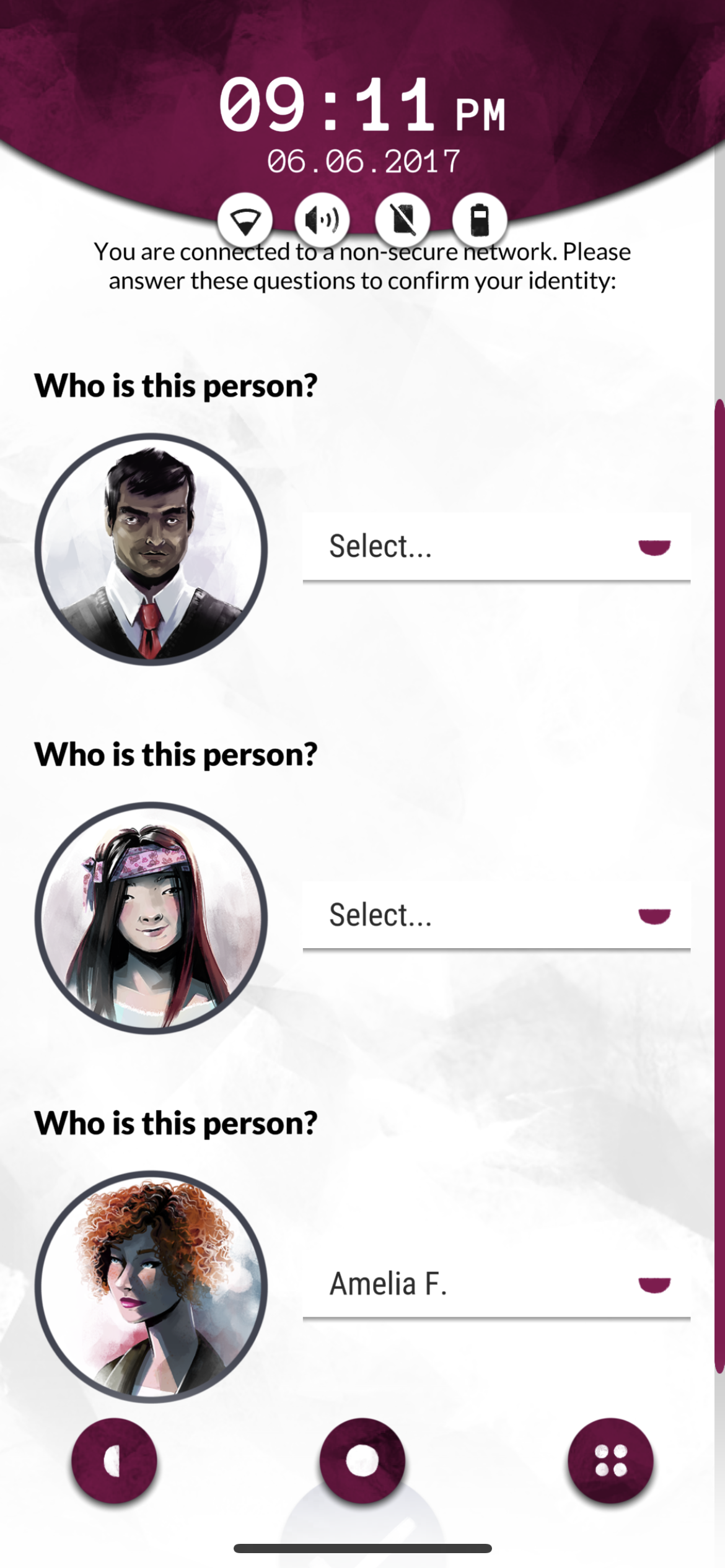
The user interacts with the game through hidden puzzles and investigative work (e.g. connecting to the phone’s Wifi requires finding the Wifi’s code within her notes). Other puzzles include getting access to PowerJob messenger, the game’s version of the professional social media app LinkedIn, by matching three of Laura’s colleagues and friends with their name. All of these tasks were done by carefully examining Laura’s photos, emails, texts, notes and calendar. 

In most games, the dialogue between characters seems artificial and tacky; however, Laura’s Story involves very realistic interactions between individuals. Her flirty texts with her boyfriend, emails to coworkers, texts with her sister, and messages to her friends make the game even more immersive. Even small details such as the way Laura writes her notes provides an immersive experience for the player. 

The fact that the game is a smartphone simulator creates a deceptively mundane environment: the simple user interface houses only twelve apps that are generic and part of every basic smartphone. Looking at the correlation between her relationship with Ben and her calendar revealed the negative social aspects of dating him. In 2016, when she first started talking to him, her calendar seemed busy with social outings such as going to “Space Bar”, travel adventures with her friend Emma, and attending conferences. However, in 2017, we see that her calendar becomes emptier and the only events that are happening are her doctor’s appointments. Even her text messages become sparse and limited over time as she stops responding to her friends and family members. 

An odd thing I found in her calendar was a daily reminder for taking a pill; at first, I thought maybe this could have been supplements or allergy medication, but she was referring to birth control pills. Upon unlocking Laura’s “SecuryChest”, an app designed to hide certain applications such as a messaging app called “OUR Messenger”, it becomes clear that there are many issues going on in Laura’s life. Through her hidden conversations with her ex-boyfriend Alex, I found out that Ben sent an intimate video message of Laura to her co-workers and others as a way of sabotaging her professional career. Ben successfully ruined her professional relationships for many months: one male co-worker, who was involved in a relationship, was sickened by the video while another male co-worker tried to seduce her. 

When I looked through the contents of the phone, I noticed a counter app which showed the date of each day followed by a number. These numbers appeared random, so when I looked for a correlation between the counter and her calendar, I saw no relation whatsoever. After synchronizing her personal and work accounts via “SecuryChest”, I discovered a hidden conversation with her co-worker Charlotte where the plot fully develops; Laura is horrified by Ben’s abusive actions and takes matters into her own hands by attending a domestic violence seminar, finding another job in a different town, and by downloading a counter to track each time Ben’s behavior is unacceptable. Innocent applications such as a daily counter, a calendar, and her email become a haunting reminder of domestic violence. 

After unlocking her work account through “SecuryChest”, the story provides a happy ending: Laura sends an email to herself as a way of notifying the person who discovers her phone that she is safe. She proceeds to instruct the player to turn on the phone’s GPS as a way of leading Ben to a dead end and asks to erase all of the data on her phone. Once the game finishes and the end credits start rolling, the player sees text messages showing Laura admitting to others that she suffered emotional pain from Ben, and she thanks the friends who helped her along her tough journey.    

Critique:

Although I found the game to be a great piece of digital storytelling, the description of Laura’s life appears to be no as t in-depth as I hoped it would. The average smartphone user like myself has hundreds to thousands of pictures along with many text messages and a plethora of downloaded apps. However, the developers attribute the limited content on her phone to the fact that Laura recently got a smartphone. I completely understand that Accidental Queens didn’t want to spend a ridiculous amount of hours making minute details and creating a more complicated narrative investigation; however, skipping over unique aspects of Laura’s “digital-life” breaks some of the immersive qualities of the game design. For example, as I was exploring her phone, I only found 7 notes and a handful of photos. In another instance, when I tried learning more about characters besides Laura and Ben, the only details I got on her sister were that she was a 33 years old manager at a Fast-Food restaurant in Edgaton. Details of other characters were lacking as well, which made Laura’s relationship with other people at times one-dimensional. Unlike the case of many stories, I believe that adding more information about characters would be beneficial in developing the story’s plot and character relationships. More digital information on Laura would, in turn, create a sense of empathy towards victims of domestic abuse. 

Furthermore, the game itself is not as participatory as one would think. Laura’s relationships, text messages, and her other digital aspects have already been established. The player is merely an observer in Laura’s world rather than a character. Unlike games such as Bury Me, My Love or even the natural language processing program Eliza, the user in Laura’s Story doesn’t have any impact on any outcomes. The developers, however, tackled the conventional norms of video games by intentionally restricting the game; in doing so, they are able to raise awareness of domestic violence among women.

Conclusion:

Although Laura’s Story has a few flaws, the experience made me feel empathy toward the protagonist. Players pierce through different layers of Laura’s “digital-self” as they investigate her life, and each user will have a different perspective on the protagonist depending on when and where they examine her phone. The game turned a mundane item into an exciting new digital medium.

Works Cited:

Bury Me, My Love: Gaming, Journalism, and Storytelling

By Cassie Z.

*Note: I highly recommend for people who are interested in the inspiration and developmental process of the game – how they approached writing the story, designing the characters, what kind of feedback the development team used while designing the game, the concerns they had, etc.– to take a look at the documentary on Bury Me, My Love produced by Split/Screen documentary on Youtube here: https://www.youtube.com/watch?v=oSP2BUu9C0w 

Nour from Bury Me, My Love

Pre-play Impressions

I think it’s important for me to include a personal confession that I suspected many others had even before opening the game: prior to playing the game, I was worried about how using the format of a game to approach and encapsulate a political and humanitarian crisis, namely the perilous migration of Syrian refugees out of a war zone in search of a better life, can go wrong in so many ways. Games are traditionally associated with entertainment and leisure, so many people may get the sense that, even before playing, that choosing such a medium to approach such a topic might be in bad taste or even disrespectful towards the plight and suffering of Syrians. 

However, the Bury Me, My Love development team is acutely aware of these perceptions. As members of the team have expressed in an interview with Split/Screen documentaries about the developmental process and release of the project. The founder of Pixel Hunt, the developer of BMML recouts (17:00): 

“I prepared a huge list of arguments to tell Dana (whose story inspired the game) that I didn’t want to trivialize the intensity of what she went through.”

“But actually, we talked five minutes and she told me it was great, every project that wanted to share her story were a good idea, and that she loved the fact that we used video games as a media, to make people live a little bit of what she lived”. 

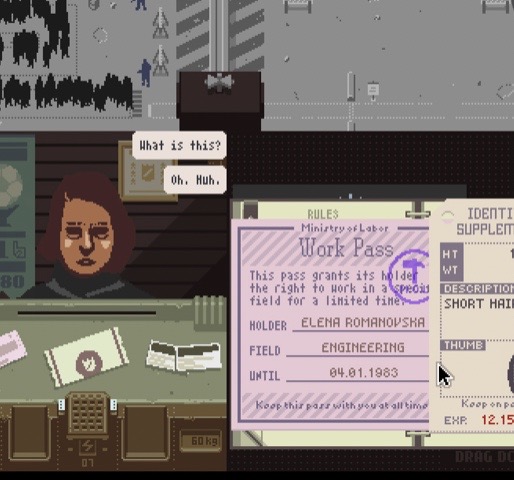
Even Lucie Soullier, the journalist whose article, “The Journey of a Syrian Migrant, as Told by her WhatsAppMessages” inspired the project, recounts her initial petrification to Florent Maurin’s proposal. She was eventually convinced by the Maurin’s dedication to research and respect for the topic through her introduction to two games: Lifeline (2015) and Papers, Please (2013), which convinced her that games were not just for “nerdy teenagers” and that there was a potential for games to be informative, educational, and enact societal and political change, which was the founding purpose of Pixel Hunt. 

The exchange between Maurin and Soullier made me realize the societal preconceptions associated with gaming and how such preconceptions are limiting in what games, as a medium with undeniable influence among children and adults, have the potential for. Especially since Bury Me, My Love is primarily a mobile game in addition to having other ports on Switch and Steam. The Pew Research Center states that 85% of Americans now own a smartphone of some kind, allowing mobile games to have a wide reach among users. 

Gameplay: Character Design

Bury Me, My Love is a text-messaging based interactive fiction game that tells the story of Nour, a Syrian migrant trying to find her way to Europe. Her husband, Majd, stays behind to take care of his parents and communicates with her via a messaging app modeled after Whatsapp. Along the way, Nour is met with strangers—some friendly and some not, rumors of political unrest, smugglers— and other decisions that she will need Majd (player’s) help on. The story has 19 endings and yes, Nour can die on the way.  

Upon opening the game, there is a statement (or disclaimer) that appears on the screen stating that the game is reality-inspired and that real-time notifications can be enabled. I thought it was interesting that such a game, which is based upon Dana’s communications and journey in many ways (audio clips, pictures, emojis, conversations) makes it a point to distance themself from being identified as a singular individual’s narrative. This distancing is also evident in how the team decided to go for an artistic rendering of the characters and scenes, and their decision to hire a French-Australian voice actress to voice Nour, instead of hiring Syrian actors to represent Nour and Majd. 

The team wanted Nour and Majd to go beyond being associated with particular individuals, rather they wanted Nour and Majd to represent the millions of Syrian women and men who are implicated in the Syrian Civil War— whether it be undertaking the journey, staying home out of necessity to take care of family and friends, or being caught on the frontlines. 

The sort of distancing is also evident in the gameplay, particularly the characters of Nour and Majd. Players will quickly realize that while they are playing as Majd and making choices for how Majd is communicating with Nour, Majd has his own personality and is his own individual. Oftentimes, the player will make a choice for a text based on two options given, and Majd will expand on that and send follow up texts based on the chosen choice. Thus, it feels like the players are influencing Majd, but the preset (and limited) options, Maid’s own biases and prejudices, and how Majd is programmed to send texts without subsequent player input convey that the player is not Majd, but more of a sprite or consciousness that sits on his soldier and angles his decisions. It is important for players to be aware that they are not Majd and to okay with not having full control over Majd as it is not their story to tell and enact (even though the game is primarily released in English and European languages). The team also came under fire for Majd’s character as Majd can make certain racist remarks and is the more religious one (and sometimes the more conservative one) of the relationship, which can prompt Nour to playfully call him a bigot. The team explains that they decided to include these options in order to be faithful to reality as there can be, and often is, a lot of racism on all sides during migration. 

The character of Nour is also unique, especially when viewed in combination with the real-time notifications setting. As a character, Nour is given a great amount of agency. Players will again quickly realize that Nour also has her own personality and way of doing things. Even when players, through Majd, suggest one route, Nour may have already made up her mind so it was simply a matter of encouraging/supporting her or talking her down, which will affect Majd’s relationship with Nour. (Yes, Nour can break things off with Majd and cut him out of her life). In addition, the conversation is almost always initiated by Nour, which puts the player into a waiting position. This position becomes nerve wracking in combination with the real-time notifications setting, which means that the conversation happens in real time and Nour may be offline for hours while she is dealing with an explosion, talking to smugglers, etc., to give players a sense of what it feels like to be Majd, waiting and worrying for his wife that is undertaking such a perilous journey. Interestingly, Nour’s character has been criticized by Syrian media due to her being an atheist. Though Nour’s character and manner of speech is constructed after Dana, who comes from a wealthier background, these critiques bring to mind questions and issues of representation (how) and reflects certain concerns for games that goes beyond treating such as a game as only a game when international politics and public relations are at stake.

Immersive Storytelling 

As I’ve talked about how the game creates distance, I now want to further touch on how the game creates immersion. I think the choice of the story being told through a text messaging app is great. Not only is it true to the original story that inspired the project, there is just something about text messaging that is incredibly personal as it feels like the reader is getting a first person account of the journey. If Dana’s story had been retold in a written story format (usually 3rd person), I felt like there would not have been such a high degree of immersion and feeling of one actually being “put in another person’s shoes”. 

I also think the decision to include money and time as variables that affect Nour’s journey is a nice touch as it is true to reality. How much money Nour has left impacts her actions and decisions such as what roads she can take and which smugglers she can go with. The emphasis on money is also a core component of the dangers of traveling as all players will experience. The first crucial choice of the game is that Nour is leaving with someone who has agreed to take her to the Beirut airport for a certain sum, but midway the driver states that he has heard that there is gunfire up ahead and takes the chance to charge Nour more for his trouble. The player must then decide whether to convince Nour to take the driver’s offer or to find another way to the airport (and potentially end up elsewhere in the process). In addition, there are other choices such as where to hide the money and what facilities/methods of transportation to take (based on cost). These decisions all require the player to take into careful consideration the financial situation of Nour and recognize how expensive such journeys cost. Migration is not as simple as traveling directly from point A to point B. As the game documents, there are costs for everything: food, water, shelter, buses, smugglers, papers, plane tickets, etc., and dangers at every corner.  

To conclude: Bury Me, My Love shows how journalism, storytelling, and gaming can intersect to create games that make one rethink what games are, what games can do, what kind of narratives can be told, and how to tell these narratives “right” through dedication to respect, communication, and research.

References:

“Category: Bury Me, My Love.” The Pixel Hunt, 27 May 2019, https://www.thepixelhunt.com/categorie/bmml.&nbsp;

“Bury Me, My Love – A Story of Love, Hope and Migration.” Bury Me My Love, https://burymemylove.arte.tv/. 

Split/Screen Documentaries. Bury Me My Love – A Split/Screen Documentary, Youtube, 10 Sept. 2019, https://www.youtube.com/watch?v=oSP2BUu9C0w. Accessed 24 Jan. 2022. 

Façade and the Future of “Artificial Intelligence Adventures”

Façade was the first game I ever downloaded on my PC. This was back in middle school, when Let’s Plays showing the game struggling to keep up with a barrage of hilarious and vulgar inputs from YouTubers were all the craze. In turn, when I played it for myself, I did the very same thing – push the game’s boundaries with bizarre dialogue and laughed as Grace and Trip looked at me in wide eyed surprise. I never ended up finishing it though, and now, after playing it through for the first time, I regret that.

Even back then, however, I was fascinated with the potential of a game like Façade. In-between bouts of laughter, I marveled at how Trip and Grace were still giving relatively human responses to the ridiculous things I was saying, and wondered how such a thing was ever made – especially in 2005.

Years later, I now have played Façade, and have only become more fascinated by how it works. Additionally, I have since began researching computer science and looking into concepts such as artificial intelligence and game design. Digital experiences like Façade, and the future that lies before them, is the place where all these interests intersect.

I touched on this in my presentation, but it is impossible to deny there is a significant demand for a follow-up to Façade. Everywhere I looked in the process of researching for my presentation and blog, there were commenters clamoring for a follow-up or remake. To their point, a follow-up was in one point in development, and by Façade’s original creators, to boot. Titled The Party, developer Matthew Mateas pitched it as such in an interview:

“where Façade had two computer-generated characters, The Party will have ten, a far more complicated proposition, but dramatically richer… The game will last about forty minutes, rather than twenty. It will support more physical action, allowing the player to do things like rendezvous with characters in a private room, lock doors, carry things around, and fire a weapon.”

Matthew Mateas

To me, and other fans of Façade, this concept sounds nothing short of perfect, and represents the ultimate evolution of what Mateas’ original project sought out to do. In turn, the way he capped off his interview was rather unfortunate. When asked if such a project was feasible, Mateas responds by saying a simple prototype would be “doable within twenty years” (Mateas 2006).

Twenty years? Surely that has to be some mistake. With how viral Façade went on the internet (even despite the fact that it got popular for its unintentional comedic moments), surely the market must be saturated with AI-driven verbal sandboxes just like it. Something like The Party must be in development as we speak!

Sadly, none of these hopes have any evidence to back them up. Releases of this type of game, which I call “Artificial Intelligence (AI) Adventures”, have been scarce over the years since Façade’s release. Only two notable examples come to mind: Event[0] and the AI Dungeon series, and both will be focused on later in this blog post, all in the context of Façade and the future of this genre.

But first: what is an “AI Adventure”? I see AI Adventures as an evolution of the “Text Adventure” game, a genre popularized in the 70s and marked by the usage of text commands to influence the game state – being utilized in controlling one’s own character, influencing the environment, and defeating enemies all by utilizing a bank of commands (similar to a computer terminal). However, these types of games are limited in terms of what specific commands they can process – if you don’t type in something that is explicitly planned for, all the game can do is give you a generic response and wait for you to tell it something it can parse. This is where AI Adventure titles differentiate themselves. In games of this type, artificial intelligence and language processing are used to make software attempt to respond intelligently to any input, no matter if a hard-baked response to it is present. This allows for a near-infinite amount of versatility and gameplay options, but also justifies why AI Adventure titles might be so rare. Making AI models powerful enough to reasonably respond to players both poses a huge challenge technologically, and also doesn’t make for a marketable framework – games like this, by design, are often absent of non-stop action, cinematic set pieces, or riveting multiplayer, all of which are big selling points of today’s industry.

But this makes the AI Adventure games that did end up coming out there all the more fascinating. I would consider the 2016 title, Event[0], a perfect example of the genre. At first glance, the text-input system of this game looks more like a traditional adventure game than an AI one, as the player’s main interaction is with a literal computer terminal – a system which is notoriously resistant to any out-of-the-box input handed to it. However, I should note that this is not just any terminal, but in fact one controlled by an in-universe sentient AI, and one capable of driving the game’s entire story forward by procedurally generating over two million lines of dialogue. In fact, the AI behind the computer terminal is so complex that it is able to shape a personality in accordance with the player’s input and even unintentionally made a new ending to the game through a bug in how it worked. AI-driven actions like this, that are both profound story-wise and technologically, are what make me beyond excited for the future of AI Adventures, and stand as the true evolution of Façade.

Speaking of the future, I would be remiss not to mention the AI Dungeon series when discussing this new genre. Originally created in 2019, the game is at first glance a text adventure game not unlike Zork and other titles of old – its interface, after all, is just simple text atop a black screen, narrating one’s journey paragraph-by-paragraph as they go along. It doesn’t take one long, however, to see where AI Dungeon makes itself unique (it’s in the name, after all!). In truth, every line of text within the series of games is written by an AI, building off an input consisting solely of a training set of known stories and the player’s own instructions, rather than a bank of keywords and actions. All you have to do is choose a setting (or make your own) and give it a sentence to start out with, and a wholly custom text adventure will form around your successive inputs. Furthermore, the AI used is not just powerful, but one of the most robust models in the entire world: as of the latest version, AI Dungeon is powered by OpenAI’s Generative Pre-trained Transformer 3, or GPT-3 for short. To give you an idea of how awe-inspiring and versatile this AI is, here is a set of images that GPT-3 made from scratch, just from someone typing a text prompt to it.

To me, these images are shocking – the illustrations are so well done that I fear for the clip art industry’s future, and the picture mockups are indistinguishable from real photos. Now, imagine this type of power, but brought to storytelling.

If you have played AI Dungeon, you may see this as a bit of an exaggeration. And I’ll admit – stories within the game can often get derailed or sound like gibberish. But even still, the ability of this game to improvise around the player’s input dwarfs that of Façade. I have seen the program respond reasonably to full paragraphs of input, I have seen it dig up old characters and utilize them flawlessly, and I have seen it build an understandable story complete with a beginning, middle, and end. AI Dungeon is nothing short of awe-inspiring and is the type of experience that I’d recommend to anyone besides the faint of heart (as capable as the model is, it has a tendency to create content that veers into the explicit, which led to developers making the controversial decision to try and wipe such stories from the platform).

This all is not to say that AI Dungeon has proved Façade redundant in the modern age. I thoroughly have enjoyed playing both, and each experience offers something completely different. Rather, I mean to say that the future of AI Adventures could represent a wonderful melding of these two experiences. What if Mateas’ Party could finally be realized, with the power of GPT-3 at the helm? What if someone could form 3-D explorable worlds around the infinitely expansive creations of AI Dungeon?

These are games that I would stop at nothing to get to play in my lifetime, but such a sentiment requires a lot of hope. In the above-mentioned interview, it was hinted that Façade’s follow-up has likely not be realized due to lack of publisher interest. Event[0], despite good reviews, hasn’t necessarily clawed into the mainstream. AI Dungeon’s first version floundered to pay for its own bandwidth. But, with its newest GPT-3-powered edition attracting $3.3 million in seed funding, I firmly believe the future is bright for AI Adventures. With news like this, Mateas’ 20-year estimate for The Party could be delightfully proven wrong.

Or not. Whatever happens, though, I’ll be waiting for it all the same.

Works Cited

Adventure Gamers. AdventureGamers.com, cdn.nivoli.com/adventuregamers/images/screenshots/15792/3997.jpg.

AI and Games. “The Story of Facade: The AI-Powered Interactive Drama | AI and Games.” YouTube, 22 Apr. 2020, http://www.youtube.com/watch?v=POv1cOX8xUM&ab_channel=AIandGames.

“AI Dungeon-maker Latitude Raises $3.3M to Build Games with ‘infinite’ Story Possibilities – TechCrunch.” TechCrunch, 4 Feb. 2021, techcrunch.com/2021/02/04/latitude-seed-funding/?guccounter=1&guce_referrer=aHR0cHM6Ly9lbi53aWtpcGVkaWEub3JnLw&guce_referrer_sig=AQAAAAZ6u5hPIa7VBrZTc6BQBNL81pqT_xjcdsiu4ntoYsIL2Vx-oqID-_5GlsAbJYsXzitWCaX8IWOEQtGD-WytQv9sNJen5QpzcXlbVdrWTGvaQpZtARACtnSxLINFIg3UjLd-NSxxYpxQr8zs5pYjyWxuG2t-5So2A-7Fqyp20rHO.

“Event[0] is 2001 Meets Firewatch, Due This September.” Eurogamer.net, 13 July 2016, http://www.eurogamer.net/articles/2016-07-13-event-0-is-2001-meets-firewatch-due-this-september.

Event[0]. Directed by Ocelot Society, 2016.

Facade. Directed by Andrew Stern, and Michael Mateas, 2005.

Harris, John. “Creating the Ever-improvising Text Adventures of AI Dungeon 2.” Game Developer, 9 Jan. 2020, http://www.gamedeveloper.com/design/creating-the-ever-improvising-text-adventures-of-i-ai-dungeon-2-i-.

Latitude. AI Dungeon, play.aidungeon.io/.

Mateas, M., and A. Stern. “A behavior language for story-based believable agents.” IEEE Intelligent Systems, vol. 17, no. 4, 2002, pp. 39-47.

Ocelot Society. “Event[0] by Ocelot Society.” Itch.io, ocelotsociety.itch.io/event0.

OpenAI, 18 June 2021, openai.com/.

Quach, Katyanna. “AI Game Bans Players for NSFW Stories It Generated Itself.” The Register: Enterprise Technology News and Analysis, 8 Oct. 2021, http://www.theregister.com/2021/10/08/ai_game_abuse/#:~:text=AI%20Dungeon%20was%20predisposed%20to,and%20characters%20into%20their%20stories.&text=The%20document%20contained%20a%20dump,the%20website%20Choose%20Your%20Story.

Rauch, Jonathan. “Sex, Lies, and Videogames.” The Atlantic, 1 Nov. 2006, http://www.theatlantic.com/magazine/archive/2006/11/sex-lies-and-videogames/305293/.

“This AI-Powered Choose-Your-Own-Adventure Text Game Is Super Fun and Makes No Sense.” Gizmodo, 3 Aug. 2020, gizmodo.com/this-ai-powered-choose-your-own-adventure-text-game-is-1844593111.

“Virtual Friends: AI-Powered Chatbots Help Against Self-Isolation.” MedicalExpo E-Magazine, 7 July 2021, emag.medicalexpo.com/ai-powered-chatbots-to-help-against-self-isolation-during-covid-19/.

Wawro, Alex. “Event[0] Has an Ending So Secret Even the Dev Team Didn’t Know.” Game Developer, 12 July 2017, http://www.gamedeveloper.com/design/-i-event-0-i-has-an-ending-so-secret-even-the-dev-team-didn-t-know-about-it.

Colossal Cave Adventure: A Modern Critique

Harrison Scott

Colossal Cave Adventure: A Modern Critique

Historical Background

            Played even by my parents at the time, Colossal Cave Adventure is a text-based adventure game originally developed by William Crowther for the PDP-10 mainframe computer in 1975. The PDP-10 was a notorious machine that enabled the development of other well-known early titles like Zork (1980) and Dungeon (1975). The PDP-10 is perhaps best known, however, for being the platform on which Bill Gates and Paul Allen developed the first BASIC interpreter; thanks to the PDP-10, Gates and Allen were able to use BASIC as a launching point for their first company– Micro-Soft. 

            As Adventure found its way into more PDP-10s, programmer named Don Woods added fantasy elements to the game come 1977; this early port sparked a frenzy of sorts, and Microsoft soon ported their own version for newly released IBM PCs in 1981. One of very few programs available at launch, Adventure found an audience in many– including my parents. The game was so popular in fact that it spawned its own video game genre, that of the “adventure game”– to say that the game was influential to the history of video games would be an understatement.

My Initial Expectations

            As a modern-day gamer influenced by titles like Minecraft and The Binding of Isaac, my expectations were for Adventure to be a procedurally generated cave game with a set number of few room types whose specific attributes would be generated on the fly. With the first of Murray’s four essential properties of digital environments in mind, proceduralism, I was excited to play a game that would be wildly different between each playthrough.

My Initial Impression

            After spending some time with the game, however, I realized my hopes for procedural generation weren’t met. Level progression was consistent and more or less predictable; save the RnG responsible for dwarves’ appearances, the game felt far more linear than I had expected. Does this then mean Adventure is not procedural, and that one of Murray’s essential properties of digital environments isn’t met in Adventure?

            Well, not exactly. The game is still quite procedural in the way it computes gameplay; although the rooms aren’t randomized, progression still follows a linear procedure that allows the player to press forward. Having questioned Adventure’s proceduralism, I began to think through the other three of Murray’s essential properties. How does Adventure stack up against Murray’s other criteria?

  1. Is Adventure participatory?
    1. Most certainly. As alluded to by Aarseth, the player must participate in non-trivial activity to continue their playthrough– that activity being entering text in a field, which itself requires the user to “participate” in the rules of the game world (for instance, limiting movement inputs to cardinal directions).
  2. Is Adventure spatial?
    1. In a non-Euclidian sense, yes. The user traverses beautifully described spaces that connect to one another (and can even be mapped out!)
      1. A testament to Adventure’s world-building abilities: if each of the 40 rooms were 130x130x130ft (40x40x40m) on average (a fair estimate), one could still fit up to 3,600,000,000,000 colossal caves in a single Minecraft world. Although Minecraft is significantly larger in scale, though, Adventure’s narration and design makes the world feel every bit as dense and complex as any Minecraft cave system.  
  3. Is Adventure encyclopedic?
    1. Most certainly, for there are myriad items the player can pick up, enemies to encounter. Compared to modern-day titles like World of Warcraft (housing over 116,000 unique items and thousands of enemy types), Adventure’s implementation is light- yet, its item and enemy selection is diverse enough so that the world feels sufficiently full and populated.

Critical Overview / Walkthrough

Outside the Cave

            Booting up the game, I started at the end of the road and quickly found myself in the surrounding forest. With the idea that my player was indeed moving in space, I continued in one direction (north, I believe) for a solid five minutes before giving up; I promptly “turned” my character around (in my mind’s eye, anyway), and buckled up for what I thought was going to be another five minutes of walking south back to my starting point.

            Only travelling back didn’t take five minutes– it was instant. I realized the game did not work based on a traditional 2-D basis, but rather via a finite number of ‘cells’ interlinked with one another; I found there were two forest cells, one of which was “near both a valley and a road,” and the other of which runs along “a deep valley to one side.” I learned space could be non-euclidian in this video game world; I could walk straight into the forest for hours, turn around, and be back to my starting point almost instantly.

            The GIF below is fairly representative of how I visualized my experience in the forest; I walked for an age, only to turn around and realize I hadn’t moved far at all.  

            Once I had gotten my bearings in and around the forest, I tried entering the wellhouse near the end of the road. Perhaps an unavoidable consequence of using a more basic NLP system, I found the rest of my time outside the cave frustrating due to the game’s occasionally inconsistent vocabulary. For example, after reaching the end of the road once again, I inputted “enter building” in the text parser; the game specified our character stands before a wellhouse, after all, and I was curious what lay within. To my surprise, this command worked– after picking up the loose items, I went to leave the building. However, entering “leave building” produced the following output:

But you aren’t in the well house. 

For whatever reason, “enter building” was recognized while “leave building” wasn’t. I then tried many combinations of the same “leave building” command:

>exit house

But you aren’t in the well house.

>flee house

That’s not a verb I recognize.

>run away

You can’t go that way.

At a loss, I finally “caved” (a little pun there) and re-read the game’s instructions– I was able to leave the house by simply “walking” west. 

            After contemplation, I thought this blatant contradiction– “enter building” working as expected, and “exit building” doing the opposite– could be a design choice aimed at acclimating the player to the cardinal direction movement system. Perhaps Crowther/Woods thought allowing the player to enter but not exit would provide an incentive to actually read the “HELP” text closely and realize the game preferred cardinal directions to description-based movement commands. A better way to motivate the player in this way, in my opinion, would be to script the following after the player tries to leave the building:

You start to leave the building, but spot a sign above the entryway. ‘ONLY TRAVEL NWSE, OR RISK GETTING LOST.’ You stop before the entryway.

This would more obviously call the player’s attention to the NWSE movement scheme, as opposed to the irritating:

But you aren’t in the well house. 

            On the other hand, though, the tutorial sequence does get world building right. For instance, although the first few areas beyond the end of the road– the valley, the slit in the streambed– are devoid of any interesting action aside from aesthetic descriptions, the lack of activity in both of these places serves the game’s overall narrative by making the above-ground seem boring and trite. When we combine this trite environment with details alluding to passage belowground– a gully flowing beyond the wellhouse, water flowing into a slit in the streambed, the dry streambed itself leading into a damp depression surrounding the grate– the player’s curiosity is piqued to where these waters lead. Much like the flowing water, I felt drawn to the depths below. 

Depth Level 1: Hall of Mists

            Beginning with my critiques of the infamous Hall of Mists, I found progressing past this level unnecessarily counterintuitive at times. For example, the black rod was a major cause for confusion– thinking it was some sort of weapon, I picked it up as soon as I could to prepare myself for the depths below. Once I found myself in the Hall of the Mountain King faced by a giant snake, I realized the rod was completely useless; recalling the bird in the canyon and the wicker cage I had picked up earlier, I quickly backtracked to try and capture the bird– only to be met with:

>capture bird

The bird was unafraid when you entered, but as you approach it becomes disturbed and you cannot catch it. 

I soon returned back to the snake, only to be attacked by a dwarf; even the dwarf’s axe, however, wouldn’t make a mark on the snake. 

            Although the bird’s fear of the rod is mentioned in the game’s “HELP” text (which I had to read a third time to progress past this point- reading comprehension doesn’t seem to be my strong suit), I feel the bird’s fear  of the rod works against the player’s progression in an unjustified way. If the rod were revealed to have belonged to a wizard that killed birds, this complication would feel more justified; as it stands, the bird’s fear of the rod comes across as the developers doing their best to work against the player’s progression. 

            On the other hand, I found Depth Level 1’s aesthetic design compelling. Following white mist meant magic was afoot; whether it was drifting upward from a cavern below or lining the walls of the corridor my player was lighting up with their lantern, the use of this white mist added a sense of ambience and atmosphere I really enjoyed. Furthermore, some of the cells were especially interesting to imagine; for instance, the “window” cell caught my attention due to its mystery:

“You’re at a low window overlooking a huge pit, which extends up out of sight. A floor is indistinctly visible over 50 feet below. Traces of white mist cover the floor of the pit, becoming thicker to the right. Marks in the dust around the window would seem to indicate that someone has been here recently. Directly across the pit from you and 25 feet away there is a similar window looking into a lighted room. A shadowy figure can be seen there peering back at you.”

            Is this pit some kind of stadium? Are these windows intended to be for two spectators? Why just two? Why can’t we see the floor? Why is the mist thicker to the right side of the room? Who was at this window earlier, the dust preserving their presence? Who lies across the pit? So many questions, zero answers– the fact that the player feels motivated to ask them is an indication that the cave’s worldbuilding is working wonders. 

Depth Level 2: Dirty Room

            Perhaps a combination of being accustomed to the control scheme and becoming more motivated to complete the game, I have nothing but praise for Depth Levels 2 and 3 of the game. Depth Level 2 stood out especially due to the unnatural way in which its main chambers are reached; before the player can access Depth Level 2’s main chambers, we must descend to Depth Level 3 and find an entrance upward back into Depth Level 2. As we pass through Depth Level 2 for the first time, the player feels there’s more to explore here and searches Depth Level 3 for an alternate entrance to the level above. 

            Another design choice I found rather charming in Depth Level 2 was the troll’s demand for treasure. Each time the player crosses the troll’s bridge, they must pay with at least one form of treasure; to free Depth Level 2’s bear and acquire its gold chain, the player must come prepared to sacrifice two pieces of treasure to cross the bridge twice. One issue: it is possible for the player to be stuck on the bear side of the troll bridge without any treasure. If this is the case, the player is soft-locked from continuing their playthrough; they must restart, as they can no longer progress to areas on the other side of the troll’s bridge. 

Depth Level 3: The Bedquilt

            Depth Level 3, home to a few secret levels, was challenging to navigate by this point in my playthrough. One aspect I could pinpoint as enjoyable, however, was the bedquilt itself. This cell is completely unique to other cells found in Adventure in that escaping it is 100% dependent on random number generation. There is a chance that walking any of 4 directions will allow the player to escape the cell– progressing beyond the bedquilt is simply a matter of brute force, entering enough commands into the parser until it eventually spits you out. 

Overall Thoughts

            Although the game isn’t the procedurally-generated cave crawler I was expecting, I definitely understand and appreciate its cult appeal. Aside from a few annoyances (not being able to “exit” the well house, the intricacies of the infamous black rod, potentially soft-locking a playthrough by either killing the bird or running out of treasure on the other side of the troll bridge), the game is a fount of entertainment and definitely worth playing!

Lost at Sea: Nonlinear Storytelling in Disappearing Rain

by Sydney Glenn

! There are spoilers for Disappearing Rain in this blog post !
To avoid spoilers, look for the (SPOILER) tag bracketing certain lines.

Upside down underwater amidst a turbulent storm– that’s what my first two hours engaging with Deena Larsen’s hypertext fiction Disappearing Rain felt like. Confused and blinded by the darkness of the water, I flailed against the torrents, waves hitting me from all angles as I struggled to discern up from down. Yet despite the turmoil, I was already absorbed in the mystery of the narrative– the disappearance of Anna Mizunami. As I fell down a rabbit hole of hyperlinks and haiku, like Mat Anderson and Patricia Tomaszek, contributors to the Electronic Literature Directory, muse in their eponymous article about Disappearing Rain, “Larsen … orchestrate[d] [my] own disappearance in the virtual reality of the Internet,” one that, as I would soon realize, mirrored the disappearance of Anna herself (Anderson and Tomaszek).

Disappearing Rain follows a cast of six family members caught up in the sudden disappearance of Anna, one of the twin daughters. Players can follow multiple characters’ story paths, including Amy, Anna’s twin sister, as she delves into the depths of Anna’s computer looking for clues, Kit and Richard, the twins’ parents, as they fight their increasing desperation over Anna’s whereabouts, and Sophie and Yuki, the grandmother and great-grandmother, in their own stories of credit card fraud, navigating memories, and the preserving the souls of their ancestors.

The story of Disappearing Rain is scattered across 144 different webpages connected with over 1,000 hyperlinks, forming an intricate spiderweb of plot points. While the prospect of piecing together so many story fragments may intimidate first-time players, Larsen has already taken this into account; she provides multiple diving spots into the story via the home page. The most visually striking examples include two links attached to kanji characters “mizu” and “kawa,” meaning “water” and “river” respectively. Accompanying the characters are the titles “Part 1: Water Leavings” and “Part 2: River Journeys,” which, along with Larsen’s description of the work, inform the player that the story content divides into two thematic halves. The description also holds four more links associated with the storylines of specific characters or character pairs as well as the title itslef. Finally, two unassuming lines, “Come on in” and “The water’s fine,” are the last remaining hyperlinks.

The home page of Disappearing Rain.

For my opening dive, I clicked on “Water Leavings,” and my eyes were immediately inundated with tons of visual stimuli. The “Water Leavings” and “River Journeys” pages contain a series of haiku– one central, bolded haiku reading from top to bottom, and a series of smaller, unbolded haiku reading in lines from left to right that branch off the individual lines of the bolded haiku. Clicking a link on an individual line or segment of a haiku links to another page with a short section from the story, each typically containing multiple linked words to another webpage’s story. And at the bottom of each page lies two haikus oriented horizontally– the bolded haiku (associated with part 1 and part 2), and the haiku subsection linked to the particular line of the bolded haiku. Thus, the haiku form an organizational system resembling a table of contents– the story divides into two thematic parts, represented with a bolded haiku; each line of the bolded haiku links to a sub-haiku, each line of which contains a page of the story. Thus, each line of the bolded haiku functions like the chapter of a book, containing a series of pages as represented figuratively by the individual parts of the sub-haiku and literally by the contents within these parts’ webpages.

The Water Leavings “home page.”

Upon my first entry into Disappearing Rain, I was not able to glean this information about the “Water Leavings” page, so I simply clicked the first word that appealed to me. And thus, for my next two hours of engagement, I followed the flow of the haiku, often clicking page-embedded links on a whim, or following each individual haiku to its end. The experience was gripping to say the least– sometimes I would read a particularly cryptic linked phrase from a webpage and click it, only to be delivered to a seemingly-unrelated anecdote. Other times, the connection would be more apparent, or occasionally, contain an entirely new piece of the story from a much later or earlier point in time. The latter type of link never ceased to shock me as it felt like I was stumbling upon plot spoilers; since my experience was nonlinear and chaotic, I had little context for the plot or characters, and the sudden skips in time only exacerbated my confusion, albeit magnifying my excitement for the mystery tenfold in the process.

Only after examining the constitution of the home page and discovering the organizational structure of the haiku did I perceive a straight path through the narrative. Despite it appearing obvious in hindsight, my discovery that the horizontal haiku of “Water Leavings” page were entirely chronological– both within the sub-haiku and between the sub-haiku –I was thrilled and proud of myself at the discovery, as I also was when I investigated the haiku on each character page and discovered them to be chronological selections of haiku lines from both “Water Leavings” and “River Journeys.” These character haiku extracted chunks of the story from within both parts and arranged them linearly; they can feel a bit disjointed to read without context of the full plot, but they glean insight at what moments Larsen thinks is most impactful in the journeys of the characters.

To properly reveal the ingenuity of Disappearing Rain, I will circle back to the quote I mentioned at the beginning. Larsen attempts to replicate the experience of disappearing into the Internet for the player by dropping them into a pool of stories without any imposed pathway through it. While she does offer structured paths in the forms of the Water Leavings and River Journeys haiku and the character-associated haiku, the novelty of the hyperlink fiction medium to most players will likely invite them to jump in headfirst, attracted by the appeal of clicking on the links, and the embedded links within the pages will form a disjointed path through the story. Unbeknownst, or possibly partially realized by them, they will mirror the experience of Amy, jumping from clue to clue without any particular logic– and if they were like me, spend hours engaged, with strained eyes, an actualized Internet binge.

I simply wanted to piece the story together, but my current approach was doing me no favors. So I returned to the home page, and after a critical examination of the Water Leavings page structure, found a chronological way through the study. I restrained from clicking any of the mid-text links to prevent myself from confusing my understanding of the plot. This experience was rewarding in the sense I achieved a fairly clear knowledge of what was going on with each character and where Anna actually disappeared to. It also brought me smaller revelations, such as, (SPOILER WARNING) the realization that the home page linked lines “Come on in. The water’s fine” were what Amy says to us, the readers, to invite us into the Internet with all the other disappeared souls, as well as what Sophie said to Amy at the river where she contemplated suicide (SPOILER END). However, while uncovering the story was indeed satisfying, something about concluding my experience with Disappearing Rain there felt wrong.

In hindsight, I think this disappointment stemmed from the conflict between my hardwired need to perceive Disappearing Rain as a story versus a recreation of the imagined experience of disappearing online, which I believe is closer to what Larsen intended. Viewing it as a story, the only way to have a traditionally-satisfying reading experience is to read Disappearing Rain from beginning to end. However, if this true, there is no need for it to be written as hypertext fiction– if the goal is purely to understand the story, a linear novel would suffice. Thus I’d claim that Larsen envisioned a concrete purpose for her choice of hypertext as a medium for the story, and I’d argue that it intends to simulate the experiences of Amy, Anna, and potentially Yuki as well.

The connection to Amy is fairly obvious– in scouring Anna’s search history for clues, bouncing from topic to topic without context, similar to how we experience the sudden skips between events in the story. However, I feel like the act of skipping through time is better explained by the descriptions Yuki’s (SPOILER WARNING) battle with Alzheimer’s. She hallucinates Anna’s ghost (as indicated by the “Hallucinations” link in “snow falls” linking to a description of Yuki with Anna’s spirit in “crystal edges”) and is brought to tears only to forget moments later; and when she dies, her memories begin to congeal in one pocket in time– in “murky puddles,” Larsen describes Yuki’s memories “shift[ing] like the water bubbling from the back of the fountain,” no longer fixed linearly but overlapping on top of each other. Yuki struggles with remembering individual memories, which Larsen describes as “push[ing] the water of her memories into the forefront of her mind.” When she tries to select one, the multitude of them “[cascade] out again like the waterfall in the fountain.” But perhaps most important is Yuki’s specific inability to discern days and faces from each other– this directly mirrors the new player’s experience should they choose to stumble from link to link before experiencing Disappearing Rain chronologically. Entering the story with no knowledge, like Yuki into the space of her memories, they stumble upon a random moment in time with no conception of when it exists in relation to the others, only to be redirected to a completely different one at a different location in time, with only small, abstract hyperlinked-threads connecting the two. (SPOILER END)

I can’t help but feel that the nonlinearity of the experience might connect to Anna’s (SPOILER WARNING) and Amy’s experience inside the Internet, yet due to the story’s evasive descriptions of the Internet-space, I can’t conclude anything decisive. But I still wonder, how does Larsen envision time working in the online space where Anna and Amy reside? Do they skip from future to past to present, like us readers? Or do they experience the flow of time linearly, occupying the same space in time as their family? How does this work with the letters they write to their family and contacts on the outside world? (SPOILER END). Perhaps the intentional ambiguity reflects Larsen’s and the world’s collective uncertainty with the Internet and the mystical viewpoint many adopted towards it– an interesting phenomenon to observe 22 years later when the Internet is as pervasive and ordinary as ever.

For some readers, piecing together a story nonlinearly by navigating hyperlinks can feel uncomfortable or stressful; clicking on a link could be a source of anxiety if the abstract, seemingly random connections between pages instill a fear of experimentation, of clicking a “wrong link” and being shunted off to irrelevant plot point and tainting one’s experience of the narrative. I believe Larsen’s choice to include multiple entryways into the narrative aims to bridge both approaches– the existence of both the haiku table of contents pages organizing parts 1 and 2 and the mid-text links allows the reader to determine what degree of linearity they want to experience the story.

There is so much more potential for analysis beyond these discussions of linearity– the content of the haiku and choice of linked words, both in the representation of their pages, the two parts, and of the characters, the magical properties of water and rivers, and more story secrets, such as (SPOILER WARNING) the identity of the person writing Anna love letters, (SPOILER END) to name a few. With all these tools and mysteries at its disposal, Disappearing Rain justifies its existence as hypertext fiction and establishes itself as a multimedia art form, setting a satisfyingly-high bar for future works of hypertext fiction to reach.


Citations

Tomaszek, Patricia, and Mat Anderson. “Electronic Literature Directory.” Disappearing Rain | Electronic Literature Directory, 19 May 2010, https://directory.eliterature.org/node/516.