An Imposter Among Us – Dylan Hernandez

At one point during covid, this game soared beyond the charts. I remember playing it in discord with my friends, and even more with random people late in the night. “Among Us” is a popular online multiplayer game that shares the detective or mystery theme we are all familiar with. A game where you’re either an imposter or crew member. The game’s main objective is trying to identify the “Imposter(s)” among the crew members you are playing with. Depending on how you set up the game, there can be more than one imposter. This aligns with the mystery that drives detective stories. Its aim is for the protagonist or “crew members” to uncover who is the culprit responsible for the murder(s) of the crew mates. In order to do so one must be very cautious of surroundings and look for even the most subtle clues.

What I find most intriguing about this game is the use of deception and social dynamics in order to pull off a win as an imposter. When trying to deceive the others, it varies how well your approach is depending on if you’re playing alone with random people or with friends. As in class, not knowing many people that closely, it was difficult figuring out when someone was telling the truth. Your friends may see you as someone who is clearly lying or trying to deceive, whereas someone you’re not too familiar with may see you as a threat. I would say another varying factor could be where everyone is located. An interesting clue can be seeing someone’s facial expressions or the tone of their voice when being interrogated. While on the other hand, when you’re playing with random people, sometimes it’s difficult because you can’t go off of the tone of voice, rather can only see the text in the chat which doesn’t help someone’s case as much.

The next thing I’d like to talk about is the use of the sabotage tactic. The sabotage tactic is different depending on the map you decide to play. For this example, let’s talk about the first one. This map allows the imposter to use a light switch, which lowers the crew members line of sight, allowing the imposter to kill easier without someone else seeing. The next is setting off the reactor alarm, which forces at least two crew members to weasel their way to the left side of the map and deactivate the reactor. This tactic allows the imposter to diverge attention one way while possibly making a kill on the other side. The next is in communications, where all tasks crew members are trying to take care of are turned off until the communications task is finished. This draws all the attention to the bottom of the ship. So reactors and comms force members to a specific part of the ship, while electrical fields block vision. Another sabotage technique that is commonly used is closing doors to specific parts of the map. This can be used to trap a singular or multiple members and can cause friction. It can also be used to block off where a body could be found. The largest tactic and one of my favorites is the use of venting. It allows the imposter to move around the map quickly, especially after executing another member of the crew.

We now know the ultimate goal of the game is to unveil the identity of the imposter before they sabotage the mission or eliminate all of the crew members. However, there is another way for the crew mates to secure a win. This being to complete all given tasks/missions before being eliminated. Even if you do get eliminated, it is important to continue completing the tasks as you are still a ghost floating on the map. That way of winning isn’t as much detective work, but still an option. The other way is through gathering clues and evidence against other members of the crew. Gathering clues could be observing other members complete tasks, and developing trust. Now that doesn’t always work as some crew members can deceive you into thinking they aren’t the imposter. By carefully analyzing other players movements and actions, you may be able to tell who it is, but at the same time have to be conscious of keeping yourself safe and not looking too out of place or suspicious. This allows a player to see discrepancies in alibis, suspicious movement or just actions that don’t align to what another player can claim to be doing. These all deduce reasoning to who the imposter could be and fall under reasonable suspicion.

All in all, I believe that this game follows the directions of what we as a class decided a detective/mystery game can be. It allows for players to gather evidence and clues. It carries the burden of suspicion and deception. It also allows for players to use logical reasoning and problem solving. The imposter themselves can often use a detective-like strategy to avoid suspicion and frame other players. 

This picture shown is of the map just to clarify any misinterpretations. The sabotages can occur in the reactor room, Electrical, and Communications. Players start in the cafeteria and can choose three different directions to surf through.

The Case of “The Case of the Golden Idol”: The Golden Idol of Puzzle Video Games by Sallie Hinkle

In the ever-evolving landscape of the gaming industry, few titles manage to strike the delicate balance between nostalgia and modern innovation as successfully as “The Case of the Golden Idol” (2022) does. With its charming blend of a 1990s video game aesthetic and an old-timey setting, this indie gem captured the hearts of players young and old and has found much commercial success. Yet, its triumph wasn’t solely rooted in sentimentality; rather, it deftly intertwined these nostalgic elements with intricately detailed technical mechanics that resonated deeply with a modern gaming audience. In this blog post, I delve into how “The Case of the Golden Idol” achieved its remarkable success by bridging the gap between past and present, offering a compelling experience that appealed to both retro enthusiasts and contemporary gamers alike.

With its glowing reviews and widespread acclaim, “The Case of the Golden Idol” stands as a testament to the enduring appeal of well-crafted video games. Yet, amidst the chorus of praise, one question echoes resoundingly: what propelled this game to such heights of success? Delving into the intricacies of its design and execution, it becomes evident that several key factors underpin its triumph. So, what precisely did the developers achieve to earn such adoration? Let’s dissect their accomplishments, categorizing them into three distinct pillars that formed the bedrock of the game’s success: Nostalgia, Narrative, and Technical mechanics.

Nostalgia – Imbued with a charmingly retro aesthetic, “The Case of the Golden Idol” harks back to the vibrant palette and pixelated graphics reminiscent of 1990s video games. Every scene is a meticulous homage to the era, brimming with intricate detail that evokes a sense of warmth and familiarity. This nostalgic allure is further amplified by the game’s immersion in the detective genre, a sphere steeped in the mystique of bygone eras, where secret societies lurk in the shadows and intrepid gentleman-sleuths unravel decades-long conspiracies.

Yet, what sets this game apart is its ability to transcend mere homage and resonate deeply with a modern audience. In an age where retro aesthetics are experiencing a renaissance across various pop culture spheres, the decision of the developers to tap into this zeitgeist proved astute. By deftly blending nostalgia with contemporary sensibilities, “The Case of the Golden Idol” strikes a delicate balance that captivates both seasoned gamers yearning for a nostalgic trip down memory lane and newer players intrigued by the allure of retro gaming. This strategic fusion undoubtedly played a pivotal role in the game’s resounding success upon its eagerly awaited release.

Narrative – The narrative in “The Case of the Golden Idol” is not only meticulously crafted but also ingeniously structured to offer players both freedom and guidance. While players have the liberty to explore and investigate at their own pace, the game subtly nudges them back on track if they veer too far off course through the use of a specific mechanic that states if their deduction is correct, slightly off, or very off (see below). This delicate balance ensures that the narrative unfolds smoothly without sacrificing the player’s autonomy, allowing them to fully immerse themselves in the narrative as an active participant.

This image depicts the “Thinking Panel” of the game. At the top of each section is a notice in green that reads “The scroll is filled in correctly.” This indicates that the player has solved the puzzle and attributed each clue to its correct deduction. Only once the scroll is complete can the player then proceed onto the next puzzle. In the event that the scroll is not filled correctly, the notice at the top will read “The scroll is filled incorrectly” in red, or “Two or less are incorrect” in yellow, indicating that the player has made some number of false deductions.

Additionally, each deduction made by the player unveils a piece of the puzzle, with optional hints available to tailor the level of challenge to individual preferences. Progression through the game is contingent upon making correct deductions, creating a sense of accomplishment and immersion. Importantly, information gleaned from earlier scenes often proves crucial in later stages, fostering a sense of continuity and depth in the storyline. This interconnectedness between scenes lays the groundwork for a larger, overarching narrative that gradually unfolds as players delve deeper into the game. As a result, the narrative becomes a tantalizing incentive for players, serving as a sweet reward that motivates them to unravel the mysteries lurking within the game’s intricate plot.

Technical Mechanics – as previously mentioned, the game makes use of a system of guidance for the players which includes both subtle nudges in the right direction and the option to engage with hints. The game developers actively discourage use of the hint system, wanting players to come to the correct conclusions on their own. One review of the game by Nicole Carpenter reads “There is a hint system that offers clues — still vague and full of riddles — designed to lead you toward answers. But the developer does caution the player from using this system without consideration; there’s no real reason given, but my best guess is that developer Color Gray wants players to take the time to consider each scene in depth, and arrive at Eureka! moments on their own.”

This hint system has received other negative reviews, overall seeming to be a point of contention within the player base. News editor Jay Peters writes “When you click the “Hints” button, the game shows a prompt, another prompt forces you to solve a puzzle, and then you can pick a hint. Even after all that, the hints themselves don’t directly give you answers; they’re just a clearer piece of information about what’s going on in the scene. It’s a clever system, and I appreciate the spirit of wanting the player to work everything out for themselves. But for the amount of work involved, I wish the hints gave clearer answers.”

Conversely, another technical aspect of the gameplay garnered significant praise—the implementation of a “disembodied” player. Instead of assuming the role of a traditional detective, players embody an omnipresent entity devoid of specific personality or appearance, preserving the game’s immersive illusion. This approach grants unrestricted access to investigation areas, eliminating the frustration typical of locked doors or undisclosed locations in other detective games. Developers balanced this omnipresence carefully, requiring players to discern which in-game characters would logically possess access to certain areas or information to arrive at correct deductions. Despite the player’s unrestricted observation, the game world remains bound by its own rules and limitations.

To end, I would like to include a quote from Nicole Carpenter that hits at the heart of why this game is so successful. In her review, Carpenter writes “The Case of the Golden Idol is a game that makes me feel like a TV detective, slapping photos on a wall and drawing red lines between them. Those strings of yarn crisscross throughout my notebook, connecting characters and murder weapons and motives. It’s easy to get sucked into small details looking for a lead, but the feeling it gives when I’ve locked in the correct answers… It’s like I’m the most brilliant person on earth — even if just for a moment. The Case of the Golden Idol, like other deep detective games, expands past its own boundaries and into the pages of my notebook, leaving me thinking about its clues long after I’ve closed the game.”

Link to Jay Peter’s Review: https://www.theverge.com/23433741/the-case-of-the-golden-idol-review-pc

Link to Nicole Carpenter’s Review: https://www.polygon.com/reviews/23433618/case-of-the-golden-idol-review-return-of-obra-dinn-detective-game

Voyeur: A look back

For class this past week, I was part of the group who played the game Voyeur. The game falls under the interactive movie genre, where the vast majority of the game is recorded cut-scenes that the player must look through and decipher. Upon its initial release in 1993, the game received numerous awards, but subsequent versions of the game received harsher reviews. Based largely on the style of game that Voyeur is, and especially when held in contrast to the film Rear Window, I think that the faults of this game hold it back more than its successes propel it forward. 

In Voyeur, you play the role of a private investigator hired to capture evidence against Reed Hawke, who is planning to announce a presidential campaign, and destroy his career. You operate a video camera overlooking the Hawke manor, and over the course of a few days, must look into different rooms and record video footage that would accomplish the said task of running his career. 

An issue I had with our group playthrough was that it was not immediately clear why we were doing this. Why would it be such a bad thing if Hawke was president? Why is it so critical that we ruin this man’s career? The initial motivation for spying on him just wasn’t there for me. Of course, as you play the game and discover incestuous relations and a murder plot, it becomes clear why he shouldn’t be president (though things of that nature haven’t stopped recent figures from rising to power). In comparison to Rear Window, the setup for voyeurism is more compelling. Here, a man who has lived his whole life on the edge filled with action is now wheelchair bound, and has nothing to do but try to find some excitement. So, he turns to observation of his neighborhood. While at first, a private investigator might make more sense as an observer than a simple man with a broken leg, the PI in Voyeur simply lacked good motivation for me. 

From the start, I wasn’t entirely captivated by the game. The gameplay itself didn’t really pull me in either. The style of game, that being an interactive movie, just isn’t a lot of fun to play through. It feels like it removes lots of the best parts of gaming – actual gameplay, character movement, character control, interactivity – and removes lots of the best parts of film – cinematography, camera movement, score – leaving the player with a watered down experience. I’m not sure how Voyeur could have done a better job at this, I think it is more a fault of the genre, especially with the technological capabilities of the time. I think the lack of actual gameplay and more cut-scene focused game would have worked better if I was more invested in the story. I didn’t feel a lot of pressure to prevent this guy, Hawke, from becoming president until I found out about his murder plan. In Rear Window, there isn’t a “looking hoping to find something”. Jeffries is suspicious of a murder and goes down that rabbit hole. When Lisa goes to investigate, stakes are raised even further. When the injured Jeffries is confronted by Thorwald, the stakes are raised again. In Voyeur, I didn;t feel that same rising tension.

That being said, there are positives for this game. I think the general concept is an intriguing one. Looking back through a 2024 lens, the political intrigue and goal of preventing a bad man from becoming president is somewhat relatable. The acting performances from cut-scene actors in this game are also done well. At the time, this game was intriguing for its use of mature and adult content in game, which, by today’s standards wasn’t as shocking or intriguing as it might have been in 1993. It is easy to judge games some thirty years after their release as not being good, especially in a field where the technology and culture has changed so drastically. 

Many of the criticisms I have levied thus far can be chalked up to Voyeur being a product of it’s time I think, especially critiques of limited gameplay and the constraints of the genre (these interactive movie games have changed dramatically in decades following, see Telltale Games) would not be as present were this a modern product. However, my lack of being initially pulled into the game, and the lack of rising tension are fair criticisms of Voyeur. That being said, I still think Voyeur has its place as a game of investigation. It was fairly groundbreaking for the time, and the concept that it has of putting the player into a mystery is one that we still see today. I think that popular games like the Telltale games and Detroit: Become Human have to credit their advent to games like Voyeur. As I mentioned before too, the subject matter of the game was a selling point at the time, and, while it might not be as special today, still paved the way for other games. I think it serves its purpose best as a piece of history to look back on. An interesting plot with a lack of intriguing gameplay, but innovative ideas that can serve as a touchstone to see just how far the genre has come.

-Luke Walker

Among Us – Joshua Durodola

About 4 years ago, Among Us had the whole world in a chokehold. Everyone from adults to children were playing it. During a time of global pandemic and panic, people found a way to come together and have fun with the game. I remember being a first year student on campus during this time and I would see group of students in their masks in a small little circle playing Among Us and trying to figure out who the imposter was between them. On TikTok, there were various videos and clips of famous streamers playing the game and viewers being enticed by it. Through all this enthusiasm about the game, I somehow managed to never find a way to play. Many of my friends would plan the time and day to play in our group chats, but I could never find it in me to play the game. 

I never played the game…until last week. When we played the game in class, I was not even sure what I was supposed to do. I knew the game required the utmost confidentiality from the imposter; and from everyone else, based on the clips I had watched, I knew the plan was to work together and try as much as possible to be transparent about what their tasks were in the game. To my surprise, I was of course an imposter in my first ever game. I did not know what to do or what was expected of me. There were fake tasks that I was given to do by the game so I could convince everyone else when a player got killed that I was actually doing a task, and not committing murder (in game of course). However, this was my first game…I did not know how to even do these tasks. To make matters worse, I did not know how to kill other characters. I would just follow them around trying to see if some button would pop up when I got close enough to allow me to kill. As one may suspect after reading this, I was swiftly voted out by other players. I was never doing a task, and I was always following people so it did not take long for other players to find me suspicious even if they never saw me kill. Therefore, the game made me wonder two things: why was the game so loved, and what made a good imposter?

As for the second question, I got my answer immediately in the following game we played. Luckily another player was the imposter and I was one of the characters that had to do a task. At this point I had figured out how to do my tasks. As a result, I was swiftly moving around doing what the game had assigned to me and asking other players what they were doing as well. During this time, the imposter was moving around subtly killing two of the players in the game yet none of us knew until a meeting was held. During the meeting when we had to vote, there was no anonymous decision that could be made as everyone had been visible during the game, and the only people that knew the truth were already dead. It occurred to me that to be a good imposter, one must not only kill, but also perform the fake tasks often enough that your whereabouts could be confirmed by others. Additionally, as the imposter you have to talk and try to add to the conversation that everyone else was having when trying to discover who the imposter is. If you are quiet, it makes others feel as though you have something to hide. After the first meeting was over, I was followed for about five seconds and before I could get a word out, I was killed. I figured out who the imposter was and realized it was someone I would have never guessed. The person that was the imposter was certainly chatting during the game but not enough to where you would suspect them of overcompensating so they are not detected. Yet they were not quiet enough to where you would suspect them of hiding something. They talked just enough to go under the radar and they never followed anyone for too long to where the victim could get out a word before being killed. Seeing the imposter in the second game in action reminded me of movies where the villain or criminal commit crimes and yet somehow get away with it because they do not draw attention to themselves. No one ever suspects them of the crime and even if they are suspected, they are never caught because they have some type of alibi that can be confirmed. For example, “Primal Fear” or “The Talented Mr. Ripley”. In “Primal Fear”, even though Edward Norton was literally on trial for murder, he had convinced people of his alibi to the point where they were convinced someone else did the crime.

Now as for the first question, why was the game loved so much…I suppose it is the reason why every detective game or crime game is loved. There is suspense. Suspense takes people on an emotional rollercoaster and these emotions can be thrilling. In Among Us, you do not know who the imposter is and everyone is trying to prove it is not them. Someone can literally be next to you doing a task and five seconds later, they kill you. You just never know and that suspense of not knowing and the mental gymnastics of trying to get the person right before everyone is killed or before the game is over makes the game that much more thrilling. Similarly, when we watch a movie, we try to guess who the killer is and we try to figure out the motive that each character could have that would lead to them committing the crime. Even though we know that we will get the answer at the end of the movie, we still do our best to figure it out anyway because the process of figuring it out is the fun. 

Red Herrings in And Then There Were None 

By Elle Thompson

Agatha Christie’s And Then There Were None has been praised as a masterful mass murder and a testament to successful suspension of mystery across multiple points of view, including the killers. However, to maintain dispersed suspicion across the ten suspects and provide their candid interiority, Christie breaks one of the fundamental rules of fair play: no red herrings. 

A red herring within investigative fiction can be defined as a clue or detail that is intended to misdirect or distract the reader. It is a betrayal of trust to further obscure the mystery and suspend its resolution. However, it is important to note that not all red herrings are necessarily a violation of the reader’s trust, nor directly in violation of fair play. Red herrings between characters within a story, for example, are necessary and natural. A murderer may try to misdirect suspicion by throwing in false evidence, or as in And Then There Were None, faking their death.

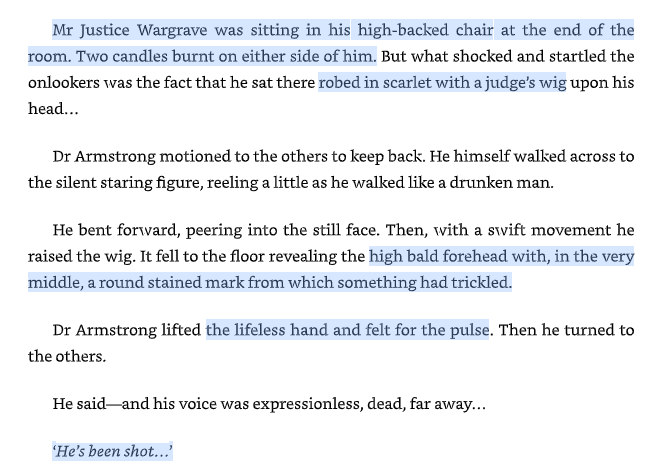
Justice Wargrave’s staged murder is as flamboyant as red herrings come, almost comical in its theatricality, with a scarlet oil slick curtain for a robe and yarn for a judge’s wig. The readers learn later that the judge was alive in this scene, and had faked his own murder through an allegiance with a too-trusting doctor and a dollop of red clay. However, that moment of revelation isn’t a betrayal of the reader’s trust but the characters. The readers know something is amiss, that the characters are constantly trying to deceive each other, even if they do not know how or when that deception is taking place. Therefore when Wargrave takes action to deceive his fellow murderers, it is perceived as a part of the mystery, contributing to it instead of distracting from it. Furthermore, the sheer dramatics are a clue to the reader, either in the moment or in retrospect, that an active attempt at distraction is taking place.

Characters in a mystery story inherently have something to hide, but so does the author. Agatha Christie’s red herrings are more subtle than the red herrings exchanged between her characters, but just as retrospectively incriminating.

Justice Wargrave is sometimes described as “reptilian” and smiling at in opportune moments. A detail that would seem damningly villainous if it were not for the “wolf-like smile,” used to describe Phillip Lombard throughout the story. Lombard’s wolfish persona is used as a distractor and equalizer to Wargrave’s unnerving presence, effectively allowing the reader to recognize the ‘snake in sheep’s clothing’ in retrospect but not in advance of when Christie wants them to. Furthermore, these animalistic characterizations, while dramatic, are used sparingly to not draw attention to the clue or the red herring until the opportune moment. This artful manipulation of the red herring still airs on the side of fair play and trust because it does not obscure details from the reader. Instead, it provides fertile ground for hindsight bias without giving away Justice Wargrave’s identity. 

While red herrings between characters or from the author can be excused as mechanics of genre, allowing the mystery to unfold at a measured pace, red herrings between the characters and the reader are another matter. To have a character actively lie or obscure information breaks the fourth wall and casts doubt upon all information presented whether it be a red herring or true evidence. In the middle of a mystery, this disruption can prove fatal to the credibility of the author and the narrator, rendering the mystery unsolvable using the evidence presented. Perhaps this is why Agatha Christie only dared to include it as a bookend revelation.

The first paragraph of the novel begins with the perspective of the Soldier Island Murderer, Justice Wargrave, seemingly thinking about everything except anticipating the murder of ten people. His voice is distant and aloof, providing only the details that he would provide later in his cover story. This is necessary for the plot to progress, and otherwise benign considering the reader has only been introduced to the character moments ago.

The epilogue, however, changes things. Justice Wargrave is revealed not only to be the Murderer of 10 on Soldier Island, but a raving, passionate, justiciar with a voice so unlike the first paragraph it seems a different character altogether. This confession letter and the voice it contains cast doubt on the sincerity of Wargrave’s point of view in the first scene. If Wargrave is thinking to himself in a carriage car, who is he acting for? The omission of his true motivation and plans is intentional, but on who’s behalf? Wargrave could indeed be role-playing or getting himself into the role he is about to play, but the grey area between character omission and authorial voice makes or breaks the rules of fair play. 

That being said, the grey area between right and wrong, fair and unfair play, is the perfect playing field for And Then There Were None theoretically and thematically. The multiple POVs, the thin line between detective and murderer, and the uncharacteristically unfit cast of characters dance on the line between genre writing and forbidden territory. Blurriness between murderer and victim, between justice and tyranny, and between red herrings and clues, further the sense of paranoia, suspense, and prophetic danger that drive the novel. The question then becomes not if Agatha Christie breaks the rules of fair play, but how she bends them and if the boundaries of investigative fiction are truly rigid enough to collapse when crossed.

The Colonel’s Bequest: A Great Watch, but Awful to Play

The Colonel’s Bequest is a point-and-click murder mystery game that uses “real-time” mechanics to give the player an active investigation experience involving traveling through rooms to find physical clues, peering through the eyeholes of paintings to hear secret conversations, and talking to NPCs to get information about suspects. As one of the first of its time (first released in 1989), this game takes some bold approaches to mechanics, and oftentimes fall flat, though the ideas explored can be observed both for their successes and failures to further the genre.

During the regularly scheduled Monday evening play sessions held for MAAD 14900, Alex Duarte, Hunter Kuhlemeier, and I chose to play The Colonel’s Bequest out of the possible “real-time mechanic games” options we had to choose from. To quote Kuhlemeier, “[The Colonel’s Bequest] is the worst gaming experience I have ever had.” Duarte remarked similarly. I found this interesting, considering the fact I personally had a wonderful time. I realized quickly though that there was one small difference: each of them took turns playing the game, while I watched and offered suggestions, but never took the helm. This led me to a really interesting question: What made the play experience so awful?

When in a friendship, there is a certain aspect of doing activities together where small amounts of pain to one member of a group is enjoyable for the others to observe. This has been seen time and time again, and at times, friends can be no better than bullies when it comes to pain reactions. And thus, as I think more on it, perhaps what made the game so unenjoyable to play was exactly what was enjoyable to watch. In talking with my companions afterwards, they shared similar experiences: the game only got unenjoyable once they themselves took the controls. There are a couple factors that I think played into this.

The first factor was definitely the movement. Rather than a standard movement system where players use W, A, S, and D or the arrow keys, holding them down to instruct the character how to move through the space, The Colonel’s Bequest instead has a press-and-release movement system, and in fact, trying to press and hold down the arrow keys leads to the game becoming slow and unresponsive. Beyond that, even when the movement was used in the intended way, the character would consistently get snagged on set pieces and invisible barriers. As a result of these, moving anywhere in any quick fashion is nearly impossible. Additionally, many modern-day point-and-click games have additional measures built into their movement system to allow the player to type a written command to move to a specific area; when used to those systems, coming to this early exploration of the genre can be met with frustration.

The second large frustration is the data gathering methods. The biggest problem here was the idea that due to how time passes, data is incredibly easy to miss. Throughout the game, various things happen that are time-sensitive, and the only way to catch them is to go to the correct place at the correct time. This becomes a problem when time progresses by simply walking into specific rooms, pushing the clock later into the night and removing any chance of hearing important conversations, barring returning to previous saves (which are manually done, the game does not save automatically), making players do things again and again in order to find everything. Additionally, sometimes the game expects one specific command to do a certain action, so even when you know what you are supposed to do, there are times where the player sits there typing 20 different commands before finding the one that the game expects to actually execute the action.

Each of these alone and even together, while frustrating, can still be played with some success, if not for the third frustration, which is how punishing and random the possible ways to die are. Upon further analysis, it is definitely understandable to recognize this problem as a product of its time, where games weren’t taken quite so seriously and unavoidable, unfair deaths were probably a little bit funnier for the player (don’t get me wrong, they were hilarious to me). The most egregious example of this is that at some point in the evening, the chandelier in the front entryway begins shaking (which you can only see if you approach from the second floor) and from that point on, if the player walks underneath it, it falls on the player’s character, crushing them and instantly ending the game. I imagine that the intent is to be a reference to Clue, released 4 years prior, as other references to this have been seen previously, such as the titular colonel’s name being Colonel Dijon (referencing Colonel Mustard from Clue). Other unfair deaths include being grabbed from a mysterious person inside a closet upon inspecting it, opening the gate in front of a horse which kicks you to death, and using a cane found somewhere else in the house to pull the string on the old bell outside, which promptly falls on the character’s head. All of these deaths are unpredictable and most certainly not fair, and really interrupts the flow of play when the player is trying to focus on a specific task.

With all this information on the table, it is easy to see how a player in control of the game could be extremely frustrated with the result. Even using a guide, we only got through the first three of eight acts in the time that we had, and by the end, both players were ready to call it quits. Not having this control gives the spectator a different perspective, and watching my friends get slowly deteriorated by this, upon closer look, torturous game was a delight. But maybe that says more about me than the game itself.

Written by Echo Ziemba

On Fair Play in And Then There Were None

And Then There Were None is a detective novel that first appears to us to abide by all the established rules of fair play. But, upon closer inspection, we find that Christie has violated several well established rules, both from the set we concocted in class, and those drawn from elsewhere, and often in an egregious manner. At the on-set Christie seems to be providing us with a situation so fair and just to the reader that it sickens us. Ten perfect strangers, all trapped on an island. Their desires and motives unknown or obfuscated, any one of them could be the killer. And indeed, by the end of the book, Christie has ostensibly followed our rules to the letter. She does not avail herself of a supernatural or otherwise “cheap” solution to the ultimate “locked room” (or perhaps “locked island” would be more appropriate here). Instead, the culprit is one of the characters we were introduced to at the beginning of the story. She does not introduce an unknown third party who is responsible, and who it would have been impossible for the reader to guess at. She does not point to some specter or ghoul, but a flesh and blood man, and a man the reader was intimately familiar with at that. So where is the cheat? Where has she led us astray? Let’s begin at the beginning.

Her first trick lies in her set-up. Providing the reader with all ten suspects from the get-go, and indeed allowing them all to be our guides through the story seems like a generous move on the part of the author, but in reality it violates one of the first rules of fair play: consistent viewpoint. There can be only one. A characteristic that must be shared by all law-abiding detective novels is the presence of one and only one viewpoint through which the reader experiences the story. Having multiple perspectives as Christie does, lends more credibility to the story on its face, as the reader now has multiple points of access and more lenses with which to view the world, but in reality only serves to “muddy the waters,” so to speak. The potential for more variety of information that we gain from listening to multiple narrators is hugely offset by how unreliable ten voices shouting different versions of the same events soon becomes. 

The second befuddlement lies in the death of Judge Wargrave. I said at the beginning that to her credit, Christie doesn’t resort to “cheap” tricks, but this device comes quite close. In allowing a murder victim to “rise from the dead”, she has subverted not only the rules of the genre, but also her own. Previously, suspects were eliminated from the mind of the reader when they were killed, “proved innocent by way of their death”, but Wargrave is the exception. And in being the only exception, she renders her own ending arbitrary in a sense. This is not to say that there was no way for the reader to know, but guessing at Wargaves’ guilt requires such a substantial leap in logic that it doesn’t allow for us to consider it “fair play”, at least under any reasonable definition of the word. Aside from its use as a literary concept, there is also an issue with how it is carried out in practice. To put it frankly, it was unbelievable in hindsight. Some might argue that the brilliance of the twist is in how believable the Judge’s death seemed at first, but I would argue that its believability is its greatest fault. The truth of the matter is so impractical, so fantastical, that the reader has no choice but to believe the false narrative present, but this is not a stroke of genius on Christie’s part, but instead an infraction on the rules of logical deduction wrapped in the veneer of wit. 

The final breach I’ll discuss today again concerns narration. As we discussed in class on the 24th, an author must take care when hiding and disguising information from the reader. To use the example of the phone call from Prof. Jones’ slideshow, if the story is told from the detective’s perspective, the author cannot in good conscience obscure the contents of a phone call received by the detective from the reader. It would contrast harshly with the sense of closeness one feels when experiencing a detective novel through the detective’s eye’s, and it is not a pill the reader would easily swallow. They would be understandably distraught at suddenly being yanked out the detective’s mind when they were once allowed free reign in it. So too, if the story is given in some flavor of omniscient or semi-omniscient perspective, does the reader have trouble swallowing the omission of the phone call’s contents. It is only if Watson tells us that Sherlock receives a call, that the reader is satisfied not being privy to the call’s contents. And here, Christie commits another transgression. In the first few pages of the novel, she boldly introduces us to our killer-to-be, unbeknownst to us at the time, of course. And yet, though he is readily and giddily planning to murder nine strangers on an island, some in particularly brutal ways, none of this is betrayed to us at the time of his introduction. Obviously, it couldn’t be, or else she might as well have ended the book at the second page, but therein lies the problem. She cannot simultaneously present to us the inner workings of the characters’ minds, their thoughts and feelings and at the same time leave out that one of the characters we have been living within is a psychotic serial killer.

But maybe the fault lies with the reader. Maybe we should be amazed that Christie snuck this right under our noses, and indeed, when one goes back over what they read previously, they may be inclined to chastise themself for not seeing what now appear to be “obvious” clues, or to draw flimsy connections where none actually existed in order to justified Christie’s shocking reveal. I submit they should not avail themself of this feeling, and instead try and take a logical and unbiased look at what is before them. Difficult as this is, I believe that when it is done, the reader will realize that all those supposed connections they drew, and many of the “clues” they missed resulted purely from the knowledge they now possess about the ending of the book. Indeed, even the early forays in Wargrave’s mind, when glanced back upon do nothing to indict him as the guilty party. How is it that we are in the head of a murderer, but don’t take him for a murderer? Some may say this is proof of a brilliant writer, but I take it as proof that Christie didn’t read the relevant literature on the rules of fair play as they pertain to detective novels. 

Justice and the Pursuit of It in And Then There Were None

For a mystery novel, And Then There Were None has pretty much everything a reader could want. From limiting the setting to an isolated, dreary island with only one means of egress to including a colorful cast of characters each with equal motive to kill, And Then There Were None has all the suspense and intrigue it needs to remain a staple of the mystery genre to this day. In addition to Agatha Christie’s well-crafted narrative, And Then There Were None wouldn’t be complete without its potent exploration and critique of justice—both the kind found within our judicial system and the kind achieved through extrajudicial means. Not only is And Then There Were None thrilling, but it also provides sumptuous philosophical food for thought for the most detail-obsessed of readers, which, as luck would have it, are often avid fans of the mystery genre. 

The Culprit

Hindsight truly is 20/20. Only with knowledge of the ending—and his entire written confession—does Wargrave become the obvious killer. Combined with the knowledge that he has a self-confessed “definite sadistic delight in seeing or causing death” (285) and learning that he had formed an alliance with Dr. Armstrong outside of the reader’s perception, Wargrave swiftly acquires the motive and the means necessary to become the killer. 

There are other clues that, in retrospect, point to Wargrave being the elusive mastermind. For example, the fact that Wargrave has a lesser, if not the least, amount of intimate perspective exhibited in And Then There Were None can be cited as potential evidence. This is a more meta indication rooted in Christie’s story-crafting methods and techniques. There is a case to be made that Marston has the least amount of intimate perspective; however, he is unceremoniously disposed of first and has the least amount of time to impact the narrative beyond being his adrenaline junkie self. The remaining cast are given far more time to expound upon their guilty consciences and their building paranoia, both internally and externally. Compared to them, Wargrave is subtly neglected.

Another meta detail of note is the fact that Christie intentionally describes Wargrave as “reptilian” towards the beginning of the novel: “The hooded reptilian eyes met [Dr. Armstrong’s]” (66). She repeats this descriptor sporadically to describe Wargrave and using turtle-like behaviors to further push his inhuman attributes. While innocuous at first, this early descriptor becomes more significant when paired with Christie’s intentional use of animalian descriptions to portray the mental deterioration of the surviving characters later in the novel:

And all of them, suddenly, looked less like human beings. They were reverting to more bestial types. Like a wary old tortoise, Mr. Judge Wargrave sat hunched up…Ex-inspector Blore looked coarser and clumsier in build. His walk was that of a slow padding animal…He was like a beast at bay ready to charge its pursuers. (212)

All of these details are subtle and could be regarded as throw-away elements. Other small details abound, such as the fact that Wargrave is the one to lead the discussion concerning the assertion that Mr. Owen must be one of their party. How much significance these details warrant remains up to the reader’s discretion. 

Additionally, Christie does play somewhat unfairly to obscure Wargrave’s truth. By “killing” Wargrave, she removes him from the survivors’ and the reader’s suspicion, seemingly following her own pre-established rule: once a person has died and the murders continue, they are acquitted of being the killer. Any reader theorizing that Wargrave was the killer is forced to discard their theories in order to observe this rule that has stood for the past murders, which, in light of the ending, could be construed as “unfair” because the reader didn’t have access to the knowledge that Wargrave and Armstrong were in cahoots. However, unfairness is rather subjective. It could be further argued that Christie only breaks a rule of her own invention for the purposes of the narrative. Arguably, obscuring some knowledge is a necessity of the mystery genre in order to achieve a satisfying experience for the reader.

Justice and its Zealots

Wargrave certainly portrays himself as a reasonable man that is only doing as he should: condemning the guilty. On the surface, this could be an honorable creed that mirrors those of many other fictional characters. A figure like Batman certainly comes to mind. However, unlike Batman, Wargrave is also a man claiming to have a preternatural ability to discern the innocent from the guilty—an ability that he feels so confidently in he can dismiss the evidence gathered by the police and Edward Seton’s to secure the guilty verdict. Despite the fact that evidence was found later that proved Seton was guilty of his crimes, it cannot stand that a man like Wargrave should retain his position as an arbiter of justice—and Christie makes no secret of this sentiment. 

Our justice system is not perfect. There are a multitude of reasons to justify this statement with varying degrees of complexity and nuance. However, one of the potential complications Christie explores in her novel is actually a particularly celebrated feature of the English judicial system (and many, many others): the presumption of innocence. The burden of proof remains with the prosecution, and it must withstand the scrutiny of the defense, presiding judge, and/or the jury. There is a unique tension between the presumption of innocence and the pursuit of justice. It is the same tension that exists between the concept of free will and the idea of living under a nation-state—as any SOSC class exploring Locke, Hobbes, and Rousseau will tirelessly discuss. When every suspect is assumed to be innocent, the chance that a truly guilty person will escape punishment is never zero, which is illustrated by select occupants of Soldier Island. However, the alternative of presumption of guilt is punitive and holds the potential to do far more harm than good. It also still does not address the quandary of what to do with cases where no legal wrong has be explicitly committed but a certain social infraction is suspected to have taken place.

Wargrave is the kind of madman found only in fiction. Despite the fact that he was right—everyone on Soldier Island was guilty in one way or another—this could never realistically occur using the same methods Wargrave employed to create his guest list to Soldier Island: listening to gossip and hearsay and relying on his sixth sense honed to sniff out the guilty. Nevermind that this sixth sense could merely be something every living person has: bias. Therefore, it cannot be assumed that Christie means to only criticize the legal system. Naturally, there is still critique. However, Christie is not saying that extrajudicial justice is the correct course of action once the legal system has fallen short. Wargrave’s mission can be more accurately described as not the pursuit of justice but the pursuit of punishment. 

And Then There Were None certainly contends that a society’s laws are fallible, and our legal system is not the only determiner of wrong or sin. However, Christie assuredly does not support the total abandonment of the established judicial system, nor does she throw her support behind the acts of people like Wargrave. Justice is complicated, and And Then There Were None provides a potent exploration of its many facets, strengths, and weak points.

– Carrie

The Lone (Were)Wolf: Predictable Unpredictability in Games of Ruse, Trust, and Betrayal

Social deduction games are an interesting case of fair play as every player goes in with different skill levels and goals, which can sometimes lead to unsatisfying outcomes.

With games of ruse, trust, and betrayal, player unpredictability is a core tenet, adding excitement and variability to gameplay. However, unpredictability is often heightened in groups of players with varying skill levels and mindsets, reflecting the broader social dynamics beyond the game itself. Having played a number of process of elimination social deduction games (Secret Hitler, Among Us, One Night Ultimate Werewolf, Mafia, etc.), I’ve encountered diverse strategies, gameplay styles, and player psychology. While I mostly agree with Robinson’s notion of “emergent fiction crafted by the game designer” in RTBs, where players “pursue goals at the behest of a designer, following that designer’s rules, and procedurally generating fiction in parallel,” it assumes that unpredictable players will adhere to socially expected rules. Sometimes players, from lack of experience/knowledge of the game or just love of pure chaos, throw a wrench in this expectation of predictable unpredictability, introducing another layer of complexity to the ruse, trust, and betrayal and/or ruining intended mechanics.

In Werewolf, players must employ various levels of ruse, trust, and betrayal to achieve conflicting goals outlined by the game developer. Lying or revealing partial truths about one’s character is a common tactic (ruse). For characters like the Seer, it is recommended to pretend you are a regular villager for as long as possible, as revealing yourself might get you killed, putting the werewolves at a significant advantage. Playing as the werewolf necessitates ruse, requiring players to convincingly blend in with the villagers while subtly manipulating information to their advantage, like picking unclaimed roles with flexible interpretations to be more convincing than others. Trust in other players’ narratives becomes essential due to the voting aspect, leading to betrayal when the convincing ruse and misplaced trust are uncovered. That expectation of play however falls through when at least one player doesn’t like rules.

Part of RTB’s predictable unpredictability is understanding that there are competing goals and every player will strategize in their best interest. Where Robinson’s theory of game designers being the ultimate arbiters of the emergent narrative falls apart is with these rogue players that do not have their best interest in mind, either by chaotically sabotaging themselves and their team’s goal of winning or by misunderstanding what their role/strategy should be to accomplish said best interest. 

Starting with the chaos players, no matter how rigid, constricted, or freeing the rules of the game are, part of playing with human opponents is that they have a mind of their own. The game expects that you would want to tell mostly truths to be trustworthy and deduce your teammates to further the collective strategy, but some lone wolves have other plans. I’ve seen this many instances with Secret Hitler, where players who are bored of being liberal will play openly fascist, thus confusing their teammates and the actual fascists, creating an extra challenge for everyone else. Werewolf is no different. Players may reveal they are werewolves, whether they are or not, and tell their fellow players to do with that information what they will, offering no other explanation. They may claim false roles despite having their own, just for the fun of it. That way, even though they have a logical alibi, they are now untrustworthy and presumed to be guilty werewolves because this radical plan was not fully thought out like we would expect of a strategy. They may also just go completely off script and not play their role, either choosing not to do the action that they have to at night, doing someone else’s actions which is not allowed, or refusing to ever check their role at all. Technically, there is nothing binding players to rules, especially soft mechanics, but it upsets the structure agreed upon by all other players, and out of the collective desire to have fun playing a game together, a player like this could be kicked out of the group for “ruining the game.”  

On the other hand, while not as frustrating as a player purposefully introducing chaos, it’s also just as likely that an inexperienced player may not play their role correctly out of confusion, adding a different layer of uncertainty. Each night, the players with roles must complete their actions as dictated by the game designer. I’ve seen many occasions where players, usually newer to the game, were not paying attention during the “nighttime” where everyone’s eyes are closed and either missed their turn, forgot their role so they didn’t do anything, or even worse, opened their eyes when they weren’t supposed to, ruining the mystery and forcing us to start over. You cannot fault players like this, especially as some fault is on the more experienced players to properly explain the rules and strategies, but it is frustrating nonetheless for those invested in the gameplay and expect a level of crafted uncertainty versus accidental failure to produce the unexpected. Just like in detective novels, it is unsatisfying to have information revealed because of an accident or coincidence. Newer players also often contribute less, leading to their being left out of the vigorous back-and-forth that is the entire excitement of the gameplay and unlikely to play again later to get better. Alternatively, this lack of experience can be used to your advantage, claiming that you are not as aware of the strategies you have indeed employed. This was my excuse for most Among Us sessions, both a partial truth that I was new and unaware of the layout and a ruse to go undetected. Werewolf is similar in that sometimes it helps to be quiet to avoid suspicion, and a new player can do that, while those more experienced are expected to be more clever in their social game. 

All of these factors need to be taken into consideration during social deduction games. Usually, everyone plays as expected, providing or withholding information to achieve their goals. Rarely are players so inept or chaotic that it completely ruins gameplay, and sometimes it spices up the monotony of predictable unpredictability, but this does lend to the idea that all games are confined to their play session. So I partially agree with Robinson that game developers craft an expected unexpected experience for players to build up within themselves, but for every rule there is a rule breaker, purposeful or not. In this way, players are the ultimate generator of deductive fictions because game rules are only a guide and the accepted laws are socially determined. A game can be very enjoyable or completely ruined based on who you trust to sit down with you, after all, the most satisfying part of a game of ruse, trust, and betrayal is not properly deducing or concealing identities but playing in accordance with what is socially acceptable. Unpredictable players create their own fictions, but they need a group to create a larger narrative within a game.

– Lia

And Then There Were None: A Lesson in Mystery

By Will Traband

Agatha Christie’s And Then There Were None is a true mystery. Many of Christie’s earlier works are considered mysteries, but many are not. They are more akin to jigsaw puzzles, where the player knows what the end product is supposed to be. A real mystery has no obvious path forward. And Then There Were None creates a real mystery by directly attacking this formula. It sets up characters like any of Christie’s works but pulls the rug out from under the reader. Agatha Christie’s And Then There Were None is a successful mystery story because it subverts the reader’s expectations in a way that forces them to consider all outcomes. 

Many of Agatha Christie’s texts work around a set of tropes. For example, in the Poirot books, there is a formula. Poirot arrives in some new setting, and a murder occurs. Poirot decides to investigate, but almost everyone is suspicious in one way or another. After a while, and with a few twists and turns, there is always a section where Hercule Poirot gathers all the suspects in a room and gives a long speech about all the clues as to who the murderer is. He ends with his announcement of the murderer’s identity, and they get taken away. These tropes are not limited to story beats, however. There was often a mysterious wealthy person who needed care for an illness and a kind caretaker who helped them. Formulas like these were ubiquitous in mystery texts but posed a problem. When a mystery becomes formulaic, it ceases to be a mystery. The clues are often the same and in the same places. There is no mystery how the story will unfold when it has occurred a thousand times before.

Christie understands the tropes that she created and uses them to her advantage. One brilliant example is Dr. Armstrong. A mysterious, wealthy person who needs care due to an illness is a recurring character in Christie’s work. Dr. Armstrong is the kind caretaker, as mentioned earlier. This setup feels familiar to long-time readers of her novels and gets them off their guard. The general setting of the book is also recognizable. A large number of suspects gathered in one place, and a murder happens. Now, the detective has to find the guilty party despite everyone involved being suspicious in one way or another. And Then There Were None first shakes up the formula with the shifting perspectives of the first chapter. No detective will solve the case, as everyone is that detective at one time or another. With the death of Mrs. Rogers, it becomes even more clear that this book is unique. Two murders, while not unheard of, are rare in Christie’s works. When General MacArthur dies, it only gets worse. Three deaths are even less common, and suddenly, there is a sense of panic.

The paranoia instilled in both the characters and the reader is palpable. It is unclear who will die next; the only clue is that it will follow the Ten Little Indians poem. It is so different from most of Christie’s works that while there is a mystery, there is also an element of horror. There is supposed to be a hero in this kind of text. There is supposed to be some detective who will save the day. As the death count mounts, the most significant subversion in this text becomes clear: there is no hero on Indian Island. There are only villains, all of whom will die. 

It is brilliant that nobody ever finds the murderer. Vera believed it to be Lombard but was wrong. The trope of someone explaining how the murders occurred still happens but in the form of a message in a bottle. Wargrave was the murderer, and he constructed the deaths of every character. Fundamentally, the lack of a hero in this text means everyone is an investigator. However, in a complete twist on most of Christie’s work, nobody succeeds. Even the police only figure out what happened from the message in a bottle. There is no satisfaction from the detective solving the case. There are only ten bodies on an island. 

Agatha Christie’s And Then There Were None uses a subversion of traditional mystery tropes to create a true mystery. It is unclear who will die, and with every death, the number of suspects seems to go down. Christie sets up a traditional murder mystery but uses a shifting perspective to show that And Then There Were None is not a typical mystery story. Once the murders start occurring, it becomes increasingly urgent to find the culprit, which encourages both the reader and the characters to rush. Ultimately, And Then There Were None is not just a murder mystery. It is successful because there is a grand scheme rather than a simple crime. And Then There Were None is a great mystery because it breaks the tropes the reader has been trained to expect.