No Need for a Watson in Searching

In Stout Rex’s “What to Do About a Watson,” he comes to the conclusion that the inclusion of a Watson character can be a beneficial tool for the creation of a good detective story. He claims that Watson provides a graceful and natural way to allow readers a way to see the thought processes of the detective without completely spoiling essential information that you don’t want readers to have access to. This is a problem that other writers have also faced and come to different conclusions about. In order for a detective story to play fair, the readers must be able to follow along with the detective’s lines of deduction. In forms of media other than written stories, such as films, this problem continues to be something that authors need to solve for their story. While many have continued to keep a Watson figure that gives opportunity to include dialogue between the detective and the Watson, some movies have adopted different strategies. The 2018 movie Searching is one example that uses computer actions as a way to get across the main character’s, David Kim’s, thought processes without relying on spoken language at all.

As opposed to traditional movies, Searching exclusively shows the displays of computer, smartphones, television, or other digital screens in its storytelling. Everything that is shown to the audience is contextualized within this view of a screen. For example, scenes that include dialogue between David and other characters are often phone or video calls that he is making from his computer. Throughout the movie, David serves as our detective character as he tries to uncover what happened to his daughter, Margot, and find her. There are only a few scenes where we are explicitly told David’s theories or his thought processes, with most of those being scenes in which he calls his brother or Detective Vick. Instead, the movie shows us David’s computer screen as he uses it which reveals many hints as to what he is thinking throughout. A very obvious example of this is when we see David type out a text message, linger for a moment, and then erase the message before typing out something different. These moments give us insight into things that David wants to say but feels unable to. While this example is not one in which David is really working as a detective, similar computer actions are later used in the same way to show how he reacts to new clues and piece things together.

A great example of this occurs towards the end of the movie, when David begins sending pictures and videos of Margot to a funeral livestreaming service and sees a stock photo which causes him to pause. He slowly moves his mouse away from the button to close the browser page as the camera zooms in on the figure in the stock image. He then goes on to pull up Margot’s photos, quickly skimming through some of them before changing gears and opening up her Facebook account instead. At this point, it is clear to audiences that David recognizes this face but is unsure where he saw it. He seems to believe that it has some relevance to Margot’s disappearance, so he continues to look for where he recognizes it from until he finds the face being used as a profile picture for one of the chat members in Margot’s livestreams. Having found this, he opens both pictures at once so that he can confirm that they are indeed, the same person. Later in the movie, we see him undergo a similar detective process as he realizes that Detective Vick has been lying to him and sees the photo of her with the ex-convict who she has claimed was responsible for Margot’s disappearance.

In all of these examples, the movie takes advantage of the audience’s familiarity with using computers in order to make these moments work as revealing David’s thought processes. Viewers understand the feeling of searching through webpages or saved files to find something that you know you can find, so when David does so, no words are needed to make audiences understand it. And if audiences did not make the connection themselves, David putting both pictures on screen at once will make it clear why he reacted this way while confirming part of his theory. There is no need for a Watson character in Searching, because the actions required to perform this kind of investigation on a computer are familiar enough to provide a window into the detective’s mind.

By Alex Duarte

The Return of the Obra Dinn: An Introspective

By Bruno Pasquinelli

Return of the Obra Dinn, released by Lucas Pope in 2018, took me by storm when I first experienced it. During spring of my freshman year, I had a weekend that was empty, and I decided to start it on a Friday night, unaware of what I was about to unleash upon myself. After playing for about 20 minutes, I was absolutely hooked, but had to go to sleep. The next day, I woke up, went directly to my computer, and played through the entirety of the game, stopping only to eat and use the bathroom. After singing its praises for months, I was recommended The Outer Wilds, which is the only game to date that has had a comparable hold on me. In hindsight, Return of the Obra Dinn is what set me down the path of studying and making games in my college career.

Beyond my personal engagement, Obra Dinn is an incredible example of developing and iterating upon a mechanic to keep the player on their toes. Whether it’s the introduction of death replays within death replays (within death replays within death replays,) or the death of a cow, or even the question of the fates of those that did not die onboard, Obra Dinn takes its central active mechanic, the Momento Mori, and fully explores it on the ship. In my own playthrough, the process of discovering another corpse and its subsequent replay was a wonderful ritual, with me excitedly following around the spirit trail thing around the ship, however, I know that others found this repeated sequence onerous and frustrating. Obra Dinn does little to explicitly guide the player at any point, and these animations, the difference between spearing spiking and stabbing, as well as the difficulty of traversing the ship to watch a specific sequence adds a lot of friction. I appreciated this friction, giving me time to think about what was occurring on the boat and retracing my steps (literally) often gave me inspiration for what I should do next. However, I contribute a lot of this to my playing of the game in one sitting. For others who may be playing across days in 2 hour chunks (I really, really recommend against this, play it in one day if you can!)

This added friction exacerbates the difficulty of playing it across an extended period of time. Essential details can be small and scattered across scenes, and having to walk across the boat, spending precious time could be really bothersome. However, in a time of vapid, vacuous open world games filled with endless slop. Having each and every item in a scene be important feels very rewarding as a player who enjoys taking the time to look at these details. For instance, in the sequence of the sailors playing cards, different characters can be identified by the number tag on their sleeping bag, which corresponds to their number on the crew list. All of this is to say that Obra Dinn is not a game for everyone, and not just from friction. There are no hints, and fates are only confirmed in batches of 3, which may feel like a boon early on, allowing you to guess and check, becomes brutal when you’re down to the last 10 or so fates. Additionally, with nearly the whole game taking place on a boat, the rocking and bobbing can cause intense motion sickness as well – there are minimal graphical options, and none that can really reduce this sensation.

Finally, my thoughts on the story – I found the characterizations very powerful, considering many characters only get a handful of lines and brief moments to memorialize them. The voice acting is fantastic, and there are many lines like “Enough! Captain cannot be trusted.” that have stuck with me for years since I first played this game. The time period on display is one that is really different from the one we live in now. You play as an insurance investigator, meaning your goal is not one of justice or knowledge, but rather one of appraisal and write-offs. Everyone must be accounted for, not because of a nation’s responsibility to its citizens, but instead for payout purposes.

However, this difference in time also poses some issues that don’t sit well with me, and illuminate comfort levels with various forms of profiling. The nationality of every character is listed, and this often plays a role in their identification. The one Irish character has a strong Irish accent, giving him an identifier, and something similar happens with the Bosun onboard. These were forms of identification that I felt comfortable with when playing, however, that comfort changed when the game indicated that I could identify Maba, the only New Guinean crewmate on board.

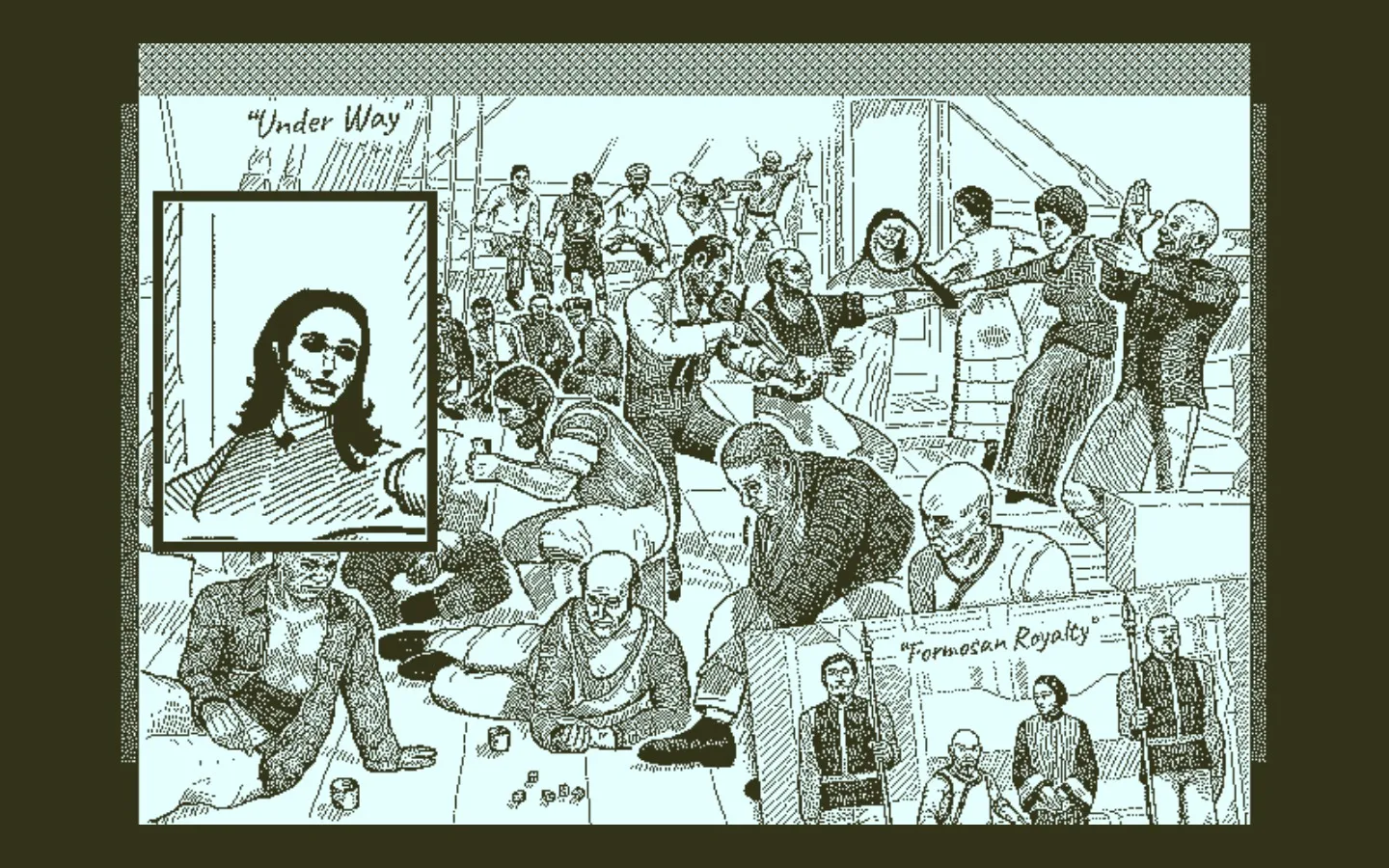
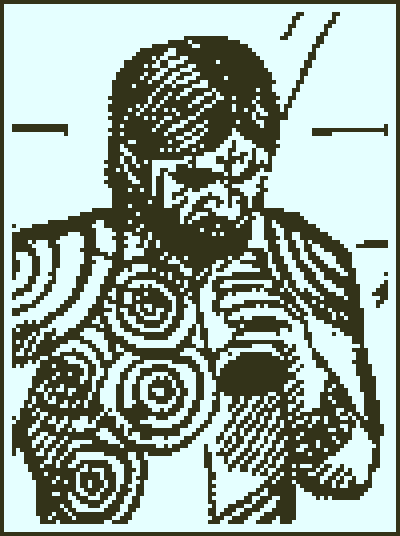
For those who haven’t played Obra Dinn, character’s faces become unblurred when they are potentially identifiable based on the replays you’ve seen, and the fates you’ve confirmed. Maba is torn apart by a kraken, and is immediately identifiable afterwards based upon his tattoos. His identification difficulty rating is 2/3, suggesting it is not too difficult. When I first played through Obra Dinn, I didn’t feel comfortable profiling Maba solely off of his tattoos, rather believing that I had missed some other aspect of information to identify who this poor soul was. While I appreciate the historical dynamics at play, Obra Dinn is expecting me to racially profile this man in a way that felt distinct from the other examples, based off my limited knowledge of New Guinea and other Pacific Islands. More specifically, “This man has pacific island-y tattoos, and there’s one guy from the pacific islands” as a train of thought is not one that I like to entertain in my life. There are some other small issues I have with the plot of the Formosan Royalty, but those aren’t as pointed or as coherent so I shall save them for another time.

An Analysis of Secret Hitler and the Strategies Within

When it comes to social deduction games, Secret Hitler is often considered one of the staples. The premise is simple: if you’re a Liberal, stop the Fascists and their Fuhrer from gaining power and influence; if you’re a Fascist, do what you do best and sow chaos. Every round, one player is the President, and they select a Chancellor. The confirmation of the Chancellor pick is put to a vote: if passed, the President draws three cards from the deck, discards one, and gives the remaining two to the Chancellor to choose from. The Chancellor chooses from one of the two cards and places it on the corresponding board. Once the game is put into play, the finer points of the various strategies one could employ become evident. 

For the more analytically-minded players, Secret Hitler is, at its core, a numbers game. There are more orange Fascist cards than blue Liberal cards in the deck (for a ratio of 11:6), and as cards are placed on either of the two boards (pictured above), the potential probabilities of what kinds of card could come next narrow. Players accurately tracking the ratio of Fascist to Liberal cards remaining can apply pressure to players lower in the round’s playing order. 

As one could imagine, this tactic can prove troublesome for Fascist players. Fascist Chancellors lower in the playing order might have undue suspicion cast upon them for playing a Fascist card should the count favor a Liberal probability—no matter the reality of what cards the President gave them. Additionally, it might be harder for a Fascist President to claim they drew three Fascist cards and had no choice but to give the Liberal Chancellor two Fascist cards to choose from, forcing the placement of a Fascist card on the board. 

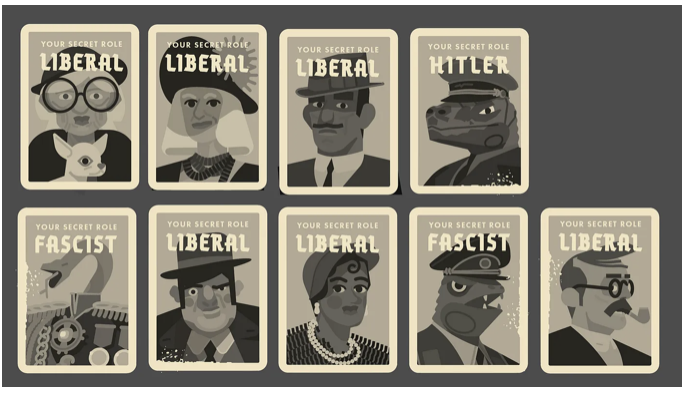
Fascist and Liberal party membership cards handed out at the beginning of the game.

However, even if a keen card counter numbers amongst the players’ ranks, there remains an element of subterfuge. In this situation, any Fascist player should lie when and where they can. If they are the President, they should lie about the identity of the third card that they discarded to further skew the count in the Fascist cards’ favor and make it easier for their Fascist brethren lower in the playing order to claim they had no choice to play a Fascist card. For a truly experienced Fascist, the optimal strategy is to become the card-counting player and gradually feed incorrect information to the rest of the players, preying on potential inattentiveness or numerical ineptitude. 

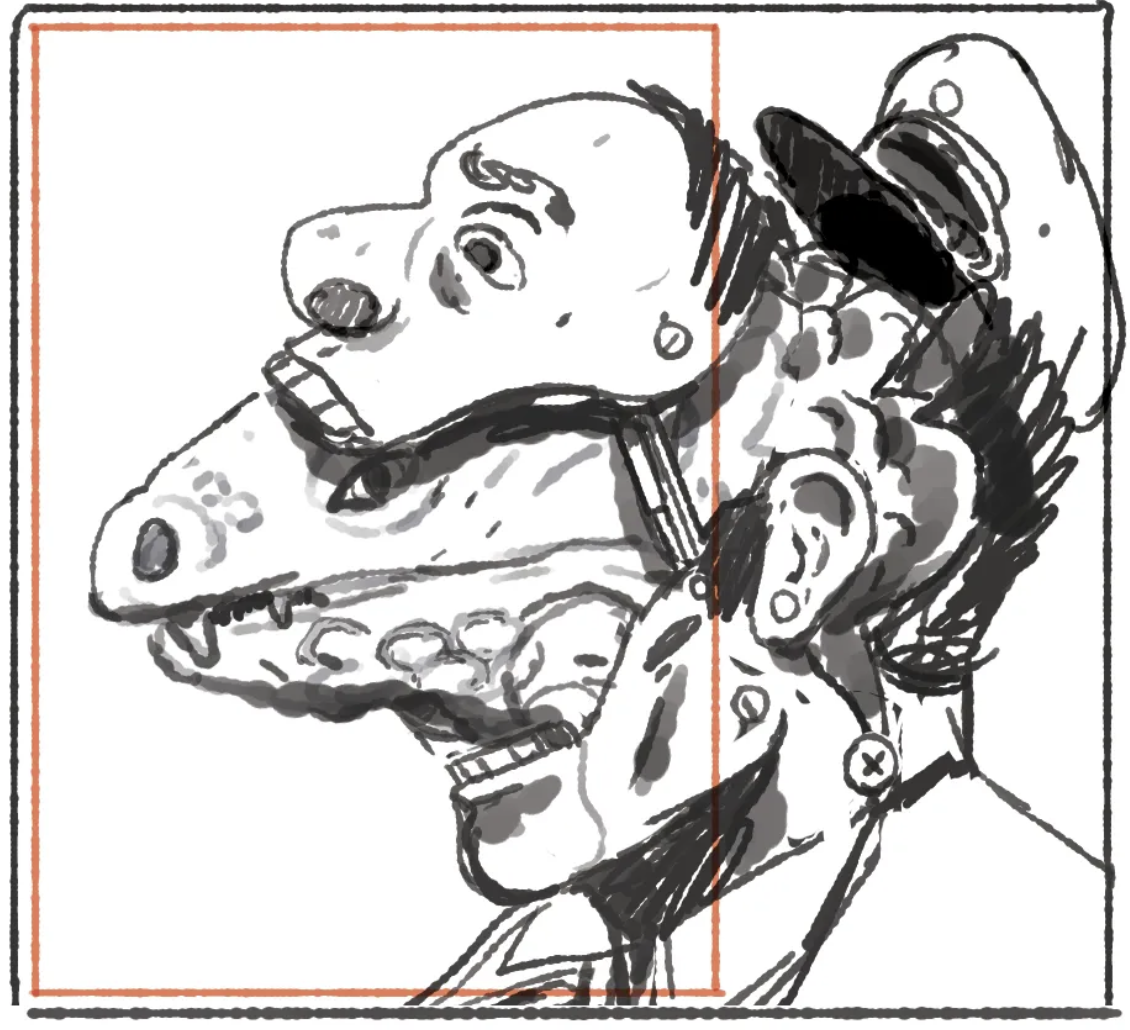
Concept art of a Fascist membership card.

This is just one specific scenario with specific players in mind. Due to its nature as a social deduction game, any and all strategies in Secret Hitler rely heavily on the make-up of the players in the group and their playstyles. Some players may live and die by the numbers. Others may forgo the strategy of counting cards entirely and base their assessment of other players’ honesty on social cues and whatever tells the player may have. 

Some players may even have an advantage over the others by virtue of knowing some of the other players better. These players are better equipped to discern the other players’ play styles—either by virtue of having played Secret Hitler with them before or simply knowing them better in their personal lives. They may know that when their friend is a Liberal, they tend to be more soft-spoken or engage more passively in debates. Or, they may know that when their friend is a Fascist, their strategy is the exact opposite: the friend will insert themselves into every debate and voice their opinions freely. 

This leads to the crux of a potential issue that players may have with Secret Hitler and other games that ostensibly favor such familiarity. To what extent does Secret Hitler rely on the social aspect of the term “social deduction?” Furthermore, does it truly matter? Should players agonize over the concept of fairness in a game where some players might derive an advantage from their familiarity with other players? What about situations where everyone knows each other equally and knows how the other players generally prefer to play—would this make the game stale? 

Finalized party identity cards.

In short, it’s complicated. On one hand, any game can and will become stale or boring the more it is played without any variation. That is inevitable. On the other hand, it would seem inadvisable for a game to hinge the majority of its enjoyability on an intense degree of interpersonal familiarity. Games could choose to prioritize such a mechanic and still be functional, but those games would likely not see much success as widely enjoyed party games or games to break the ice with new friends and acquaintances. They would likely be seen as games best-suited for established, close friends groups.

The perceived problem of players learning each other’s strategies and their behavioral patterns is something that could be “fixed” by the players themselves. Once made aware—whether it be through discussion or observation—players might deliberately toss up their playing strategies. They might experiment with new strategies, attempt different maneuvers, or lie more extravagantly. This may come at the expense of victory for a game or two (or three), but in the long run, this shake-up could lead to more victories down the road as other players become less sure of one’s social tells or strategies. It might seem dishonest to do this—it is lying, of a sort, but this is Secret Hitler. Lying is the name of the game. 

Generally, social deduction games are responsible for providing a semi-flexible base and framework of rules for the players to adapt to their desires and playstyles. Players should still seek out the games whose basic premises interest them; one should not ask a game to be something different than what it is intentionally designed to be, especially when there are a multitude of games in existence that actually are the thing the player desires. However, social deduction games’ strength lies in an allowance for player mutability. 

Shifting the onus from the game—so long as it has provided an adequate base—to the players to “shake things up,” as it were, is likely the most expedient solution to this perceived conundrum, particularly for social deduction games. The best—or the more commercially successful—social deduction games do not rely so rigidly on the players being familiar with one another. Any interpersonal familiarity is certainly no hindrance to the game’s enjoyability, and it might very well give the game a new edge of difficulty as players attempt to mask their tells from their friends, but in most cases, it is not absolutely integral to the game’s basic functionality. Secret Hitler is such a game where even if all social elements were to be stripped from it, there remain multiple opportunities for lies to be called out, numbers to not add up quite right, or for patterns of behavior within the span of a game to be established.

-Carrie Midkiff

Image source: https://medium.com/@mackenzieschubert/secret-hitler-illustration-graphic-design-435be3e3586c

Secret Hitler Analysis by Arush Guliani

Secret Hitler is a unique take on the social deduction game format which has taken many forms throughout the years. Specifically, players are randomly assigned into a group of fascists and liberals, with one of the fascists being Hitler himself. If Hitler is elected chancellor, fascists win, and if Hitler is killed, liberals win. Furthermore, each team can win by passing a certain amount of policies in line with their party membership. By observing each player’s behavior, alongside the kinds of policies they pass, deductions are made and each player tries to reach their party’s win conditions.

While a very basic simple social deduction game at its heart, Secret Hitler has a few aspects that set it apart from other such games and make it a true fan favorite. The first of these aspects is simply the somewhat absurd theme of the game. Hitler is of course a very taboo topic and many people become uncomfortable at the very mention of him in conversation. Thus, basing a game around Hitler utilizes this discomfort and turns it into humor and a plethora of memorable moments. Absurd scenarios occur in the discussion surrounding this game, moments that could never possibly occur in any other naturally occurring conversation. This theme sets the game apart and truly makes it entertaining in a way beyond most other social deduction games. Even in a conversation primarily regarding Secret Hitler as a puzzle game, it is necessary to consider its theme, since the corresponding absurdity codes the experience of the players very deeply.

In terms of the investigational aspect of Secret Hitler, the game is largely focused on the passing of different policies. The role of president is rotated between all players and the role of chancellor is elected each turn. Three policies at random are given to the president, who passes two to the chancellor, from which the chancellor selects one to pass. The remaining players can only see the single policy that is passed, not the initial three policies or the two given to the chancellor. So, many deductions need to be made to figure out who has allegiances to which party. This deduction in Secret Hitler has complete fair play throughout the gameplay. Any information that is passed along to the players, whether it be the actual type of policy passed, or simply the body language of the player passing the policy is given equally and intentionally.

In regards to equality — the information about policy passing and body language is naturally available to everyone; everyone gets a chance to observe, and the amount of information that is able to be deduced from observations is entirely skill-based. People with better social intelligence and knowledge of the group will have greater information regarding who is likely lying. However, this seemingly unequal information actually comes from a place of equality, since skill dictates information, not some other arbitrary metric that would infringe upon fair play. This equality makes sure that all players are dealt the same general conditions of gameplay, and no one is playing from a position of inherent power that falls outside of the natural dynamics of gameplay.

The next point of discussion is the intentionality of the information given to players — of course, the policies selected are shown to the players intentionally. These are pieces of information specifically designed by the game to be released explicitly, and they serve a very clear purpose: to provide clear information about the likelihood of someone belonging to a party. Due to random variables, a person’s party membership can’t be known just by what policies they pass, but since the likelihood of each combination of tiles is known to everyone, everyone is given some incomplete information very intentionally. More importantly, the social information that is exchanged is exchanged with a purpose. Every player has control over their behavior, and so if they choose to act a certain way, whether that increases suspicion or not, that behavior is intentional. Even if a player acts suspiciously without meaning to, that is also intentional information, since this is information about suspicion that the game designers intended to be communicated. All in all, the information moving between the game and its players is handled intentionally, and every piece of information communicated is done so at the will of the player or the game design.

Together, the intentionality and equality of the information moving across the game table ensures fair play in the context of Secret Hitler as an investigative game. The equality of the game makes it impossible for players to have inherent advantages that are not purely skill-based, and this creates fair play. There is not information being kept from a player, and this is very important to fair play as per the class definition we are using. Furthermore, intentionality prevents red herrings or information that is intentionally misleading. These sorts of red herrings are a breach of fair play as we defined it, and the fact that all information comes from a place of meaning, whether it be from the player or the game designers, ensures that no information is pointless. If information is misleading, it is because a player intends to mislead, and at this point, the information is no longer breaching fair play, and instead allowing skilled play.

Having discussed the mechanics of Secret Hitler as a social deduction game, the theme of Secret Hitler as an absurd driver of humor, and the fair play of Screte Hitler as a byproduct of its equality and intentionality of information, we are left with one final question: is the game successful as a social deduction which both succeeds as a game in its class and as a standalone unique product which differentiates itself? I would argue yes, Secret Hitler is a vastly successful game. Not only does Secret Hitler stay true to its genre through a fair system of deducing information, but it also does so with a unique policy-passing system that feeds players just enough information that they are working with more than just the behaviors of their peers, but not so much that the game is no longer primarily social deduction. Furthermore, it differentiates itself through its unique mechanics, and more importantly its theme, which creates moments of humor and absurdity in the context of an otherwise stressful and strategically complex social deduction game.

Simplicity and Difficulty in File://maniac

By: Miles Rollins-Waterman

File://maniac is an excellent game with more than a few flaws. First and foremost, I found the game to be too simple. It lacked a certain depth and width that I believe could have elevated the experience to a significant degree. Second, the game, in my opinion, holds the players hand too tightly, and could benefit from more dead ends and false paths. Finally, and I’m actually not quite sure this should be counted among my criticisms, as it’s more of an observation, but I don’t believe this game deserves the title of “detective” game. Another way to put it I suppose would be that file://maniac is not a successful blend of the detective novel genre and video games, but to be clear, I don’t believe this failure detracts from the quality of the experience, just the lens through which we ought to view it. 

I’ll begin with its simplicity. On face, the idea of digging through indexes in File Explorer as a way to interact with the game world is fascinating. It’s a medium of play I haven’t encountered, and the way it was handled in this game was close to perfect. But I think it could stand to be more difficult. As strange as this is going to sound, I would have preferred if navigating the game files was just as arduous and time-consuming as the puzzles themselves. Granted, there is a thin line here between a beneficial amount of extra challenge, and a bloatsome amount, but if correctly navigated it could be a huge boon to the quality of the experience. For instance, there could be a part of the game where the File Explorer breaks temporarily and the player is forced to use archaic command line tools to continue the story and perhaps repair their original medium. Maybe certain puzzles could require accessing files that are scattered across the user’s machine, and not just localized to the game folder. Even small additions like these could have pushed the limits of the ingenuity of this concept, a push that this game desperately needed. 

To take this simplicity critique further, I’d ask that one try to conceptualize what it means to alter a game’s files. Acknowledging that the reader of this post may not have played the game, think about what this would look like to you. For my part, when I first heard that this was the game’s main mechanic, I was thrilled. To me it represented endless possibilities for creative workarounds and clever backdoors. I envisioned being able to find solutions to the puzzles that the developers themselves hadn’t necessarily considered, and being able to chip away at the game’s challenges with my own brand of intelligence. Harkening back to the maze discussion we had in class when talking about The Name of the Rose, I suppose I pictured the developers dropping us into a maze and giving us a sledgehammer; so we might smash our own path to the center. Reality is often disappointing. Although diving through files, rewriting, moving and deleting them, was the game’s major focus, I felt it was missing the space for wild innovation I had imagined. We were given this fun and expressive medium through which to experience the game, yet we were confined to the path the developers had laid out for us, with no actual mechanism by which we could circumvent the narrative. Our phasers were set to stun, so to speak. To give a concrete example, the very first puzzle of the game involves deleting a “door” file from the game’s directory in order to open a locked door in the game itself. Once the file is deleted, your character can open the door and continue the game. I love the fact that deleting the door file actually affects the door in the game world, but I am baffled that it was executed in such an appallingly basic manner. The file is just sitting there in the main game directory. The player doesn’t need to think or struggle to find it. They don’t need to consider where a door file might be, and use some form of deduction or logical path to get to the answer. It’s provided for them on a silver platter. 

This critique about simplicity folds nicely into my second point about difficulty. Simply put, the game is too easy. The answer to each and every puzzle is quite literally spelled out for the player, and although it is done in an interesting fashion on one occasion, 99% of the other puzzles are akin to reading instructions off a page and then carrying them out. When dealing with something so seemingly volatile and powerful as editing game files, one would expect a degree of volatility and power, and yet. More to the point, it is quite impossible to fail at a given task. Not only because the instructions are written out for you or because of the looping nature of the game, but because the developers didn’t take their idea far enough. When I think of modifying game files, I think of something a little dangerous. I think of the danger of corrupting your save, and having to start again, or deleting/misplacing something vital to the game. Things that have concrete consequences. It feels like the developers have baby-proofed (or maybe idiot-proofed) this tool for their players, and in doing so have taken away much of the gravitas and intrigue that they garnered by including it in the first place. As I mentioned earlier, many of the puzzles are criminally simple, and while a few like these are important to allow the player to get their feet wet and feel a sense of accomplishment, a game filled with nothing but left me at least feeling unfulfilled. This simplicity or “hand-holding” as I called it earlier makes the game experience far less rewarding in two ways. 

Firstly, the sense of accomplishment one feels after completing a puzzle is, in my opinion, greatly diminished by their difficulty or lack thereof. While it is cool to see my deleting or renaming a file have in-game consequences, it doesn’t feel so good that I only did those things because it was explicitly spelled out for me. Second, it chokes out the feeling of freedom one gets from the actual act of editing game files. I’ve already talked at length about my expectations and how they weren’t exactly met, but I can’t understate how neutered this game felt to me on my first playthrough. The developers are giving us this tool that is supposed to be potent but dangerous, and yet we get neither. It’s as if they are giving us a sandbox to play in, but we can only build our little sandcastles in the 5ftx5ft section of the box they allow us to operate in. It’s frustrating to say the least. I should be able to break the game, whether by accident or on purpose, in my pursuit of the truth. I should be forced into dead ends, such that my only option is to carve a new path forwards through the fabric of the game. I would like to feel as though me and the developers are at war, with them creating a complex world for me to try and tear down, and me hacking away at what they’ve built for me with gusto. Instead, I feel like a gradeschooler who’s teacher is leading them by the hand through a museum, where they are allowed to look all they want, but never touch. Where the only path forwards is where the grown-up says to go. I think this final point is exacerbated by how the developers chose to implement this deep dive into the game files. It feels very sanitized and structured. They’ve given us this idea that we’re doing something taboo and illicit, but it’s very clear that everything has been laid out for us in such a way that we couldn’t do anything destructive if we tried. The “game files” we’re editing seem to be in a cordoned off section from the rest of the game’s innerworkings to ensure that we can’t really break anything. The most “searching” we have to do is switching between one folder and another, and almost every time the folder the file you need is in is given to you, without you having to lift a finger. 

My final critique, if you can call it that, moves away from loftier ideals and concerns the actual execution of file://maniac as a gamification of a detective novel. My position is quite cut and dry in that I don’t think it is one, or if it was intended to be one, then it fails spectacularly. There isn’t really much detecting that goes on in the course of the game, and I’d label it more as a series of puzzles than a proper narrative of detection. Most of this stems, I believe, from the games simplicity and rampant babying, which I already discussed at length. After all, there isn’t much to detect when most everything is written up for you. More than this though, file://maniac doesn’t offer the player any kind of narrative whatsoever. It is a short game to be sure, but even in brevity there is room for exposition and storytelling, neither of which the developers endeavored to accomplish. As a result, this game felt much more like a proof-of-concept or a demo for something larger and richer, narratively speaking. It really was just a series of puzzles set to mysterious music and with some light graphical and point-n-click elements. If that’s all the developers intended, then my previous criticisms aside, they’ve hit the nail on the head. Yet I can’t help but wonder if they could have done something more. 
file://maniac and the Player as a Character

file://maniac is a short but effective step into the “broken fourth wall” genre of games, which I in general think is pretty interesting to examine. The most prominent entry into this genre from recent memory is undoubtedly Team Salvato’s Doki Doki Literature Club from 2017 with its file shenanigans – in particular, the way its most notable character would delete others before ultimately being deleted by the player herself. file://maniac also reminded me of One Shot and Baba Is You. In the former, while the player may control Niko, the main character, they are a distinctly separate entity acknowledged in the story itself, and the game leverages that extrinsic nature to have the player guide Niko through puzzles and challenges that would otherwise be impossible. Conversely, Baba Is You doesn’t really have a story but its gameplay revolves around altering the fundamental rules of the world as puzzles to get whatever represents “you” to whatever represents “win”. For example, if “Door is Shut” and is trapping Baba, it can be opened by replacing the “Shut” block with an “Open” one in the rule, or you can change from controlling Baba to a key on the other side by replacing “Baba” with “Key” in the “Baba is You” rule, or you can even add to the rule that “Baba is You and Open” in order to make Baba himself capable of opening the door, among a plethora of other creative solutions based in the rules and blocks available.

Whether this counts as “fair play” is questionable, though. In games like these, the clues are often wholly accessible to the reader but not the actual character, then requiring supernatural (or similar digital) means of explaining how the character progressed, if the excuse of coincidence isn’t used. As mentioned in class, even if the supernatural rules of the world are clear, reasonable, and well-explained for the reader, it could be considered unfair for the detective if they don’t already know they live in a world where the supernatural exists, since it’s a fairly large leap in logic to make from an otherwise grounded reality. Since Baba Is You isn’t a story-driven game, there isn’t much need for explanation, but “You” is a canonically distinct existence from Baba given that the player can separate themself from Baba and move or win without him. In One Shot, the player is positioned as a god Niko is meant to look to for guidance, which is reasonable given the context of Niko being pulled from another world to fulfill a prophecy of delivering a light bulb to replace the world’s dying sun. Meanwhile, Doki Doki Literature Club’s Monika is a strangely advanced artificial intelligence for a supposed dating simulator that not only has control over the game itself but is aware that you, the player behind the perspective character, are the only “real” thing in the world.

file://maniac lacks any explicit explanation for its mechanics, but in its defense, it is only a game jam prototype for a planned longer series. As such, there seems to be a story, but very few details are given and many questions are left yet unanswered. The protagonist is a silent and otherwise unidentified “agent” that enters and then descends a building, facilitated by the player’s interactions with each level’s files in the file manager. Text appears on screen to direct the player on where to go and what to do, but it leaves you to wonder exactly who is talking and why. If it’s the protagonist, does he know you’re there? If so, how and how is he aware of the intricacies of the file system for his game? If not, who is he talking to then? If it’s not the protagonist, who is it and why are they helping you? It could simply be narration, but it never describes the actions of the man or the environment and instead instructs us along with directly congratulating us at times, which makes it seem like a person. Similarly, I wonder how to regard the notes occasionally dropped into the file system, especially given that they relate to in-game material but are only conveyed outside of the actual game client.

The ending is also quite curious, given that it shows the protagonist in a loop of traversing a building labeled “home” that can only be ended by the player deleting the home directory, implying that even the setting may not be “real”. My first thought was that we were simply dropped in media res for this prologue chapter and more detail would be given as the story progressed, but then I began to wonder if the protagonist was the murderer. If we were viewing or interfacing with the killer’s mind or dreams in some way, that would explain why the notes seem to be someone’s (the protagonist’s?) relevant thoughts and simply pop into “our” awareness via the file system, along with how “we” are able to manipulate the world. Story-wise, the killer could be having some sort of break with reality and is stuck wandering and re-wandering the mental halls of their “home” until they straighten out their thoughts, remember what they did, and finally come to terms with it instead of turning away and choosing to forget again, which would also explain needing to sort the victim’s names and the line “the home was his mind” at the end. But the  “Congratulations agent” also at the end implies that the protagonist (or maybe just us, the player) is some kind of detective investigating the deaths, maybe by exploring the real killer’s mind somehow? I’m not exactly sure where the story is going, but I’m interested in seeing if it ever continues and how they’ll integrate the player into the story as it goes on.

– Corian

Pentiment, or How to Play at Solving the Unsolvable

Pentiment is less a narrative of investigation and more a narrative about investigation. The game follows the perspective of an artist, Andreas Maler, who frequently visits a Bavarian town while apprenticing as an illuminator at the nearby Abbey. In order to defend his friend who is falsely accused of murder, Andreas conducts an independent investigation into the incident. The player can use Andreas’ limited time to pursue different threads, and after the time is up, can accuse one of several suspects of having committed the murder. When Andreas returns seven years later, he is tasked with investigating yet another murder, and can once again utilize his time to pursue evidence and suspects, ultimately choosing one to blame for the crime.

In the game itself, however, there is no confirmation that the player has chosen correctly (or incorrectly) during these initial two investigations. After playing the game, I was uncertain of my choices, and did not know if I had found the true culprits. Because it is impossible to pursue every lead with the limited time you have, I knew I had missed evidence, and wondered if I had neglected to interview the correct suspect. I was curious, and googled to find out if I was correct—only to find that there were no correct answers. While some suspects are more or less suspicious, there is no in-game clarification as to who ultimately committed the murder. This is a striking choice, particularly considering the analytical writing surrounding the investigation genre. A lot of sources, from Haycraft to Rodell, are focused on the fairness of a murder mystery. They attempt to codify guidelines to keep the narrative comprehensible and solvable, even for the reader. These rules, however, belie a deeper assumption: that the murder is solvable—that there is a single, definitive answer. This is something Pentiment intentionally eschews.

Thus, Pentiment is not truly a classic murder mystery or a detective story. While the central narrative and ludic loop is engaging in investigation (interviewing suspects, examining evidence, etc.), the investigation itself is not the central focus—it is ultimately pointless, because the player cannot find the true culprit in the first and second murders (inasmuch as there is a “true culprit”). Investigation into the murder is not the only narrative in Pentiment, however—and indeed, it is not the only investigation the player can conduct, either. Pentiment’s murder mysteries are presented against the backdrop of sociopolitical strife. The locals experience conflict between their pagan cultural traditions and the instruction of the monastery, class conflict against heavy taxation, and even broader conflict as wars between larger kingdoms are mentioned. Andreas can speak to the citizens and gain insight into these broader thematic conflicts, such as tradition versus innovation.

These overarching themes are ultimately what the murder mysteries serve to contextualize and affect. They are not so simple as a selection from a pool of neutral suspects—they involve potentially deepening the rift between the local populace and the abbey (by blaming one or the other for the strife after the murder), or between political sects arguing about taxation, or between individual citizens who may have a grudge against one another. What is explored in Pentiment is thus less the murder mystery itself, but the effect a murder mystery (and ensuing investigation) can have on a community. Andreas progresses from a nuisance in the first murder mystery to a trusted public figure in the second, creating his own Holmes-like detective mythos.

This has a meta-effect on the player, who, in playing the game, is creating a narrative of their own. Because there are so many leads and choices of what to do with their time, no two playthroughs of Pentiment are exactly the same. This means that each player’s choices of which leads to follow creates their own individualized narrative, even though they ultimately played the same game. In this way, because players will necessarily see evidence of guilt from the people they pursue, they will end up convincing themselves of that person’s culpability. They have crafted their own explanatory narrative, similarly to how a detective will ultimately explain the mystery at the end of a novel or movie.

The player will almost always find themselves feeling as though they are choosing someone to hold accountable, rather than correctly identifying a killer. With the limited time, players may either complete a shallow investigation of each suspect, or deeply consider one or two. This means that either they will lack evidence to make a compelling decision, or “waste” their time on people who most likely did not commit the murder. Even if they are unconvinced of a certain character’s guilt, the player may continue to pursue the lead—in my own playthrough, I fell victim to sunk-cost fallacy a few times, and reasoned that I did not have enough time to pursue other leads, and would simply have to find someone to blame even if the evidence was circumstantial.

This is the crux of Pentiment’s unique structure. Rather than solving a seemingly unsolvable case and coming up with unquestionable truth, Andreas has a far more difficult task at hand—he (and by extension, the player) must sift through unreliable and inconclusive evidence and decide who to blame. Will he point the finger at the most likely murderer? Blame whoever will minimize strife? Seek to advance the goals of a particular organization or party by eliminating their opposition? When finding the truth is literally impossible, what priorities should an investigator have? In this way, Pentiment responds to the assumptions and genre conventions of the murder mystery, utilizing interactivity to de-stabilize the certainty of the detective and the mythos of the murder mystery as a solvable puzzle.

By Nicole

The Collision of Puzzle and Narrative: How Golden Idol Combines both to craft a widely acclaimed game

By Alex Ding

Amidst the vast array of gaming options available today (AAA, mobile, MMO, MOBA) etc… I sometimes have had a hard time finding time to explore a relatively stand-alone, short puzzle indie game such as “The Case of the Golden Idol.” However, having spent quite a long time fully completing the game and delving into both its story narrative and its game mechanics, I can say that “The Case of the Golden Idol” has excelled at a couple main points that I want to write about in my blog post. The first point is allowing the player itself to solve the mystery using an unique omnipresent POV that I haven’t yet seen in other detective-like video games. The second point is its attention to detail in its narrative which goes above and beyond in building the fantasy world inspired by late 18th century Europe. The unique narrative and storytelling which allowed me to fully be immersed in the game’s story, which in turn helped me solve the identities and actions of certain characters in the story. Furthermore, I want to expound on these strengths and introduce some criticisms to fully flesh out why I think that this game is so well done and yet capable of improvement.

Unique POV:

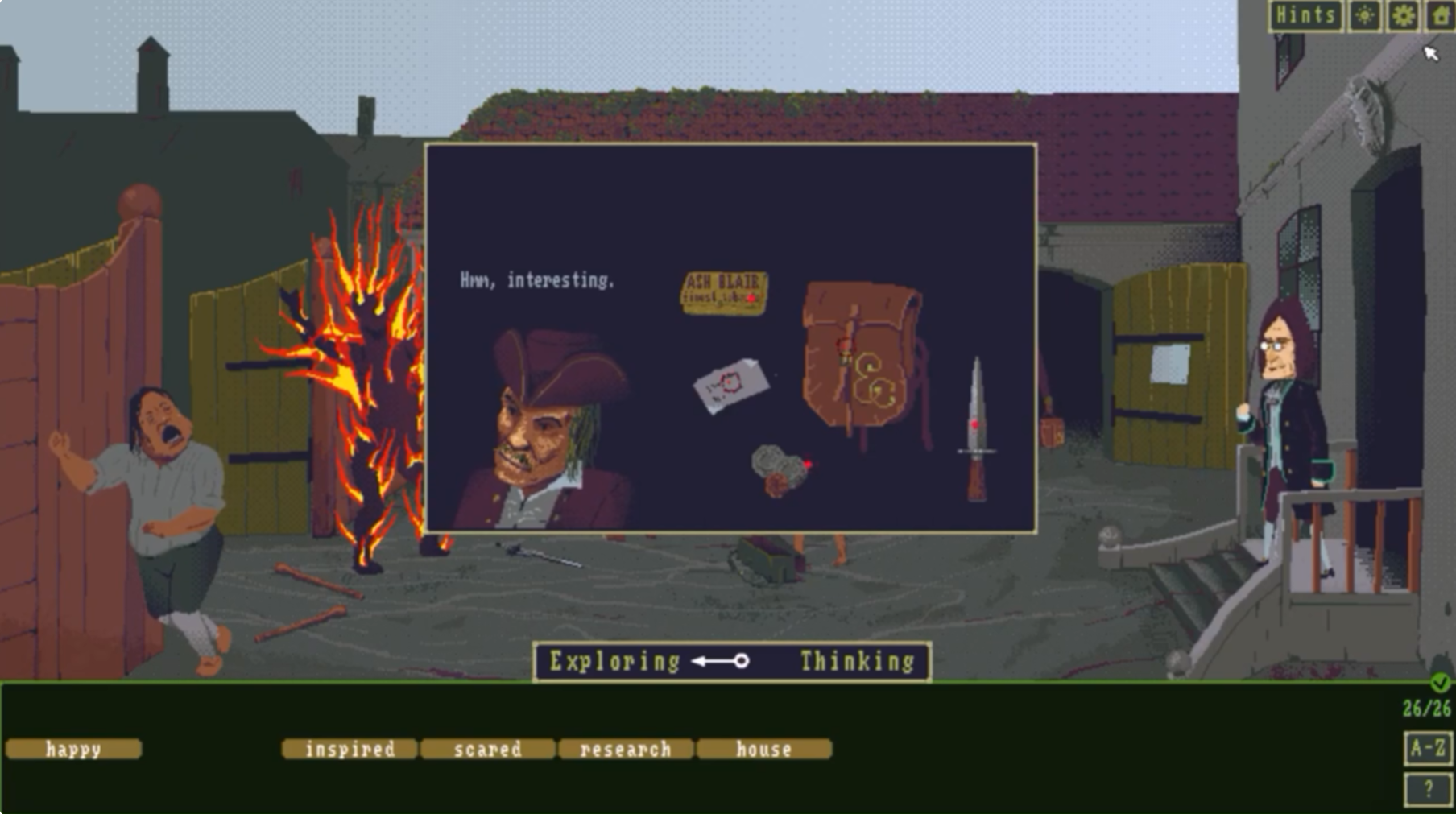
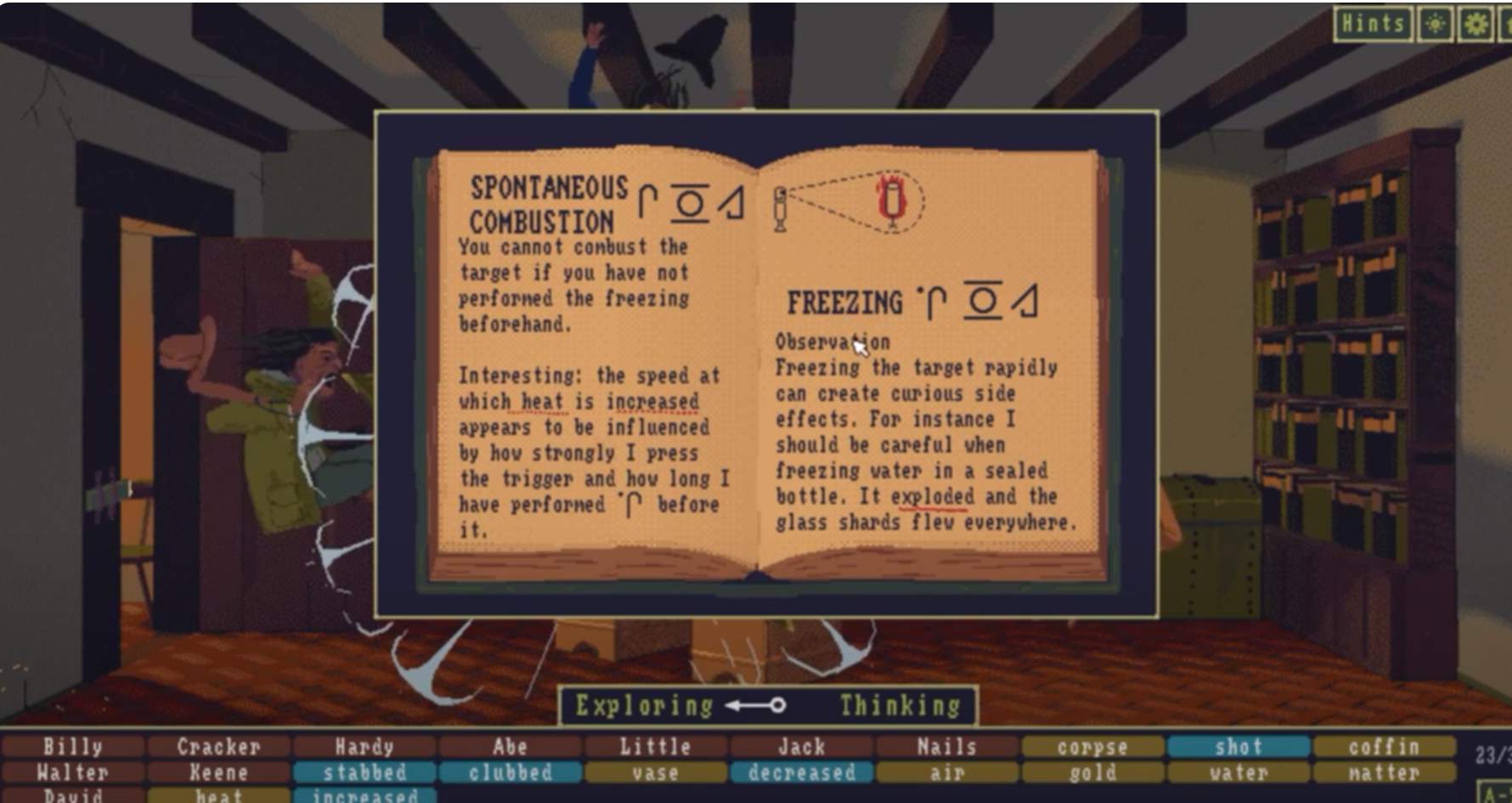
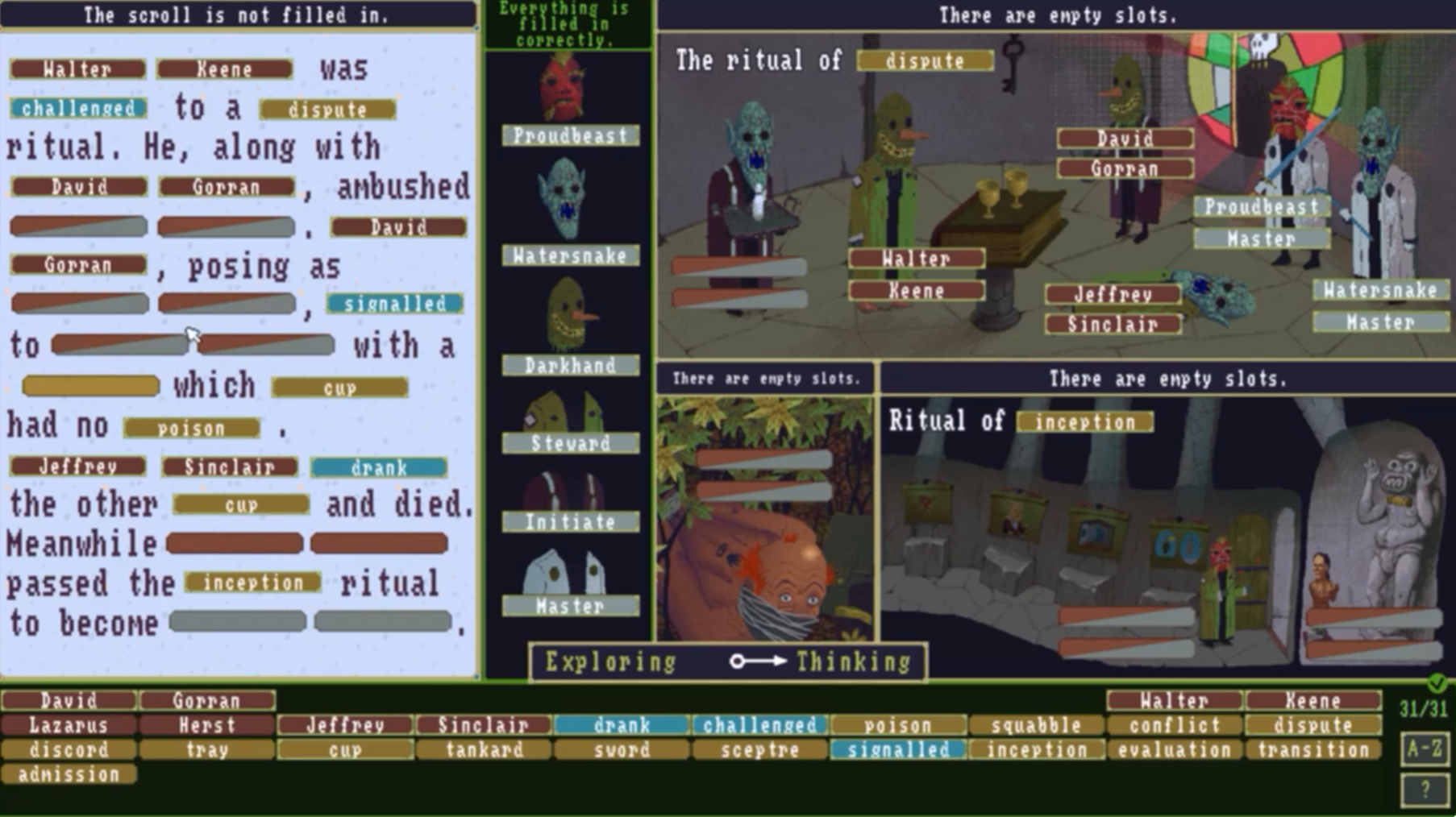
In “The Case of the Golden Idol,” after loading up and starting the game, I was immediately shown a murder case with a body lying on the water after having been pushed by another person. Here, the game explains its technical mechanics where one has to match words/names with blank words and pictures. Here, I played as the omnipresent detective without a name or a face, which allowed for the discovery of otherwise private clues and facts that couldn’t have been found if the neutral detective was in the game’s narrative, for example, like searching through dead people’s bags and purses and finding hidden letters or even hidden people. Thus “The Case of the Golden Idol” could be able to expand on what clues were in the scenes itself, without being limited by the detective’s bias or interference from other in-universe characters.

Additionally, unlike in other mystery games that I’ve played, I was forced to solve these mysteries without any direct help from other playable characters or the game itself. A mechanic that was of help was the “sparkable” clicks that turned yellow/red based on if you found the clue/word that could be identified by that object in the scene. Another game mechanic that helped make the game more accessible to players was the green/yellow/red “bar” at the top of the “Thinking” screen, which tells you if you are far away/almost there/perfect with the deductions present. I felt that this was extremely helpful as without the game narrative itself helping you with the mystery through other in-game characters talking with you through the mystery, that some sort of system that told you if you were correct or not was essential in order to gain a sense of progress towards these mysteries. What was instantly noticeable was the “Victory” music and disappearance of words when you got a section or the entire puzzle correct. Thus, the game rewards you with advancement which gives me and other players a sense of achievement after solving the mystery. 

Attention to Detail:

“The Case of the Golden Idol” fleshes out the in-game universe extremely well which allowed for me to be fully immersed in the game. While the first few chapters of the game focus more on a micro perspective of a single murder or crime, the later chapters really shine for me in expanding what we have found in those first few scenes into how it affects the greater world. For me, I was most fascinated with being in this dystopian-like alternative history while trying to figure out the mystery of why several characters were killed. I was constantly reminded of allusions to Revolution-era France while playing the game with its Society of Virtues and its metering out of unpleasant punishments. The scene that I felt most fleshed out about was the judgements of several characters that were present in previous scenes being punished by the “main character/villain” in the lair of the secret societies/cult that was ever present in the game. Trying to figure out the roles of several characters in masks was extremely tough, yet rewarding as it greatly helped me find out why certain characters were against each other. The last mystery further expands on this feeling of expansion of world view that I felt earlier, having the mysteries’ scope be the entire city that the game took place in. This type of immersion would not be there usually for a less than 5-7 hour game, but “the case of the Golden Idol” gets you right there with its extremely detailed backgrounds and scenes. 

Criticisms and ways to Improve:

One criticism that I had was the frustration I had when I was stuck in a puzzle. I was constantly clicking on clues that were already present in the word bank. The constant re-clicking was both tedious and sort of cut the continuous narrative up. I think some sort of refinement of that system would be great to make the game a bit smoother so that the narrative could flow a bit better. I think that the hint system could be much more refined so that it would be used more effectively.

Secondly, when I was at the end of the game, I was unenthused about there not being a grand ending/ scene that the main villain was in. The ending was underwhelming in my opinion and wrapped up the story in a way that felt was contrasting to the built up. I think that adding a DLC/extra chapters where the ending is more fleshed out and satisfying would be a way to fix what me and others are thinking when playing the ending chapter.

Conclusion:

“The Case of the Golden Idol” emerges as a remarkable fusion of puzzle-solving mechanics and narrative depth, captivating players with its unique perspective and attention to detail. Despite the plethora of gaming options available today, this indie gem stands out for its immersive world-building and engaging gameplay. While it’s not without its flaws, such as repetitive and sometimes frustrating interactions and a somewhat lackluster ending, the game’s strengths shine through, offering players a truly memorable experience. As I reflect on my journey through its mysteries, I’m left impressed by the game’s ability to transport me to a world filled with intrigue and suspense, solidifying its place as a standout title in the realm of indie puzzle gaming.

“The Case of the Golden Idol.” interview where the creators talk about its game development here: https://www.gamedeveloper.com/design/case-of-the-golden-idol

Setting and Storytelling in Obra Dinn

by Jacob Wilson.

The Return of the Obra Dinn is a truly interesting game in the mystery genre. I played it for about 3 hours and enjoyed it. Set in 1807, the premise is that you, as an insurance investigator for the East India Company’s London Office, must figure out what happened to the 60-person crew of the titular ship that was declared lost at sea in 1803. Did they all die? And if yes, how?

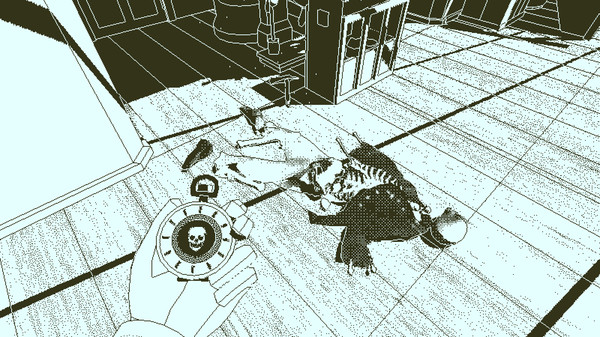
If that sounds like a daunting task, that’s because it is. Realistically, it’d be impossible, but if one finds a corpse (whether it is physically there or not) and uses a magical pocket watch, they can travel back in time to explore the exact moment when a character dies and hear some of the preceding dialogue. This device may initially seem to defy the rules of detective stories as we discussed due to its supernatural powers. In effect, though, it’s really not much different from having a third-person narrator like in And Then There Were None, wherein this style of narration was well used.

The pocket watch also quickly becomes normalized in this world once you realize that the legendary Kraken and odd spider-like creatures that shoot spikes also exist. I did not expect to find these elements in the story, but in retrospect, one could’ve expected it due to the magical watch. In its mixing of history and fantasy, the setting is thus reminiscent of Pirates of the Caribbean and quite unique in the mystery genre. Said monsters also behave consistently and do not seem to violate the laws of physics, effectively making them bizarre animals as opposed to devices that would violate the rules of detective stories by leading the player to unnatural and illogical conclusions – they are, perhaps in a twisted sense of the word, natural. One may compare this usage of animals to the snake in The Case of the Speckled Band or the orangutan in The Murders in the Rue Morgue. However, Obra Dinn’s use of animals is, rather than being the key to a puzzle that you aren’t supposed to expect, entirely unconcealed, which feels fairer to me.

The game’s way of revealing information makes for an engaging if perhaps imperfect blend of storytelling and puzzle-solving.

Players can identify the crewmates by their social standing on the ship (an expansive list of naval terms is used), their names, their appearance (clothes, facial features, tattoos, etc.), or their accents/nationality. Since you are only granted a split second of visual information, the visuals don’t give you the most exact portrayal of events, and neither does the audio, which doesn’t always tell you who exactly is speaking and at what time. This implores the player to use their imagination and pay attention to what few details they get. It makes for a fun challenge that can be solved in multiple ways, which allows for a varied player experience, but at the same time, the spread-out and sporadic pacing of revelations along with the paucity of information given in each scene made me feel that I was making very little (if any) progress. This remained true even as I binge-watched the stories of so many corpses, a process that eventually became exhausting. That said, I think Obra Dinn has an interesting way of storytelling that may only be possible in a game… the omission of so many details might seem more out-of-place in a movie or book.

The dialogue and overall narrative also suffer slightly due to the game’s structure. Some aspects of character interactions feel obligatory rather than natural, such as one crewmate addressing another as “you bloody Dane” or one of the Austrian characters saying “Verdammt.” To me, the former seems like too weak of an insult to use against the man who you think killed your brother, and the latter feels like a silly cliche equivalent to a French character in something unnecessarily saying “bonjour” and “mon dieu!” Nevertheless, I recognize that Lucas Pope had a very difficult job when trying to balance the difficulty in this game, so it’s a forgivable sin. These clues did help me pin down some identities after all.

The presentation of events out of order and with limited context also shifts the game away from properly employing the three standards of detective stories: means, motive, and opportunity. Means and opportunity naturally remain in play, perhaps only because they integral to the gameplay, but motives may remain a mystery for a long time or are stated very bluntly as in the case of that “bloody Dane.” Even if events are presented out of order, this order is thankfully indicated, unlike in Cain’s Jawbone. I could imagine myself eventually figuring out motives through playing more of the game and seeing how more of the story unfolds, but the lack of attention towards them means the story lacks the psychological depth and stakes it could otherwise have. It’s interesting enough that the first thing you see is the captain killing two crewmates and then himself at the start – it’s unexpected and also something that incites curiosity within me. Why did he do that? How did we get here? Other scenes taken out of context may arouse curiosity in this way, but after playing the game for longer, that curiosity waned due to having very few clues about people’s identities. It’s truly an interesting game and truly an interesting narrative, but it’s a bit unsatisfying in this sense.

Overall, I’d say the narrative execution of the Return of the Obra Dinn isn’t quite as solid as in other stories we have read and perhaps other games we’ve played… but don’t let my critiques detract from the fact that this is a fun game with a great, mood-enhancing soundtrack. I highly recommend it if you’re up for a challenge.

Marriage Between Puzzle and Story in Return of the Obra Dinn

by Sean

I came into Return of the Obra Dinn relatively unspoiled. Was it a puzzle game? A game of investigation? A heavily narrative-focused game with a few interactive elements? All of this I wondered as I started up the game and was greeted with the opening flyer:

“Lost at Sea, 1803

THE GOOD SHIP

‘OBRA DINN’”

As I played through the game, those initial questions withdrew from the forefront of my mind as I became more and more captivated by the slowly unfolding nonlinear narrative. Using the protagonist’s “Memento Mortem” watch, I was able to view the last moments of the unfortunate souls who had died on the ill-fated journey through the Atlantic. Through these scattered memories, I was able to piece together a clearer and clearer picture of what had occurred on the Obra Dinn.

Returning to those initial questions, I felt—first of all—that the “narrative” and “puzzle” elements had not been in tension in the slightest. As someone with experience playing other mystery games, I was accustomed to the idea of puzzles serving as something to interrupt the story. As an example, earlier in the quarter, I played Sherlock Holmes: Crimes & Punishments. At one point in the game, Sherlock sniffs a pouch of tobacco, remarking that its aroma is familiar. To mirror the process of Sherlock forming a “picture” of his associations with the smell, the player is tasked with rotating and arranging a fragmented picture of a sailboat in three dimensions until the picture forms a coherent whole. This section brought our group’s investigation to a sudden and unceremonious halt. We were no longer engaging with a narrative nor investigating a series of clues; the game was forcing us to take a break and complete an unrelated and tedious exercise.

Instances do exist in which the game designers attempt to integrate the puzzle-solving into the game’s world—in Portal, for example, the puzzle rooms (“test chambers”) exist as justified and plausible elements of Portal’s Aperture Science laboratory. But what separates both kinds of puzzles from those present in Return of the Obra Dinn’s puzzles is simply that Obra Dinn doesn’t ask the player to step away from the narrative at all. On the contrary, when the player is asked to solve the fates of each of the members on the ship, the player is brought further into the story; they are forced to pay attention to each minute detail: the characters’ accents; the implied relationships between the characters; each crewmember’s clothing. They are then tasked with critically engaging with those details: what do they imply about the chronology of events? About this or that character’s identity? About this character’s potential motive for murder? In this way, I felt that the relationship between puzzle and narrative was utterly seamless.

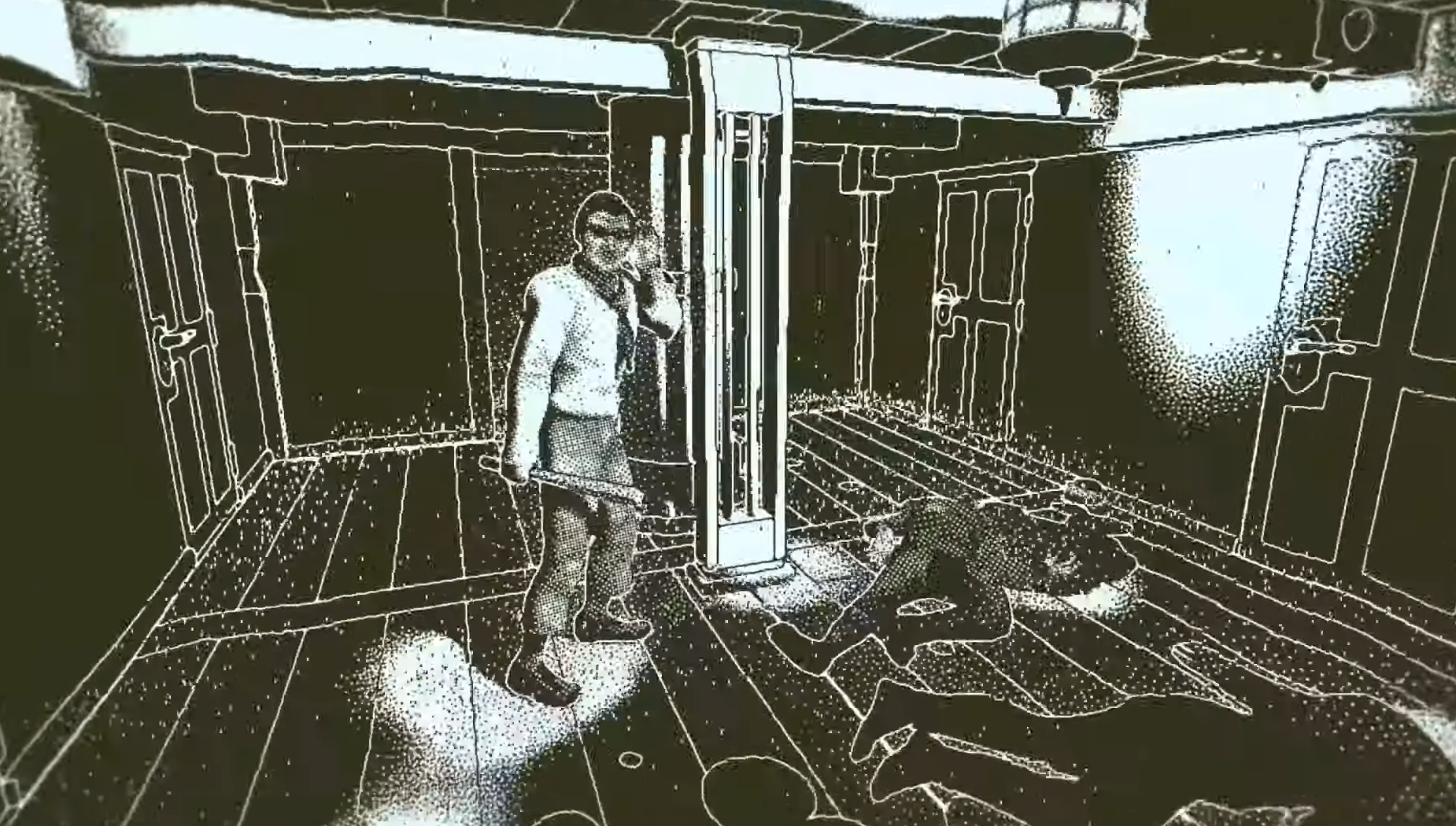
That being said, this marriage between the process of narrative comprehension and puzzle-solving did result in some absurdities. As the game puts it during its tutorial, “Decisive information is rare. You will have to make assumptions using partial information.” Typical detective stories are much the same—circumstantial evidence might only suggest certain culprits; decisive evidence is often reserved for the end. However, there is a key difference: the reader of a detective novel is not being scored on their ability to deduce names, methods, and killers—but the Obra Dinn player is. As a result, the game is sometimes forced to make its circumstantial evidence very suggestive. Occasionally, this comes at the expense of any narrative subtlety and immersion. At one point, one character in a small room calls out to another outside of the room for help: “Brennan! Bring the surgeon’s kit,” he cries. The player is then allowed to explore the scene right at this moment. There are two characters directly outside of the room—one might wonder, which one is Brennan? At least, one wonders this until noticing the exaggerated “I-just-heard-my-name-called,” hand-to-ear listening pose of one of the men. Indeed, this is Brennan.

(Pictured above: Brennan)

Another time, the player listens to the last words of a currently unidentified member of the crew. There isn’t much information to go by, until the man suddenly exclaims the German exclamation “verdammt” in a sentence otherwise entirely composed of English. The significance of this interjection becomes apparent when the player scans the crew manifest and discovers that only one person on the ship is from a predominantly German-speaking country (Austria): Alfred the Bosun.

By unblurring the characters’ faces, the game demonstrates that it expects the player to be able to guess these people’s names from this information. In order to allow the player to make the right guesses, the game is forced to lean a little too far toward the side of unsubtlety to let players make those reasonable logical jumps—whereas, on the other hand, a novel can allow these half-certainties to exist.

This speaks to a broader issue with gamifying narrative comprehension in this way. A character’s identity must either be “guessable” or not—something explicitly shown via the blurring and unblurring of characters’ faces in the journal. Detective novels have the liberty to leave the reader in a state of half-awareness and self-doubt on such matters—Obra Dinn must draw a hard line, removing some degree of the suspense and mystery present in a narrative of investigation. Nonetheless, the game demonstrates that a seamless marriage between detective storytelling and puzzle game is possible, even if it does compromise the strength of the narrative to some extent.