White Cube / Black Box / Phone Screen

By Sage Adams

As I was posing questions for discussion, I was operating, perhaps problematically, under the assumption that gallery and theater spaces were standard and that digital spaces may perhaps undermine them or fail to adequately engage spectators. This is an especially salient question given the limited access to gallery/theater spaces during the pandemic, bolstering an already large-scale acceleration of the 21st century digital takeover. However, I was taken aback to hear that many people in class strongly preferred digital methods of engaging with art as opposed to the gallery space. Among other critiques, people noted that galleries were too formal or sterile, they impose strict criteria for which art is considered valid, and imply something is wrong with you if you don’t appreciate a certain piece of art on display. On the other hand, there was a general consensus that digital spaces are a valid addition rather than a source of degradation to traditional art spaces. In particular, there was discussion of curated art pages and tiktok videos as methods to democratize art and increase its reach. At least one person stated that they were familiar with Can’t Help Myself, a piece I presented in class, but would never have known about it if not for social media. 

In hindsight, I now recognize a parallel between the work that moving image artists were doing to problematize the gallery/theater dichotomy and the advent of digital art spaces. By blurring the lines between formal art contexts, moving image artists asserted not only their right as artists to properly contextualize their art, but also the right of spectators to engage with art in various non-traditional ways. Similarly, digital spaces offer us the opportunity to encounter art on our own terms; we gain more control over contextualization, method, depth, and duration. This democratization of art has been an important offshoot of the greater democratization of knowledge that the internet has contributed to. The ability to discover new pieces of art online with a wealth of information available at your fingertips is priceless. 

Though the breaking down of barriers and limitations in the art world expands its reach to ever more people, there is a tension: sometimes limitations serve important purposes. Encountering art is not the same as engaging with it, and leaving everything up to spectators can potentially undermine the work of the art and artist. For instance, the constraints of the gallery and theater spaces force a focus on the art which is on display. It’s considered bad form to check your phone during a movie or take a call at the museum. In digital spaces, or in the home, these social and artistic customs lose their force. It’s incredibly easy to be distracted by a notification, switch to a different app, or even to have your feed refresh only to lose the art you were looking at. Humans are easily distractible, and the oversaturation of online content only feeds into this tendency. If the post of a piece of art isn’t immediately interesting, we’ll just scroll past it. If it’s not entertaining, we won’t work to understand it. Alternatively, in museums, I frequently find myself looking at all the pieces of art displayed in a particular gallery or room. I don’t want to be gauche, disrespectful, or miss out on an important continuity by skipping unappealing art installations. I’m more likely to engage cognitively, to read the plaque on the wall, to attempt to determine why this piece of art was chosen for a curated exhibit. So, even as digital spaces afford greater opportunities for us to encounter art, what good is it if we don’t care? What do we gain from staring at a screen-sized photo of a ten foot painting for a mere 30 seconds before promptly forgetting and moving on to the next post? 

Even with the reading for our class, which I did my best to genuinely work to understand, which I had to pay attention to lest my presentation be terrible, there is still a limit to how much I can learn when I can’t see the central pieces of art in person. The best I could access were the pictures in the reading (with explanations), pictures and videos posted online, and gifs. Despite such a heavy emphasis on the physicality of art pieces from Breer, Duchamp, and Paik, I will always lack some of their intended effect because I was unable to interact with these pieces in real life. Not only was physical apparatus and situation in space integral to their works, so was the complicity, even necessity, of the spectator as an integral element of the art itself. It was disappointing to be unable to experience these works of art in their entirety. Something is missing.

But how often do people consider the missing element when they come across art online? We’ve been so inundated with pictures of the Mona Lisa or Van Gogh’s Sunflowers that we become completely blind to the fact that there’s more than the photo; the scale of the paintings, the brushstrokes, the texture and thickness of the paint, the true hues of the colors. We are so conditioned to the mere image, replicated digitally, that we forget the physical. Equally worrisome are the stories of visitors to the Louvre taking pictures of the Mona Lisa then moving on, more concerned with telling people that they saw it than actually seeing it. Even when the physical is right before us, we still fail to recognize its importance. 

I think, then, that we come right back to the problem moving image artists attempted to address: context of art is important, and when it’s wrong, the art is unable to come into its entirety. Different art works best in different spaces, and artists deserve some degree of say in which spaces those are. But this is not to discount the digital entirely. While paintings may be best in the gallery, while experimental video art may be best in the theater, and while pieces like the Mutoscope may bridge both spaces, there are countless forms of art which thrive in the digital. It’s up to us to recognize which forms these are. 
De La’s Soul

by Cassie Haas

Occasionally media outlets will do these interviews where they ask folks what the objects they can’t live without are. Be that personal items, fancy jewelry, or in the case of Danny Pudi, socks and a good cup of coffee. I generally stay away from these as the lives of celebrities and those with amounts of money I’ll never even be in proximity to within my lifetime don’t interest me. That being said, I often wonder what those items are for me. I come back to a few each time: my Nikon D3500 camera, my blanket made from shirts I grew up with I received as a graduation gift from my Mom(thank you Mom), and my CD copy of De La Soul’s 3 Feet High and Rising. Now this last one is interesting, because I don’t own a CD player. Well, I did when I inherited my Dad’s old desktop he made in the early 2000’s. And there was a brief period of driving a 2005 Toyota Prius named Francis that housed both a CD and a cassette tape player. Vintage! But now, nothing. The CD sits on the lower shelf of my bookcase next to my vinyl records in the warm company of The Fugees and Jim Croce. Haven’t used it in years. Besides, I can listen to it at any point I want from wherever I want due to the modern age of streaming. And yet, it remains there still.

When De La dropped 3 Feet in 1989, they were at the forefront of a new wave of hip hop coming out of New York. By no means the first group that experimented with jazz rap, they were among a group of likeminded creatives in the newly formed Native Tongues collective. While somewhat short lived(by only 4 years later Q-Tip of A Tribe Called Quest is quoted saying “that native shit is dead”), by the release of High and Rising the collective had already grown to include De La, ATCQ, Jungle Brothers, Queen Latifah, and Monie Love. They were a group dedicated to their Afrocentric roots, calling back to the past with samples of music created by those who came before them to address the life and beauty of the modern age amidst an era of gangster rap that emphasized being hardcore and individualized from others.

Where ATCQ and the like tended to take some pride in sampling the deep cuts, spending hours in the record store looking for what would work just right, De La grasped for what sounded good. Of course this isn’t to say Tribe didn’t sound good—they have my favorite three album run ever—but it’s undeniable that De La went for the heavy hitters. Steely Dan, The Turtles, Hall and Oates, Johnny Cash, Billy Joel, The Isley Brothers, and those were just some of the names on their first album. They continued this trend through their next few albums, sampling the big names and turning them into something new and beautiful entirely in its own unique way. I hesitate to call them unlucky as their peers were already avoiding the trap they would soon fall into, but these works came at a new age in music legality. Groups started to get somewhat peeved at De La’s usage of their music on De La’s own releases. In 1991, The Turtles filed a lawsuit against De La Soul for a whopping $2.5 million dollars with Mark Volman of The Turtles somewhat famously claiming that “sampling is just a longer term for theft”. Other groups would come forward and air their grievances as time went on, but repercussions would not truly show themselves until the streaming era. For years and years none of De La’s 80s or 90s releases were available anywhere digitally due to legality reasons. The only way to access them were through the CD or the vinyls that were pressed. 

I grew up in Columbus, my Mom in Youngstown, and that’s as far back as I know. Grandma Cookie was alive just long enough to see me into this world and then was lost to the home my Mom and my uncle grew up in as it engulfed her in flames. Willa Crawford was her given name, and my mother knew Willa’s mother, but Lord help me if I could tell you a thing about her. I think of our generations as being compact; Mom was only 22 when I was born, and it wasn’t far off in distance from her own Mom. Each of us knows nothing. Lord, the remaining family recently attended a military funeral for Cookie in Northeast Ohio. It was the whole shebang, so to speak. Three rifle volleys, a folded flag, a speech. Only me, Mom, my step-dad, my uncles and my uncle’s wife were there to see it. We had always known she was in the Navy(hence this ceremony taking place at all, especially 18 years after she passed), but it wasn’t until arriving at her plot in the cemetery that any of us learned she used to be a drill sergeant. A drill sergeant! We laughed, of course. There was a mutual understanding that there was so little we did know that finding this out couldn’t even be classified as a surprise. This is all to say that the history of my family is dwindling, and will continue to do so.

So when I say that De La Soul is and was reaching back into the past through the music, I mean it. It’s the only way I’m able to reach into my family’s history myself. I’ll never know exactly whether this is what Pos, or Mase, or Trugoy intended when they joined forces together—after all, they were just high schoolers looking to have fun. I’ll never know my grandparents, or their parents, or their history, and especially not the music they listened to. Oftentimes though, I think of the samples they used as a place to sit alongside them. I’m not radically spiritual, but to think of it as a front porch in the summer, sipping iced tea alongside them—it helps. Trugoy the Dove passed at 54 on February 12th of this year. Just a few weeks after that, on March 3, 2023, the albums made their way to streaming services for a new generation of listeners to experience. Legal issues were finally cleared up after years of fighting between De La Soul, labels(including their own), and other artists. Less than three weeks between his death and their release. It seems sometimes that the world is against preservation. His music will finally now have a chance to live on, but it took until his passing to do so.


The story goes that Me Myself and I was originally created in just a day, whipped up as a final addition to the album as a joke by the group. Their label had been requesting a song that would be a hit, something that would make it to the radio. De La laughed them off and created something entirely their own, their interpretation of a radio hit. Their joke was successful, of course, and is how many know the group today. But it did start as just that: a joke. In that moment, a group of friends, freshly graduated from high school, playing with samples from Funkadelic, the Ohio Players, Edwin Birdsong and more in Mase’s mother’s basement, created a time machine. A time machine I enter as often as I need, less than I need if I’m being honest with myself, to quietly sit on the porch on a sunny day with that family I’ll never know, and will never know me.

A Reflection on Minimalist Music

Going into discussion beforehand, I didn’t have much previous knowledge on minimalist music. After the discussion we had in class, I got a few clarifying questions sort of answered and gathered a few take aways that bettered my understanding of the genre.

First, I went in not fully understanding the difference between ambient versus minimalist music. Within the scope of all the different sub-genres of electronic music, and music in general, I felt the lines were a little bit blurred between what distinguished the two from each other if even at all. After a little extra research, I kind of came to the conclusion that ambient music is a little more cohesive in what a standard song might sound like while minimalist music, more specifically its origins and first iterations of it are more experimental. After the class discussion, I also came to a better kind of distinction between the two genres in the fact that ambient music more so focuses on textures of the music more than minimalist music.

I appreciated the conversation we had throughout the discussion from class relating to the future of loops and music production, starting off with the question from the minimalist discussion of whether loops might lead to more minimalism in music, whether in the more traditional minimalist way, or by creating more music that sounds the same. I think that it is important to take into consideration the amount of accessibility there is now and days for people that want to make music. There’s a larger platform with the internet that allows for more sharing of music and allows for more simplicity when it comes to accessing the tools to produce music. I think that within the realm of minimalist music, since so many of the examples seen began to feature loops thanks to innovations in the craft of minimalist music from artists like Terry Riley, it’s interesting to think how the future of minimalist music might develop with the development of more technology and accessibility. For one, there are plenty of places for people to access loops, whether less experimental guitar loops or FX sound effects. There are also countless effects and modulation plug-ins that make the creation of more experimental music as easy as clicking one button.

I think with all these resources, while there isn’t as big of a scene for experimental music as there is for more traditional sounding songs for a variety of reasons, it might be interesting to see if there is a sort of resurgence in minimalist music or at least a little more production similar to the production of its innovators/founders. I think with a sort of nostalgia being seen in younger people for a time before they were even born, it might be interesting to see how up and coming producers might be able to create a new adaption of minimalist music or even pay homage to more traditional minimalist music by combining the tools of old production with the tools of new production. For example, record players are some what coming back into fashion amongst younger people. There’s a sort of aesthetic that comes with owning a record player now and days only further spread through social media. For producers, this might mean finding actual records and playing around with glitching them using technology now and days that allows recording to a DAW (digital audio workstation, basically what software music producers use to actually produce music) to create weird samples to use in their minimalist music.

Straying away from this, another thing I found kind of interesting to think about within the scope of minimalist music was the notion of trying to use as few instruments as possible on the track. I think back to some of the tracks on the playlist for class, specifically “String Trio” by Terry Riley, I think about how that might be seen in music today. I feel with the development of technology, there are a lot more options of what you can put in a song. Rarely do I listen to an album and see a smaller instrumental track, let alone one that features minimal instruments. I do take that with a grain of salt that the music I’m listening to is not minimalist music, and so there shouldn’t really be a surprise that the music isn’t minimalist; however, I do know that every once in a while there are some interlude tracks on albums that could technically be classified as minimalist music according to this definition of using minimal instruments. I think this is interesting to think about and raises a few questions in my head: did the artist make this song with the intent for it to be a sort of more “put together” minimalist track (by “put together” I mean a less experimental track that goes more in line with more common song structure)? I then think even without the potential intent for the song/track to be minimalist, do these example act as more recent examples of minimalist music?

All in all, I still think I would need a bit more time to try and focus in on what minimalist music really is to be able to better understand it. I feel like after the discussion in class, I’ve gained both a slightly better understanding of minimalist music as well as a better understand of how to think about minimalist music in the context of music today. I still say to take everything said with a grain of salt since I still feel shaky on my understanding of minimalist music, although I know this isn’t the focus of the class. Loop wise, it’s very apparent, in some examples more so than others, where the concept of the loop comes into play in minimalist music. There are still a few questions I would want to ask about the relation of loops in music and their impact/role within minimalist music, but I feel as thought I can do a deep dive to better understand the genre and then wait and see how the music community evolves and what that means for minimalist music.

Gabriel Byrd

Loops in Video Game Music

When listening to arrangements of early looped and electronic music, the crafted compositions were evidently experimental. Access to new technology allowed for composers to be much more radical and imaginative with their works. As such, diverse instrumentation, varied melodies and harmonies, and generally innovative ways of creating music came forth. Thus, looped music became a catalyst for musical evolution as it pushed the process of composition to its absolute limit.

As time progressed, integration of skills and ideas from looped music intersected with more traditional methods of creating music. Looping certain rhythmic and melodic patterns became a more common practice in modern music, whether it was looping the beat to a song or a certain harmonic progression. However, I find that where I notice the evolution of looped music is in video game music. Why do video game soundtracks rely on loops? It’s because they have to. 

For those who are less familiar with video games, the easiest analogy is that video game music operates similarly to movie soundtracks. Compositions are created to further immerse the player in the environment or situation the characters find themselves in. Essentially, video game music is meant to elevate the player’s experience by creating atmosphere or emphasizing the emotional impact of a scene.

There are a few reasons why loops serve video game music so well.

Simply from a production level, I think it is important to recognize that in video games, music is an almost constant element of the experience. Whether it is a theme for a character, theme for a setting such as a dungeon, or theme for an intense battle, music plays a crucial role in gaming. As I started to consider why loops are used in video game soundtracks, I realized the sheer number of pieces that need to be composed for every game. For example, Final Fantasy IX and Xenoblade Chronicles both feature soundtracks that consist of over 100 unique pieces each ranging around 4-5 hours if all the works are compiled together. If these compositions did not loop, it would significantly delay game production and would likely mean cutting down the number of distinct musical pieces that these games include. 

This is also why within video game music, there are often even sections of a piece that loop. Whether it be a looped background rhythm or drumming beat, or a phrase that is repeated back-to-back, these loops can help create a piece easier for composers who have to compose so many unique sections. Additionally, some pieces will loop a melody, but introduce a new instrument or harmony to transform a piece and make it appear less repetitive.

Further, game developers have no way of knowing how long a player may need or want to remain in an area for, and therefore pieces of music have to loop. For example, two people who are playing the same boss battle may take different amounts of time to complete the encounter. If the music did not loop and just ended at some point for the player who required a longer time, the atmosphere of the scene would disappear and thus the player’s immersion would be jarringly broken.

For players, a benefit to the repetitive nature of looped music is that they can easily recognize and follow a musical piece. After listening to the composition in a repetitive setting, it becomes very familiar. As they run through an area, they can hum along or simply enjoy the music since it is something they can easily recognize. As such, a piece can be something that passively plays in the background as a player is deciding how to win a battle, or it can be something they are actively listening to as they are just trying to get from point a to point b.

However, this emphasizes the difficulty of creating video game music. The music must be stimulating enough to positively attract the attention of a player by illustrating the situation it is played in. Yet, the music cannot be overpowering to the point where it turns attention away from the game. Likewise, a composition cannot be too repetitive to where the listener either gets bored of the piece or can no longer enjoy it. It is a constant tension within the very concept of game music that makes it so complex. 

To conclude this post, I wanted to analyze two examples of pieces that utilize loops in interesting and original ways. Consider The Fallen Arm from Xenoblade Chronicles as our first example. 

After a brief introduction around 0:12, we are introduced to the sorrowful melody of the piece played by an oboe. Then at 0:39, this section loops but has added contrapuntal lines played by strings, giving it a new, more complex feeling despite featuring the same melodic material. At 1:05, we are introduced to a part of the piece that introduces a different melody. This provides a breath of new air as this is new melodic material we have not heard before. At 1:32, the original melody reappears, however, it is now joined by a counter melody played by the strings. This gives the piece a more dense texture, and makes it difficult to recognize the original melody. At 1:59, the melody and the contrapuntal line are looped again right after it is played, which allows the listener to fully identify the combined melodies that are being played together. At 2:25, the main melody appears with a new timbre as it is played by the piano instead of a violin with a slight variation at the end.  This reappearance of the melody leads to instrumental piano postlude that mirrors the harp prelude from the very beginning. Thus, the loop of the entire composition is completed. 

Here, there are really two distinct sections that are played. However, the continuous variations in the instrumentation (from oboe solo, to oboe/ violin dialogue, to strings, to violin solo with piano accompaniment, and finally to piano solo) make the repetitions appear different. Added to changes of instrumentation are contrapuntal melodies and new, richer harmonies that make the piece both easy to follow and still unique and not repetitive. This music plays in an area that holds a nearly-eradicated civilization in a forgotten land. The downcast sound evokes a feeling of pain that the civilization endured. 

A different approach is taken in Final Fantasy X’s Path of Repentance

The entire piece is played by piano solo and centers on a simple melodic phrase. The very first couple of notes played in the right hand part establish the melodic motive which is looped to create the A section. Essentially, the same pattern of melody and rhythm dominate this section with the pattern being sequenced up or down a whole step. Thus, a loop of a single sequence is used to create the A section in its entirety. At 0:20, the A section loops and is played again. At 0:39, a B section is introduced. While this section introduces a new melodic pattern, this pattern is then again sequenced going up and down by half steps and looped. After this, the A section is played again and the loop is complete. 

This piece is much more straight-froward, as it is played only by a piano, features only two sections, and consists of both small scale (sequenced melodic patterns) and large scale (ABA pattern) loops. Yet, the piece does not feel repetitive since it employs pitch sequence in place of actual repetition and large scale pattern by including ternary form. This piece plays as your character is escaping a prison after being wrongfully detained. The repetitive pattern illustrates the confining environment your character finds themselves in, and the sole piano reflects the isolation and sorrow you feel separated from your party. 

I encourage you, the next time you are playing a game, to dedicate a little time to appreciating the music that is being played. 

By Aimee S

Escaping the Daily Animation Loop/ Why are we so scared of Loops?

  • By Nora Jovine

As a cryptic form of self flagellation I listened to Smile by Noehida while I wrote this Blog post, by no means is it necessary to join me. This song was my most listened to song since 2016 every year as I would loop it for days on end, until this year- where I seemed to break out of the loop. If you prefer songs without lyrics while you read I recommend Osho. Alright, settle in and lets get looping!

In this blog post I would like to explore how the loops in animation mirror the looping routines (I assume) many of us find ourselves in- should this looping be considered a failure of a boring individual? And why stagnation presented as the most terrifying loop of all.

From positive affirmation journals, and meal prep, to weekly workout schedules, routines are prefaced as the way to solve mental health to physical ailments alike. But at what point does a routine become harmful? Despite routine being highlighted as this cure all, when it comes to our content the loop is often considered a way of cutting corners and effectively cheapening a work. In 101 Dalmatians after analyzing the sheer amount of looped puppies the glamour of the beautifully animated movie seemed to slip away as I was left with the knowledge that animators were probably underpaid or overworked and leaned on the loop out of necessity to ensure the film remained visually exciting. The disguising of the loop via slowing certain frames or layering images to different scales emphasizes the dichotomy of the loop as necessary for production but also its ugly nature as something repetitively mundane used to create constant movement in a more economical way. So, why when we see the looping dots bouncing as these tiny dogs run do we chuckle to ourselves at the outrageous nature of stretching the same drawings repeatedly, but are awed by those who manage to wake up at 5am everyday and go to the gym. What makes it inspirational to loop ourselves but lazy to loop animation. x

The driven ideal of someone with a fantastic looping routine becomes admiration due to the amount of discipline it takes to live in such away. With the proliferation of lifestyle vloggers and influencers creating the perfect ‘routine’ is seemingly always trendy. Though the idea of looping in such a rigorous way seems to neglect the downsides of efficiency. In the video essay “The Defense of Inefficiency” Zoe Bee discusses the lack of efficiency of the creative process- and the relatively recent nature of society’s obsession with optimizing ones time. When considering that creativity requires a certain aspect of looplesness, would the creative evolution of ones own person not be subject to the same rules. How can an individual grow if they are bound by the shackles of a rigorous loop that occupies their every waking moment. If we were to expand from that, and please tolerate my humanity major ramblings, how can the loops of generational trauma, toxic masculinity, and systemic racism, ever be stopped if one is to remain stuck in the industrious loop of a admirable routine. The loops of normal behavior, while on occasion rewarding, can also distance one from the human needs of your community. The loop of school, work, buy a house, have kids, die, I assume can be fulfilling but at what point does it cheapen the growth and diversity of human nature in the same way a looping character becomes visually exhausting after the third reiteration.

However, on the other hand we cant be rid of the loop just yet. Without the repetition and practice of looping would change ever occur on a scale that isn’t individual. Additionally, there is truth to the comfort of a loop, the reliable nature of your favorite idle animation creates a sense of reassurance that may be what we all need in these increasingly chaotic times. Heck, I’m guilty of this all the time and have consumed the same comforting cute romance stories since I was young enough to read, and when everything seems utterly incomprehensible the safe haven of a narrative loop is what the heart needs every now and then. This push and tug of stagnation versus growth in its own way is a loop of itself.

Grounding this in animation again, the necessity of a little loop clarifies itself. When looking at the “12 principals of Animation” created by Disney animators in the 1930s and was outlined by Ollie Johnston and Frank Thomas, these principals provide the foundation of most animation education till today and can all be distilled to different loops of motion. For Example, ‘Drag’ refers to the process of delaying motion of objects connected to the main body, e.g your feet moving slightly after you turn with your torso, and it parallels how ones technical abilities only catch up with ones imagination after the process of practice and creativity begins. While utilizing these 12 principals is key in creating lifelike animation, ensuring the less flashy transitions are readable is equally as important in creating a character that is as endearing in their moments of action as they are in their more passive frames. This principal of mastering the subtle motions of animation comes with the unfortunately hard loop of practice, you only have to think of the paralyzing tranquility of a Miasaki film to know that the action is often the least important part of animation. I will save you all the spiel of how revolutionary these principals were and how each of the twelve highlights a different aspect of looping frames- but mastering these 12 loops is, to a certain extent, how you become a fantastic animator.

And in a wonderfully tangential way, I think mastering your own loop is how you become a fantastic person.

Anyways that’s all- I will now finally free myself from this looping song that will surely be an earworm for the rest of my day. Oh well- also! What loops do you find yourself stuck in? Are there any loops you want to work towards? Do you think some cultures/people are better at looping than others? Either way, I hope the rest of your daily loop is rewarding!

-Nora

I Wish I Can Change Sth (Or Can I) & Who Am I?

By Helen T

—My Attempt to classify time-travel stories into their own place

(This’s my original character in her 13 and 19) Just thought it’s cool and also consistent with the theme of time travel having multi-versions of oneself standing right next to each other ;D

Time travel has been a tantalizing and ominous topic for a long time since the explosion of all kinds of natural science and the Industrial Revolution. It seems like human beings become much stronger and more powerful everyday at an astonishing speed, but in many’s eyes another vicious process has begun, and this world is drifting into an unreturnable abyss – pollution from earth to ocean and air, war from local to global, machine gun to nuclear weapons, etc. Nietzsche said that the evolution of science and technology will eventually lead to the failure of humanity, Marx describes Capitalism as the process of dehumanization, and Arendt argues that the ultimate change of human conditions leads to an entirely different mindset. In the nostalgia of “the good old days” and the fear of the shit-like presence as well as the bleak unknown future, time travel stories as a genre were born. 

There is an interesting argument coming from Hume who argues that one cannot imagine a presence coming out from nowhere/he or she never perceived before, and he gives an example saying that a Chimera is merely composed of all different kinds of animals that exist in the real world. If we apply this idea to all kinds of fantasy and science fiction, it makes sense to argue (and I personally believe) that authors are depicting and exaggerating the present Earth in their imaginary futuristic/imaginary world, and they’re either secretly or openly embedding their own wishes into it. Either for By His Bootstraps or Man Who Met Himself, authors give more space to describe the experience and influence of time travel and the reaction of the protagonist instead of making sense of the mechanism of the time machine. However, probably because there is always a time machine existing in the story, the most common category people grant to time-travel stories is “science fiction” instead of something else. 

There are many definitions of what classifies real science fiction, one of them that I think makes the most sense is that the author is trying to use logic and scientific methodology to make sense of the imaginary setting or invention he or she adds to the top of the real world. (Eg. in Dune, although Arrakis doesn’t exist in the real world, its ecosystem still makes sense in terms of either ecology or biology and there’s a complete and delicate design of it made by the author. If we take this as the definition of science fiction, there are a few things that those two novels I mentioned above failed to fulfill: in By His Bootstrap, there is no explanation of the reason for such a weird kind of future world to occur; and in both novels, the central sci-fi concept – the time machine – ends up with few explanations. Although both authors close the logic loop in the end (the time travel trip is just a smaller loop inside a bigger one), this is still a deviation from the more authentic kind of science fiction. In fact, Via the Time Accelerator, though using a pretty awkward and weird explanation of the time accelerator at the beginning of the story, does try to make sense of the time accelerator. (This type of explanation is pretty common in the earlier stage of sci-fi, in that time era one responsibility of sci-fi is education). Therefore, those two novels emphasize the type of society, the kind of warning/wish both authors have toward the real world, and probably also some philosophical reflection, but not the science or technology itself (although the settings are certainly inspired by Einstein’s Relativity).

Another topic worth discussing is about the concept of “Me” and the manipulation of identity in time travel stories. One’s destiny is always intertwined with the history (“plot”) of the world and a major and cliche reason for someone to either travel to the future or especially back to the past is to change his/her (or his beloved’s) destination. There are usually two kinds of world settings: 1. Predestination, the whole universe from its creation to its death has already been determined, and time travel is just a slightly special smaller loop inside a bigger one; 2. multiverse/paradox, one can change the past or future, but this will usually result in a completely different new world with (sometimes) unexpected consequences due to the so-called Butterfly Effect. 

Interestingly, both kinds of settings involve multi-selves and free will. According to the two novels (belonging to the predestination category), human beings exist discretely in a slice of time and are merely connected by common memory. The thought that “this WAS me who did this” creates an illusion of a single self. Multiverse on the other hand handles this problem more gently, with a focus on the discussion on the relationship between one’s identity/personality with his or her destiny/the world he or she is living in. In terms of free will, accompanied by the close loop of logic and the paradox created by time travel, Predestination manipulates the protagonist and beats them eventually with the cruel fact that they cannot do anything. On the other hand, the multiverse does emphasize the difficulty and subtlety of changing anything that happened in the past, but also grants characters the power to change something with a time machine, and time travel is not a cruel show demonstrating the power of fate anymore. In terms of both free will and identity, the multiverse is a milder and more colorful version of the predestination time story, the loose of strict requirements of a close time loop does introduce more possibility to the plot and makes it much more interesting. And that’s probably also the reason why the second kind dominates today.

Conceptual Relativity: Time and Time Again

Science has always served as an absolute for myself. Through strict, replicable, provable guidelines I find a sense of solace in understanding the broader world around us. For me, this has meant that improper science within media and games has always altered the amount of enjoyment that I received for them. Due to that underpinning, I have often failed as a critic of media to properly analyze the underlying themes beyond the scope of the story itself, instead turning to analyze the robust, and often false, science that breaks the aforementioned immersion.

Our discussions in class regarding The Einstein Theory of Relativity and Via the Time Accelerator then helped me become aware of the broader media context I was missing, and how as a result the notion, and human fascination, with time itself was something important to be analyzed. It wasn’t the actual scientific backing that opened the door into an explorative story, it was the thematic underpinnings relating to revolutionary scientific advancements that allowed people to dare to dream. 

With this in mind, Einstein’s influence with the introduction of special and general relativity is the basis that then facilitated these imaginary gateways into scientific exploration. Sure, the science wasn’t completely sound, but it was just coherent enough that for the general population, it satisfied their need for justification.

I want to explore science fiction because the components that are central to its genre help the genre itself facilitate thematic narrative decisions. To begin, I want to generalize themes I feel are set in place with other fictitious genres, and extrapolate how their core questions influence their imparted morals.

Within the fantasy genre we see the question of “what can we imagine” – it is founded in the abstract and openly invites narratives that don’t ask for an explanation. By immersing ourselves in this genre, we step into a “magic circle” where we abide by whatever principles the author chooses to provide us. Historical fiction offers a different lens, now asking us “what could’ve been”. With a pre-established factual framework to operate within, we can explore alternate timelines that are baked into a rich, often blurry history. Realistic fiction offers us “what can be”, working within the present or near present to tell stories of everyday life, whether it is a more standard story or an abstraction of reality.

Science fiction, however, is truly an open ended question – for myself I feel that it asks “what could be”. But, in regards to the application of science, it ensures that there is a grounding in reality for its audience to springboard off of. This is important because of the affordance of plausibility, where each new discovery facilitates a broader understanding of not just the science itself, but the potential – albeit normally incorrect – trajectory of where we could go.

Now we can circle back to what we see within Via the Time Accelerator, as it is an extrapolation of Einstein’s introduced Theory of General and Special Relativity. Correctness aside, we see Frank J. Bridge craft a narrative that centers around two principles. The first is the application and explanation of relativity, and how it can be applied to facilitate time travel, namely solely introducing the theory that you can travel to time at any point. The second principle is the question of the future, and what the affordance of time travel allows people to imagine.

Bridge’s title suggests that the “Time Accelerator” itself is the facilitator of this journey, allowing Brockhurst, our main character, to take this adventure. Quoting the principles of physics, our narrator even correctly identifies the notion of a world-line, stating “A world-line is a continuous succession of point-events in a four-dimensional space; or, in other words, it is the path pursued by any particular body through space and time.” This seemingly minor inclusion has broader implications towards the audience, it given them a kernel of scientific fact to ground themselves within, so when Bridge’s continues to introduce more complex theorems, ideas, and “facts”, readers take them at face value.

Yet, moving into the second principle of future application, I feel Bridges uses the desolate city as veiled commentary towards the current world we find ourselves in. Particularly, when Brockhurst talks with The Last Man, he writes “Greed and avarice, lust for power, oppression of the weak and rebellion of the untutored – it is the same old circle over and over again. They rise, they flourish, and they fall.” As much as this serves as context to the futuristic world, it is also socially relevant commentary that Bridges chooses to elaborate on within his piece

This brings all the themes of the piece back to present, expanding upon the cyclical nature of civilization and extrapolating it within the future. Via the Time Accelerator, whether knowing it or not, incorporates loops in a variety of levels. In its application, it allows for the looping nature of time travel to facilitate its journey. In conversing with The Last Man, Brockhurst (and by extension the audience), are reminded of the cyclical, inescapable nature of civilization and humanity, one that we cannot simply seem to outrun. Back to the nature of relativity, our perspective is seemingly engrained by our experiences, and in some ways, it serves no more as the absolute truths to the patterns we see time and time again.

The application of science adds a plausibility to an abstract story within Via the Time Accelerator, however it is in the introduction of loops, whether aware of it or not, that truly imparts a truth found throughout our broader society as a whole. So, sometimes it is important to look beyond the scientific inaccuracies within literature, and instead focus on what the narrative is trying to impart with its question of “what could be”.

Katherine

Beyond gender: The inclusivity potential of cyber-body horror

By Katelyn Gutierrez

Tetsuo: The Iron Man (1989) by Shinya Tsukamoto

“Powerful as the sensations of the jerk might be, we may only be beginning to understand how they are deployed in generic and gendered cultural forms.” 

Linda Williams on the future for genderfluid film bodies, “Film Bodies: Gender, Genre, and Excess”

In ongoing discussions on how cinema hypnotizes and immerses us with sound and moving image, there is particular emphasis on the audience’s departure from the “real world” and into the moving image on screen. Of primary concern to most theorists is the extent to which embodiment and identification occurs between the audience and the onscreen characters, even if the worlds of each are incongruous. The horror genre continues to innovate on scare tactics, diversify the casts of characters, developing inclusive and complex themes, and—albeit on a limited basis—answering the call for diverse representations of human bodies, allowing many to “see oneself” on the big screen. So, what is the role of gender in body horror? Has the focus on representation reached the bounds of a finite view on gender? Are we truly past the time of Clover and Williams, where the very scaffolding for body genres, slashers, and other gory subgenres is built upon the outdated gender binary? (Did you see They/Them, released this year, in 2022? If so, I’m so sad you had to waste eye strain on it.) We’ve got a long way to go in pursuit of body horror that starts in the flesh just like its compatriots in the genre and doesn’t mobilize through gender norms.

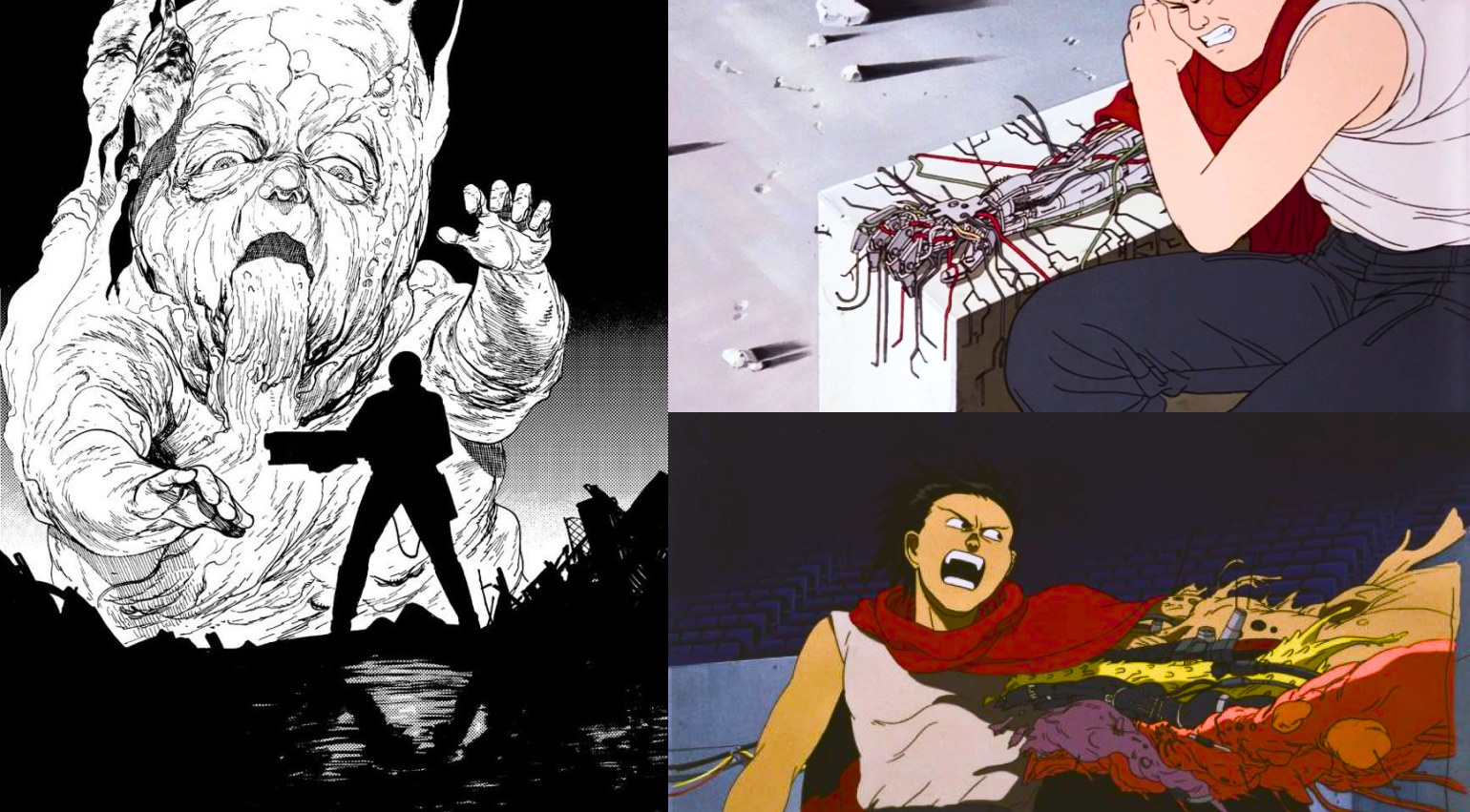
Left: Manga scans of works by Kazuo Umezu. Right: VHS sleeve for the film Conton (1987) by Takuro Fukuda.

“It may be through the female body that the body of the audience is sensationalized, but the sensation is an entirely male affair.”  

Carol Clover on film bodies in slasher movies, “Men, Women, and Chainsaws”

This isn’t to say that there aren’t already groundbreaking cyber-body horror works in manga, anime, and film by Japanese directors like Kazuo Umezu, Takuro Fukuda, Shinya Tsukamoto, among so many others. It is my opinion that the treatment of body horror in works by these artists, such as Tetsuo: The Iron Man, Conton, Akira, and Drifting Classroom, are stunning displays of body horror that go beyond the physical body and into the horrifically fantastical, previously marked bodies become depersonalized in some way. For example, the technological horror displayed in both the Tetsuo series of films and Akira are now iconic fixtures in the horror film arsenal for their fusion of cybernetics and human flesh. The most intimate moments in these movies happen when human flesh is torn to reveal the inner mechanisms of a cyborg. The horror of being an alien to one’s self, on top of the anguish written on Tetsuo’s (from either Tetsuo: The Iron Man or Akira!) face, is mighty immersive on its own outside of other elements that further abstract Tetsuo from his humanity. Reminiscent of Foucault’s concept of biopolitical power, these works demonstrate the scientific dehumanization of human subjects and the ruinous quest for absolute power that often transcend the horror genre and into others (i.e. cyberpunk media). This notion, wrapped up in bloody cords born from parasites that overwrite your cells’ code and transform you into a fleshy, imperfect machine—the one that could show the way for a new body for body horror.

Left: “Akira” (1982) the manga, by Katsuhiro Otomo. Right: Akira (1988) film adaptation by Otomo & Izo Hashimoto.

How could this direction lead us into the cybernetic future for body horror? It is an urgent priority to refocus the topic of gender in body genres away from embodiment and toward the core of the genre: The most private aspects of our selves, the true ego, or however one might prefer to put it, lies within us. It’s in our guts, the blood and discharge and excrement, and the ways in which a body can feel pain. Public opinion on gender fluidity in media is performatively positive at best; it is only skin-deep (the puns keep writing themselves) with support still linked to the capitalistic structures that protect the most vocal of bigots. The potentiality of ungovernable bodies threatens the surveillance state, as there exists a potent fear of “abnormal” bodies using their ancient magic to gender-stealth the system and subsume the current powers that be. For now, I hope I’ve left you with something to ponder, explore, have nightmares about, or even encourage you to redefine what makes the perfect horrific body for you.

The Uncle Who Works for Nintendo Reminded Me of Home

By Adayan Munsuarrieta

Michael Lutz’s game, The Uncle Who Works for Nintendo, is definitely one of the most dynamic iterations of a Twine game that I have played during my time in college, considering the limitations of the medium. The implementation of replayability as a key mechanic that creates a sense of intertextuality between each playthrough is something that felt as though it lent itself to Twine pretty well, since looping is one of the easiest things to do on the platform. Because of this, I want to think about the replayability in this game in three distinct ways: as it relates to the horror of the game, as it relates to reading the game itself, and as it relates to my own childhood. My goal is to flesh out replayability as not just a mechanic, but as a form of critique. As a reading practice. As a memory. 

Michael Lutz’s game, The Uncle Who Works for Nintendo, is definitely one of the least terrifying games I’ve played. The implementation of horror within the game was most salient in its first playthrough, where the loud sounds were startling and I was not anticipating to “lose control” of the end scene through the Uncle seemingly taking over the game. But perhaps, there is something deliberate within the loss of fear within the game. The familiarity that is built over time through the visuals, the narrative, and the mechanics serve as a way of situating the player alongside the child visiting their best friend. Of course, the space would feel familiar and you would be able to guess what your friend would say, you know them. There is something powerful in the ordinariness of the game as it progresses, that I don’t necessarily think is captured by the ending where one finally overcomes the uncle because the mundaneness overpowers any affect that is evoked. And it is this unremarkable familiarity that makes the game stand out within the genre, because horror is evoked from suspense and the unknown not from what you do know. Because of this, I see the game more so as a critique of horror and our fixation on fear. Why do we crave it? Why are we critical of it? Why is it often indicative of the success of horror media? Why is it a genre that is tied so closely to affect? Why do we rewatch our favorite horror films? Why are we not frustrated by the lack of fear in our subsequent screenings? Why is there not a genre or term for horror that loses its ability to evoke fear through replay or rewatch?

Michael Lutz’s game, The Uncle Who Works for Nintendo, is definitely one of the games I’ve had to replay the most in my life, admittedly this is due to my inability to properly execute the steps in the guideline… But thankfully this allowed me to sit with exploration within the game longer. There is a tension that is brought to the fore through this replayability insofar as it does create this feeling of familiarity that detracts from its horror but also a sense of defamiliarization of the narrative. And by defamiliarization, I am referring to it as a reading practice that involves paying attention to the smaller details of things that would otherwise be performed without thinking. I believe that the specificity of distinct game paths through each replay conditions you to do this, as you try to track the changes that emerge from ending to ending. Oftentimes, not leading to much beyond expanding options and flavor text through the interaction with your friend’s inactive parents. Here, the replayability of the game pushes you towards wanting to feel estranged from the familiarity it evokes, as a form of making an otherwise boring experience feel interesting. This form of active defamiliarization as something the game conditioned me to do felt like a challenge from the game to see what would give: my desire to completely understand it or the content that it had for me to play through. 

Michael Lutz’s game, The Uncle Who Works for Nintendo, is definitely a game that reminded me of my own childhood. Particularly, it’s position as being a game that contends with accessibility and affordability within the gaming industry. I can say that as a child, there was always a part of me, like any other gamer, that wanted to constantly keep up with the newest releases of popular games. Though this was not possible for my family and it was something that stuck with me as I grew up. As I began to be more cognizant of this reality, I found ways to reinvent how I related to videogames that I did have. This was often through replay, as a form of queering normative playing experiences to make the game stretch in between purchases. My replay was driven through my own desire for a new challenge, but also perhaps from a feeling of indebtedness to my parents; a feeling of making the most out of the game so that they know they didn’t waste their money on it. Therefore, replay is a key mechanic within the game that itself can be reread in multiple contexts, that can be a movement towards reflection and care, that serve as a reminder that there is no end to replay.

RE7 VR: Dissecting the Shortcomings of a Horror Title

I, like many horror enthusiasts, have known about the wonders of Resident Evil for the majority of my media-filled life. With the release of Resident Evil 7, I distinctly remember setting aside time in my middle-school days to huddle under my covers and watch my favorite streamers play their way through the jump-scare filled medium. Yet, when it was finally my turn, I never experienced the same high that they seemed to emphasize.

RE7 served as a landmark for horror games. Deviating from the series prior iterations, RE7 took an approach more closely focused on puzzles, complex layouts, immersive graphics, and resource management. These attributes, when coupled with the ever-looming threat of what may-or-may-not kill you, made for an extremely compelling experience for myself as a child. This has changed now that I have gotten older, and as ‘horror’ games have navigated into the VR realm, it begs the question – within the format, can they truly continue to be considered horror games?

Cornelia Schnaars comments on a mechanical shift in Redefining Horror within the VR Genre, writing “The controllable camera enables a three-dimensional view that can constantly be adjusted, granting players more control over the environment. Combined with abundant weaponry and improved combat and aiming systems, the player no longer  feels as helpless –even when facing  hordes of enemies.” (182) This was distinctly notable within RE7, where I found myself now more focused on the challenging navigation mechanics and the rather…odd strategies needed to engage in combat. This disjointedness was felt both in and out of VR. Again, Schnaars comments on this, saying “These visual and mechanical features are essential to gameplay, as they “create a player-avatar relationship that sacrifices control and predictability for perceptual unease and cinematic horror.” (186) As the player, I was forced to rely on my sense of perception to navigate the spaces put in front of me. However, the actual presentation of the mechanics were counterintuitive and confusing, leading me to escape the sense of immersion to instead focus distinctly on how I chose to navigate. Enemies were also leveled in a startlingly different manner, they were incredibly easy to defeat within RE7 VR. What this meant, then, was that over a short period of time I was desensitized to their level of “threat” because given my resources, I could easily outmatch them. 

With that, can VR horror really still be classified as horror? When talking to Emily about this question, she postulated “Well, what if horror games are limited to their sense of enjoyment because we don’t have enough genres to accurately define them…what if RE7 was instead a game marketed with a thriller context?”

Within film, the genres “thriller” and “horror” are distinct labels that carry vastly different meanings. Neil Chase, a screenwriter, clarifies the two, stating “horror is focused on eliciting a feeling of fear in the viewer or reader, while thrillers are designed to generate suspense and excitement.” So, given the limitations of VR, RE7 may in fact fall into the thriller category due to its lack of true audience fear, instead opting to provide its layer with a new sense of intrigue, excitement, and suspense.

“Since VR is still in its technological infancy, it is prone to errors and glitches and, like early survival games, it is saddled with technological limitations.” (183) Then, how do these limitations break a sense of player immersion, and as a result tend RE7 from the horror genre to the thriller genre? One major note of compensation throughout RE7 VR was the amount of ammunition they provide you with, coupled with the scaled enemies that fall much quicker. And, alongside the increase in ammunition, I actually felt that the aiming mechanic was much more accurate within RE7 VR despite it being less realistic. With a crosshair situated on the center of your screen, your aiming was entirely up to how you chose to position your head, ignoring what direction your body faced in-game. Furthermore, although aiming with my head felt unnatural at first, after picking it up I was much more accurate than in comparison to when I used handheld controllers outside of a VR playspace. 

RE7 VR, for myself, lacked that sense of fear that is integral to the horror label. Sure, at times the occasional jumpscare did get me, but it turned formulaic overtime, becoming predictable. I learned how to most efficiently navigate spaces, avoid enemies, and utilize the safe zones within the game to optimize how I chose to move around. My position as a player turned from reactive to active, and I gained the agency (and ammunition) to simply steamroll my way through sections without really caring about conserving my ammunition too stringently. This all served to change any residual fear into excitement, and I no longer found myself worried about what may or may not happen to me.

Finally, moving away from the mechanical nature of RE7, I feel the fantastical nature of the monsters significantly diminished any sense of fear I was experiencing, as their disjointedness and lack of humanity made me less scared. For instance, Jack was the most fearful entity throughout RE7 because he “appeared” as I did, that being human. His invulnerability, however, was a stark contrast from how damageable I was, and he was an ever present, unpredictable force within a space I felt was familiar. Only then was I afraid, because as I moved forward the enemies became less and less human and I no longer had a set ‘expectation’ as to how damageable they should be. For Marguerite, Evie, and even Jack III, their lack of humanity eradicated my fear, now amping me up and adding to the sense of suspense and excitement.

RE7, despite its downfalls within VR, is still a fantastic game that served as a landmark within the horror game industry. RE7 may be formulaic, but it is an immersive experience regardless of what format you choose to play it in, and I highly recommend you try out RE7 VR if given the chance. While it feels less like a horror game and more like a thriller, it still serves as a memory-filled game and one I will enjoy playing for years to come.

Katherine Waterman