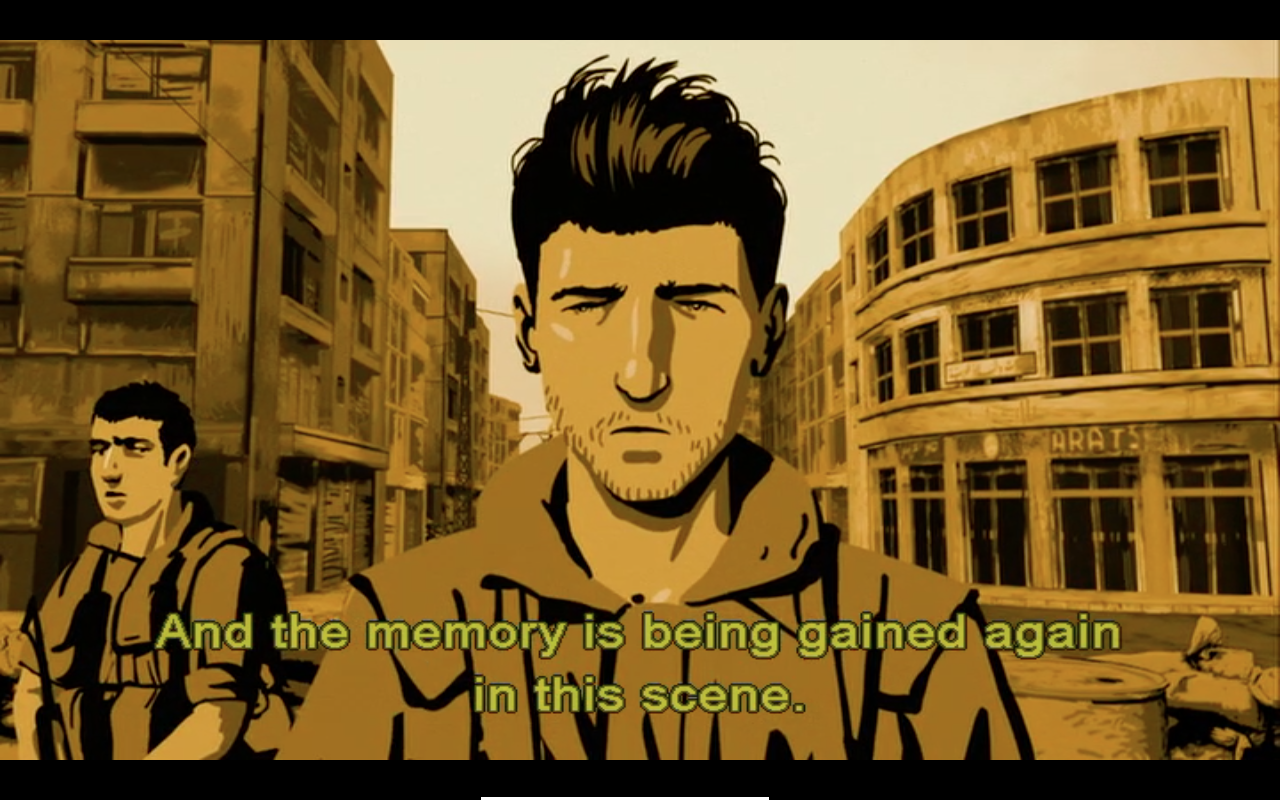
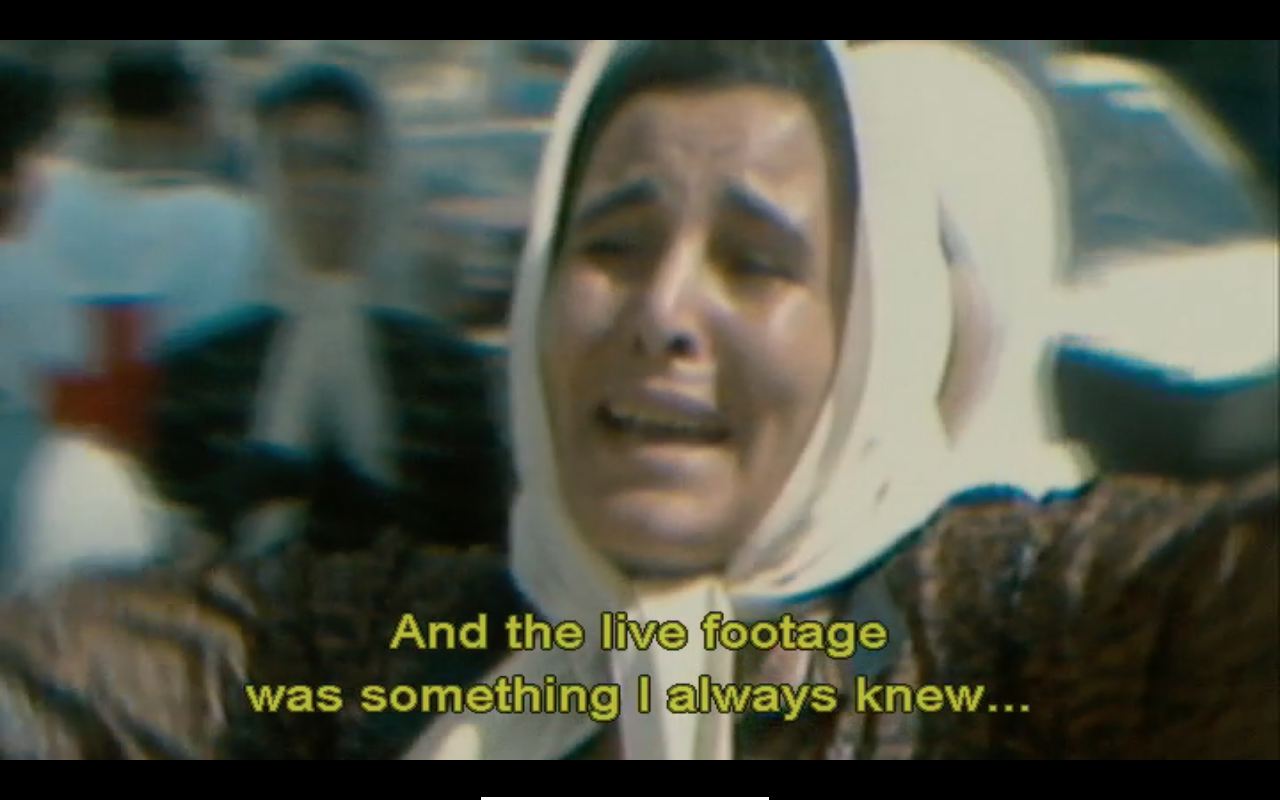
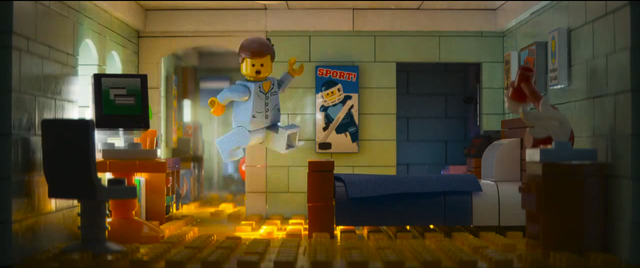
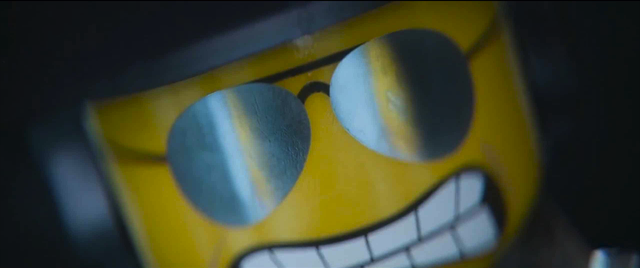
We will first focus on “Photograph and Screen” in which Stanley Cavell discusses the different “realities” and “worlds” that viewers are presented in paintings, photographs, and films. The painter chooses a world to show his audience: one that may not exist in reality and is limited by what is present on the canvas. Photographs, on the other hand, are strictly images of the world. So, any question the viewer might have about what is obstructed in the frame or what lies outside the frame have definite answers. Cavell claims that the “implied presence of the rest of the world and its explicit rejection, are as essential in the experience of a photograph as what it explicitly presents,” (Cavell, 24). What do you make of this claim?
by Isabella SAIC ENG 1005-14: First-Year Seminar II Avant-Garde Film and Video Art Spring 2017
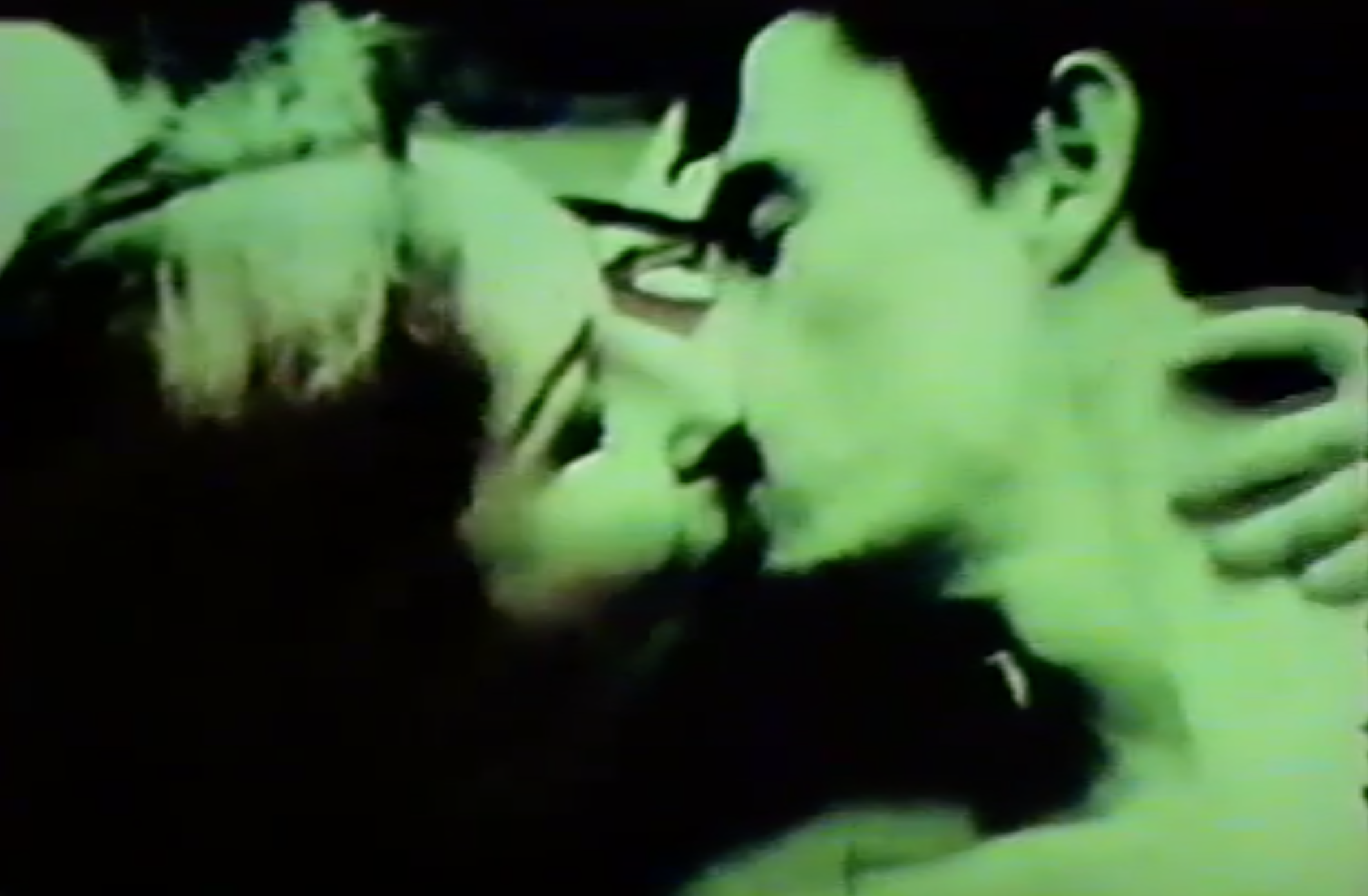
When discussing any piece of art it is very likely that the artist will become a part of the conversation. However, many artists do not wish this upon the viewer. The artist as a not to be acknowledged entity has been around long before avant-garde cinema. The male-dominated realm of avant-garde cinema participates in this trope and wishes for the work to speak for itself. However, when it comes to Carolee Schneemann you will find she comes attached with her work. In Fuses, her first of three films created in 1967, Schneemann inserts herself physically into the film by including shots of her having sex with James Tenney. The film also consists of close shots of her vulva and his penis, shots of her cat, them kissing, as well as the outdoors. It becomes very obvious why for many people Schneemann appears too connected to her art, and for this supposed reason she was rejected from the avant-garde cinema community. Scott McDonald shares his perspective on the reason men in avant-garde cinema shied away from Fuses, “In a culture where men still tend to be trained to deny their emotions, the assumption that the making of ‘serious’ art must involve detachment implicitly promotes art produced by males” (135). McDonald makes a good point about detachment as a product of the patriarchy, however, I do not see Schneemann’s marginalization as so polite. To me, this was just an excuse for dismissing a confident woman who has chosen to provide a reality many people have lost sight of. As a result of making men uncomfortable, Fuses was unfairly cast towards the genre of pornography. This begs the question, was Schneemann’s Fuses marginalized because it was not detached from its artist or because it was made by a woman who refuses to be a prisoner of sexual standards created by men?
Once Schneemann’s film is given a chance to be interpreted it becomes clear how Fuses easily transcends pornography. McDonald explains that it gives us a healthy measurement of “sexuality” between “real lovers”, which further emphasizes the “dramatization” of sex in “commercial cinema” as well as the “male-oriented fantasies” brought to life in most pornographies (135). It is obvious that a line can be drawn between Fuses and pornography but Schneemann intends the closeness to act as a criticism. Since unhealthy standards of sexuality are constantly shoved in our faces, I think giving us a healthy perspective of sexuality is an important aspect of Fuses. Although, I do not think it was Schneemann’s intent for her viewers to use it as a measuring tool. However, in contrast to other films that incorporate unrealistic standards about sex, it is simple to see that McDonald’s intent is to highlight the real sexuality displayed in the film. This context is part of what lifts Schneemann’s film to the level of avant-garde, but it also brings to light why she was rejected. Schneemann insisted on bringing to light how the male-gaze dominates sex culture, which in turn properly exposed the men of the cinema community.
What also brings Fuses to the level of the avant-garde is how visually it looks nothing like pornography. The dust and the coloring on the film speak specifically of the artist’s hand. The acknowledgment of the artist’s presence in the editing is key to appreciating the extent to which the film is demonstrating to the viewer that sex should be individualized and not a series of performative actions. A porn focuses on nothing but the visual fantasy, they wish to play it off as a reality, not something coordinated by a director and film crew and then edited by another set of people. Schneemann is giving us her reality in the shots and in her editing. She proves to the audience that there is no outside manipulation, thus making her critique of the fake realities of sexuality displayed in cinema even more effective. If she had used someone to play her would the film lose its earnest intent in showing that sex was a “psychic and physical exploration between lovers”? (McDonald 135) To me, if she were just behind the camera directing the male and female there would be no critique. Her inclusion in the film drags in the realness that is central to the context.
What is very intriguing about Fuses is the different kinds of responses it ignited from members outside of the avant-garde cinema community. McDonald explores this a bit in his interview with Schneemann, and we are informed that the reactions varied. There was plenty of controversies, the film made some men feel a sense of “wholeness” (141), others felt let down by the lack of “real” sexuality, and one woman was empowered by the idea that no one should be telling anyone what sex needs to be or means. This woman specifically, I think addressed Schneemann’s presence in Fuses very effectively, “‘The role model in the film is the fact that the filmmaker envisions her own life, and we should see it in that way’” (141). This is what Fuses demonstrates to me, that the intimacy of the film speaks only of sincerity between the two lovers. There is nothing commanding about the film; nothing that encourages the viewer to take notes.
Schneemann displays for us her sex life in order to refer to the unhealthy sexual standards most people are accustomed to seeing in cinema. I am sure the fact that Schneemann was so integrated into her own film made the men of avant-garde film uncomfortable for reasons McDonald explained; but what caused them to dismiss Schneemann was her commitment to real sexuality and the acknowledgment of the unrealistic standards of sexuality set by men in cinema. This marginalization was of course complemented by the general discrimination women face in film.
Was Schneemann’s Fuses marginalized because it was not detached from its artist or because it was made by a woman who refuses to be a prisoner of sexual standards created by men?
If she had used someone to play her would the film lose its earnest intent in showing that sex was a “psychic and physical exploration between lovers”? (McDonald 135)
by JB SAIC ENG 1005-14: First-Year Seminar II Avant-Garde Film and Video Art Spring 2017
The avant-garde, experimental films of the late 1960s put their audience in the darkness of the theater with radical images and speculative subjects. The viewers were left to wonder “What am I watching,” “Why is this happening,” and ultimately “What went wrong?” Which is the same question that Blonde Cobra presents at the end of its duration. Naturally, we question the intentions of artists in this movement. Blonde Cobra flaunts its awareness of failure to unravel film and identity. It reminds us the world is not a spectacle easily observed but a reminder that we are cinema. We are no longer bought into the heteronormative conventions in the mainstream of Hollywood. Thus we begin to realize our position as spectator in relation to what is being viewed. In the “Introduction (to Flesh Cinema)” by Ara Osterweil, we are immersed into the ideas behind Ken Jacobs’ Blonde Cobra of embracing failure and queering the image in the corporeal turn of the avant-garde.
“Failing” is pivotal in the films of the American underground cinema. “Losing, forgetting, unmaking, undoing, unbecoming, not knowing may offer more creative, more cooperative, more surprising ways of being in the world” is what Judith Halberstam has manifested in the ‘queer art of failure.’ Osterweil introduces us to the platform in which Jack Smith performs for Jacobs’ Blonde Cobra. Described as “the worst film ever made” by critic David James, Blonde Cobra is the composite of Bob Fleischner’s parody films of Blonde Venus (1932) and Cobra Woman (1944) with the narration of a live radio. Jacobs deconstructs the fictional world that lives in cinema by taking away the image, playing the audio throughout the theater opposed to speakers behind the image. The blackout of the image, a persistent feature in the film, is the instance of what could’ve been a mistake. Rather its failures are key and used to queer cinema from heteronormative commerciality that is capitalism.
The social and cultural environment in which images like this emerged was in experimentation of music, visual arts, and performance. Artists continue to make radical film post the 1960s, and the spirit of social transgression that characterized early underground cinema lives on through works of more contemporary American filmmakers, such as Sadie Benning. She is an artist most well known for her Pixel Vision videos that give the viewer an inside look into her personal life and adolescent culture with a mix of music, extreme close up shots of her face and jumping narratives that highlight her suffering through, similar to a diary.
Living Inside explores the family dynamics and short moments of adolescent stream of consciousness. Benning faces rejection of her peers, feelings toward school and family and very irrelevant topics that break up the narrative such as “i got a pimple,” “my dog like dog food,” and “I know lots of people that like ham.” These fragments of personal thoughts are interrupted by cuts and the noise present from the analog medium of the Fischer-Price Pixel Vision she taped films on.
Questions for the class:
How do Sadie Benning’s videos relate to the images seen in the American Avant-Garde of the 1960s? Do they fail?
Can you think of any forms of failure seen in contemporary media and images?
Even though the intentions of these films were to fail, fuck up, be ugly- are they bad? Can we get past taste to appreciate films like this?
by Heather
University of Chicago CMST 10100, Intro to Film
Spring 2015
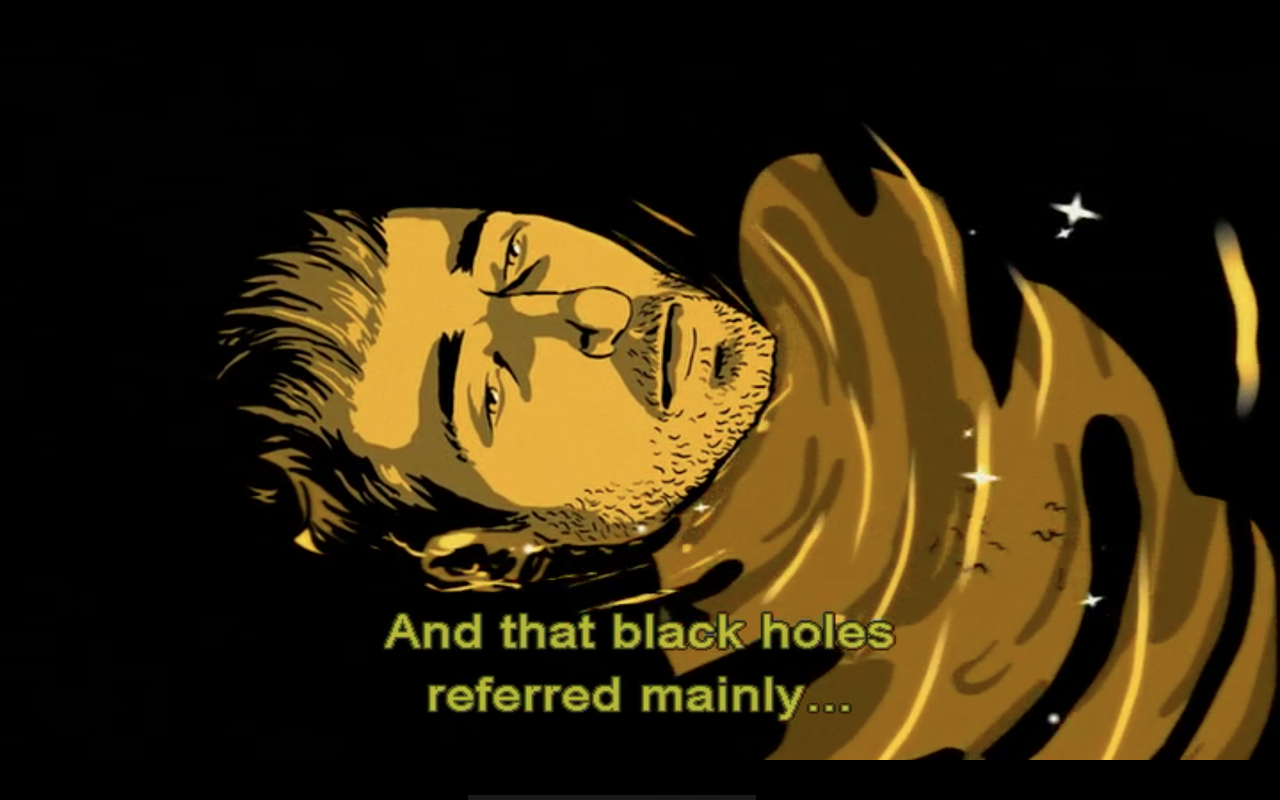
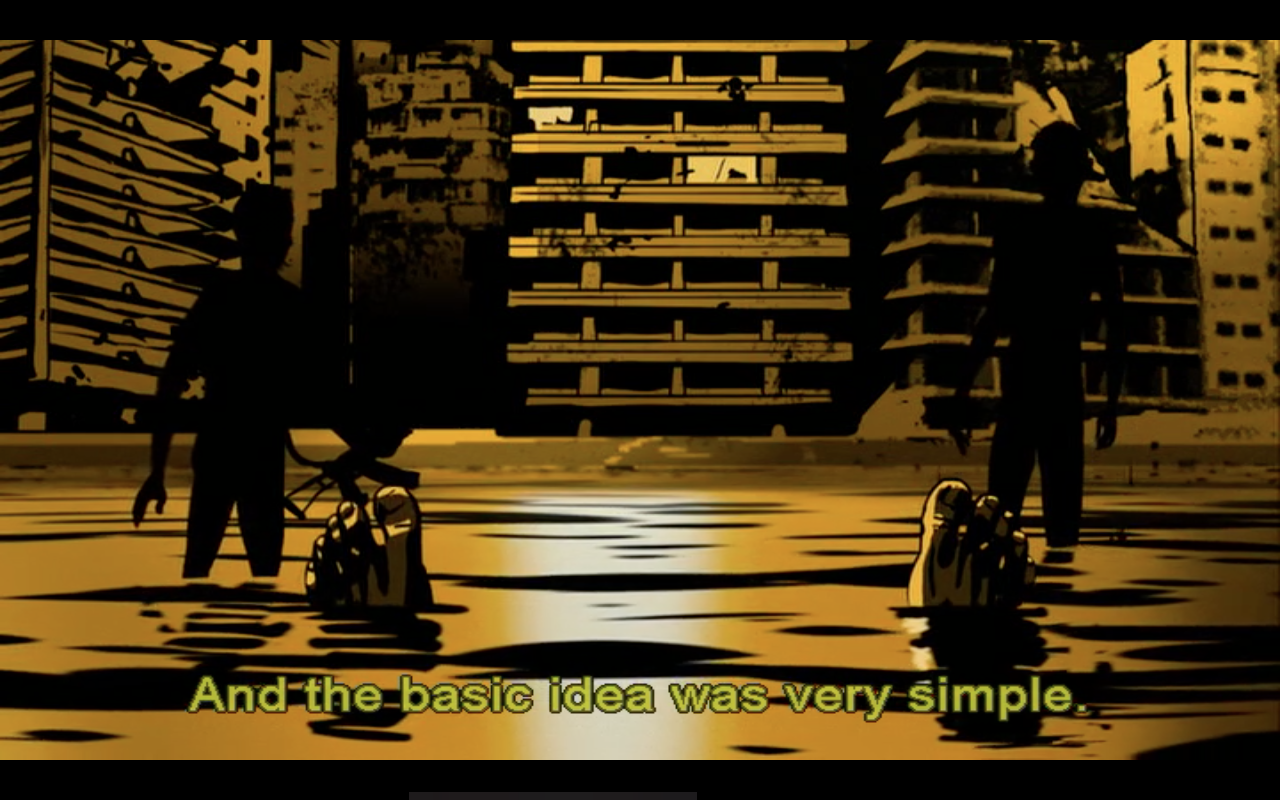
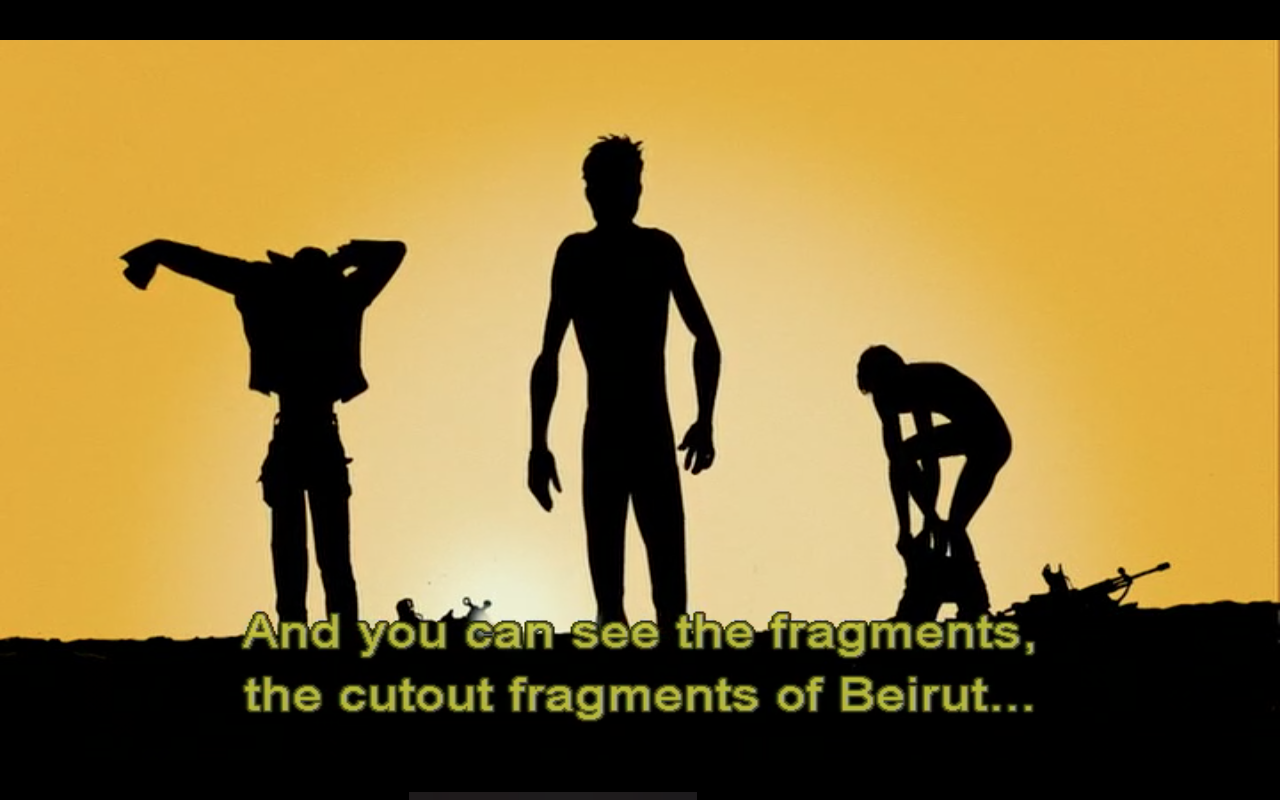
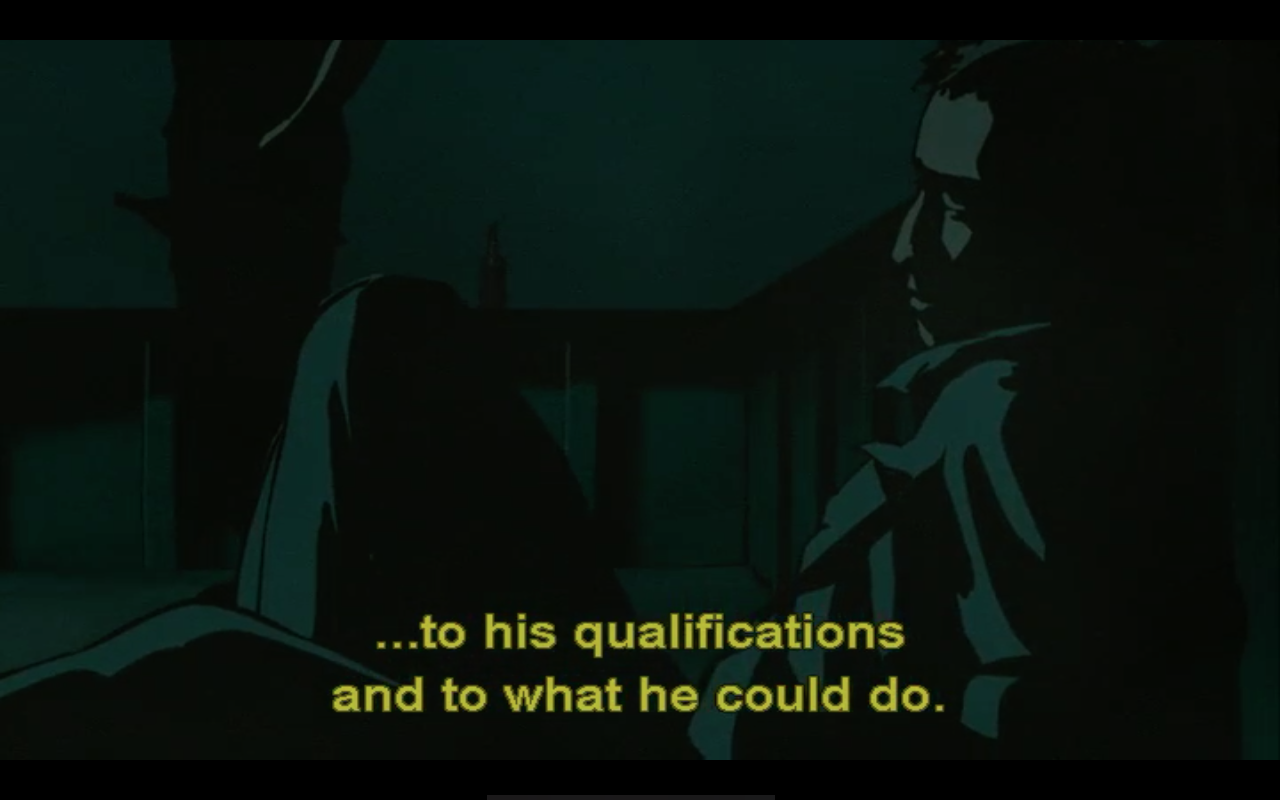
As the first ever feature-length animated documentary, Waltz with Bashir (2008) recounts director Ari Folman’s quest to uncover his memories of the role he played 20 years prior in the 1982 Lebanon War. Plagued by his inability to recall any of the events from the time he spent as an Israeli soldier, Folman enlists the help of his old military friends to discover the truth. During his journey, he faces many obstacles that take a toll on his mental state (primarily his memory). Aside from these narrative setbacks, the movie grapples with some greater problems that come in the form of binaries: between the real and the surreal, truth and fabrication, and guilt and innocence. Throughout the film, Waltz with Bashir walks a fine line, dancing back and forth between these conflicting themes. However, the message ultimately becomes clear that the correct path lies in reality, truth and acceptance of one’s own guilt, and the film – in its creation, script, mise en scene, and overall artistic aesthetic – serves as an analogous representation that enhances this viewpoint.
The three main binaries in this film are all interwoven, yet function in distinctive ways. The real versus surreal binary contrasts the events that occurred in real life to the idealized version of reality displayed in the movie, since the latter manages to mask many of the horrors of war through its medium of animation. Instead of using more live footage or making a documentary composed solely of found materials, Folman makes the cinematic choice to romanticize events and blur the distinction between facts and imagination by creating a visual consistency for both reality and fantasy.
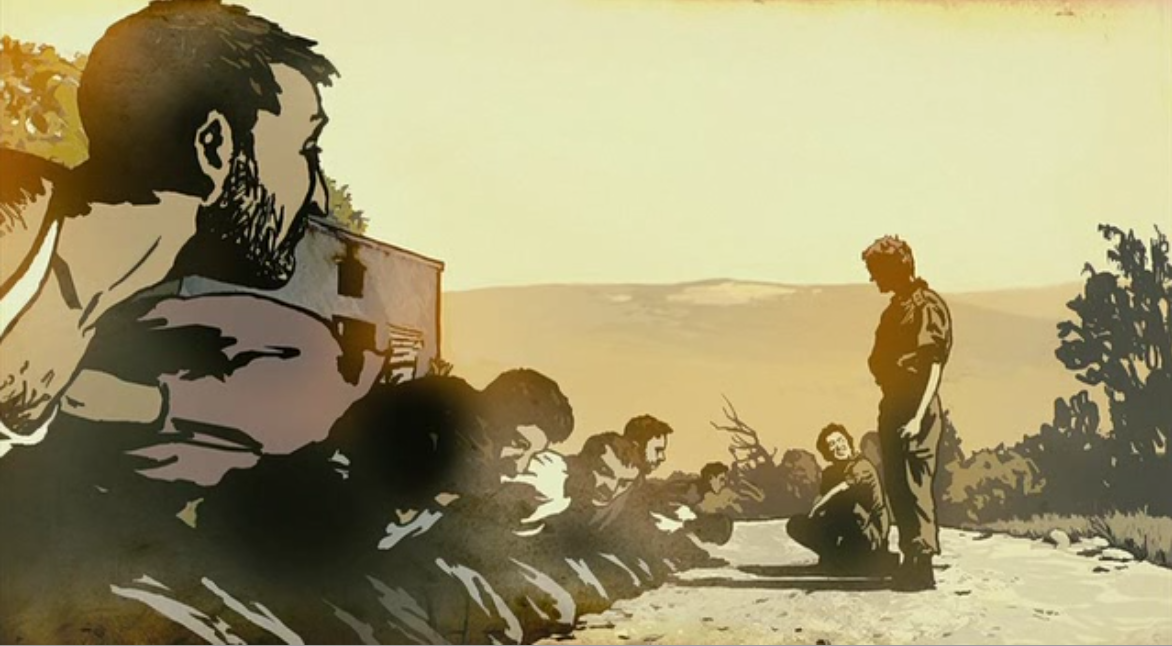
These stills are manifestations of dreams and hallucinations, but they match other aspects of the film that are supposed to represent real events, in terms of visual style. The only noticeable difference is in color – whereas actual events are not restricted in hue, dream sequences, hallucinations, and other non-real instances are rendered monochromatic. This artistic decision thus creates the basis of the problem that the characters and viewers must face: of distinguishing between dream and reality and choosing which realm to live in. At first, it seems like Ari Folman picks the surreal, denying himself of the truth about his experience in the war; however, as the movie progresses and his fabricated memories are pieced together into something intelligible, he pulls himself out of the dream world and into a livable reality.
The second binary, between truth and fabrication, helps solve the aforementioned problem. The fact that this movie is animated raises questions to its validity, giving it a different function from traditional documentaries, which would normally convince us of its veracity. The viewer’s inclination to not trust a form that is crafted by one’s hand urges us to assume that the content in this film should not be so easily believed. Even if it may be harsh or uncomfortable to confront, it seems like Folman is making a grander statement about the importance of searching for truth, since it is rarely as simple as we would like it to be.
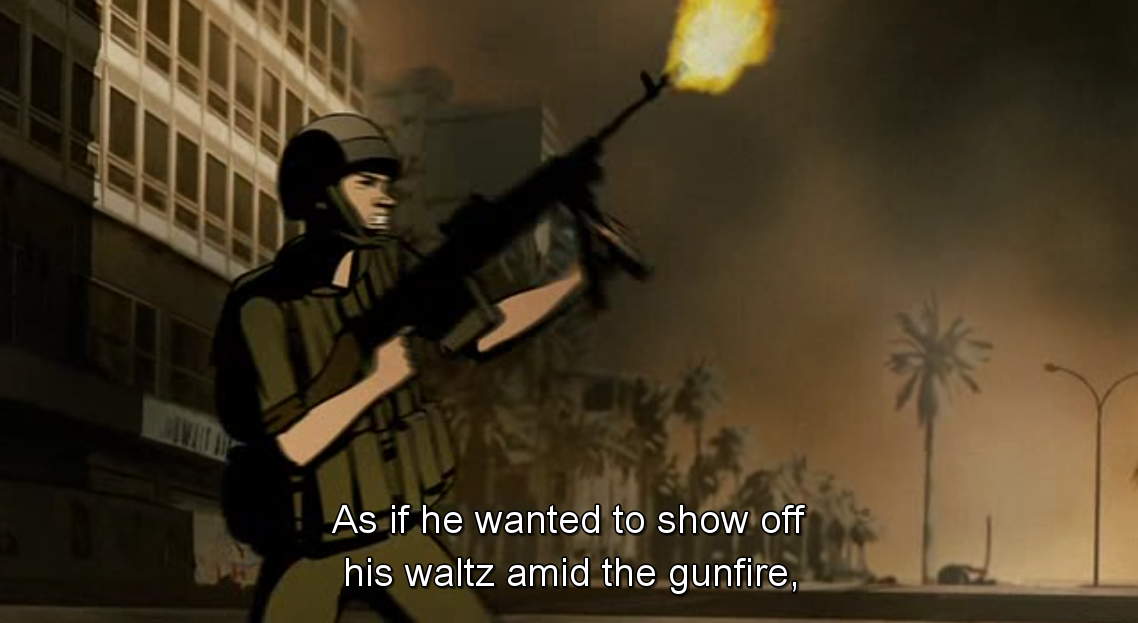
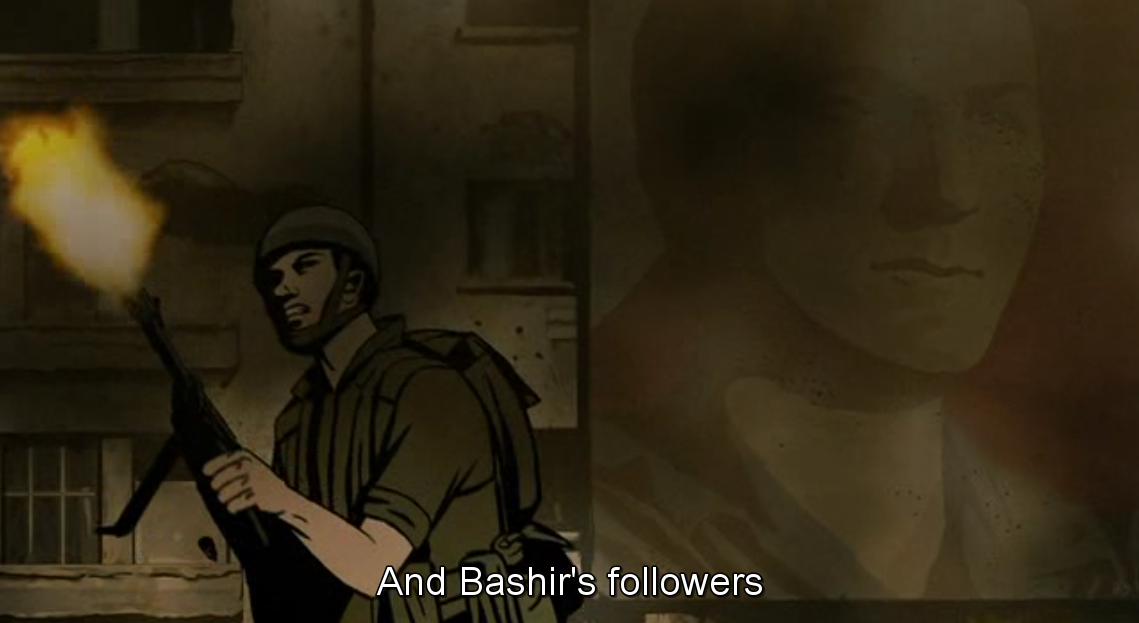
For example, these two stills depicting Frenkel in a waltz-like trance provide rich imagery and help readers make sense of the title of the movie, since the waltz is both literal and figurative. Primarily, it describes the actual “dance” performed by Frenkel, but it also refers to the tactful Israeli relationship with Lebanese president Bashir Gemayel during the war. This latter interpretation is particularly evident in the second still frame where Frenkel is placed alongside Bashir because both take up half of the frame compositionally, further suggesting the double meaning of the word “waltz.” Even though this is a documentary based on real interviews and historical facts, the biased, artistic hand of the animator guides the viewer to see events in a rose-tinted lens. This effect is significant because the film pushes boundaries by challenging traditional notions and by playing with our expectations, making us realize that the truth is hardly ever obvious or clear-cut, but is rather shrouded by metaphors.
Finally, the guilt and innocence binary exists in the script and narrative aspect of the film, as Folman tries to understand why he has blocked out his memories of war and brutality. The entire movie is a journey of Folman coming to terms with his actions from 20 years ago and attempting to find a way to live with what he has done. The text in this film is extremely powerful, and while some moments are didactic, others are just strikingly powerful and profound. This narrative serves to provide viewers with the message to accept responsibility for one’s guilt.
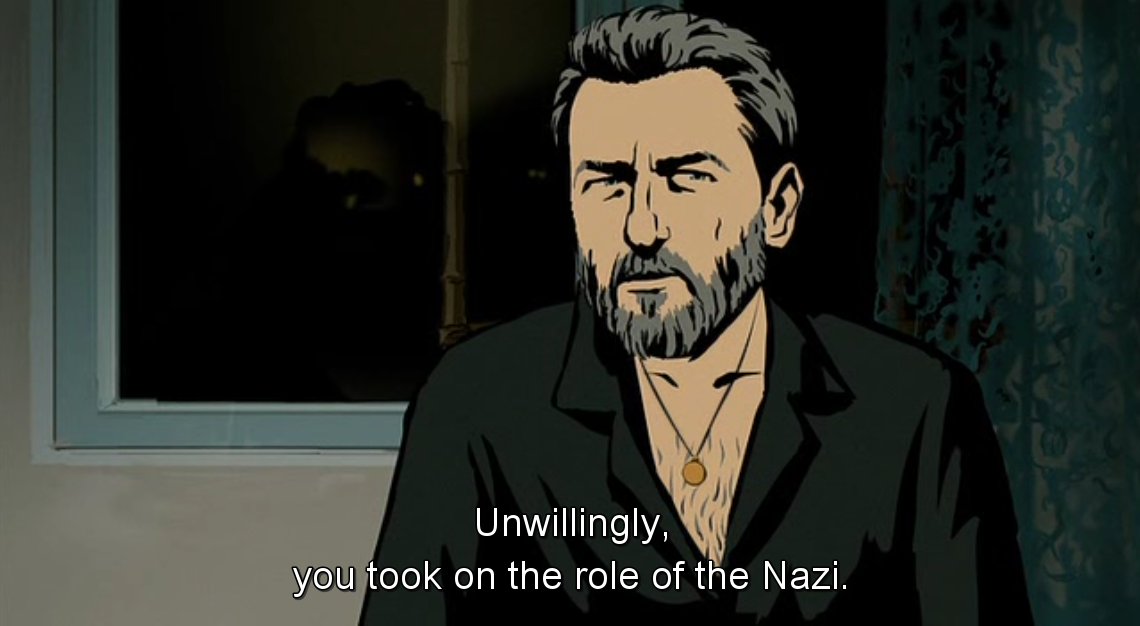
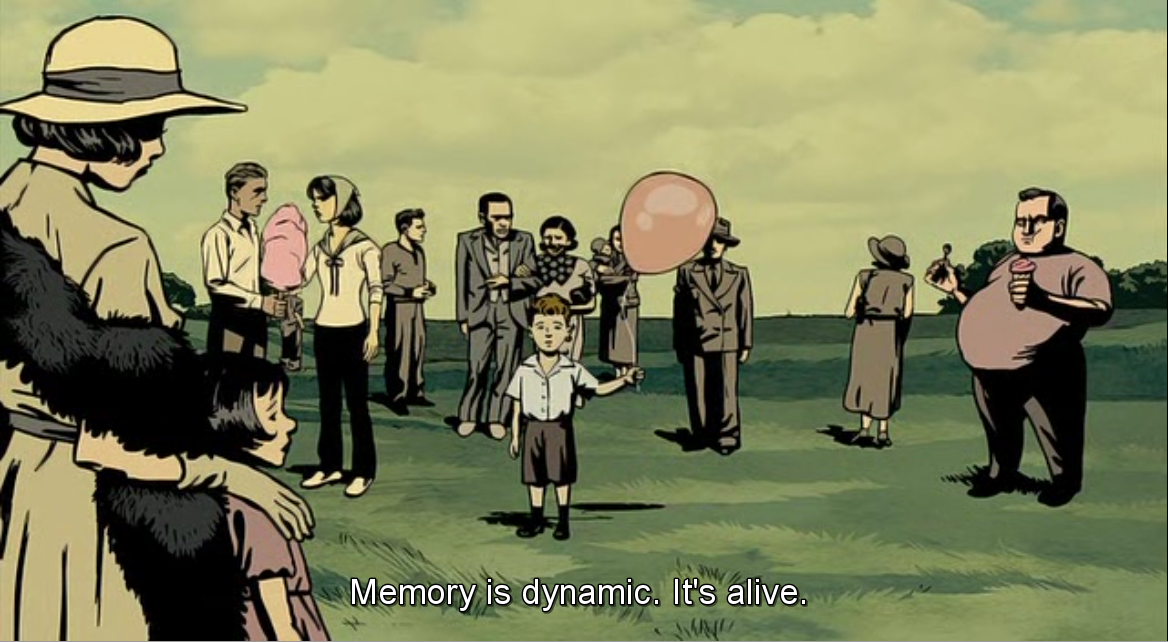
Some of the most insightful scenes are those involving Folman’s therapist, who acts as a moral compass and philosopher for the human psyche. In saying that Folman “unwillingly took on the role of the Nazi,” the therapist implies that Folman suppressed his memories to distance himself from this feeling of shame and guilt. However, he argues that the deaths of the Palestinians, especially at Sabra and Shatila, were not Folman’s fault, and that Folman “only lit fires” because he didn’t know any better. The subsequent still, which shows a constructed memory, uses edifying language to help Folman further deal with his past. The therapist says here that “memory is dynamic. It’s alive.” The juxtaposition between the grown up Folman and the young child (who can also be viewed as the younger Folman who fought the war) draws a parallel between the innocent and guilty binary – the child as the innocent one who constructs memories based on what other people tell him, and the adult as the failed product of those lies. It is evident from these psychological teachings that it is important to remember one’s past, even if it is full of pain, because the alternative only leads to more problems and haunting questions that may never get answered.
There is one particular moment in the film that captures all three binaries in a seamless way that is not only successful, but also takes advantage of film techniques to accomplish this task. In the specific scene from 41:55 to 43:55, Folman visits another therapist, Prof. Solomon, who tells him about an old patient of hers who had used a camera to document the atrocities of the war. However, when his camera broke, he fell apart mentally and emotionally as well because he had been using that camera as a mechanism for dissociation; sadly, “once pulled into the events, he could no longer deny reality.” The idea of the real vs. the surreal is emphasized here, as the shots change in color and lighting when transitioning from the therapist’s office to the montage of the photographs, which represent the romanticized and dreamlike nature of the war.
While the real world is depicted in a very neutral and unsaturated color scheme, the photograph, in contrast, is highly saturated, with lighter white spots near the edges of the frame that make the image seem more like a hazy dream.
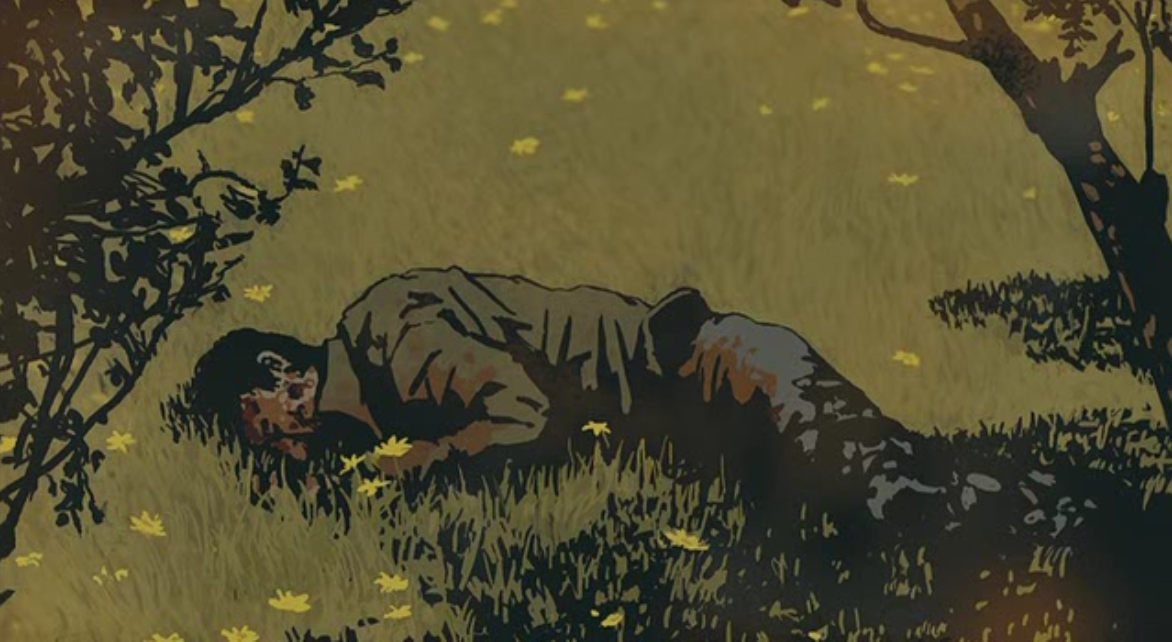
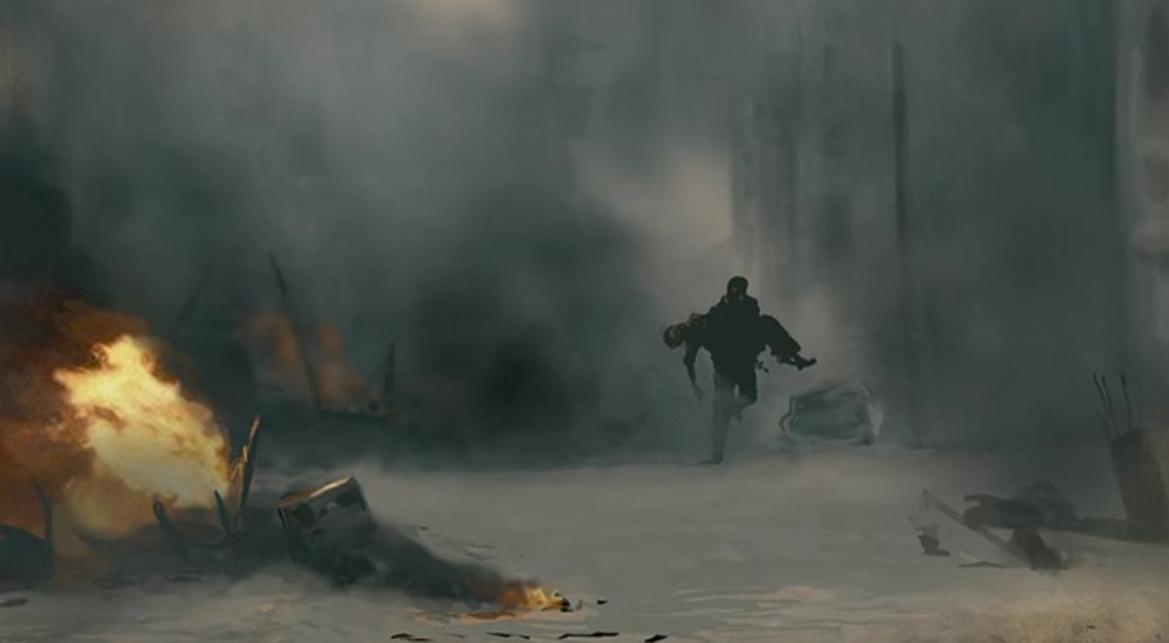
The montage sequence from 42:31 to 42:49 is interesting because these photographs distort reality in a way that beautifies and idealizes true events. This collection of 8 shots each display a gold-coated version of the truth and show how living in denial under surrealist fantasies can actually cause more harm than good. Although it can serve as a quick fix to allow people to cope with their stress, it is not a long-term solution to one’s problems.
These two shots are examples of some of the images in the montage, and they are considered beautiful, rather than gory because of the mise en scene. In the image of the dead soldier, vivid yellow flowers surround the corpse, somehow lightening the intensity of this photograph. The frame of the leaves and trees also provide an ornateness that beautify rather than traumatize. Meanwhile, in the second shot, the fire is dramatized and the soldier in the background looks like a hero, carrying a wounded mate out of the smoky haze. There is also a brightness, like a halo, just around the figure that makes his survival seem more hopeful. Both of these shots are perfect examples of how an art form can distort reality to seem less truthful, which is ironically what the film accomplishes by being an animation itself. These shots also create a stark contrast between the neutrality of the therapist’s office, which represents reality, and the colorful, dramatized nature of the photographs, which represent surrealism.
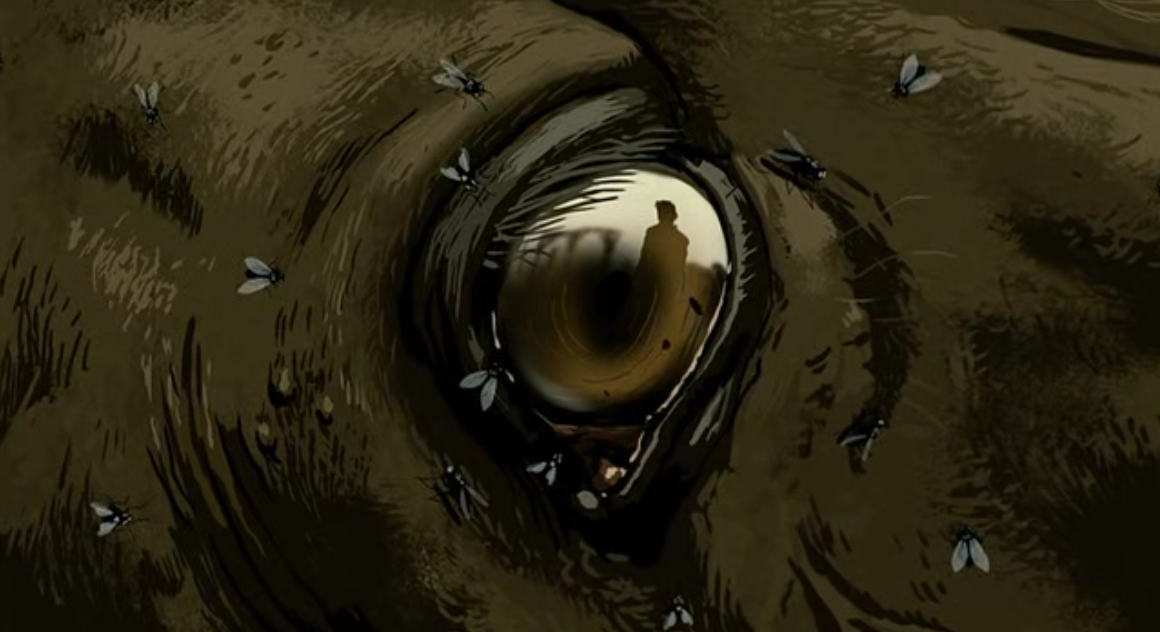
The most intriguing part of this scene, however, is the last shot, from 43:48 to 43:55. It is one of the most unforgettable and harrowing parts of the film, as we are given an extreme close up shot of a horse’s eye as it slowly dies. Even more interesting is the reflection of the man who passively watches this tragic death happen but does nothing to try to help. The flies surrounding the face and the wateriness of the eye make it seem like the horse is about to cry, personifying it and giving it humanlike qualities. We see an innocent animal suffer, while the perpetrators of such ghastly horror and tragedy stand idly by. The dichotomy between master and slave, guilt and innocence, powerful and weak are all present here, and in this hopeless shot, we cannot help but feel a social and moral responsibility to own up to our actions in order to prevent further innocents or civilians from dying in a battle that’s not even worth fighting.
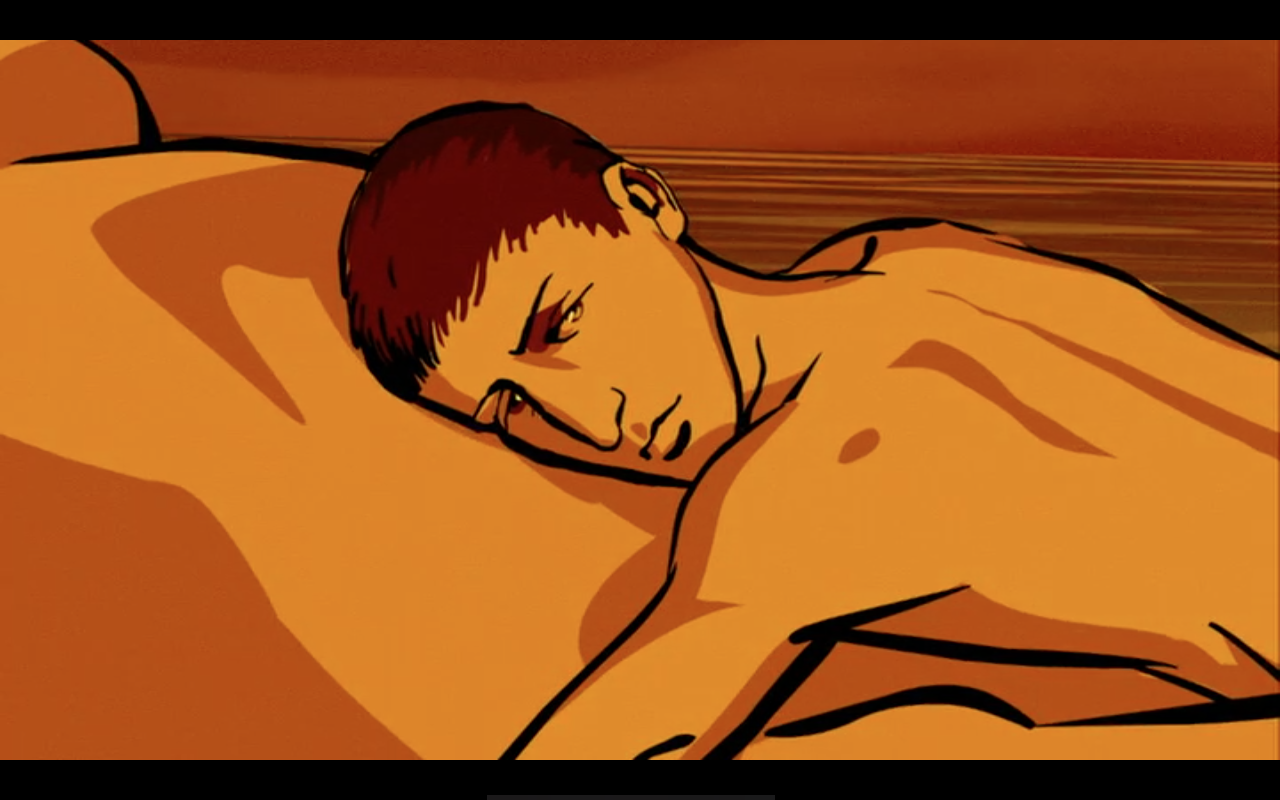
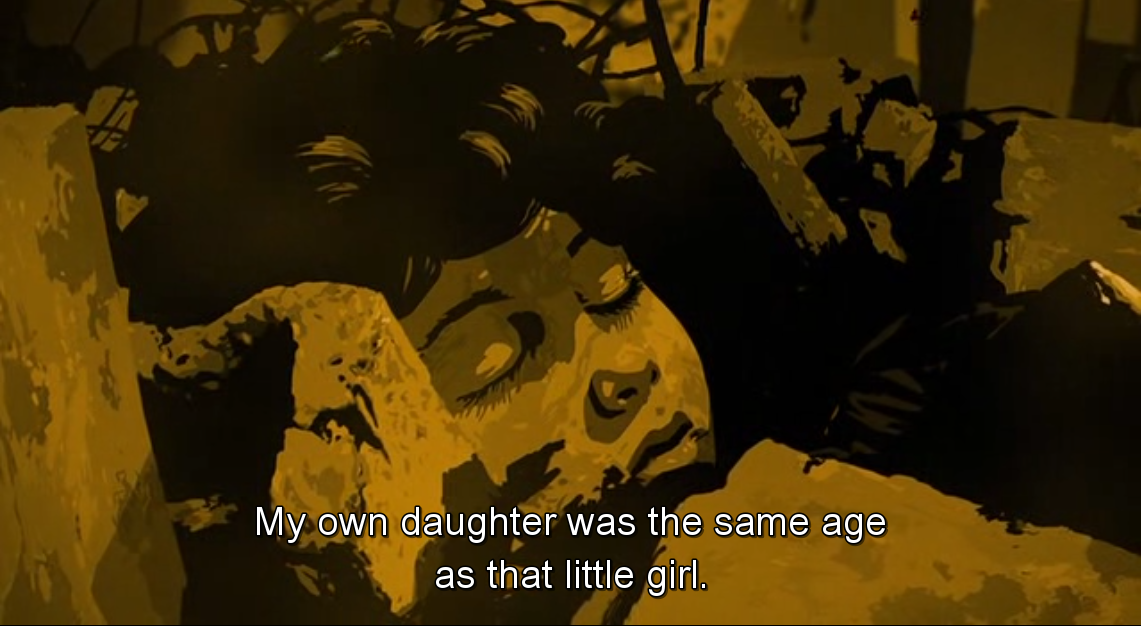
One of the last scenes in the entire movie depicts a similar shot, in which a young girl is found dead among the rubble in the aftermath of the Sabra and Shatila massacre. A familiar circle of flies swarm around her face, but in this particular shot, her eyes are closed, and we are given a full view of her head. The monochromatic orange, which was previously used to portray Folman’s “rising from the ocean” dream, is used here, and we as viewers are tempted to believe that this death is just a dream, too: it’s not real. However, the movie, once again, fools viewers of their expectations and shows that color cannot be expected to play one constant role.
In conclusion, Waltz with Bashir is an extremely convoluted, amazingly constructed film that explores the complexity and the psychology of the human mind through three binaries, and demonstrates that very intricacy in the cinematic techniques and editing choices. In a short 90 minutes, the film makes the viewers feel the same sensation of yearning for truth that Ari Folman feels, which is what triggers him to make this documentary. Through this immersive and almost interactive journey, we learn, as Folman does, that people must face their demons, take responsibility for their actions, and live in the real world, for living in a dream doesn’t mean you won’t get any nightmares.
by Sherlock University of Chicago CMST 10100, Intro to Film Spring 2015
Wong Kar-wei’s In the Mood For Love depicts the story of a man (Chow) and a woman (Su) who, both suspecting that their spouses are involved in extramarital affairs, become close companions to each other in their loneliness. As the story progresses, however, their platonic friendship spills over and they begin to fall in love.
Their story unfolds in carefully controlled sequences that are almost dreamlike in nature as, together, they fabricate a fantasy world for themselves in which they pretend to be in love as their spouses are – and then continue, even when the façade of romantic affection becomes a reality. One of the most obvious visual cues in the mise-en-scène that indicate the portrayal of these moments is in the lighting. In all of these sequences, the lighting is more dramatic: it is low-key, sharp, and almost always artificial, as these scenes overwhelmingly take place under cover of night. This type of lighting is fundamental in setting the mood in these sequences; the subtle expression of emotion and the tension of physical bodies is highlighted, literally, by its use.
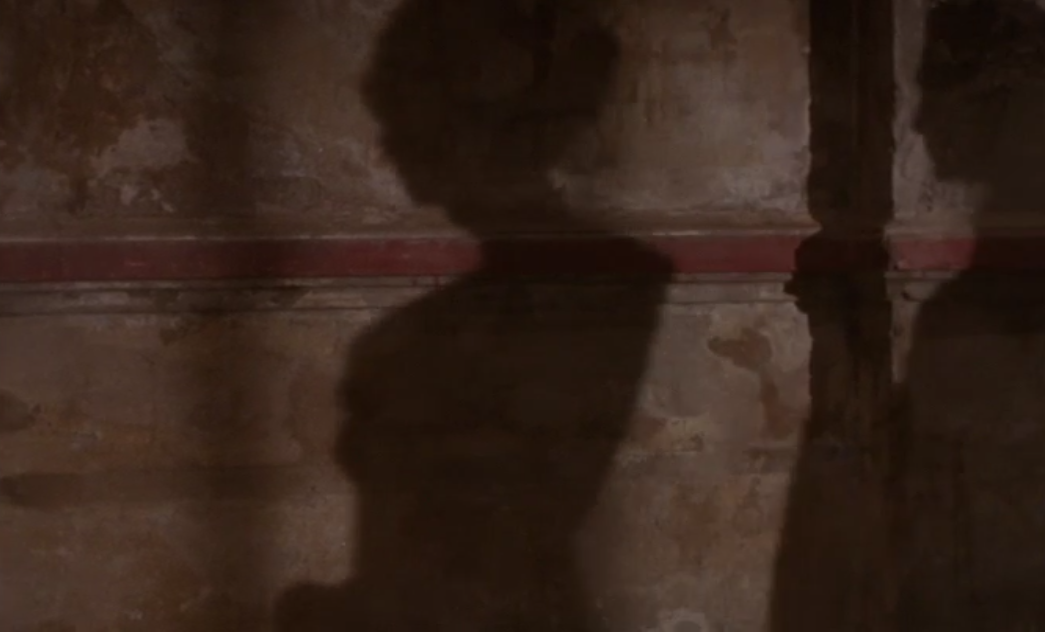
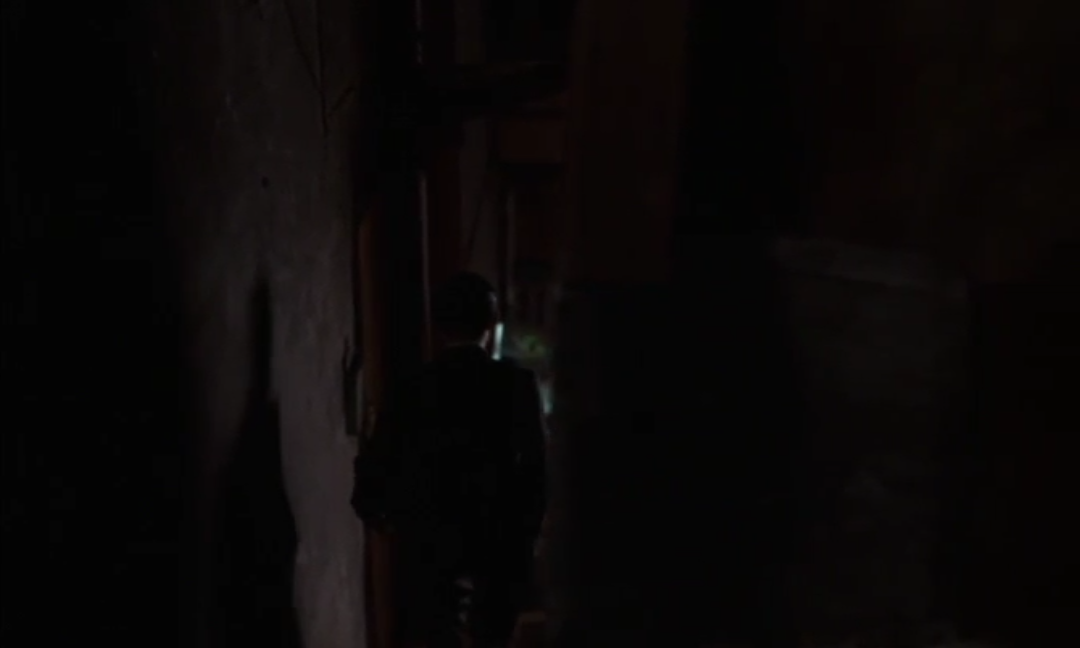
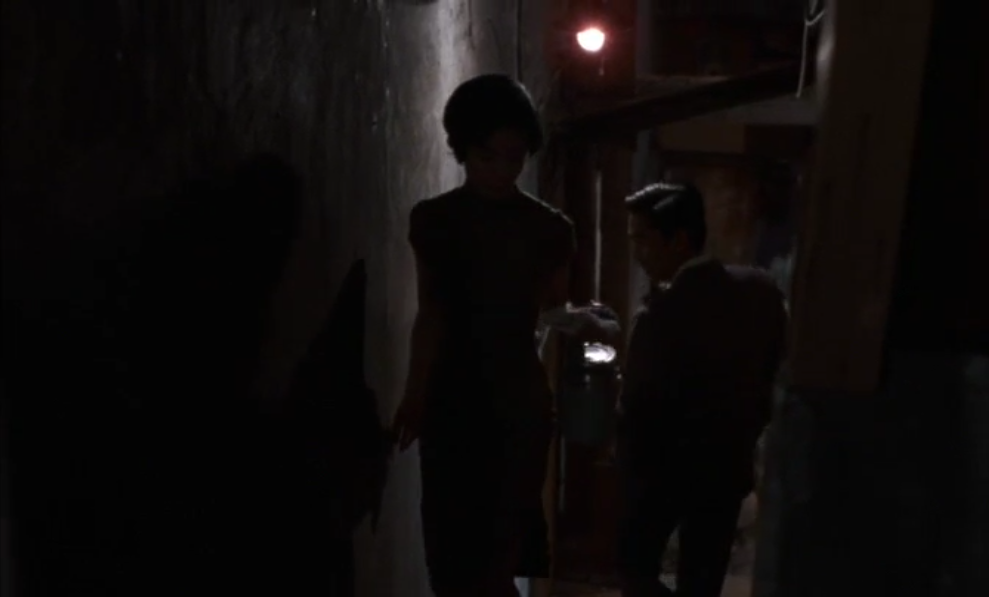
The first major sequence of this nature occurs before their relationship has strictly started but after they are both aware of each other. In this sequence, first Su and then Chow go out to get noodles. The entire scene appears in slow-motion, and the lighting is intensely more dramatic than perhaps any other scene in the film up to this point. It takes place at night, so the only light comes from street lamps; overwhelmingly the world is dominated by shadow. As both characters go up and down the stairs to the noodle stall, we see both their physical figures, in sharp silhouette, and their shadows, on the wall descending with them; this adds an air of intrigue and, it could be even said, mystery to the scene. In this world of shadows, without the light of day, everything is a little more uncertain; the shadows serve as a lingering presence of the characters even when they themselves are no longer visible in the frame, and that presence is tense, tangible, fleeting.
In the sequence we see first Su as she goes down and up the stairs –
and then later Chow –
And then, at the culmination of the sequence, we see them both on the stairs at once, meeting as Su ascends and Chow descends, and the tension of both of them at once in a space previously inhabited by just one of them is heightened still more by the lighting, and the fact that we can essentially only see the outline of their frames in silhouette – close, almost touching, like two shadows meshing together on the same expanse of wall. We become, in this fleeting moment, hyper-aware of the possibility of contact, of their silhouetted bodies touching. In the world of shadow, they are the only things moving – dark forms, graced by light.
A second sequence occurs a few minutes later, again with them going to the noodle stand. This scene is similarly lit in artificial, sharp lighting, and similarly serves to heighten dramatic tension.
Here are two still frames of first Chow and then Su from the same sequence:
The lighting on Su’s face is sharper and a little brighter, but the lighting on Chow is still sharp enough that his face, hand, cigarette, and collar pop most, and everything else recedes into shadow; similarly, Su’s profile is what pops most immediately in the second frame. It is also interesting to note that their profiles mirror one another.
The next sequence in their constructed reality is the most direct one thus far, by far – they dine together in a restaurant. In this scene, dominated by middle shots and close-ups, the lighting is again artificial and sharp, coming primarily from the point source of a single lamp hanging over their table at the restaurant. It beautifully highlights their faces, capturing subtle, subtle expressions of emotion, minute twitches of facial muscle, fluttering eyelashes, stuttered breath. It also works wonders for capturing Chow’s cigarette smoke.
This sequence, like most of the other sequences of their constructed reality in the film, feels almost noir with its air of dramatically-lit, subtle intrigue. Chow’s smoking adds to this; it feels suave, sexy, backlit and tinged with the dark, rich red of the seats around them – but if this scene were lit differently the effect would be entirely different. It is the sharp lighting that creates such a powerful atmosphere of mystery, tension, and drama.
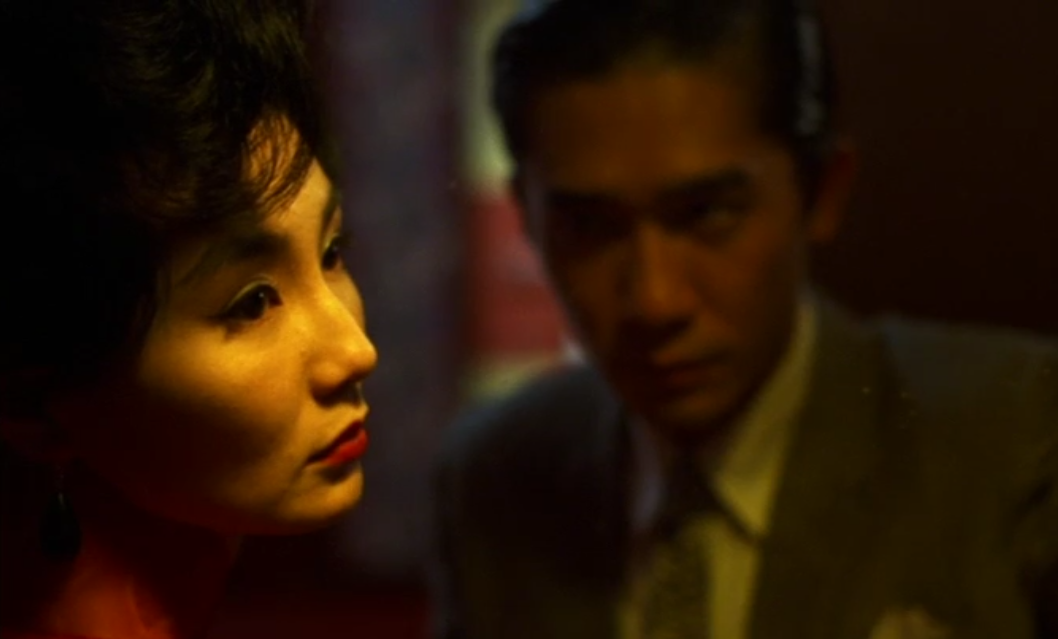
The next sequence of this kind begins with this frame:
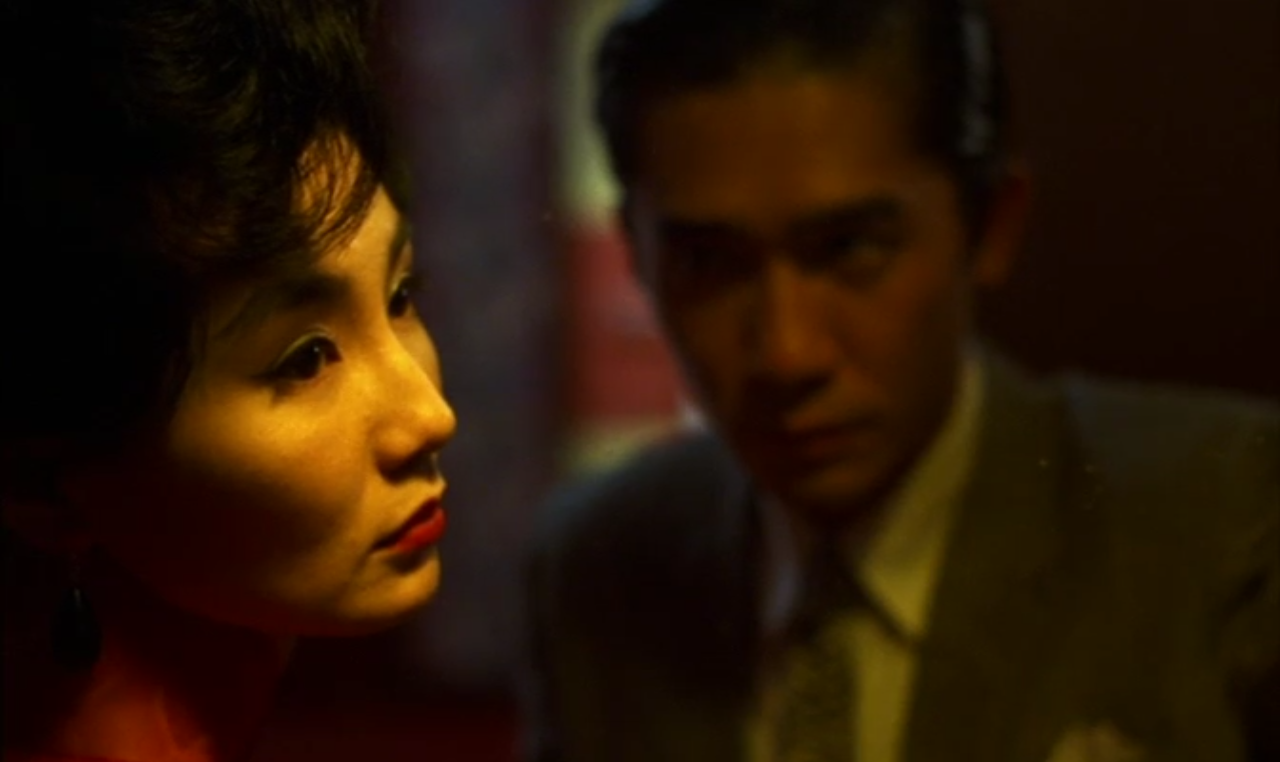
Everything about this shot is utterly stunning. The light on Su’s face is perhaps the most dramatic in the entire film: bright, sharp, highlighting the shadows under her cheekbones and her winged eyeliner, and also very artificially coloured, almost golden, making her lipstick look brighter and her features more defined. Chow is behind her, in a different depth of field; still, we can tell that his gaze is on her, and the resultant tension is incredible. (If there was a visual climax of the film, I would say it’s right here: this moment, more than any, captures the drama, the tension, the subtle intrigue, the possibility of hidden feeling, the hint of passion – and visually, it is incredibly beautiful.)
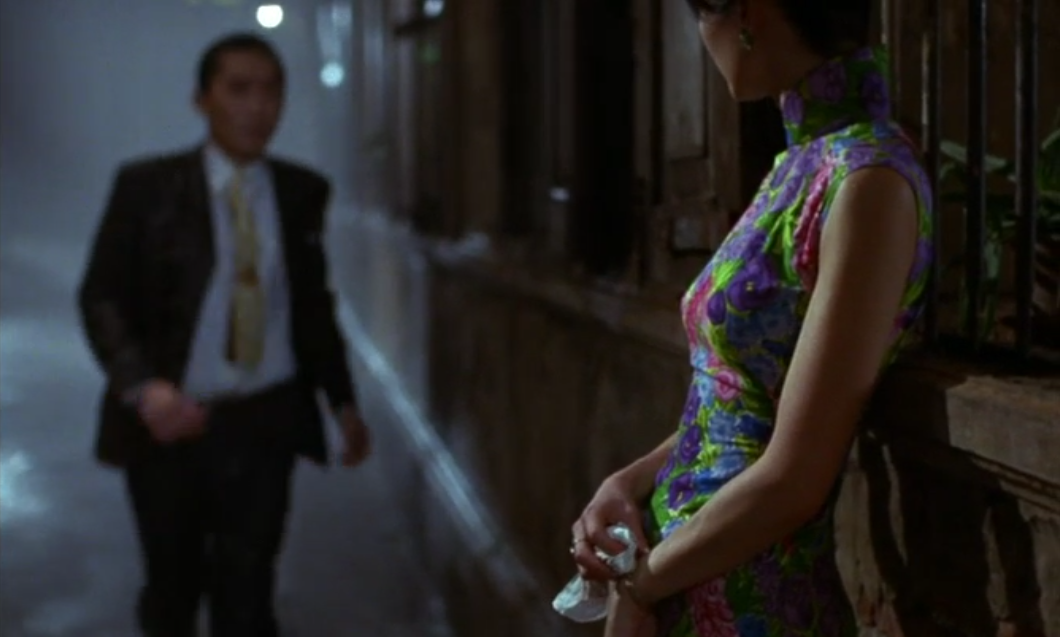
Later, a scene between them betrays a slightly different feeling, but still heightened by the effects of lighting. In this scene they are in the rain, having a conversation about the beginnings of their relationship. This sequence is less cinematically dramatic; singularly, there is no music playing, and they are holding a regular conversation instead of moving in slow-motion like two shadows on the verge of touching. It begins with Chow running towards Su in the rain, in an echo of an earlier scene:
The two proceed to have perhaps the most honest conversation that takes place over the course of the entire duration of the film. Here we see their fantasy reality of romance being acknowledged directly – a break from tradition – but lighting still serves to heighten the sense of tension and emotion in the scene.
The light is a dull colour, a soft blue or grey, and more diffuse than it has been previously. In many ways it’s a visual cue that this scene, that the events transpiring between them now, are different than they have been in the past. It is still dark enough that it could be night and there is still sharp lighting on their faces from a streetlight somewhere – but the shadows are no longer as deep, as the barriers between their pretended reality and actual reality break down.
A final scene between them shows them saying good-bye to one another for a final time – or, as we later realise, rehearsing saying good-bye.
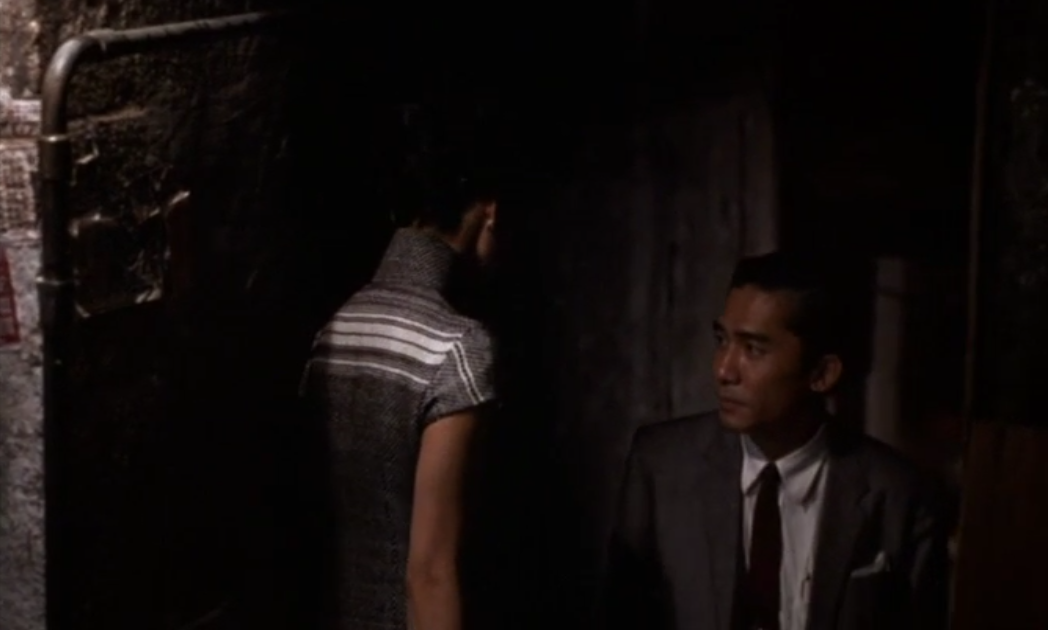
Here the light is once again very dramatic in its sharpness and the dramatic and physical tension it provides. The above frame is particularly poignant because of the shadows present. The single thrown by Chow is lonely and stark against the wall, and also carries narrative significance because it is alone, not accompanied by Su’s shadow – as they are parting. But what is perhaps even more poignant is the shadows of bars that are cast over the characters, because they can be read to have a metaphorical significance: bound by societal convention and scrutiny of neighbours – imprisoned by convention and expectation – Su and Chow must always be secretive and must now even say good-bye (or prepare to) in secrecy.
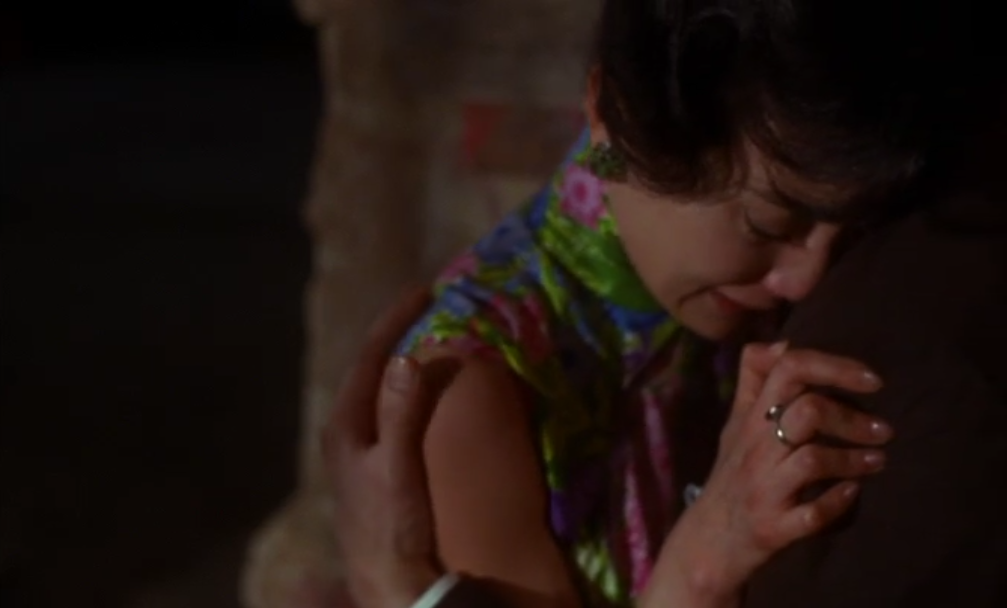
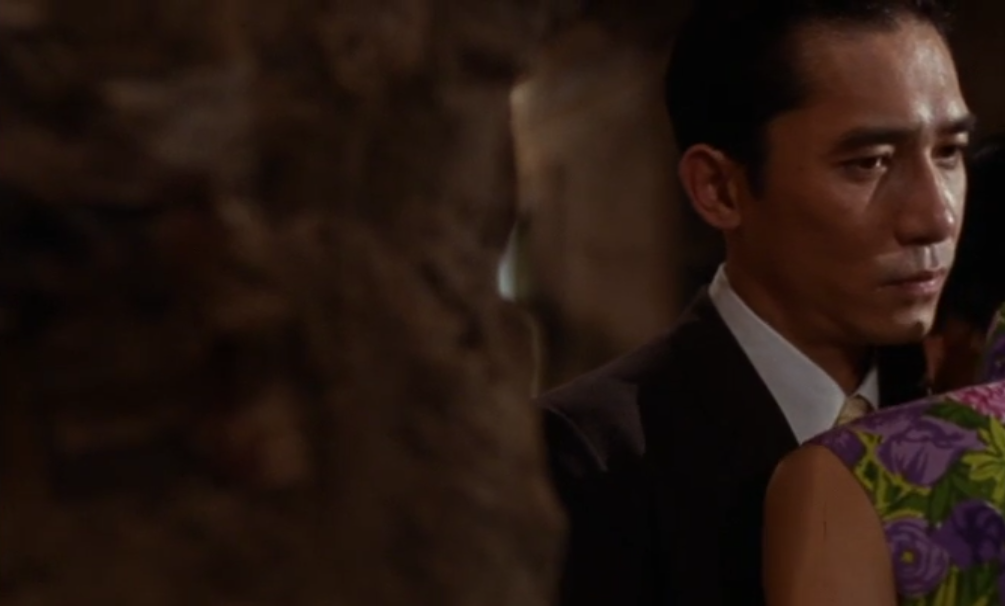
The illusion dissolves in the next moments of the scene as we realise that this good-bye was only a rehearsal – but the lighting remains the same. In this part of the scene it serves to heighten the emotional distress of the characters, as Su weeps in Chow’s arms. They are in a closer embrace than we have ever seen them in before, so much of the physical tension is (finally!) abated, but the emotional intensity remains. Su finally dissolves, in the first time we have seen her lose composure so openly, and Chow, in contrast, visibly struggles to remain stoic.
In conclusion, the lighting in the sequences that catalogue the progression of Su and Chow’s relationship is cleverly used to heighten dramatic, narrative, and physical tension; it highlights undercurrents of uncertainty, hesitation, and occasionally sensuality that emotionally charge their interactions, and it allows us as viewers to better see the subtle expressivity of their faces. With this lighting, the tangibility of their interactions becomes at once more fleeting and more real; more satisfying and more infuriating: in these moments of touching or almost touching, the light throws everything into sharp contrast, into a dreamlike world of sharp light and slow, lurking shadow – a murky world in which one can easily fall in love in the shadows and under streetlamps – but also a world in which even silhouettes cast shadows, and the consequences of such actions cannot remain hidden forever.
by Julia University of Chicago CMST 10100, Intro to Film Spring 2015
Jacques Tati often liked to say that the only real star of his film Playtime (1967) was the set itself. With his brilliant manipulation of its mise en scène, those words hold to be quite true. The minimally dialogued, loosely plot-based film is mainly structured around the changing of settings. As the movie goes on, an apparent pattern emerges among the scenery—it almost entirely consists of grey, pristine buildings, from the steely Orly Airport to the shiny new Royal Garden restaurant. Tati establishes this foundation in order to build up and play with the dichotomy of public and private space. Throughout the film, he juxtaposes these two ideas and questions the boundary that divides them.
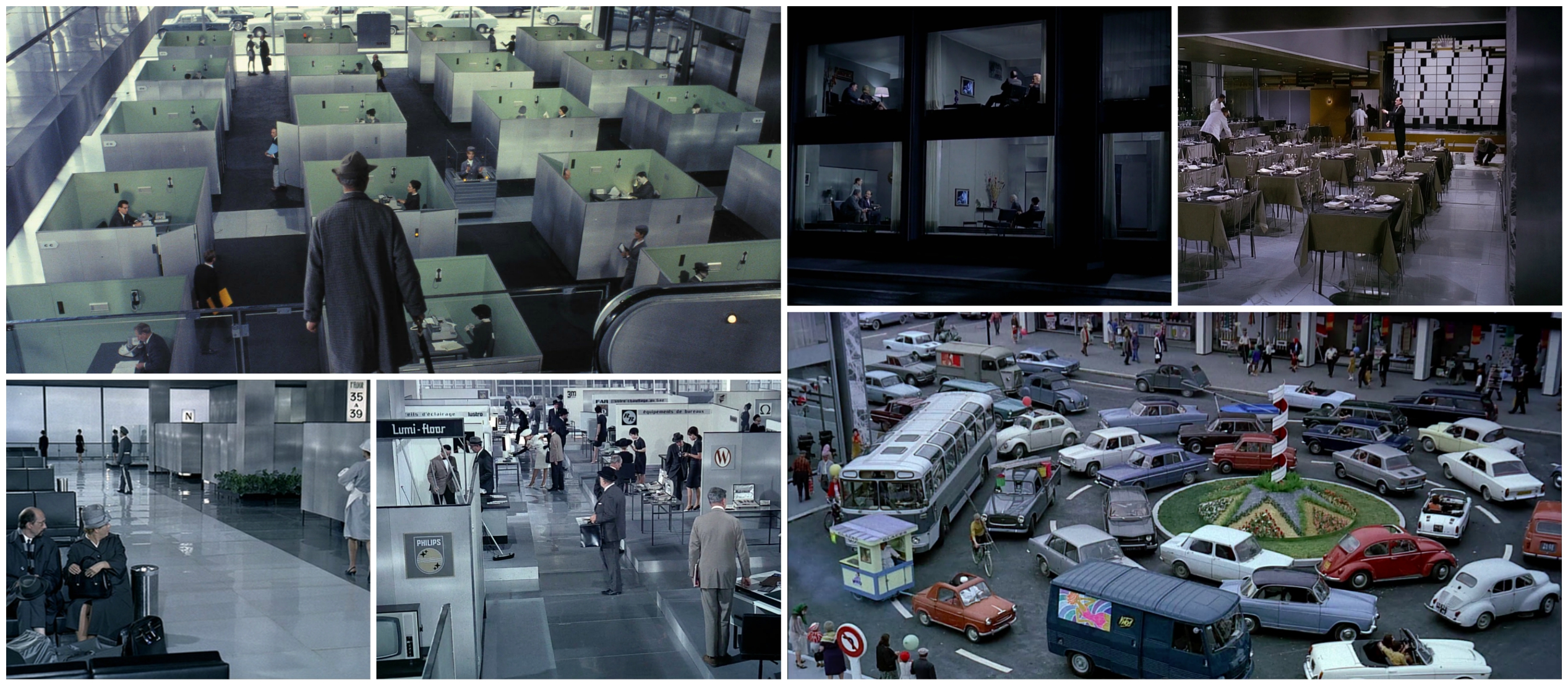
The only moment of private space we see in Playtime is when Monsieur Hulot’s acquaintance from the army invites him into his recently bought apartment. However, Tati takes this scene and challenges the extent to which the space could be deemed personal. First off, the design of the apartment complex remains consistent with the public buildings that we have previously seen—grid-like, silver, and clean-cut. In the below collage of the six main scenes in the movie, the apartment (middle picture of the top row) blends right in with the other buildings of this ultra-modern world. By making the aesthetics of families’ homes parallel that of public locations, the distinction between them becomes slightly blurred, for our expectations of how the two different spaces should look are challenged. Tati creates a disturbance in what we think we know—if we are not certain of how a private space should appear, do we even know how they function?
As the scene unfolds, Tati continues to blur the line by showing each apartment in the complex watching TV. With each group partaking in the same form of entertainment, it appears as if they are all involved in a public activity while in their supposedly private space. A connection is established between the apartments by cutting to a zoomed-out shot revealing all four apartments in the complex. Our eyes are drawn to Hulot and his friend by the high-key lighting used on them contrasted with the remainder of the frame in dim lighting. We then witness Hulot and his friend looking up at the ceiling, as if they are looking right at the couple in the room above them. This first moment of play between the different apartments foreshadows the extended gag that is to come.
Tati sets up the gag with two establishing shots: one angled so we can see the room with Hulot and his friend in full view, and another angled shot so we then get to see the apartment to the right of them. In doing this, it is pointed out to us that the televisions of both rooms share the same wall. The camera cuts again to focus on both rooms straight on, making them appear as if the two rooms are looking at each other. Tati then plays with this illusion, first having it look like the left room is watching the right room, with the reactions of the left timed perfectly so it seems as if they are responding to what is occurring in the room next door rather than the television. When the woman touches the man’s bruised nose, the people in the left room immediately yelp and cringe.
The gag continues in this way, such as when the man on the right begins taking off his work clothes and the parents in the left room subsequently tell their daughter to leave the room. By blending the activities of the two rooms, Tati emphasizes the overlap in what each room is doing, and thus questions their use of private space.
Other aspects of this scene further address the question, such as the choice of stationing the camera outside of the apartment complex. It is as if the viewer is respecting the privacy of the home, for we cannot hear the dialogue inside. Instead, we just overhear conversations of passersby since they are walking in a public area.
And yet at the same time the privacy of the space is still uncertain, considering we can still see everything that is happening inside the rooms due to the big glass windows. Even an entire group of American tourists was able to gaze into the apartment as they passed by on their bus. This scene in Playtime addressed how we define private space and whether it is all that different from the area of the public.
The exploration of this concept continues into the scene of The Royal Garden restaurant. At this point, Tati begins to demonstrate various attempts of creating a private space within the public realm in an effort to draw attention to the arbitrariness of these distinctions. We see this being played out with the role of the doorman. Since the restaurant can only accept a certain amount of people, the doorman controls the flow of people and who is let in. However, this exclusivity is completely illusory—a physical barrier of glass is the only thing preventing the general public from entering the restaurant. When Hulot accidentally shatters this glass door, there is no longer any obligation to acknowledge the nonexistent boundary.
This point is further emphasized when a man drunkenly walks straight through the “door” and into the restaurant, despite the doorman’s efforts at creating an illusion of the door still existing. The restaurant’s attempt at privatizing a public space ended up failing, for the line that divides the two realms is not easily maintainable since the line itself is fairly ambiguous.
Another example of an endeavor of creating privacy in the public is when the American businessman, Mr. Schultz, tries to create a “VIP” area inside the restaurant by only allowing people with the chair imprint on their back into the space. Tati calls attention to the absurdity of the concept of a privatized VIP space in a public restaurant. He demonstrates this with Mr. Schultz’s humorous judgment on who makes the cut and who does not. The silly requirement that Mr. Schultz enforces pokes fun at exclusivity and what defines it. The absurdity is further exaggerated due to his chosen place, which is definitely not a VIP area. It merely consists of a corner of the restaurant that was deconstructed by the rowdy dinner guests. The blown fuse is the finishing touch for this exclusive space of the elite.
Playtime puts to question the definitions of public and private, and how they restrict the two from blending into one another. Tati challenges these restrictions by organizing humorous situations and playing around with space—both the concept of it and its physical makeup. Through this film, he teases people’s attempts at imposing distinctions between public and private spaces while at the same time distorting those divisions. Jacques Tati pulls off making a joke of this idea while he playing around with innumerable gags in this delightfully whimsical and charming film.
by Domitille University of Chicago CMST 10100, Intro to Film Spring 2015
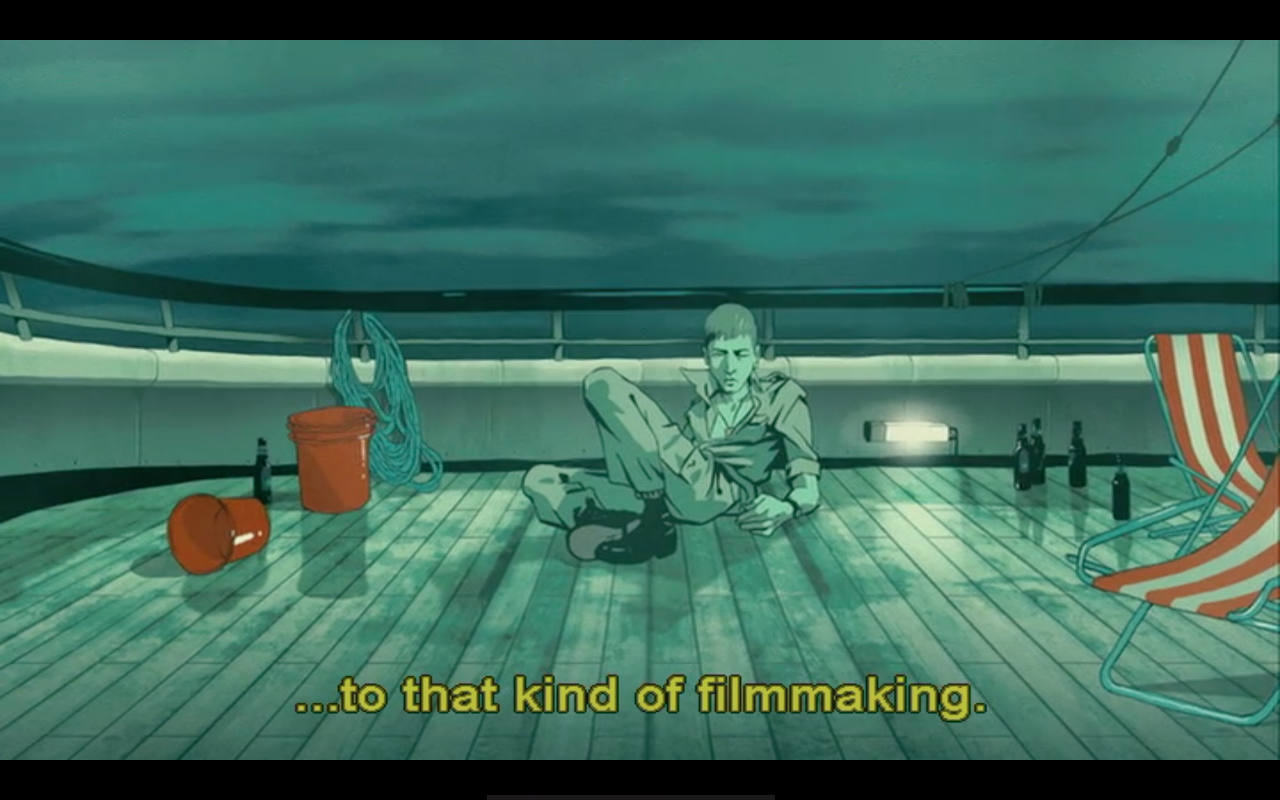
Ari Folman’s Waltz with Bashir first stands out to us because of its use of animation despite its identification as a documentary film– how can a non-fiction narrative be justly portrayed using highly stylised illustration? Yet it is evident by the end that the medium of animation not only allows the viewer to easily cross over any visual and temporal boundaries but also turns around and forces the boundary to be redrawn in a harsh awakening. Thus the documentary footage, hallucinations and flashbacks can all be presented on the same visual plane, that is, until the film’s final clip. Similarly, the characters themselves are enveloped in their own safety nets of self-induced amnesia and coping mechanisms that at once shield them from PTSD symptoms but also help to propagate them.
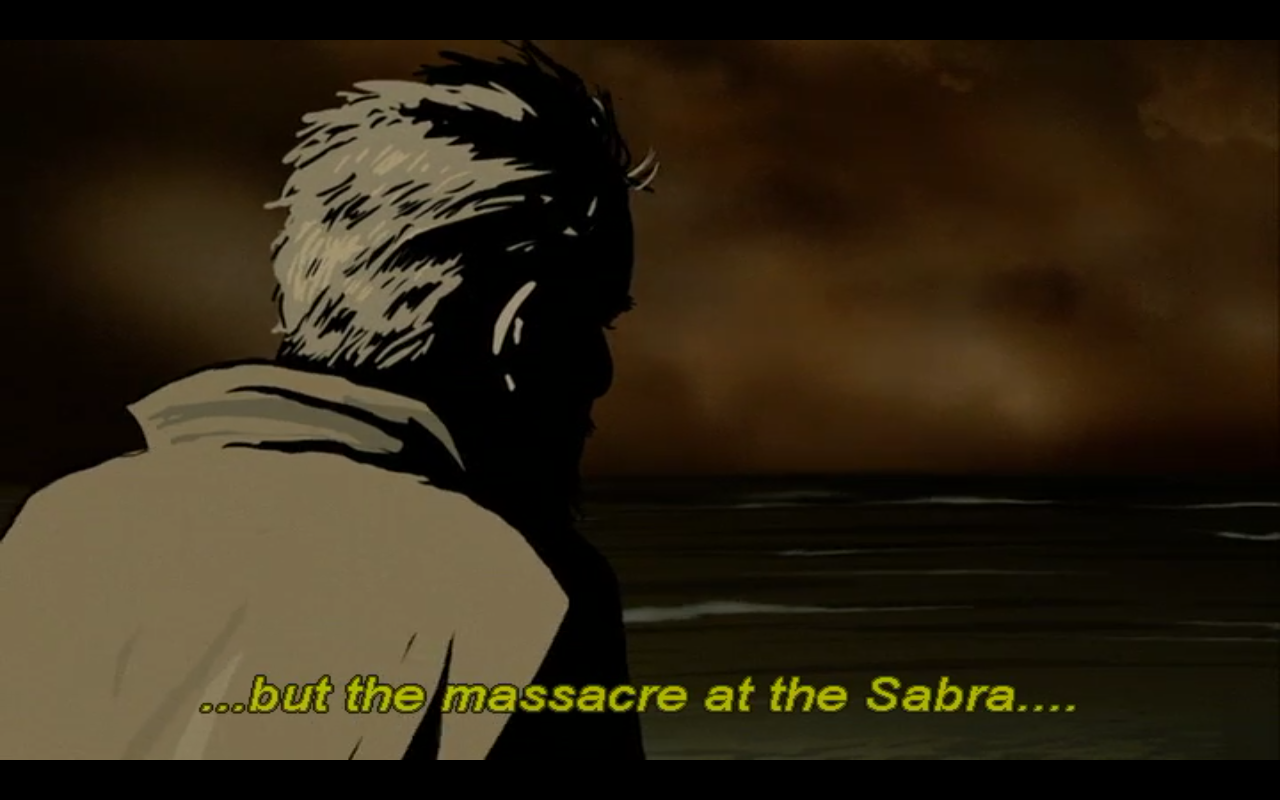
An essential manifestation of these protective mechanisms are the hallucinations that plague many of the characters and exist in a halfway point between memory and dreamscape. Among these hallucinations is the reoccurring motif of the sea and its role as a protection from enemies and a shield from reality. The sea manifests itself in three key scenes, Ari Folman’s first hallucination of the beach, Carmi Cna’an’s dream of the woman, and Ronny Dayag’s escape at sea. These three all reveal the sea to be a place of escape and protection, as Dayag states, a place of “fear [and] feelings.”
Folman’s Hallucination of the Rise from the Sea
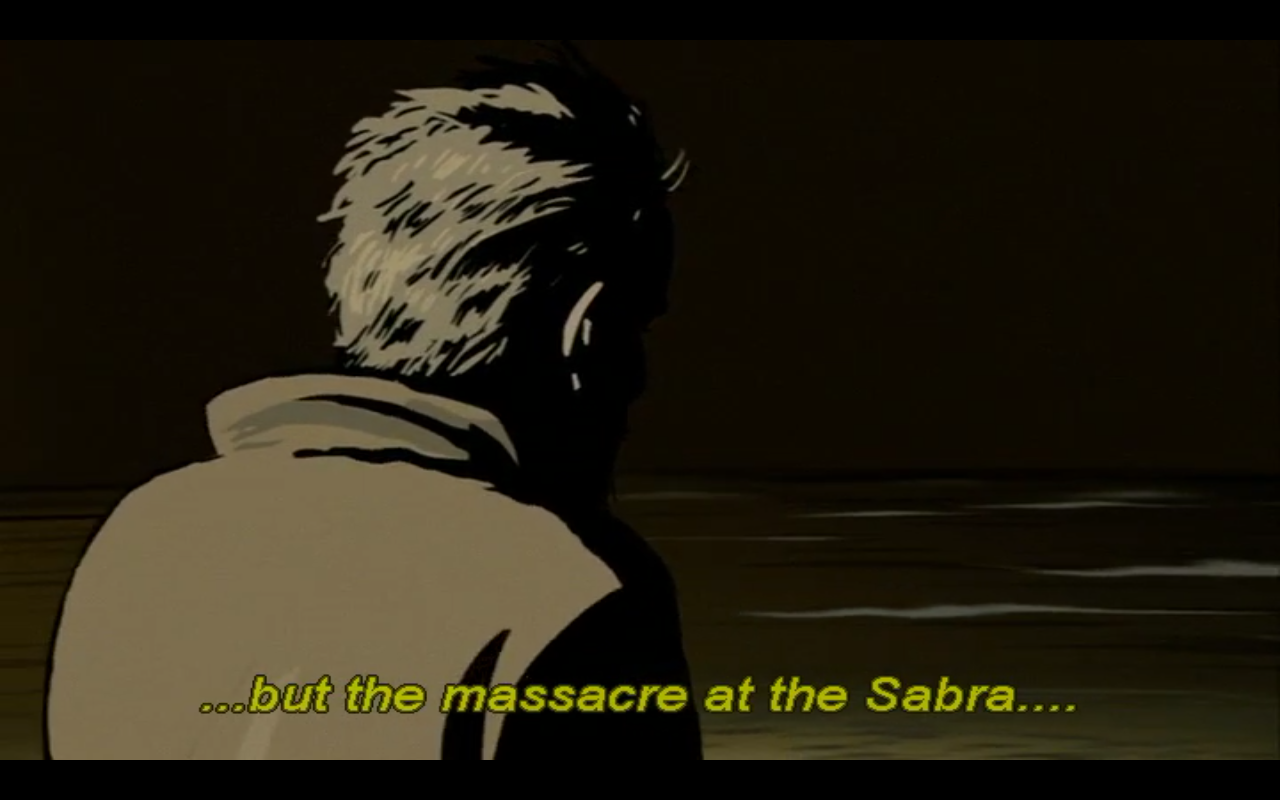
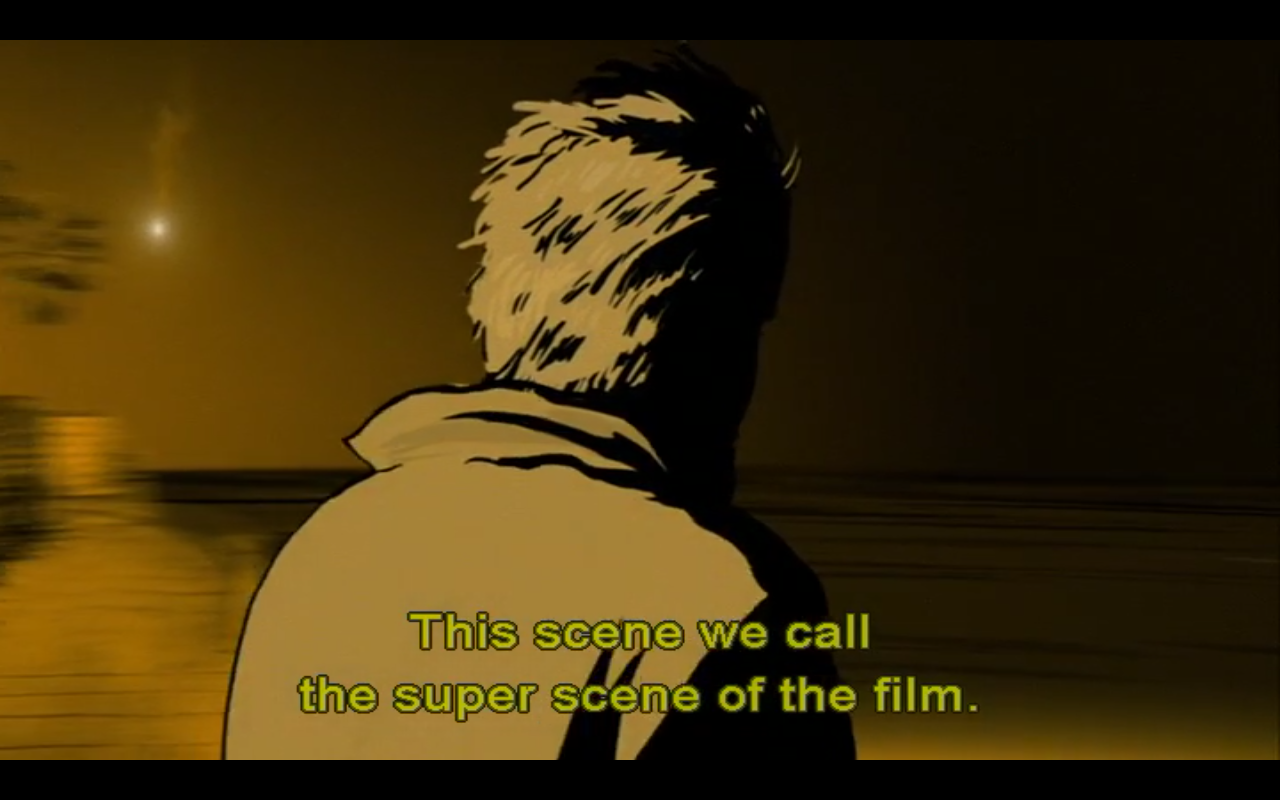
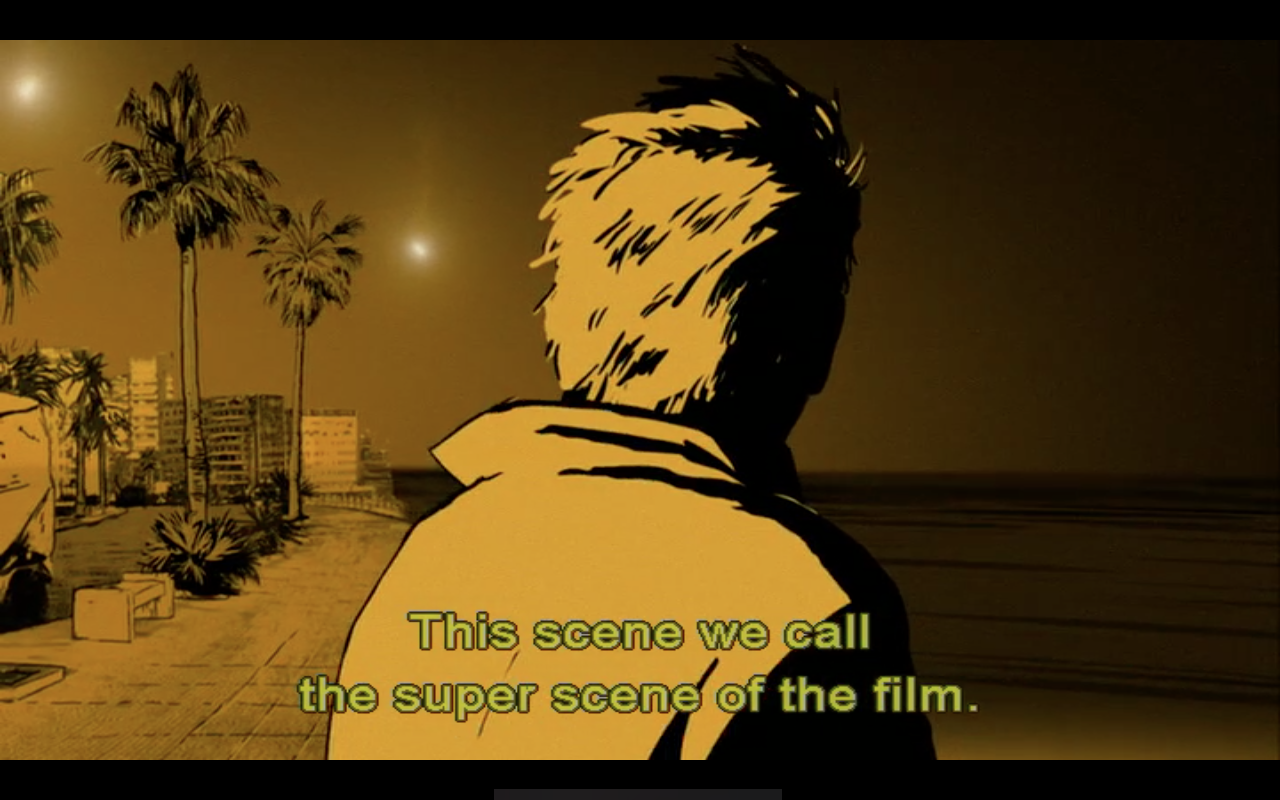
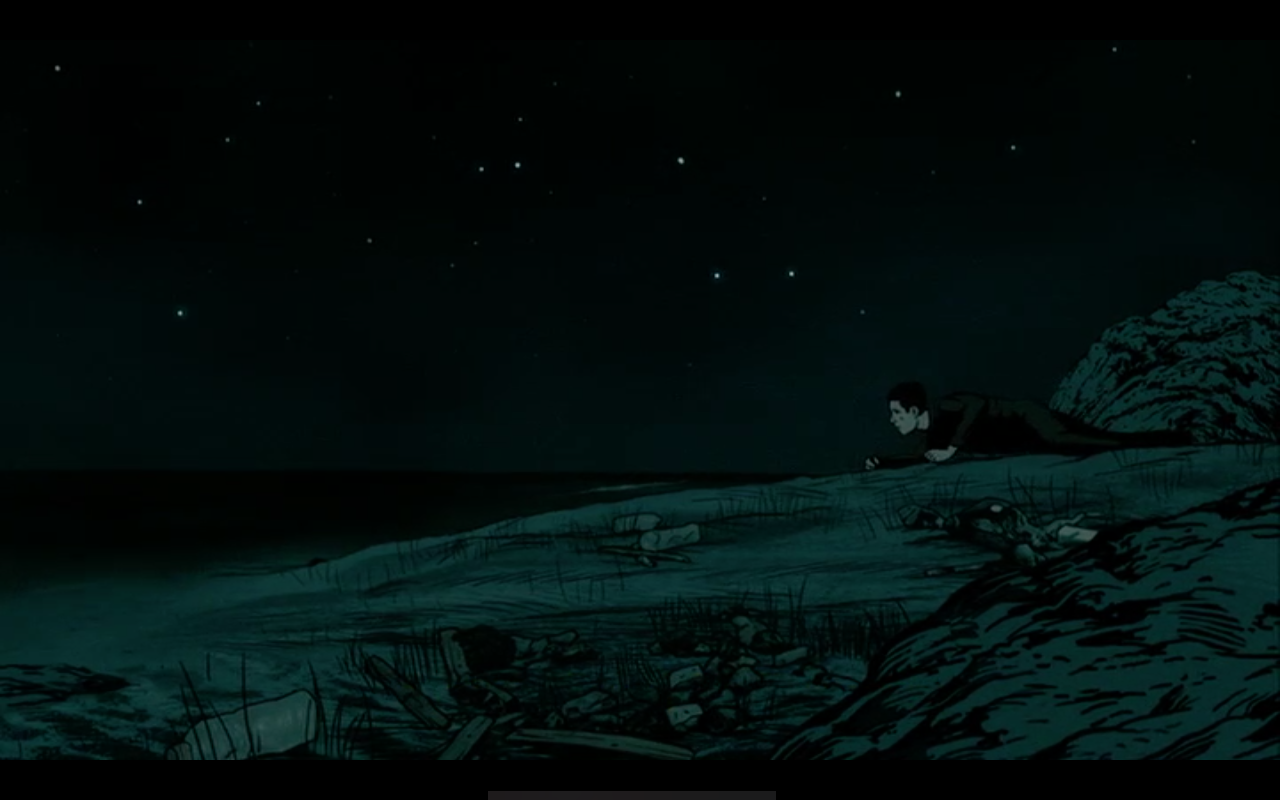
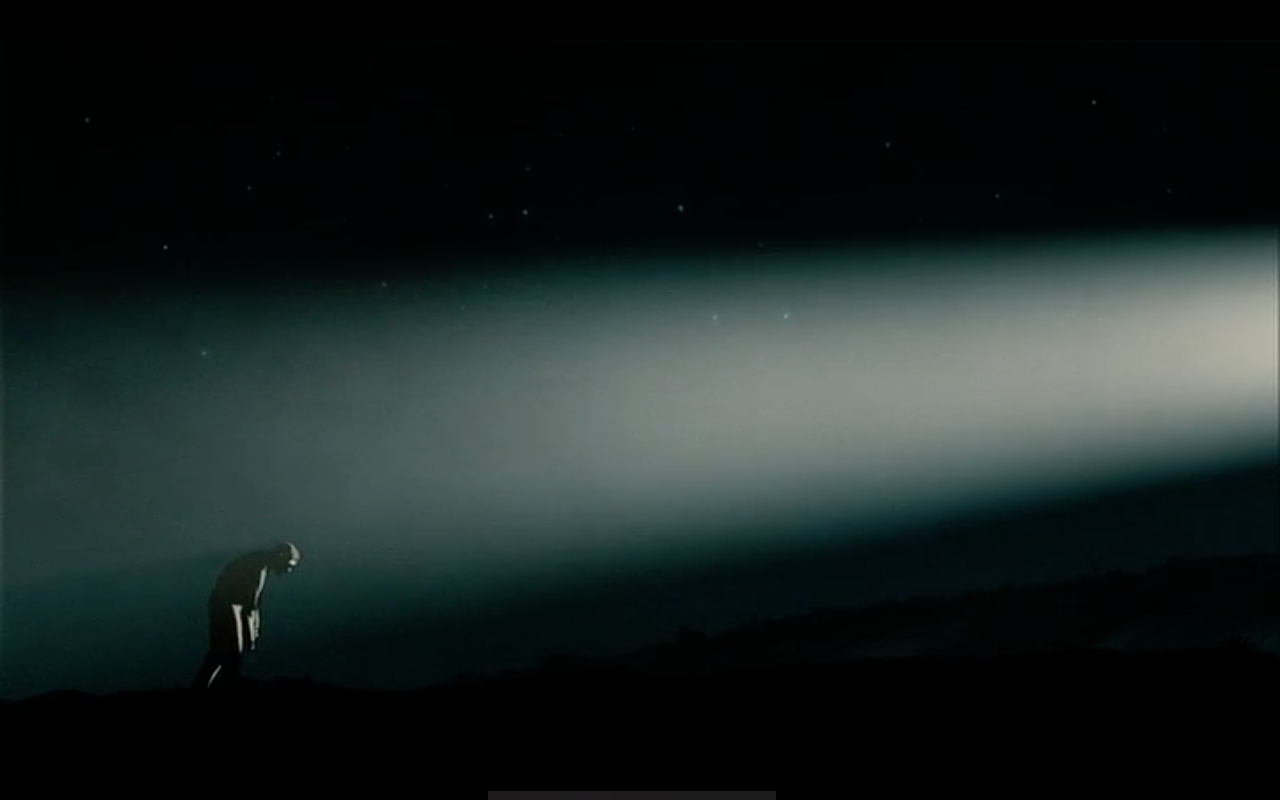
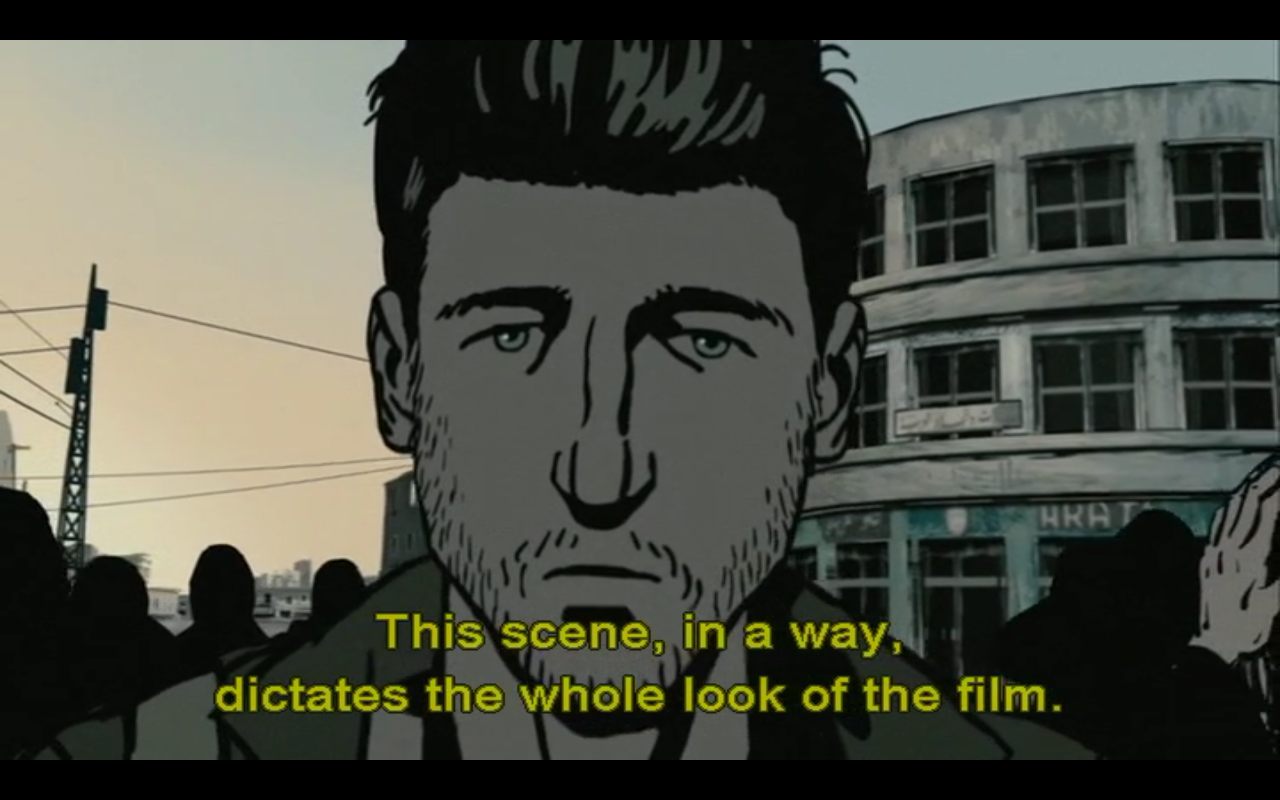
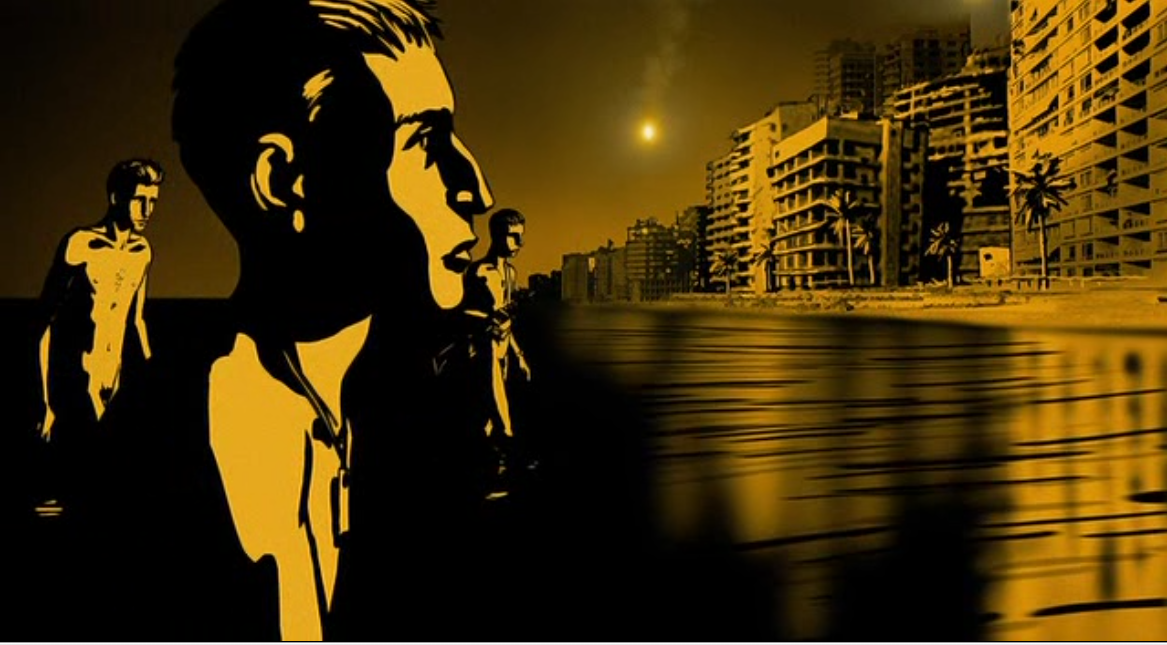
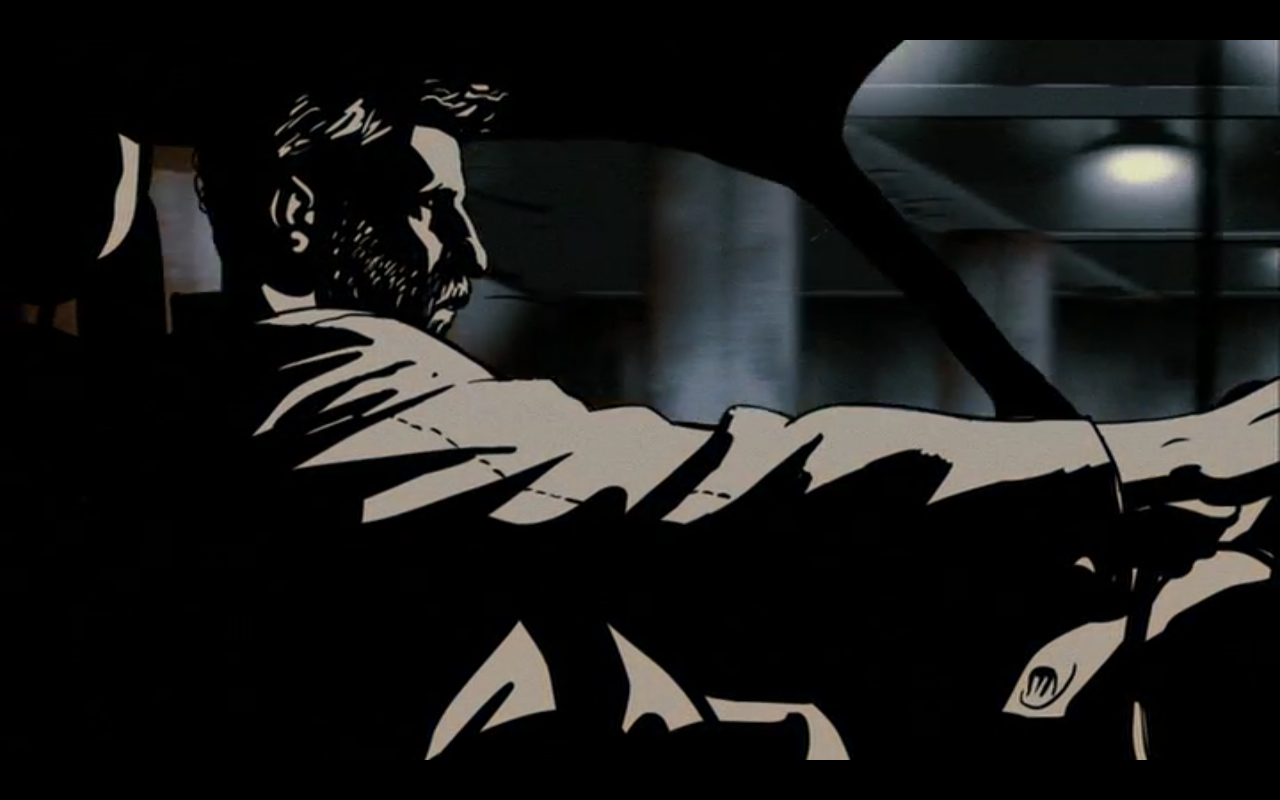
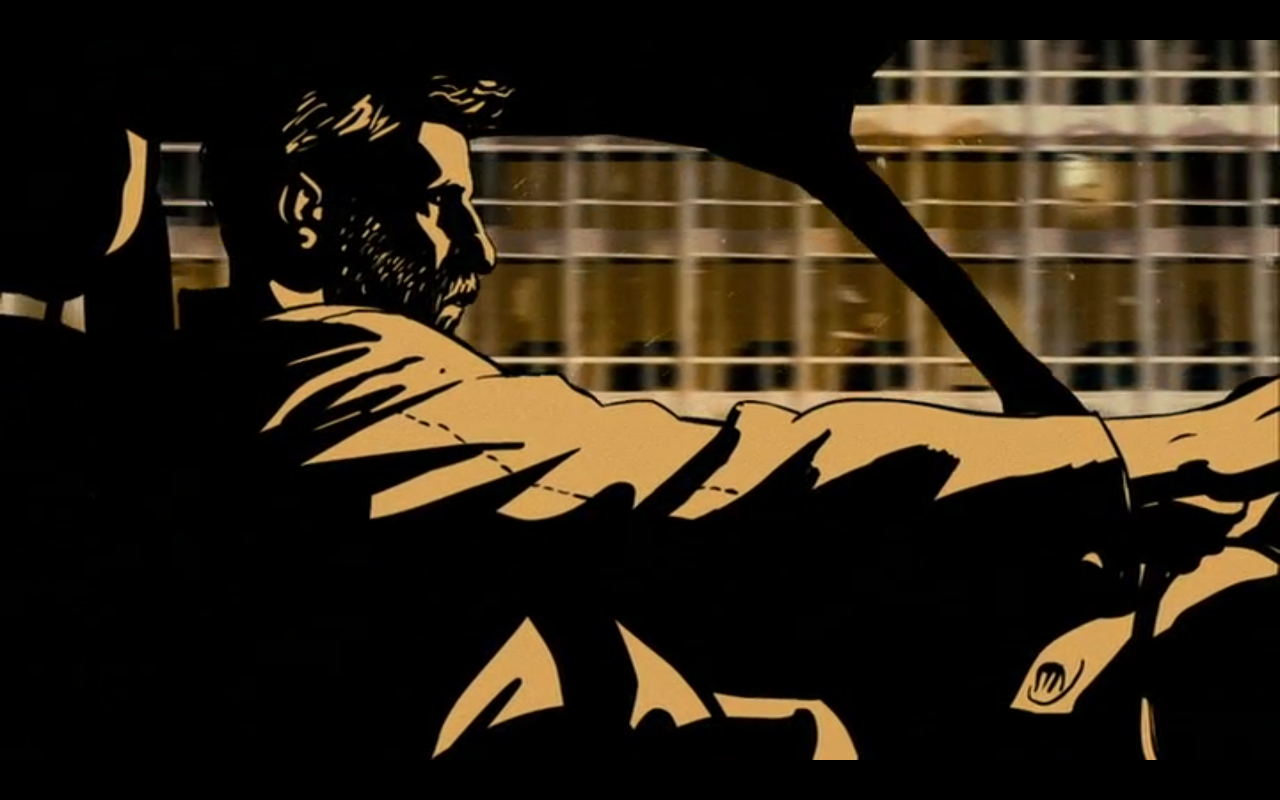
Folman experiences his first hallucination after meeting with his friend Boaz; in fact the drive from this meeting mirrors the gradual delving into Folman’s mind. Not only do the flashing colours indicate distance traveled and lend an otherworldly “down the rabbit hole” aspect, but they also show a movement through time. The continuity of direction towards the right, sustained until Figure 4 when Folman reaches the beach depicts the arrival at a mental destination– the recesses of Folman’s consciousness.
[Figure 1]
[Figure 2]
[Figure 3]
[Figure 4]
This is a prelude into the scene of the rise from the sea, which reappears three times throughout the film and serves as the driving force behind Folman’s desire to recover his memory. Not only does it portray a strange amalgam of destruction and birth through its evolutionary appearance, but also introduces the trend of blurring reality and illusion.
[Figure 5]
[Figure 6]
[Figure 7]
[Figure 8]
The sequence extending from Figure 5 to Figure 8 exemplifies the nearly imperceptible visual change from Folman’s reality, as he broods along the sea to a close-up that follows his head movement to the left, into another realm. The colour change into sepia, despite being the indicator of a removal from reality is very gradual and appears to be due to the flares. However the use of the falling lights as well as the ensuing sparkles in the water serve to reinforce the hallucinatory and surreal aspect of the scene, and the setting as one removed from physical reality. Two shots later this is confirmed as we see a younger Folman floating in the water, followed by a POV shot of the beach.
[Figure 9]
[Figure 10]
[Figure 11]
The change in location of the subject in Figure 9, as well as his younger face illuminated by the flares and the sparkling lights surrounding his naked body bring the viewer fully into a different space. The use of the POV shot transports the viewer closer to Folman but also creates a disorienting perception of narrative that goes between this POV shot and a wider angle (Figure 11) that depicts Folman in the background and instead highlights Cna’an’s presence and importance at the location. Yet as the narrative focus becomes opened even further, created through the use of the following silhouette shot in Figure 12, a more universal image is introduced.
[Figure 12]
The rise of the men, vulnerable and elementary through their nudity, from a limbo-esque state of protection within the sea speaks to the greater experience of war for many of the soldiers. Furthermore, the low-key lighting casts harsh shadows that often obscure the subjects’ expressions (Figure 9 to Figure 11) and render obsolete any clear grasp of what they are thinking; in fact in Figure 11 they just seem to be inexplicably drawn towards the shore without much of an emotional reaction to the setting around them. Thus the almost mechanical rise from the safety of the sea and the donning of clothing reveals a sudden growth despite being psychologically unprepared for the consequences. Figure 12 helps to further illustrate the various stages of development, and closely ties the three subjects together through the use of the silhouettes that blur individuality.
Cna’an’s Dream of the Woman at Sea
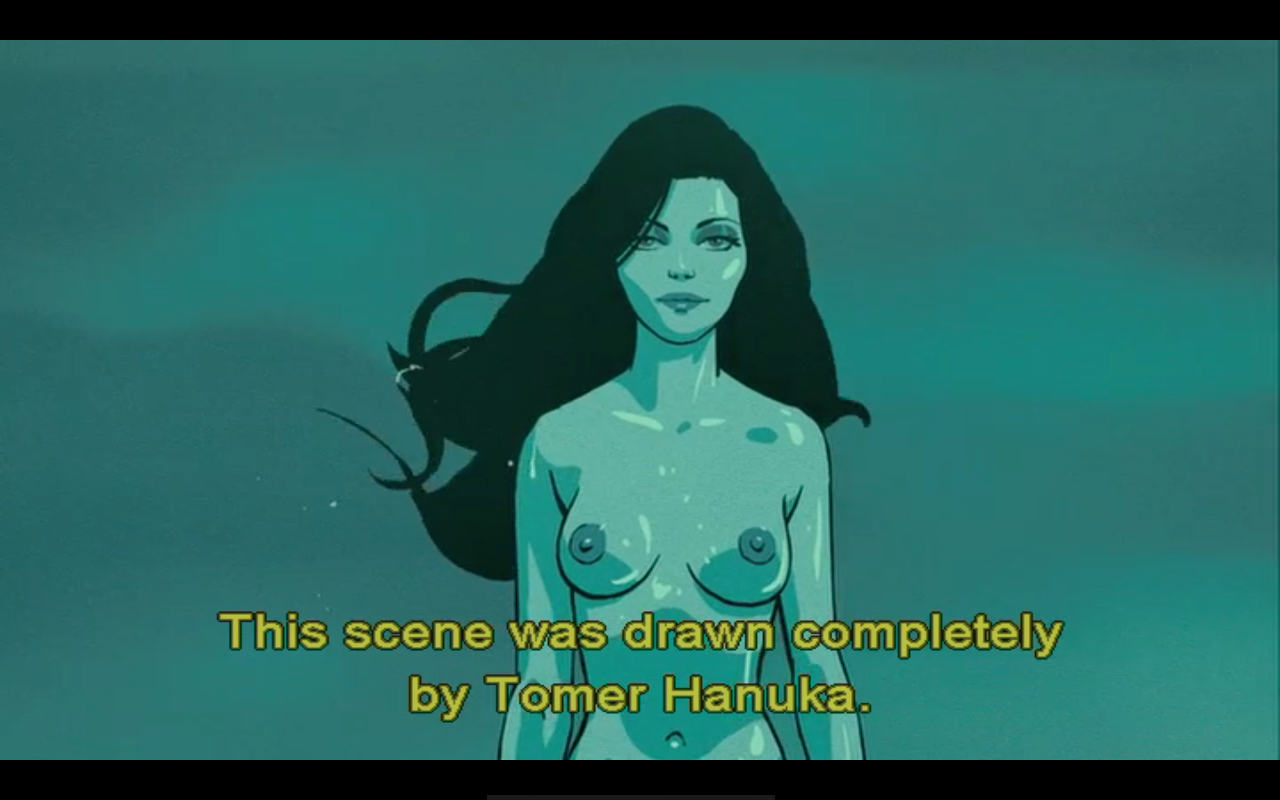
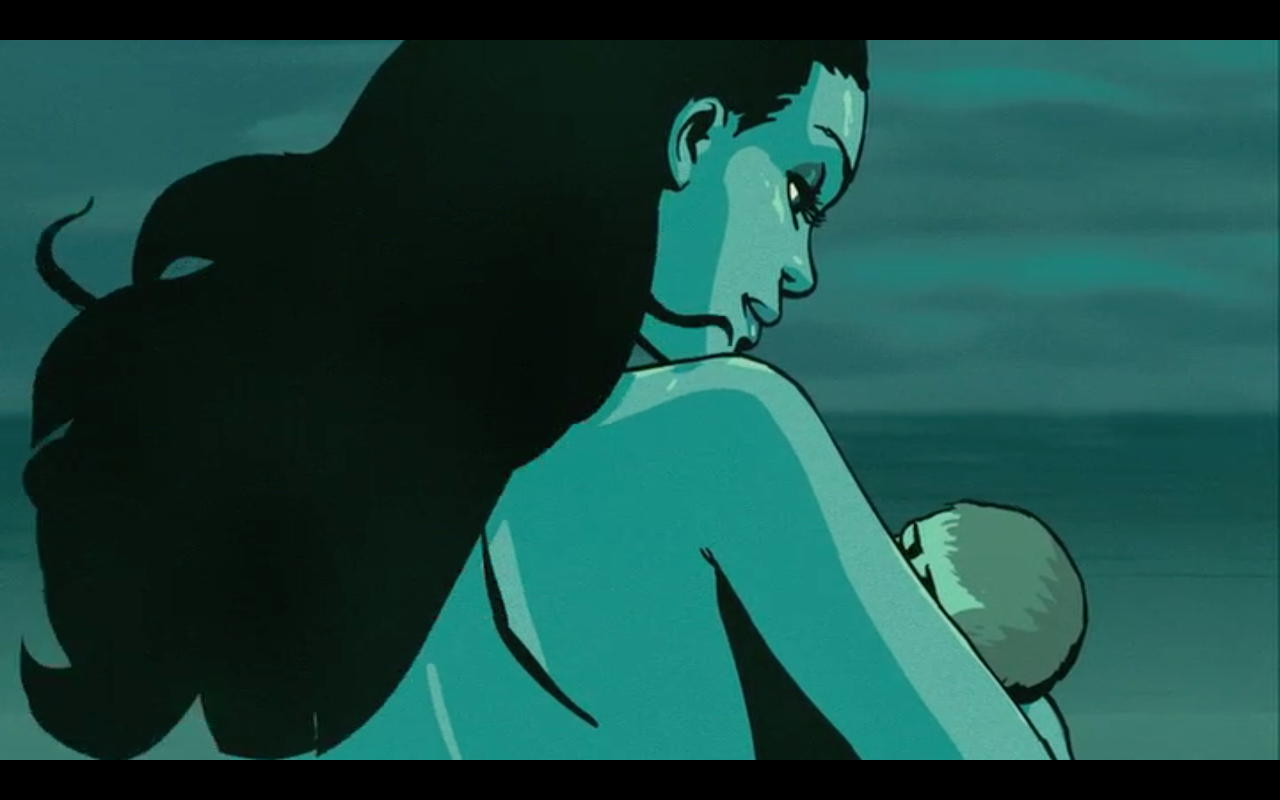
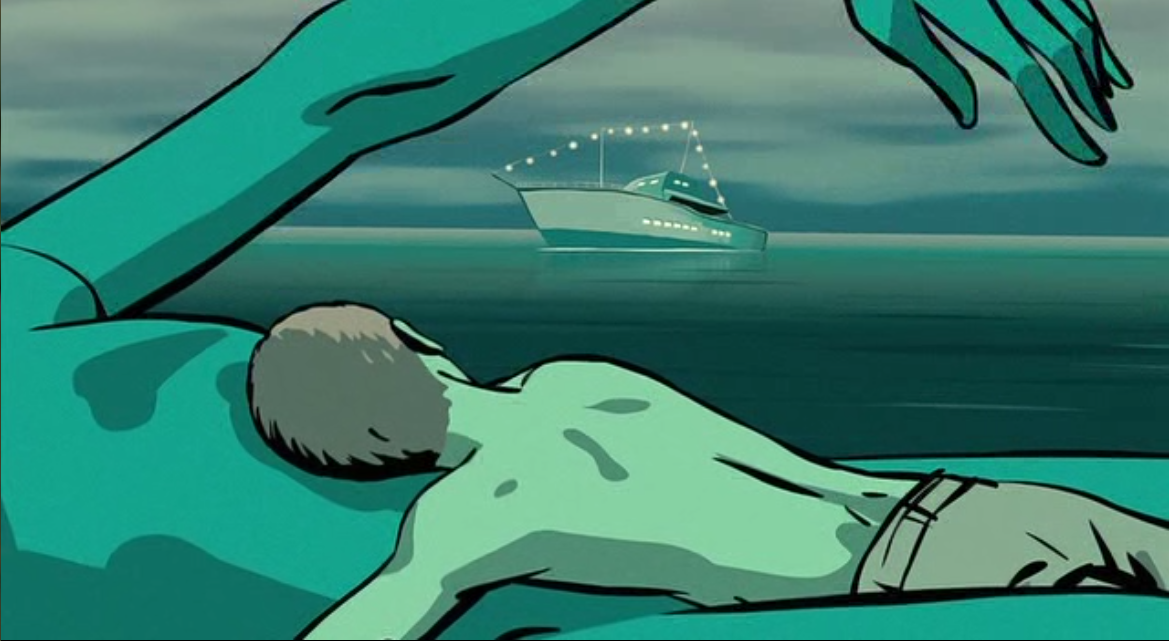
Similarly, Cna’an has his own hallucination involving the sea that is embodied as a woman come to “take [him] for the very first time.” It is revealed that as a very bright but “nerdy” eighteen year old, he had an urge to prove his manliness and capability, which included being acknowledged by women. And thus he slips into sleep as a means of escape from reality, stating that “even now, I escape into sleep and hallucinate.” The hallucination here is clearly distinguished from reality through the mysterious tone of the music that accompanies the swimming woman in Figure 15, as well as the sudden and almost eerie brightening of the background between Figure 13 and Figure 14 (similar to the sudden flares that appear in Folman’s hallucination).
[Figure 13]
[Figure 14]
[Figure 15]
[Figure 16]
Additionally, the woman comes from the sea and is a similar blue colour, which assimilates her to it as part of it and maybe a personification of the sea itself.
[Figure 17]
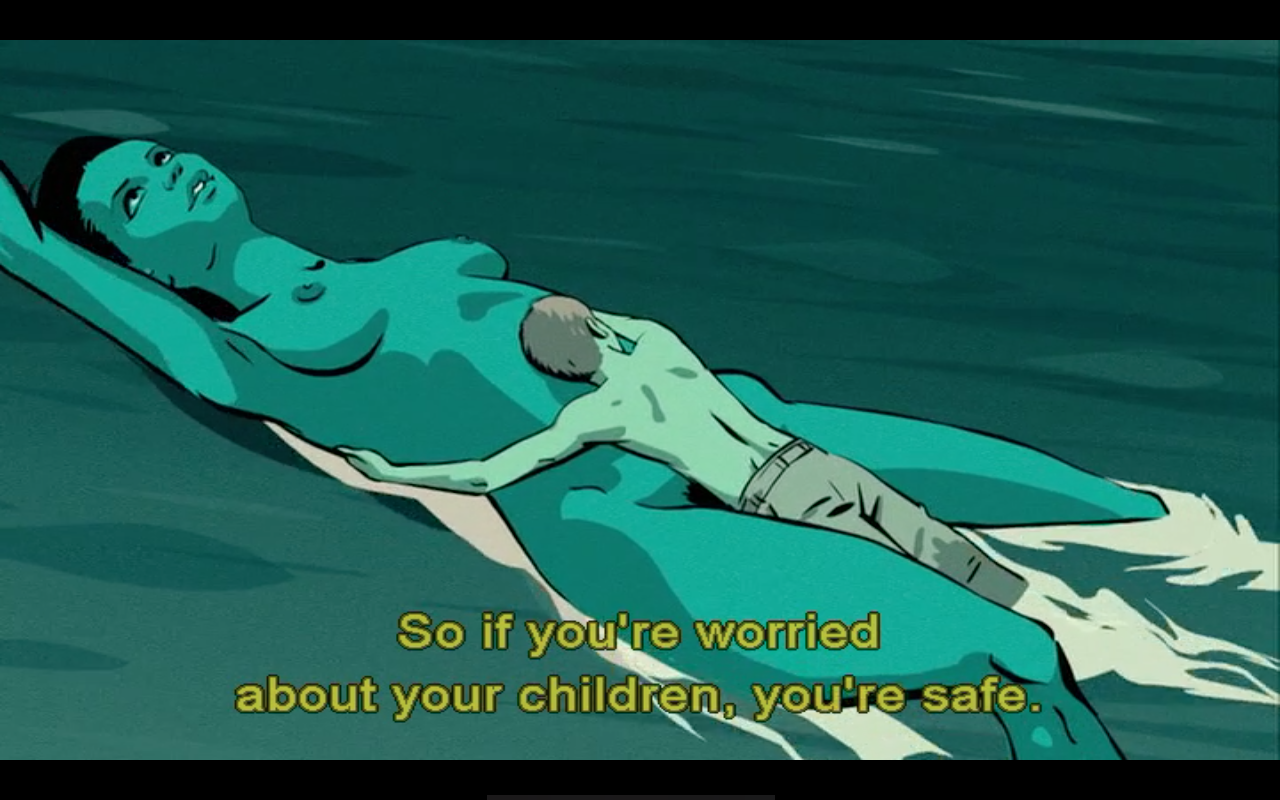
The otherworldly shine on her body (Figure 17) and her blending into the scene itself makes her appear larger than life, and also much larger than Cna’an himself– the woman does not portray so much a sexual being as a maternal figure and Cna’an, her child she cradles to her breast.
[Figure 18]
[Figure 19]
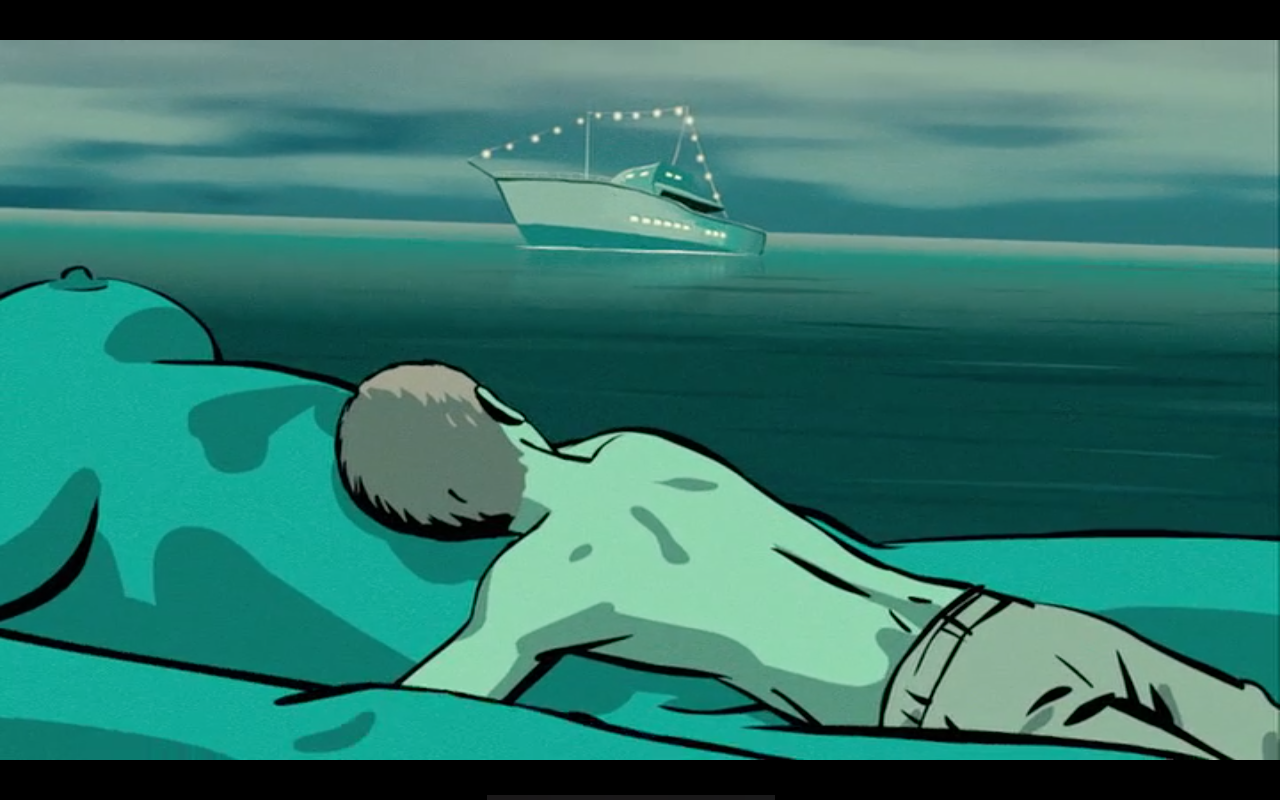
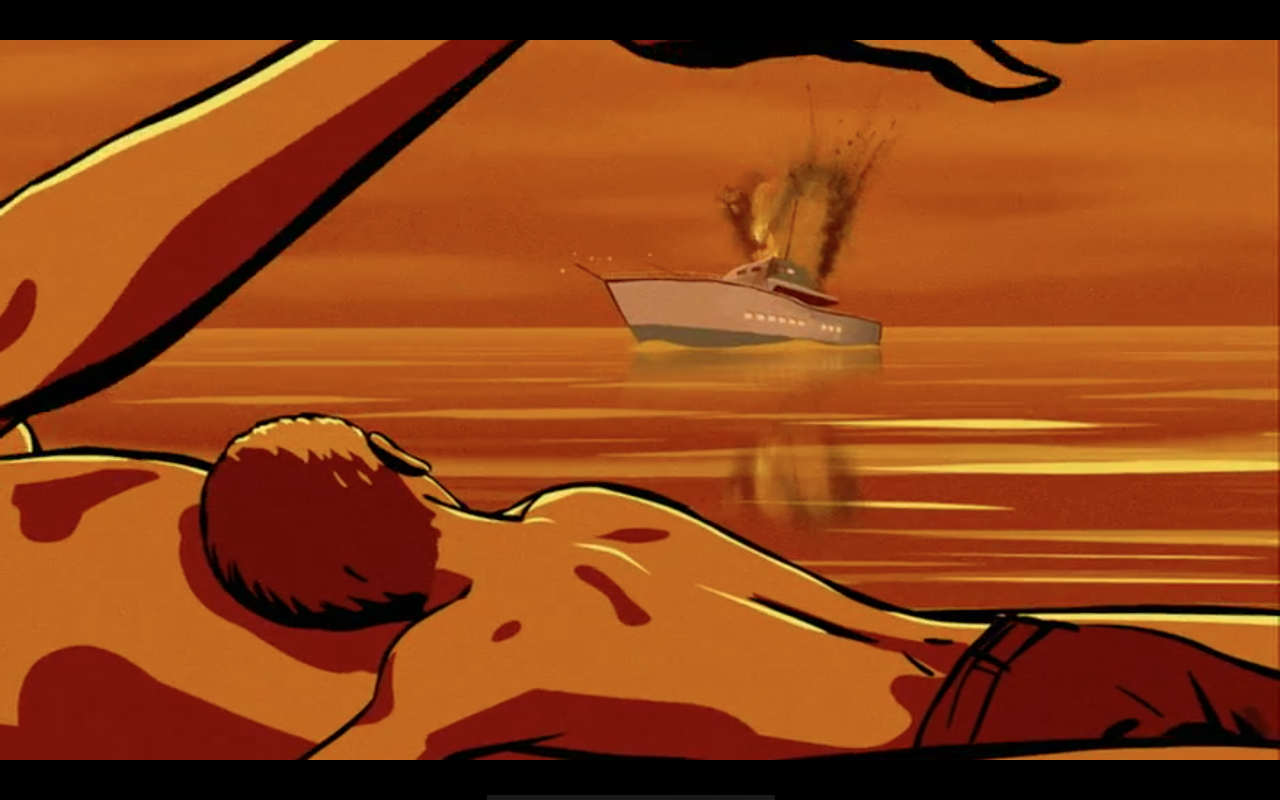
The maternal aspect of the woman is shown in Figure 18 and Figure 19, through the allusion to the cradling of a baby. The difference in size between the two in Figure 18, as well as the placement of Cna’an’s head also suggests breast-feeding. Furthermore, the clinging onto the body of the woman and resting upon her stomach emphasises the motherly aspect and protection she provides; there is a lack of autonomy as he simply lets her take him away from the real world and ultimately the bombing of the ship.
[Figure 20]
[Figure 21]
[Figure 22]
The removal from this reality is emphasised by the vivid change of colour between Figure 20 and Figure 21, which puts into focus the lack of movement of Cna’an. Despite the following close-up reaction shot on Cna’an’s face, we are not given much indication of his emotional interiority and are instead presented with an almost confused face of resignation and uncertainty.
Dayag’s Escape at Sea
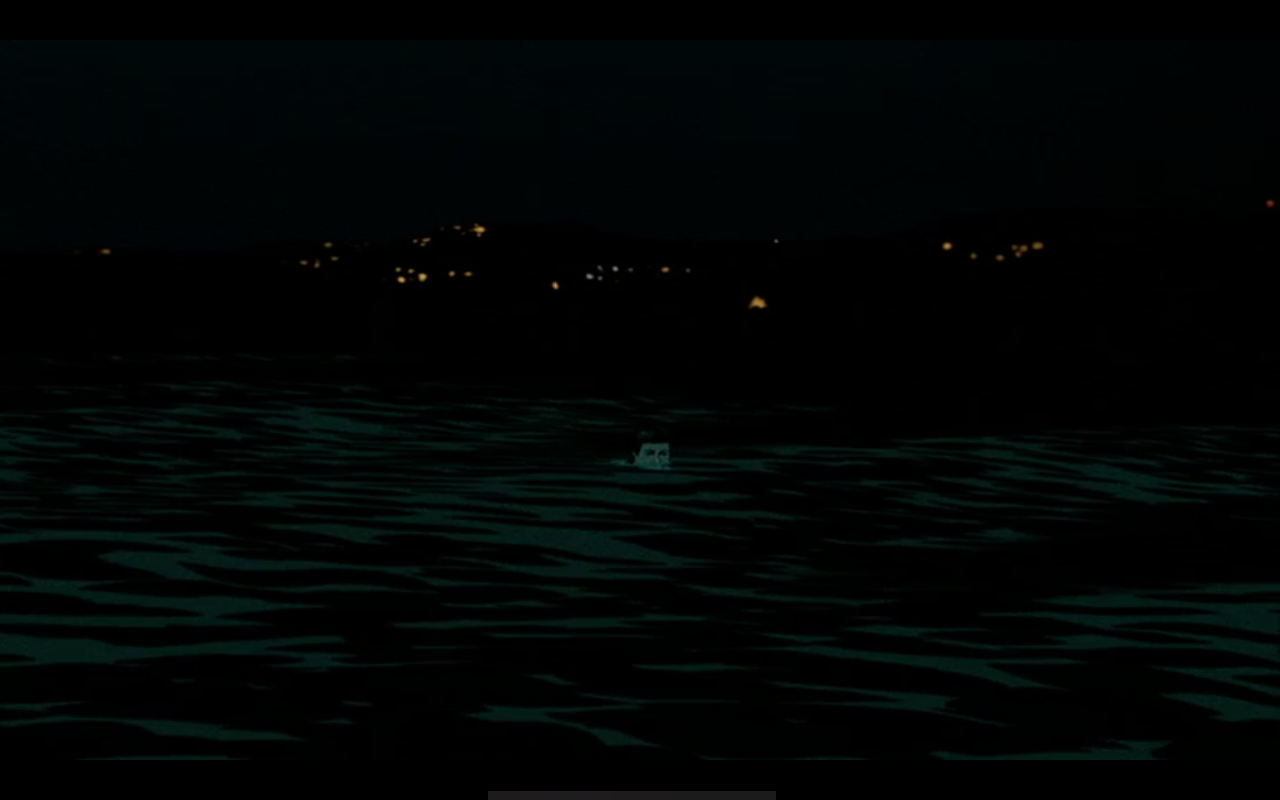
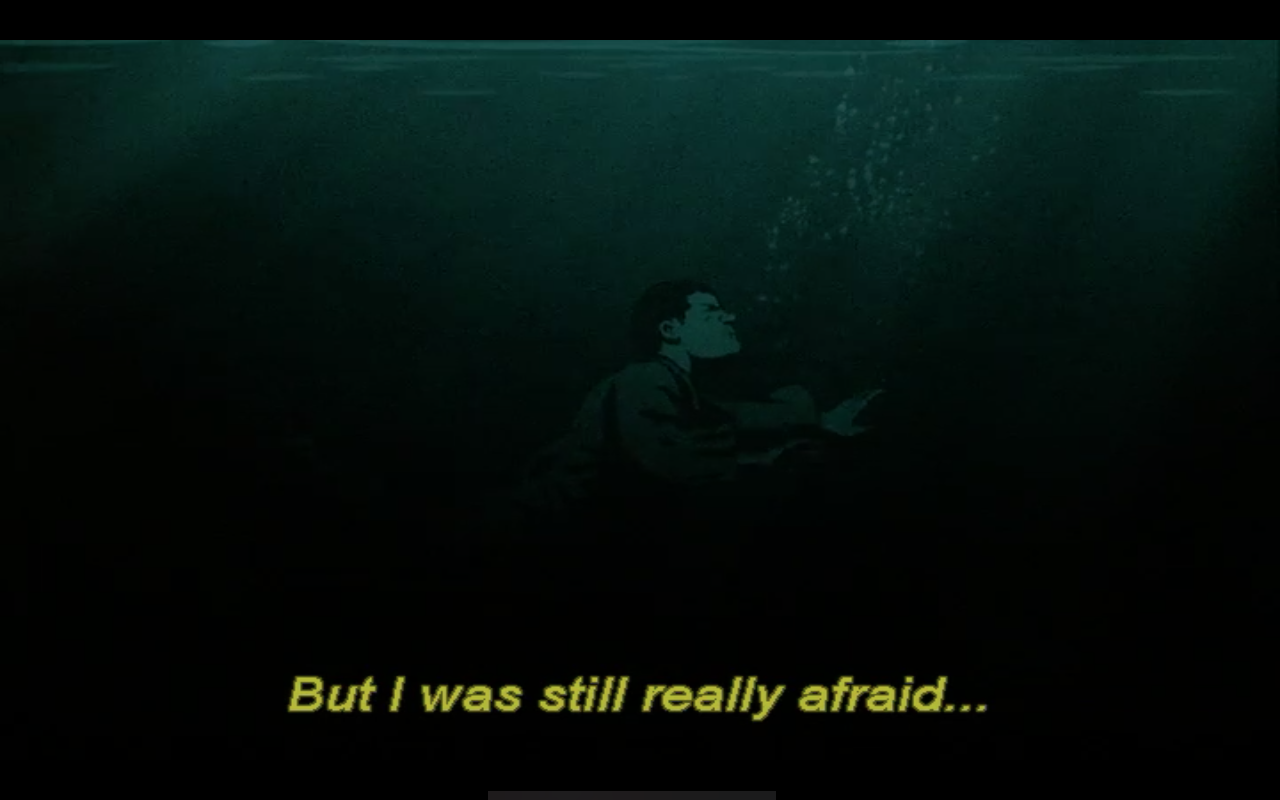
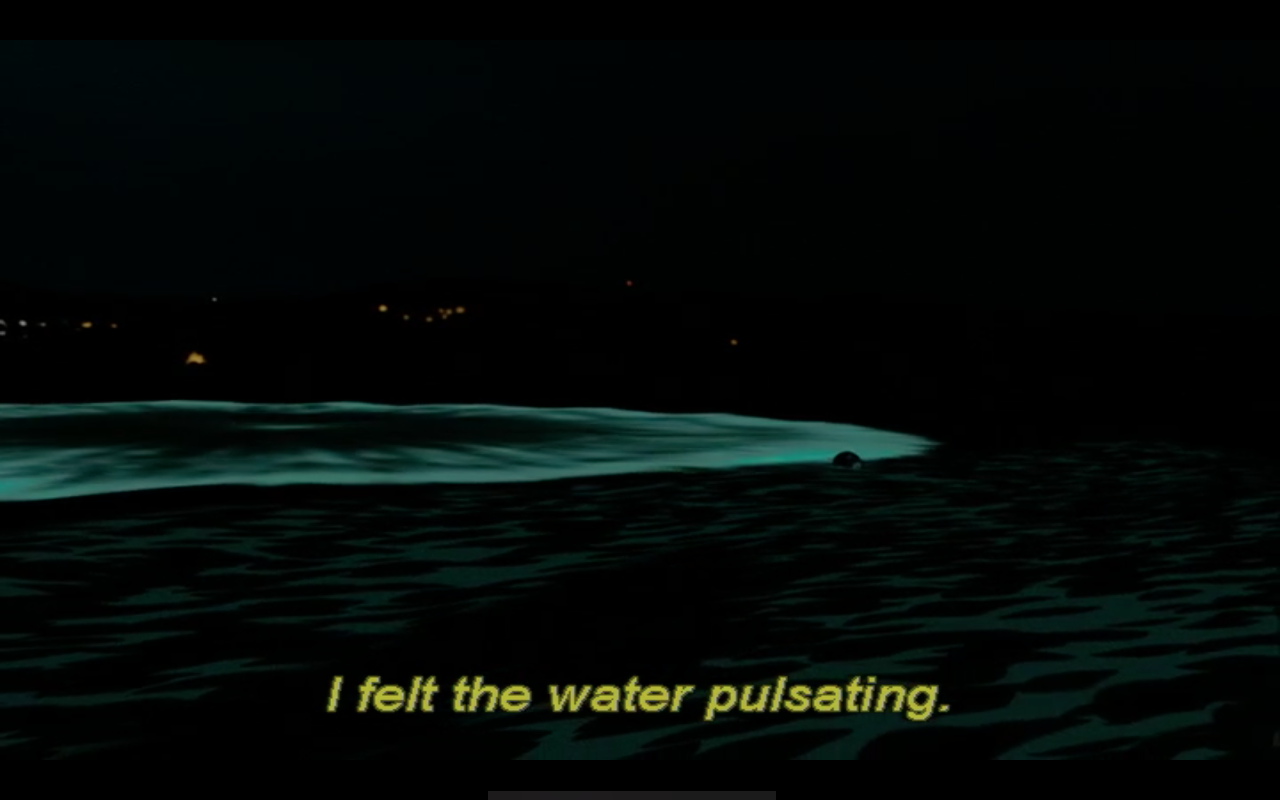
The case of Dayag’s escape by swimming is not, as the other two, closely tied to hallucination but still presents the sea as a place of escape and protection. He swims for 6 miles, despite being a weak swimmer and is transported by the water miraculously back to his regiment. Additionally despite it being a real occurrence, the combination of exhaustion as well as fear transforms the sea into a more surreal and dream-like setting.
[Figure 23]
[Figure 24]
[Figure 25]
[Figure 26]
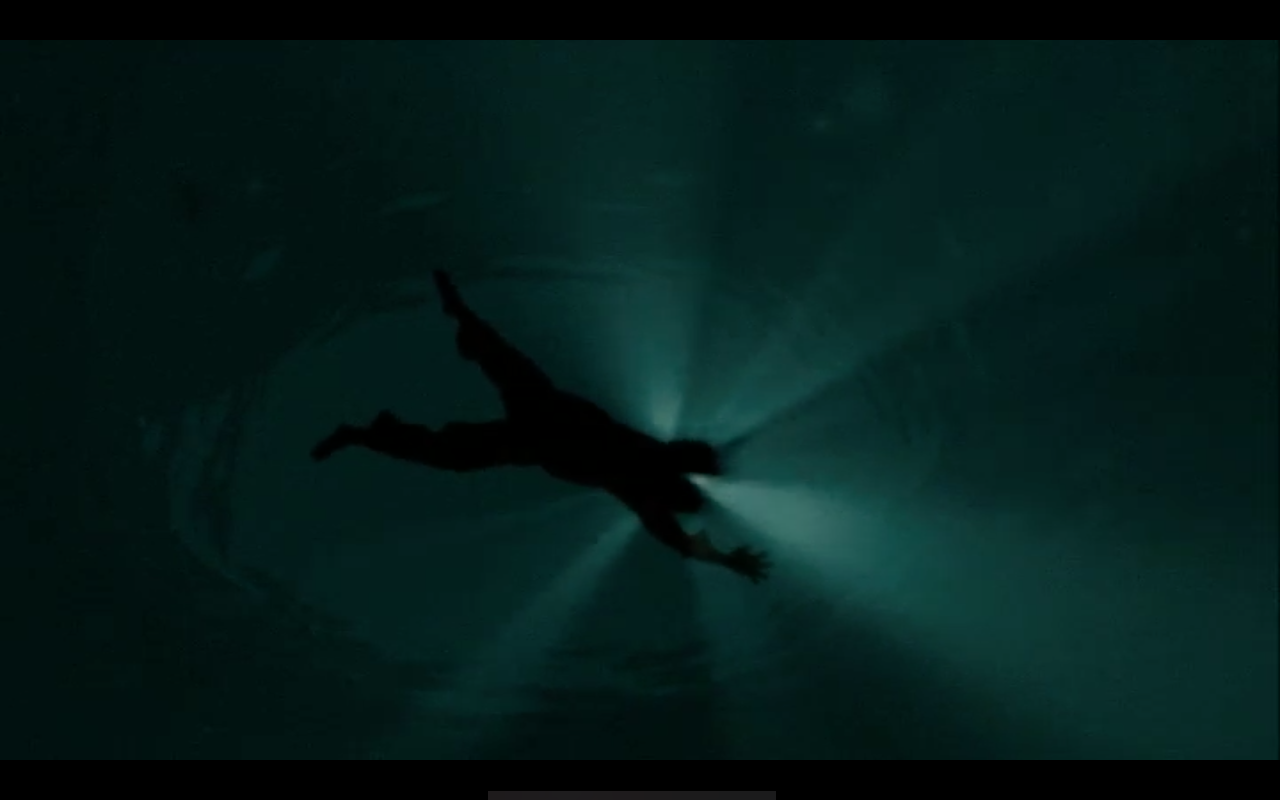
The surrealism of this journey is demonstrated by the darkness that blurs the landscape and envelops Dayag in Figure 23 and Figure 24. He often is pushed under the water and he describes that the water “enveloped him,” and in this way becomes more closely connected to it and its movements. The after-effects of a bomb being dropped made him feel “the water pulsating” in Figure 25, and likewise his body also pulses with fear. The use of different shot angles, such as the shot from underneath of Figure 26 allows for further blending together of the body with the water.
[Figure 27]
[Figure 28]
Lastly, the crawling into the water from the beach in Figure 27 illustrates a regression into a space of protection and infancy similar to Folman and Cna’an’s child-like state when in the sea. Then Figure 28 portrays a coming out of a protected state and future confrontation with reality– in Folman’s case the realisation of the massacre as he is surrounded by the wailing women, and in Dayag’s the guilt of survival and cessation of visiting his friends’ graves.
Final Thoughts and the Confrontation with Reality
The sea thus represents a space of protection and sheltering for the wounded minds of Israeli soldiers, just as Dayag states that the “sea is calm and peaceful.” Yet at the same time, he is also terrified of drowning or being shot at– there is a sense that while the sea offers safety, it is only temporary and it can also lead to a loss of memory and drowning in one’s own fear and hallucinations. One can only remain in this space of security for so long until he must confront reality, and in the final shots of the film that work as an actual extension of the hallucinatory beach scene, Folman suddenly awakens.
[Figure 29]
[Figure 30]
[Figure 31]
Thus one can observe the change in facial expression between the blank stare that usually concluded Folman’s hallucination in Figure 29 and the expression of realisation in Figure 30. Likewise, the audience itself despite feeling more aware at this point of the reality behind the film is not awakened until it is shown the last shots of the film (Figure 31). And thus Folman ultimately reestablishes the crucial divide between reality and hallucination, and documentary footage and animation, while simultaneously breaking down the boundary of disassociation between the films’ subjects and the audience in a confrontational demand for awareness.
by Juho University of Chicago CMST 10100, Intro to Film Spring 2015
The Lego Movie (2014) is a parody on so many levels. The story follows Joseph Campbell’s The Hero with a Thousand Faces outline to a tee. Almost every character is unabashedly an archetype or parody of something, be it The Matrix, the Dark Knight trilogy, or Morgan Freeman. But it’s all intentional. The superficial plot is as contrived and derivative as a child’s imaginary adventures with plastic representations of pop culture properties are expected to be. Once The Lego Movie establishes that the story is a fabricated metaphor of deeper conflict at the heart of the film, the perpetual parody becomes meaningful and easier to swallow.
The film’s aesthetic plays a similar game. It’s a parody of stop motion animation, a computer animated film in disguise as a stop motion film, and while that in itself includes elements of realism (as stop motion consists of still photographs of real objects), a stop motion film composed entirely of Legos ultimately implies a level of absurdity and abstraction that’s unmatched by anything live action. The elaborate camera and lighting techniques, the distinct movement of its characters, and the consistency of its Lego aesthetic all indicate that The Lego Movie isn’t a movie about just Legos or even a movie made with just Legos, but a movie that is the sum of Legos and a boy’s imagination.
Realism
Several facets of The Lego Movie’s stop motion aesthetic are completely realistic, because its object of parody involves actual photographs of actual things.
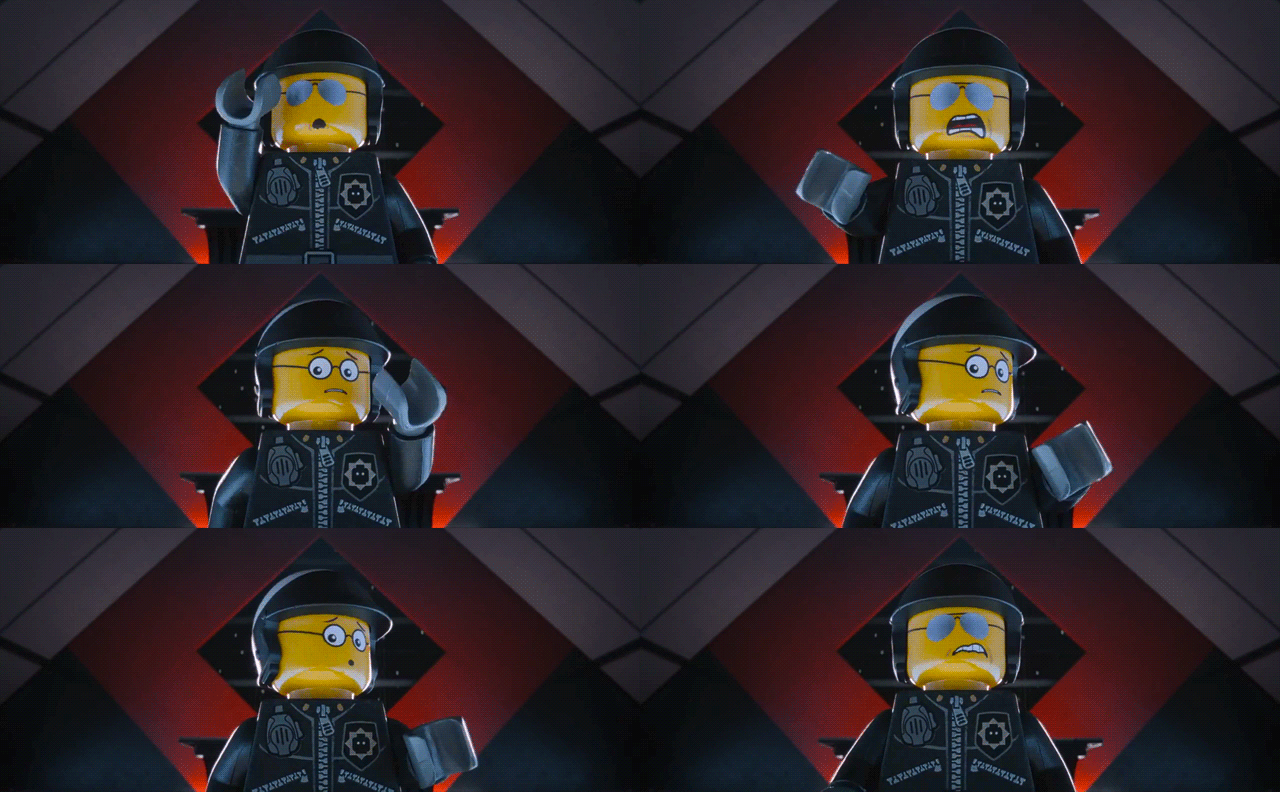
For example, it’s easy to describe the virtual camera’s lens in realistic terms. Its focal length is consistently small, usually with a narrow depth of field. This serves several purposes. For one, it enlarges the film’s scale by donning the illusion that the distances between foreground and background elements are longer than they appear. In the extreme close-up above, Bad Cop’s head (despite presumably being about a cubic centimeter in volume) appears almost life-sized, in part due to his helmet and the sides of his face being out of focus. The shot below it shows more of the questioning room and divides itself into three layers of depth, with Emmet in the foreground, Bad Cop in the middle, and gray metallic walls in the background. With only Bad Cop in focus, the shot feels deeper than it actually is. The room feels like an actual room, instead of a minuscule chamber of only a few square inches in floorspace. But more importantly, the film’s virtual lens behaves exactly like a real one.
Realistic analyses can also apply to the film’s lighting. The entire questioning scene is bathed in a harsh top light and the objects on-screen are illuminated as expected. Emmet’s hair and Bad Cop’s helmet reflect the light source, but they both have the surface texture of a matte plastic. The light striking the two would have to be extremely bright and concentrated to achieve such an effect. The darkness of the background as well as the shadows cast on their faces and bodies all imply hard top lighting as well.
The Stop Motion Aesthetic
However, committing to the stop motion aesthetic requires unrealistic abstractions that aren’t present in live action. For example, The Lego Movie will supplant traditional effects with Lego-only replacements wherever possible. One such effect is the motion blur, as shown below:
Here, Bad Cop/Good Cop alternates back and forth between his two personas, causing his head to spin quickly and erratically. While it’s hard to see in motion, a still frame of his face mid-spin shows motion lines and gestures painted on the head itself with the sharpness of a still object.
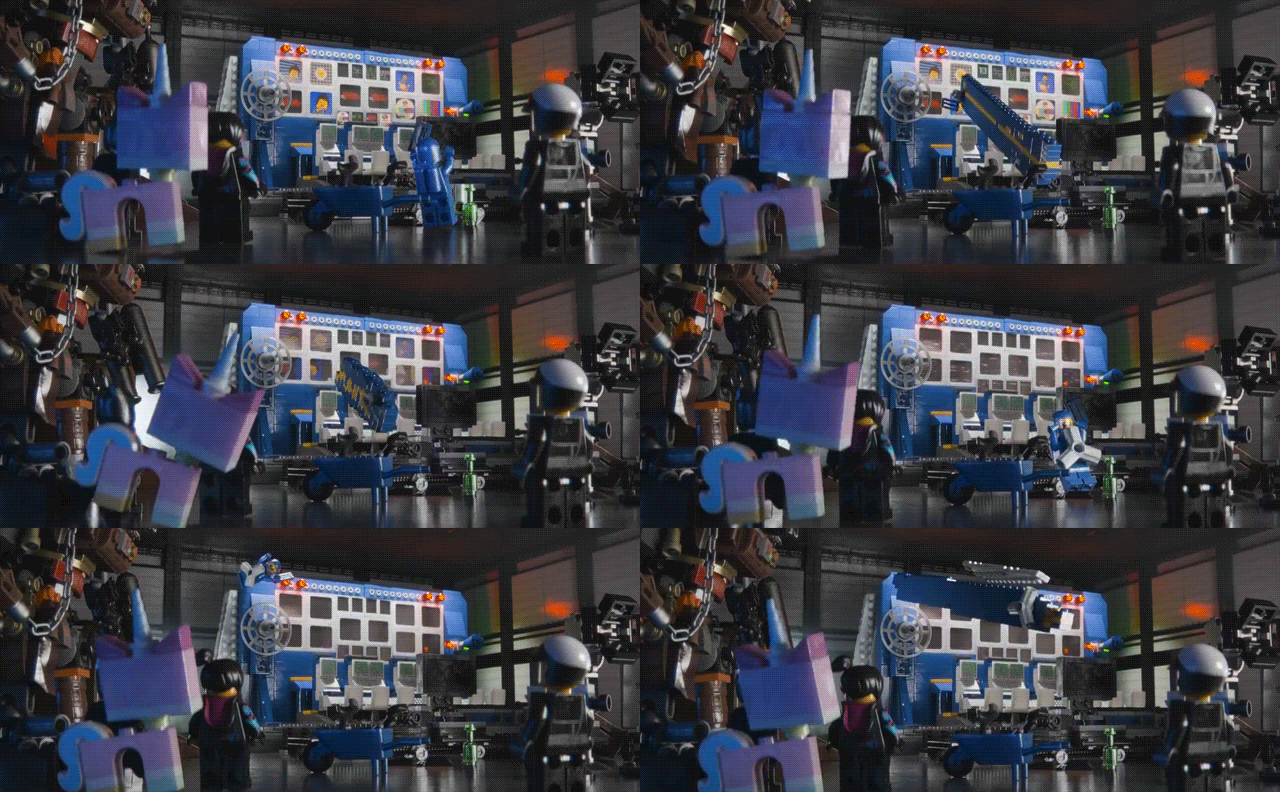
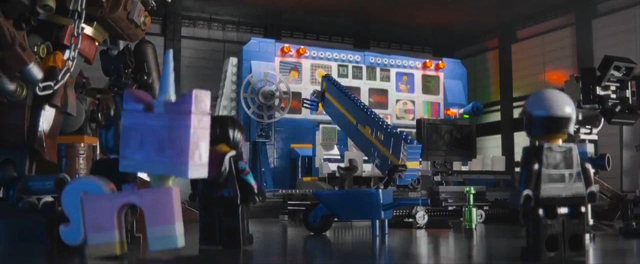
Another example is when Benny the Spaceman assembles a spaceship. Instead of his velocity translating on screen to blurry streaks, still frames show that Benny becomes a long strip of linear Lego blocks without any of the distortion indicative of motion blur.
So why does Bad Cop’s face change completely as he shifts personalities? Why does Benny dissolve into Lego strips as he skirts around? Once again, stop motion animation is essentially a sequence of photographs of still scenes. During the recording process, the camera never actually captures motion, like a video recorded with infinitely short shutter speed. Thus, motion blur or light streaks are rarely present. Instead, to convey speed, the animators incorporate artificial motion blur that is both motionless during capture and consistent with the Lego aesthetic.
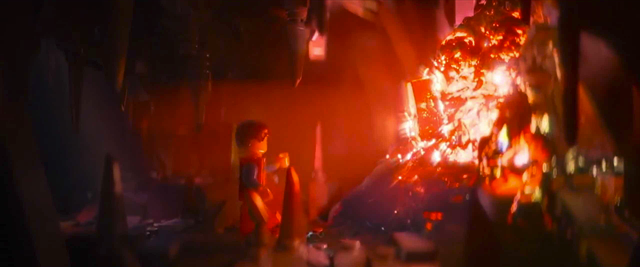
Particle effects such as smoke, water, and mud splatter are also replaced by their Lego counterparts. These aesthetic decisions stem from similar reasons as above. Effects such as smoke, running and splashing water, and splatters are rarely seen in their natural form in stop motion, as they’re impossible to manipulate frame by frame. Thus, they’re usually choppily and messily animated with alternatives such as tissue or gelatin. The Lego Movie recreates these effects with Lego for not only a more authentic stop motion aesthetic, but also a more consistent Lego world.
Computer Abstraction
So far, all discussion of The Lego Movie’s aesthetic is consistent with that of traditional stop motion animation. However, being a computer animated film, The Lego Movie accomplishes feats that are either impossible or impossibly difficult in both traditional stop motion and live action footage. The introductory shot that sweeps around Cloud Cuckoo Land as shown above would be almost impossible to capture with a physical camera, stop motion or not, due to the irregular, airborne path of the camera track and the countless legion of onscreen characters that must be manipulated. Computer animation makes this shot—among the many other hypermobile shots in the film—possible. These shots evoke a sense of grandeur and dynamic action that rarely grace live action films, which instead rely on quick cuts and shaky camera handling to convey motion. They build the fantastic aesthetic that is characteristic of a child’s imagination.
Aesthetic and Story
Imagine what The Lego Movie could have looked like in lazier hands. If it had been anothergeneric computer animated film, with each character being smoothly animated, slickly designed, polished representations of the toys that they were engineered to sell. Without the realism offered by the stop motion aesthetic to cement their identities as plastic toys, the story loses its charm and intelligence. But the larger than life abstractions of computer animation are also essential; they reinforce the creative spirit of this imaginary world, thereby validating the movie’s message of individual expression. The Lego Movie is a cheeky homage to stop motion animation that retains the cinematic grandeur of computer animation. Its aesthetic is just like its story, a stylish vehicle that portrays and enhances its themes and philosophy, and that’s exactly what an aesthetic should be.
by Wei Yi University of Chicago CMST 10100, Intro to Film Spring 2015
In the Mood for Love (2000)is a beautiful study in restraint. Set in 1960s Hong Kong, the film details the intimate relationship that develops between two lonely neighbours, Chow Mo-wan (Tony Leung) and Su Li-zhen (Maggie Cheung). Neglected and later betrayed by their spouses, they foster a special kinship which social mores dictate must be concealed. This is a society that operates not by brute force but by much more subtle ways; through its institutions, through the eyes and ears of one’s neighbors, through the personal values individuals feel compelled to uphold, and the dark desires they actively repress.
The restraint demonstrated by the characters, who are far too disciplined and respectful to enact any sort of revenge or vent their passions, is echoed by the understated nature of storytelling. Wong Kar Wai capitalizes on the cramped living spaces in Hong Kong, which erode the boundaries between social and private life, to create tension that drives the narrative – it is much harder to keep secrets when your neighbors live so close to you. This in turn shapes the way the narrative is told: since most of the dialogue is either vague or dishonest, the truth must be told another way. I wish to analyze how costume design contributes to the film’s overarching narrative and themes, often filling audiences in on what is left unspoken. The costumes are an outward manifestation of characters’ internalization of the gaze of others – of social responsibility and convention. From Su Li-zhen’s cheongsams to Chow Mo-wan’s suits, characters wear a uniform that projects how they wish to be seen by others. But we see that costumes also betray the secrets people keep.
The devil in the details
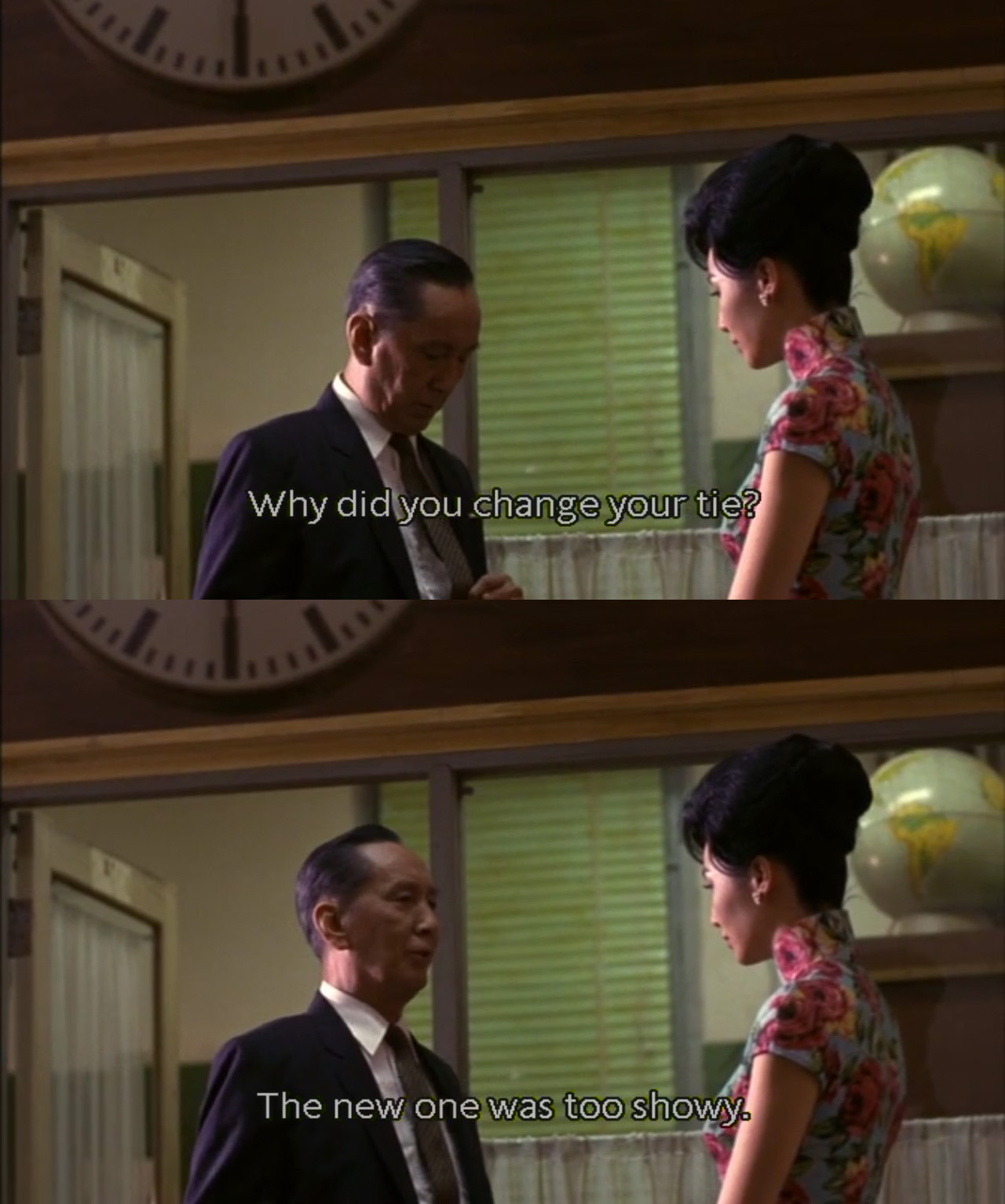
While pursuing the suspicion that her husband and Chow’s wife are having an affair, Su Li-zhen facilitates the infidelity of her boss. In one scene, she informs him that his wife will be at the restaurant at 5.30pm, and hands him a gift from his mistress. Presumably the gift is a tie, because Su Li-zhen casually remarks on it when she returns from getting him coffee:
Later, she catches him as he leaves the office to have dinner with his wife:
In other words, the new tie might have exposed his affair to his wife. This scene hints to us how Su Li-zhen discovered her husband’s infidelity, which is confirmed later in the film. This scene is also significant because it signals to audiences that there is intentionality on the filmmakers’ part in such minor costume details as the choice of tie for a certain actor in a certain scene – you notice things if you pay attention.
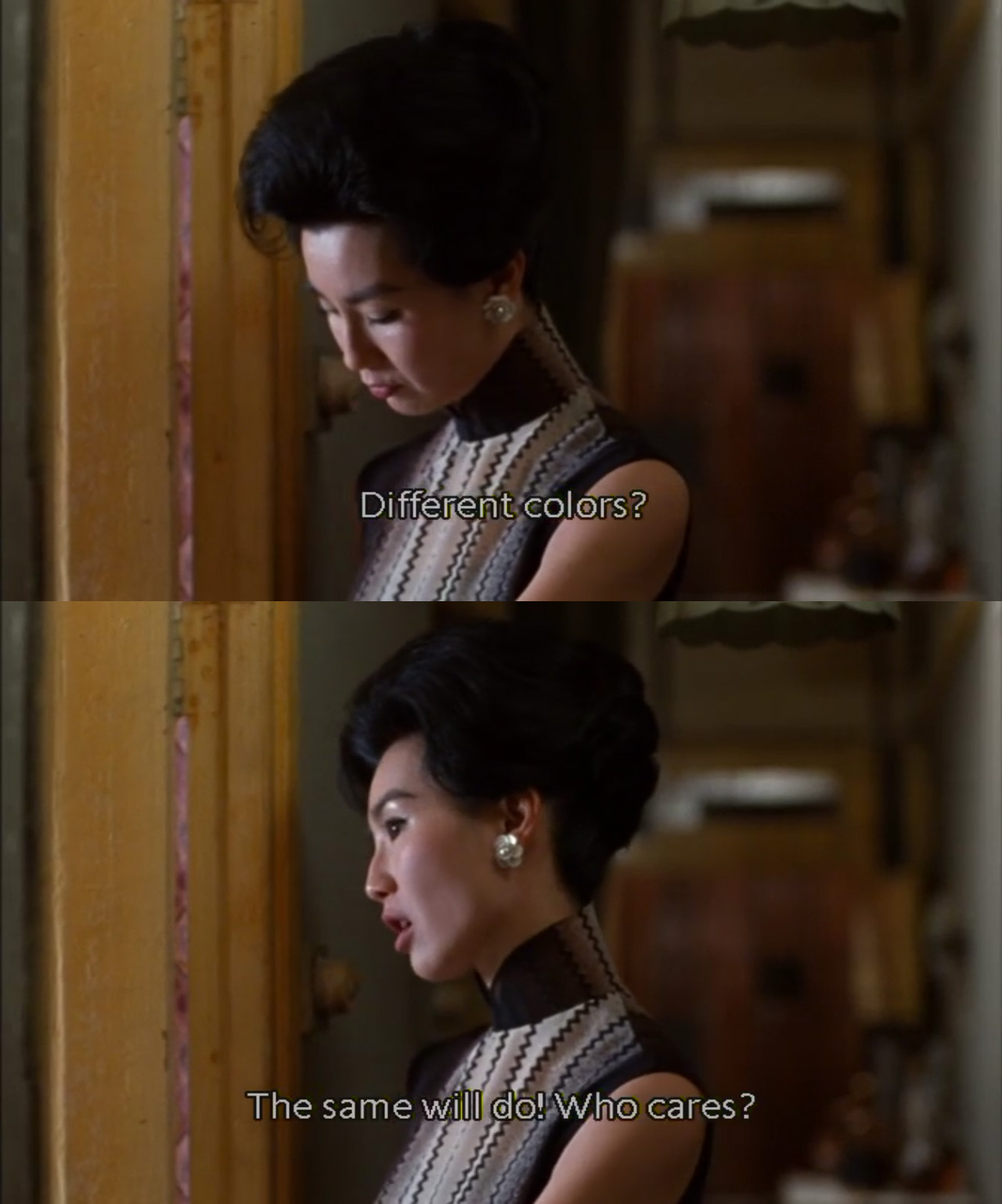
The infidelity of Su Li-zhen’s boss is employed as a parallel to the affair between her husband and Chow’s wife, often used to foreshadow the realization of the latter. Earlier in the film, Su Li-zhen asks her husband to bring back two handbags from Japan for her boss, one for his wife and one for his mistress:
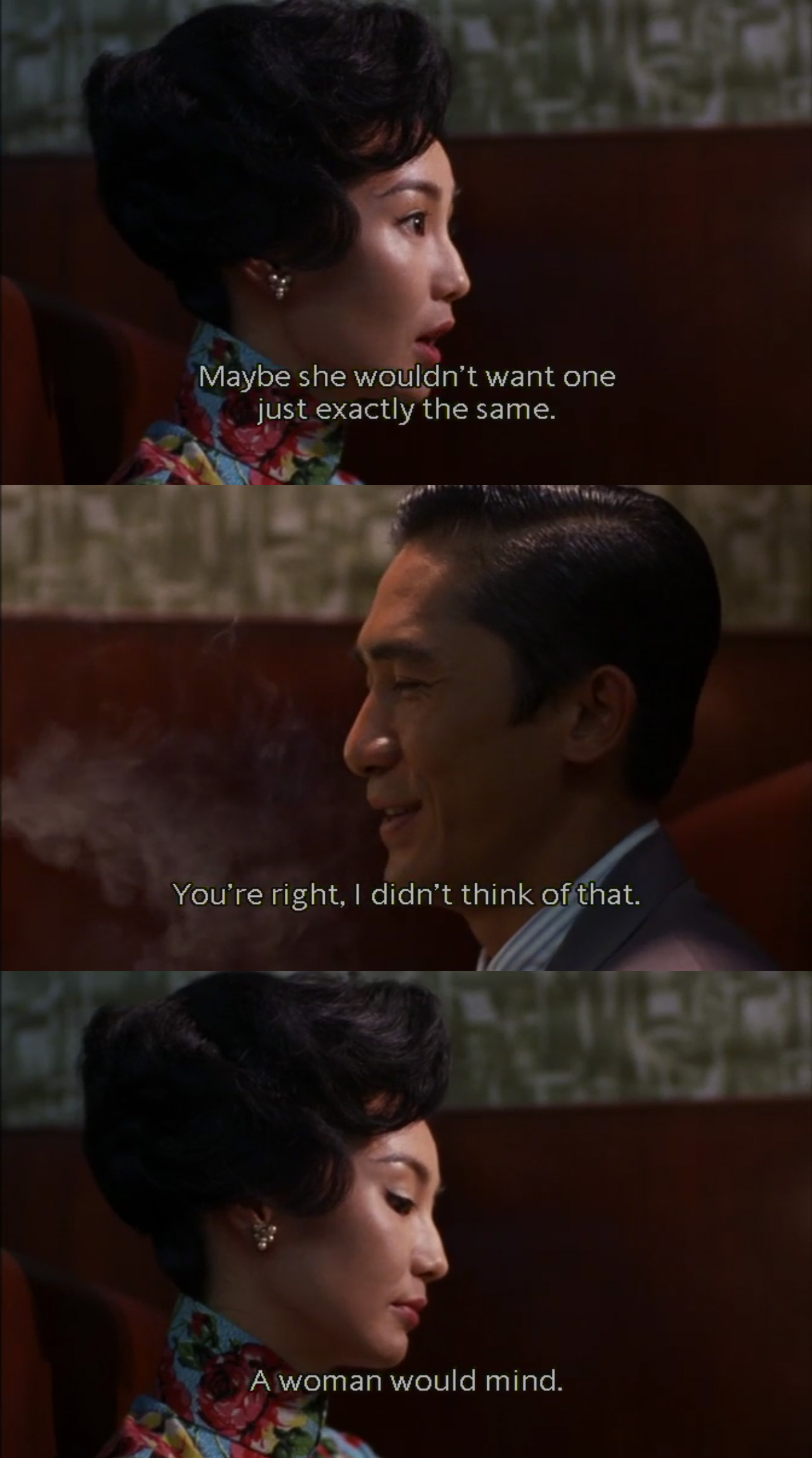
Later in the movie, Chow asks where he can purchase her handbag for his wife:
She would mind, because she knows what it means to have the same handbag as the woman who lives next door, and to see their husbands wearing the exact same tie. Chow knows too; in this scene we discover that despite his verbal dismissals, he is not so naïve as to ignore the evidence before his eyes. He simply plays the fool before the eyes of others. Their astuteness becomes apparent; later on they use their attentiveness to detail to engineer a moment of deception, when Su Li-zhen changes into heels and leaves her slippers in Chow’s apartment to fool the landlords, who return home earlier than expected. The knowledge that any little detail could be used against you is perhaps why both of them take such great care with their own appearance.
Playing dress-up
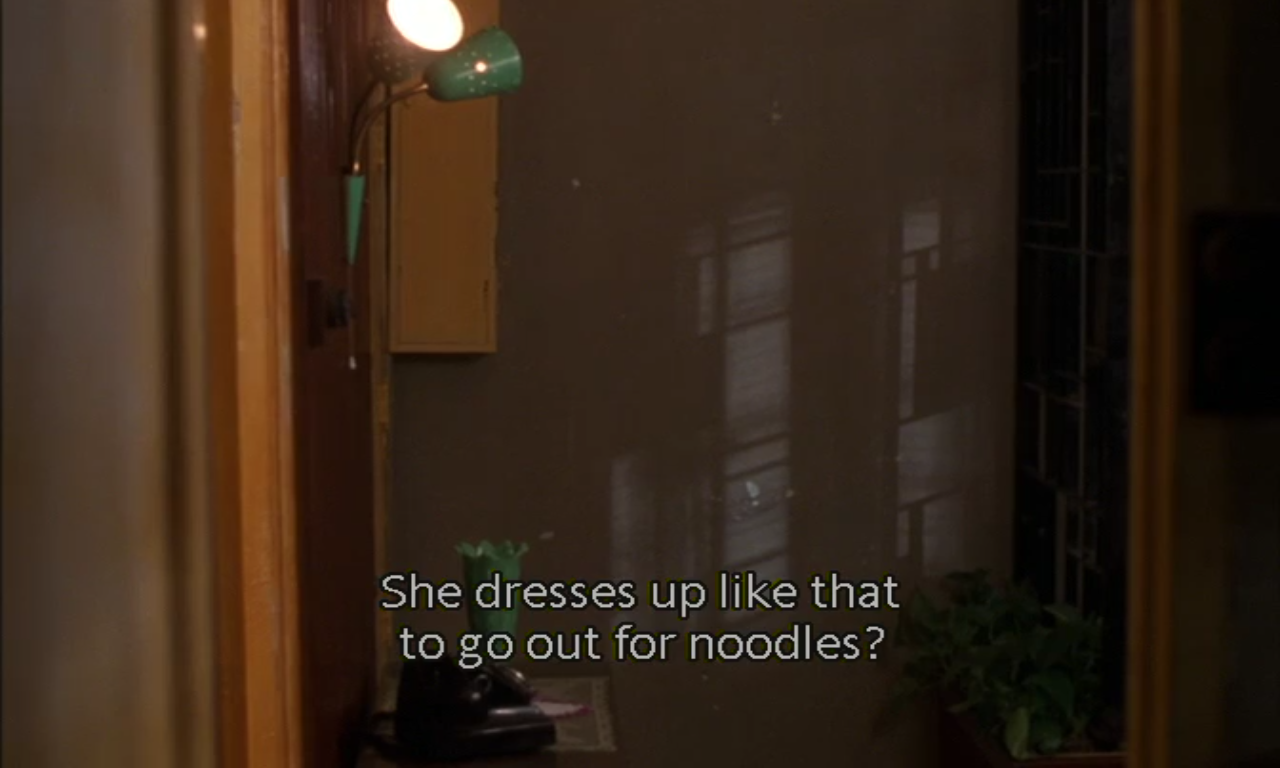
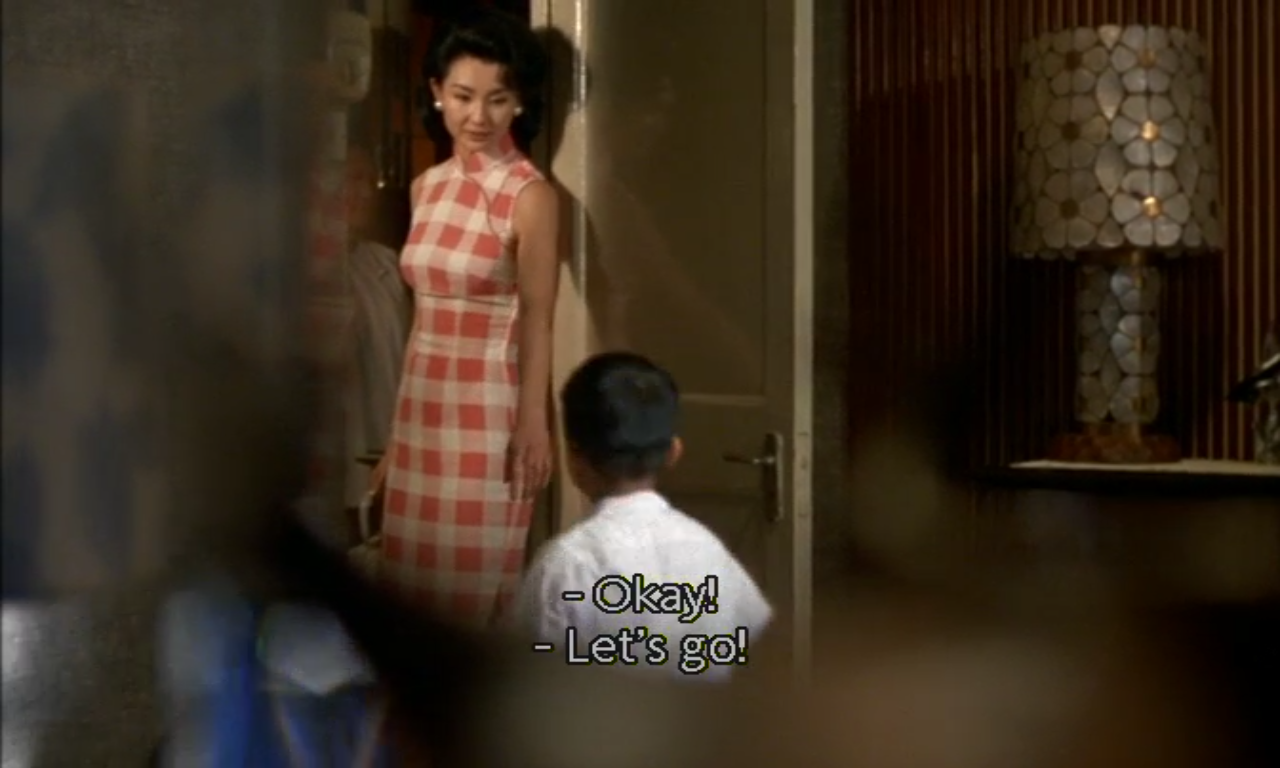
This humorous remark by one of the landladies implies that Su Li-zhen’s commitment to her uniform of beautiful and restrictive cheongsams is distinctive not just to audiences, but to other characters as well. Su Li-zhen alternates between 21 cheongsams over the course of the film (though some of them only appear in one scene), and her wardrobe is one of the most visually arresting elements of In the Mood for Love. Here they are in order of appearance:
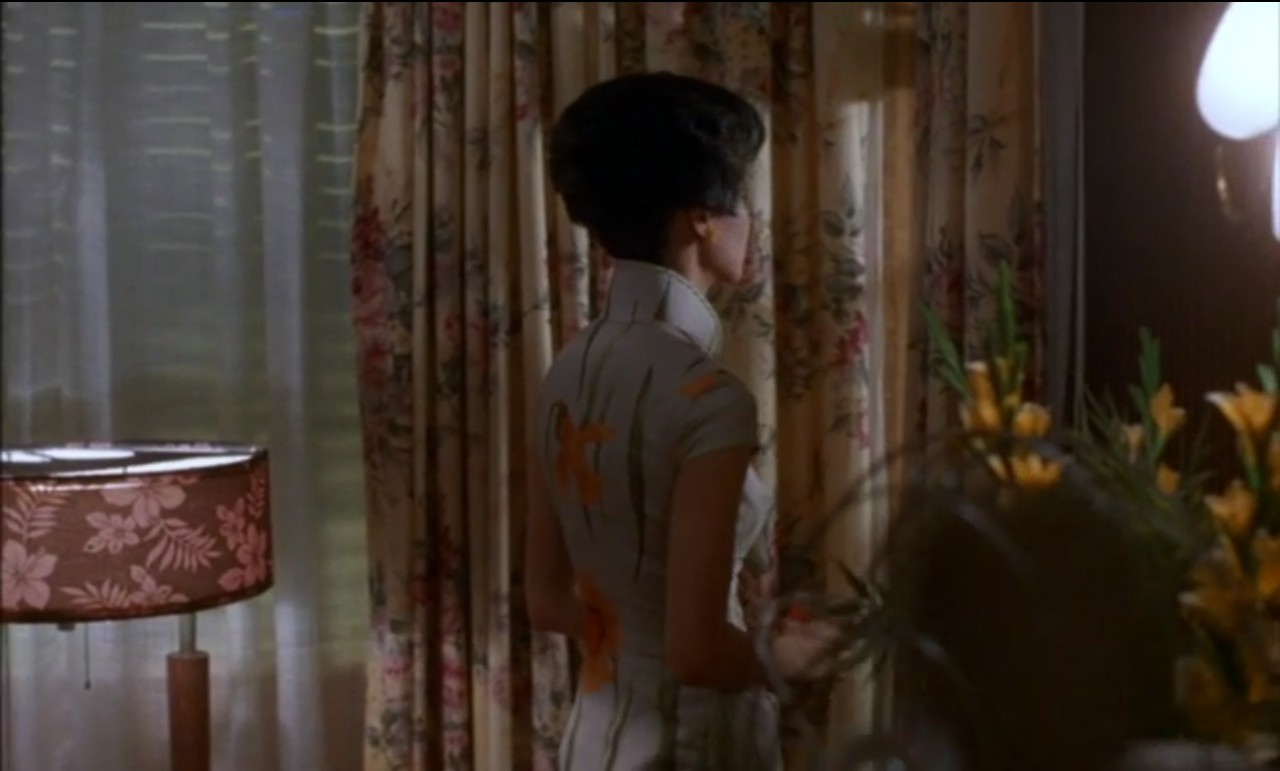
Given that the film returns to the same few interior or nighttime sets (the apartments, their offices, the noodle stand, the corridor) again and again, Su Li-zhen’s changing dresses help indicate to us the passage of time. Often they complement the rest of the mise-en-scène, such as this instance where yellow flowers in the room are echoed by her dress:
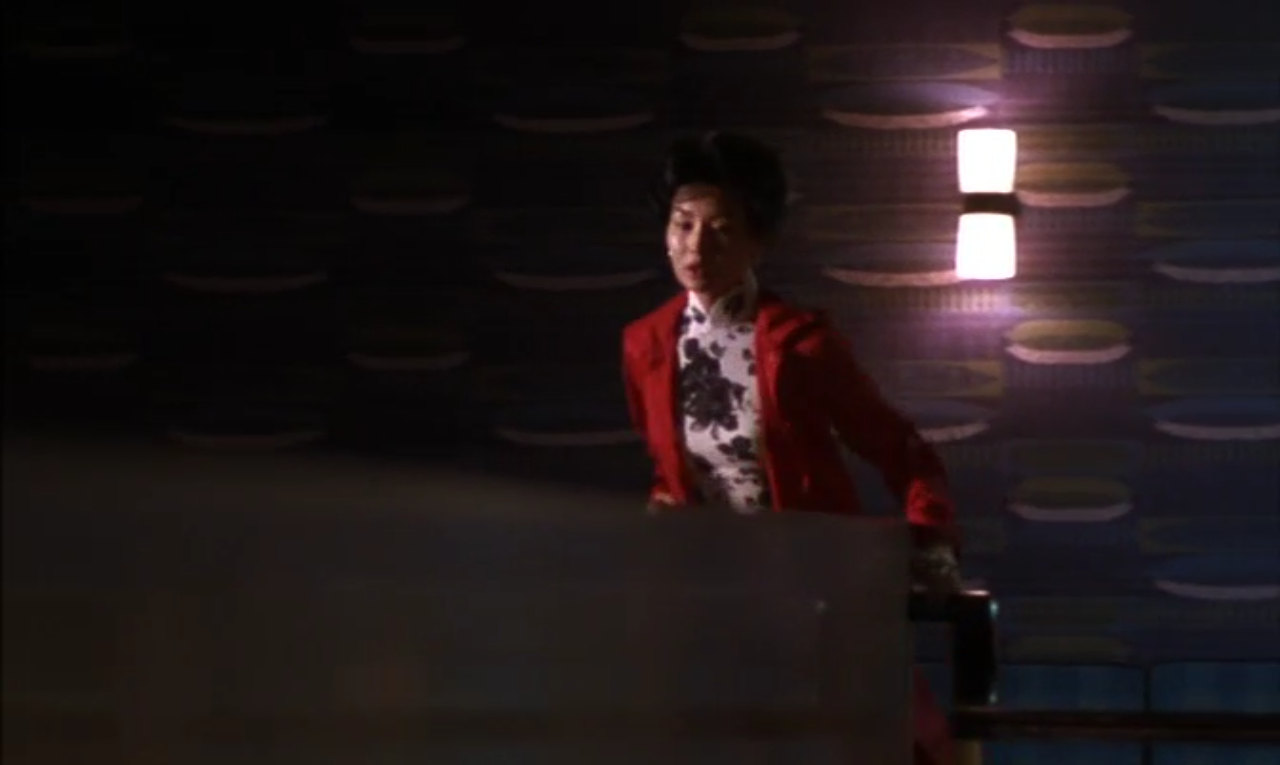
Form-fitting and elaborate, with unusually high collars that can resemble a neck brace, Su Li-zhen’s cheongsams reflect how incredibly self-conscious she is about her image and the restrictions she places on herself in order to ensconce herself in Hong Kong society, especially compared to the more varied and Westernized attire of Chow’s wife. The uniformity of her appearance means that deviations from trend are significant. At a pivotal moment in the film, when visiting Chow after he has been missing for several days, she dons a red coat. The feelings she has for him, that she had previously suppressed, are finally revealed – she literally wears her heart on her sleeve.
Four years later, we note the plainness of her last two cheongsams relative to the others, the lower collar, and a new hairstyle:
This is the last time we see her. The intertitle immediately preceding this shot reads: “That era has passed. Nothing that belonged to it exists anymore.” Su Li-zhen, by choosing to uphold her public status at the expense of her personal feelings, is able to reintegrate back into society and move into a new stage of her life: motherhood. We have traced the evolution of a character in the way she dresses.
We can do the same for Chow Mo-wan. His uniform consists of a suit and tie, hair slicked back and neatly parted, and an opaquely polite smile:
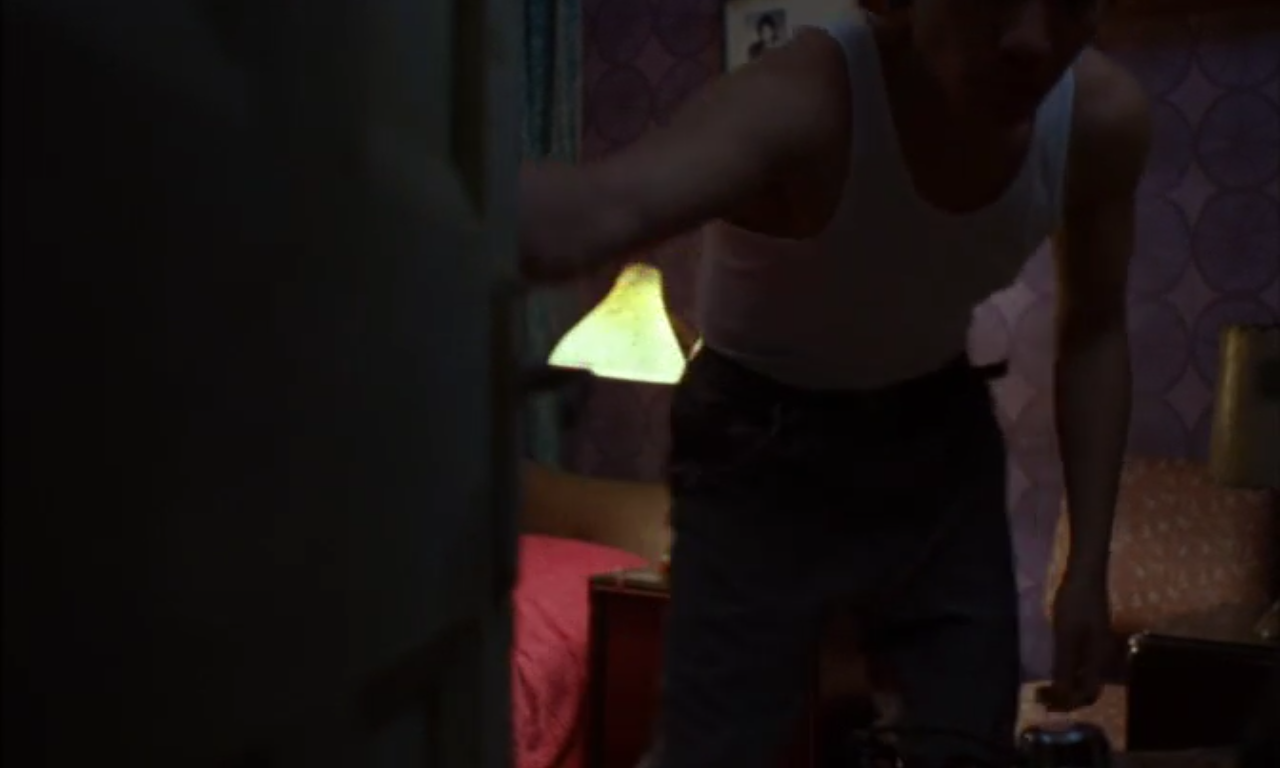
Like Su Li-zhen, Chow is also very conscious of external chatter, and he is as reticent in private as he is among his neighbors. In a rare moment, we see Chow in a singlet reading a letter from his wife, who is in Japan with Su Li-zhen’s husband. He crumples up the letter and shuts the door on the camera:
As a storyteller, Wong Kar Wai is insistently indirect; often the camera seems to be just outside the locus of activity, like a voyeur peering into the private lives of these individuals. Audiences, too, are implicated in the intrusiveness of the public eye.
Gossip and unrequited love drive Chow away from his apartment to Room 2046. When seeing Su Li-zhen out after her visit, we notice that his normally perfectly gelled hair is partially undone:
Given that at no other point has he had a single hair out of place, we can infer that this is a deliberate costuming decision. The internal conflict between his personal desires and his social obligation as a married man has caused him to come undone. Chow cuts himself off from society – he even stops going to work – and eventually leaves Hong Kong entirely, retreating to Singapore. Since he cannot reconcile his public and private lives, he chooses instead to live in exile, only returning years later.
As long as you both shall live
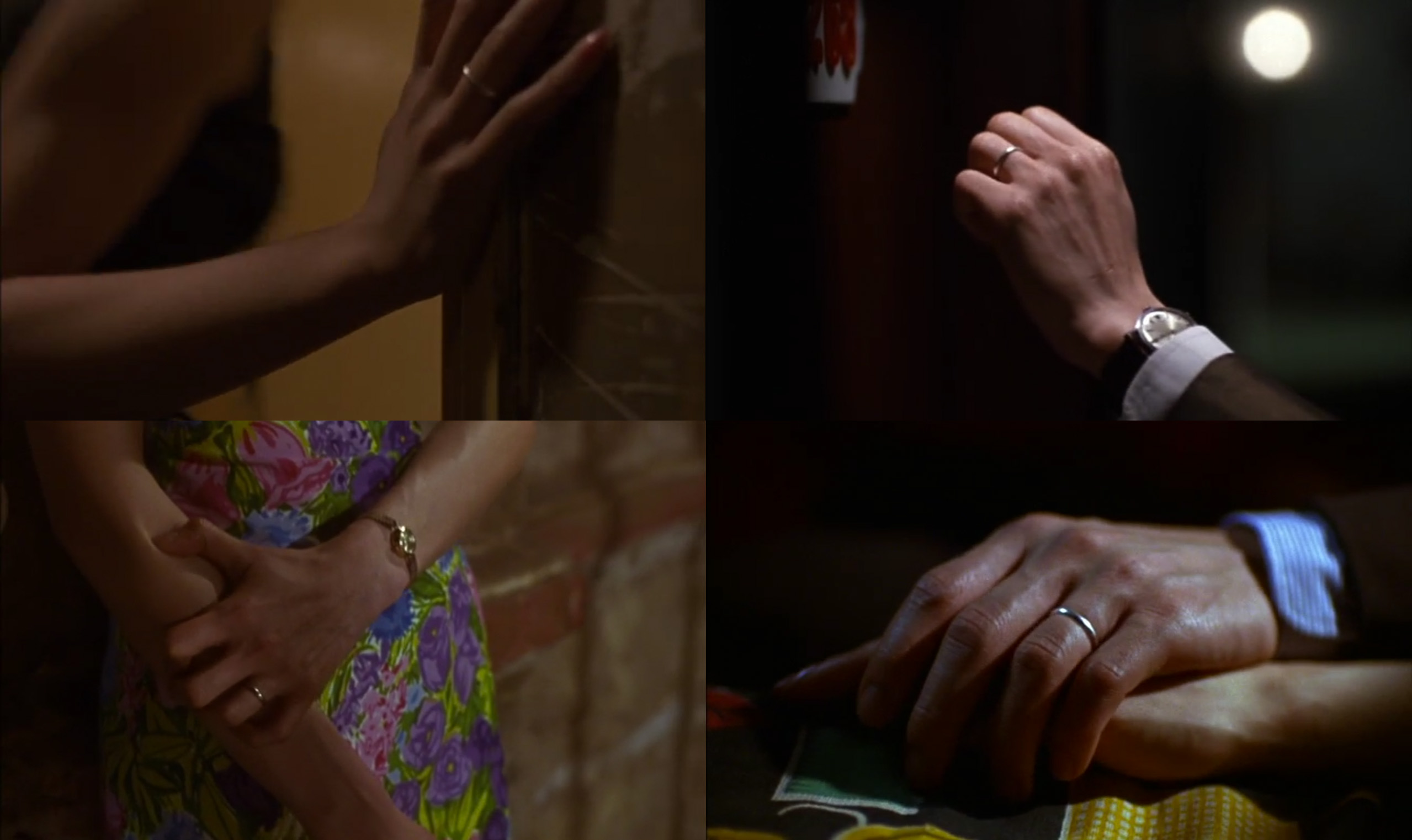
In the Mood for Love is about a love story that never happened. We observe that the relationship between Su Li-zhen and Chow Mo-wan, flush with emotion and possibility, remains unfulfilled within a society that conspires to keep them apart. Yet we also observe the agency by which they determine this outcome. Just as their spouses decide to defy the promises they made in marriage, Su Li-zhen and Chow Mo-wan actively chose to terminate their relationship. The institution of marriage casts a heavy shadow over the actions of these characters, and it is visually depicted in the multiple close-ups on wedding rings we see throughout the film:
Notably, rings are always shown worn on the hand, never removed from it. When the relationship between spouses begins to break down, the rings that once signified a great love become a reminder of a social obligation, an observed and observable commitment. They are therefore tied to image, reputation, integrity – socially determined characteristics. Unwilling to relinquish the moral high ground to their cheating spouses, the bond between Su Li-zhen and Chow Mo-wan ultimately becomes a secret whispered into the hole of a tree: an unrealised wish, a blurred memory.







![[Figure 1]](https://intermittentmechanism.blog/wp-content/uploads/2015/06/screen-shot-2015-06-05-at-20-32-25.png)
![[Figure 4]](https://intermittentmechanism.blog/wp-content/uploads/2015/06/screen-shot-2015-06-05-at-20-32-44.png)