by Mimi
University of Chicago CMST 10100, Intro to Film
Spring 2020
Clueless by Amy Heckerling includes some of the most memorable costume design from the 1990s. Anyone who has seen the movie, even if they cannot remember a specific outfit, remembers the fashion as distinctly bold and of the moment. The movie is about a girl who loves shopping, so naturally the costumes reflect that. I counted and the protagonist, Cher Horowitz, wears 42 distinct outfits throughout the movie. That is a new costume roughly every two minutes. These outfits, and those of others in the movie, provide insight into character, demonstrate relationships and showcase the power of fashion for a teenage girl with a credit card.
Mad for Plaid
The most iconic outfit of this movie, one that has been recreated over and over, and still sells as a Halloween costume is, of course, Cher’s yellow plaid coordinated school look:

The first thing Cher does at the beginning of the movie when she’s introducing herself to the audience is to put together this outfit. This costume says a lot about Cher. For one, it speaks to a level of perfectionism. There are several pieces in this outfit and they all perfectly match with each other. Even her chewing gum matches.

Not only is the outfit coordinated within itself, but it is coordinated with her location. It’s a plaid schoolgirl-esque outfit and she’s wearing it to school. Cher sports a number of these looks throughout the movie, exclusively at school.

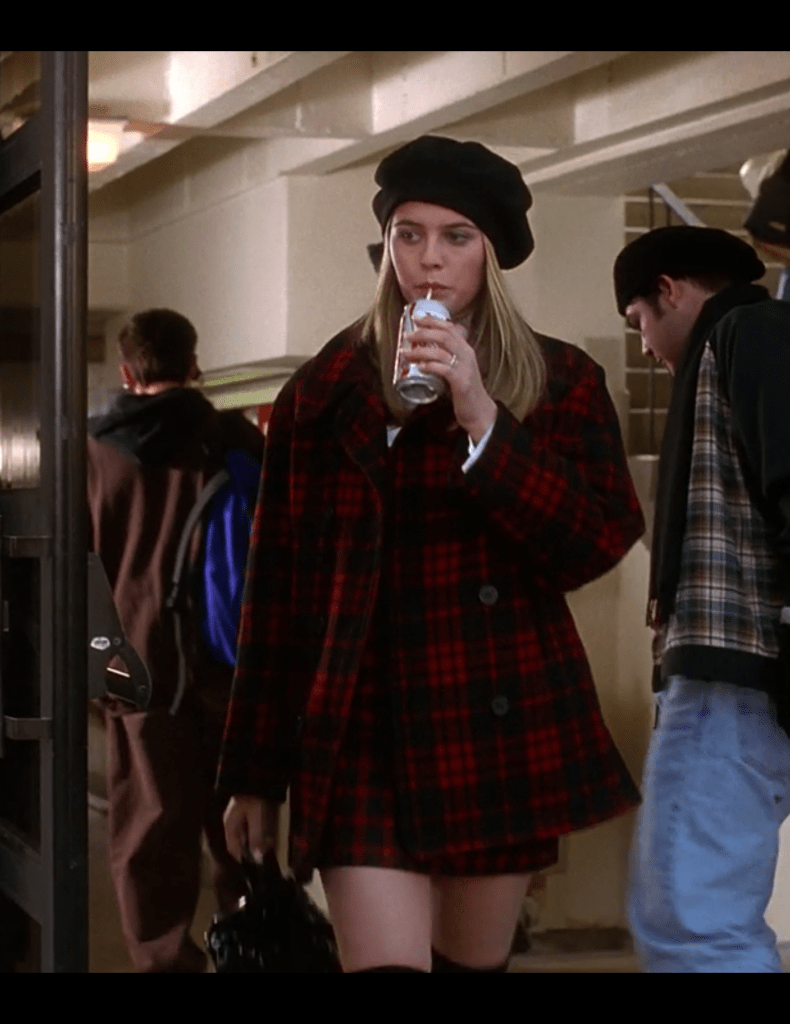

She is someone who cares about and knows how to dress for an occasion, and plaid becomes a signifier of that in the movie. She even has coordinated plaid pajamas!

We see other characters adopt similar looks but always in relation to Cher. The outfit Dionne is wearing when she is introduced is also a coordinated plaid schoolgirl look, showing her and Cher’s affinity and their like-mindedness when it comes to the importance of fashion. It’s significant however that Dionne never wears a coordinated plaid outfit again. For Dionne, plaid serves only to demonstrate her connection to Cher.
Tai’s first post-makeover outfit at school includes a plaid skirt and color coordination. Cher has transformed Tai in her image and the outfit reflects that. Later in the movie, when Tai reveals her crush on Josh and is seen flirting with him, she wears an entirely coordinated plaid schoolgirl look.


This second plaid outfit is a culmination of Tai threatening to replace Cher’s status, beginning with her increased popularity after her dramatic experience at the mall and coming to a head with trying to usurp Josh’s affection. The callback outfit shows how much of a threat Tai is to Cher, and the power that Cher’s makeover had on Tai’s social status. The rest of the movie, Tai wears no plaid.
In fact, the only other major character who wears plaid as consistently as Cher is Josh. With Josh however, it is not a coordinated, event-appropriate outfit. It’s grungey plaid flannels fit for a Nietszche-reading college freshman.

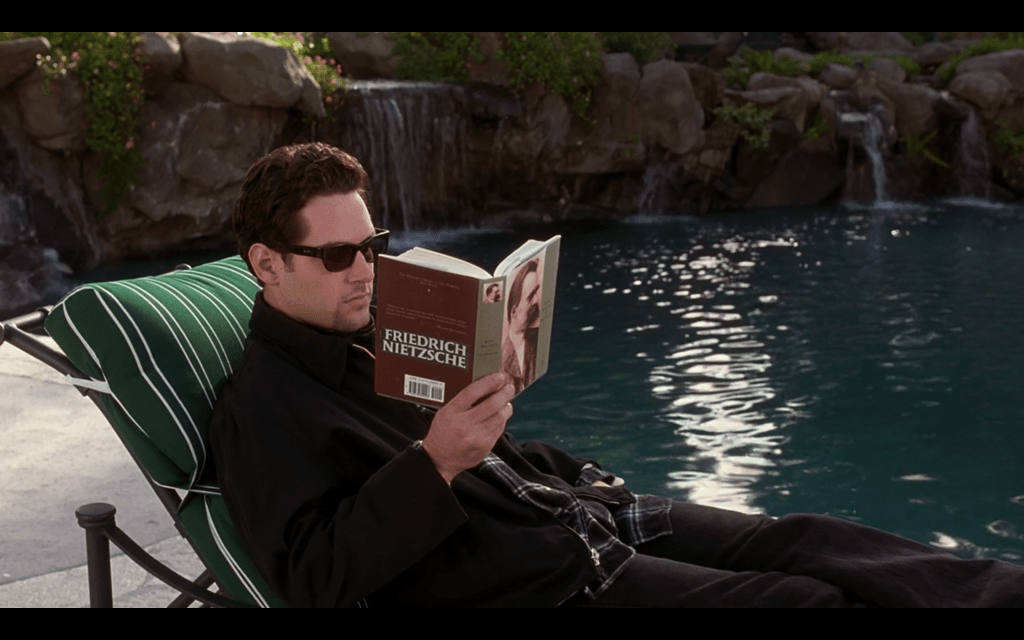
On Cher, plaid highlights her dedication to perfection and fashion. On Josh, plaid shows a similar dedication to aesthetic but that of someone who “doesn’t care” about fashion. He aggressively signals the opposite message that Cher does, but with the same pattern. The way they both employ plaid shows how their characters are different sides of the same coin. They have differing world-views but at the end of the day they have an undeniable chemistry and compatibility. Their matching plaid outfits visually demonstrate this for the viewer.
My final note on plaid is on how it coincides with Cher’s growth throughout the movie. At the beginning of the movie she is a somewhat silly schoolgirl who emphasizes appearance and shallow approval too much, and her schoolgirl plaid skirts reflect that. After realizing this about herself and performing her “makeover on her soul” Cher has ditched these schoolgirl skirts and now almost exclusively wears pants. However — plaid pants!

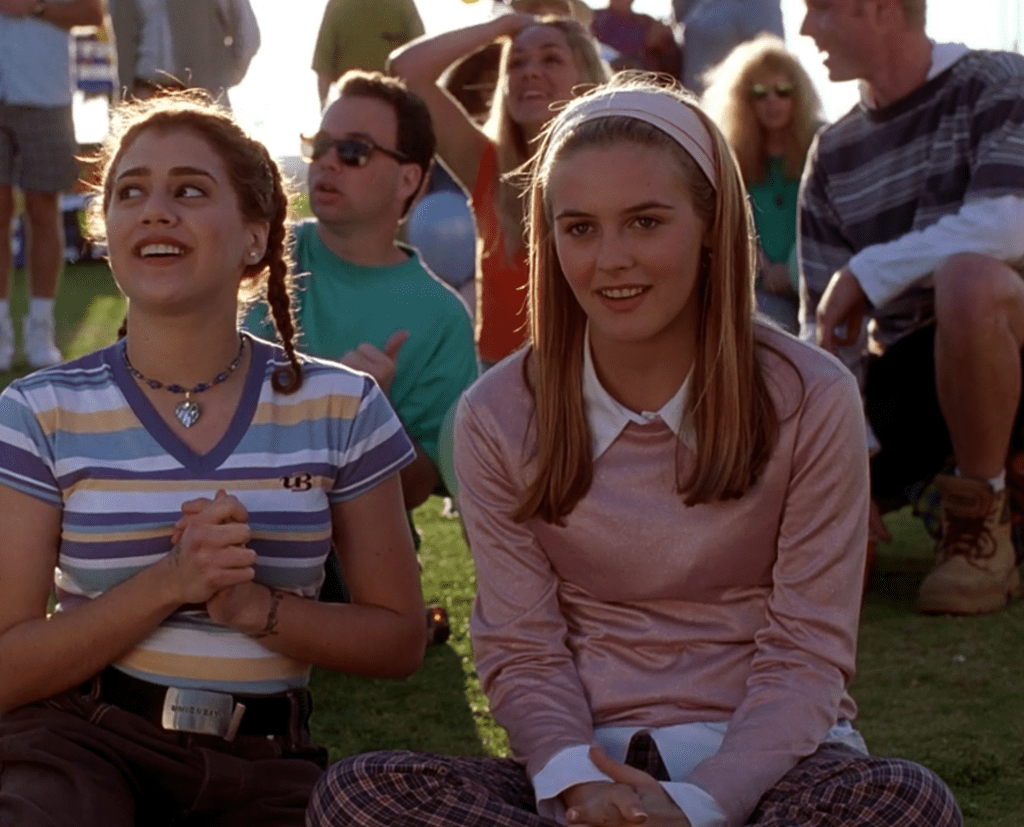
She has not abandoned her love of fashion or her perfectionist ways. Cher is more serious and grown-up but she still remains true to herself and her love of fashion, and the proof is in the plaid.
Cher as a Beau Ideal
Cher isn’t the only fashionista at Beverly Hills High. Every single peripheral character has their own fashion statement. These peripheral characters are largely fleshed out through their fashion and serve as foils to Cher’s clothes. Through their clothes these side characters establish their own personalities, and when compared to Cher’s clothing, carve out nuances in her character as well.
Take Dionne as an example. Clearly, she is just as fashion-conscious as Cher, and that is their main bonding point. However, her clothes are typically more garish and revealing than Cher’s. For instance, she accessorizes with plastic-looking hats where Cher leaves herself unadorned.
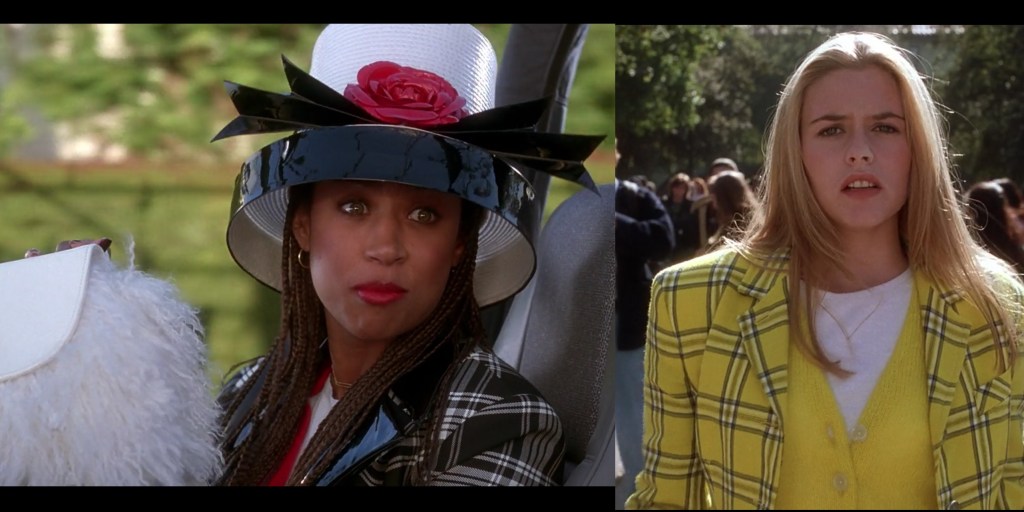
Where Cher wears short schoolgirl skirts Dionne does the same but in pleather and with fishnets.

Dionne matches the thread in her braids to her top, in equally bright colors. At the same party, Cher wears a bright bold outfit but in a solid color, and her hair is in an elegant and effortless updo.

Dionne’s actions go along with her brighter, bolder, and tackier style. She gets in dramatic fights with her boyfriend for everyone to see. She is also bad at driving, but to the point where she has a screaming fit on the freeway. Cher has similar qualities – being whiny with Josh and running through stop signs come to mind – but hers are more subdued than Dionne and in general Cher has a more genteel demeanor. Their clothes reflect this and provide a visual aid that establishes these aspects of their personalities.
Another peripheral character that really sticks out through her clothing is Amber. I discussed previously Cher’s coordination and perfectionism, and Amber shares those qualities when it comes to her fashion but takes it to an extreme level. Look at this outfit:
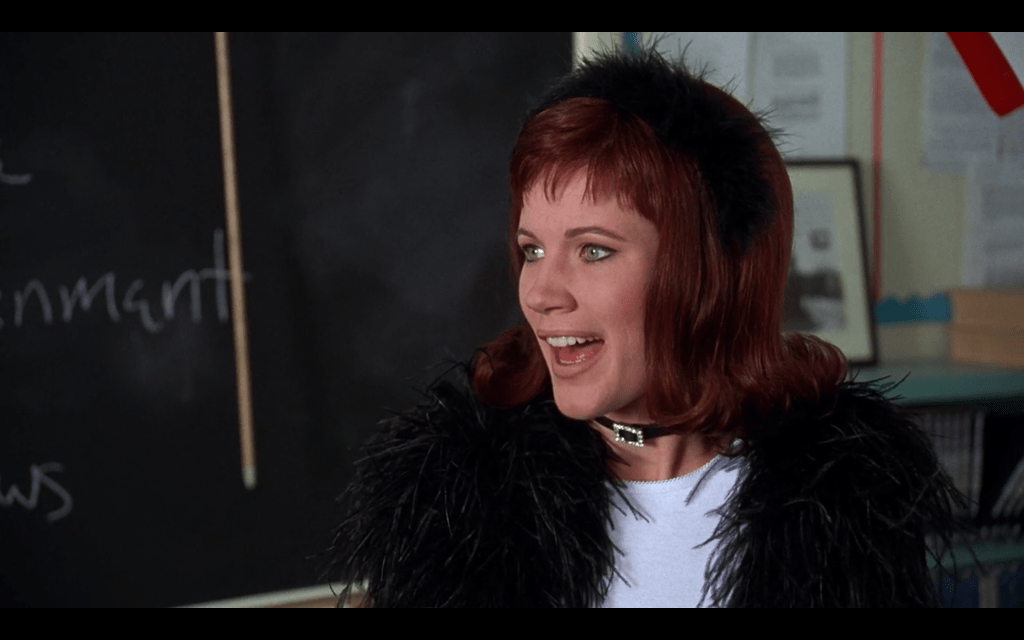

It’s a callback to an earlier scene when Cher is picking up Dionne for school and pokes fun at her hat saying, “Shopping with Dr. Seuss?” and Dionne retorts “Well at least I wouldn’t skin a Collie to make my backpack!” holding up Cher’s fluffy purse. Amber has a similar purse, but much larger, and her entire outfit is constructed around that material. Not only is she coordinating to an extreme level, but with a fabric established within the world of the movie to be gaudy and over the top.
All of Amber’s outfits are meticulously coordinated like this, to the point where it becomes cartoonish:


Also, her hair is always perfectly coiffed, with obvious effort and a lot of hairspray going into it.


This stands in contrast to Cher’s easygoing blonde locks that seem to effortlessly fall from her head looking naturally beautiful.
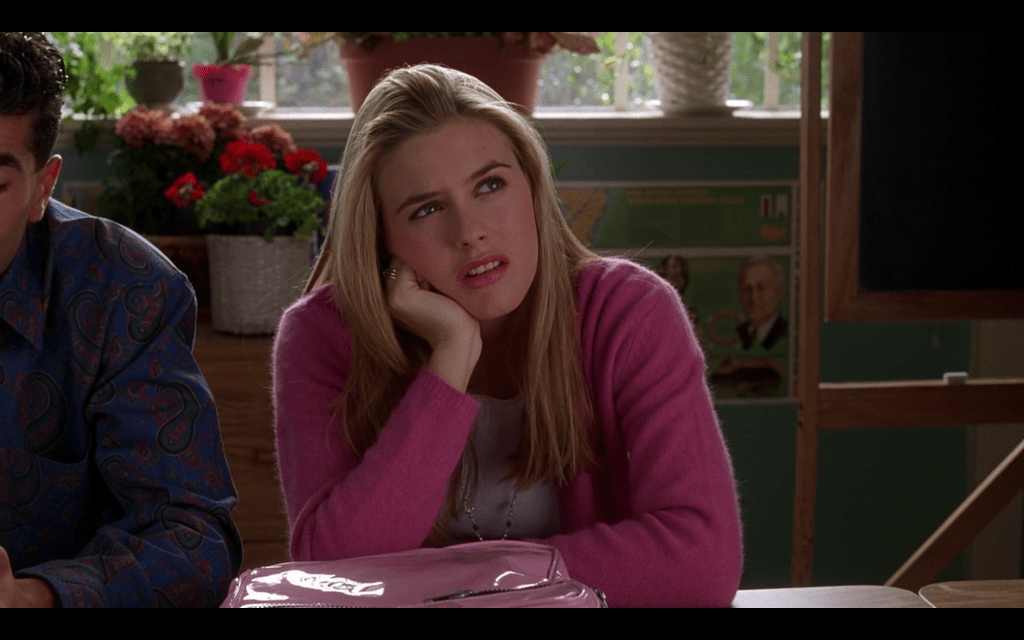


Amber has even less screen time and fewer lines than Dionne, but her personality is clearly demonstrated through clothing. She is attention-seeking, image-obsessed, and lacks elegance. All of these traits are established through her boldly cartoonish looks that portray her as a “fashion victim.” Cher, in contrast to Amber is much more effortless and stylish. Although Cher’s outfits are meticulously accessorized and coordinated, she knows when to stop.
A famous saying in fashion, from Coco Chanel, is “Some people think luxury is the opposite of poverty. It is not. It is the opposite of vulgarity.” Chanel’s designs were known for their luxurious elegance and effortless class. Cher’s outfits in contrast to Amber’s and Dionne’s show this side of her. They establish her as more level-headed and mature in comparison to her friends and place her as the beau ideal of fashion and teenage girlhood at Beverly Hills High.
A Sense of Control
Right after Cher and Dionne meet Tai, they offer to give her a makeover. Tai originally declines and, among their pleas, Dionne says this about Cher:

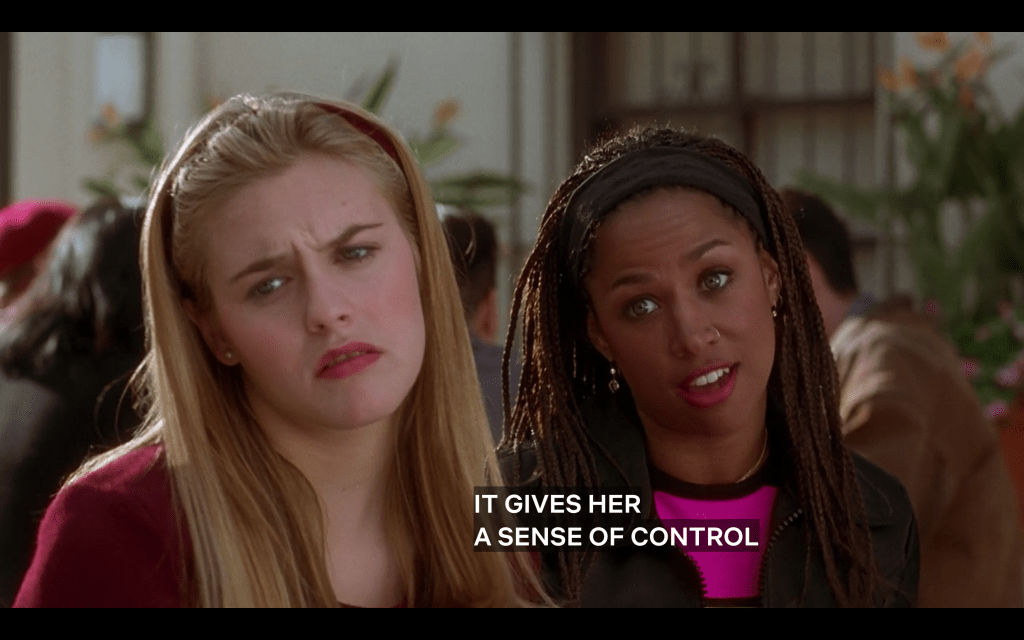
More than just makeovers, the movie shows time and time again how Cher gains a sense of control through fashion and shopping. The first thing we see her do is assemble the iconic yellow plaid outfit. Perhaps even more than the outfit, the process of choosing the outfit reveals Cher’s character. She has a computer system in her room that scans her clothes for mismatches and provides a mockup of her wearing the clothes.
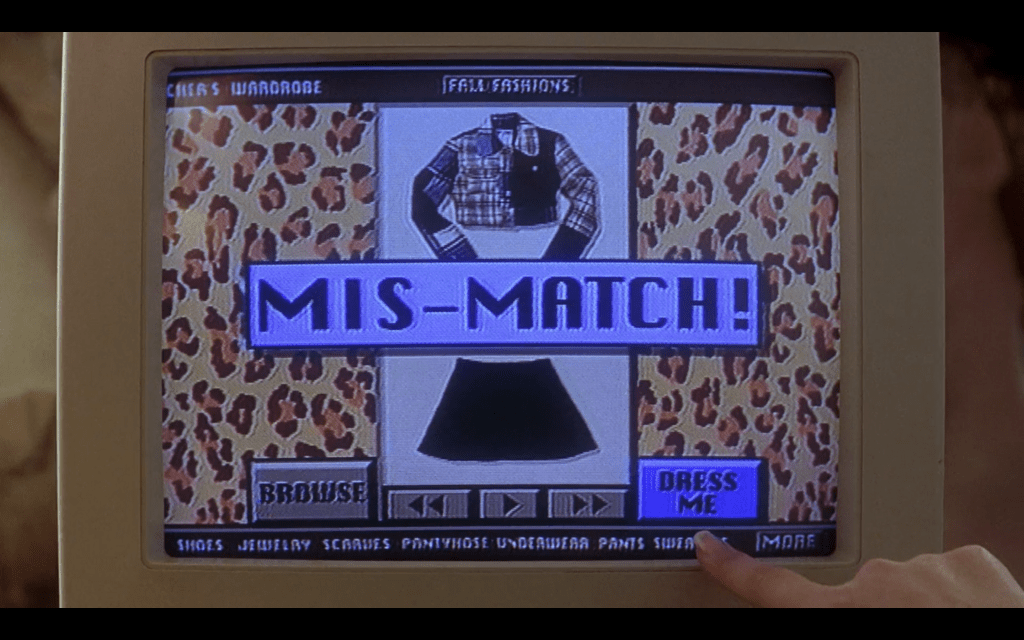
Cher is a savvy woman who seeks control over her life through clothing. She treats fashion as more than a hobby. It is something that involves precision. There are right and wrong answers. It is a tool for her to wield, and the most important one in her arsenal.
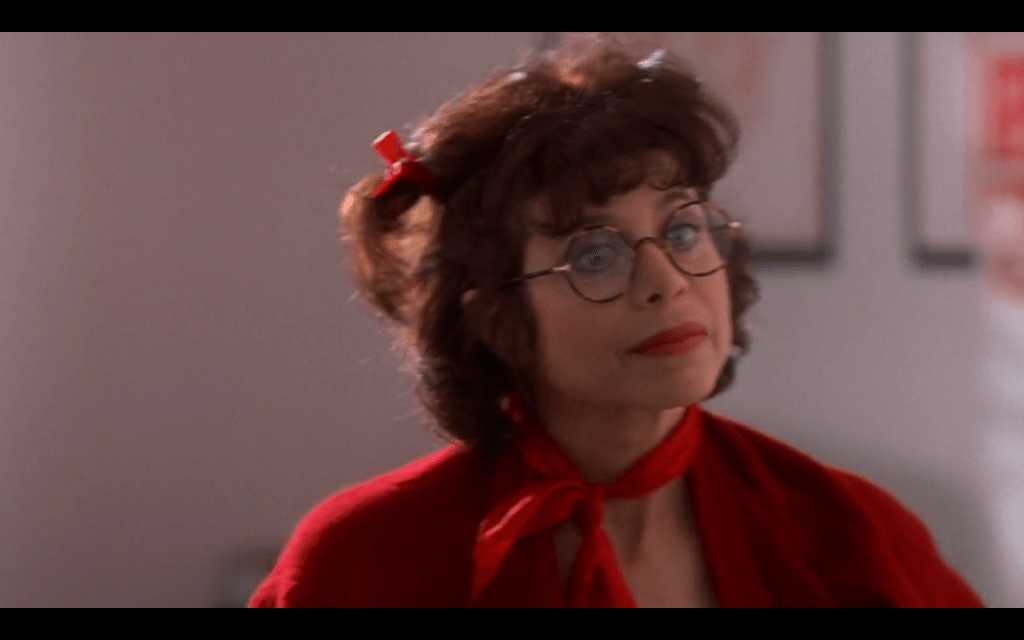
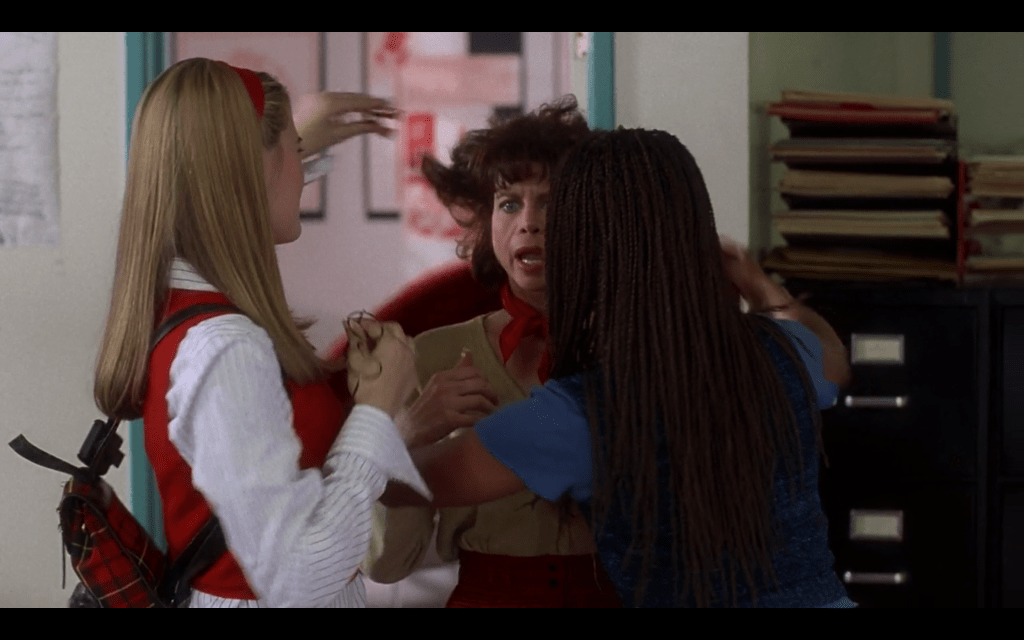
Cher demonstrates this ability to use fashion as a tool for her own gain when she gives her teacher a makeover. Her grades are lackluster in two classes, so she gives one of those teachers a makeover and sets them up with each other, and sure enough, they change her grades in her favor.
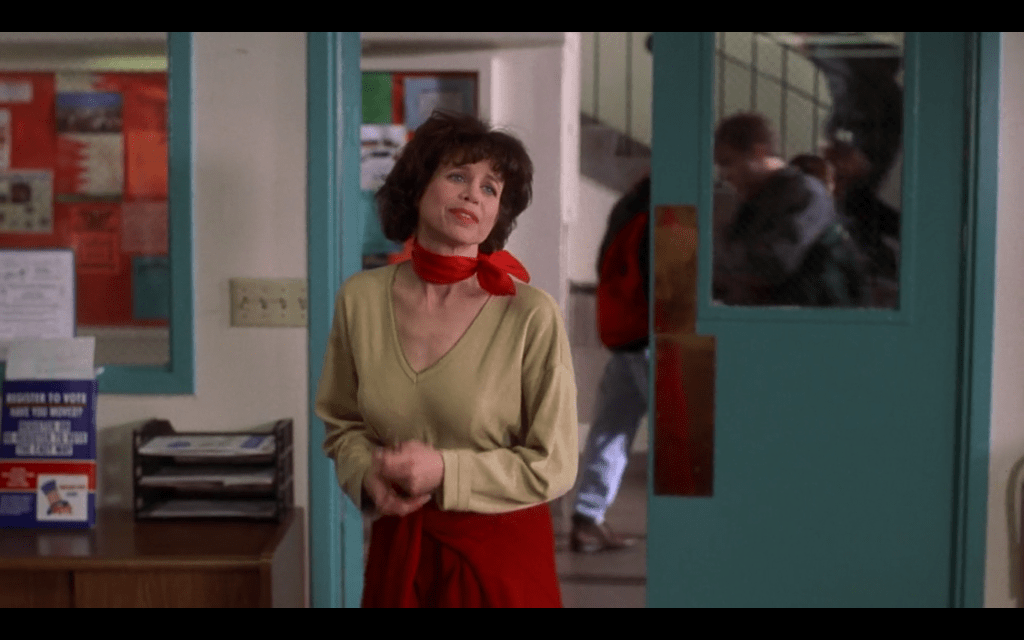
Later, Cher uses fashion to control a situation with her father. When Christian picks her up to go to a party, her Dad tells her to cover up because her clothes are too revealing. Cher obliges, but covers up with a see-through garment. Here she uses clothing to stop a fight and be able to wear the clothes she wants, so she can try to get the guy she wants.
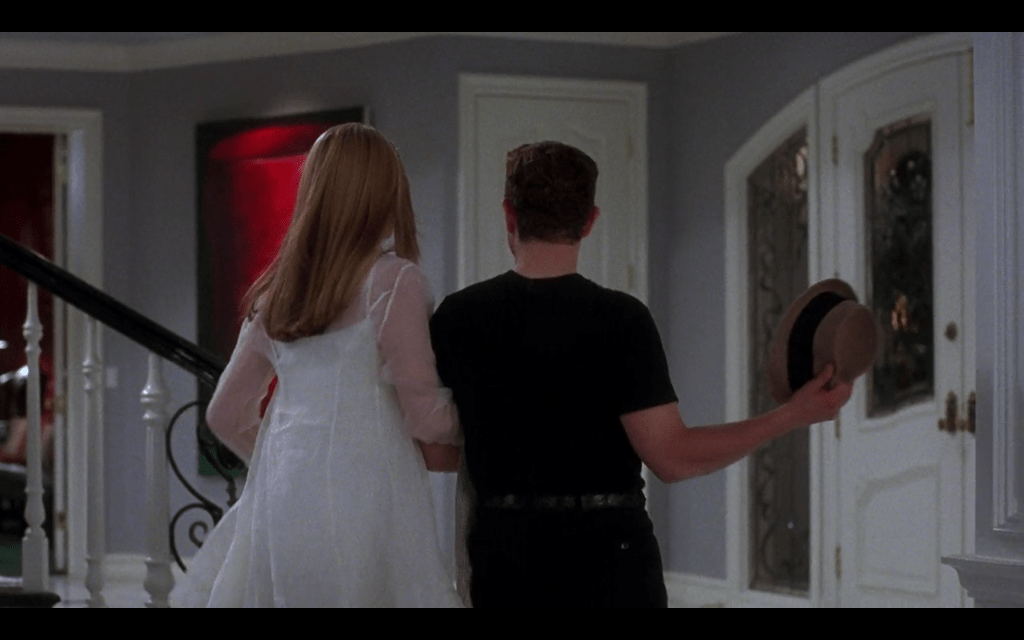
Her relationship with Christian is one where she has an unprecedented lack of control. Before finding out he is gay, she wants to seduce him. Even if he weren’t gay, wanting someone to see you in a romantic way is still a pretty powerless position to be in. Discounting lying and plastic surgery, there is not much one can do to control whether someone will like you or not. But, Cher still attempts to gain power in this situation through her clothing. She wears more revealing clothes to attract him, and when he is coming over for a night alone, she spends almost all day picking an outfit with Dionne.


Because fashion has worked like this for her in the past, Cher believes the right outfit will give her the power to control whether a boy likes her.
Cher has a similar approach when it comes to her driving test. We continually see Cher drive poorly and never really see her practice or attempt to get better. Then, the day of the test she throws a fit when she can’t find her “most responsible ensemble” – a “white collarless shirt from Fred Segal.” However, like with Christian, her outfit would have made no difference. She still fails, no matter how capable she looks. Her losing her ability to control her world through fashion plays into her character’s turning point in the story.

After failing her driving test, when she is at her lowest point and is soul searching for why she is so affected by Tai’s crush on Josh, Cher stops her inner monologue and goes into a boutique to buy a dress. The scene cuts to her with a shopping bag, still soul searching. Her life has been turned upside down when she realizes that she can’t talk her way out of failing her driving exam and her friend likes the same boy as her – and her response is to go shopping. At the most unstable moment in the movie Cher seeks a sense of control through fashion.


When Cher realizes that she loves Josh and needs a “makeover for her soul” she also involves fashion, but this time not for her own benefit. She acts as Captain for a group that is collecting items, like clothing, for families affected by the fictitious “Pismo Beach Disaster.” It’s notable that Cher is using fashion for good, but also that the Pismo Beach relief involves more than clothing. She also collects things like canned goods and kitchen wear. This is a small development that shows Cher’s overall growth. She is still trying to find control in a chaotic world, but now it is not just for herself, and not just through fashion.

The costume design in Clueless illustrates all the nuances in Cher’s character, and all the steps she takes in her maturation. She goes from a silly schoolgirl who wants to always has to get her way to a level-headed woman that gives back to the world – and remains effortlessly elegant throughout. Both the costumes worn by the characters and her character’s attitudes towards the costumes in the movie flesh out her personality and its evolution.