Confirmation in The Return of Obra Dinn

By Elle Thompson

(Disclaimer: This post is based on my perspective on a play-through of Obra Dinn. I realize that others might solve/think about solving the mystery differently so take this as more of a take-away post than a generalization about the game at large.)

The Return of Obra Dinn, though a complex mystery, is largely a game of well-informed guess and check. The player’s primary agency and interaction with the investigation is through observation and deduction. The pocket watch allows the player to step into the memories of the deceased former crew of the Obra Dinn and relive still frames of their last moments. Through these memories, the player is expected to ascertain “the identity and fate of everyone aboard.” And although the game provides the player with a wealth of clues, many of them are obscured, and only accessible through a Sherlock Holmsian level of niche observation on the character’s actions, words, whereabouts, and appearances. With sixty identities and fates to solidify, the game would be all but impossible without a confirmation system.

The confirmation system in Obra Dinn comes in sets of threes. The player must correctly identify three individuals’ names, fate/cause of death, and sometimes the responsible party for their deaths. All three details within the journal entry must be correct before it counts towards a correct identity. A name can be correctly matched but if the fate or cause of death is wrong it does not count towards the three cases needed, and vice versa. However, once the player is reasonably confident in at least two of these identities or narrows their pool of identities, it becomes easier to abuse the system and guess and check names and fates until they receive a “Well Done” notification from the system.

This produces a level of confirmation bias that seems antithetical to the mechanical intention of careful observation and deduction carried throughout the game. To illustrate this juxtaposition it is important to take a close look at the clues and methods of deduction actively encouraged by the game to deduce the identities of the “unknown souls” and their “unknown fates.”

Unknown Souls

There are sixty names on the crew manifest. Each of those names has a corresponding occupation and country of origin listed.

The occupation can often be a helpful clue when observing an individual’s actions on board the ship. For example, there is a scene in which Huang Li, a topman, is killed by a lightning strike when climbing the ship’s rigging. It stands to reason that the others who have climbed the rigging with him are also topmen and therefore narrows their possible names as well as their location in the crew sketches (conveniently crew of the same rank tend to stand together). The sketch is also a helpful resource for consulting crew uniforms and matching like crew members with already identified members of the same occupation.

The same trick can be used for the country of origin a little less subtly. The Formosa nobles, for example, have their own labeled section of the sketch titled “Formosan Royalty.” Therefore any crew picture that matches those four faces is of four names marked as Formosan in the Manifest. Audio Queues can also be used to differentiate between crew countries of origin, as some crew members converse in, exclaim in, or translate for other languages. A quick Google search of the transcribed dialogue can match a crew member to a country and therefore narrow down or completely solve the crew member’s identity based on the manifest. 

Unfortunately, this narrow and direct correlation between race, nationality, and identity can lead to pretty blatant profiling in order to deduce identities. For example, there are four Indian seamen, two of whom get sick and die from illness, two of whom are crushed to death. Only one character is named in dialogue “Syed,” and the rest are never named out loud leaving the easiest course of action to cycle through their names with the crew members identified speaking to him in Hindi.

Similarly, there is little to no differentiation between the Chinese crew members, who are identified in the scene by looking vaguely Asian and serving as translators for the Formosan nobles. The four Chinese crew members are all topmen, and all have little to no plot relevance, leaving the simplest course of action to cycle through their names with the Asian characters from the sketch. 

It is also relevant to note that both the sets of Indian Seamen and Chinese Topmen deductions are structured like dominos. If the player correctly identifies one or two of these characters, it stands to reason that the only other Asian or Indian-looking faces in the sketch must belong to the remaining names. This imparts some degree of flippancy in the deduction of these groups and rewards race-based deduction instead of proper investigation into these characters’ identities that other characters (namely Europeans) require. 

(Disclaimer: According to the Wiki there are other ways of learning these crew members’ identities such as matching their bunk numbers to their shoes. However, considering the pixelation and similarity of the niche outfit cues, and the explicit correlation between race and identity, the point still stands.)

Unknown Fates

There are 24 fates, or causes of death or disappearance, that can be matched to those names. Some of these fates have sub-fates, such as “Shot” which has the subcategories of “canon,” “gun,” and “arrow.” Some of these fates will not be matched to a cause of death at all, and some are used multiple times. All of these fates rely on mostly visual cues to deduce the manner of death by identifying a weapon or attacker. There are exceptions, like illness and environmental hazards, however, those are also heavily reliant on visual observation of the scene.

Although some deaths are simple to deduce, such as the Kraken/beast tearing a man in two and spilling his pixelated guts, others are purposefully or unfortunately obscured. For example, during “The Doom,” chapter, the player must deduce the fate of several characters who were thrown overboard by inferring when they are present in one scene and not the next. This is difficult but not impossible given enough attention and backtracking through the memories. Less intentionally obscure, however, is the fate of characters like Bun-Lan Lim who was clawed to death by a “beast.” 

The clawing part, however, is up for debate as seen in the image, it is incredibly unclear what the beast is doing to her (biting? eating? poisoning?) nor does it necessarily look fatal in comparison with other fates in the same boat as her (speared, drug overboard). The other Formosan noble, It-Beng Sia, meets a similarly confusing fate as he “burns to death” after opening a chest. The pixelated and monochromatic art style leaves both of their deaths unclear regardless of deduction prowess and effort. The only way to deduce either of their fates is through a process of elimination and testing with reasonable confidence in two other individuals’ fates. This leaves the player to rely on abusing the confirmation system blindly instead of relying on the visual evidence presented.

Guardrails

However present the instinct and reward of confirmation bias might be, there are some guardrails put in place by the game to discourage random guessing and impulsive deduction. For example, when a player attempts to identify a character, whether it be based on generalization like in the case of race and nationality, the process of elimination like in the case of pixelated graphics, or other shortcuts, the game will warn them against guessing without proper information. 
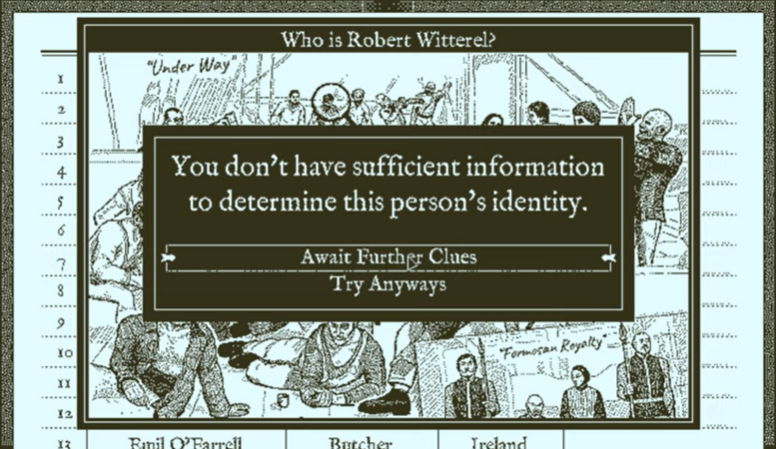
This is more of a discouraging attempt than a hard stop as players can still select “try anyways,” but the passive aggressiveness of that diction suggests that the player is attempting to play the game in a way the developer did not intend but is willing to tolerate. 

The game also implies at multiple points that there will be times, regardless of the player’s investigative prowess, when they do not have enough information to make a solid identification of all the individuals. While not as direct as the previous example, this implies that the player should try their absolute best instead of getting roadblocked or resorting to desperate methods. Instead of giving in to random guessing players can work with the evidence they have and revisit the memories with new insights. 

Takeaway

Overall The Return of Obra Dinn, while seemingly at odds with itself mechanically, does a decent job of discouraging guess and check confirmation bias through these guardrails and the sheer volume of information players are asked to sift through. After all, it would take as much or more time to guess through 60 names than to pay attention and carefully sift through it with an investigative eye. While I have my complaints and criticisms as detailed above, they are not game or immersion-breaking at any point and it is still a fantastic example of investigative fiction that asks the player to step into the detective’s shoes without handholding. 
Deep Red: The “Aha Moment” in Investigative Storytelling

The 1975 Italian investigative horror film Deep Red attempts to tell a detective story, following a ruthless murderer who seems to consistently be one step ahead of him. It seems to pride itself in not pulling its punches in its graphic depictions of its deaths: one character is drowned in scalding hot water, another’s head is smashed against a desk corner repeatedly, and a third is dragged by a garbage truck and then gets his head crushed by the wheel of a moving vehicle. But who performs these violent acts? Well, the last one is an accident, so nobody, but as the lead detective Marcus Daly (who is not an actual Detective, but rather a jazz conductor who, for some reason, heads this case despite having no relation to the first victim besides being a minor witness) follows a thread that continues to wind and weave through different locations, the identity of the person committing these crimes is cloaked in a brown leather trench coat with black leather gloves… or is it?

At the end of the movie, it is revealed that the murderer is completely visible in a single shot at the beginning of the movie, as Marcus searches the first victim’s apartment. This shot is set up in a very specific way: it depicts Marcus walking down a hallway filled with paintings, the camera positioned behind him, capturing the left side of the hallway as it follows him walking. At roughly the middle of the hallway, there is a diverging path that goes off to the left, and from that little bit of wall that can be seen, a mirror reflecting a similar painting can be seen. He continues walking, but later returns to the hallway and is unable to find the painting he noticed in his initial passthrough. At the end of the movie it is revealed that the painting was not in fact removed, but rather was a different painting with the murderer standing in front of it, face fully pointed at the mirror, and thus at the camera. When it came out, this single shot was a huge deal in the scene, and is largely the reason this film is remembered today. Nobody had ever seen this bold of a clue hidden in an investigative story before. It set a new standard for what was possible in a detective film, and made the genre even more enticing to consume, with eagle-eyed viewers really believing that they would be able to figure out whodunnit if they paid close enough attention.

That being said, I think that this moment is absolutely ridiculous. First off, the murderer revealed in this scene had not been even seen on screen yet, so anyone who noticed the shot for what it was wouldn’t make a connection, but instead be confused, which is exactly what happened to me. When I first watched this scene, though I couldn’t tell what specifically was off, this shot immediately set off alarm bells in my head that something was up. To me, the shot just looked like passing a hallway with a person standing in it, and I was really lost as to why that kind of just got ignored in the moment. Furthermore, when he went back and noticed the painting was different and began searching for it, I only became more confused as I had already understood what was meant to be the supposed plot twist at the end. Upon analyzing it further, I think that something else which makes this reveal not work is the very specific camerawork used; so specific, in fact, that it isn’t seen anywhere else in the film. Deep Red is comprised nearly completely out of still shots, and the shots that are moving generally are used to provide a fuller view of the space than would be possible with a still shot. But why is it so then that this shot couldn’t be explained by giving further exposure to this hallway? Well, the shot only shows, at most, 1/3 of the hallway. If the shot was meant to give the audience a better sense of the apartment’s layout, it would follow Marcus from directly behind, allowing a view of both walls and giving an idea of the room he is walking toward. As a result of this, this shot feels intentional to an extent where something feels off.

Setting my critiques of the shot aside, what Deep Red attempts did indeed push the boundary for what was possible in an investigative film, and paved the way for many that followed it. Directors, cinematographers, and screenplay writers learned from Deep Red (in both its successes and failures) as to how to better give the audience the chance to “solve the riddle” before the answer is given. For example, in Rian Johnson’s 2019 murder mystery Knives Out, subtle hints can be potentially noticed, giving characters context and even alibis. One specific instance of this happens when dealing with the relationship between Linda Drysdale, daughter of the murdered Harlan Thrombey, and her husband Richard. Before being murdered, Harlan finds out that Richard is cheating on Linda, and threatens to tell her with a letter in an envelope. After his death, Richard goes through Harlan’s desk and finds the letter, opening it and finding a blank sheet of paper. Annoyed at Harlan’s seemingly empty threat, he leaves it on the desk torn open. But not two scenes later, Linda can be seen remembering her father by going through old letters he has given to her, and the paper can be seen having singed edges, hinting to the audience that the letters are written in invisible ink, and can be revealed by holding a flame beneath them; this idea is later explained more explicitly, but this single small shot, intentionally included, allows for the audience to make this connection much earlier on, giving character information to the relationships between Harlan, Linda, and Richard, and as a result allowing viewers to come to more formed conclusions about characters and their motives for murdering Harlan.

In all, the inclusion of this “aha moment” in Deep Red, in retrospect, feels confusing, disappointing, and underwhelming. It allows viewers to make a connection not by giving them a hidden clue, but just hiding the answer in plain sight. While this technique is overall a failure in Deep Red, the film’s pioneering of this technique displayed what is possible for more modern detective stories, and as a result, can be recognized in its on right as a success for the genre as a whole.

By Tyler Ziemba

Among Us as a Social Phenomenon

By Tara Makhija

When Covid first hit back in early 2020 I remember I would take to Club Penguin to “hang out” with friends during isolation. It got old quick–Club Penguin, while inherently a more social platform, didn’t actually have much you could do with your friends. Really, the most social it got was trying to tip the iceberg or trying to start a minigame at the same time as your friend on the same server in order to get paired with them. And while I know several other people also tried to go back to their roots and end up on the Summit server, the world was itching for a non-gamer-friendly online game good enough to use an excuse to play with their friends.

Among Us had existed for a few years before that point but never quite took off. There was no need, I suppose. Gamers had more gamer-y games to play, Among Us was a little bit too fun, in a tacky, summer camp way. Non-gamers would have had no reason to know it existed. But then all of a sudden people had nothing else to do. I remember signing up for email alerts from ten different websites just trying to buy a Nintendo Switch. I don’t even like video games. But people were just looking for something, be it Tiger King or whipped coffee or some sort of social video game. And so Among Us took off, along with Jackbox games. But Among Us was indubitably the one that went the most viral, probably due to its ease of access.

Unlike Jackbox games, Among Us didn’t require a Steam account or even a specific video game console. Anyone could play it. It was simple to share links with friends. Anyone could learn the rules within the span of a 5 minute game. It had tasks, it had deception, it had social deduction. The game was more fun when you knew the people you played with, because it made the accusations all the more personable. It was lighthearted, which meant that it never really grew old, it just grew ironic.

The structure of the game was simple. You’re a little alien on a spaceship trying to complete certain tasks to make it run. There’s an imposter trying to stop you and kill everyone. They don’t have tasks. By asking people about their tasks and seeing what location they’re at people try to figure out who the imposter is. If you’re the imposter, you also have to keep some basic things in mind. Don’t vent to a separate room (an imposter-only ability) in front of people. Don’t kill someone in a group. Always have an alibi for why you were in a room ready (what tasks are you going to say you were assigned?). Among Us isn’t the best game for truth-tellers.

The reason it succeeded laid in its simplicity. As I mentioned earlier, it was designed to be easy to pick up, it was designed to be easy to access, it was designed to be easy to play regardless of gaming background. But more than just that, the graphics of the game were simple. This is arguably directly tied to its ability to go viral. Among Us quickly made its way across various internet channels. The graphics made it well adapted to meme formats. It even took over Gen Z linguistics, and served as the origin of the shorthand “sus” that people still use regularly, four years later. I remember a friend of mine from high school made us all fuse-bead keychains of our Among Us characters. In freshman year of college, our RH gave us all Among Us stickers. I even made my friend an Among Us friendship bracelet/keychain because even if I never got into it, he was obsessed with it. Among Us became a social phenomenon outside of the game itself. It invaded social media, but also the tactile, which simply never would have been possible to the extent it happened with a game with more complex graphics. Among Us’s simplicity also made it well suited for tactile or pixel-art-esque elements. And its character customization ability made it appeal younger audiences.

Then, older audiences found Among Us integrated into their daily lives more and more too. In my freshman year of college, our house’s weekly study breaks would be Among Us nights. I imagine internship icebreakers could utilize the game too. And soon its network effect amplified it like crazy–you only had to have one friend that had heard of it to end up playing it. And unlike its Mafia-type social deduction counterparts, the game was more fun the less seriously you took it. In a Covid environment, those attributes made it the perfect game.

Among Us took off because of circumstance. While fun, the fact it didn’t gain popularity until two years after its release does indicate a heavy correlation with Covid in its success. Covid also made people more active on social media in attempts to connect with their friends. So its presence in memes and other media-based formats grew because it had a larger audience engaging with it. Its a fun game, and its traits of simplicity and accessibility were key to its success in Covid times and going forward.

Searching: As Film, as a Narrative of Investigation

By Luke Walker

In thinking about Searching, I found myself looking at it from two different perspectives: as a narrative of investigation, but also just as a film in and of itself. In approaching an analysis of Searching from these two different angles gave me a more full appreciation of the work. Obviously, due to the nature of the class, we look at these pieces as narratives of investigation. But I think giving it some grace and viewing the movie for what it is, as a film, is also useful in increasing enjoyment and appreciation of the film.

For starters, I quite enjoyed this movie on a personal level. I’m a fan of John Cho’s work, and he plays the lead role of David Kim here. I’m most familiar with his comedy films, particularly the Harold and Kumar Go to White Castle series. So, seeing him in this more serious and dramatic role was interesting and fun to me. That being said, I’m approaching this analysis from an objective perspective, and I don’t want my personal enjoyment of actors to change my argument. I figured it would be worth pointing out the “bias” of sorts that I have, as a John Cho fan.

With that out of the way, let’s look at Searching. I want to first look at this film from that narrative of investigation mindset. It is unique from other media that we’ve looked at in class in large part due to its very modern, and intentionally so, structure. The movie (released in 2018) is set in 2017 and follows the disappearance of a high school girl. Naturally, with the subject of a high school teen, the internet is almost a character itself in the movie. As an investigation narrative, the internet is crucial in Searching. It’s through information available online that the majority of the investigation is done. 

The film is told entirely through screens, as if we’re viewing a laptop or cell phone screen and aren’t some sort of third person observer as is typical in movies. Because of this film style, in order for a movie to really exist, lot’s of the “investigation” in the film is done by David Kim, on his computer. This investigation is done pretty well actually, in the sense of clues left behind. There isn’t something out of the blue that shows up. All the connections between characters are shown, thinking here of Detective Vick being photographed with the man who made a fake confession to Margaret’s murder. In terms of fair play, this works well. David doesn’t really know anything about his child online that we the viewer don’t know or can’t quickly assume. There isn’t any secret information hidden that made the end of the film feel “deus ex machina”. The resolution feels plausible. 

However, the process by which we get there I have issues with. It just doesn’t make much sense. If there’s a criminal investigation going on, they have a team doing that work. The fact that so much information is found out from the dad – including some people no longer being viewed as suspects – just doesn’t feel very realistic. No police investigation would allow a father to be the chief researcher on the case. The rebuttal to this of course is that Detective Vick isn’t actually trying to solve the case and is planting a false narrative. However, a high profile teen murder investigation like this one – that has gone viral on Twitter and other social media platforms – would have many more people than one lead detective in the room. There would be more checks to make sure all stones are unturned. 

That being said, I don’t think this issue impacted my enjoyment of the film very much, if at all. There were really strong acting performances across the board. One that stood out to me was Sara Sohn as Pamella Kim. The mom of Margot and wife of David, her death from cancer is critical to the film, and occurs early on. But in the short screen time she has, she does a great job of creating a picture of a loving mother, who’s loss would be so incredibly brutal to a family. Of course, John Cho is excellent as David Kim. I already mentioned my familiarity with his comic work, but in this serious role he plays a very convincing part. His sudden short temper and snaps of unger as he searches for his daughter are truly heartbreaking. I’d be remiss if I didn’t mention how the style of the film impacted my enjoyment. Everything is told through screens, and it made for a very unique viewing experience. I’m not sure if I’d like to watch a lot of films in this style, it might get old quickly (the film’s original conception as a simple short film shows that worry I think). That notwithstanding, the style is intriguing and not something I’ve really seen before. 

Searching is a unique film. It makes use of the internet and its style as a “screen-shared” movie is unlike anything that we’ve looked at in this class. And, while there is an issue of believability within David’s involvement as an investigator, strong acting performances and adherence to fair play principles kept this film one that was well worth my hour and forty-two minutes.

Exploring the Use of “Double Identity” in Digital Storytelling: A Deep Analysis of Searching

Watching the 2018 film Searching in class offered an interesting viewing experience, primarily because of its emotionally charged backstory and unexpected twists. Directed by Aneesh Chaganty, the film is unique in its narrative approach, unfolding entirely within a digital landscape. This innovative use of technology as the primary storytelling medium keeps the plot engaging and fast-paced and challenges traditional cinematic storytelling by offering a fresh perspective through its virtual action. 

Initially, I was unsure why the producers decided to showcase the movie through a digital interface. However, one theme that particularly stood out to me when analyzing the movie was the concept of digital identity, highlighted through Margot’s “double” identity online. Unlike typical portrayals in cinema, Margot’s persona on social media turns out to be a more authentic reflection of herself rather than a fabricated alter ego. This unique representation is crucial to the film’s narrative. Writer Aja Romana, in her Vox article “Searching, a movie puzzle about digital isolation, is a bit of a mess. See it anyway,” supports this view by noting that Margot, “like many of us, is being the truest version of herself—lonely, introverted, and complicated” through her online interactions. This perspective allows the audience to understand Margot’s genuine identity, contrasting with the common misrepresentations on social media.

While traditional mystery writers like Agatha Christie might argue that incorporating modern technology into mysteries could dilute suspense and complexity by detracting from character development and intricate plotting, I believe Searching counters this viewpoint. The film integrates digital tools into its mystery by enhancing the storytelling experience when delving into the theme of Margot’s ‘double identity.’ The digital landscape is a pivotal medium for uncovering the truth about Margot’s disappearance and her real persona.

The film starts by setting the emotional groundwork with a depiction of a small Korean-American family focused on David Kim (the father and protagonist) and his daughter, Margot. The narrative quickly establishes an emotional core with the revelation of Margot’s mother’s death from cancer, which catalyzes the distance between David and Margot. The plot intensifies when Margot vanishes after leaving behind two missed calls on David’s phone. David teams up with Detective Vick and begins to explore Margot’s digital footprint, uncovering various aspects of his character in the process. His relentless pursuit to discover the truth about his daughter’s disappearance not only underscores his commitment and love but also his desperation and the lengths he will go to find answers. This investigation, primarily driven by digital tools, ultimately exposes (spoilers) Detective Vick’s and her son’s unsettling involvement in Margot’s disappearance at the movie’s end.

Going back to the topic of “double identity,” to support my argument about the effectiveness of digital platforms in uncovering true identities, I will draw a parallel with one of Agatha Christie’s classic mysteries, Murder on the Orient Express. In this novel, the renowned detective Hercule Poirot unravels a complex murder case aboard a snowbound train. Poirot’s investigative method involves interviewing passengers, observing their behaviors, and piecing together tangible clues, such as a handkerchief or a pipe cleaner found at the crime scene. Christie’s narrative primarily unfolds through face-to-face conversations and the detective’s acute observation of human psychology and physical evidence.

In contrast, in Searching, the protagonist, David Kim, exemplifies the modern detective. He leverages digital platforms to solve the mystery of his daughter Margot’s disappearance. David gathers and pieces together clues using social media apps like YouChat and Tumblr, emails, news sources, and online transaction records. This digital approach diverges significantly from Christie’s traditional detective methods, which focus on physical and psychological observations. Searching demonstrates that technology can not only complement but enhance detective work. For example, David’s ability to rapidly sift through vast amounts of digital data and connect disparate online activities offers a comprehensive and immediate understanding of the situation. This showcases how digital footprints can be crucial in modern investigative work, adding a new dimension to the mystery genre and challenging the notion that technology dilutes the complexity or suspense of a narrative.

In both scenarios, the detectives are faced with piecing together a hidden truth from available clues. However, while Poirot’s approach is constrained by the physical and the observable, David’s investigation extends into the digital realm, discovering facts and insights into personal identities and relationships. We can see how cruel some of Margot’s classmates genuinely are, like Abby, when she is seen both when David calls her and when she uploads a video of her crying as she pretends to miss Margot. This comparison highlights how Searching uses digital tools not merely as a gimmick but as a significant evolution in how narratives can explore and resolve mysteries, thereby providing a richer understanding of characters and their hidden lives.

Overall, I found the theme of Margot’s authentic digital identity to be the main interest in this movie, which is what I believe to be the main success when the producers utilized the digital interface as the primary medium for the film. Even though there could have been some potential improvements for the movie, such as how we are limited to truly understanding the actual lived experience of these characters, we do get a strong glimpse of Margot’s true feelings and perspective on what she’s gone through with the help of social media, which is what I consider as the “icing on the cake” for what makes this movie fulfilling. For anyone interested in watching the film, I recommend it! 

Author: Daniel Myung
Sources used: https://www.vox.com/2018/8/29/17790040/searching-john-cho-review

The Limitations of Searching’s Digital Landscape

“Searching” presents a unique experience by presenting the entire film within the confines of a computer screen. While this innovative approach offers a fresh perspective on storytelling, and is often successful in its attempt, it also imposes significant limitations on the audience’s ability to connect with the characters potentially undermines the protagonist’s credibility, and adds a level of disbelief for those who are very technologically literate such as younger viewers. The inherent constraints of the digital medium, the portrayal of the main character’s proficiency in navigating the digital landscape, and the need to be understandable by a cross-generational audience leads to hiccups in an otherwise thoroughly entertaining and fresh cinematic medium. 

I believe that the film’s reliance on the computer screen as the primary storytelling device creates a sense of detachment between the audience and the characters. Unlike conventional films where viewers are immersed in the physical world inhabited by the characters, “Searching” keeps them at arm’s length, observing the action unfold through a series of digital interfaces. There are some ways that the filmmakers worked to overcome these limitations, with the intro montage being particularly successful, by showing a series of emails and home videos uploaded to the internet they are able to quickly engage us in the lives of these characters while still remaining within the screen. On the other hand, there are times where I felt that being locked within the screen was a detriment to the story; most prominent in my mind are when David went to the lake and the only perspectives we got were first a kind of strange gps shot of his car going from his home to the lake, followed by an awkward facetime call to the detective where he talked vaguely about what he found and when they forced in the existence of a funeral live-streaming service just so we would get a shot of David confronting the detective. I believe that both of these scenes, and a few others, would have been infinitely more engaging if we were with David, in those spaces and able to experience the emotions he was feeling alongside him rather than from a distance (in the case of the lake scene, we don’t even get to see his immediate reaction). Additionally, there were several times where it felt strange to be viewing David through the lens of his camera even when he wasn’t really on a facetime call or anything similar, and the necessity of nearly every call in the movie to be a video call just so we could both see and hear the actors added an additional dimension requiring a degree of belief suspension. I understand that the filmmakers were committed to this medium of storytelling, but that being said, I don’t feel like it would inhibit the story or the experience to switch between a normal storytelling method where we are physically in the scene with the characters and the computer screen. 

The sense of detachment and requirement of belief suspension is even further exasperated by the portrayal of the main character, David Kim, and (again) the limitations of the medium. While he is portrayed as a loving father, the nature of the film requires him to know essentially nothing about his daughter’s life, as we need to be able to understand her friends and social life almost solely through methods such as phone calls and text messages. While at convenient times he seems quite technologically proficient, there are many times when it feels like he is simply bumbling through the digital landscape, which serves to undermine his competency as a credible protagonist, makes it even harder to emphasize with him as he comes off as a generally ineffectual detective who simply stumbles into the right answer, and also makes for jarring moments when his typical lack of technological knowhow clashes with times where the narrative requires him to understand something important quickly. David typically moves the mouse and windows around the screen at a snail’s pace, which is understandable because the audience needs to be able to follow every move. He doesn’t understand basic concepts, like the existence of stock image models or live streaming, so that the film can explain them to any audience member who doesn’t know. Perhaps this comes down to a generational divide, and I am biased in my existence as a member of my generation, but I can’t help but feel that while it may be a boon for some viewers, the need to comply with these limitations makes a less engaging and believable experience for others. 

Speaking of the relationship between these limitations and the lived experience of the viewers, several people in class also pointed out something that I felt while watching, which was that the portrayal of the internet in the movie is not very true to life. For example, the live streaming site keeps a thorough catalog of past streams, including viewer count and chat logs, which only the very biggest sites of that variety do (and only starting to pop up around the time this film released) so that the father would have that information available. Additionally, the daughter’s tumblr was oddly focused on her photography and included no references to any of her other interests, something that is possible but extremely unusual, and I can only assume was done either because of a lack of understanding of that culture or because of a desire to focus the information on screen. The latter seems more likely to me, and again adds to the ways that the limitations of the form and the need to be approachable by a cross-generational audience add a barrier to the investment of many viewers who, like myself, may have found the experience unrelatable, confounding, and, at times, even frustrating.

– Hunter

Orwell: A Game About Normalizing Oppression

By Will Traband

Orwell starts with the mundane. You open the game and get a login screen, as you would on any website. The credentials you give are your name for the game, but it still feels like any other login screen.  When we played it, we did not take this very seriously and made a name that is, shall we say, inappropriate. This moment is the key to why Orwell is effective, but it will take some time to understand why.

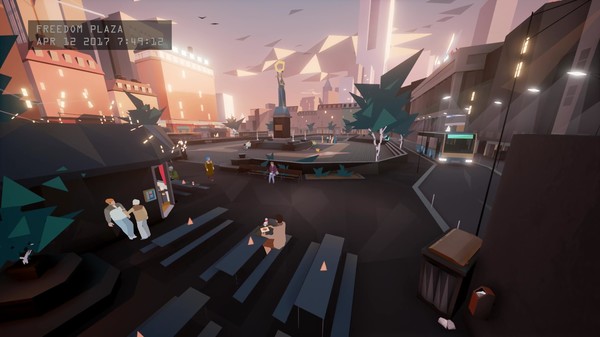
The game thrusts you into a place labeled Freedom Plaza plaza, or rather, a hidden camera spying on people there. As you watch people go about their day, little biographies about them pop up. One person is unknown to the system, but the program notes one lady as having previously had an altercation with the police. A couple sits together on a park bench. Then, the bomb goes off. Your job is to find the culprit, and the entire game takes place on your work computer, through cameras and the internet. However, notice that the game has primed you in two ways. Firstly, the game took its time to propagandize you with the best of The Nation. It portrays an idyllic plaza to you and highlights the innocents who died in the blast. The game leads you to feel bad for the people who died and distracts you from the authoritarian regime. Secondly, Orwell shows you a lady with a rap sheet. She is lead number one, and you are led to suspect her despite little to no evidence.

Suddenly, you see an office interface and an adviser talking to you. Your job is to find who did this using a new program called Orwell. Immediately, the game starts getting you used to the software, and once again, everything is mundane. It feels like office training, not preparing to invade people’s lives. Orwell is fundamentally about sorting through files and finding connections, which makes it easy to forget that the premise is that you are spying on people. As we played, we found it easy to make fun of characters. Interestingly, it made us more amenable to The Nation. One lady looked like the stereotype of blue hair and pronouns. Another guy looked like a standard rebellious musician. Since many of us playing could fit some of those descriptions, it was easy to laugh. I, for one, made several jokes about how anything The Ministry of Truth says must be true. Investigating this woman named Cassandra Watergate felt like office snooping, not wiretapping her phone and listening to the details of her personal life. We gossiped about her love life while putting together the information to put her in jail for the rest of her life.

Orwell is just a game, of course, but it actively dissuades you from taking it entirely seriously. It puts pressure on you in the form of another bomb threat, but everything about the interface screams office worker. Now that you have the correct mentality, meeting your goals feels better. Only after you prove Cassandra is guilty of her previously accused crime are you hit with a dose of reality. A scene occurs where your adviser interrogates Cassandra and reveals they have information from private calls to arrest her. She swears and feels violated by the intrusion. I realized then that I would feel the same way. Although she is only a game character, and I had embraced the position of the bad guy long ago, I still was left with a bittersweet feeling. However, I still had work to do, so I left those feelings at the door.

Orwell is masterful at manipulating you. It gives you a familiar interface, like social media and internet browsers, but lets you do horrible things with them. That moment I mentioned earlier highlights this perfectly. We messed around and put bad words into our video game name, and in the process, we took the gravity of our actions less seriously. Orwell feels so mundane that it becomes routine when people suffer directly because of you. The game makes you feel as if they deserve it anyway. Cassandra hit a police officer with a rock when he tried to arrest her friend. Her friend expresses gratitude for being saved and calls Cassandra a hero. The game tells you the officer had a broken skull and had to go to the hospital for weeks. We could spend hours discussing whether or not her intentions make up for her actions, but the game makes you sidestep all of the philosophical discussion. You must find the data to arrest her since it is your job. There is no place for nuance in The Nation, and once data is in Orwell, it must be acted upon.

Orwell presents an interesting dichotomy between the normality of office work and the oppression of an authoritarian regime. It sets itself up with propaganda to make you sympathetic to The Nation and has characters from groups of outcasts, so you empathize with them less. Even though you recognize the blatant propaganda, the unsubtlty makes it funny. Then, despite the heavy nature of the topic at hand, the game makes spying on people feel routine. It makes the consequences for those you spy on feel less severe and emphasizes your impact on The Nation. Sure, you are trying to stop another bomb from going off, but once you do, your adviser tells you to go home and get some rest. You are left with no time to wonder if the ends justify the means. After all, you still have work in the morning.

Photos from: https://store.steampowered.com/app/491950/Orwell_Keeping_an_Eye_On_You/

The Name of the Rose ?

By Sage

The Name of the Rose is incredibly frustrating. In the postscript, Umberto Eco discusses the problematics of the process of writing a novel, remarking of rules and speaking of the relationship between inspiration and necessity. There’s a whole lot of ‘well, I must include x’ and ‘because of y, then naturally also z.’ In this sense, the novel is not only the product of a system, but also an emblem of this system, a cog in the machinations of biopower. Such a novel is already difficult to read, let alone write about, and I could spend months and years trying to untangle my thoughts. Here is a beginning.

The Name of the Rose constructs a world according to a very carefully considered set of rules. Eco asks us to believe in this world and accept these rules even when they do not always align with what we know. Only by trusting the author and the world do we come to realize it is not in fact constructed, it is real in its own right, forcing us to rethink what we believed we knew about reality. It can only play fair if we do too, and that means agreeing to its rules.

But the rules are arbitrary, as is everything, they work because they work together as a set, not because the specific content of the set really matters – nor do they work because they have a specific end or goal in mind. The Name of the Rose is not necessarily a detective novel, nor are there necessarily murders, nor is there a true culprit although we can see an antagonist if we squint. We do get a Sherlock/Watson dichotomy with William and Adso but is this really enough?

Perhaps it does not matter whether The Name of the Rose is technically a detective novel. There is still much to be discovered in reading it; it is a work which carries detective-like experientiality. And it is still helpful to think about it as a detective novel or from a lens informed by the detective novel because biopower relies on categorization. It is the means but not the means to an end, biopower has no end, its purpose is to reify itself. And searching for the truth of a thing reifies that search. If you want the mechanisms – power – of the search to exist in perpetuity, you must believe that there is a fundamental truth, but there isn’t, there never is, because if there was it could be found and the search would end. Power sustains itself by disguising this absence of a profound reality. (As an aside, this is why the lack of a legitimate murderer, as well as the loss of the Finis Africae is particularly significant, but that will be discussed.)

And this is how the constructed world in The Name of the Rose can assume a (hyper)real status. There is such pleasure in the search, even if for naught, and to be engaged in the search is to access power. We see this on two levels. William is entrusted with power by the Abbott though he also goes beyond the Abbey’s structures, opting to empower himself with knowledge and to gain knowledge, and isn’t there such a perverse pleasure in this kind of pursuit? To disobey the mandates of Earthly religion, often both arbitrary and contentious, for the possibility of a deeper truth, a greater moral cause, one which God might forgive your sins for? Only to find nothing, really. William is never able to read the Finis Africae. There is no culprit. There’s hardly even an answer. Instead William becomes culpable for the destruction of the Library, a terrible conclusion, but it is also a symbol of knowledge and of secrecy and of greed and of desperation and of guilt and those too are all destroyed. But in this loss, pleasure is sustained through mystery, the search goes on, and it is thus especially poignant when Adso returns many years later to look for any salvageable books or pages or artifacts. The Abbey – with the library – remain a compelling force.

Pleasure is such an important theme within the book, very literally and perhaps a bit heavy-handedly with Adso’s Sin of fornication, but also with the intrigue and desire surrounding the library. Pleasure and desire cannot be separated; we understand pleasure as a supposed end of our desires. The desire to see inside the library, to access that which is forbidden, to wield all its secrets and knowledge – it is a desire for power, and its fulfillment is the greatest pleasure these Monks could truly fathom.

And thus, Jorge is evil. He has no right to that which is kept from all, but he has the audacity to guard it, to play God, to kill perhaps neither directly nor indiscriminately, but to be responsible for deaths nonetheless of those he deemed transgressive. Because daring to be curious supposedly constitutes a crime, but he at the same time jealously protects knowledge which he has no claim to. This is the epitome of hypocrisy, to punish those who desire the same thing you hold dear.

As Eco mentions, the debate about poverty was impossible to ignore and has to be discussed. So at this point I must also discuss poverty, specifically the poverty of Christ (and his followers), which is debated at great length between characters and becomes a significant subplot. Throughout time immemorial, wealth has often been tied to power – and class has been an axis of subjugation. So what does it mean to position Christ as poor? The Son of God, indeed, God himself incarnate on Earth – although the Protestant/Catholic schism comes many years after the setting of this book, and thus both inception and resolution of the Christ as God vs. Christ as Son of God debate – but all-powerful regardless, as lacking material possessions, material wealth, what we might understand today as an oppressed position without power?

God made us in his image, and He came to us in our image.

The Interplay of Puzzle and Narrative in “Return of the Obra Dinn”

One of my favorite video games is “Papers, Please,” developed by Lucas Pope, who also created “Return of the Obra Dinn.” Naturally, I was excited to play “Return of the Obra Dinn” for class, and the gameplay experience pleasantly exceeded my expectations. “Return of the Obra Dinn” is a first-person mystery adventure game where the player assumes the role of an insurance investigator dispatched to examine the remains of the merchant ship Obra Dinn, which was lost at sea five years ago. As the investigation deepens, the player progressively uncovers the fate of the crew. The game presents its investigative narrative with a unique monochromatic art style. This essay will discuss the relationship between narrative and puzzles and how “Return of the Obra Dinn” incorporates puzzles as gameplay mechanisms that support the story’s narration.

In chapter fourteen of Jesse Schell’s “The Art of Game Design,” the author inquired into the distinction between puzzles and games. Games and puzzles can be considered problem-solving exercises; what differentiates them is how they engage with the players. Specifically, puzzles allow players to develop a “dominant strategy.” This diminishes the replayability of puzzles as once the solution is found, the puzzles are no longer challenging for the players and thus no longer interesting. On the other hand, games usually employ dynamic elements and mechanisms that prevent the development of a single “dominant strategy” or solution. This distinction is also mirrored in the concept of “fair play” in mystery narratives. In mystery stories, the plot functions as an interactive activity constrained by a set of rules, providing readers with the necessary clues to solve the mystery. This invites readers to engage with the story actively, exploring different interpretations and solutions. Similarly, in investigative games, the narrative and its mysteries can unfold in diverse ways with each play through. Players are motivated to explore various strategies and outcomes, ensuring that each experience is unique and the narrative remains engaging.

The “Return of the Obra Dinn” uses the puzzles as a vehicle to deliver the narrative. As the primary investigator, the player uses the Memento Mortem, a pocket watch, to observe the exact moments before someone’s death. By examining these particular moments, the player will be able to connect the faces of the subjects under investigation with the names and identities listed in the logbook. This investigation mechanism provides excellent puzzles that follow Schell’s “Puzzle Principles.” First, the player’s objective is clear– to complete the logbook and uncover the reason behind the deaths on the ship. Additionally, the logbook provides a sense of progress for the players. Through matching more faces to the identities, the players will feel like they are step by step approaching the “truth.” Moreover, the difficulty of the game increases gradually. In the beginning, matching corpses to identities is easy because you are exposed to less information pointing towards a few possibilities. However, as one progresses in the game, the connection between each character becomes more intricate, and it takes more time to fill in the logbook. 

Although the game does get harder, it compensates for that by engaging the audience emotionally. The game characterizes the people murdered on the ship by utilizing a lot of visual clues moments before their deaths. Some poignant stories told at these instances before the characters’ deaths foster an emotional connection, compelling the players to discover the fates of each individual. For instance, one of the midshipmen named Thomas Lanke was murdered by the Gunner’s Mate. Before his death, instead of calling out the murderer with resentment, Lanke chose to ask the First Mate William Hoscut to deliver a message to Milroy’s (Milroy is another midshipman who unfortunately died from the Kraken attack) mother that he tried his best to save her son before he passed away. Since solving more puzzles reveals more of the narrative, this form of characterization in the game further drives the gameplay forward.

Nonetheless, certain aspects of the game emphasize its puzzle elements. For instance, the game’s design allows players to freely explore scenes without following a defined order. This nonlinear structure can create an unorganized repository of information that players must piece together, potentially making progression difficult and breaking the immersion of the story. However, this very structure also gives players control over the order in which they unravel the mystery. As suggested in “The Art of Game Design,” in such a game structure, players will “naturally gravitate toward answering the questions that are easiest for them and slowly work their way up toward harder questions” (259). Therefore, the nonlinear narrative helps with creating a gameplay experience that gradually increases in difficulty. As the puzzles become more challenging, the satisfaction derived from uncovering the narrative after solving each puzzle becomes more rewarding for players. Moreover, the nonlinearity accentuates the sense of “fair play” in the game by allowing the players to approach the mystery from different perspectives and consequently reach different endings of the story. The high degree of freedom invites the players to replay the game to explore different outcomes. 

In conclusion, “Return of the Obra Dinn” creates an immersive and interactive experience that fulfills the “Fair play” rules of mystery fiction and the principles of puzzle design. By integrating the narrative and puzzle-solving components, the game ensures consistent player engagement. The gradual increase in difficulty and clear objectives provide a balanced and rewarding puzzle-solving experience. At the same time, the emotional depth of the narrative allows the players to empathize with the characters.

— Panthita T.

References:

Schell, J. (2020). The Art of Game Design: A book of lenses. CRC press, Taylor & Francis group.

Environmental Storytelling in Searching

The 2018 mystery film Searching has an unparalleled control of its utilization of space that many films cannot dream of replicating. The form of film that is told solely through digital screens can perfectly set-up and frame all shots to make perfect use of the environment to their control. Normally, films have to make use of the environment already at play to create interesting shots or to draw the watcher’s eye; this could be in the form as wide as large landscape shots to convey breath of space or as small as a shot through a windows blind to coney paranoia and the feeling of watching. In both these instances, the cinematographer is making creative use of a restrictive space. While there are restrictions to the way Searching can film and get shots, the actual space of the computer screen always remains a control. The filmmaker has full control of how to present objects on the digital screen and even has a cursor that allows the audience’s eyes to follow exactly where the filmmaker wants them to be. It is within this extreme control of space that the makers were also able to embed supplemental narratives that most will not catch on a first watch. 

The most common and talked about secondary plot line in Searching is the existence of aliens and how the internet is reacting to that news. Through a series of recommended videos and articles, we can see that there have been a series of alien leaks that have a serious enough weight as to garner the president speaking on these events. Common online reading of this film suggests this narrative to be taken at face value. The final article that references this plotline throughout the film is  titled “NASA calls emergency White House. Defense Secretary present.” This leaves an open ended conclusion to this narrative thread that allows the audience to ask what will become of these aliens and the United States response; however, the more interesting question to me is not what will become of the aliens but if they were really real at all? We have a proclivity to believe information that film presents to us but could this just be a more modern case of the unreliable narrator. The film presents all this information in the form of click-bait articles and videos which are most likely being recommended to our protagonist David Kim as he is constantly on the paranoia side of the internet looking into hypotheticals on the case of his daughter. The searching for patterns in life, especially when presented in a medium of investigation that makes us hypervigilant, often has us confirm things that are true from the connections alone. The common Beatles theory “Paul Is Dead” is a great example of this phenomenon where people will believe the outrageous specifically due to the mountain of information that can be tied together to support the claim. Searching is no different, for by seeing how all these articles and videos link together, we immediately have the inclination to believe it to be true and the filmmakers are rewarding us for our observant nature. The presence of these articles goes back into the environmental design of the film, and their inclusion creates a further sense of realism to what David Kim would actually recommend; therefore, while they serve a purpose in the narrative to create realism and are connected, their mere existence does not confirm that the world of Searching secretly has aliens that are being dealt with on a governmental level. 

The environment plays another larger role in the film when it comes to the lake as the place is both reflected in Margot’s real and digital life. Barbosa Lake is the lake that Margot likes to visit where she feels she can be alone in the world, while also simultaneously broadcasting her experience there to the world. Barbosa Lake is where the inciting incident of the movie also takes place and where Margot is eventually found near. It is here where she often talks to fish_n_chips, the police’s son Robert who is catfishing her.  In the movie, they have a discussion about which Pokémon are their respective favorites. Margot answers Uxie, a generation four Pokémon that is a lake guardian and can be found in game at Fogbound Lake. Margot answers that she likes Uxie because she can make people forget, which is in reference to Uxie’s Pokedex entry that states: “[Uxie is] known as “The Being of Knowledge.” It is said that it can wipe out the memory of those who see its eyes.” Robert’s (A.K.A. fish_n_chips) replies by saing that Kecleon is his favorite Pokemon. Kecleon is a chameleon based Pokémon that name comes from the Japanese word to hid “kakureru” and chameleon. This is all to say that their Pokémon choices reflect their real life counterparts; the environment of Barbosa Lake makes Margot feel safe, which is the same environment in which Robert uses to reveal his disguise. The real life locations of the film and the digital one’s hint at merging together in the same way that Margot and Robert’s online personalities come together that creates chaos. Searching as a film takes care to embed its narrative with clues that come from the source it is taking inspiration from: the internet. I appreciate greatly the care they took to create these fake article sidebars and actually research into Pokémon to pick Margot and Roberts’ favorites that have thematic ties to the narrative. It is in no way a perfect depiction of the internet or internet subculture, but Searching is earnest in its attempt to replicate the world of the internet. Beautiful films all the time strive to capture environments truthfully in order to allow others to experience what being there is like, and Searching is no different in its approach to our modern world wide web.