by Sean
I came into Return of the Obra Dinn relatively unspoiled. Was it a puzzle game? A game of investigation? A heavily narrative-focused game with a few interactive elements? All of this I wondered as I started up the game and was greeted with the opening flyer:
“Lost at Sea, 1803
THE GOOD SHIP
‘OBRA DINN’”
As I played through the game, those initial questions withdrew from the forefront of my mind as I became more and more captivated by the slowly unfolding nonlinear narrative. Using the protagonist’s “Memento Mortem” watch, I was able to view the last moments of the unfortunate souls who had died on the ill-fated journey through the Atlantic. Through these scattered memories, I was able to piece together a clearer and clearer picture of what had occurred on the Obra Dinn.
Returning to those initial questions, I felt—first of all—that the “narrative” and “puzzle” elements had not been in tension in the slightest. As someone with experience playing other mystery games, I was accustomed to the idea of puzzles serving as something to interrupt the story. As an example, earlier in the quarter, I played Sherlock Holmes: Crimes & Punishments. At one point in the game, Sherlock sniffs a pouch of tobacco, remarking that its aroma is familiar. To mirror the process of Sherlock forming a “picture” of his associations with the smell, the player is tasked with rotating and arranging a fragmented picture of a sailboat in three dimensions until the picture forms a coherent whole. This section brought our group’s investigation to a sudden and unceremonious halt. We were no longer engaging with a narrative nor investigating a series of clues; the game was forcing us to take a break and complete an unrelated and tedious exercise.
Instances do exist in which the game designers attempt to integrate the puzzle-solving into the game’s world—in Portal, for example, the puzzle rooms (“test chambers”) exist as justified and plausible elements of Portal’s Aperture Science laboratory. But what separates both kinds of puzzles from those present in Return of the Obra Dinn’s puzzles is simply that Obra Dinn doesn’t ask the player to step away from the narrative at all. On the contrary, when the player is asked to solve the fates of each of the members on the ship, the player is brought further into the story; they are forced to pay attention to each minute detail: the characters’ accents; the implied relationships between the characters; each crewmember’s clothing. They are then tasked with critically engaging with those details: what do they imply about the chronology of events? About this or that character’s identity? About this character’s potential motive for murder? In this way, I felt that the relationship between puzzle and narrative was utterly seamless.
That being said, this marriage between the process of narrative comprehension and puzzle-solving did result in some absurdities. As the game puts it during its tutorial, “Decisive information is rare. You will have to make assumptions using partial information.” Typical detective stories are much the same—circumstantial evidence might only suggest certain culprits; decisive evidence is often reserved for the end. However, there is a key difference: the reader of a detective novel is not being scored on their ability to deduce names, methods, and killers—but the Obra Dinn player is. As a result, the game is sometimes forced to make its circumstantial evidence very suggestive. Occasionally, this comes at the expense of any narrative subtlety and immersion. At one point, one character in a small room calls out to another outside of the room for help: “Brennan! Bring the surgeon’s kit,” he cries. The player is then allowed to explore the scene right at this moment. There are two characters directly outside of the room—one might wonder, which one is Brennan? At least, one wonders this until noticing the exaggerated “I-just-heard-my-name-called,” hand-to-ear listening pose of one of the men. Indeed, this is Brennan.
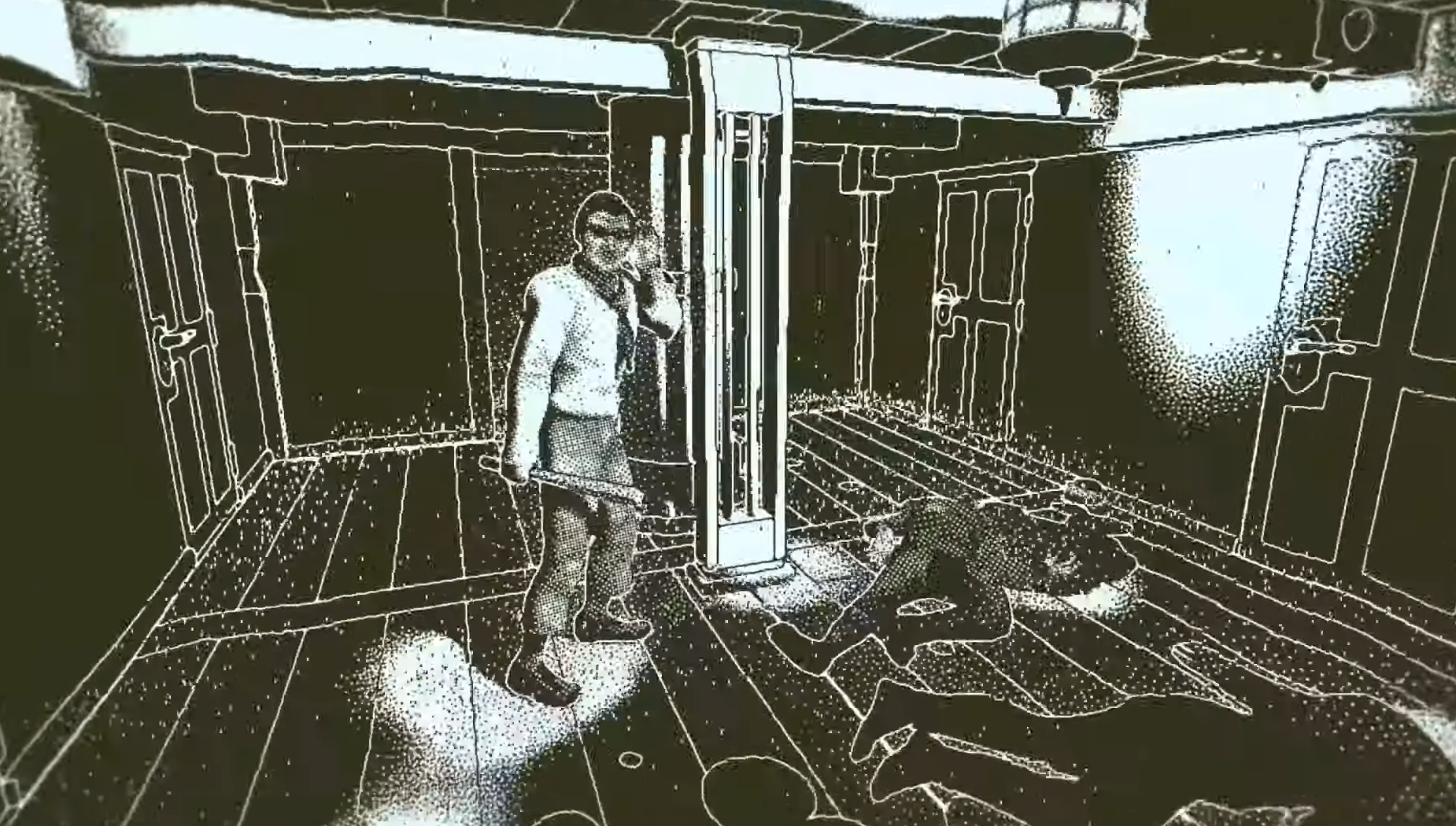
Another time, the player listens to the last words of a currently unidentified member of the crew. There isn’t much information to go by, until the man suddenly exclaims the German exclamation “verdammt” in a sentence otherwise entirely composed of English. The significance of this interjection becomes apparent when the player scans the crew manifest and discovers that only one person on the ship is from a predominantly German-speaking country (Austria): Alfred the Bosun.
By unblurring the characters’ faces, the game demonstrates that it expects the player to be able to guess these people’s names from this information. In order to allow the player to make the right guesses, the game is forced to lean a little too far toward the side of unsubtlety to let players make those reasonable logical jumps—whereas, on the other hand, a novel can allow these half-certainties to exist.
This speaks to a broader issue with gamifying narrative comprehension in this way. A character’s identity must either be “guessable” or not—something explicitly shown via the blurring and unblurring of characters’ faces in the journal. Detective novels have the liberty to leave the reader in a state of half-awareness and self-doubt on such matters—Obra Dinn must draw a hard line, removing some degree of the suspense and mystery present in a narrative of investigation. Nonetheless, the game demonstrates that a seamless marriage between detective storytelling and puzzle game is possible, even if it does compromise the strength of the narrative to some extent.
 Intermittent Mechanism