by David Hall
How does an environment shape those who inhabit it? In the wild, animals adapt to survive physical external forces, and only the fittest survive to carry on those traits—those with the fastest legs, the most convincing camouflage, the smartest minds. Following in this evolutionary tradition, we as humans have also adapted to nature, creating shelters, then communities, then societies—our own built environments that keep us safe from the wild.
But… are we really safe with these social mechanisms in place? Luis Buñuel’s 1962 film The Exterminating Angel examines the breakdown of this social environment; by holding dinner party guests hostage with only themselves, they are forced to confront their own social rules and determine whether or not they still hold while in danger. And, not only this, but the physical environment around them takes on surreal qualities that challenge their own notions of reality, constantly adapting itself to the guests’ words and actions.
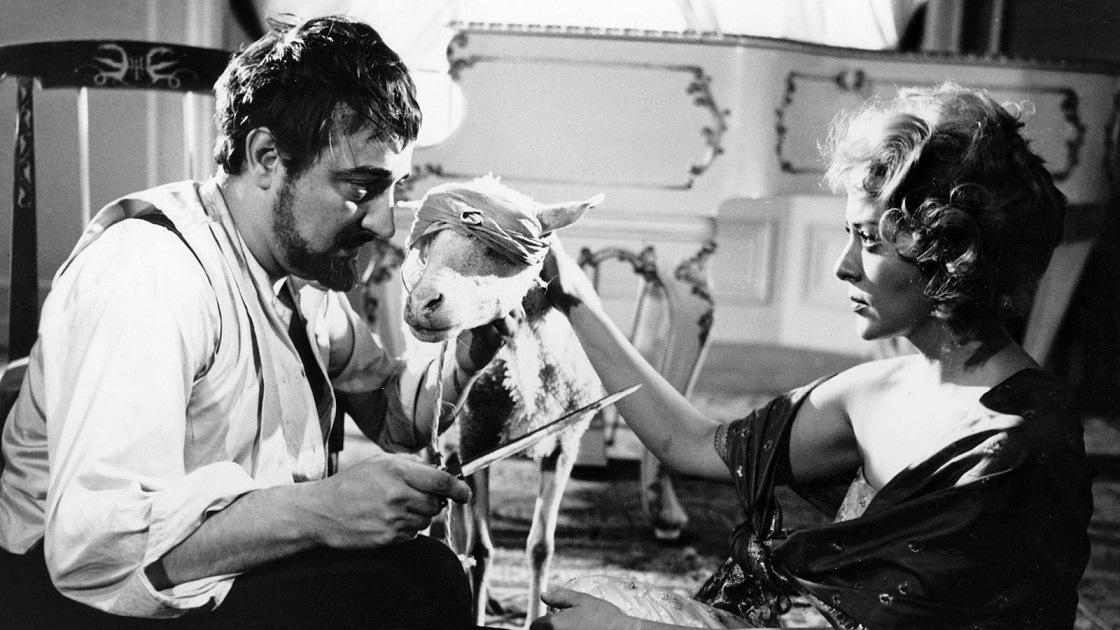
Buñuel’s commentary (obviously) in large part focuses on class dynamics—there is a reason why he chooses to demonstrate the failures of the bourgeoisie, after all. The depravity of the upper class is the ultimate showcase of the bourgeois failure to adapt to a just society. While existing within a surreal world where they are all equal to each other, their social power over others means nothing, so they must learn to re-adapt to a new society. Instead of this, as Roger Ebert notes, they grow “increasingly resentful at being shut off from the world outside” and “their worst tendencies are revealed.” Buñuel constructs his surreal space such that these characters are forced to interact with each other to save themselves, yet their focus is not on teamwork but instead on individual escape. The materialization of specific objects, including opium and other desirable means of escapism, creates competition between the guests, while the lack of necessities like food and water, which the guests must work together to achieve, is only ever acknowledged as a problem without a solution—that is, until lambs wander into their space and are eaten shortly thereafter. (I would mention that the guests chip away at the wall to burst a water pipe, but this short-lived democratization of resources quickly devolves into a free-for-all.) The divine punishment of teamwork is always undesirable in their eyes, and, rather than confronting themselves, they sit in wait for the outside world to rescue them—which never happens.
The outside world, in contrast to the inside world, is a place that the guests have power over. The reason why they are resentful at being shut off from them is not that they have lives to get to, but rather that they hold no power in their surreal space and cannot deal with that reality. Left to their own devices, the upper class, as Buñuel predicts, will break their social rules in an attempt to form some sort of new hierarchy. But, when everyone exists on the same social level, what is there to separate them socially?
The answer to this question is nothing. Below social classes, there is nothing except for age, strength, cunning. This is why conflicts are resolved through physical fights that establish dominance—Raúl establishes himself as a leader with the goal of killing Edmundo—or mental games that shift the flow of resources—or, sneaking opiates. And this is also why the weakest characters are at the fringes of the age spectrum—Sergio, one of the oldest, dies from sickness, and Eduardo and Beatriz, a young couple, kill themselves in a closet. This new social order, entirely removed from the rest of the bourgeoisie, is a step backward for human development. The animalization of the upper class, as Buñuel posits, is inevitable when they realize for themselves that their social rules don’t hold.
To end, I want to talk about a line toward the middle of the film that interests me. Rita says: “Creo que la gente del pueblo, la gente baja, es menos sensible al dolor. ¿Usted ha visto un toro herido alguna vez? Impasible.” Her indifference toward lower classes, going so far as to compare them to bulls, reveals the upper class’ perception of the rest of society as being on the same level as animals. Just like the only thing separating humans from animals is our ability to form a society, the only thing separating the upper class from the lower class is… their ability to form a society? That doesn’t sound right—both classes are made up of humans, so on some level they must be equal. Robert Stam writes that “the ‘Angel’ executes a mission of social justice, an apocalyptic laying low of the noble and the powerful.” But this social justice is not what we know as ‘social justice’ today; it does not work to lift up the lower class from their situation, but rather to tear down the upper class, bringing down the rich to the same level at which they perceive the poor. So now, being on that same animalistic plane as the poor, they can learn for themselves that suffering is very real for those unlike themselves.
Rita’s comparison of the poor to a bull is also fascinating; in bullfighting, is is always the matador who kills the bull in the end, using his skill, grace, and daring to subdue the beast. But Rita does not assume the role of matador—rather, she asks if anyone else has seen a wounded bull, from the perspective of a spectator. This framing leaves the matador’s skills without an owner—the bull lacks these qualities, while the audience is an observer of the dance between the two, enjoying the fact that they are removed entirely from the action, from the danger. In the outside world, they are able to be part of the social audience, but in the inside world, when they are in danger, they become the bull, brutishly angry at the matador of the Angel.
 Intermittent Mechanism