By Priscilla Bermudez
Background
Mystery House, originally known as Hi-Res Adventure #1: Mystery House, was released in 1980 by Ken and Roberta Williams. The game is known as a foundational adventure game due to being one of the first adventure games to include computer graphics and introducing the great potential gaming with graphics could have on Apple II software. Roberta Williams revolutionized the genre of adventure games with this creation. Before Mystery House, all interactive games were text-based. The creation of Mystery House was inspired by the first text-based adventure game called ADVENT, also known as Adventure or Colossal Cave. Both Ken and Roberta played the game, but Roberta was deeply engaged with the game which caused her to be passionate about the adventure game genre. Once she ran out of games to play, she decided to make Mystery House. The game would be based on the board game Clue and Agatha Christie’s And Then There Were None. An aspect that sticks out to me of the game’s history and origin is the important role a woman plays in its creation. At the time when computers and video games were left to men who had access to computers and in elite college spaces that men dominated, a woman was the one to create a foundational video game. I find this important because it shows how women can break through and accomplish important work in male-dominated spaces.
The plot of the game revolves around a player being locked inside an abandoned Victorian house with seven other non-playable characters. There the player finds a note that says that there are jewels hidden in the house and whoever finds them gets to keep them. As the player searches the house for the jewels, dead bodies begin to appear in the different rooms. So now on top of finding the jewels, the player needs to find the killer before the killer kills them.
Impressions
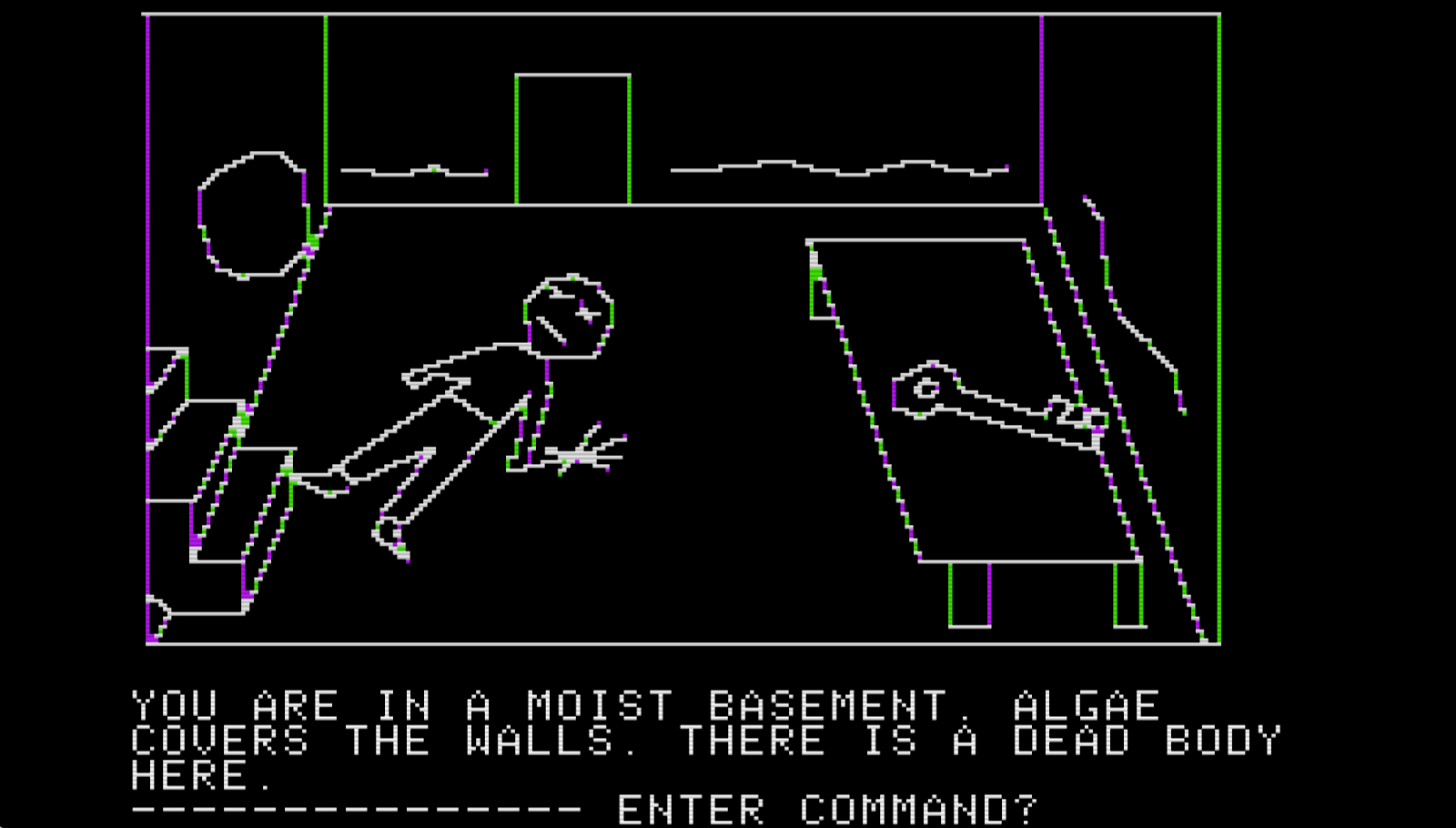
Upon playing for the first time, I was shocked by how much the game still relies on text for the player to understand their surroundings. In hindsight, with Mystery House being the first adventure game to introduce graphics, the graphics play a more complementary role to the text rather than guiding the game. Coming into the game with the mentality of modern games, I expected the graphics to have more details, whether it be details in the room or with the different characters. Many times the game’s text included descriptions of what the rooms consisted of in case it was unclear or sometimes. Once I got over that concept in my head, I could understand would become an aspect that complements the text and becomes visually appealing rather than encompassing the text. I still had a bit of trouble navigating the game due to its use of cardinal directions to guide the players through the house. It was a bit easier for me to go to the locations I wanted in Mystery House due to its use of graphics, so I could visualize more clearly that I was headed towards the kitchen for example, or the study. This is an aspect I find interesting in text-adventure games. The player has to make a mental picture of the locations in regards to world-building and in a way keep a map of the locations they have gone. While in Mystery House, you still have to keep track of the locations you have already been to, the graphics help keep it all visually organized.
On the topic of directions, providing the text parser with directions at times became a point of frustration for me in the game. The game provides you with a set of rules of what directions can be given to the game; two-word commands containing a verb and a noun. It provides a list of example actions one can give the system but if one provides a command that the system is not prepared for, it just says it does not understand and does not provide you with options on how to move forward.
Another thing that made playing slightly difficult for me was the lack of a list of objectives and items required of the player. It is very cool in the game to keep an inventory of the objects one picks up in different rooms and be able to use them later on in the game. Since the game does not provide a list of items to find, one may overlook an item in a room and that would lead to their death later on.
Characters

The function of the other characters in the game Mystery House also intrigued me in comparison to present day. While in a modern game, the characters may play a more active and detailed role in the adventure, in a game like this all we know of the characters is what is provided in the instructions. It caused me to think about modern adventure games like “Detroit: Become Human” where how a player chooses to interact with certain characters is what ultimately determines the path and ending the player will experience. Additionally, it was interesting how on-the-nose the hints found on or near the dead bodies were since one does not have the option to interact and interview with the characters. (SPOILERS) Each dead body that was found had to be specified by the text and since the graphics themselves were not very distinguishable. The hints found on the dead body like blonde hair and a daisy in a body’s hand, made it easy to discern Daisy as the killer once the other blonde characters turned up dead. Meanwhile, to keep using the example of Detriot: Become Human, technology has made the characters in the game look so detailed and realistic that for example the character Markus resembles very closely its voice actor, Jesse Williams and this happens similarly with the rest of the cast. In terms of the characters, I see how including different characters with differing occupations and identities would become popular in later games and how Mystery House begins to establish its purpose.
Overall Thoughts
Overall, I did enjoy playing the game and gained a new sense of appreciation for how detailed and immersive games have become nowadays. The advertising for Mystery House itself demonstrates how the game’s main selling point was its graphics and natural language commands, “Through the use of over a hundred Hi-Res pictures you play and see your adventure. You communicate with Hi-Res in plain english (it understands over 300 words!)” (Nooney, p.88) Currently games advertise the world-building aspects of the games and the paths and actions of the characters have heightened in complexity. Returning to the in-class discussion of the return of providing natural language as a mode of input, I do not see this method of input as making a comeback, especially with how AI has begun to understand more complex commands. I do think it is very important to look back on games like Mystery House to see how far technology has come to create the method we interact with games now and experience these heavily text-based adventure games.
Sources:
Nooney, Laine. Sierra On-Line and the Origins of the Graphical Adventure.American Journal of Play, vol. 10, 1. (2017)
Playthrough: https://www.youtube.com/watch?v=kiwHwPvIHBs
 Intermittent Mechanism