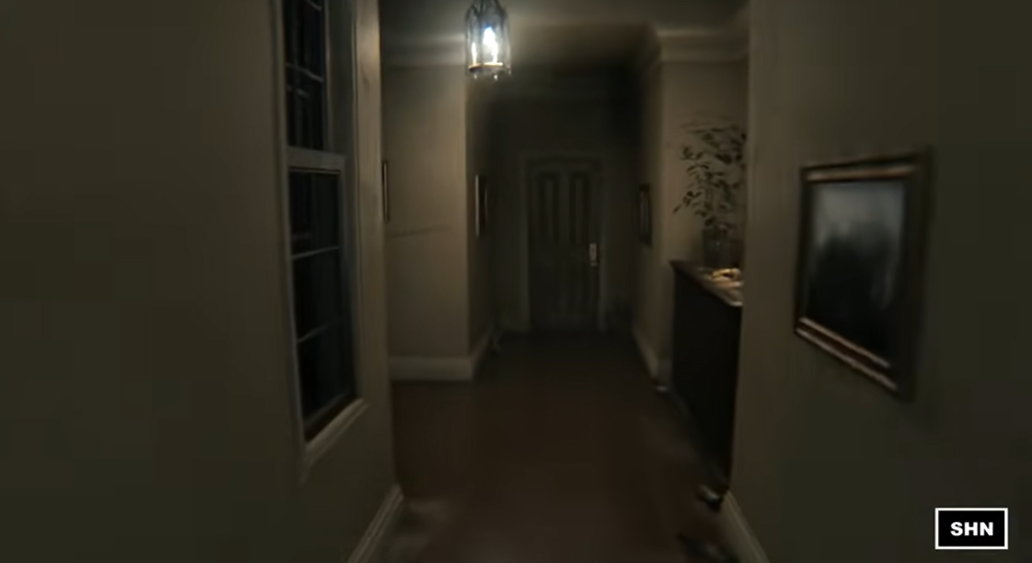
Fourth episode of the Shape Up! series is here, this time on a game I’ve taught several times in classes and long wanted to do a video about: P.T.
Due to the busyness of this academic quarter, I won’t be able to keep up with the one-video-per-month schedule I’ve set for myself since October. Hoping to get at least one more episode of the Shape Up! series out between now and summer, and then return to the one-video-per-month schedule during the summer.
The script that follows below the jump is the shooting script for the video. (It differs from the actual transcript in one key respect.)
by Emily C University of Chicago MADD 14920: Comparative Media Poetics – Horror Autumn 2022
As the player traverses the endlessly looping hallways of P.T. Silent Hill, it is frighteningly easy to become desensitized to one of the first moments of the “uncanny” that the game presents us: our character limps. Players who are familiar with first-person games may be accustomed to a relatively steady camera, one that simultaneously contains enough movement to suggest a character’s embodied experience, but is specifically designed to be unobtrusive. Often, the camera only becomes noticeably unsteady when your character is severely harmed and you are potentially on the brink of dying. So, when the first steps you take in P.T. Silent Hill seem to lurch forward and the camera almost mimics the viewpoint of someone staggering, the player is immediately filled with a multilayered sense of unease. Through its camera work, P.T. is able to foster a sense of soft rejection—the player cannot effortlessly slide into immersion since the perspective they are inhabiting is a jarring reminder of the character’s own distinct body and identity. This furthers the environmental sense of the “uncanny” that we were discussing in class.
In my presentation, I tried to draw attention to two ways in which the spatial design of P.T. created a sense of the “uncanny.” I initially outlined how the infinitely looping hallways structure of P.T. perverts what the player would recognize as a home into endless liminal space. This reconfigures the players’ associations with the home as a safe space of dwelling, or residing, and transforms it into a hostile, transitional space. A second form of the “uncanny” that I thought P.T. was engaged with was a distortion of linear time into frozen, or endlessly repeating time. On this point, the class conversation seemed more divided and some people critiqued whether elements of time manipulation were actually salient in the gameplay of P.T. One comment that particularly stood out to me was made by Wes. He pointed out that although he was aware that diegetically time was at a standstill, his experience of time as a player remained quite linear, as he still experienced the passage of time as linear during each traversal of the loop. I found his comment interesting to consider in relation to Gazzard’s piece, Mazes in Videogames. Gazzard’s conception of time does seem to be space and player-centric. This idea comes up in her discussion of the loop-along, “The loop-along, however, is more cunning. It too acts as a spatio-temporal delay device, although this time it is mixed with some slight confusion on the part of the walker/player as he emerges from the delayed journey further along the original path” (54). In her argument, her references to time imply that the player’s perception of how long it takes to traverse space, which is influenced by how complex it is to navigate, becomes the basis of how time flow is experienced. This seems to resonate with Wes’ comment that his played experience of traversing the space was not fundamentally jeopardized or changed by the narrative implication that time has been distorted. However, others in class pushed back on Wes’ view and described that the looping nature of the hallway did foster a sense of being temporally “stuck” or that the game was able to effectively communicate the character’s own experience of being frozen in or forced to re-live a particular moment.
Personally, I was interested in how the conversation returned to themes of the character’s perspective and thinking about how this concept in P.T. Silent Hill functioned differently from the role of perspective in nana825763’s horror short film, My house-walkthrough. The basic premise of nana825763’s film is strikingly similar to P.T. Silent Hill. The audience is taken along on a narrated “tour” of the endlessly looping corridors of someone’s dilapidated Japanese-style home. Narration is delivered in the form of subtitles, with certain phrases eerily repeating, mimicking the looped nature of the visuals. Similar to P.T., the house slowly undergoes changes as the narrator continues to walk through the hallways and deliver the story of the house and his family.
Despite these similarities, the presence of this informed narrator and the medium of film makes the experience of watching this piece of media considerably different from the experience of playing P.T. Part of what is unsettling about nana825763’s narrator is his calm and undisturbed commentary and his way of navigating through the house. His intense familiarity with the space becomes juxtaposed with our discomfort and confusion. The film dramatizes the narrator’s own uncanniness by having him interact with the space as if it is normal, and thus, in the same way the limp causes us to be initially separated from the character’s perspective in P.T., we almost viscerally reject identifying with and immersing ourselves into the narrator’s perspective, despite the film being similar to an extended point of view shot. While players are able to acclimatize to the movement of the camera in P.T. and eventually immerse themselves into the perspective of the character they are playing as, the narrator of My house-walkthrough continuously maintains this divide. Our medium-specific lack of control over the camera movement and the rate at which the house is explored in My house-walkthrough presents new obstacles for our identification with the narrator.
Finally, to tie in our discussion of “sympathetic” identification in horror films, I find that My house-walkthrough cleverly subverts and reverses the concept that the audience can identify with a perspective while knowing more about the space than the characters do. Despite the film being framed as a “house tour,” the lighting in the film, the rapid pans, and the obstructed views that characterize the footage give the impression that the house is being shown without actually allowing the viewer to visually take in the space. Thus, the narrator walks us through the space as if we understand what we are seeing, but even after multiple loops, we remain helplessly disoriented and the space persists as an unknown and unmappable entity. Suspense is generated despite us knowing, and intensely feeling that we know, next to nothing about this house compared to the narrator. It is precisely because of this dissonance between being shown, but never really seeing, between being addressed as if we are also gaining familiarity, but never really understanding, that we are deeply unsettled and feel resistant to identifying the perspective presented by the point of view shot. While both P.T. Silent Hill and My house-walkthrough use infinitely looping hallways to transform the home into non-Euclidian spaces, the difference in medium and the perspectives in the two pieces generate ultimately different experiences of the uncanny.
by Audra B University of Chicago MADD 14920: Comparative Media Poetics – Horror Spring 2022
My discussion animation drew from the terminology Alison Gazzard outlined in Mazes inVideogames: Meaning, Metaphor and Design to ask two questions about PT.
Question 1: Is PT a maze?
Alison Gazzard immediately differentiates between real-world mazes and video game mazes, stating that real world mazes are pathways of experience while video game mazes are pathways to completing an objective (42). PT does not seem to fit into either of these categories; its paths do not stand alone as entertainment because you solve puzzles within them, but the final objective is never explicitly defined. The game just starts from a first-person POV waking up on the floor of a dark room and you are able to walk through a door.
Gazzard developed a “morphology of paths” that defines set path structures. While PT’s path aligns with the defined structures, “maze-emes”, there are not enough maze-emes present for PT to be considered a maze. The relevant definitions are as follows:
Core path = “any path that has no other use than to guide us between the other parts of the path”, can also contain keys or rewards
Blind turn = “it is a breaking of the direction of the path, while the same path still continues”
Loop-back = “starts to take the walker/player somewhere new, and then continues back on itself”
PT is made up of one core path with a blind turn in the middle. There is a “start door” and “end door”. The end door, when unlocked, opens up to the view of coming out of the start door. The end door to start door travel represents a loop-back, but is physically missing the connection path. See the image below for a representation:
The missing loop-back path and single core path with a bathroom constitute the entirety of PT’s world. Kendrick argued in class that PT is strictly a game of solving puzzles within a space. He said it was not a maze, but a series of puzzles. Building off of this, PT is a single path, not multiple. Gazzard defines video game mazes as pathways to completing an objective. PT does not have pathways, which removes the confirmation of interaction that is present in video game mazes with paths to choose from. PT players do not get to choose their path.
In class, Ben suggested that if PT is not a maze, it could be a labyrinth: a single, non-branching path that leads to a center. Gazzard discusses two types of labyrinths in video games: spaces of illusion and tracks. There are many video games that exist on a unicursal path like PT, but the game designers have chosen to make the area feel expansive and explorable to give players a sense of freedom. These are called spaces of illusion, which PT clearly does not fit into as it was designed to feel repetitive and claustrophobic. Additionally, spaces of illusion incorporate obstacles to movement that subconsciously direct the player to move along the single path, rather than exploring the false expanse. PT does not have any specific obstacles to movement because the entire space acts as the obstacle. PT is most similar to the space of illusion labyrinth in that “the path is not restricted once it has been walked” (67). This is a superficial similarity, however, because retracing your path in a space of illusion does not benefit the player, while in PT solving the puzzles is dependent on the player re-walking the path. For example, you need to dash between the radio and the phone to trigger the first baby laugh. The second type of video game labyrinth is the track, where the player cannot choose where to go on the single path. The player can control the speed of the avatar or initiate certain actions, but ultimately they do not control the player’s movement through space. PT does not fall into this category because, as discussed earlier, complete freedom of movement and control over the only action, focusing, is imperative to solving the puzzles.
From class discussion, PT does not seem to align with any of Gazzard’s video game maze or labyrinth definitions. It may align with an entirely different video game category, and its similarity to an escape room could be explored further.
Question 2: Can an entire game be a dead end?
A dead end is a closed path with no way through, requiring the player to retread their steps if they want to continue their journey (62). Before discussing if PT overall is a dead end, a potential dead end within the game is the “end door”.
The PT end door can be categorized as both a gate and a dead end, at times simultaneously. A gate hides the path beyond it and forces the player to wait for it to open onto the next section of the path. After the end door is unlocked early in the game, the door is a gate because it allows the player to pass through it while hiding the path beyond it. However, upon failing to solve a puzzle, like the “Hello!” puzzle, the end door remains a gate because the player can pass through it, but brings you back to the exact same path. It makes the player double-back while physically moving forward. Gazzard describes video game dead ends as paradoxical because they prompt movement through the denial of movement (62). In PT, the denial of movement is denying progression towards the end goal, like resetting the “Hello!” puzzle. The end door may not be a physical dead end, but it serves the same purpose.
In class, we discussed two ways in which PT could be classified as a dead end overall. PT is a game of puzzles that must be solved with a specific methodology, none of which are told to the player. PT forces the player to retrace their steps until they solve each puzzle. We experienced this ourselves in our class attempt, where we tried upwards of ten times to get the second baby laugh at the end of the game. We never knew if we had failed the attempt or just needed to wait a little longer. Each time we had to choose a time to double back and start again. In this way, PT is a game of doubling back until something in the limited space changes, a continuous dead end. Additionally, my classmates explored how PT could be a metaphorical dead end. PT is a playthrough teaser-trailer for a Silent Hill video game that was never released. Therefore, the final objective of PT, drawing players to a new complete video game, is left unaccomplished, making PT a dead end.