MADD 15303
Most recently taught: Spring 2025
Course Description
From hypertext works spanning thousands of nodes to algorithmically-generated animations that unfold slowly over the course of hundreds of years, 21st Century media has leveraged digital technology to approach scales never before conceived. This class examines a broad array of digital artworks and theoretical trends from the past several decades, all circling around issues of endings and infinity. This includes everything from humanistic inquiries into the nature of closure in electronic literature of the 1990s to contemporary dreams of infinite machine-generated content (coinciding with the reciprocal promise of infinite growth via replacing human labor). Course assignments will be a mix of analytical writing and creative projects.
Learning Outcomes
By the end of this class, students will:
- Trace a history of machine-based, collaborative, and digital approaches to art across the 20th and early 21st Centuries that have pursued vast and previously-unimaginable scales
- Critically assess the ideological trajectory of how labor, technology, and economic growth have been conceptualized in the internet era, and how these conceptions have informed digital media
- Investigate imagined futures—by science fiction authors, tech entrepreneurs, venture capitalists, economists, environmentalists, labor radicals, and professional prognosticators of all stripes—and work to imagine their own futures
- Undertake critical multimedia research projects incorporating digital media analysis, cross-media comparative examination, and critical commentary
Assignments and Grade Distribution
Students’ final grades will be determined by adherence following 4 expectations:
15% Attendance and Participation. Participation in class activities is expected. Students may miss two days of class without penalty; beyond this point unexcused absences will have an impact on this portion of your grade. Masking is encouraged if it will allow you to participate more fully.
20% Presentation. Once during the quarter, students will give an in-class presentation. This can take the form of an extended dive into some facet of the week’s material (a particular reading, artist, piece, technology, or technique). It can also be used to present on a personal research interest related to the course topic but not covered in the syllabus. Topics and days will be divvied up according to student preferences. Depending on your focus, you may spend your time talking, ask questions to animate discussion among your peers, or engage the class in some sort of activity. Whichever route you take, your total time should not exceed 20 minutes.
20% Event score responses. As an alternative to traditional discussion board posts, this course borrows the Fluxus practice of “event scores,” instruction sets for undertaking (or at least imagining) some activity. Seven event scores have been embedded into this syllabus. Each is an invitation to write fiction, pitch an imagined project, show and tell, or engage in some other activity. I have set up an assignment drop box on Canvas corresponding to each event score where you can submit your responses. You are expected to respond to six of these scores, which means you can skip one of your choosing without penalty.
45% Final project. This project is variable in form, and variable in the number of people involved.
- Variable in form: The final project may be a work of hypertext fiction, hypertext nonfiction, game prototype, piece of net art, work of short fiction, musical composition, traditional term paper, or something else entirely.
- Variable in the number of people involved: Some of these forms (i.e., games) are more conducive to group projects, while other (i.e., term papers) are more conducive to individual authorship. You may pursue either an individual or group project.
Whatever the form of the project, or number of people involved, you must provide the following components:
- An abstract of 300–400 words, due Friday May 9 (5%)
- A presentation serving as a preview of the project, given the evening May 22 (5%)
- The final version of the project, whatever form it may take (35%)
Course Materials & Thursday Evening Session Logistics
This class has a slot reserved on Thursday evenings, 6:30–9:30 PM, for hands-on play labs and/or screenings. However, this slot will be used irregularly. We will have play labs on the evening of April 10 and April 17, a screening on May 15, and time reserved for final presentations in the evening of May 22. Those four dates will be the only Thursday evenings we convene.
Attendance at these four evening sessions is expected as a general rule. However, if you have tested positive for COVID or are feeling unwell, you may (and should) excuse yourself from these sessions. If you miss a play lab session, you can check out hardware that these games have been installed on during the MADD Center’s regular hours. This can be used to make up materials from class play sessions, or to look at games beyond what we were able to look at during the play labs. If you miss the May 15 screening, you can make up the material by other means.
Aside from material presented at these play labs/screenings, all other material for the course will be made available as a download or link on Canvas. This includes take-home assignments looking at art, reading hypertext literature, or playing games available online. Students are not required to purchase any materials for this course.
Course Schedule
March 27 Class: Beginning with Endings
Required readings to do prior to this class meeting:
- Barbara Herrnstein Smith, Poetic Closure (1968), Introduction
- Noël Carroll, “Narrative Closure” (2007)
- Walter Benjamin, “The Storyteller” (1936)
- Jorge Luis Borges, “The Book of Sand” (1975)
April 3 Class: The Song That Never Ends
Required readings to do prior to this class meeting:
- Alastair Brotchie and Mel Gooding, A Book of Surrealist Games (1995), excerpts
- John Cage, “To Describe the Process of Composition Used in Music of Changes and Imaginary Landscape No. 4” (1952)
- John Cage, “Composition as Process” (1958), lecture 1 “Changes” & lecture 2 “Indeterminacy”
- John Cage, “Art and Technology” (1969)
- Liz Kotz, “Post-Cagean Aesthetics and the Event Score” (2011)
- Yōko Ono, Grapefruit (1964), selected piece descriptions
- Philip Oltermann, “‘There’s a Certain Madness to It’ … Fans Await New Chord in John Cage Gig with 616 Years Left to Run” (2024)
- Italo Calvino, “Cybernetics and Ghosts” (1967)
Supplemental materials and recommended further reading:
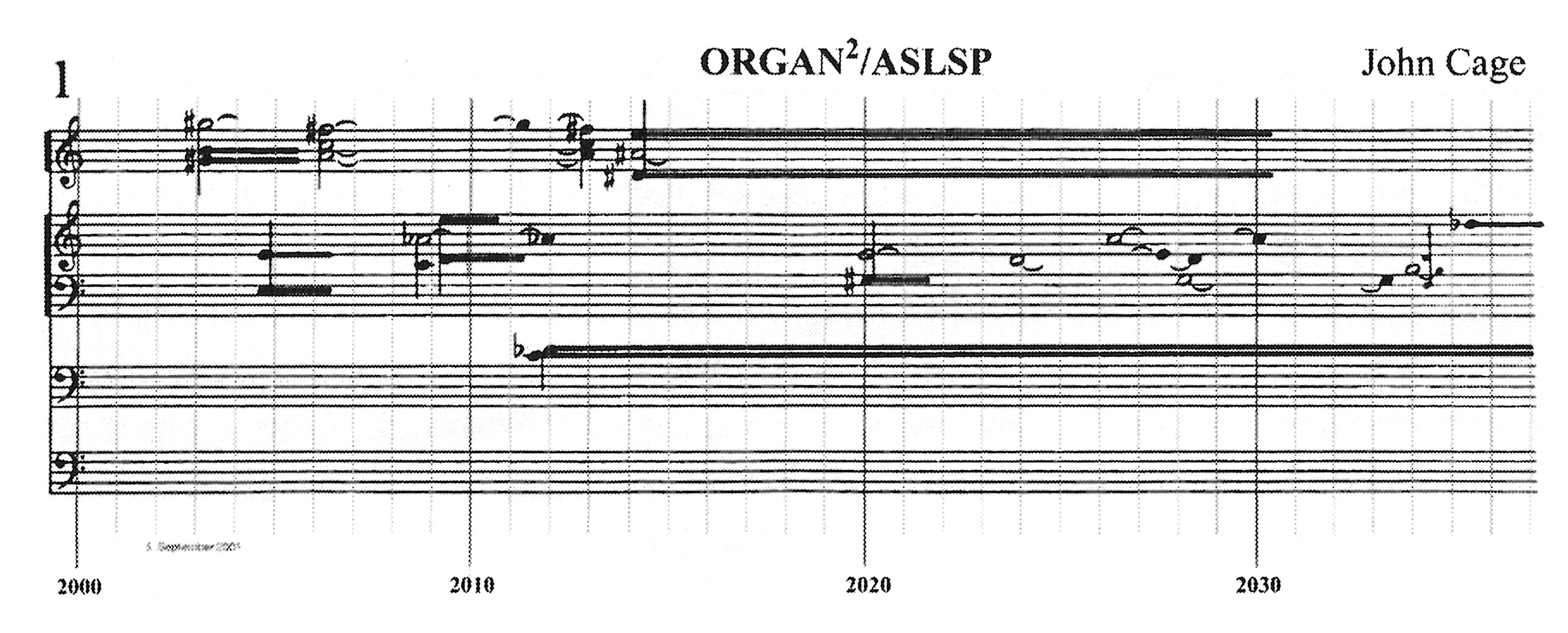
- John Cage, score for ORGAN²/ASLSP (1987)
- David Zintl, “Cages ‘As Slow As Possible’ als heterochrones Kultur-Objekt” (2014)
April 10 Class: Questions of Closure in Electronic Literature
Required readings to do prior to this class meeting – for everyone, regardless of group:
- Robert Coover, “The End of Books” (1992)
- J. Yellowlees Douglas, The End of Books—Or Books Without End? (2000) Ch 2, “Books without Pages—Novels without Endings”
Additional Material for Group 1:
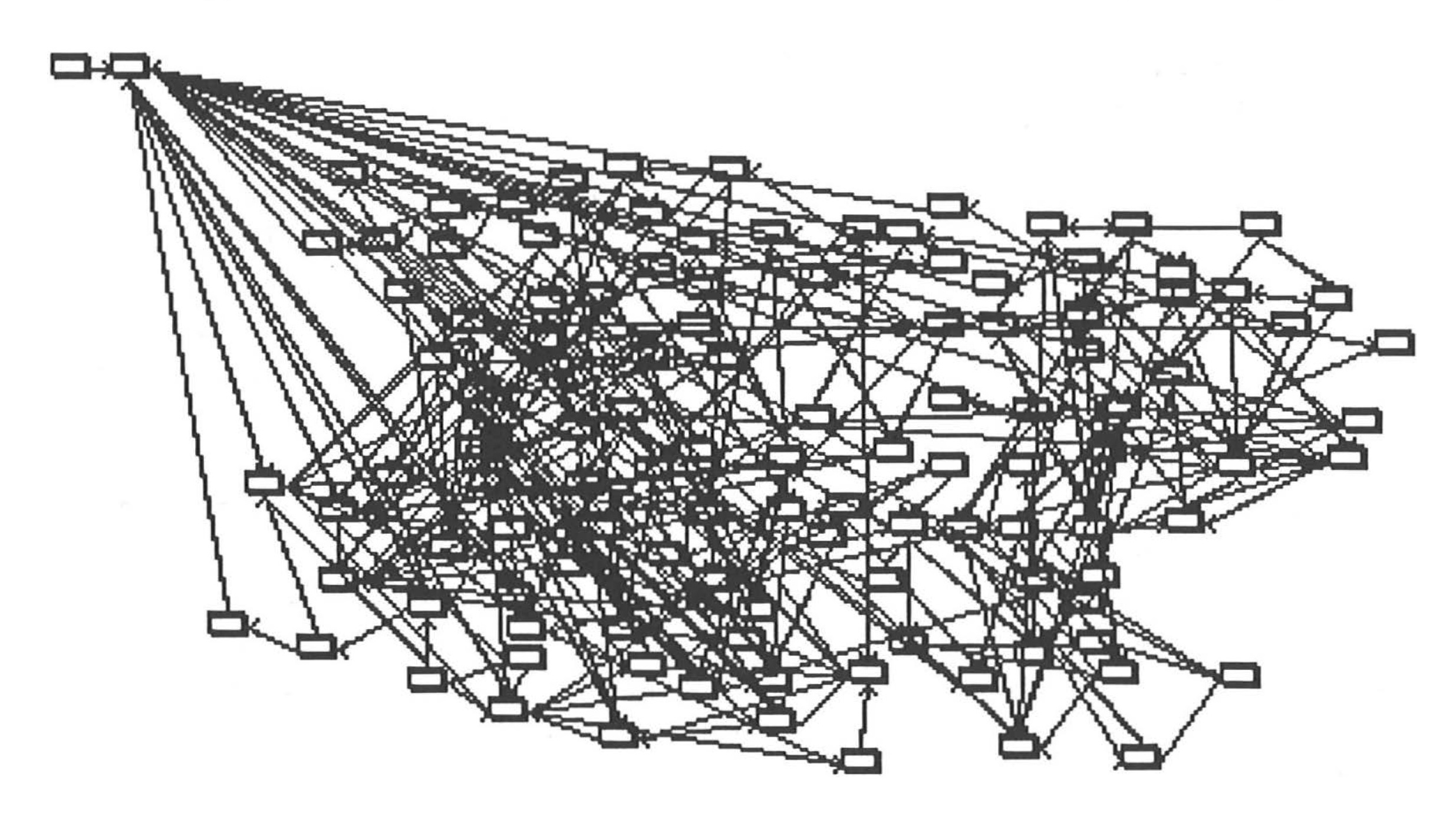
- Take-home hypertext assignment: Forking Paths (Stuart Moulthrop, 1987)
- J. Yellowlees Douglas, The End of Books Ch 4, “Charting Maps and Raising the Dead”
Additional Material for Group 2:
- Take-home hypertext assignment: afternoon, a story (Michael Joyce, 1990)
- J. Yellowlees Douglas, The End of Books Ch 5, “Just Tell Me When to Stop”
Recommended further reading (for everyone):
- Vannevar Bush, “As We May Think” (1945)
- George P. Landow, Hypertext (1992), Ch 4 “Reconfiguring Narrative”
Week 3 Event Score: Write about a moment that frustrated or confused you while navigating either Forking Paths or afternoon.
+1 Extra Credit: Be frustrated or confused by every moment in these hypertexts.
+2 Extra Credit: Be frustrated or confused by everything we look at in this course.
April 10 Evening Play Lab
- Station 1: Roblox (Roblox Corporation, 2006)
- Station 2: Super Mario Maker 2 (Nintendo EDP, 2019)
- Station 3: Dreams (Media Molecule, 2020)
April 17 Class: User Generation
Required readings to do prior to this class meeting:
- Jeff Howe, Crowdsourcing (2007), Ch 7 “What the Crowd Creates”
- Tiziana Terranova, “Free Labor” (2000)
- Sara Grimes, “Little Big Scene: Making and Playing Culture in Media Molecule’s LittleBigPlanet” (2015)
- James Newman, “Kaizo Mario Maker: ROM Hacking, Abusive Game Design and Nintendo’s Super Mario Maker” (2018)
Recommended further reading:
- Stephanie Boluk and Patrick Lemieux, Metagaming (2017), Ch 4 “Hundred Thousand Billion Fingers”
Week 4 Event Score: Write a review of a user-created level you played, either during our April 10 play lab or on your own.
+1 Extra Credit: Make your own level for a game that supports user-generated content.
+2 Extra Credit: Make your own level for a user-generated content game that is no longer online.
April 17 Evening Play Lab
- Station 1: The Elder Scrolls II: Daggerfall (Bethesda Softworks, 1996)
- Station 2: Dwarf Fortress (Bay 12 Games, 2006–)
- Station 3: No Man’s Sky (Hello Games, 2016–)

April 24 Class: Procedural Generation
Required readings to do prior to this class meeting:
- Laura U. Marks, Enfoldment and Infinity (2010, Ch 6 “Baghdad, 830: Birth of the Algorithm” [excerpt, pp 153–174]
- Darren Grey, “When and Why to Use Procedural Generation” (2017)
- Mark R. Johnson, “Meaning” (2017)
- Stephanie Boluk and Patrick Lemieux, “Dwarven Epitaphs: Procedural Histories in Dwarf Fortress” (2013)
- Raffi Khatchadourian, “World without End: Creating a Full-Scale Digital Cosmos” (2015)
- Kevin Schut, “Hello Games’ No Man’s Sky” (2018)
- Joseph Addison, “On the Pleasures of the Imagination” (1712)
- Immanuel Kant, Critique of Judgement (1790), Second Book: Analytic of the Sublime, §23–28
- Patrick LeMieux, “Histories of the Future” (2014)
Take-home net art viewing assignment:
Week 5 Event Score: Narrate a Dwarf Fortress play session, or narrate the experience of a particular planet in No Man’s Sky.
+1 Extra Credit: Write an imagined story set at the time a particular icon appears in Every Icon.
+2 Extra Credit: Procedurally create your own setting where a story can occur.

May 1 Class: Made this syllabus with my own hands 😄, but no one appreciates this 😭
Required readings to do prior to this class meeting:
- Kevin Kelly, The Inevitable (2016), Ch 7 “Filtering”
- Chris Hayes, The Siren’s Call (2025), Ch 6 “Dawn of the Attention Age” [excerpt, pp 164–183]
- Roald Dahl, “The Great Automatic Grammatizator” (1953)
- Karl Schroeder, “Noon in the Antilibrary” (2018)
- Max Read, “Drowning in Slop” (2024)
- Renee DiResta and Josh A. Goldstein, “How Spammers, Scammers and Creators Leverage AI-Generated Images on Facebook for Audience Growth” (2024)
- Jason Koebler, “AI Slop Is a Brute Force Attack on the Algorithms that Control Reality” (2025)
- Philip K. Dick, “Pay for the Printer” (1956)
Take-home viewing:
Recommended further reading:
- Jorge Luis Borges, “The Library of Babel” (1941)
- Herbert A. Simon, “Designing Organizations for an Information-Rich World” (1971)
Week 6 Event Score: Find AI-generated spam on a social network of choice and fall down a slop rabbit hole. Bring your favorite examples of slop to class as show-and-tell.
+1 Extra Credit: Follow AI slop accounts until you irreparably ruin your social media feed.
+2 Extra Credit: Delete all your social media forever.
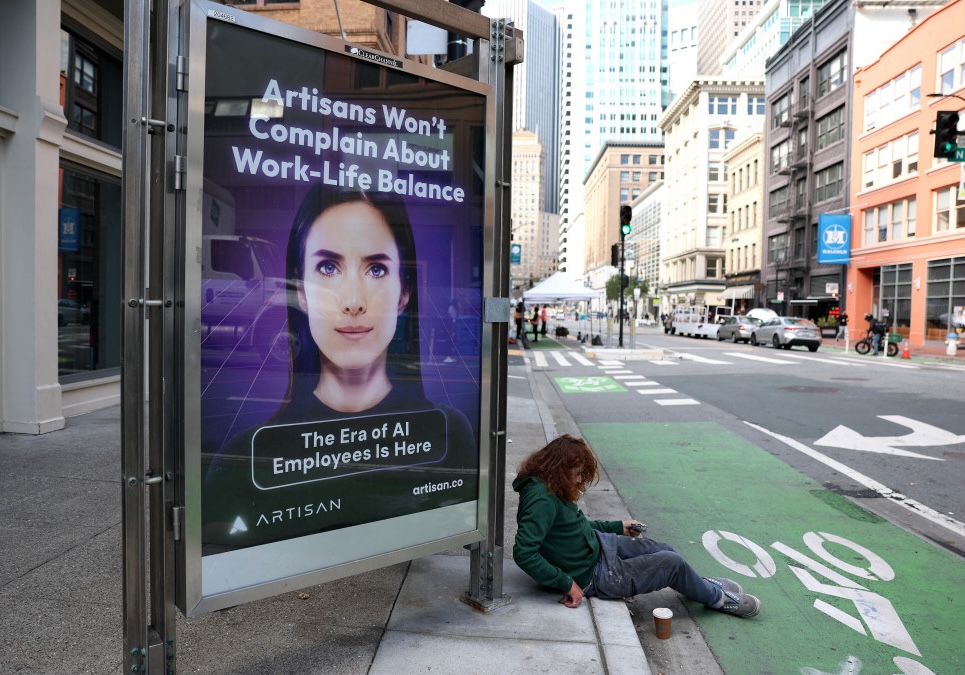
May 8 Class: Automation and the End of Wage Labor
Required readings to do prior to this class meeting:
- James Boggs, The American Revolution (1963), Ch 2 “The Challenge of Automation” & Ch 4 “The Outsiders”
- Murray Bookchin, “Towards a Liberatory Technology” (1965)
- Nick Srnicek and Alex Williams, Inventing the Future (2015), Ch 5 “The Future Isn’t Working” & Ch 6 “Post-Work Imaginaries”
- Stephen Council, “SF Tech CEO’s Billboards Are ‘Dystopian.’ That’s How He Wants It.” (2024)
Week 7 Event Score: Don’t write your own response to this event score. Instead, prompt an LLM to write about a post-work future.
+1 Extra Credit: Seriously, don’t turn in something you yourself wrote yourself this week.
+2 Extra Credit: I will use an AI checker, and if it flags your response as not being AI written I will consider it a breach of academic integrity and have no choice but to report you to the Office of College Community Standards.
Friday, May 9
Abstract for final project due. If you are planning a group project, you must have solidified your group by this point. Not every student needs to turn in their own abstract, but every student must be attached to a project with an abstract turned in at this time.
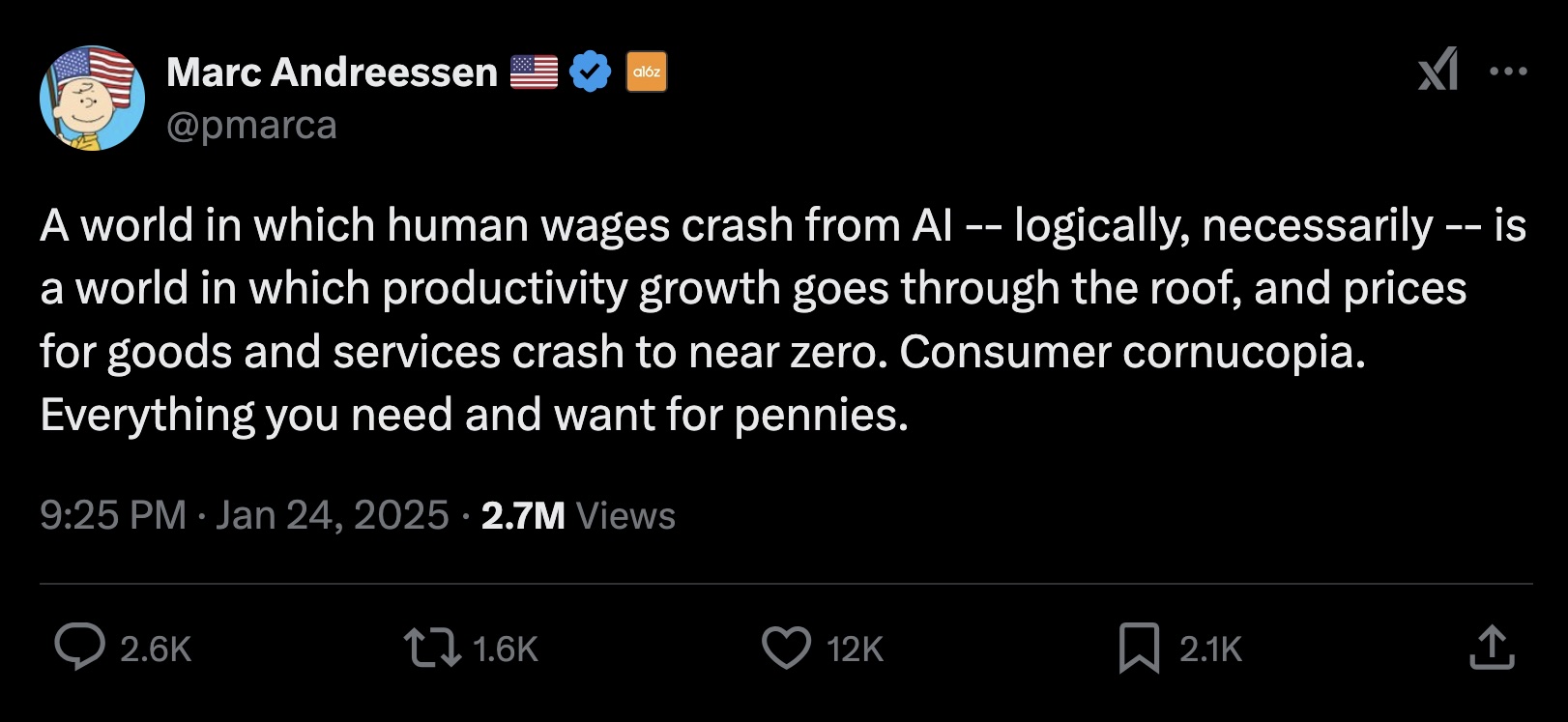
May 15 Class: Times of Plenty
Required readings to do prior to this class meeting:
- Paul Collier, The Plundered Planet (2010), Ch 2 “Is Nature Priceless”?
- Tyler Cowen, Stubborn Attachments (2018), Ch 5 “What About Redistribution?”
- Nick Bostrom, “Ethical Issues in Advanced Artificial Intelligence” (2003)
- Nick Bostrom, “Astronomical Waste: The Opportunity Cost of Delayed Technological Development” (2003)
- Donella H. Meadows, Jorgen Randers, and Dennis L. Meadows, The Limits to Growth (30 Year Update edition, 2004), Ch 1 “Overshoot”
- Marc Andreessen, “The Techno-Optimist Manifesto” (2023)
- David Berreby, “As Use of A.I. Soars, So Does the Energy and Water It Requires” (2024)
- Mack DeGeurin, “The Future of AI Is Even More Fossil Fuels” (2025)
- F.T. Marinetti, “The Founding and Manifesto of Futurism” (1909)
- Arthur C. Clarke, “The Nine Billion Names of God” (1953)
Take-home play assignment:
Recommended further reading:
- Alexandra Sasha Luccioni, Sylvain Viguier, and Anne-Laure Ligozat, “Estimating the Carbon Footprint of BLOOM, a 176B Parameter Language Model” (2022)
Week 8 Event Score: Draft a plan for a project that uses all resources on Earth.
+1 Extra Credit: Draft a plan for a project that uses all resources in the galaxy.
+2 Extra Credit: Enact your plan as this class’s final project.
May 15 Evening Screening
- Black Mirror Series 2 Episode 1, “Be Right Back” (Owen Harris, 2013)
- Excerpt from Amazon re:MARS 2022, Day 2 Keynote
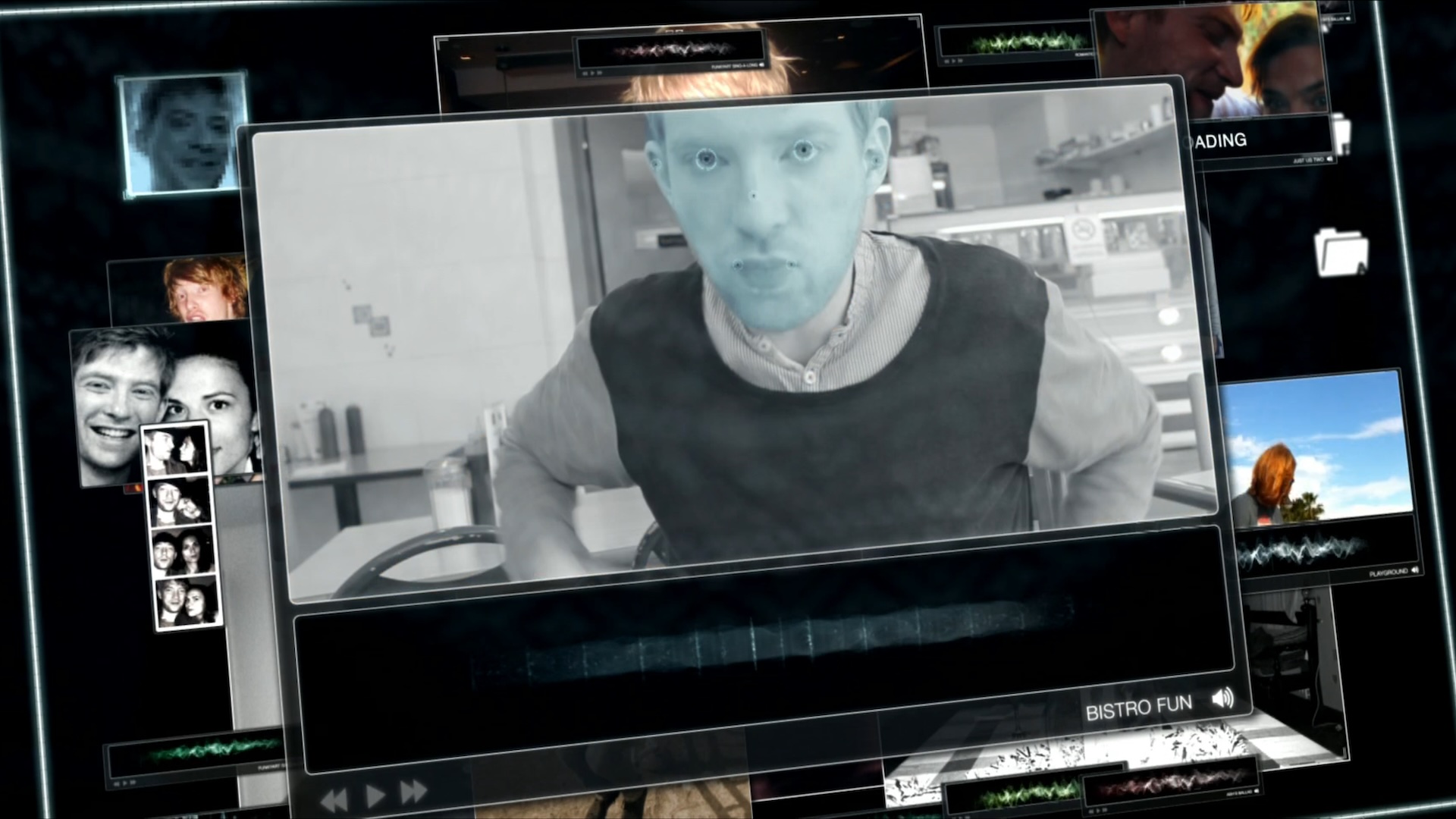
May 22 Class: Eternal Life
Required readings to do prior to this class meeting:
- Ray Kurzweil, The Singularity Is Near (2005), Ch 4 “Achieving the Software of Human Intelligence” [excerpts] and Ch 7 “Ich bin ein Singularitarian”
- Meghan O’Gieblyn, God, Human, Animal, Machine (2021), “Pattern”
- Zeyi Yang, “Deepfakes of Your Dead Loved Ones Are a Booming Chinese Business” (2024)
- André Bazin, “Ontology of the Photographic Image” (1945)
Recommended further reading:
- Timnit Gebru and Émile P. Torres, “The TESCREAL Bundle: Eugenics and the Promise of Utopia through Artificial General Intelligence” (2024)
Recommended further listening:
- Love+Radio, “Insufficient Data” (2022)
Week 9 Event Score: Draw up a will that will determine the means by which you will live forever.
+1 Extra Credit: Actually live forever.
+2 Extra Credit: Opt not to live forever, even though you could have.
May 22 Evening Session
Final project presentations
Due date for final projects TBA, depending on how many group vs. individual projects there are. No earlier than May 26.

