The Search for a “Good” Ending in Save the Date

by: Madelyn

In most games, it isn’t possible to sit down for two minutes, make a couple choices, and get to a screen that tells you it’s “The End.” In Save the Date, that is just about the only thing that can happen—but just because the player has reached the end of a storyline, this is far different from having reached the end of their gameplay experience. In fact, the exact opposite is true. Save the Date is built around a core gameplay loop that expects the player to feel unsatisfied with the narrative ending they receive and play again to try to get a “better” one. However, one could argue that the player will never reach a satisfying ending, if their goal is to “save the date”—to successfully go out with Felicia while keeping her alive.

The game includes a variety of narrative paths that ultimately lead to (as far as I am aware) twelve different main diegetic endings—eleven of which involve Felicia’s death in some way or another. The twelfth requires only a single choice from the player, choosing to not go out with her in the first place. This option feels intuitively “incorrect,” as a player’s natural response would likely be “How can I save the date if there is no date?” However, after repeated failed attempts to go on the date without Felicia dying, one returns to this menu dialogue option with a different perspective—“maybe the only way to save the date is not going on one at all.” While this option does keep Felicia alive, it is still unlikely that players will find it satisfying.

Save the Date also has potential for two nondiegetic “endings”—both of which come to a less tragic conclusion than any of the twelve narrative endings, but it is debatable whether either of these endings can be considered a legitimate ending of the game to begin with. First, there is the “hacker ending.” The player can navigate through the game’s directory to find a file named I_AM_A_HACKER.rpy, and by editing a line in this file from “False” to “True,” the player will now have access to a new dialogue option at the beginning of the game—to suggest having “an awesome dinner in [their] floating sky castle because [they are] a hacker!” If the player chooses this option, they and Felicia will both become extremely wealthy and live out all their wildest dreams, so it may at first seem like a “good” ending. However, this route tends to leave players unsatisfied as well, because the game makes them feel like they cheated to even get this option in the first place. After experiencing this ending for the first time, the player encounters an unexpected new catalyst for repetition—a search not just for a “good” ending, but for a “good ending” that they feel like they have earned.

Finally, once the player has repeated several iterations of the loop and they go out with Felicia to Moore’s Hill (where she will still eventually die), being truthful with her about their intentions and about the loop will lead to a deeper, more philosophical conversation than anywhere else in the game. In this conversation, Felicia attempts to help the player find an ending that they deem to be “satisfying.” If the player chooses the dialogue option suggesting that they just want a “You Win” screen, Felicia offers to simply say it to them and asks if this will solve the problem (interestingly, this is not considered an actual ending to the game—the dialogue keeps moving forward past this point). Further, Felicia suggests that maybe the way to get a satisfying ending is to close the game and imagine an entirely different ending if they don’t like the one the author created. Ironically, this is one of the few endings that the creator of the game himself deems to be the “true” ending of Save the Date. However, it is once again debatable whether this can even be considered an actual ending of the game, when it solely exists outside of the body of the work itself. Does this mean that any alternative ending we can think of for any piece of media is equally as legitimate as the ending(s) of the work itself? Is this case different because the creator of the game specifically wanted people to create their own endings? Is Felicia even really meant to be saved? These are all valid questions that arise from considering this abstract “ending” to Save the Date, and there is no objective answer to any of them. Some players may be satisfied with the idea of the game allowing them the creative freedom to think up their own ending, while others may find this unfair or illegitimate and argue that Save the Date simply has no happy ending.

At some point, the player will no longer feel the desire to keep looping through the game in search of a “good” ending—they will either accept or deny the one in their imagination, but after they have completed all of the diegetic storylines to the game, this is when their playthrough truly “ends.” At this stage, they have experienced twelve to fourteen endings, depending on which they consider to be legitimate, and all that is left is for them to decide which ending they liked the best. Many players will likely choose to accept one of the more controversial endings, such as the imagined ending or the hacker ending, but some may also choose to take one of the death endings and interpret it as their version of the game’s canon, simply because they found it the most entertaining. As the player chooses their macro-level ending of the game, having experienced micro-level endings many times, Save the Date’s gameplay loop finally draws to a close.
Save the Date’s Groundhog Day Style Loop

By Spencer

I find Save the Date to be very fascinating in terms of how it relates to the Groundhog Day style time loop. One of the most important parts of Groundhog Day’s time loop is that Phil doesn’t understand why it’s happening or how to end it. Thus, if we accept the common assumption that the way to break the loop was for Phil to become a good person, Phil’s only option is to naturally achieve this goal. He can’t just come up with a precise strategy to get through his goals for the day or a way to “quit” the loop by dying. By comparison, the interactive fiction the loop can teach you a lesson or skill, but they’re rarely necessary to reach the loop’s end point. For instance, in Majora’s Mask, you know that you’re constantly working towards the goal of becoming skilled enough at the game to stop the fall of the moon, or in Diablo you know that your loop is constantly improving with the goal of fighting Diablo at the bottom floor of the dungeon. However, because you know what your goal is in these loops, there’s always a direction you can force your way towards. Instead of understanding the intricacies and skills needed to beat the game, it’s possible to simply memorize the patterns of actions you need to take, or brute force your way through with saves and loads. In Groundhog Day this would be equivalent to Phil’s failed attempt at having a good date with Rita by memorizing specific pieces of information that he knows will draw her interest. Similarly, in these games you never need to achieve the goal of the loop. It’s always possible for you to give up when you die and stop playing or take a break and never come back. In Groundhog Day, this corresponds to the times Phil attempted to end the loop by dying. These sorts of solutions don’t work in the loop put forward by Groundhog Day.

In contrast, in Save the Date the only way out of the loop is to, on some level, have arrived at the loop’s purpose. Since you don’t have a specific end goal, you can’t know that the decisions you’re making are progressing you towards ending the loop. You can make what seems like progress, but ultimately it doesn’t amount to anything substantial. In the end you can’t memorize a set of decisions to progress further, because you don’t know if you’re going in the right direction in the first place. This is of course assisted by the nature of the way to end the loop, quitting the game either to imagine a good ending for yourself or to stop the bad endings from continuing to occur. Since the goal of the loops is to teach the player that they can’t rely on the author to give a satisfying ending in a collaborative storytelling experience, the endings are only achievable if the player understands this at some level and makes the choice to stop playing the game. Even if the player quits out of frustration, lack of time, or some other reason, this means they’ve implicitly understood the message, as they’ve made the decision that whatever ending is waiting for them isn’t worth the work or time they’d have to put in. In this way, Save the Date’s loop is one of the most similar to that of Groundhog Day in any piece of interactive fiction, since the only way out of it is through understanding the loop’s message.

This also ties into the way in which the deaths in Save the Date operate. For instance, in class we discussed the seeming contradiction in the fact that the game seems to be pushing the player towards being a better person towards Felicia by telling the truth but still making her death inevitable in these cases. This contradiction is resolved if we consider that the point the game is aiming for isn’t just for us to be honest with Felicia but to actually help her, which means turning off the game. In these cases, by being honest with Felicia the game helps the player reach the point where Felicia tries to dispel their misconceptions about the goal of the game. At that point, almost all paths directly tell the player that they should reset before Felicia dies or stop playing altogether. Thus, if you continue to play the game to help Felicia, you shouldn’t see her die again from this point, at most she should come close. Thus, Felicia’s deaths will continue so long as the player doesn’t understand the point the game is making but will end if they understand. There’s no sequence of decisions you could make to save her because that isn’t the way to save her.

Addictive game design

by: Dylan Martin

Video game addiction is a real phenomenon. The reason why such an assertion must be stated is due to the stigma around video game addiction. It is often devalued, often seen as something that does not truly exist or is not as bad as other addictions such as drugs and alcohol. Without discounting the severity of those other addictions, it is important to acknowledge that gaming addiction has severe social, mental, and physical consequences. If you or a loved one you know suffers from gaming addiction, please seek professional help. If you are unsure if they are suffering from gaming addiction, look out for the side effects: 

  • Poor performance at school, work, or household responsibilities as a result of excessive video game playing.
  • Withdrawal symptoms, such as sadness, anxiety, or irritability, when games are taken away or gaming isn’t possible.
  • A need to spend more and more time playing video games to get the same level of enjoyment.
  • Giving up other previously enjoyed activities and/or social relationships due to gaming.
  • Being unable to reduce playing time and having unsuccessful attempts to quit gaming despite the negative consequences it’s causing.
  • Lying to family members or others about the amount of time spent playing video games.
  • A decline in personal hygiene or grooming due to excessive video gaming.
  • Using video games as a way to escape stressful situations at work or school or to avoid conflicts at home.
  • Using video games to relieve negative moods, such as guilt or hopelessness.

As with all mental health topics, please navigate the topic with sensitivity and care. 

This leads to the essential question: what makes video games addicting? Addictive game design is interesting because it is not exclusive to video games but to most games. For instance, gambling, more specifically slot machines and poker, is arguably one of the most predatory uses of addictive game design. Addictive game design capitalizes on the human desire for dopamine, and the natural acquisition of the hormone. Dopamine is colloquially known as the “feel good chemical”, often released in your brain to make you feel pleasure as a part of the brain’s reward system. Any number of things can cause dopamine to be released, but what addictive design attempts to do is capitalize on specific triggers of dopamine. 

Game designers are frequently looking for new ways to trigger the brain into giving the player a dopamine release, making the game feel “fun”. While dopamine can be released from a variety of things, the main trigger focused on during the class animation/screening was learning. The brain is designed to release dopamine when learning a new skill, a feature that has been pivotal to our evolution as humans. However, learning in games is different from learning in real life, as in games we do not have to face the severe consequences of our actions the way we must in real life. This may diminish the anxiety about the unpredictable nature of something new. However, the reason why we do not get bored after we learn how to play a game is because of the idea of looping. A looping design helps foster the need to consistently learn a new skill, as the player will need to continue learning and adjusting when faced with a looping game design. The loop does not have to be explicit or consistent, rather the opposite is true. There seems to be a “Goldilocks zone” when it comes to looping game design.  A loop must be ever-changing and challenging enough to keep the player engaged. A game that does not challenge the player, and remains constant without introducing new patterns of gameplay will eventually become stale and boring. At the same time, a loop much not be too complicated or unpredictable. A game that is too much for the player will become frustrating and push the average player away from the game.  

Moreover, a game can become addicting when it is entrancing. This is known as “the zone”. Famously, casinos are known to put and keep their customers in the zone. The zone is described as a trance-like state, where nothing exists outside of the player and the game they are playing. This is achieved by creating an environment that feels specifically designed for the player. This is famously done in slot machines. The mechanics of a slot machine are very simple and easy to understand, while the outcome is always shrouded in mystery. The risk per turn is relatively low, but the promise of a high reward allows the player to justify their continuous use. Many describe continuous gameplay as a means to stay within the zone more than a means to victory. The lack of time indicators also helps keep the player fully entranced in the game, not allowing them to acknowledge the passing of time. The use of tokens or points allows the player to lose any physical indication of how much money they are spending. 

Games are constantly evolving to keep the player more and more entrancing, stripping them away from a bleak reality and allowing them to obsess over a hyper-reality in which they can experience concentrated joy. The consequences of these developments are severe and should be enjoyed responsibly. 

The “Dark Souls” of Player Motivation

By Nick Venegas

In my initial analysis of core gameplay loops, I examined the four principle loops to game design: the internal game loop, the player’s mental loop, the interactive loop, and the designer’s reactive loop. In my presentation, I only analyzed how gameplay loops operate with near-exclusive respect to the interactive loop and my discussion questions only suggested broader implications towards the player’s mental loop through monetization models and myopic effects on player psychology when all the systems work as intended. Since then, I’ve been thinking a lot about the recursive structure of the interactive loop: the player makes a choice which changes the game model which then, in turn, gives new stimulus to the player, causing them to make new changes to the game, and so on. The idea that a video game can change the way a player thinks is something that I just kind of brushed over as I briefly discussed how designers employ this principle to achieve design goals within the game world. In order to delve deeper into my understanding of the player’s mental loop, I am taking the unique opportunity of this blog post to go a little “meta” and explore how the principles presented in core gameplay loops have affected me and what implications my example may raise for player psychology as a whole.

Firstly, I’d like to start with what spurred my specific interest in player psychology. I was watching Ian’s video essay on Jonathan Blow’s The Witness and I was fascinated with his particular section on pedagogy: the art, science, or profession of teaching people. Although his discussion pertains to The Witness’s tutorials, I found the contrast of his examples to be intriguing even in a broader context. Specifically, The Witness employs “safe failure” as a means to communicate new information to the player. Rather than an explanation of how the mechanics work, Blow instead uses simple puzzles with only a limited number of solutions so that the player may experiment with different approaches in order to recognize patterns and discern the rules for themselves. By their very nature, all games use safe failure since they are intrinsically devoid of real or serious consequences outside of their own ruleset. However, this method of learning via failure was sharply contrasted by the methods of contemporary academia where students (typically) only get one chance at an assessment with severe and permanent consequences for failure, encouraging intense preparation before the first, and likely only, attempt. 

As somebody whose life has been encompassed in equal part by both video games and school, I wondered how these different teaching methods could coexist in my head; how could I consistently learn in a system that threatened severe consequences for failure whilst simultaneously playing games which allowed me to learn through failure without consequences? The ostensible incompatibility of these methods wasn’t reconciled until I thought about my experience with one of my favorite game series: Dark Souls. Initially, I considered how I would die to Dark Souls bosses over and over again in order to learn from my failures, seemingly embodying the philosophy of safe failure. However, I also recalled my intense proclivity to rigorously research wikis and forums for what weapons, armor, spells, and equipment I should use in order to make my character as strong as possible. Even as I replayed these games multiple times, breezing through most encounters with ease, my research habit prevailed as my focus shifted from what equipment would maximize my survival to what equipment would maximize my “fun” on a given playthrough. Here I was practicing the safe failure method in one facet of the game while practicing a fear of failure in another. Surely, I could just experiment with different armor and weapons in order to find out which ones suited me best just as I experimented with my approach to fighting bosses? Why didn’t I do it? What makes these scenarios any different? I believe the answer lies in the motivational disparity between explicit and implicit player goals.

As the player understands and evaluates the game’s model in their own mental loop, both explicit and implicit goals motivate the player to carry out actions. Explicit goals are goals that the game sets for the player. To retain the Dark Souls example, this would be something like an obstructive boss which the player must defeat. Implicit goals are goals that are entirely generated by the player in response to what they know to be possible within the game’s model. Dark Souls presents the players with many different kinds of divergent weapon types, but the designers never explicitly motivate the use of one playstyle over another. So, the player will generate an implicit goal of what kind of specific build they want to use in response to what they know the game will allow them to do. Generally, explicit goals fall in line with the safe failure method of learning since the consequences of not achieving the goal are only limited to the game world. However, I believe that implicit goals bridge the gap between the player’s in-game actions and real-life ramifications since their source is generated from outside the game model. When failing to complete their implicit goal, the player is no longer facing consequences purely from the game. They are also facing consequences from themselves as any disappointment or frustration from failing their own self-created task transcends the game and becomes real. However, these consequences don’t necessarily have to be severe; it is entirely up to how much the player chooses to emphasize their own goals. It is for this reason that I believe implicit goals have the potential to be much more motivating than explicit ones. This would explain why my proclivity to research equipment always beats out my desire to experiment with builds: I am worried of the real-world consequence of potentially wasting my time on a playthrough where I could have had more fun. 

The power of implicit goals is especially apparent in phenomena such as challenge runs and speedrunning. Despite the game designers giving no explicit incentives to have players constrain themselves or beat the game as fast as possible, some players recognize that they can and will do it anyway. For implicit goals, the designer’s intention doesn’t matter because the goal is merely a recognition of what the players discover to be possible, so designers have no control over what they do with open-ended mechanics; if Mario levels can be completed at any time, there will exist a player that will want to complete it at the quickest time; if Mario can freely jump, there will exist a player who will try to complete a level by not jumping at all. As a result, implicit goals are very volatile and can result in both positive and negative experiences for players; a player may make more fun for themselves with their implicit goal, but another player’s paranoia may cause them to do something boring or frustrating which contradicts the designer’s intention. So although a game may be meant to be easygoing, taken slowly, or experimental, the power of implicit goals will see players restricting their own abilities, speedrunning the game, or even meticulously “min-maxing” their Dark Souls build. 

Life on the Inside: Living in a Post-Skinner World

B.F. Skinner was an incredibly influential psychologist from Harvard who made massive strides in the field of behavioral psychology. His most famous experiments involved animals inside deprivation chambers having access to seemingly innocuous levers or buttons that would cause some kind of change in the animals’ environment. However, the conditions under which a change would occur were controlled by Skinner. For instance, he could make a rat pull a level ten times before receiving one food pellet, or he could make a rat wait until the first lever pull after an hour to receive the same reward.

His work is especially notable, particularly in our modern world, for its definition of learning. Skinner defines learning as a multistep process, beginning with an environmental stimulus, followed by a response, and then tail-ended by feedback from the environment. As this cycle repeats, it will become clearer with every iteration which behaviors lead to desirable outcomes and which lead to unfavorable outcomes. For example, if someone notices that the forecast says it will rain and they don’t bring an umbrella, the displeasure created by getting rained on will motivate them to try a different response. So the next time it rains, the person decides to bring a metal rod taller than all of the objects in the surrounding area. As you can imagine, the result of that really will disincentivize that particular behavior. When this individual finally settles on a beneficial response, like bringing an umbrella, they will be happy, on some level, with their current situation, which motivates them to continue to bring their umbrella in the future.

Now, what does this mean for us as individuals in the modern era? More specifically, what does this mean for us as individuals with constant access to devices that provide stimulus and feedback? As a further complication, all of these devices that we have access to and that respond to us and get us to do tasks were sold by a company for profit and host apps that elicit money from users. In summation, we are constantly holding a device created for extracting profit at the point of purchase and throughout its use that can make us react and can also provide feedback conducive to the profit motive. We all own devices that interact with us in a way that fits Skinner’s definition of learning—namely, we are prompted by our phones to do things, we pick a response, and then are given a type of feedback as a result—and they train us to make money for them.

For example, an app like Instagram shows us things that we may enjoy. If we decide to engage with this content, we get more of it. The same is true of things like YouTube, TikTok, and Facebook. In order to maximize user enjoyment, an important modification has been made to Skinner’s original design. That is, there is no response on the part of the user that will lead to negative feedback from the app itself. Every engagement is positive to the app, and the feelings you get from seeing more of the things that you like, as well as having people like your posts, will have you coming back for more. The consistent user base created who become increasingly dependent on these positive feelings equates to a consistent stream of data for advertisers and a platform that is guaranteed to have an audience for advertisers to market to.

Mobile games are another opportunity for some old-fashioned newly-fashioned learning experiences. As we discussed earlier the rate at which feedback is administered is highly adjustable and can lead to different results. In recent years, as it relates to games, researchers have found a variable schedule of feedback distribution to lead to the most player engagement. Consequently, many games such as Candy Crush makes players wait for powerups or even additional chances to play the game for variable intervals of time. This conditions users to acquire their happiness in bursts, as just like in the Instagram example, the negative feedback element has been removed, although here the penalty for waiting is definitely harmful to players’ enjoyment. To circumvent this problem that they created, these games typically provide cash-based get-out-of-jail-free cards, which allows the companies to be quite forward in their profit-seeking. The “apt” among mobile gamers may download many of these kinds of games and schedule their playtime in such a way that they never have a time in which they are locked out of at least one of their games, but this is akin to thwarting McDonald’s by ordering a Whopper Junior, Dave’s Single, and a Famous Star With Cheese, in addition to a Big Mac; the more of their product that you consume, the more you are going to want to partake, and the more you partake, the more data you provide, and the more exposure you give to the app.

This positive feedback loop in particular is not something to take lightly. Other corporations are stuck with much longer wait times between engagement with products, regardless of how enticing they make them. For instance, no matter how beautifully you craft a hotel experience, it is unlikely that consumers will stay in a hotel unless the need arises. Additionally, unless one has an infinite amount of money, one cannot stay forever. In fact, even if getting a hotel room had been previously pleasurable if one were to purchase one while under tight financial constraints, the stress created may completely outweigh any of the luxuries the hotel can offer, ultimately damaging one’s view of hotels, at least for a little while.

The same kind of refractory period does not exist for those who spend most of their time in apps or online; there exists an endless amount of interesting content and most of it is readily accessible for free. The consequences for engaging with that content in a serious fashion long-term are not yet socially accepted, usually being alluded to as something that everyone experiences but accepts as a part of life. However, stripping away one’s sense of consequence in terms of actions harms interpersonal relationships, work ethic, motivation, and mental health overall, potentially, to an alarming degree. By teaching users that fun things should be repeated as much as one desires, as that repetition actually will make things more fun, companies are steadily increasing your reliance on their products for their own gain, regardless of how it may affect your personal life and ability to function. The scariest part about seeing parallels to the behavior of rats within ourselves is seeing the parallels between their cages and the way that we live. Ultimately, we must disengage from such content. Despite the short-term negative consequences of doing so, it is never too late to enjoy a life outside of the box. Out there, as opposed to in here, pleasure is derived from making the best of unpredictability and accepting hardship, which provides a greater sense of being than anything appealing to our lowest instincts can provide.

-Steven

Repetition Compulsion in Popular Media: Art Imitates (and Implicates) Life?

From the catchy tunes of Britney Spears’ Oops!…I Did It Again to the binge-worthy plotline following Walter White in Breaking Bad, perhaps nothing screams “Art Imitates Life” more than the relentless and fascinating portrayal of repetition compulsion in popular media. Laying bare the intricate human struggles of self-destructive loops, modern media has the power to intimately connect with its audience and implicate their lives away from the screen. 

Rooted in Freud’s psychoanalytic theory, repetition compulsion is the individual’s disposition to reenact painful and/or self-destructive behaviors because of past traumas. This process can unfold in various ways: a false sense of self and defensive attitude towards the bad behavior, a yearning for familiarity in past experiences however unpleasant, a desperate attempt to master anxious and helpless feelings, or the mere inability to see beyond flawed behavioral models learned in early life.

Entertainment media eagerly adopts the story of the vicious cycle, especially those with potent narrative powers like songs and television series. 

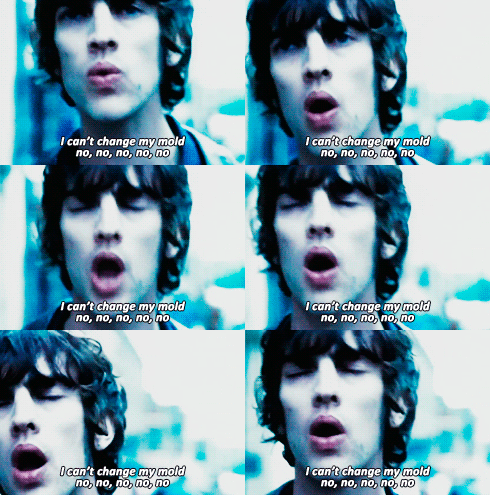
Britney Spears’ character in chart-topper Oops!…I Did It Again embraces a corrupt self-image, whistling “That is just so typically me” before transitioning to the iconic chorus. The Verve’s 90s hit Bitter Sweet Symphony resounds, “You know I can change… But I’m here in my mold,” echoed by Current Joys in A Different Age with the lyrics, “And I wish I could change, but I’ll probably just stay the same.”

The Verve — Bitter Sweet Symphony

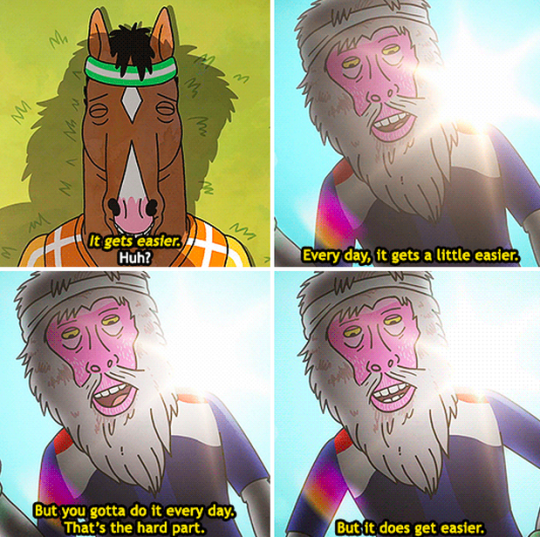
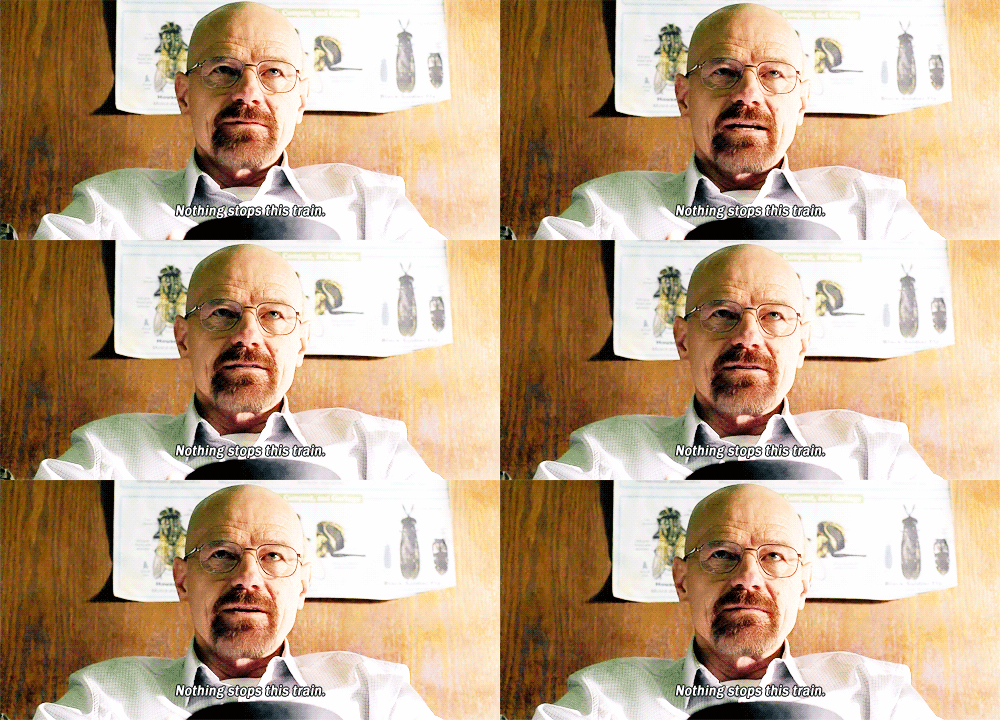
Some of the most popular and critically acclaimed TV series of all time, namely Breaking Bad, The Sopranos, Euphoria, and BoJack Horseman, all observe characters trapped in behavioral loops. In Breaking Bad, high-school teacher Walter White embarks on a journey of increasingly dangerous and immoral actions following his cancer diagnosis, uncovering a deep-rooted egoism that detonates against the powerless fear of death. In The Sopranos, mob boss Tony Soprano acknowledges his violent past and dysfunctional family dynamics as he attempts to salvage his emotional well-being. Euphoria follows Rue, a high school student grappling with drug addiction and mental health issues amidst the turbulence of adolescence and the loss of her father. Also an addiction story, BoJack Horseman chronicles a self-centered yet self-destructive Hollywood celebrity as he confronts the depraved nature of his actions. 

Walter White from Breaking Bad

Beyond mere content in lyrics and character plots, these artistic creations embrace the behavioral loop in their form, the materiality of their very production. In both the songs Oops!…I Did It Again and Bitter Sweet Symphony, the verses seem to vary only as a backdrop to, and in anticipation of, the amplified and repetitive chorus chanting “I did it again” and “I can’t change my mold.” Similarly, the format of seasons and episodes in TV series is ideal for crafting a character-led cyclical narrative. BoJack Horseman, for instance, consistently reserves the few final episodes of each season for a dramatic climax concerning the protagonist’s entanglement in repetition compulsion. The media’s structural repetition oppressively reminds its viewers of the behavioral loop around which everything revolves. 

Does popular media’s success in portraying repetition compulsion mean anything for audiences grappling with similar issues? In Remembering, Repeating, and Working-through, Freud proposes therapy as a possible cure. If the patient can recall and reenact their trauma in a safe and controlled environment, they may gain valuable insights into the roots of their behaviors and eventually correct them. However, Freud asserts the first step of the treatment must be to “bring about a change in the patient’s conscious attitude to his illness” (152). According to Freud, all victims of repetition compulsion may initially resist help. Someone, or something, must show the victims their illness “has solid ground for its existence” and matters for “things of value for [their] future life” (152). 

This is precisely where popular media comes in. Nothing rivals the appeal and accessibility of entertainment products, and the audience’s engagement with these pieces is as crucial as their ingenious production. Whereas the latter is the message, the former is its delivery. Songs are often saved and listened to on repeat, while TV series allow audiences to closely observe the destructive nature of repetition compulsion and the potential for change from a third-person perspective. Although removed from technical terminologies, these media effectively convey the need for a victim to reverse the course through persistent efforts. 

Green Day’s single She poses the question, “Are you locked up in a world that’s been planned out for you?” and suggests smashing the loop “with the brick of self-control.” Linkin Park’s Breaking the Habit repeats, “I don’t know how I got this way. I’ll never be alright. So I’m breaking the habit. I’m breaking the habit tonight.”, evoking relatability and inspiration to change in victimized listeners.

Similarly, the aforementioned TV series’ thorough depictions of repetition compulsion in the characters’ daily life highlights the illness’s intrusive nature and the devastating consequences of inaction. Audiences cannot help but introspect on their own terms, and numerous individuals have shared how these artworks spurred awareness within them and encouraged them to seek professional help, including Euphoria and BoJack Horseman. 

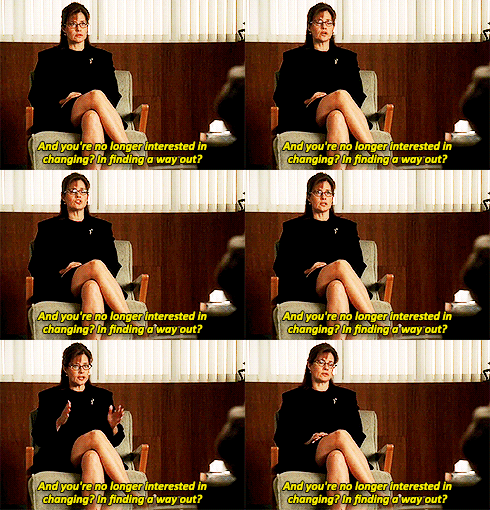
However, the process of instilling awareness and inspiring change in victims of repetition compulsion is far from straightforward. Freud attests to the concept of resistance, whereby individuals refuse to acknowledge their illness and defy change for various reasons (149). They might be protesting the idea that they need “fixing,” like Walter White and BoJack Horseman did, or they fear not being able to return to familiar situations, as seen with Rue’s refusal to attend rehab. Even when these individuals enter a therapist’s office and recount their behaviors, they may still construct a resistant wall, selectively narrating their stories to avoid accountability and justify their harmful actions, as happened in The Sopranos. Pink Floyd’s classic hit Comfortably Numb depicts a fictional artist, Pink, found overdosing on heroin in his hotel room. The lyrics, “I can’t explain, you would not understand. This is not how I am.” perfectly encapsulate the denial rhetoric commonly used by victims of repetition compulsion.

A therapy scene from The Sopranos

Similar to these fictional characters, real-world audiences who are not ready for change may force these media to conform to their distorted and destructive worldviews. In this way, the media intended for awareness could inadvertently exacerbate their behavioral looping process. The episodic structure and dramatic cinematography of TV series actually enable audiences to selectively view the characters, downplaying consequences while fixating on “success moments,” for example, through online fan-cam edits. As a result, they validate and glamorize harmful behaviors of repetition compulsion, evade confrontation, and remain in their comfort zone.

This duality of TV shows in the individual’s processing of repetition compulsion holds true for the broader digital landscape. On the one hand, mental health awareness is more accessible than ever, with concepts like “trauma,” “healing,” or “triggers,” and even specific manifestations of repetition compulsions, such as “toxic relationships” or “trauma-related drug abuse,” becoming increasingly prevalent across social media platforms. Multiple YouTube self-help videos discuss the need to recognize and break bad habits or toxic patterns (this one is from two months ago and has 1.4B views.) This public blog post is another drop in the sea. On the other hand, however, an increasingly enabling algorithm shows individuals only what they want to see, as exemplified by glamorizing fan-cams of corrupt characters or platforms that promote manipulation of romantic partners (please take the time you need to process that.)

Ultimately, the journey to escape repetition compulsion requires not just awareness, but courage, vulnerability, and readiness from the individual. As we consume these media on repeat, seeking out the next melancholic song and moving from one TV show featuring flawed characters to another, we cannot help but confront the loops in our lives. The illness is not linear, and neither is the healing process. The best we can do is put in consistent efforts, and perhaps with a little help from these “relatable” media, we may at last find hope. 

– Mai

Experimental films, TikTok, and other art forms

Although I have studied art history extensively, especially art throughout the twentieth century, I don’t usually encounter art that is intentionally taxing and unwatchable. Repetition and looping, on the other hand, are entirely different for me and quite enjoyable, so it was interesting to see a mix of these techniques. I didn’t know anything about experimental filmmaking before, so the experience was confusing, intriguing, then back to confusing. I had many questions and wrote down my observations during the screening. My initial observations included words like collage, layering, sampling, abstraction, and means of editing that felt oddly contemporary, much like the parody videos today. 

Like the class discussion said, T,O,U,C,H,I,N,G was mentally taxing, inducing in different people a spectrum from boredom to anxiety. In my case, it was an uncomfortable mix of both. Destroy, destroy, destroy, destroy, destroy… Regarding the formal qualities of the film, I am drawn to the dynamic use of color and light, but I could not sit through more than 30 seconds of it before going on my phone and looking at something more calming. The rapid repetition of both images and sound created a sense of urgency that could not be escaped even when I closed my eyes, because I could still see the flickering light and hear the robotic voice.  Destroy, destroy, destroy, destroy, destroy… 

As the screening continued, I found myself becoming more and more immersed in the films. My Name is Oona was quite relaxing and poetic. Wonder Woman was funny and insightful; I was very engaged because I had never seen the show, and I completely understood the message of critiquing the depiction of females as objects of desire, even when they were superheroes. Something is to be said about all of these films: the use of unconventional techniques such as found footage, abstract visuals, and non-linear narratives challenged my preconceived notions of what constituted a film. I realized that experimental filmmaking was not just a means of creating art but also a way of subverting traditional modes of representation and challenging societal norms. The artists sought to break free from the shackles of commercial cinema and use their craft as a tool for social commentary and political activism, which was eye-opening to see.

Having been born in the era of the attention economy and a regular consumer of short-form video content, I have made “successful” Instagram posts and TikTok videos that made use of the algorithm, and it does feel good to have accomplished such goals when the standard is ever so elusive and fleeting — and I do realize this line of thinking is problematic. Hence, it would be interesting to imagine how to use formal qualities of contemporary media to critique themselves. T,O,U,C,H,I,N,G would totally work in the browser, in form of a pop-up window that cannot be exited without watching for a duration of time, almost like an uninvited virus; Vertical Roll could be transformed into a critique of mindless scrolling on TikTok; furthermore, there are already edits on different Internet platforms that use parody to make fun of celebrities, politicians, and such. Some people noted under the discussion thread that these critiques are always limited by physical constraints of the media, but so is every art form. Paint doesn’t work without a canvas; code doesn’t work without a computer; video art doesn’t work without a television. 

At the same time, 2023 is different from the late twentieth century. Although there are many restrictions imposed by online platforms, media has become less centralized (at least on the surface?) and distributed into the hands of creators, where diverse voices can be heard if they make smart use of the algorithms. Yes, there is the problem of algorithmic bias, but it is not unbeatable. With persistence and creativity, creators can find ways to work within the system and make their voices heard. Ultimately, the democratization of media offers both challenges and opportunities, and it will be interesting to see how this trend continues to evolve in the future.

Throughout the twentieth century, there was the desire to combine art and technology to make art more meaningful and technology more humanistic. Video art was one of the many examples where artists sought to control the means of influence and make it work for the people. Bauhaus came before it, and glitch/internet art came after it. There will always be resistance to new and emerging technology, and I see AI and machine learning art to be the next manifestation of the rebellious spirit of artists, especially the creative technologists. I am currently taking an AI art class, and one of the things we discussed was how prompt engineering can be put in conversation with Fluxus – it’s interesting to see themes in the past resurface and become relevant again. 

by Vivian

Curation in Galleries and Theaters

By Chloe Perez

Considering how video artists had to fight in order to reach gallery spaces because these artists wanted their work to be engaged with in the way that people look at sculptures and paintings instead of as a film, it was interesting to see how our class engaged with the art form from the screening last Wednesday. Much like the works from the reading, the films we watched dealt with storytelling through loops. The speed, length, and movement of these loops all came together to tell these stories. Despite how often we encounter these loops in our daily lives through the various forms of media we consume, like music and social media, the lengths of the films were excruciatingly long and painful to watch to the point the majority of people walked out during the screening. This made me think about what may be the problem with the screening since the class is for people who are more inclined to explore this type of art than most people and how people would have felt or reacted to them if they had watched them somewhere else.

Artists like Robert Breer refused to have their work in the theater. The mysticism of the environment takes away from art or at least his own. Not to mention, a theater is more of a space designed for enjoyment(no offense) and not one where people think critically about art. At least for me, I like to sit at home and process what I watch, not as I see it. Simply put, a theater is more of a place where I take the content as it is. Especially since in the theater, the viewer sees everything once. It limits the viewer/audience’s understanding of the film and elevates every moment because it can only be seen once. The viewer cannot leave because they cannot miss something. If viewers miss something, they cannot simply go back. They must watch it all over again in the theater. Something I find interesting about this is since each time you rewatch a film, although it is the same, the previous context from the last viewing builds on to your engagement and experience with the film. The viewer notices smaller details and is less focused on the mystery of the unfolding plot. 

I think this is the most major advantage gallery spaces have over theater spaces. It is less so the mystery of the theater itself but the curation of films in theaters that are actually distracting to the viewer. In gallery spaces, although there is pleasure in art, people are given as much time as they want with a piece. There is no rush and no mystery. Art is presented as it is, and viewers are not forced to see everything exactly once for a second. Although, of course, the curation of art in a gallery is somewhat a mystery in itself where the exhibit guides you through each piece to give you some sort of greater connection or meaning to the art all together. The curation of the exhibit also changes the outlook a viewer may have on a piece of art. However, I still think that since the viewer is given as much time to explore as they like, it is nowhere near the same as the mystery of the theater.

When it specifically comes to video art in galleries, they are often put in darker, theater-like rooms. To an extent, the darkness of the room is distracting because it is different from the light of other rooms. However, the ability to walk in and out of the exhibit and stay for different periods of time completely alters how the films are taken. Not to mention, the darkness of the room is part of the artist’s vision as to how their film should be shown, and they may want to have a mystical theater atmosphere. Unlike theaters, the viewers come in at different times of the film, which creates more individual personalized experiences with the art since the plethora of art creates a much more relaxed environment. Not everybody sees the same scenes. Not everybody stays as long as others. In works such as Breer’s Recreation, not everybody remembers the same images. Although people have personal connections with films in the theater, everybody sees the same thing at the same time. The personalization through the randomness of videos in galleries allows for different types of conversations than those of ones in theaters, mostly about loops. 

If the films we watched in the screening last week were in an art gallery, not a single person in the class would have sat through the whole thing. They may not even watch the same videos or the same parts of them. Videos in gallery spaces are important, but so are those in theater spaces. They matter most when considering the interpretation of art in the space it is in. That’s why I think art should not be in spaces outside of how the artist chooses. It completely changes the message of the art and evolves into the art of the art because it is no longer in the control of the artist and becomes removed from them. Art spaces are much more important than the art itself since the spaces mediate the way the art is absorbed.

White Cube / Black Box / Phone Screen

By Sage Adams

As I was posing questions for discussion, I was operating, perhaps problematically, under the assumption that gallery and theater spaces were standard and that digital spaces may perhaps undermine them or fail to adequately engage spectators. This is an especially salient question given the limited access to gallery/theater spaces during the pandemic, bolstering an already large-scale acceleration of the 21st century digital takeover. However, I was taken aback to hear that many people in class strongly preferred digital methods of engaging with art as opposed to the gallery space. Among other critiques, people noted that galleries were too formal or sterile, they impose strict criteria for which art is considered valid, and imply something is wrong with you if you don’t appreciate a certain piece of art on display. On the other hand, there was a general consensus that digital spaces are a valid addition rather than a source of degradation to traditional art spaces. In particular, there was discussion of curated art pages and tiktok videos as methods to democratize art and increase its reach. At least one person stated that they were familiar with Can’t Help Myself, a piece I presented in class, but would never have known about it if not for social media. 

In hindsight, I now recognize a parallel between the work that moving image artists were doing to problematize the gallery/theater dichotomy and the advent of digital art spaces. By blurring the lines between formal art contexts, moving image artists asserted not only their right as artists to properly contextualize their art, but also the right of spectators to engage with art in various non-traditional ways. Similarly, digital spaces offer us the opportunity to encounter art on our own terms; we gain more control over contextualization, method, depth, and duration. This democratization of art has been an important offshoot of the greater democratization of knowledge that the internet has contributed to. The ability to discover new pieces of art online with a wealth of information available at your fingertips is priceless. 

Though the breaking down of barriers and limitations in the art world expands its reach to ever more people, there is a tension: sometimes limitations serve important purposes. Encountering art is not the same as engaging with it, and leaving everything up to spectators can potentially undermine the work of the art and artist. For instance, the constraints of the gallery and theater spaces force a focus on the art which is on display. It’s considered bad form to check your phone during a movie or take a call at the museum. In digital spaces, or in the home, these social and artistic customs lose their force. It’s incredibly easy to be distracted by a notification, switch to a different app, or even to have your feed refresh only to lose the art you were looking at. Humans are easily distractible, and the oversaturation of online content only feeds into this tendency. If the post of a piece of art isn’t immediately interesting, we’ll just scroll past it. If it’s not entertaining, we won’t work to understand it. Alternatively, in museums, I frequently find myself looking at all the pieces of art displayed in a particular gallery or room. I don’t want to be gauche, disrespectful, or miss out on an important continuity by skipping unappealing art installations. I’m more likely to engage cognitively, to read the plaque on the wall, to attempt to determine why this piece of art was chosen for a curated exhibit. So, even as digital spaces afford greater opportunities for us to encounter art, what good is it if we don’t care? What do we gain from staring at a screen-sized photo of a ten foot painting for a mere 30 seconds before promptly forgetting and moving on to the next post? 

Even with the reading for our class, which I did my best to genuinely work to understand, which I had to pay attention to lest my presentation be terrible, there is still a limit to how much I can learn when I can’t see the central pieces of art in person. The best I could access were the pictures in the reading (with explanations), pictures and videos posted online, and gifs. Despite such a heavy emphasis on the physicality of art pieces from Breer, Duchamp, and Paik, I will always lack some of their intended effect because I was unable to interact with these pieces in real life. Not only was physical apparatus and situation in space integral to their works, so was the complicity, even necessity, of the spectator as an integral element of the art itself. It was disappointing to be unable to experience these works of art in their entirety. Something is missing.

But how often do people consider the missing element when they come across art online? We’ve been so inundated with pictures of the Mona Lisa or Van Gogh’s Sunflowers that we become completely blind to the fact that there’s more than the photo; the scale of the paintings, the brushstrokes, the texture and thickness of the paint, the true hues of the colors. We are so conditioned to the mere image, replicated digitally, that we forget the physical. Equally worrisome are the stories of visitors to the Louvre taking pictures of the Mona Lisa then moving on, more concerned with telling people that they saw it than actually seeing it. Even when the physical is right before us, we still fail to recognize its importance. 

I think, then, that we come right back to the problem moving image artists attempted to address: context of art is important, and when it’s wrong, the art is unable to come into its entirety. Different art works best in different spaces, and artists deserve some degree of say in which spaces those are. But this is not to discount the digital entirely. While paintings may be best in the gallery, while experimental video art may be best in the theater, and while pieces like the Mutoscope may bridge both spaces, there are countless forms of art which thrive in the digital. It’s up to us to recognize which forms these are. 

De La’s Soul

by Cassie Haas

Occasionally media outlets will do these interviews where they ask folks what the objects they can’t live without are. Be that personal items, fancy jewelry, or in the case of Danny Pudi, socks and a good cup of coffee. I generally stay away from these as the lives of celebrities and those with amounts of money I’ll never even be in proximity to within my lifetime don’t interest me. That being said, I often wonder what those items are for me. I come back to a few each time: my Nikon D3500 camera, my blanket made from shirts I grew up with I received as a graduation gift from my Mom(thank you Mom), and my CD copy of De La Soul’s 3 Feet High and Rising. Now this last one is interesting, because I don’t own a CD player. Well, I did when I inherited my Dad’s old desktop he made in the early 2000’s. And there was a brief period of driving a 2005 Toyota Prius named Francis that housed both a CD and a cassette tape player. Vintage! But now, nothing. The CD sits on the lower shelf of my bookcase next to my vinyl records in the warm company of The Fugees and Jim Croce. Haven’t used it in years. Besides, I can listen to it at any point I want from wherever I want due to the modern age of streaming. And yet, it remains there still.

When De La dropped 3 Feet in 1989, they were at the forefront of a new wave of hip hop coming out of New York. By no means the first group that experimented with jazz rap, they were among a group of likeminded creatives in the newly formed Native Tongues collective. While somewhat short lived(by only 4 years later Q-Tip of A Tribe Called Quest is quoted saying “that native shit is dead”), by the release of High and Rising the collective had already grown to include De La, ATCQ, Jungle Brothers, Queen Latifah, and Monie Love. They were a group dedicated to their Afrocentric roots, calling back to the past with samples of music created by those who came before them to address the life and beauty of the modern age amidst an era of gangster rap that emphasized being hardcore and individualized from others.

Where ATCQ and the like tended to take some pride in sampling the deep cuts, spending hours in the record store looking for what would work just right, De La grasped for what sounded good. Of course this isn’t to say Tribe didn’t sound good—they have my favorite three album run ever—but it’s undeniable that De La went for the heavy hitters. Steely Dan, The Turtles, Hall and Oates, Johnny Cash, Billy Joel, The Isley Brothers, and those were just some of the names on their first album. They continued this trend through their next few albums, sampling the big names and turning them into something new and beautiful entirely in its own unique way. I hesitate to call them unlucky as their peers were already avoiding the trap they would soon fall into, but these works came at a new age in music legality. Groups started to get somewhat peeved at De La’s usage of their music on De La’s own releases. In 1991, The Turtles filed a lawsuit against De La Soul for a whopping $2.5 million dollars with Mark Volman of The Turtles somewhat famously claiming that “sampling is just a longer term for theft”. Other groups would come forward and air their grievances as time went on, but repercussions would not truly show themselves until the streaming era. For years and years none of De La’s 80s or 90s releases were available anywhere digitally due to legality reasons. The only way to access them were through the CD or the vinyls that were pressed. 

I grew up in Columbus, my Mom in Youngstown, and that’s as far back as I know. Grandma Cookie was alive just long enough to see me into this world and then was lost to the home my Mom and my uncle grew up in as it engulfed her in flames. Willa Crawford was her given name, and my mother knew Willa’s mother, but Lord help me if I could tell you a thing about her. I think of our generations as being compact; Mom was only 22 when I was born, and it wasn’t far off in distance from her own Mom. Each of us knows nothing. Lord, the remaining family recently attended a military funeral for Cookie in Northeast Ohio. It was the whole shebang, so to speak. Three rifle volleys, a folded flag, a speech. Only me, Mom, my step-dad, my uncles and my uncle’s wife were there to see it. We had always known she was in the Navy(hence this ceremony taking place at all, especially 18 years after she passed), but it wasn’t until arriving at her plot in the cemetery that any of us learned she used to be a drill sergeant. A drill sergeant! We laughed, of course. There was a mutual understanding that there was so little we did know that finding this out couldn’t even be classified as a surprise. This is all to say that the history of my family is dwindling, and will continue to do so.

So when I say that De La Soul is and was reaching back into the past through the music, I mean it. It’s the only way I’m able to reach into my family’s history myself. I’ll never know exactly whether this is what Pos, or Mase, or Trugoy intended when they joined forces together—after all, they were just high schoolers looking to have fun. I’ll never know my grandparents, or their parents, or their history, and especially not the music they listened to. Oftentimes though, I think of the samples they used as a place to sit alongside them. I’m not radically spiritual, but to think of it as a front porch in the summer, sipping iced tea alongside them—it helps. Trugoy the Dove passed at 54 on February 12th of this year. Just a few weeks after that, on March 3, 2023, the albums made their way to streaming services for a new generation of listeners to experience. Legal issues were finally cleared up after years of fighting between De La Soul, labels(including their own), and other artists. Less than three weeks between his death and their release. It seems sometimes that the world is against preservation. His music will finally now have a chance to live on, but it took until his passing to do so.


The story goes that Me Myself and I was originally created in just a day, whipped up as a final addition to the album as a joke by the group. Their label had been requesting a song that would be a hit, something that would make it to the radio. De La laughed them off and created something entirely their own, their interpretation of a radio hit. Their joke was successful, of course, and is how many know the group today. But it did start as just that: a joke. In that moment, a group of friends, freshly graduated from high school, playing with samples from Funkadelic, the Ohio Players, Edwin Birdsong and more in Mase’s mother’s basement, created a time machine. A time machine I enter as often as I need, less than I need if I’m being honest with myself, to quietly sit on the porch on a sunny day with that family I’ll never know, and will never know me.