A Murder Mystery and The Foundations of Adventure Game Graphics

By Priscilla Bermudez

Background 

Mystery House, originally known as Hi-Res Adventure #1: Mystery House, was released in 1980 by Ken and Roberta Williams. The game is known as a foundational adventure game due to being one of the first adventure games to include computer graphics and introducing the great potential gaming with graphics could have on Apple II software. Roberta Williams revolutionized the genre of adventure games with this creation. Before Mystery House, all interactive games were text-based. The creation of Mystery House was inspired by the first text-based adventure game called ADVENT, also known as Adventure or Colossal Cave. Both Ken and Roberta played the game, but Roberta was deeply engaged with the game which caused her to be passionate about the adventure game genre. Once she ran out of games to play, she decided to make Mystery House. The game would be based on the board game Clue and Agatha Christie’s And Then There Were None. An aspect that sticks out to me of the game’s history and origin is the important role a woman plays in its creation. At the time when computers and video games were left to men who had access to computers and in elite college spaces that men dominated, a woman was the one to create a foundational video game. I find this important because it shows how women can break through and accomplish important work in male-dominated spaces. 

The plot of the game revolves around a player being locked inside an abandoned Victorian house with seven other non-playable characters. There the player finds a note that says that there are jewels hidden in the house and whoever finds them gets to keep them. As the player searches the house for the jewels, dead bodies begin to appear in the different rooms. So now on top of finding the jewels, the player needs to find the killer before the killer kills them. 

Impressions
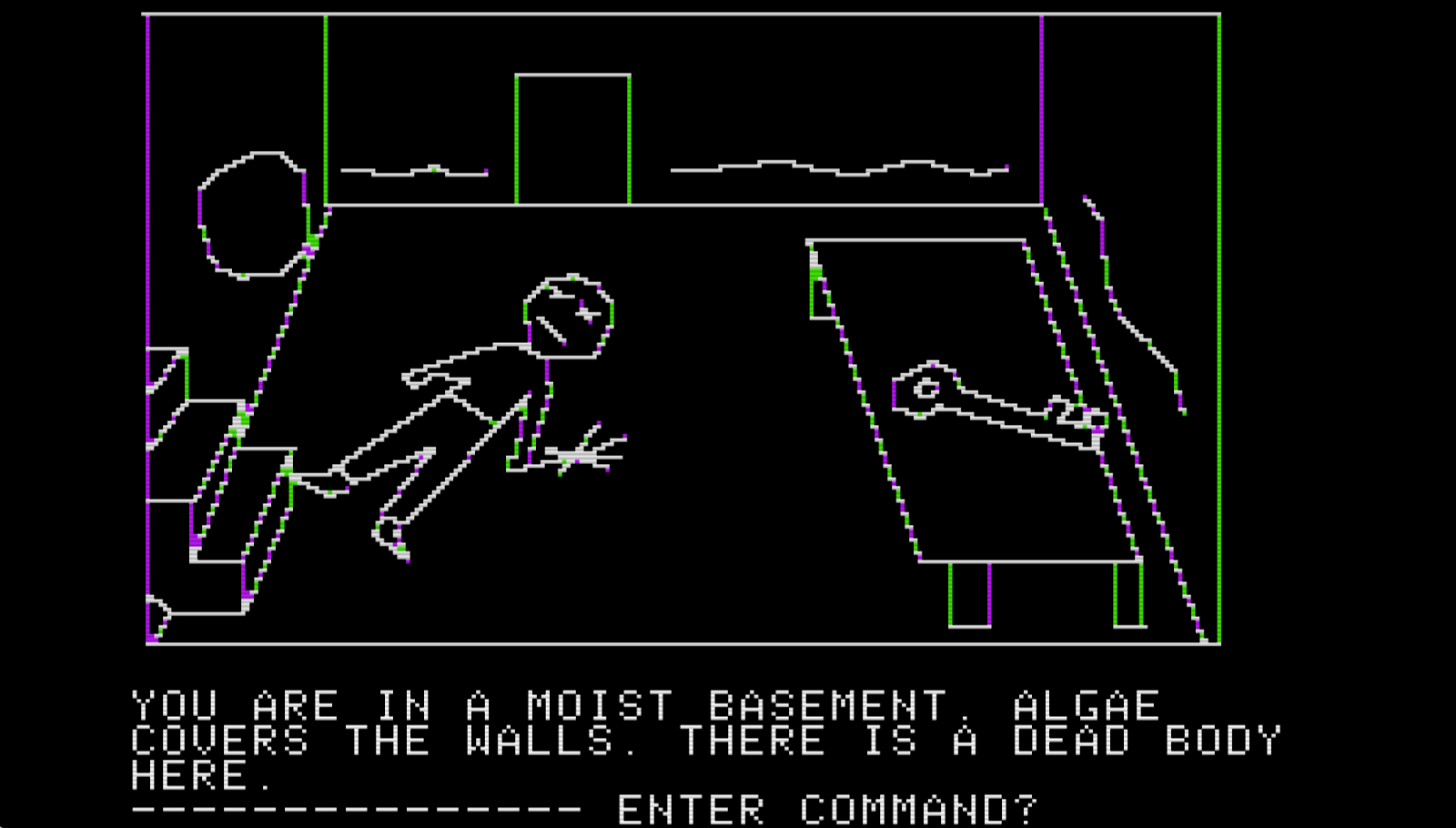

Upon playing for the first time, I was shocked by how much the game still relies on text for the player to understand their surroundings. In hindsight, with Mystery House being the first adventure game to introduce graphics, the graphics play a more complementary role to the text rather than guiding the game. Coming into the game with the mentality of modern games, I expected the graphics to have more details, whether it be details in the room or with the different characters. Many times the game’s text included descriptions of what the rooms consisted of in case it was unclear or sometimes. Once I got over that concept in my head, I could understand would become an aspect that complements the text and becomes visually appealing rather than encompassing the text. I still had a bit of trouble navigating the game due to its use of cardinal directions to guide the players through the house. It was a bit easier for me to go to the locations I wanted in Mystery House due to its use of graphics, so I could visualize more clearly that I was headed towards the kitchen for example, or the study. This is an aspect I find interesting in text-adventure games. The player has to make a mental picture of the locations in regards to world-building and in a way keep a map of the locations they have gone. While in Mystery House, you still have to keep track of the locations you have already been to, the graphics help keep it all visually organized.

On the topic of directions, providing the text parser with directions at times became a point of frustration for me in the game. The game provides you with a set of rules of what directions can be given to the game; two-word commands containing a verb and a noun. It provides a list of example actions one can give the system but if one provides a command that the system is not prepared for, it just says it does not understand and does not provide you with options on how to move forward.

Another thing that made playing slightly difficult for me was the lack of a list of objectives and items required of the player. It is very cool in the game to keep an inventory of the objects one picks up in different rooms and be able to use them later on in the game. Since the game does not provide a list of items to find, one may overlook an item in a room and that would lead to their death later on. 

Characters


The function of the other characters in the game Mystery House also intrigued me in comparison to present day. While in a modern game, the characters may play a more active and detailed role in the adventure, in a game like this all we know of the characters is what is provided in the instructions. It caused me to think about modern adventure games like “Detroit: Become Human” where how a player chooses to interact with certain characters is what ultimately determines the path and ending the player will experience. Additionally, it was interesting how on-the-nose the hints found on or near the dead bodies were since one does not have the option to interact and interview with the characters. (SPOILERS) Each dead body that was found had to be specified by the text and since the graphics themselves were not very distinguishable. The hints found on the dead body like blonde hair and a daisy in a body’s hand, made it easy to discern Daisy as the killer once the other blonde characters turned up dead. Meanwhile, to keep using the example of Detriot: Become Human, technology has made the characters in the game look so detailed and realistic that for example the character Markus resembles very closely its voice actor, Jesse Williams and this happens similarly with the rest of the cast. In terms of the characters, I see how including different characters with differing occupations and identities would become popular in later games and how Mystery House begins to establish its purpose. 

Overall Thoughts
Overall, I did enjoy playing the game and gained a new sense of appreciation for how detailed and immersive games have become nowadays. The advertising for Mystery House itself demonstrates how the game’s main selling point was its graphics and natural language commands, “Through the use of over a hundred Hi-Res pictures you play and see your adventure. You communicate with Hi-Res in plain english (it understands over 300 words!)” (Nooney, p.88)  Currently games advertise the world-building aspects of the games and the paths and actions of the characters have heightened in complexity. Returning to the in-class discussion of the return of providing natural language as a mode of input, I do not see this method of input as making a comeback, especially with how AI has begun to understand more complex commands. I do think it is very important to look back on games like Mystery House to see how far technology has come to create the method we interact with games now and experience these heavily text-based adventure games.

Sources:

Nooney, Laine. Sierra On-Line and the Origins of the Graphical Adventure.American Journal of Play, vol. 10, 1. (2017)

Playthrough: https://www.youtube.com/watch?v=kiwHwPvIHBs 

Text-Based Games and the Trouble of Simplicity

Article by Matt Brennan

Last week, I played through the game Colossal Cave Adventure for class, and in my playthrough and the subsequent discussion we had as a class, one specific topic popped up with regularity: the text parser. The text parser was no small innovation for its time, but returning to it nearly 50 years later was an exercise in frustration. The parser was extremely simple, as it had to be for its time, and thus only accepted a very small—and very specific—list of inputs. This confused every player, myself included, and led to the game becoming a tug-of-war between the player and the controls, with the game itself, while never quite becoming secondary, taking a very clear back seat to the struggle to play at all.

For movement, the parser of Adventure accepts cardinal directions (though not the command to “go” or “move” in these directions), as well as up and down. Everything else gets more arcane from there, as the parser allows for “get” and “take” but not “use” or “investigate.” “Look” is allowed but only gives a description of the room around the player character, and “throw” does the same thing as “drop,” preventing any chance at lobbing objects at enemies as weapons. Eventually, it occurs to the player that their best bet at succeeding is to input only the exact thing they want to interact with and no other words, and allow the game to fill in the rest of the data. This works more often than not, which is its own issue. In a game like Dungeons and Dragons, which was brought up in discussion and was a clear inspiration for Colossal Cave Adventure and every other early text adventure of the day, it’s a reflex for the players to describe what they do in great detail so that the game’s adjudicator, its Dungeon Master, knows exactly what the players want to attempt and how to judge them on the fly. That level of detail, necessary in D&D, becomes an active hindrance in Adventure, and the player must rely on simple, often one word, inputs to move the game forward.

The important distinction between a game like Dungeons and Dragons and a game like Adventure is the level of freedom in both. D&D is nearly pure improv; the players work together and keep each other focused and up to speed on how the game is working at any given moment, but nothing is set in stone in terms of story, and anything can change on a whim or an unexpected die roll. Adventure, for how much it’s inspired by D&D, is nearly the exact opposite; the single player is completely alone, has to figure everything out themselves, and is working to advance the single plot down its defined tracks until it reaches the ending, which is always the same. If the plot of a D&D campaign is an adventure, the plot of Adventure is a train ride with a sticky handbrake. There are interesting and clever moments—for instance, the player needs to keep their inventory clear, but if they don’t set down a porcelain vase in the same room where they set down a decorative pillow, the vase will fall and shatter—but those are hard-coded into the game, not the result of a clever piece of judging by another person. The mechanics can be interesting, but there’s a certain attempt to make Adventure something it isn’t, and the text parser makes this abundantly and uncomfortably clear.

Not to say I didn’t enjoy playing Adventure. I thought it was a very solid game for its age, and the fact that the most frustrating thing about a game over twice as old as I am was that its controls were counterintuitive does say a lot of good things about the game. A lot of it holds up really well, but at every turn when I played, the text parser became a more and more pressing issue. Thankfully there were a handful of passwords to skip most of the long walking sections (where the game has the most chances to screw up and dump the player somewhere in an endless forest), but that was only a workaround, hardly a solution. A text-based MUD I have some experience with, Discworld MUD, also uses a text parser to control the game, but this parser is much more sophisticated and, more importantly, flexible than the parser used in Adventure, and as a result the game experience feels much more akin to D&D and other roleplaying games than to the old text-based adventures we played for class. While this is certainly an unfair comparison between the two, I find it fascinating how far the technology for text-based games has developed even amidst the advent and growth of graphical games. It’s a far fairer comparison between the two, I think, to bring up how beloved and propulsive for the genre both games have been.

Chatbot AI and Humanity

I have separated my understanding of the chatbot ai phenomenon into two philosophical and conceptual frameworks; information and connection, or to put it another way chat gpt and character ai. In class, I asked the question, how is digital media evolving what we understand being human to mean? And, in regards to digital media, especially artistic media, this question becomes increasingly important as we must also interrogate and define art. This is an interesting corner that we have been figuratively forced into by the rapid evolution of ai. Art is a concept that is notoriously difficult to define, what makes art what it is, and more deeply what signifies quality in art remains elusive. However, a principle that seems to go without saying is that it is created and consumed by humans. We value the sweat upon one’s brow, the wavering of a voice in song. It is the small idiosyncrasies and laborious nature of art, the emotion and intentionality of a piece, that must be and is based on its distinctly human nature. In other words, it is the subjectivity of human creation that makes it art, or at least that is how we as a society have subconsciously regarded it. We know that a piece of art is a piece of art because someone made it. The same can be said for how we communicate with one another. We know that real “authentic” communication is occurring because it is happening with another living being who can respond and understand and insert their own subjective experience into what is otherwise a one-sided non-exchange. So then, with ai, we seem to be seeking this out when we create digital minds that are capable of mimicking this connection as I have described it as above. So then, art is a form of communication, however broad and intangible it may be, and communication is the human means of connection. If we are to understand the creation of ai under these lenses, to serve either to connect us or streamline information, then we must then understand why ai takes the shape and form it does, in the most literal sense. Why do we imagine the most advanced AI as taking the rudimentary form of the human body, and able to speak as fluidly as another person. Why must it speak to us at all, and have a “human” voice. Similarly, why do we have character ai that simulates conversing with the president, or a mob boss? On the one hand, it is an appeal to the senses. What digital media intrinsically lacks is the ability to stimulate us on any level beyond 2-dimensional pixels. This is why so much software and hardware is now dedicated to advancing technology on the fronts of sound and sight. This is the reason a “meta” wishes to completely immerse us in sight and sound to the virtual spaces, and attempt to simulate a 3-dimensional world. So then, what humanity is importantly defined by in this new digital age, and what much of digital media attempts to do is arrest our attention on the most fundamental levels of human senses. Though, what else might be the reason for the way that AI chatbots are designed, and the way that robotic forms as well as certain digital media are crafted. We create these forms of intelligence in our image, and to meet the conscious and subconscious desire for these artificial intelligence to transcend their limitations as we too attempt to. In the question of transhumanism, it would seem to me that just as humans create AI and other technological advancements to transcend our organic limitations, we are simultaneously pushing AI to transcend its mechanized limitations. Though we imagine it to be for the purpose of serving humans. So then, an almost existential question comes to mind. We are attempting to reach the complexity of the human mind, by artificial means, in order to serve us. It would seem then, that human needs and wants are only satiated through the intensive labor of other humans, or human-like performance. Other questions I have considered for this topic were more on the side of AI art. What makes an original idea? It is the matter of the amalgamations and originality of a piece. AI is requiring us to bring the abstract of these artistic processes into focus. Art AI artists “real” artists? This uncanny valley of creation and whether or not this thin thread of “human intervention” is enough to keep us protected from AI manufacturing human talents in the next few years, possibly months. It is a question of utility and ethics. We have yet to form shared ethics around ai, and how it is best to perform with these tools under the contexts of information and connection. What values should we have underpinning those ethics? To what degree can these AI be utilized safely and objectively? How do we ensure that prejudices are separated from AI?

The Evolutions of Sampling

Calahan Smith

In its infancy, the art of sampling mainly referred to the looping of drum breaks. However, as technology advanced beyond turntables and the genre spread across the world, sampling took many new forms. There are three subgenres in specific which I would like to go over in terms of their effects and appeal, those being Memphis rap and vaporwave.

Starting with Memphis rap, the genre was perhaps most popular in the 90’s, with groups such as Three 6 Mafia taking front stage for the style of music. Characterized by dark lyrics, lofi aesthetics, and eerie beats, Memphis rap was one of the progenitors of the horrorcore genre.

When it comes to sampling, however, Memphis rap has some rather unique components which differentiate it from other sample-based genres. For one, Memphis producers often did not sample drum breaks. Rather, they would create their own artificial drums using electronic drum machines. This was rather unique in hip-hop at the time and has been widely adopted since then by other producers who do not wish to source their drums from already-existing songs. In lue of sampling drums, then, Memphis producers mainly sampled melodies, either from jazz and R&B (which was incredibly popular at the time) or often from horror movies. An example which comes to mind is Body Parts, by Three 6 Mafia, which samples John Carpenter’s classic soundtrack to his 1978 film Halloween.

Perhaps the most unique aspect of Memphis production is its sampling of hip-hop, namely Memphis rap itself. Producers, instead of having rap artists sing hooks or choruses for their songs, would simply loop a vocal sample of a previous song for a few bars. Often this vocal sample would consist of a small snippet of one of another song’s verse, however this simple repetition of a phrase was massively popular and influential. It is a hallmark of Memphis and one of the immediate identifiers that the song you are listening to came in some way or another from the region.

All of these factors come together to form the moody, eerie atmosphere that is riddled throughout Memphis rap. It is evidence of the hopelessness that these artists felt from their environments. Feelings of being trapped in a horror film, that you’ve heard these voices before over and over, are focal points of the genre, and it is the height of awful irony that many of these artists have been demonized for the nature of their lyrics when what they are truly expressing is their lack of agency and control over their situation.

Vaporwave, sonically speaking, is a fairly different genre. Popularized in the late 2000’s/early 2010’s by artists such as Daniel Lopatin and Ramona Xavier, the genre is known for its slow, looping, hypnagogic melodies and recontextualization of popular music.

Similar to the drumless movement in hip-hop, in which added drums were foregone to prioritize the natural percussion of the sample, vaporwave is one of the most purely sample-based genres out there. Inspired heavily by the work of DJ Screw, who would slow down and remix hip hop songs, vaporwave producers will take a portion of a song, slow it down and loop it. This creates a rather hazy and psychedelic environment where no sound can really be nailed down, as it echoes throughout your head repeatedly, similar to the phenomena of only being able to remember a portion of a song you heard on the radio. It is a rather simplistic, yet effective, formula, and has been majorly influential upon remixing and TikTok culture today.

Another very important aspect of vaporwave is the nostalgia attached to it. It has been very common, especially in the genre’s infancy, for producers to sample very popular radio hits of the past, or even elevator jingles which everyone is familiar with. Through this looping, hazy recontextualization, the genre was able to turn songs which were seen as soulless pop or guilty pleasures into “high art.”

I mentioned earlier the concept of remembering only part of a song you heard on the radio, and vaporwave’s appeal for many is at the heart of this idea that memories erode, that the past cannot be fully experienced as it was, and that everything one once had attachment to will fade with time. Vaporwave thus places subtext where there was emptiness before, hence being able to turn a generic pop hit of the 1980s into something which people appreciate on a greater level. And while the genre is not as overtly horror-themed as that of Memphis rap, it is this deeper level of nostalgia and the unrelenting and uncontrollable passage of time which I find to be rather similar to the feeling of hopelessness and fear which is so closely integrated into Memphis rap.

To conclude, this post-modern recontextualization of existing music is evident of the times in which we live. The things of the past are gone, the hope of a happy ending is a childhood fantasy for many, and life will simply go on, leaving us behind, and repeating the same thing to the new generations.

Generational Cycles in Outer Wilds

by Josephine Markin

The ending of Outer Wilds is an impactful, overwhelming sequence of revisiting the many stories you encountered in your journeys throughout the solar system. The instruments of the Outer Wilds Ventures explorers you have met are joined by the music of the Nomai civilization in a hauntingly beautiful song, and the universe collapses into the smoke of a familiar campfire until you leap into the infinite possibilities of the future. The final screen shows a new universe born from the death of yours, painted with some familiar images as well as some entirely new creatures and elements. All of existence has begun a new cycle, and from all you have learned about the Eye of the Universe and the patterns of time, you can surmise that this was how your world was born as well. By giving you the willing decision at the end to move into the future, the game reinforces the message that its entire ending conveys: your life, and the universe you lived in, is passed on as part of the existence the new generation inherits. Your time is over, and the stories to come will both carry the familiar strains of your legacy and entirely new ones.

Although this message comes together cohesively in the ending sequence, the entirety of the game leading up to the end cultivates this theme, building on a time-loop mechanic and a narrative of generational knowledge and legacy. The player starts the game at a campfire, and for the rest of their Outer Wilds experience they will find themselves returning to this campfire over and over to begin a new iteration of their loop – the same campfire, significantly, features in the ending screen image. In the approximately twenty minutes following their awakening at the campfire, the player can explore the solar system and do anything they want on any planet; however, they will inevitably die and awaken once again at the campfire where they started from. The loop is not entirely self-contained, however: there are some actions which can carry on between cycles. These include collectable information like the launch codes; new dialogue options reflecting the experiences the player has had in a previous iteration; the rumors which are permanently recorded on the map; and even small reflections of the particulars of the previous loop, like the player making different gasping sounds when they wake up depending on how they died in the previous loop. In the case of the dialogue options, rumors, and collectable information, these reflect a growing compendium of useful knowledge the player is giving to their next iteration as they explore the world. Diegetically, the player is passing on knowledge to their “next” self through the method of the Nomai memory transfer statues and the Ash Twin Project; this technology itself is also a symbol of passed-on knowledge, as it comes from a long-dead civilization from which the Hearthians have inherited much. The awakening gasp which reflects the previous death is a more natural, subtle nod to this inheritance, because it is not useful, permanent, or discrete information. Instead it is an involuntary sign of the previous loop’s role in the birth of the new one: however the player died in the last iteration is how they were born in their new iteration, just like the way in which their universe dies is how the next one is born.

The Hearthians and Nomai themselves are another iteration of the passage between generations. The player is told in the beginning that they are the newest generation of Outer Wilds Ventures explorers, and in Timber Hearth and then in dialogue with Hearthian explorers off-world they inherit knowledge and skills from their fellow Hearthians. The Nomai, however, provide the structure of the core of gameplay: uncovering new knowledge from long-past Nomai writings and structures. By scanning spirals; tracing the paths of the actions of the Nomai who ended up in their solar system long ago; examining skeletal remains and collapsed space suits; and utilizing the left-behind Nomai technology, the player learns about a past iteration of life in their universe. However, this knowledge is not useless history: the actions and discoveries of the Nomai have ripples that continue to shape the path of the universe as the Hearthians inhabit it. The connections between Nomai and Hearthians are closely traced: notes unveil that the Nomai discovered the evolutionary ancestors of the Hearthians long ago, while Hearthian exploration technology is founded on the devices left by the long-dead wayfarer species. The doom that the system faces is (at first glance) because of the experiments of the Nomai, while the project which revives the player with memories of a different iteration of themselves was built by the Nomai. Outer Wilds explores this connection further by creating a Nomai character who is still alive: Solanum, an explorer residing on the Quantum Moon. Solanum, as she tells you herself, is likely both dead and alive: because time operates strangely on the Quantum Moon, her bones can be found in some places, but a timeless version of her lives on and can be encountered. The interaction between the player and Solanum provides a concrete bridge between the two civilizations, even more explicit than other connections, and the two can exchange a variety of information in their conversation. However, because Solanum cannot understand the player as well as the player can understand Solanum, the exchange is mostly a passing-down of Solanum’s knowledge to the player; the player cannot tell Solanum anything in return. In this way, the generational cycle is reinforced, and the Nomai continue to have a legacy on the Hearthians but cannot ever come back. 

Outer Wilds masterfully uses both a narrative of generations and a time-loop mechanic to create a powerful theme of the forward march of time into new and unique iterations of life that inherit and add to a legacy from past civilizations. The very malleability of time in the game is used to deeply explore the connections between two generations of existence, while the inevitable rebirth of the process and the ending which follows the creation of yet another universe emphasize the unending loop of death, birth, and change. The player finds themselves in a unique position to truly understand and be a part of this generational exchange, and while their story must come to an end, its end is just another beginning.

Love and the Loop: Groundhog Day and the Human Desire for Connection

In Harold Ramis’ 1993 film Groundhog Day, the main character Phil Connors wakes up in a time loop which forces him to relive the titular holiday over and over again in the city of Punxsutawney, Pennsylvania.  Even describing Phil’s predicament feels redundant to a degree because of how ubiquitous the film and its central device has become over the past 30 years;  the notion of using “Groundhog Day” as a shorthand to describe someone trapped in a loop has become so ingrained into our cultural fabric that it can feel at times like there is no fresh analytical points that can be made in regards to the film.  But upon looking at how the film impacted other pieces of media that took advantage of its conceit and took it into new territory, as well as examining the mechanics of Phil’s loop at a granular level, shows how Groundhog Day set a narrative template that impacted American popular culture in ways that aren’t immediately apparent. 

The circumstances of Phil’s entrapment are never explained to the viewer or to Phil himself, which feels like a breath of fresh air compared to the current media landscape where each fantastical plot element is over-explained to the point of losing any sense of mystery or thematic resonance.  It is clear that Phil has an innate pomposity and inflated sense of self that makes him want to leave Punxsutawney as quickly as possible, so upon first glance it would make sense to surmise that the loop is designed on a narrative level to give Phil the comeuppance he deserves and force him to become a more engaged, altruistic person.  And while the ending of the film certainly shows this reading of the film to be at least partially true, it is an inherently reductive view of the film and its themes.  

In order to jump into the thematic complexity of Groundhog Day it is necessary to explicate how the loop itself works.  At 6 am each morning, any changes that have occurred over the course of the day are completely reset, not dissimilar from how a level in a video game will restart once its main character has died.  This was illustrated when Phil broke a pencil and put it by his bedside right before he fell asleep, only to find it intact when he woke up the next morning.  While there is an intrinsically hellish aspect to this existence, in which meaning is drained away and actions have no consequences because there is literally no tomorrow, Phil begins to take advantage of his newfound situation.  He asks a woman named Nancy Taylor where she went to high school and who her 12th grade English teacher was in order to opportunistically use the information the next day to seduce her, and steals money from a Brinks truck in order to buy a lavish new car and Western outfit for a date.  It would seem that far from forcing Phil to become a better person, the loop validates his worst tendencies and causes his vanity to explode in the process.

It is Phil’s courtship of Rita, the optimistic producer who accompanies him to Punxsutawney, that reveals exactly what Groundhog Day has been playing at the whole time.  He attempts to use the Nancy Taylor playbook in order to get her into bed, which is almost successful until Rita catches on to Phil’s master plan and leaves abruptly.  But instead of admitting defeat and moving on, Phil recognizes a desire on his part to be with Rita that doesn’t stem from cheap gratification but instead a profound longing for self-betterment.  Phil’s worldview had become so jaundiced by cynicism that only seeing someone who is genuinely positive and cheerful can be a catalyst for him changing his ways.  As such, the loop doesn’t force Phil to change but instead reveals who he was all along:  a secret romantic who wants to be more engaged with others and his surroundings but is moving too fast to do so.

This perhaps explains why love is so totemic when it comes to time loop narratives.  In films such as Palm Springs and even the Tom Cruise action film Edge of Tomorrow, the core relationship between the two main characters serves as what drives the story forward;  Cruise’s character William Cage in Edge is tasked with staving off an apocalyptic alien invasion but the setup fades into the background over the course of the film as his potentially romantic relationship with his commanding sergeant, Rita Vrataski, develops.  In that film, there isn’t the kind of payoff that comes at the end of Groundhog Day (where Phil and Rita get together and decide to live in Punxsutawney), but in its more piquant ending Edge of Tomorrow speaks to how relationships are the one thing that matter most when it comes to time loop narrative.  Cage sees Vrataski after he has successfully neutralized the alien threat, and laughs when he sees that she doesn’t recognize him;  however, there is a distinctly melancholic look in his eye, and it leaves the viewer to ponder whether he would have traded the fate of the world if it meant that he and Vrataski could end up together.  A loop may mean that nothing changes, yet if there is one thing that Groundhog Day and films of its ilk show is that the desire to find someone else transcends even the most fantastical quirks in temporality, or at least makes a very good story.

— Finn Flackett-Levin

TikTok: The Loopiest App of All Time

By Lyssa

In my class presentation, I talked broadly about how TikTok uses loops in a variety of ways. Here, I want to do a close reading of one video in particular; one that embodies the variety of ways that TikTok utilizes loops. 

In “Please Duet This: Collaborative Music Making Lockdown on Tiktok” D. Bondy Valdovinos Kaye talks about the duetting scene on TikTok, primarily by citing the ways that duetting can produce collaborative results, especially in the music scene. Admittedly I am not on JazzTok or even MusicTok in general, however everyone once in a while, a video that traditionally only circulates within a small subset of people becomes circulated outside of the circles. One example I can think of is the chronically stuck-in-my-head interaction between Megan thee Stallion and Keke Palmer at the 2022 Met Gala. You can click here to watch it.

This duet encapsulates loops in the way that all duetting does: it uses footage already created. Just like experimental videographers who use found footage or music that samples past songs, duetting draws on someone’s original work and the ability to modify it. In this case, the comparison to reusing footage is even more poignant as neither Palmer nor thee Stallion asked for people to “Duet this,” they simply conducted an interview, and other people modified it. Much like Report by Bruce Conner- he uses news footage that wasn’t meant to be changed, didn’t ask for people to modify it.  

But TikTok presents loops in more ways than the duetting that Kaye explores. The first way I’ll talk about is in relation to “sounds.” Sounds on TikTok are what they sound like- a sound that goes over the visual (and sometimes audio-visual) portion of a video. People most often engage with sounds by lip-syncing to them, or can simply let them play in the background. The Megan\Keke sound became a meme in the way that sounds often do on TikTok. People put the sound over their videos to make a joke about not seeing someone in a long time, or as the inverse to give that original meaning an ironic twist by making a joke about seeing someone you see often. Tangentially related is also the way that people used the sound to make a joke about someone who would traditionally be an other in a group.

In these ways, the loop in this video becomes more than just the way that duetting presents loops: it also does it with sound. The sound is widely circulated and shared, a sort of collaboration in itself. Someone sets the standard for how the sound ought to be used, and other people engage with it similarly, making small deviations where they see fit. They create their own versions of the same meme over and over. But these variations are also important: the minor sense of agency that comes with using the same sound and the same video structure but attaching a different meaning- by adding an ironic twist to a meme that possibly didn’t begin that way or by adding a different meaning. And then that meaning is additionally circulated. While I only gave one example of each way the sound was used, there are a little over 190,000 posts under the sound, the sound is used multiple times in all of these categories. 

This breadth of sound and video is my next point: there are loops with the way TikTok is set up itself. Once you like one video with this sound you will see more videos with this sound. Even if one just looks at the comments of a video with this sound one will hear this sound more and more. Megan thee Stallion begets Megan thee Stallion. The ever-present loop of TikTok gets even more complicated when one thinks about the ways that the app insists that when a trend happens it becomes a trend. The only reason that trends happen is because TikTok’s algorithm makes possible a user’s engagement with a sound they’ve engaged with multiple times.  Someone who is engaged with the app is aware of a number of videos related to a trend because the FYP cycles through them until the trend cycle is over.

This all leads me to my main point: these loops assist in making TikTok “the zone.” As Natasha Dow Schüll defines it in Addiction by Design: “a state of ongoing, undiminished possibility that came to trump the finite reward of a win.” (Schüll,97). Although there is no “winning” TikTok there is a state of ongoing, undiminished possibility. The knowledge that as long as one scrolls there will always be something new to watch and engage with. TikTok’s algorithm will continue to take what a user had already watched and use that to shape what they believe a user will also enjoy. At the same time, TikTok uses the looping sounds to help curate the zone as well. The video it suggests may be familiar because sounds often cycle through, but even those videos–with their everchanging meanings and new variations–will be different enough to be engaging. 

Tiktok’s curation of “the zone” is even more obvious when confronted with the fact that no other social media that I’ve been on has needed a piece of media to interject all the other media one is consuming to tell people to take a break. When someone has been scrolling on TikTok longer than a consecutive hour a video will pop up on their FYP telling them that they may want to take a break. The captivatingness of the app–perpetuated by its use of loops–necessitates the app intervening so people don’t get too invested. In this way, TikTok is a social media site that is immersed in loops. 

“I am him”, how Majora’s Mask let the player be in control

Besides the mechanics employed, The Legend of Zelda: Majora’s Mask made a groundbreaking impact within the game industry. The game was able to impact the industry in how games should approach driving a narrative, along with the sort of resourcefulness and cleverness that companies can employ when creating new content out of older, already familiarized assets.

How Nintendo creates a well-driven narrative is through the game’s main mechanic with time. Since the game runs on a 72 hour cycle (or 54 real-time minutes), it is virtually impossible to do everything the game has to offer to you within one cycle, be it side quests or mini-games. So, to solve this issue, the player can choose to reset the 3-day cycle whenever they so please at the expense of their items gathered during the cycle (rupees, arrows, etc. except for important items such as masks).

This accomplishes two things. The first is that players need to be careful in choosing what they want to do within one cycle. Do you want to save the relationship with Anju and Kafei? Well, you better make sure you have enough in-game time to do so otherwise Termina will be destroyed, and all the progress made within that quest is lost. Even when the quest is completed, players still have to go back in time to further advance in other areas of the game. This sort of mindset helps to establish the player as the main character, not Link. Sure, the player plays as Link, but the choices made are all up to the person holding the controller. Whether it be going back in time, choosing to save Anju and Kafei’s relationship, or even letting Termina be destroyed: all of these choices are made solely by the player. This differentiates Majora’s Mask’s version of Link to the series’ past and future predecessors. Link’s demeanor already makes him a suitable candidate for the player to feel in control, given his silent nature and sort of “bland” personality. However, Majora’s Mask can be played in a multitude of different ways with Link choosing which adventures and quests the player so chooses to go on. In the past games, the story is very linear, making Link go on a sort of straight line when progressing through the game leading to a specific ending. In Majora’s Mask, the ending can be the world being destroyed or it being saved, but the outcome all depends on the player’s actions within the game, not Links. The line to the finish isn’t straight, but instead has loops, curves, and sometimes even gets cut and put back together in different spots, thus creating a new experience every time. To simply put, the player is the main character, not Link, and it is up to the player’s discretion in how the game should be played.

The impact that the narrative described above had on the game industry was quite powerful in how games should approach narratives where the player is in control. Today we see many games where the player is the main character and not the other way around. Instead of adopting the persona of the main character (like Joel in The Last of Us series), games are starting to make the players be responsible for the character’s persona and how they act. The best example I could think of is with V from CyberPunk. The game throws so many dialogue options and actions to the player, letting them fully customize and cater the adventure to their own liking. The main character is never the same when played by a different player, thus creating a new experience in which the player is controlling the story.

The experience leads to the second thing that Majora’s Mask had successfully conveyed within the game, which is the replayability of a game. With the different choices, loops in time, and actions the game offers, it creates a new experience each time the player chooses to start the game. Add in other players, and now each player can have a virtually unique experience when taking up the game. Not only does this help in how often the game can be played, but it also extends the game’s shelf life. Throw in the fact that Majora’s Mask had quite literally used all of its assets from its predecessor Ocarina Of Time, and it is clear to see how resourceful Nintendo was in creating new content that had a lasting shelf life thanks to the unique experiences it creates for each individual player. The adventure caters to the player’s choices and actions.

Nintendo and Eiji Aonuma proved to the industry that a solid story can indeed be accomplished with recycled assets and some clever thinking when implementing new game mechanics. It is clear to see the impact Majora’s Mask had on the game industry, and how more and more games are adopting this sort of style in which the player creates the main character instead of them already being established within a story. Letting the player have complete control in how the story should be driven creates a narrative unique to the player along with opening up the possibilities of what direction the game can be taken in.

Grief, Agency and Time in Majora’s Mask

The Legend of Zelda: Majora’s Mask was the sequel to Ocarina of Time, released under two years after. In many ways, Majora’s Mask could not exist without Ocarina of Time. For example, many of the game’s character assets have been pulled directly from its predecessor, their characters otherwise totally transformed (one of Ocarina’s endgame bosses runs a swamp boat tour). However, Majora’s Mask goes far beyond what Ocarina of Time was able to accomplish, both narratively and mechanically, and cemented itself as one of the all-time classics of the N64 and gaming as a whole. The gimmick of Majora’s Mask is relatively iconic at this point ‒ the moon is coming crashing down into the world of Termina, and it’s set to impact in exactly 72 hours (54 real life minutes). Link must travel to the various regions of the realm, defeating evil spirits and doing general 3D Zelda things. However, within this relatively-simple structure is a shockingly mature and dark narrative about grief and denial. Intertwined is its brilliant usage of time as a mechanic, which is integral to that storytelling. 

In Majora’s Mask, time is a tool to be manipulated. Link can slow down, skip through and reset time whenever he pleases, even in the middle of combat. Most games do not bother with freeform time travel ‒ time generally just moves forward. Time manipulation makes a game’s story inherently vulnerable to paradoxes and strange contradictions. However, Majora’s Mask handles this surprisingly-elegantly. Resetting time makes Link lose his non-essential material possessions, like his spare arrows and money. He does maintain his key items, but with every cycle refresh, Link starts anew. The few ways in which Majora’s Mask isn’t logically consistent are in ways the player never questions. Technically, Link should move slower when time is slowed down. Or at the very least, enemies definitely should. But they don’t (for obvious game design reasons) and I never even noticed the logical inconsistency until researching for my presentation. Another example ‒ Link should lose his bow and hookshot too upon resetting, but that would, of course, put incredibly arbitrary limitations on how the game could be designed.

Those key items are central to how the game maintains both a legitimately circular game state and legitimately linear progression at the same time. For example, on your first three day cycle, you can’t leave Clock Town. You’re stuck in your Deku form, a race that the townsfolk explicitly discriminate against and view as defenseless. Guards block your path, and you need to get through the first cycle to gain the Deku Mask, allowing you to transform at will. Only once you’re back to child Link and can wield your sword again will they let you through, apologizing for underestimating you. However, on resets, you have to read that text, of the guards blocking and subsequently apologizing, every time. After all, the guards don’t know you have a sword until you show it! But the difference in new cycles is the hassle of earning the Deku Mask and becoming child Link again was already done. Through key items you can save the time you spent in earlier cycles. In every cycle, you’re investing in your future, accomplishing objectives to reach what are functionally checkpoints of progression. This is central to the game ‒ the four macguffins from the four temples travel through time too, which is the reason you don’t need to do all the temples (basically the whole game) in one cycle. It feels natural, and linear game progression is maintained in a believable, compelling and occasionally genius manner inside a constantly looping game state.

The storytelling in Majora’s Mask intrinsically relies on that system. Majora’s Mask is a game about grief and denial. In the wake of the moon’s slow descent to Termina, all of the characters in the world are coping with their inevitable demise. They do this in real-time, growing progressively more concerned, angry, delusional or depressed as the game moves from the dawn of the first day to the final hours. Some characters choose to flee, knowing its futility, while others accept their fate. Very few other games allow the player to watch characters grapple with their emotions in natural, if sped up, time. Even fewer let it happen with no player input. In most games, storytelling progresses through time artificially. The game state fundamentally changes when the player accomplishes objectives. In Paper Mario 64, the Shy Guys aren’t going to overrun the town no matter how long you leave the console running. You need to beat chapter 3 for it, and they will wait for you. 

However, Majora’s Mask’s manipulatable but constant timer makes the feelings of characters significantly more poignant. Their lives are legitimately in your hands ‒ if you leave your game on for an hour or two and never play the Song Of Time, entire civilizations die. When you reset the cycle after defeating dungeons and defrosting the mountains or purifying the swamp of poison, you are plunging entire civilizations back into misery for the sake of the greater good. The story is as much about watching characters cope with calamities while lacking agency as it is about you, the player, coping with the agency you’ve been given in the lives of its NPCs. While you’re saving the Zora, the Gorons are starving to death. While you’re saving the Gorons, the Zora are starving to death. You’re not going to save everyone in every cycle, and you certainly aren’t going to learn everyone’s story without many, many repetitions. All you can do is reset the clock and try your best. Even more than time and its manipulation, Majora’s Mask is a heartbreaking and brilliant game about grief, and the agency you can have in the lives of those grieving.

-Braden Hajer

The Human-Divine Dichotomy: Journeying through Iteration and Recursion

Essay by Noah Naranjo

Before we begin this (personally) intellectually stimulating journey, I’d like to preface it with a quote we’ve seen before that has been resonating in my mind: “To iterate is human, to recurse is divine.” While this sounds profound, what does it even mean? I mentioned this quote in my presentation last week, but I don’t think I explained it very well. And admittedly, I didn’t fully understand the difference, either. So, let us journey through the labyrinth of Iteration and Recursion together to discover why the latter is at the heart of divinity.

Iteration and Recursion are two distinct approaches to repeating actions at the heart of programming. Iteration is to walk a well-worn path over and over again, whereas Recursion is to walk a spiral staircase, with each step leading to a smaller or larger version of itself.

Now, If you’d humor me for a second, imagine a row of ten apple trees in front of you. If I were to ask you to ‘Iterate’, you would pick an apple from the first tree, then move on to the second, then onto the third, and so on until you had picked one apple from each tree individually. In the world of Recursion, however, you’d instruct an invisible ‘mini-you’ to pick an apple from each tree, beginning with the next one while you pluck from the first. This ‘mini-you’ would then order their ‘mini-mini-you’ to do the same, and so on until the last apple was plucked.

Recursion may now appear a little more complicated, and with good reason. Recursion is a labyrinthine mystery buried within itself, a matryoshka doll of orders if you will. But then, why is it regarded as divine? To answer that, let’s think in terms of philosophy and metaphysics. Recursion is a mathematical concept that reflects the processes of nature, the cosmos, and perhaps even the workings of God, just as a single-cell can replicate itself to form complex organisms. The spiral galaxies in the universe, the nested layers of human consciousness, and the fractal pattern on a fern leaf are all examples of this endlessly repeating pattern.

Iteration, on the other hand, depicts our humanity, our daily routines and habits — the boring linear progression of time as we perceive it. Everyday we wake up, go to class, go to work, go to sleep, rinse, and repeat. We live our lives bound by loops, bound by the constraints of time and physicality.

However, Recursion transcends these limitations. Just as a Zen master uses koans to reach enlightenment, Recursion mirrors the endless cycle of creation and destruction, existence and non-existence. It’s no surprise Recursion is equated to the ouroboros, the divine dance of Shiva.

If it’s so divine, then why don’t we use it as our primary structure in programming? The answer is the inherent limitations of our systems. Like humans, computers have a limited amount of memory and resources available to them at one time. Each Recursive “mini-me” we create needs its own chunk of memory, so too many Recursive “mini-mes” would overwhelm the system (kinda like how too much introspection results in existential dread hahaha jkjk unless). As a result, we’re forced to follow Iteration, the well-worn, well-known boring linear progression, and the methodical apple-picking labor.

Regardless, it’s important to appreciate Recursion’s beauty and potential as the divine algorithmic component. It challenges us to think outside the box and imagine the infinite within the finite. Recursion is the core of creativity, the soul of inspiration, and the manifestation of the divine in the human mind. Recursion, therefore, is a window into the divine, an indication of the infinite, and a whisper of eternity within the fleeting world of binary code.

“To iterate is to human, to recurse is to divine,” perhaps then, symbolizes iteration as the pulse of our humanity and the rhythm to our lives. It is the practical, grounded, and methodical procession of human thought. As for Recursion, it is a window into the supernatural and a doorway to the infinite. It is the reflection of the divine in the building blocks of our mind and the imprint of the cosmos in our mental blueprints.

To end this adventure, we can put it like this: the dichotomy between Iteration and Recursion reflects the contrast between humanity and divinity, the finite and the infinite, the temporal and the eternal. It’s a taste of the metaphysical and philosophical dichotomy that has captivated philosophers and artists for as long as time itself. This contrast is a reminder of our humanity, our divinity, and the delicate balance between the two as we delve deeper into the world loops.

We exist in a loop of loops, a Recursion of Recursions in the grand net of existence. We are the algorithm and the programmer, the query and the response, the firing pistol and the finish line. In the never-ending circle of existence, we are both human and divine.

So keep this in mind the next time you find yourself in front of a row of apple trees (or lines of code): Iterating is living in the world; Recursing is seeing beyond. Achieve balance between the two because it is in this place that existence’s essence, the beauty of the loop, and the form of the formless are found.