A Murder Mystery and The Foundations of Adventure Game Graphics

By Priscilla Bermudez

Background 

Mystery House, originally known as Hi-Res Adventure #1: Mystery House, was released in 1980 by Ken and Roberta Williams. The game is known as a foundational adventure game due to being one of the first adventure games to include computer graphics and introducing the great potential gaming with graphics could have on Apple II software. Roberta Williams revolutionized the genre of adventure games with this creation. Before Mystery House, all interactive games were text-based. The creation of Mystery House was inspired by the first text-based adventure game called ADVENT, also known as Adventure or Colossal Cave. Both Ken and Roberta played the game, but Roberta was deeply engaged with the game which caused her to be passionate about the adventure game genre. Once she ran out of games to play, she decided to make Mystery House. The game would be based on the board game Clue and Agatha Christie’s And Then There Were None. An aspect that sticks out to me of the game’s history and origin is the important role a woman plays in its creation. At the time when computers and video games were left to men who had access to computers and in elite college spaces that men dominated, a woman was the one to create a foundational video game. I find this important because it shows how women can break through and accomplish important work in male-dominated spaces. 

The plot of the game revolves around a player being locked inside an abandoned Victorian house with seven other non-playable characters. There the player finds a note that says that there are jewels hidden in the house and whoever finds them gets to keep them. As the player searches the house for the jewels, dead bodies begin to appear in the different rooms. So now on top of finding the jewels, the player needs to find the killer before the killer kills them. 

Impressions
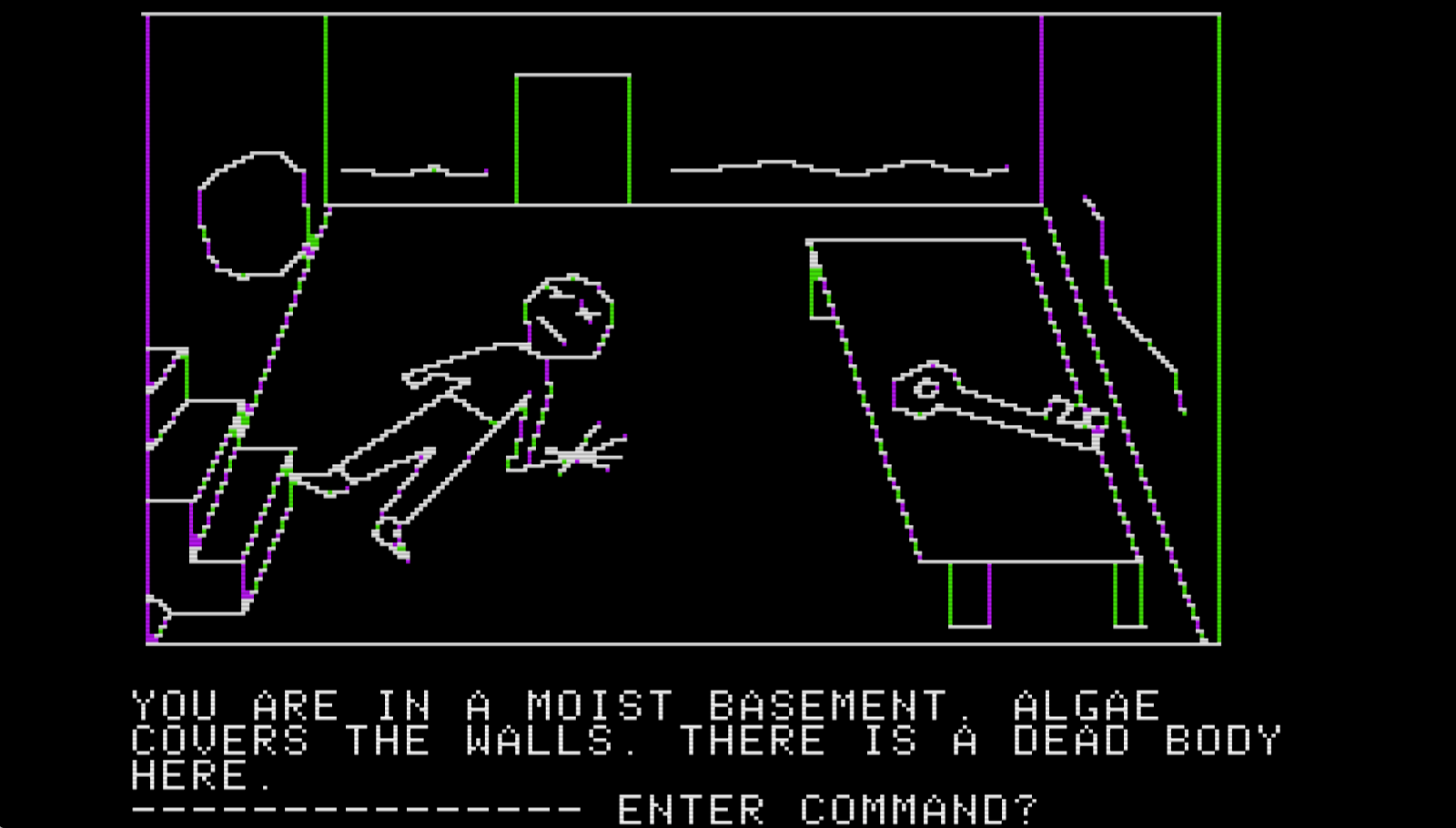

Upon playing for the first time, I was shocked by how much the game still relies on text for the player to understand their surroundings. In hindsight, with Mystery House being the first adventure game to introduce graphics, the graphics play a more complementary role to the text rather than guiding the game. Coming into the game with the mentality of modern games, I expected the graphics to have more details, whether it be details in the room or with the different characters. Many times the game’s text included descriptions of what the rooms consisted of in case it was unclear or sometimes. Once I got over that concept in my head, I could understand would become an aspect that complements the text and becomes visually appealing rather than encompassing the text. I still had a bit of trouble navigating the game due to its use of cardinal directions to guide the players through the house. It was a bit easier for me to go to the locations I wanted in Mystery House due to its use of graphics, so I could visualize more clearly that I was headed towards the kitchen for example, or the study. This is an aspect I find interesting in text-adventure games. The player has to make a mental picture of the locations in regards to world-building and in a way keep a map of the locations they have gone. While in Mystery House, you still have to keep track of the locations you have already been to, the graphics help keep it all visually organized.

On the topic of directions, providing the text parser with directions at times became a point of frustration for me in the game. The game provides you with a set of rules of what directions can be given to the game; two-word commands containing a verb and a noun. It provides a list of example actions one can give the system but if one provides a command that the system is not prepared for, it just says it does not understand and does not provide you with options on how to move forward.

Another thing that made playing slightly difficult for me was the lack of a list of objectives and items required of the player. It is very cool in the game to keep an inventory of the objects one picks up in different rooms and be able to use them later on in the game. Since the game does not provide a list of items to find, one may overlook an item in a room and that would lead to their death later on. 

Characters


The function of the other characters in the game Mystery House also intrigued me in comparison to present day. While in a modern game, the characters may play a more active and detailed role in the adventure, in a game like this all we know of the characters is what is provided in the instructions. It caused me to think about modern adventure games like “Detroit: Become Human” where how a player chooses to interact with certain characters is what ultimately determines the path and ending the player will experience. Additionally, it was interesting how on-the-nose the hints found on or near the dead bodies were since one does not have the option to interact and interview with the characters. (SPOILERS) Each dead body that was found had to be specified by the text and since the graphics themselves were not very distinguishable. The hints found on the dead body like blonde hair and a daisy in a body’s hand, made it easy to discern Daisy as the killer once the other blonde characters turned up dead. Meanwhile, to keep using the example of Detriot: Become Human, technology has made the characters in the game look so detailed and realistic that for example the character Markus resembles very closely its voice actor, Jesse Williams and this happens similarly with the rest of the cast. In terms of the characters, I see how including different characters with differing occupations and identities would become popular in later games and how Mystery House begins to establish its purpose. 

Overall Thoughts
Overall, I did enjoy playing the game and gained a new sense of appreciation for how detailed and immersive games have become nowadays. The advertising for Mystery House itself demonstrates how the game’s main selling point was its graphics and natural language commands, “Through the use of over a hundred Hi-Res pictures you play and see your adventure. You communicate with Hi-Res in plain english (it understands over 300 words!)” (Nooney, p.88)  Currently games advertise the world-building aspects of the games and the paths and actions of the characters have heightened in complexity. Returning to the in-class discussion of the return of providing natural language as a mode of input, I do not see this method of input as making a comeback, especially with how AI has begun to understand more complex commands. I do think it is very important to look back on games like Mystery House to see how far technology has come to create the method we interact with games now and experience these heavily text-based adventure games.

Sources:

Nooney, Laine. Sierra On-Line and the Origins of the Graphical Adventure.American Journal of Play, vol. 10, 1. (2017)

Playthrough: https://www.youtube.com/watch?v=kiwHwPvIHBs 
Text-Based Games and the Trouble of Simplicity

Article by Matt Brennan

Last week, I played through the game Colossal Cave Adventure for class, and in my playthrough and the subsequent discussion we had as a class, one specific topic popped up with regularity: the text parser. The text parser was no small innovation for its time, but returning to it nearly 50 years later was an exercise in frustration. The parser was extremely simple, as it had to be for its time, and thus only accepted a very small—and very specific—list of inputs. This confused every player, myself included, and led to the game becoming a tug-of-war between the player and the controls, with the game itself, while never quite becoming secondary, taking a very clear back seat to the struggle to play at all.

For movement, the parser of Adventure accepts cardinal directions (though not the command to “go” or “move” in these directions), as well as up and down. Everything else gets more arcane from there, as the parser allows for “get” and “take” but not “use” or “investigate.” “Look” is allowed but only gives a description of the room around the player character, and “throw” does the same thing as “drop,” preventing any chance at lobbing objects at enemies as weapons. Eventually, it occurs to the player that their best bet at succeeding is to input only the exact thing they want to interact with and no other words, and allow the game to fill in the rest of the data. This works more often than not, which is its own issue. In a game like Dungeons and Dragons, which was brought up in discussion and was a clear inspiration for Colossal Cave Adventure and every other early text adventure of the day, it’s a reflex for the players to describe what they do in great detail so that the game’s adjudicator, its Dungeon Master, knows exactly what the players want to attempt and how to judge them on the fly. That level of detail, necessary in D&D, becomes an active hindrance in Adventure, and the player must rely on simple, often one word, inputs to move the game forward.

The important distinction between a game like Dungeons and Dragons and a game like Adventure is the level of freedom in both. D&D is nearly pure improv; the players work together and keep each other focused and up to speed on how the game is working at any given moment, but nothing is set in stone in terms of story, and anything can change on a whim or an unexpected die roll. Adventure, for how much it’s inspired by D&D, is nearly the exact opposite; the single player is completely alone, has to figure everything out themselves, and is working to advance the single plot down its defined tracks until it reaches the ending, which is always the same. If the plot of a D&D campaign is an adventure, the plot of Adventure is a train ride with a sticky handbrake. There are interesting and clever moments—for instance, the player needs to keep their inventory clear, but if they don’t set down a porcelain vase in the same room where they set down a decorative pillow, the vase will fall and shatter—but those are hard-coded into the game, not the result of a clever piece of judging by another person. The mechanics can be interesting, but there’s a certain attempt to make Adventure something it isn’t, and the text parser makes this abundantly and uncomfortably clear.

Not to say I didn’t enjoy playing Adventure. I thought it was a very solid game for its age, and the fact that the most frustrating thing about a game over twice as old as I am was that its controls were counterintuitive does say a lot of good things about the game. A lot of it holds up really well, but at every turn when I played, the text parser became a more and more pressing issue. Thankfully there were a handful of passwords to skip most of the long walking sections (where the game has the most chances to screw up and dump the player somewhere in an endless forest), but that was only a workaround, hardly a solution. A text-based MUD I have some experience with, Discworld MUD, also uses a text parser to control the game, but this parser is much more sophisticated and, more importantly, flexible than the parser used in Adventure, and as a result the game experience feels much more akin to D&D and other roleplaying games than to the old text-based adventures we played for class. While this is certainly an unfair comparison between the two, I find it fascinating how far the technology for text-based games has developed even amidst the advent and growth of graphical games. It’s a far fairer comparison between the two, I think, to bring up how beloved and propulsive for the genre both games have been.

Chatbot AI and Humanity

I have separated my understanding of the chatbot ai phenomenon into two philosophical and conceptual frameworks; information and connection, or to put it another way chat gpt and character ai. In class, I asked the question, how is digital media evolving what we understand being human to mean? And, in regards to digital media, especially artistic media, this question becomes increasingly important as we must also interrogate and define art. This is an interesting corner that we have been figuratively forced into by the rapid evolution of ai. Art is a concept that is notoriously difficult to define, what makes art what it is, and more deeply what signifies quality in art remains elusive. However, a principle that seems to go without saying is that it is created and consumed by humans. We value the sweat upon one’s brow, the wavering of a voice in song. It is the small idiosyncrasies and laborious nature of art, the emotion and intentionality of a piece, that must be and is based on its distinctly human nature. In other words, it is the subjectivity of human creation that makes it art, or at least that is how we as a society have subconsciously regarded it. We know that a piece of art is a piece of art because someone made it. The same can be said for how we communicate with one another. We know that real “authentic” communication is occurring because it is happening with another living being who can respond and understand and insert their own subjective experience into what is otherwise a one-sided non-exchange. So then, with ai, we seem to be seeking this out when we create digital minds that are capable of mimicking this connection as I have described it as above. So then, art is a form of communication, however broad and intangible it may be, and communication is the human means of connection. If we are to understand the creation of ai under these lenses, to serve either to connect us or streamline information, then we must then understand why ai takes the shape and form it does, in the most literal sense. Why do we imagine the most advanced AI as taking the rudimentary form of the human body, and able to speak as fluidly as another person. Why must it speak to us at all, and have a “human” voice. Similarly, why do we have character ai that simulates conversing with the president, or a mob boss? On the one hand, it is an appeal to the senses. What digital media intrinsically lacks is the ability to stimulate us on any level beyond 2-dimensional pixels. This is why so much software and hardware is now dedicated to advancing technology on the fronts of sound and sight. This is the reason a “meta” wishes to completely immerse us in sight and sound to the virtual spaces, and attempt to simulate a 3-dimensional world. So then, what humanity is importantly defined by in this new digital age, and what much of digital media attempts to do is arrest our attention on the most fundamental levels of human senses. Though, what else might be the reason for the way that AI chatbots are designed, and the way that robotic forms as well as certain digital media are crafted. We create these forms of intelligence in our image, and to meet the conscious and subconscious desire for these artificial intelligence to transcend their limitations as we too attempt to. In the question of transhumanism, it would seem to me that just as humans create AI and other technological advancements to transcend our organic limitations, we are simultaneously pushing AI to transcend its mechanized limitations. Though we imagine it to be for the purpose of serving humans. So then, an almost existential question comes to mind. We are attempting to reach the complexity of the human mind, by artificial means, in order to serve us. It would seem then, that human needs and wants are only satiated through the intensive labor of other humans, or human-like performance. Other questions I have considered for this topic were more on the side of AI art. What makes an original idea? It is the matter of the amalgamations and originality of a piece. AI is requiring us to bring the abstract of these artistic processes into focus. Art AI artists “real” artists? This uncanny valley of creation and whether or not this thin thread of “human intervention” is enough to keep us protected from AI manufacturing human talents in the next few years, possibly months. It is a question of utility and ethics. We have yet to form shared ethics around ai, and how it is best to perform with these tools under the contexts of information and connection. What values should we have underpinning those ethics? To what degree can these AI be utilized safely and objectively? How do we ensure that prejudices are separated from AI?

TikTok: The Loopiest App of All Time

by Lyssa A
University of Chicago MADD 15300: The Loop as Form
Spring 2023

In my class presentation, I talked broadly about how TikTok uses loops in a variety of ways. Here, I want to do a close reading of one video in particular; one that embodies the variety of ways that TikTok utilizes loops. 

In “Please Duet This: Collaborative Music Making Lockdown on Tiktok” D. Bondy Valdovinos Kaye talks about the duetting scene on TikTok, primarily by citing the ways that duetting can produce collaborative results, especially in the music scene. Admittedly I am not on JazzTok or even MusicTok in general, however everyone once in a while, a video that traditionally only circulates within a small subset of people becomes circulated outside of the circles. One example I can think of is the chronically stuck-in-my-head interaction between Megan thee Stallion and Keke Palmer at the 2022 Met Gala. You can click here to watch it.

This duet encapsulates loops in the way that all duetting does: it uses footage already created. Just like experimental videographers who use found footage or music that samples past songs, duetting draws on someone’s original work and the ability to modify it. In this case, the comparison to reusing footage is even more poignant as neither Palmer nor thee Stallion asked for people to “Duet this,” they simply conducted an interview, and other people modified it. Much like Report by Bruce Conner- he uses news footage that wasn’t meant to be changed, didn’t ask for people to modify it.  

But TikTok presents loops in more ways than the duetting that Kaye explores. The first way I’ll talk about is in relation to “sounds.” Sounds on TikTok are what they sound like- a sound that goes over the visual (and sometimes audio-visual) portion of a video. People most often engage with sounds by lip-syncing to them, or can simply let them play in the background. The Megan\Keke sound became a meme in the way that sounds often do on TikTok. People put the sound over their videos to make a joke about not seeing someone in a long time, or as the inverse to give that original meaning an ironic twist by making a joke about seeing someone you see often. Tangentially related is also the way that people used the sound to make a joke about someone who would traditionally be an other in a group.

In these ways, the loop in this video becomes more than just the way that duetting presents loops: it also does it with sound. The sound is widely circulated and shared, a sort of collaboration in itself. Someone sets the standard for how the sound ought to be used, and other people engage with it similarly, making small deviations where they see fit. They create their own versions of the same meme over and over. But these variations are also important: the minor sense of agency that comes with using the same sound and the same video structure but attaching a different meaning- by adding an ironic twist to a meme that possibly didn’t begin that way or by adding a different meaning. And then that meaning is additionally circulated. While I only gave one example of each way the sound was used, there are a little over 190,000 posts under the sound, the sound is used multiple times in all of these categories. 

This breadth of sound and video is my next point: there are loops with the way TikTok is set up itself. Once you like one video with this sound you will see more videos with this sound. Even if one just looks at the comments of a video with this sound one will hear this sound more and more. Megan thee Stallion begets Megan thee Stallion. The ever-present loop of TikTok gets even more complicated when one thinks about the ways that the app insists that when a trend happens it becomes a trend. The only reason that trends happen is because TikTok’s algorithm makes possible a user’s engagement with a sound they’ve engaged with multiple times.  Someone who is engaged with the app is aware of a number of videos related to a trend because the FYP cycles through them until the trend cycle is over.

This all leads me to my main point: these loops assist in making TikTok “the zone.” As Natasha Dow Schüll defines it in Addiction by Design: “a state of ongoing, undiminished possibility that came to trump the finite reward of a win.” (Schüll,97). Although there is no “winning” TikTok there is a state of ongoing, undiminished possibility. The knowledge that as long as one scrolls there will always be something new to watch and engage with. TikTok’s algorithm will continue to take what a user had already watched and use that to shape what they believe a user will also enjoy. At the same time, TikTok uses the looping sounds to help curate the zone as well. The video it suggests may be familiar because sounds often cycle through, but even those videos–with their everchanging meanings and new variations–will be different enough to be engaging. 

Tiktok’s curation of “the zone” is even more obvious when confronted with the fact that no other social media that I’ve been on has needed a piece of media to interject all the other media one is consuming to tell people to take a break. When someone has been scrolling on TikTok longer than a consecutive hour a video will pop up on their FYP telling them that they may want to take a break. The captivatingness of the app–perpetuated by its use of loops–necessitates the app intervening so people don’t get too invested. In this way, TikTok is a social media site that is immersed in loops. 

Grief, Agency and Time in Majora’s Mask

by Braden H
University of Chicago MADD 15300: The Loop as Form
Spring 2023

The Legend of Zelda: Majora’s Mask was the sequel to Ocarina of Time, released under two years after. In many ways, Majora’s Mask could not exist without Ocarina of Time. For example, many of the game’s character assets have been pulled directly from its predecessor, their characters otherwise totally transformed (one of Ocarina’s endgame bosses runs a swamp boat tour). However, Majora’s Mask goes far beyond what Ocarina of Time was able to accomplish, both narratively and mechanically, and cemented itself as one of the all-time classics of the N64 and gaming as a whole. The gimmick of Majora’s Mask is relatively iconic at this point ‒ the moon is coming crashing down into the world of Termina, and it’s set to impact in exactly 72 hours (54 real life minutes). Link must travel to the various regions of the realm, defeating evil spirits and doing general 3D Zelda things. However, within this relatively-simple structure is a shockingly mature and dark narrative about grief and denial. Intertwined is its brilliant usage of time as a mechanic, which is integral to that storytelling. 

In Majora’s Mask, time is a tool to be manipulated. Link can slow down, skip through and reset time whenever he pleases, even in the middle of combat. Most games do not bother with freeform time travel ‒ time generally just moves forward. Time manipulation makes a game’s story inherently vulnerable to paradoxes and strange contradictions. However, Majora’s Mask handles this surprisingly-elegantly. Resetting time makes Link lose his non-essential material possessions, like his spare arrows and money. He does maintain his key items, but with every cycle refresh, Link starts anew. The few ways in which Majora’s Mask isn’t logically consistent are in ways the player never questions. Technically, Link should move slower when time is slowed down. Or at the very least, enemies definitely should. But they don’t (for obvious game design reasons) and I never even noticed the logical inconsistency until researching for my presentation. Another example ‒ Link should lose his bow and hookshot too upon resetting, but that would, of course, put incredibly arbitrary limitations on how the game could be designed.

Those key items are central to how the game maintains both a legitimately circular game state and legitimately linear progression at the same time. For example, on your first three day cycle, you can’t leave Clock Town. You’re stuck in your Deku form, a race that the townsfolk explicitly discriminate against and view as defenseless. Guards block your path, and you need to get through the first cycle to gain the Deku Mask, allowing you to transform at will. Only once you’re back to child Link and can wield your sword again will they let you through, apologizing for underestimating you. However, on resets, you have to read that text, of the guards blocking and subsequently apologizing, every time. After all, the guards don’t know you have a sword until you show it! But the difference in new cycles is the hassle of earning the Deku Mask and becoming child Link again was already done. Through key items you can save the time you spent in earlier cycles. In every cycle, you’re investing in your future, accomplishing objectives to reach what are functionally checkpoints of progression. This is central to the game ‒ the four macguffins from the four temples travel through time too, which is the reason you don’t need to do all the temples (basically the whole game) in one cycle. It feels natural, and linear game progression is maintained in a believable, compelling and occasionally genius manner inside a constantly looping game state.

The storytelling in Majora’s Mask intrinsically relies on that system. Majora’s Mask is a game about grief and denial. In the wake of the moon’s slow descent to Termina, all of the characters in the world are coping with their inevitable demise. They do this in real-time, growing progressively more concerned, angry, delusional or depressed as the game moves from the dawn of the first day to the final hours. Some characters choose to flee, knowing its futility, while others accept their fate. Very few other games allow the player to watch characters grapple with their emotions in natural, if sped up, time. Even fewer let it happen with no player input. In most games, storytelling progresses through time artificially. The game state fundamentally changes when the player accomplishes objectives. In Paper Mario 64, the Shy Guys aren’t going to overrun the town no matter how long you leave the console running. You need to beat chapter 3 for it, and they will wait for you. 

However, Majora’s Mask’s manipulatable but constant timer makes the feelings of characters significantly more poignant. Their lives are legitimately in your hands ‒ if you leave your game on for an hour or two and never play the Song Of Time, entire civilizations die. When you reset the cycle after defeating dungeons and defrosting the mountains or purifying the swamp of poison, you are plunging entire civilizations back into misery for the sake of the greater good. The story is as much about watching characters cope with calamities while lacking agency as it is about you, the player, coping with the agency you’ve been given in the lives of its NPCs. While you’re saving the Zora, the Gorons are starving to death. While you’re saving the Gorons, the Zora are starving to death. You’re not going to save everyone in every cycle, and you certainly aren’t going to learn everyone’s story without many, many repetitions. All you can do is reset the clock and try your best. Even more than time and its manipulation, Majora’s Mask is a heartbreaking and brilliant game about grief, and the agency you can have in the lives of those grieving.

The Human-Divine Dichotomy: Journeying through Iteration and Recursion

by Noah N
University of Chicago MADD 15300: The Loop as Form
Spring 2023

Before we begin this (personally) intellectually stimulating journey, I’d like to preface it with a quote we’ve seen before that has been resonating in my mind: “To iterate is human, to recurse is divine.” While this sounds profound, what does it even mean? I mentioned this quote in my presentation last week, but I don’t think I explained it very well. And admittedly, I didn’t fully understand the difference, either. So, let us journey through the labyrinth of Iteration and Recursion together to discover why the latter is at the heart of divinity.

Iteration and Recursion are two distinct approaches to repeating actions at the heart of programming. Iteration is to walk a well-worn path over and over again, whereas Recursion is to walk a spiral staircase, with each step leading to a smaller or larger version of itself.

Now, If you’d humor me for a second, imagine a row of ten apple trees in front of you. If I were to ask you to ‘Iterate’, you would pick an apple from the first tree, then move on to the second, then onto the third, and so on until you had picked one apple from each tree individually. In the world of Recursion, however, you’d instruct an invisible ‘mini-you’ to pick an apple from each tree, beginning with the next one while you pluck from the first. This ‘mini-you’ would then order their ‘mini-mini-you’ to do the same, and so on until the last apple was plucked.

Recursion may now appear a little more complicated, and with good reason. Recursion is a labyrinthine mystery buried within itself, a matryoshka doll of orders if you will. But then, why is it regarded as divine? To answer that, let’s think in terms of philosophy and metaphysics. Recursion is a mathematical concept that reflects the processes of nature, the cosmos, and perhaps even the workings of God, just as a single-cell can replicate itself to form complex organisms. The spiral galaxies in the universe, the nested layers of human consciousness, and the fractal pattern on a fern leaf are all examples of this endlessly repeating pattern.

Iteration, on the other hand, depicts our humanity, our daily routines and habits — the boring linear progression of time as we perceive it. Everyday we wake up, go to class, go to work, go to sleep, rinse, and repeat. We live our lives bound by loops, bound by the constraints of time and physicality.

However, Recursion transcends these limitations. Just as a Zen master uses koans to reach enlightenment, Recursion mirrors the endless cycle of creation and destruction, existence and non-existence. It’s no surprise Recursion is equated to the ouroboros, the divine dance of Shiva.

If it’s so divine, then why don’t we use it as our primary structure in programming? The answer is the inherent limitations of our systems. Like humans, computers have a limited amount of memory and resources available to them at one time. Each Recursive “mini-me” we create needs its own chunk of memory, so too many Recursive “mini-mes” would overwhelm the system (kinda like how too much introspection results in existential dread hahaha jkjk unless). As a result, we’re forced to follow Iteration, the well-worn, well-known boring linear progression, and the methodical apple-picking labor.

Regardless, it’s important to appreciate Recursion’s beauty and potential as the divine algorithmic component. It challenges us to think outside the box and imagine the infinite within the finite. Recursion is the core of creativity, the soul of inspiration, and the manifestation of the divine in the human mind. Recursion, therefore, is a window into the divine, an indication of the infinite, and a whisper of eternity within the fleeting world of binary code.

“To iterate is to human, to recurse is to divine,” perhaps then, symbolizes iteration as the pulse of our humanity and the rhythm to our lives. It is the practical, grounded, and methodical procession of human thought. As for Recursion, it is a window into the supernatural and a doorway to the infinite. It is the reflection of the divine in the building blocks of our mind and the imprint of the cosmos in our mental blueprints.

To end this adventure, we can put it like this: the dichotomy between Iteration and Recursion reflects the contrast between humanity and divinity, the finite and the infinite, the temporal and the eternal. It’s a taste of the metaphysical and philosophical dichotomy that has captivated philosophers and artists for as long as time itself. This contrast is a reminder of our humanity, our divinity, and the delicate balance between the two as we delve deeper into the world loops.

We exist in a loop of loops, a Recursion of Recursions in the grand net of existence. We are the algorithm and the programmer, the query and the response, the firing pistol and the finish line. In the never-ending circle of existence, we are both human and divine.

So keep this in mind the next time you find yourself in front of a row of apple trees (or lines of code): Iterating is living in the world; Recursing is seeing beyond. Achieve balance between the two because it is in this place that existence’s essence, the beauty of the loop, and the form of the formless are found.

The Search for a “Good” Ending in Save the Date

by Madelyn E
University of Chicago MADD 15300: The Loop as Form
Spring 2023

In most games, it isn’t possible to sit down for two minutes, make a couple choices, and get to a screen that tells you it’s “The End.” In Save the Date, that is just about the only thing that can happen—but just because the player has reached the end of a storyline, this is far different from having reached the end of their gameplay experience. In fact, the exact opposite is true. Save the Date is built around a core gameplay loop that expects the player to feel unsatisfied with the narrative ending they receive and play again to try to get a “better” one. However, one could argue that the player will never reach a satisfying ending, if their goal is to “save the date”—to successfully go out with Felicia while keeping her alive.

The game includes a variety of narrative paths that ultimately lead to (as far as I am aware) twelve different main diegetic endings—eleven of which involve Felicia’s death in some way or another. The twelfth requires only a single choice from the player, choosing to not go out with her in the first place. This option feels intuitively “incorrect,” as a player’s natural response would likely be “How can I save the date if there is no date?” However, after repeated failed attempts to go on the date without Felicia dying, one returns to this menu dialogue option with a different perspective—“maybe the only way to save the date is not going on one at all.” While this option does keep Felicia alive, it is still unlikely that players will find it satisfying.

Save the Date also has potential for two nondiegetic “endings”—both of which come to a less tragic conclusion than any of the twelve narrative endings, but it is debatable whether either of these endings can be considered a legitimate ending of the game to begin with. First, there is the “hacker ending.” The player can navigate through the game’s directory to find a file named I_AM_A_HACKER.rpy, and by editing a line in this file from “False” to “True,” the player will now have access to a new dialogue option at the beginning of the game—to suggest having “an awesome dinner in [their] floating sky castle because [they are] a hacker!” If the player chooses this option, they and Felicia will both become extremely wealthy and live out all their wildest dreams, so it may at first seem like a “good” ending. However, this route tends to leave players unsatisfied as well, because the game makes them feel like they cheated to even get this option in the first place. After experiencing this ending for the first time, the player encounters an unexpected new catalyst for repetition—a search not just for a “good” ending, but for a “good ending” that they feel like they have earned.

Finally, once the player has repeated several iterations of the loop and they go out with Felicia to Moore’s Hill (where she will still eventually die), being truthful with her about their intentions and about the loop will lead to a deeper, more philosophical conversation than anywhere else in the game. In this conversation, Felicia attempts to help the player find an ending that they deem to be “satisfying.” If the player chooses the dialogue option suggesting that they just want a “You Win” screen, Felicia offers to simply say it to them and asks if this will solve the problem (interestingly, this is not considered an actual ending to the game—the dialogue keeps moving forward past this point). Further, Felicia suggests that maybe the way to get a satisfying ending is to close the game and imagine an entirely different ending if they don’t like the one the author created. Ironically, this is one of the few endings that the creator of the game himself deems to be the “true” ending of Save the Date. However, it is once again debatable whether this can even be considered an actual ending of the game, when it solely exists outside of the body of the work itself. Does this mean that any alternative ending we can think of for any piece of media is equally as legitimate as the ending(s) of the work itself? Is this case different because the creator of the game specifically wanted people to create their own endings? Is Felicia even really meant to be saved? These are all valid questions that arise from considering this abstract “ending” to Save the Date, and there is no objective answer to any of them. Some players may be satisfied with the idea of the game allowing them the creative freedom to think up their own ending, while others may find this unfair or illegitimate and argue that Save the Date simply has no happy ending.

At some point, the player will no longer feel the desire to keep looping through the game in search of a “good” ending—they will either accept or deny the one in their imagination, but after they have completed all of the diegetic storylines to the game, this is when their playthrough truly “ends.” At this stage, they have experienced twelve to fourteen endings, depending on which they consider to be legitimate, and all that is left is for them to decide which ending they liked the best. Many players will likely choose to accept one of the more controversial endings, such as the imagined ending or the hacker ending, but some may also choose to take one of the death endings and interpret it as their version of the game’s canon, simply because they found it the most entertaining. As the player chooses their macro-level ending of the game, having experienced micro-level endings many times, Save the Date’s gameplay loop finally draws to a close.

The Dark Souls of Player Motivation

by Nick V
University of Chicago MADD 15300: The Loop as Form
Spring 2023

In my initial analysis of core gameplay loops, I examined the four principle loops to game design: the internal game loop, the player’s mental loop, the interactive loop, and the designer’s reactive loop. In my presentation, I only analyzed how gameplay loops operate with near-exclusive respect to the interactive loop and my discussion questions only suggested broader implications towards the player’s mental loop through monetization models and myopic effects on player psychology when all the systems work as intended. Since then, I’ve been thinking a lot about the recursive structure of the interactive loop: the player makes a choice which changes the game model which then, in turn, gives new stimulus to the player, causing them to make new changes to the game, and so on. The idea that a video game can change the way a player thinks is something that I just kind of brushed over as I briefly discussed how designers employ this principle to achieve design goals within the game world. In order to delve deeper into my understanding of the player’s mental loop, I am taking the unique opportunity of this blog post to go a little “meta” and explore how the principles presented in core gameplay loops have affected me and what implications my example may raise for player psychology as a whole.

Firstly, I’d like to start with what spurred my specific interest in player psychology. I was watching Ian’s video essay on Jonathan Blow’s The Witness and I was fascinated with his particular section on pedagogy: the art, science, or profession of teaching people. Although his discussion pertains to The Witness’s tutorials, I found the contrast of his examples to be intriguing even in a broader context. Specifically, The Witness employs “safe failure” as a means to communicate new information to the player. Rather than an explanation of how the mechanics work, Blow instead uses simple puzzles with only a limited number of solutions so that the player may experiment with different approaches in order to recognize patterns and discern the rules for themselves. By their very nature, all games use safe failure since they are intrinsically devoid of real or serious consequences outside of their own ruleset. However, this method of learning via failure was sharply contrasted by the methods of contemporary academia where students (typically) only get one chance at an assessment with severe and permanent consequences for failure, encouraging intense preparation before the first, and likely only, attempt. 

As somebody whose life has been encompassed in equal part by both video games and school, I wondered how these different teaching methods could coexist in my head; how could I consistently learn in a system that threatened severe consequences for failure whilst simultaneously playing games which allowed me to learn through failure without consequences? The ostensible incompatibility of these methods wasn’t reconciled until I thought about my experience with one of my favorite game series: Dark Souls. Initially, I considered how I would die to Dark Souls bosses over and over again in order to learn from my failures, seemingly embodying the philosophy of safe failure. However, I also recalled my intense proclivity to rigorously research wikis and forums for what weapons, armor, spells, and equipment I should use in order to make my character as strong as possible. Even as I replayed these games multiple times, breezing through most encounters with ease, my research habit prevailed as my focus shifted from what equipment would maximize my survival to what equipment would maximize my “fun” on a given playthrough. Here I was practicing the safe failure method in one facet of the game while practicing a fear of failure in another. Surely, I could just experiment with different armor and weapons in order to find out which ones suited me best just as I experimented with my approach to fighting bosses? Why didn’t I do it? What makes these scenarios any different? I believe the answer lies in the motivational disparity between explicit and implicit player goals.

As the player understands and evaluates the game’s model in their own mental loop, both explicit and implicit goals motivate the player to carry out actions. Explicit goals are goals that the game sets for the player. To retain the Dark Souls example, this would be something like an obstructive boss which the player must defeat. Implicit goals are goals that are entirely generated by the player in response to what they know to be possible within the game’s model. Dark Souls presents the players with many different kinds of divergent weapon types, but the designers never explicitly motivate the use of one playstyle over another. So, the player will generate an implicit goal of what kind of specific build they want to use in response to what they know the game will allow them to do. Generally, explicit goals fall in line with the safe failure method of learning since the consequences of not achieving the goal are only limited to the game world. However, I believe that implicit goals bridge the gap between the player’s in-game actions and real-life ramifications since their source is generated from outside the game model. When failing to complete their implicit goal, the player is no longer facing consequences purely from the game. They are also facing consequences from themselves as any disappointment or frustration from failing their own self-created task transcends the game and becomes real. However, these consequences don’t necessarily have to be severe; it is entirely up to how much the player chooses to emphasize their own goals. It is for this reason that I believe implicit goals have the potential to be much more motivating than explicit ones. This would explain why my proclivity to research equipment always beats out my desire to experiment with builds: I am worried of the real-world consequence of potentially wasting my time on a playthrough where I could have had more fun. 

The power of implicit goals is especially apparent in phenomena such as challenge runs and speedrunning. Despite the game designers giving no explicit incentives to have players constrain themselves or beat the game as fast as possible, some players recognize that they can and will do it anyway. For implicit goals, the designer’s intention doesn’t matter because the goal is merely a recognition of what the players discover to be possible, so designers have no control over what they do with open-ended mechanics; if Mario levels can be completed at any time, there will exist a player that will want to complete it at the quickest time; if Mario can freely jump, there will exist a player who will try to complete a level by not jumping at all. As a result, implicit goals are very volatile and can result in both positive and negative experiences for players; a player may make more fun for themselves with their implicit goal, but another player’s paranoia may cause them to do something boring or frustrating which contradicts the designer’s intention. So although a game may be meant to be easygoing, taken slowly, or experimental, the power of implicit goals will see players restricting their own abilities, speedrunning the game, or even meticulously “min-maxing” their Dark Souls build. 

Life on the Inside: Living in a Post-Skinner World

by Steven H
University of Chicago MADD 15300: The Loop as Form
Spring 2023

B.F. Skinner was an incredibly influential psychologist from Harvard who made massive strides in the field of behavioral psychology. His most famous experiments involved animals inside deprivation chambers having access to seemingly innocuous levers or buttons that would cause some kind of change in the animals’ environment. However, the conditions under which a change would occur were controlled by Skinner. For instance, he could make a rat pull a level ten times before receiving one food pellet, or he could make a rat wait until the first lever pull after an hour to receive the same reward.

His work is especially notable, particularly in our modern world, for its definition of learning. Skinner defines learning as a multistep process, beginning with an environmental stimulus, followed by a response, and then tail-ended by feedback from the environment. As this cycle repeats, it will become clearer with every iteration which behaviors lead to desirable outcomes and which lead to unfavorable outcomes. For example, if someone notices that the forecast says it will rain and they don’t bring an umbrella, the displeasure created by getting rained on will motivate them to try a different response. So the next time it rains, the person decides to bring a metal rod taller than all of the objects in the surrounding area. As you can imagine, the result of that really will disincentivize that particular behavior. When this individual finally settles on a beneficial response, like bringing an umbrella, they will be happy, on some level, with their current situation, which motivates them to continue to bring their umbrella in the future.

Now, what does this mean for us as individuals in the modern era? More specifically, what does this mean for us as individuals with constant access to devices that provide stimulus and feedback? As a further complication, all of these devices that we have access to and that respond to us and get us to do tasks were sold by a company for profit and host apps that elicit money from users. In summation, we are constantly holding a device created for extracting profit at the point of purchase and throughout its use that can make us react and can also provide feedback conducive to the profit motive. We all own devices that interact with us in a way that fits Skinner’s definition of learning—namely, we are prompted by our phones to do things, we pick a response, and then are given a type of feedback as a result—and they train us to make money for them.

For example, an app like Instagram shows us things that we may enjoy. If we decide to engage with this content, we get more of it. The same is true of things like YouTube, TikTok, and Facebook. In order to maximize user enjoyment, an important modification has been made to Skinner’s original design. That is, there is no response on the part of the user that will lead to negative feedback from the app itself. Every engagement is positive to the app, and the feelings you get from seeing more of the things that you like, as well as having people like your posts, will have you coming back for more. The consistent user base created who become increasingly dependent on these positive feelings equates to a consistent stream of data for advertisers and a platform that is guaranteed to have an audience for advertisers to market to.

Mobile games are another opportunity for some old-fashioned newly-fashioned learning experiences. As we discussed earlier the rate at which feedback is administered is highly adjustable and can lead to different results. In recent years, as it relates to games, researchers have found a variable schedule of feedback distribution to lead to the most player engagement. Consequently, many games such as Candy Crush makes players wait for powerups or even additional chances to play the game for variable intervals of time. This conditions users to acquire their happiness in bursts, as just like in the Instagram example, the negative feedback element has been removed, although here the penalty for waiting is definitely harmful to players’ enjoyment. To circumvent this problem that they created, these games typically provide cash-based get-out-of-jail-free cards, which allows the companies to be quite forward in their profit-seeking. The “apt” among mobile gamers may download many of these kinds of games and schedule their playtime in such a way that they never have a time in which they are locked out of at least one of their games, but this is akin to thwarting McDonald’s by ordering a Whopper Junior, Dave’s Single, and a Famous Star With Cheese, in addition to a Big Mac; the more of their product that you consume, the more you are going to want to partake, and the more you partake, the more data you provide, and the more exposure you give to the app.

This positive feedback loop in particular is not something to take lightly. Other corporations are stuck with much longer wait times between engagement with products, regardless of how enticing they make them. For instance, no matter how beautifully you craft a hotel experience, it is unlikely that consumers will stay in a hotel unless the need arises. Additionally, unless one has an infinite amount of money, one cannot stay forever. In fact, even if getting a hotel room had been previously pleasurable if one were to purchase one while under tight financial constraints, the stress created may completely outweigh any of the luxuries the hotel can offer, ultimately damaging one’s view of hotels, at least for a little while.

The same kind of refractory period does not exist for those who spend most of their time in apps or online; there exists an endless amount of interesting content and most of it is readily accessible for free. The consequences for engaging with that content in a serious fashion long-term are not yet socially accepted, usually being alluded to as something that everyone experiences but accepts as a part of life. However, stripping away one’s sense of consequence in terms of actions harms interpersonal relationships, work ethic, motivation, and mental health overall, potentially, to an alarming degree. By teaching users that fun things should be repeated as much as one desires, as that repetition actually will make things more fun, companies are steadily increasing your reliance on their products for their own gain, regardless of how it may affect your personal life and ability to function. The scariest part about seeing parallels to the behavior of rats within ourselves is seeing the parallels between their cages and the way that we live. Ultimately, we must disengage from such content. Despite the short-term negative consequences of doing so, it is never too late to enjoy a life outside of the box. Out there, as opposed to in here, pleasure is derived from making the best of unpredictability and accepting hardship, which provides a greater sense of being than anything appealing to our lowest instincts can provide.

Repetition Compulsion in Popular Media: Art Imitates (and Implicates) Life?

by Mai V
University of Chicago MADD 15300: The Loop as Form
Spring 2023

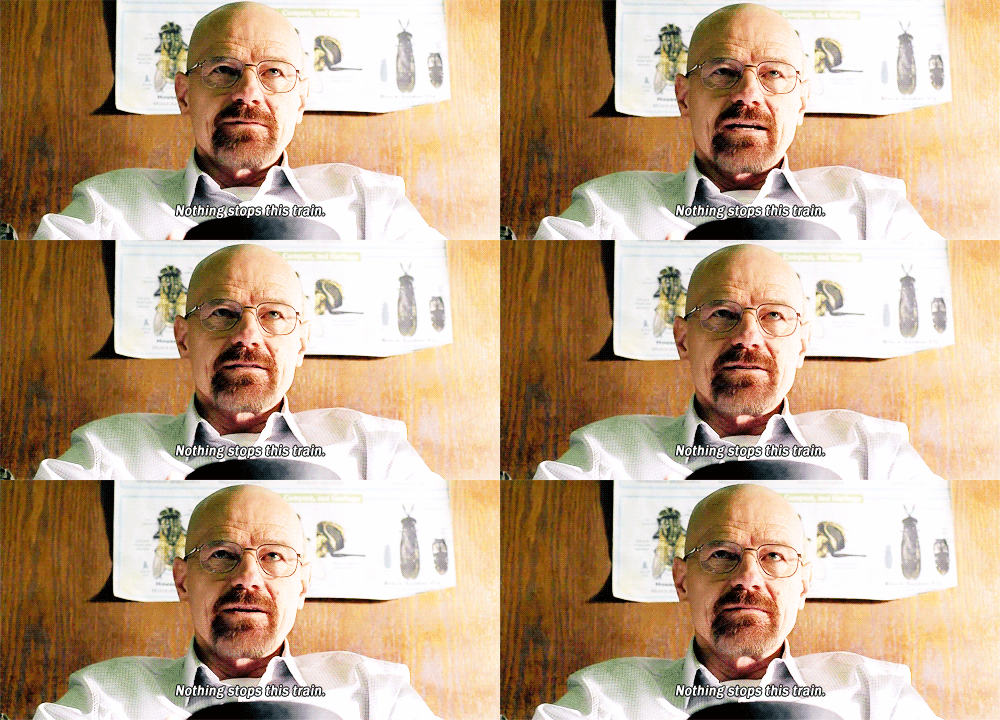
From the catchy tunes of Britney Spears’ Oops!…I Did It Again to the binge-worthy plotline following Walter White in Breaking Bad, perhaps nothing screams “Art Imitates Life” more than the relentless and fascinating portrayal of repetition compulsion in popular media. Laying bare the intricate human struggles of self-destructive loops, modern media has the power to intimately connect with its audience and implicate their lives away from the screen. 

Rooted in Freud’s psychoanalytic theory, repetition compulsion is the individual’s disposition to reenact painful and/or self-destructive behaviors because of past traumas. This process can unfold in various ways: a false sense of self and defensive attitude towards the bad behavior, a yearning for familiarity in past experiences however unpleasant, a desperate attempt to master anxious and helpless feelings, or the mere inability to see beyond flawed behavioral models learned in early life.

Entertainment media eagerly adopts the story of the vicious cycle, especially those with potent narrative powers like songs and television series. 

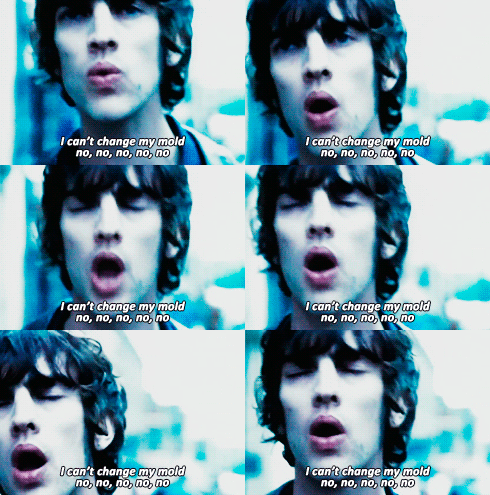
Britney Spears’ character in chart-topper Oops!…I Did It Again embraces a corrupt self-image, whistling “That is just so typically me” before transitioning to the iconic chorus. The Verve’s 90s hit Bitter Sweet Symphony resounds, “You know I can change… But I’m here in my mold,” echoed by Current Joys in A Different Age with the lyrics, “And I wish I could change, but I’ll probably just stay the same.”

The Verve — Bitter Sweet Symphony

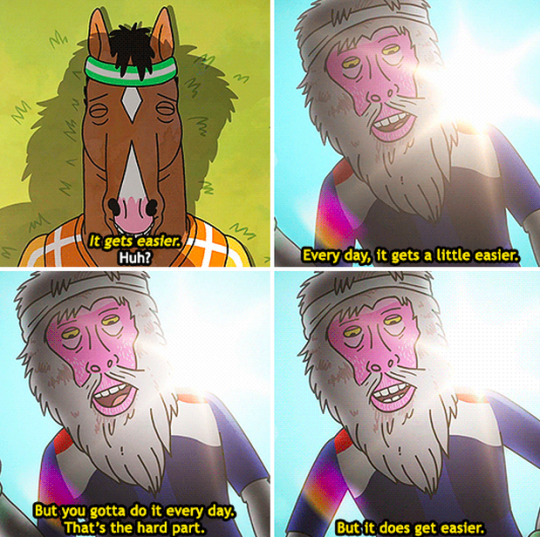
Some of the most popular and critically acclaimed TV series of all time, namely Breaking Bad, The Sopranos, Euphoria, and BoJack Horseman, all observe characters trapped in behavioral loops. In Breaking Bad, high-school teacher Walter White embarks on a journey of increasingly dangerous and immoral actions following his cancer diagnosis, uncovering a deep-rooted egoism that detonates against the powerless fear of death. In The Sopranos, mob boss Tony Soprano acknowledges his violent past and dysfunctional family dynamics as he attempts to salvage his emotional well-being. Euphoria follows Rue, a high school student grappling with drug addiction and mental health issues amidst the turbulence of adolescence and the loss of her father. Also an addiction story, BoJack Horseman chronicles a self-centered yet self-destructive Hollywood celebrity as he confronts the depraved nature of his actions. 

Walter White from Breaking Bad

Beyond mere content in lyrics and character plots, these artistic creations embrace the behavioral loop in their form, the materiality of their very production. In both the songs Oops!…I Did It Again and Bitter Sweet Symphony, the verses seem to vary only as a backdrop to, and in anticipation of, the amplified and repetitive chorus chanting “I did it again” and “I can’t change my mold.” Similarly, the format of seasons and episodes in TV series is ideal for crafting a character-led cyclical narrative. BoJack Horseman, for instance, consistently reserves the few final episodes of each season for a dramatic climax concerning the protagonist’s entanglement in repetition compulsion. The media’s structural repetition oppressively reminds its viewers of the behavioral loop around which everything revolves. 

Does popular media’s success in portraying repetition compulsion mean anything for audiences grappling with similar issues? In Remembering, Repeating, and Working-through, Freud proposes therapy as a possible cure. If the patient can recall and reenact their trauma in a safe and controlled environment, they may gain valuable insights into the roots of their behaviors and eventually correct them. However, Freud asserts the first step of the treatment must be to “bring about a change in the patient’s conscious attitude to his illness” (152). According to Freud, all victims of repetition compulsion may initially resist help. Someone, or something, must show the victims their illness “has solid ground for its existence” and matters for “things of value for [their] future life” (152). 

This is precisely where popular media comes in. Nothing rivals the appeal and accessibility of entertainment products, and the audience’s engagement with these pieces is as crucial as their ingenious production. Whereas the latter is the message, the former is its delivery. Songs are often saved and listened to on repeat, while TV series allow audiences to closely observe the destructive nature of repetition compulsion and the potential for change from a third-person perspective. Although removed from technical terminologies, these media effectively convey the need for a victim to reverse the course through persistent efforts. 

Green Day’s single She poses the question, “Are you locked up in a world that’s been planned out for you?” and suggests smashing the loop “with the brick of self-control.” Linkin Park’s Breaking the Habit repeats, “I don’t know how I got this way. I’ll never be alright. So I’m breaking the habit. I’m breaking the habit tonight.”, evoking relatability and inspiration to change in victimized listeners.

Similarly, the aforementioned TV series’ thorough depictions of repetition compulsion in the characters’ daily life highlights the illness’s intrusive nature and the devastating consequences of inaction. Audiences cannot help but introspect on their own terms, and numerous individuals have shared how these artworks spurred awareness within them and encouraged them to seek professional help, including Euphoria and BoJack Horseman. 

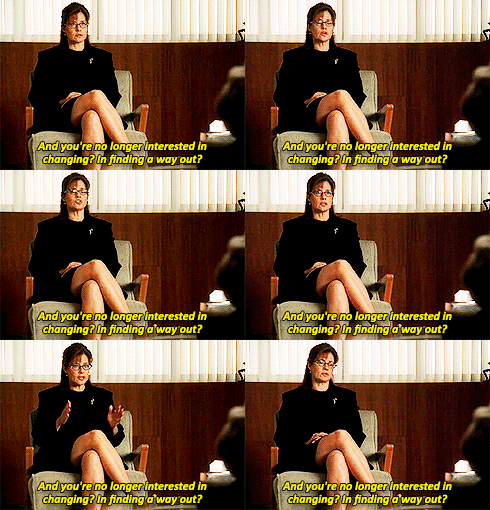
However, the process of instilling awareness and inspiring change in victims of repetition compulsion is far from straightforward. Freud attests to the concept of resistance, whereby individuals refuse to acknowledge their illness and defy change for various reasons (149). They might be protesting the idea that they need “fixing,” like Walter White and BoJack Horseman did, or they fear not being able to return to familiar situations, as seen with Rue’s refusal to attend rehab. Even when these individuals enter a therapist’s office and recount their behaviors, they may still construct a resistant wall, selectively narrating their stories to avoid accountability and justify their harmful actions, as happened in The Sopranos. Pink Floyd’s classic hit Comfortably Numb depicts a fictional artist, Pink, found overdosing on heroin in his hotel room. The lyrics, “I can’t explain, you would not understand. This is not how I am.” perfectly encapsulate the denial rhetoric commonly used by victims of repetition compulsion.

A therapy scene from The Sopranos

Similar to these fictional characters, real-world audiences who are not ready for change may force these media to conform to their distorted and destructive worldviews. In this way, the media intended for awareness could inadvertently exacerbate their behavioral looping process. The episodic structure and dramatic cinematography of TV series actually enable audiences to selectively view the characters, downplaying consequences while fixating on “success moments,” for example, through online fan-cam edits. As a result, they validate and glamorize harmful behaviors of repetition compulsion, evade confrontation, and remain in their comfort zone.

This duality of TV shows in the individual’s processing of repetition compulsion holds true for the broader digital landscape. On the one hand, mental health awareness is more accessible than ever, with concepts like “trauma,” “healing,” or “triggers,” and even specific manifestations of repetition compulsions, such as “toxic relationships” or “trauma-related drug abuse,” becoming increasingly prevalent across social media platforms. Multiple YouTube self-help videos discuss the need to recognize and break bad habits or toxic patterns (this one is from two months ago and has 1.4B views.) This public blog post is another drop in the sea. On the other hand, however, an increasingly enabling algorithm shows individuals only what they want to see, as exemplified by glamorizing fan-cams of corrupt characters or platforms that promote manipulation of romantic partners (please take the time you need to process that.)

Ultimately, the journey to escape repetition compulsion requires not just awareness, but courage, vulnerability, and readiness from the individual. As we consume these media on repeat, seeking out the next melancholic song and moving from one TV show featuring flawed characters to another, we cannot help but confront the loops in our lives. The illness is not linear, and neither is the healing process. The best we can do is put in consistent efforts, and perhaps with a little help from these “relatable” media, we may at last find hope.