by Sherry G
University of Chicago MADD 14920: Comparative Media Poetics – Horror
Autumn 2022
What leads someone to believe in ghosts? Perhaps a spooky encounter that can’t be explained. But if ghosts are supposed to be scary, why does it seem like so many people wanted to believe in them with the spirit photography craze of the latter half of the 1800s?
William Mumler was a jewelry engraver turned (spirit) photographer who claimed to have taken the first “ghost photo” in 1862. According to Mumler, he was alone in his studio taking a self portrait, and when he went to develop the image, a ghostly figure resembling his late cousin appeared in the frame. Mumler went on to self-promote his abilities as a medium in various newspapers to attract people to his studio with promises that he could coax their dead relatives to appear in a photo with them. He charged $5-10 per photo, roughly $150-300 in today’s dollars, and quickly became quite wealthy with the high public demand for pictures of people’s dead family members.
However, Mumler’s rise to fame came about as quickly as his fall from grace. From the beginning, Mumler had vocal skeptics. Though no one was ever able to exactly recreate his photographs, photographers and scientists at the time gave at least a dozen different plausible explanations for ways the images could have been faked in Mumler’s 1869 fraud trial. But photography was still a new medium, having only been invented in 1822, and was expensive so the mechanisms of the technology were not widely understood by the general public. It was argued that the limits of photography were unclear, so perhaps ghosts could really be captured on film. Damningly though, there were multiple instances where someone who was still alive was captured as “ghost” by Mumler, including people he had recently photographed in the studio. Not only that, it was alleged that Mumler broke into people’s houses to steal photos of dead family members prior to sessions they had scheduled with him.
So, with all this evidence against Mumler’s claims, why did so many people go along with Mumler’s claims that he could communicate with those beyond the grave? Looking at Mumler’s photography today, it’s clear that they were faked. Many of the ghosts in the images have the exact same silhouette with no clothing details, only different faces.
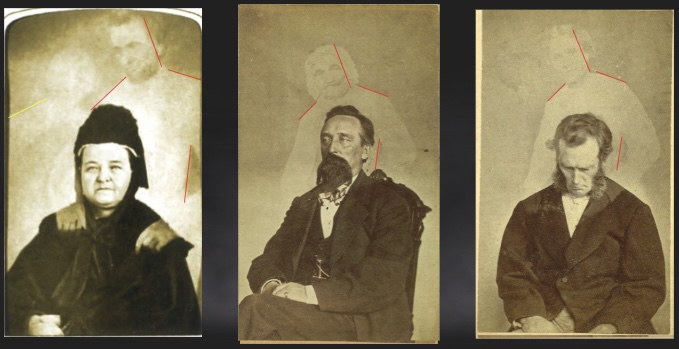
Noticing this immediately, I was initially baffled at why anyone would have believed Mumler or believed in ghosts in general. However, times were different back then. There was no internet, no database of every photo Mumler ever took for people to compare and scrutinize. Upon further investigation with this in mind, I argue that in this period of rapid change and uncertainty, people were desperate to hold onto any semblance of constancy. For many, ghosts were comforting because they represented a continuity of life after physical death.
The 1860s was a period of rapid change and uncertainty in the US with the Civil War spanning the first half the decade. The country was split and families were separated as men went off to fight with no guarantee of returning home alive. News traveled slowly, so people waited anxiously for weeks to hear from their loved ones and no one knew when the fighting would end. This war brought an unprecedented number of casualties. Grief was overwhelming and there was widespread mourning across the nation.
The mid-1800s was also a period when new technologies were constantly being invented and changing vital aspects of life multiple times throughout a person’s lifetime. Notably, the invention of the telegraph in 1844 fundamentally reshaped communication and peoples’ relationship to and understanding of the body. For the first time, the human voice could be disembodied from the corporeal. With this new concept of disembodied communication, Spiritualism rose in popularity as a religious movement that proclaimed communication with the dead was possible because the soul and body are separate entities.
With the Civil War’s devastating aftermath and the rise of belief in spiritualism, ghosts became a source of comfort rather than fear. Death is horrifying. Losing loved ones fundamentally alters how someone looks at life. Processing death is difficult and painful. How do you begin to process a loved one’s death when all you get is a letter that says they were killed in battle, knowing that you will never get a chance to see their face again?
While Mumler was a savvy businessman who capitalized on mass mourning, it was clear he understood the power of nostalgia. Seeing the smiling faces of their dead relatives one last time, even the form of a hazy translucent figure (that most certainly was a photo from when they were alive), allowed many people to feel that their loved ones were still with them on the other side. Although death is inevitable, the existence of ghosts means that life still exists past death. Spirits do not die because the soul is eternal. Mumler’s spirit photos gave his clients a physical reminder of this, that just because their family members are dead doesn’t mean they are completely gone from their lives.
Death leaves many questions that will forever go unanswered and brings on many fears. Perhaps the greatest fear that death brings is whether that person’s presence will continue to be felt in the mourner’s life, or whether their memory will eventually fade to nothing. A ghost photo serves as a permanent memorialization of the dead, a memory physically externalized so that it cannot be completely lost. Grief never fully goes away, but those grieving eventually learn to live with that uncertainty. When the unknown becomes the only constant in a sea of change, it becomes a source of comfort.