Color in Spider-man: Into the Spiderverse

Screen Shot 2019-12-12 at 7.59.40 PM

by Nick
University of Chicago CMST 14400: Film and the Moving Image
Autumn 2019

Spiderman: Into the Spiderverse is a superhero film that tries to emulate the experience of reading a superhero comic book. The film moves away from the live-action superhero paradigm and fills the screen with bold colors, halftoned graphics, and word-boxes that one would see in the comics. Color in particular plays a variety of roles in establishing character traits and developments throughout the film. This post analyzes three main uses of color in the film. First, I will examine how color is used to establish good and evil figures in the film. Next, I will focus on how color is used to emphasize the emotions of characters and the overall tone of a scene. Finally, I analyze the role that color plays in signifying turning points in the narrative arc and various character arcs.

Background on Comic Book Color

Four colors serve as the basis for most of the colors we see in early comic book prints and Into the Spiderverse: cyan, magenta, yellow, and black. The CMYK color model (K being a “key” color, black) stands in contrast to the RGB model, as cyan, yellow, and magenta subtract red, blue, and green from white light, respectively. So, instead of white being the sum of our basis colors, as is the case in RGB, combining cyan, magenta and yellow produces black. It was of course cheaper to simply print pure black instead of combining all three inks.

Screen Shot 2019-12-12 at 10.12.23 PM

To produce an RBG color of a particular saturation, illustrators use a process called halftoning where small dots of each CYAM color printed over each other.

Screen Shot 2019-12-12 at 9.55.55 PM

Color: Separating Superhero from Supervillain

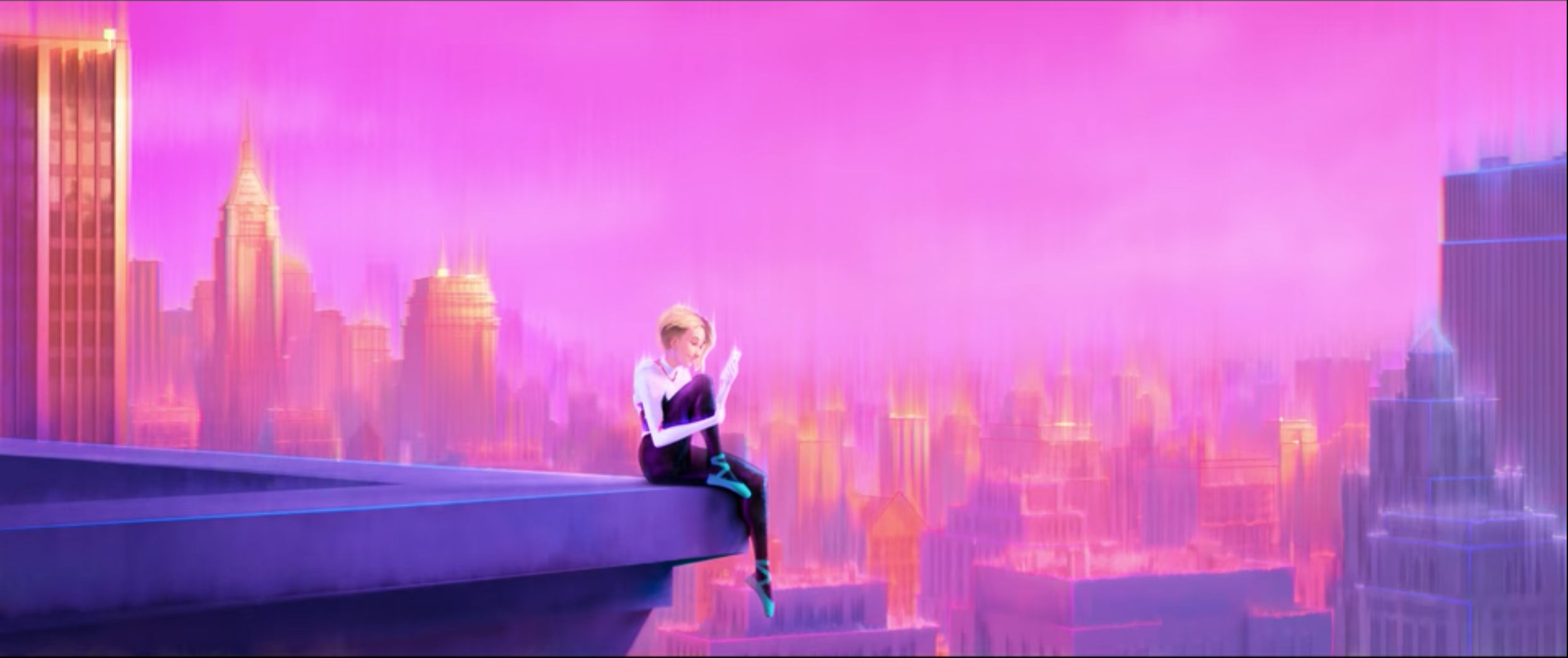
Audience members without any knowledge of Spiderman or comic books in general can look to a character’s color palette to see if that character is good or evil. Heroes tend to have lighter, brighter colors like red, pink, white, and blue while villains tend to have darker, unnatural looking colors like black, purple, or green. The one exception in Into the Spiderverse is the color black, since Spider-Noir, Miles, and Gwen all have black in their costumes.

Screen Shot 2019-12-12 at 11.11.48 PM

Screen Shot 2019-12-12 at 10.18.18 PM

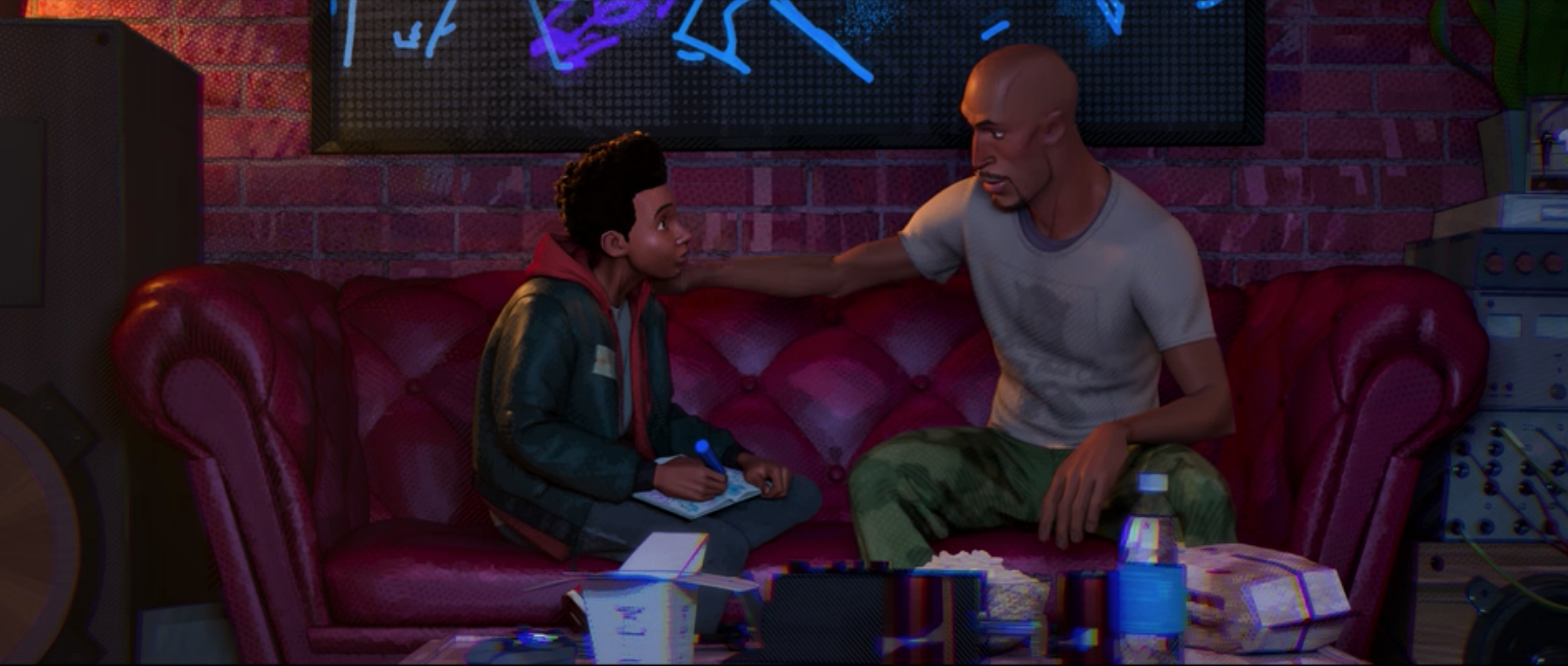
Into the Spiderverse cleverly uses these colors to give the viewer an early indication of the “bad guys.” Miles’ uncle, Aaron, is introduced as the “cool uncle” who is not as uptight as Miles’ father. When Miles visits Uncle Aaron for the first time, we get clues from his apartment that he might be a supervillain. As Miles looks up to his uncle’s apartment from the street, the light coming from his apartment gives the surrounding outdoor objects like the fire escape and building edges a purple tint.

When Miles sends Aaron a picture from his window, the phone screen and background is tinted purple. The purple furniture like Aaron’s sofa gives another signal that he might be some kind of “bad guy” in a sense not imagined by Miles’ father. Of course, we later find out that Uncle Aaron is the Prowler, whose costume uses purple and black as its primary colors.
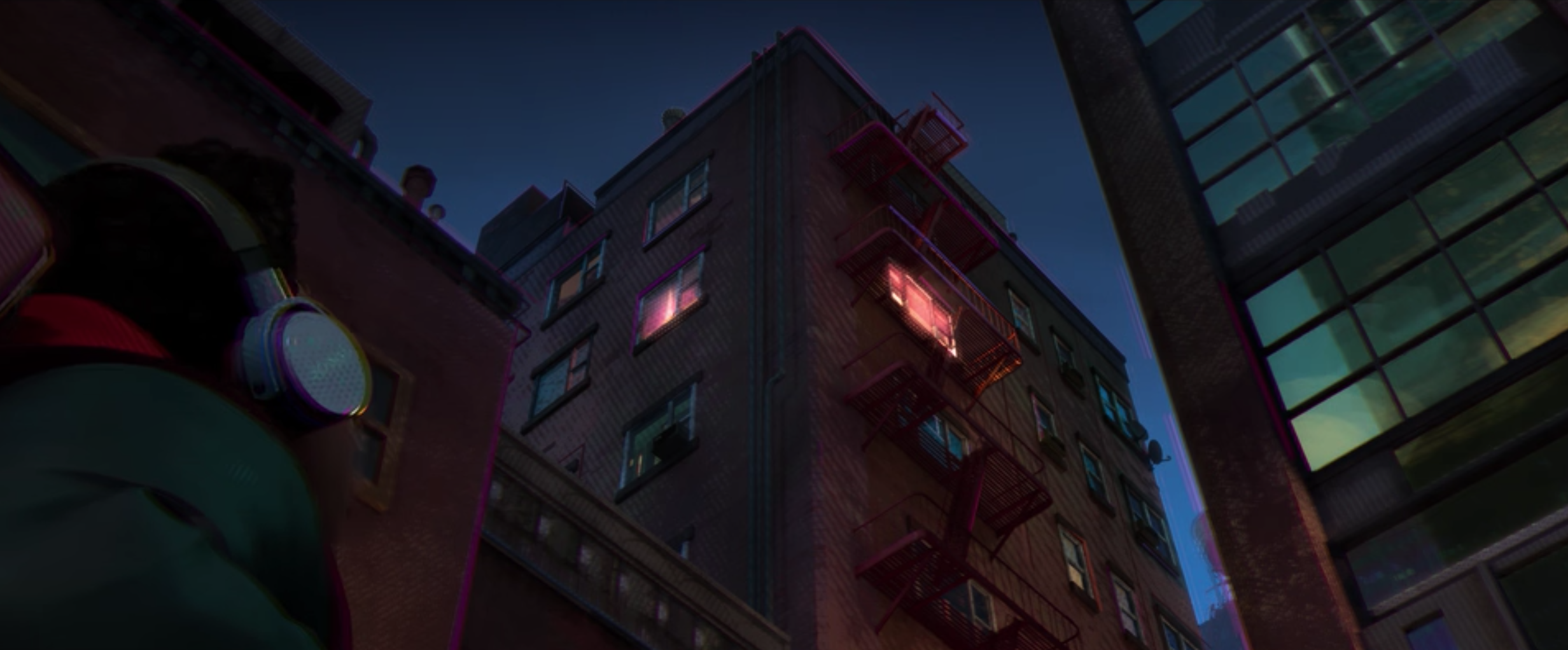
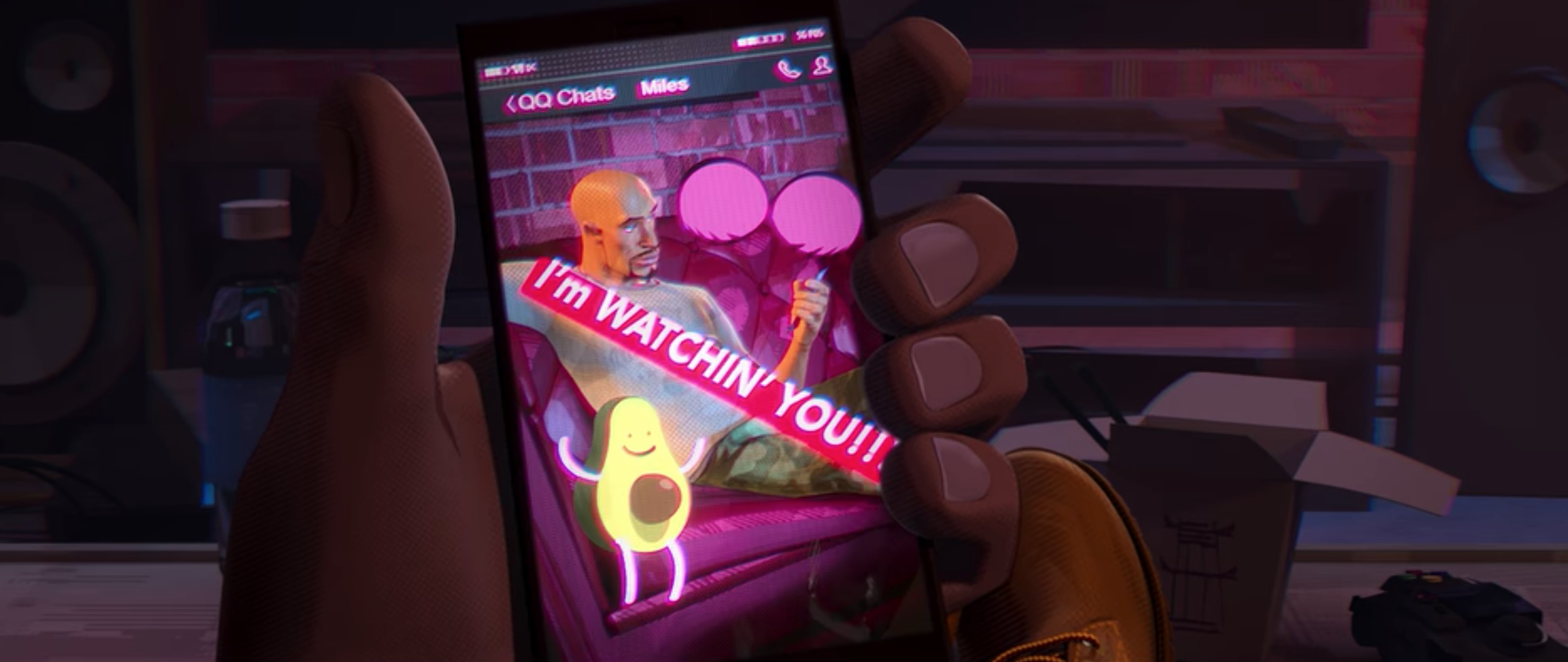
Screen Shot 2019-12-13 at 12.53.08 PM.png

Screen Shot 2019-12-13 at 12.53.30 PM

Screen Shot 2019-12-13 at 12.54.43 PM

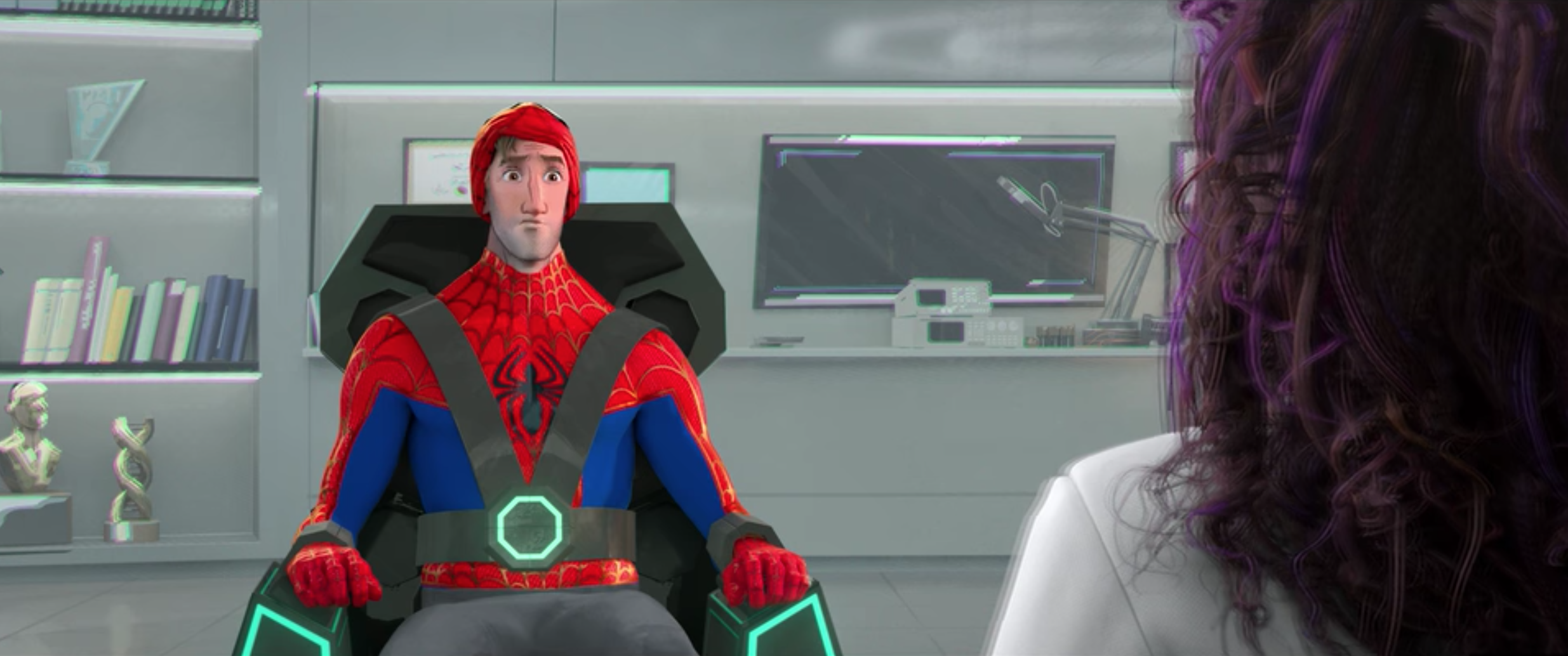
The color scheme used in Dr. Olivia Octavius’ lab also indicates that she might not be just a doctor who is working for the villains in the movie, but a supervillain herself. As Miles approaches her lab through the vent, the light from the interior of the lab gives the vent a light green tint. We see the same unnaturally green color coming from objects in her lab such as her computer screen and testing chair. Her second primary color is purple, another classic supervillain color that can be seen in her hair, skirt, and surrounding items in the room. These colors are all introduced to the viewer before she reveals herself as Doc Oc, allowing the viewer to foreshadow her reveal.
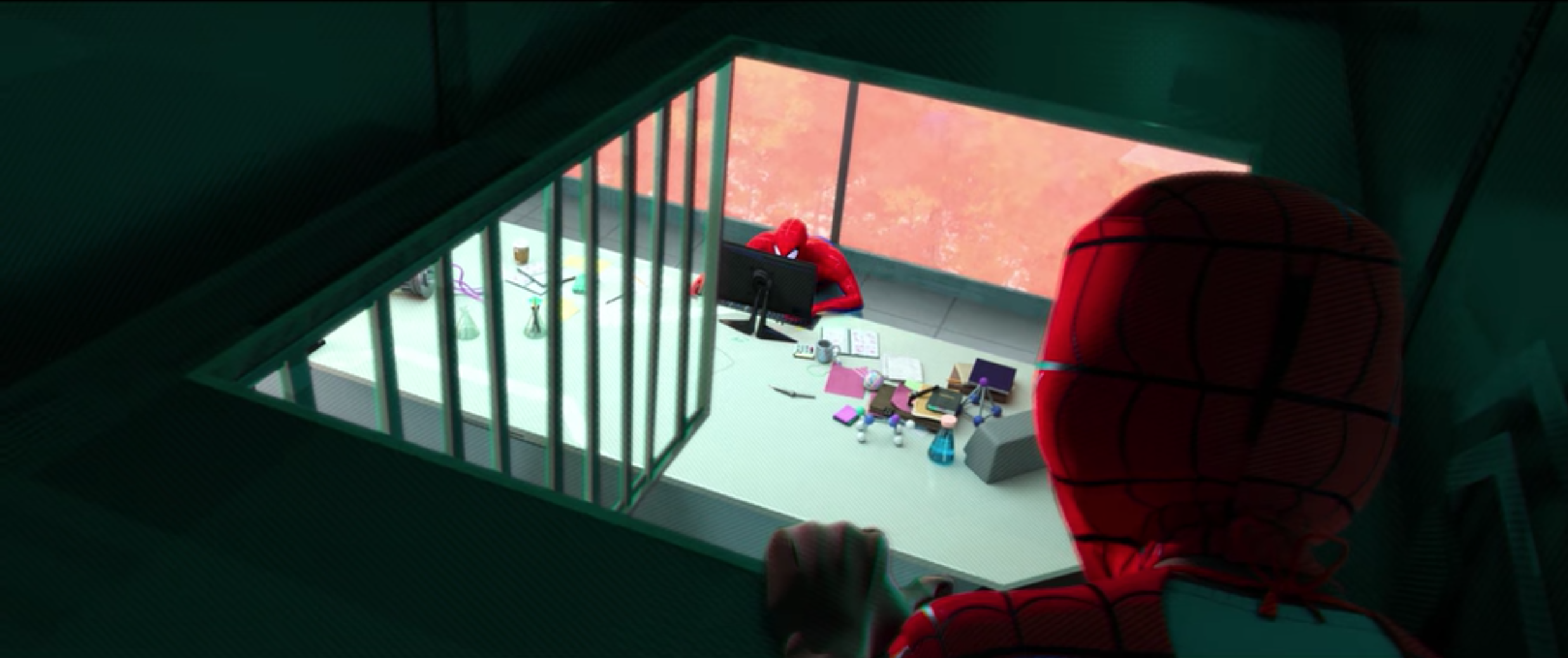
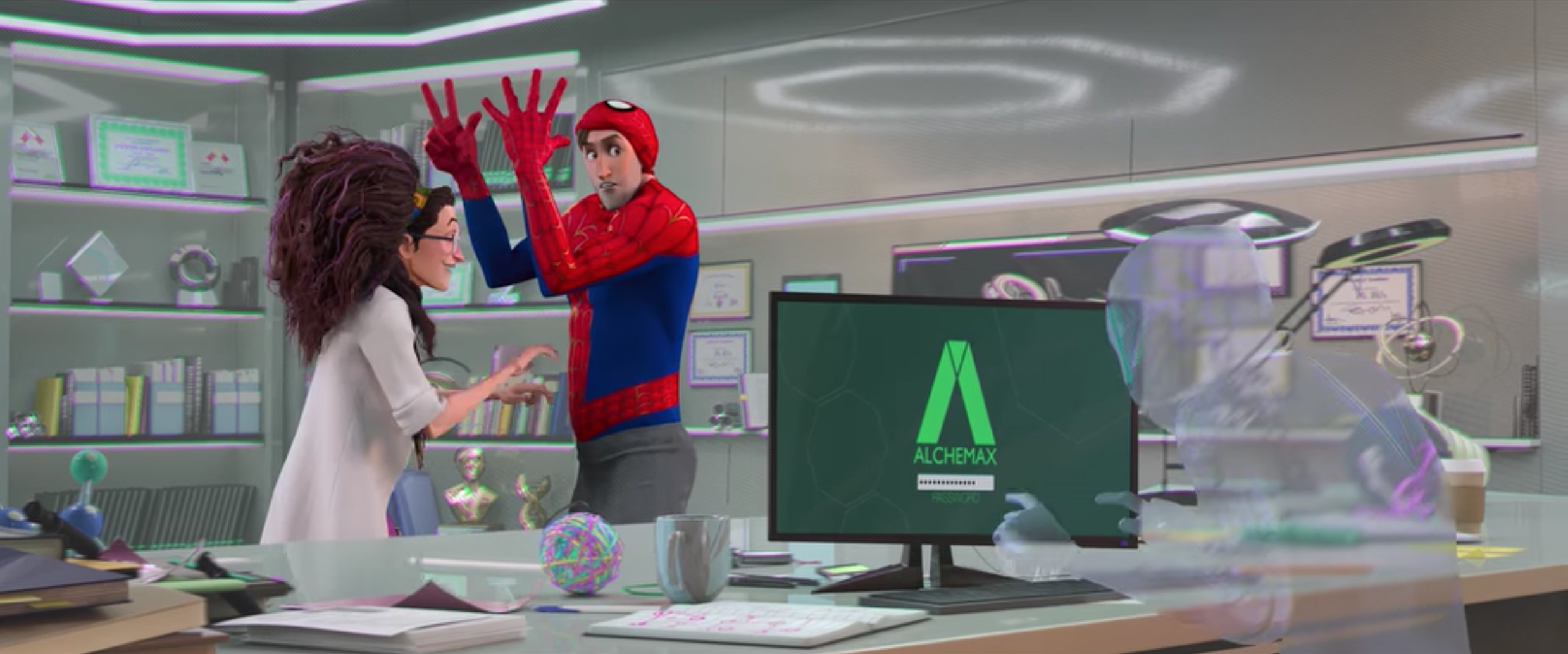
Screen Shot 2019-12-13 at 1.16.03 PM

Screen Shot 2019-12-13 at 1.37.17 PM

Screen Shot 2019-12-13 at 1.45.53 PM

Color: An Indicator of Emotion

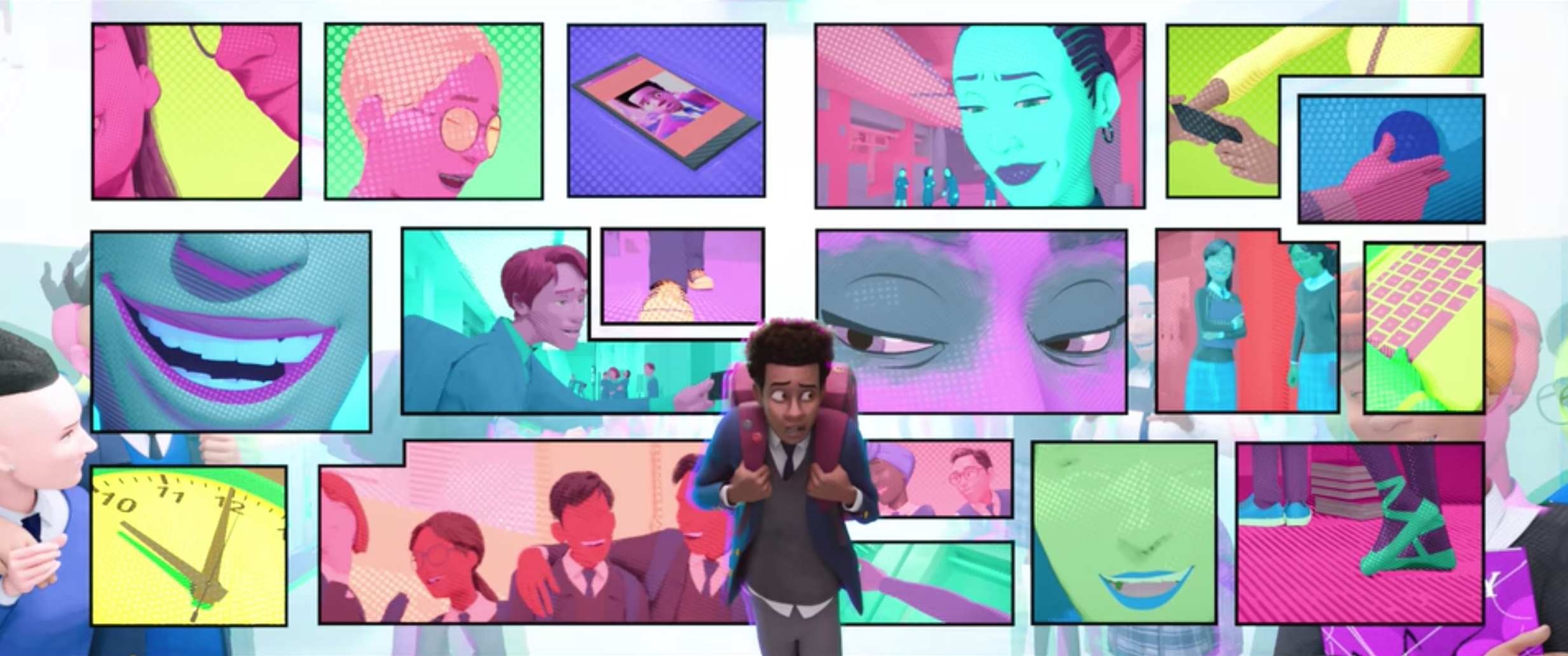
After Miles gains his Spidey powers, his emotions manifest themselves on the screen in various ways. One of the most prominent reoccurring feelings throughout the film is Miles’ fear when overwhelmed by social pressure or danger. This fear causes a fight or flight response in Miles, usually triggering some Spidey power like invisibility. We also see the color scheme change at these points where Miles feels overwhelmed.

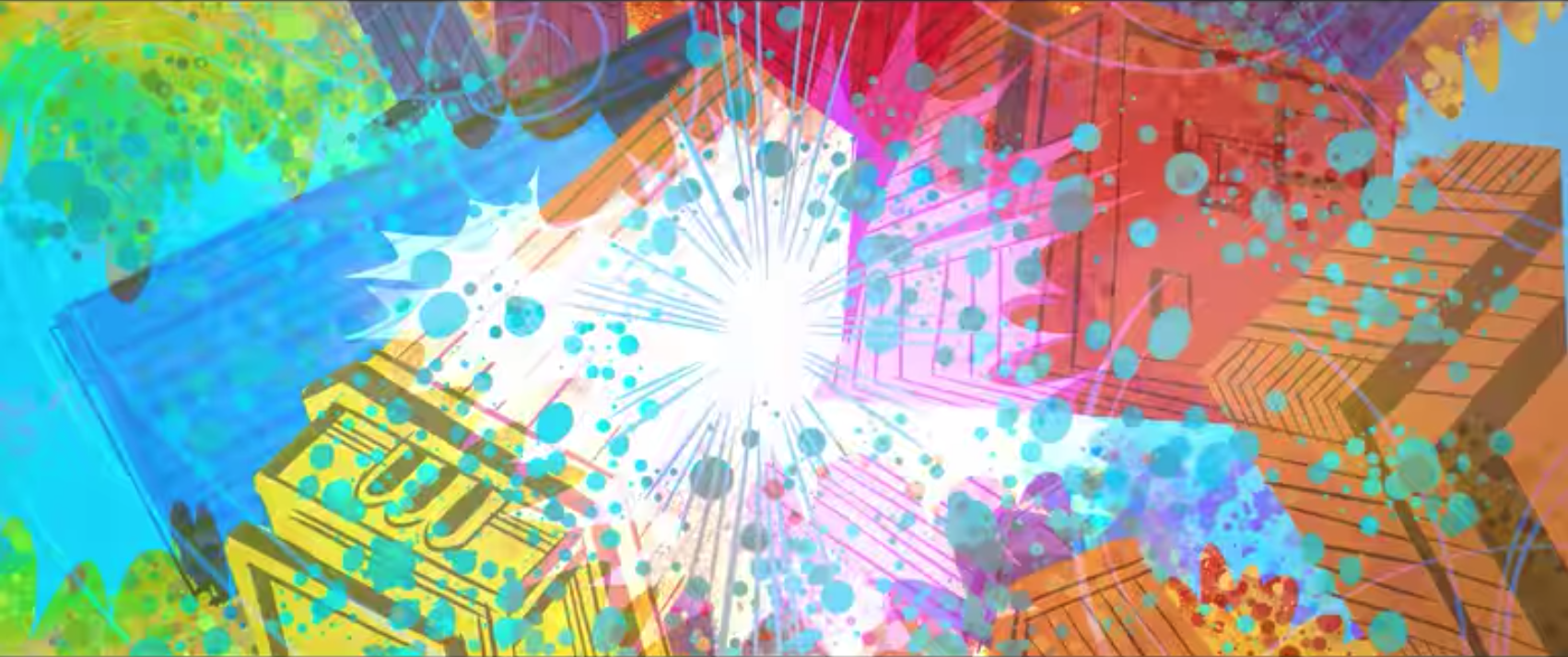
A good example is early on in the film when Miles sees that everybody in school has heard about him accidentally ripping Gwen’s hair out. In the style of a comic book, the screen becomes populated with boxes that show what Miles is afraid of: all the other students judging him and gossiping about him. Just as Miles is overwhelmed by the situation, the colors are intentionally overwhelming to match Miles’ emotional state. Pure cyan, magenta, and yellow are scattered in different boxes throughout the screen and jump out at our eyes.
Screen Shot 2019-12-13 at 3.17.05 PM

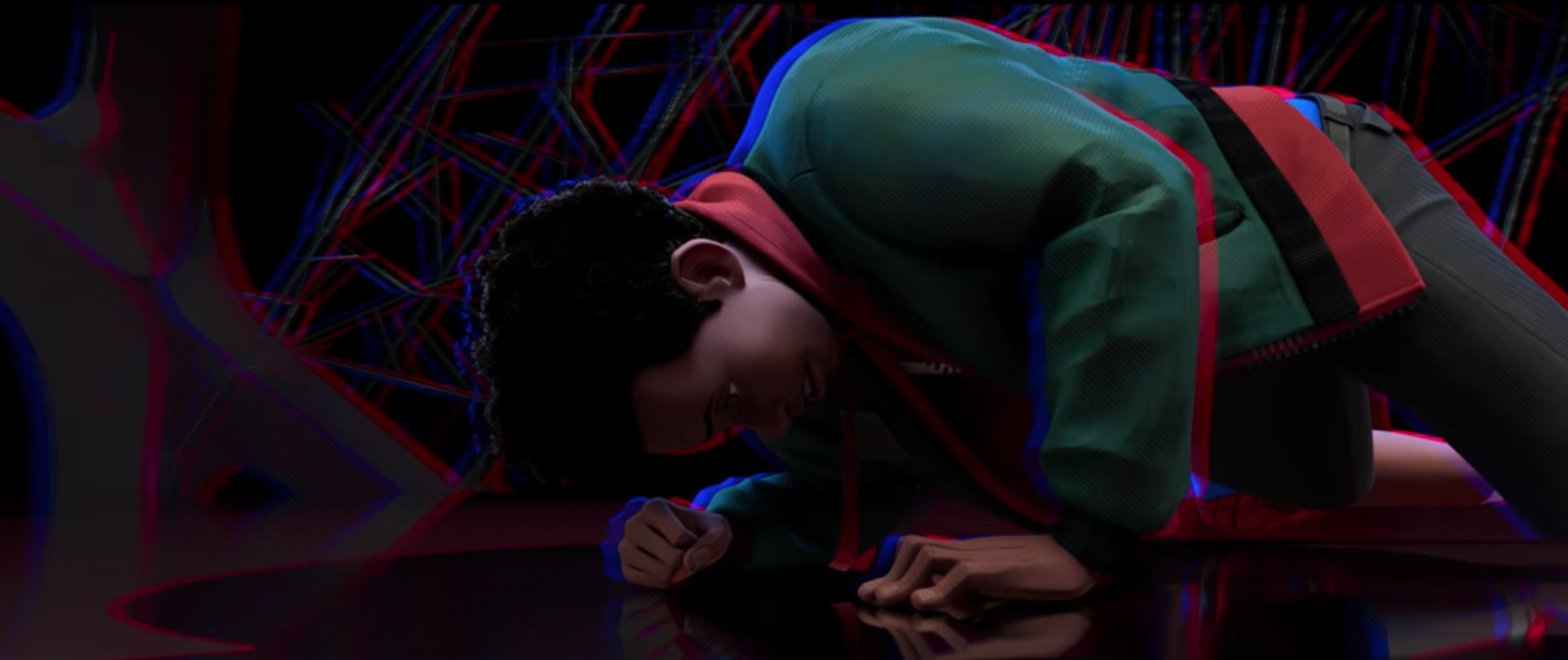
We see this appearance of the classic comic book color palette again when Miles is tested by the Spideys from each dimension at Aunt May’s house. When he fails to control his powers and fight back, Miles is knocked to the ground and colors seem to blur off of his body before his invisibility kicks in and he flees the scene. Again, the viewer is overwhelmed with bold primary colors to display Miles’ inner anxiety about achieving what is expected of him.
Screen Shot 2019-12-13 at 3.25.00 PM.png

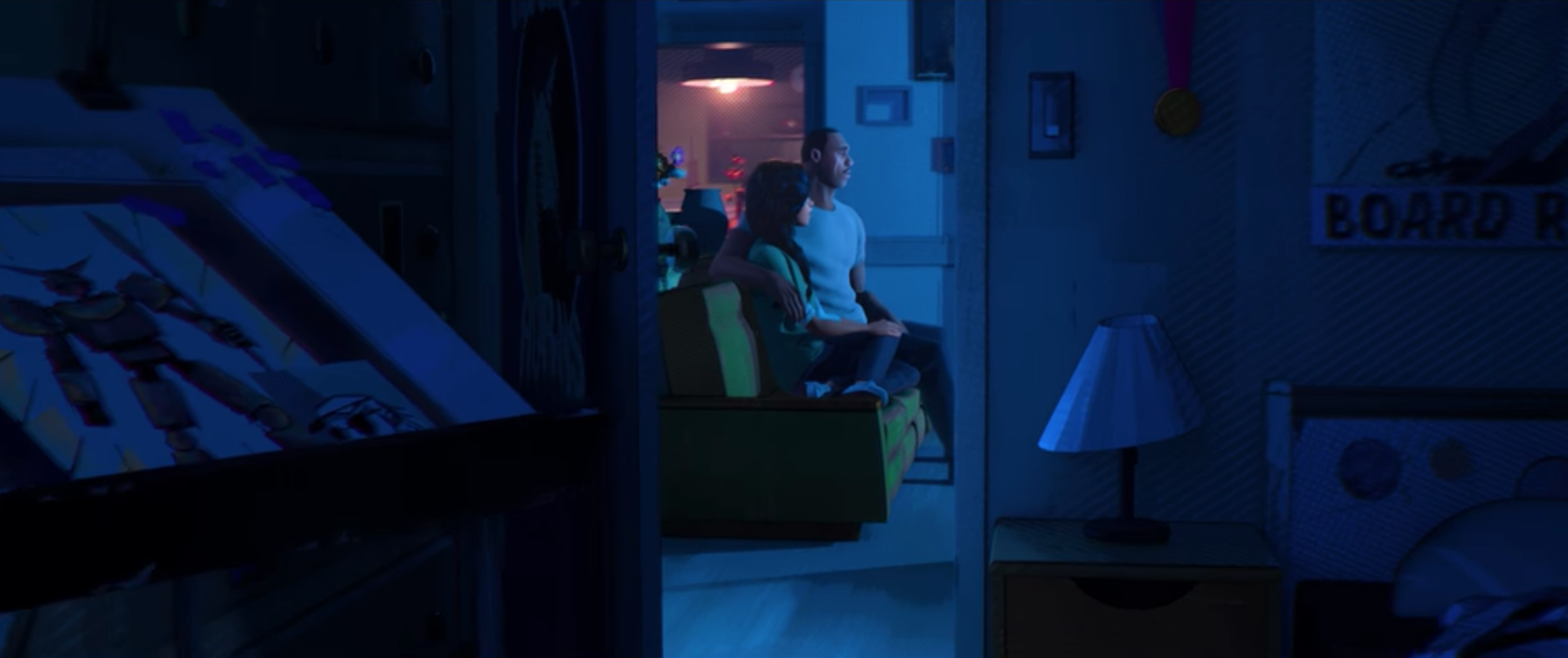
The color blue is also used to set the tone of sad moments in the film. When the original Peter Parker dies at the hands of Kingpin, Miles runs home to his parents, who find out about Parker’s death as it is broadcasted on the news. The light from the television screen tints the apartment blue, and we next see the entire city tinted a similar blue as everyone sees the announcement of Parker’s death. The creators of Into the Spiderverse were not bounded by realism that live-action filmmakers are limited to, in trying to give a scene its emotional tone. Along with sad music, this blue tint further emphasizes the sadness of the city in response to the death of their hero.
Screen Shot 2019-12-13 at 4.49.37 PM.png

Color and Character Arcs

The main and supporting protagonists possess a set of primary colors that establish a part of their identities. When a character’s primary colors are emphasized or changed in some way, this change in color has a corresponding character development. Two key examples of this are in Spider-Man Noir and Miles’ character development.

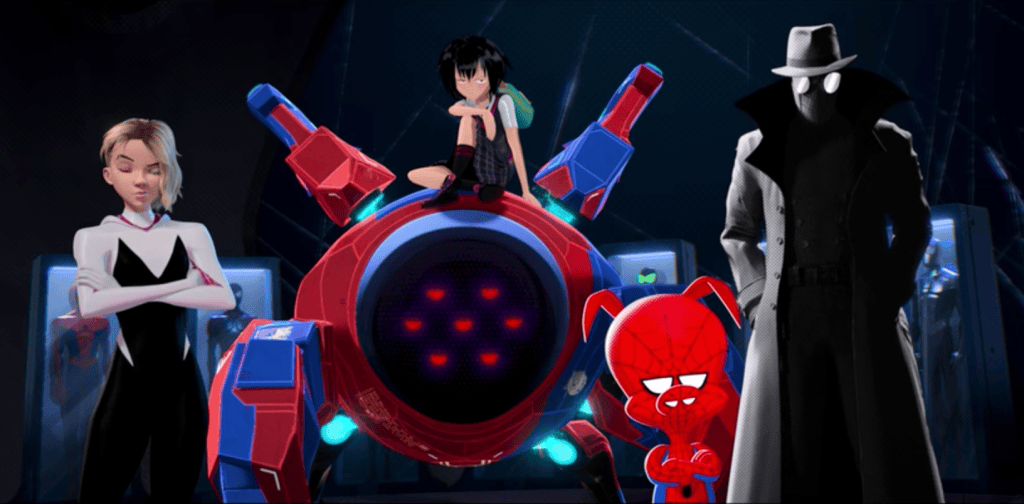
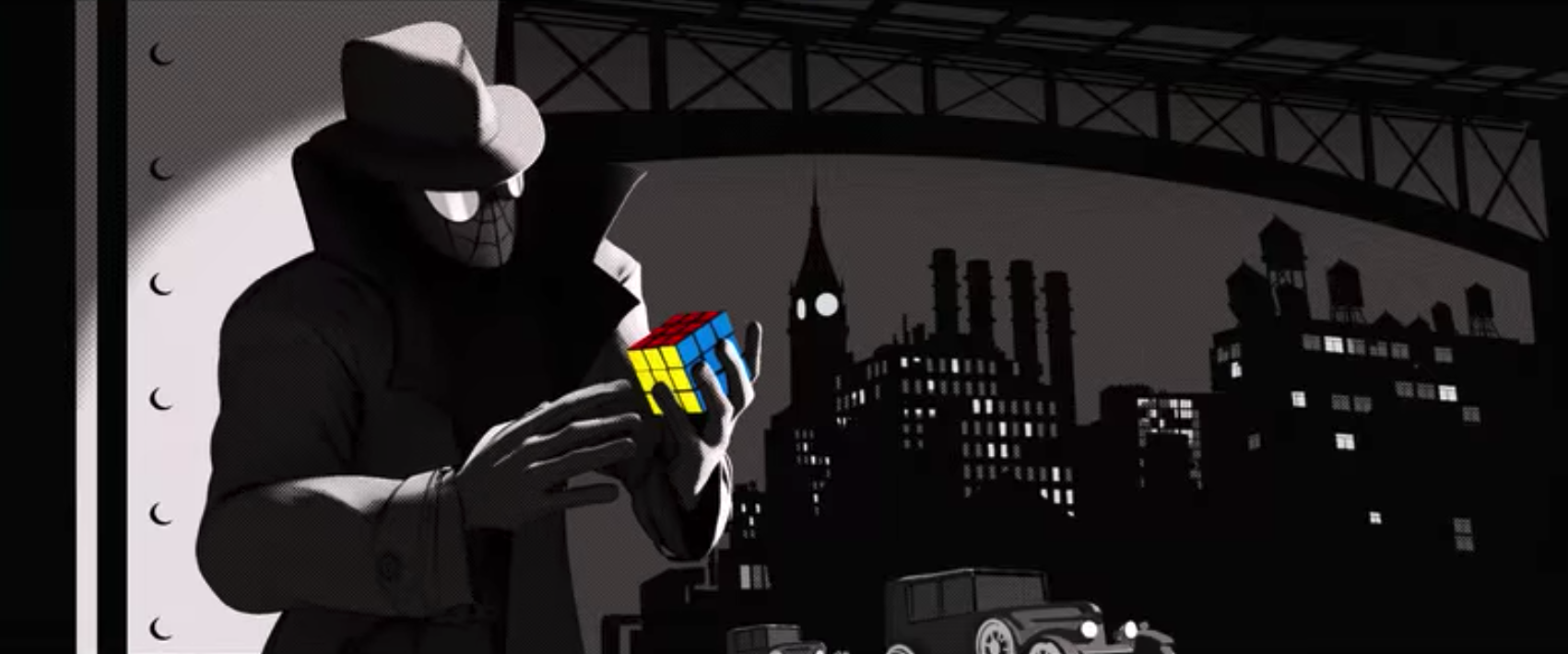
Spider-Man Noir is introduced as a man whose life of fighting crime has led to become hardened and devoid of emotion. The black and white coloration of his universe reflects the fact that he does not have the ability to feel feelings. In this new universe, he discovers that he is not the “one and only” Spider Man, but that there are many others like him that share some variant of his experiences. At the film’s climax, we see that he has developed the capacity to have and share emotions. As Penni’s robot dies, he is behind her with his hand on her shoulder to comfort her. Before returning he says with hesitation in his voice and the Rubix cube in his hand:

“I…love you all. I’m taking this cube thing with me. I don’t understand it, but I will.”

When we see him one last time during the resolution of the film, he has solved the cube, the one colorful item in his colorless world. The interplay of colors with their absence (in the RBG system) serves as a symbol of Spider-Man Noir’s character change.
Screen Shot 2019-12-12 at 2.45.27 PM

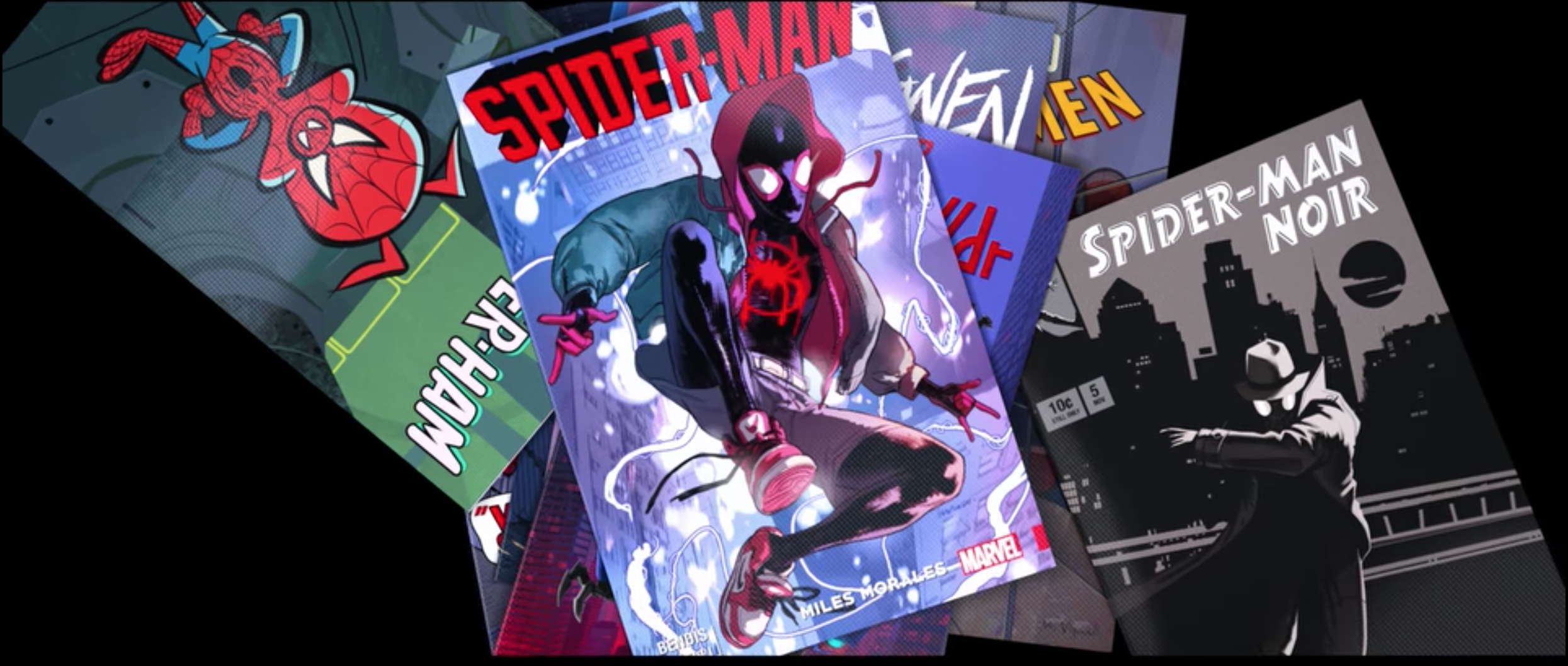
Miles’ main character development in the film is defined by ability to harness the Spider powers that have been granted to him. Miles struggles with this challenge as he tries to learn how to be Spiderman from Peter, but cannot hone his powers successfully. He has no set of defining colors for most of the film. He tries to emulate Peter’s look with a red and blue Spiderman costume that does not fit him. The scene where Miles manages to hone his power and swing throughout the city with his new red and black costume solidifies his new identity as a true superhero. His true colors, red and black, are revealed to us, and we see a new Spiderman comic book falling onto the stack of others.
Screen Shot 2019-12-13 at 7.25.39 PM.png

Color at the Climax

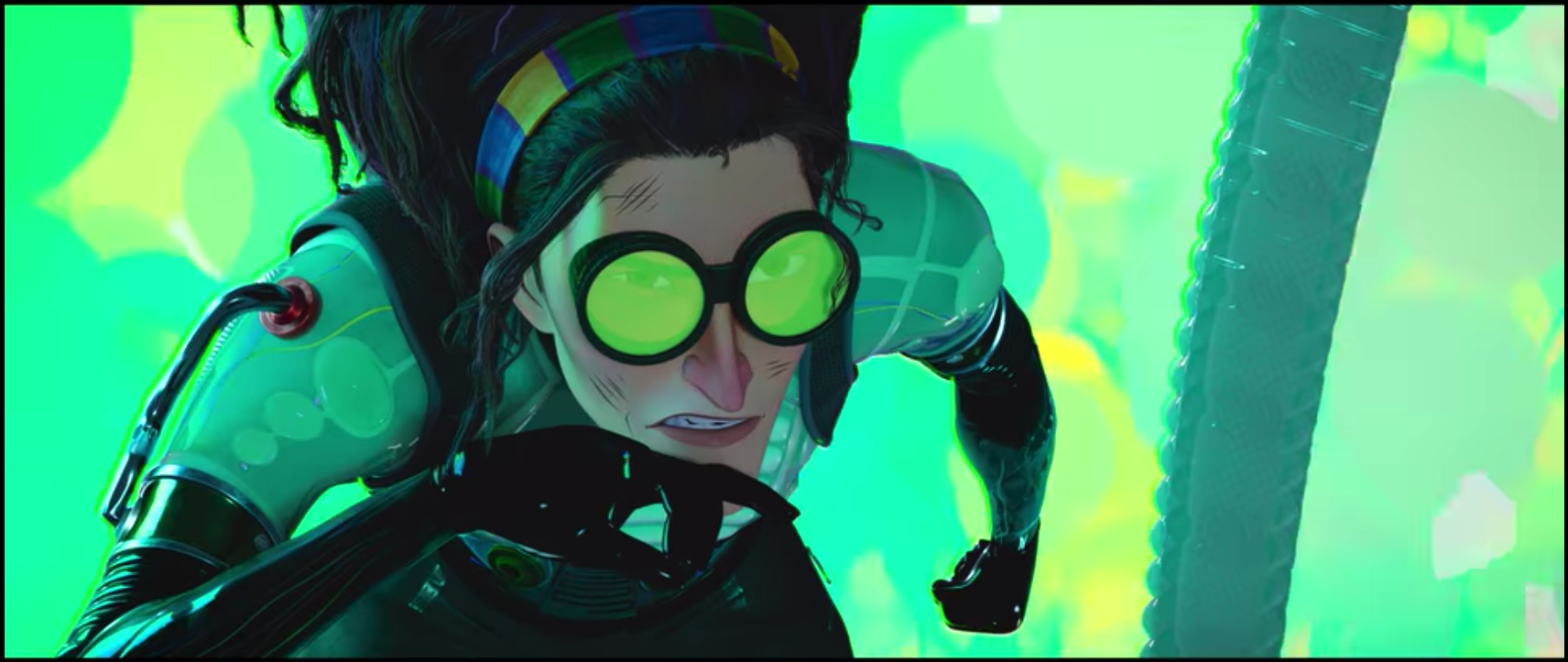
At the climax of the film, the collider beam shoots out cyan, magenta, yellow, and many other combinations to represent the colors in all the universes in a kaleidoscopic way. The energy of the scene is matched by the vibrancy of each character’s main color or color scheme. We can see this additional vibrancy first in the fight scene with Doc Oc. At other points in the film, her green appearance is dampened by the surrounding colors. However, when she is in focus during the final fight with Spiderman, her green color is amplified by the presence of the collider beam and fills the entire screen. The peak intensity of her primary color is seen at the peak of her action in the film.
Screen Shot 2019-12-12 at 2.27.11 PM

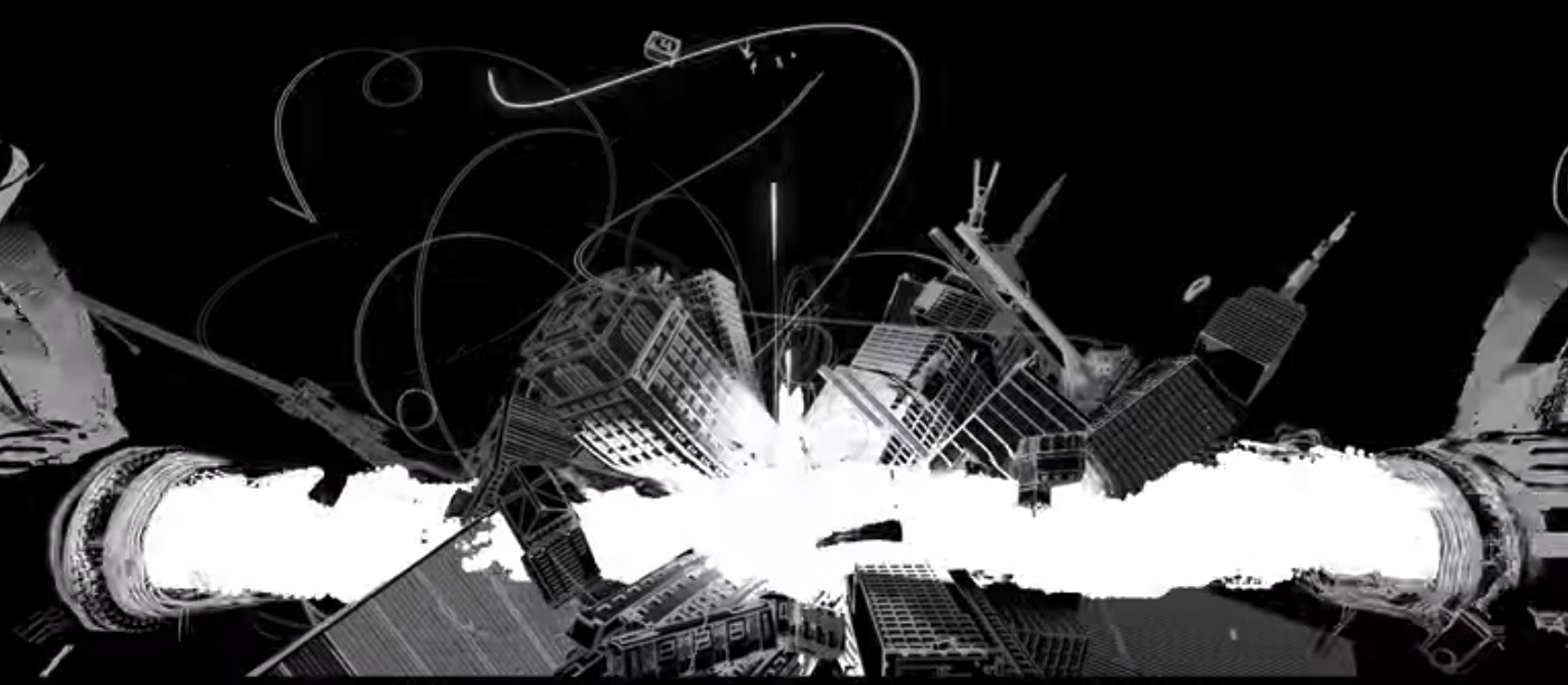
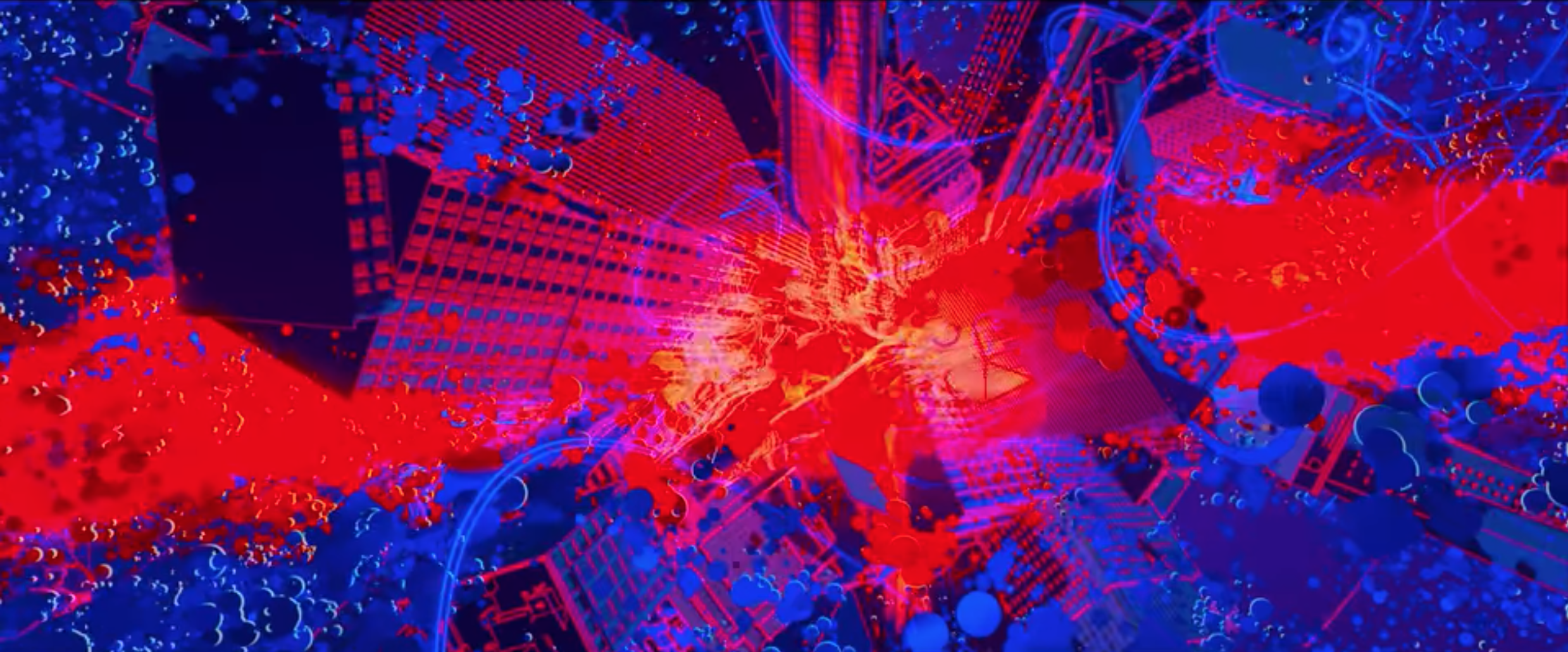
Further, the final return of each Spidey to their respective universe is established by the use of color in the collider beam, rather than bringing the audience to each character’s universe. When Spider-Man Noir jumps into the beam, the room lights up in his primary colors: black and white. When Penni and Porker do the same, we see the room filled up with the color schemes of her robot, and the Looney Tunes world, respectively.
Screen Shot 2019-12-12 at 2.47.44 PM
Screen Shot 2019-12-13 at 6.07.01 PM.png
Screen Shot 2019-12-12 at 2.48.15 PM

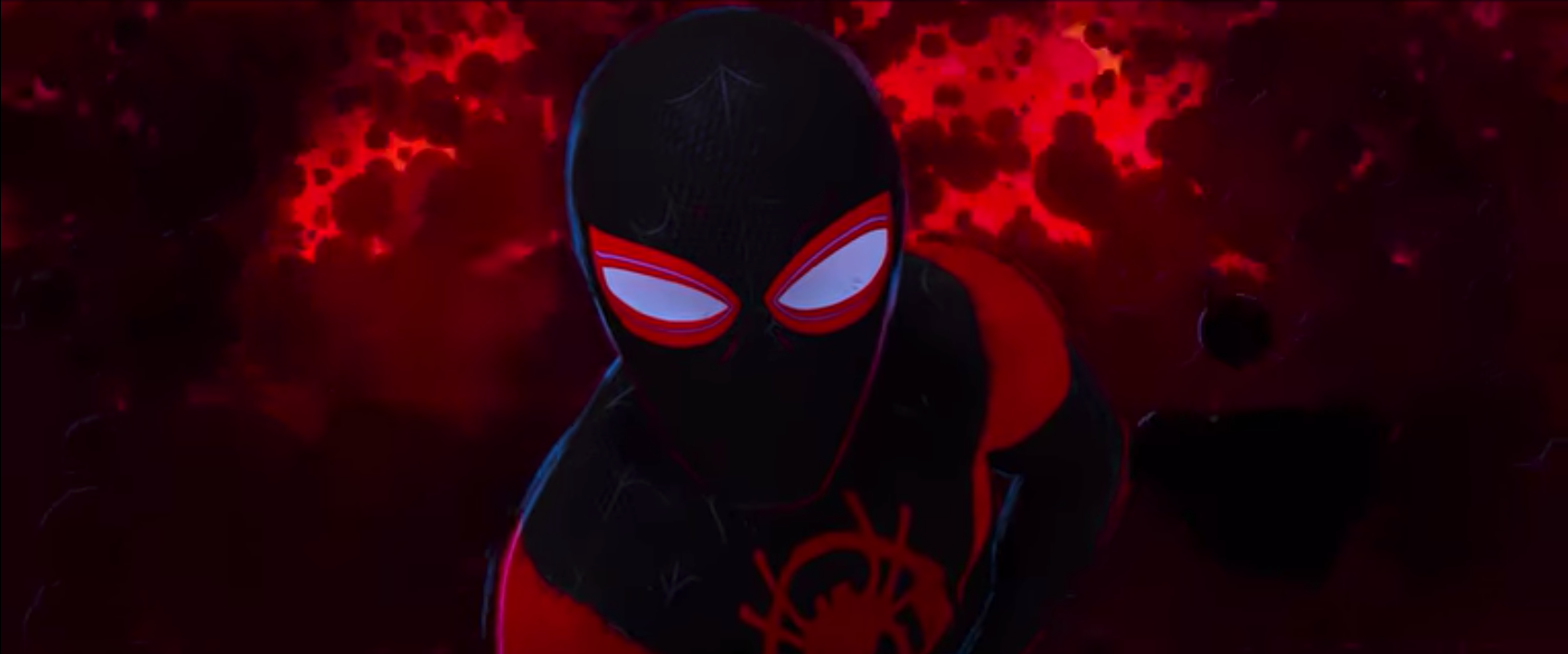
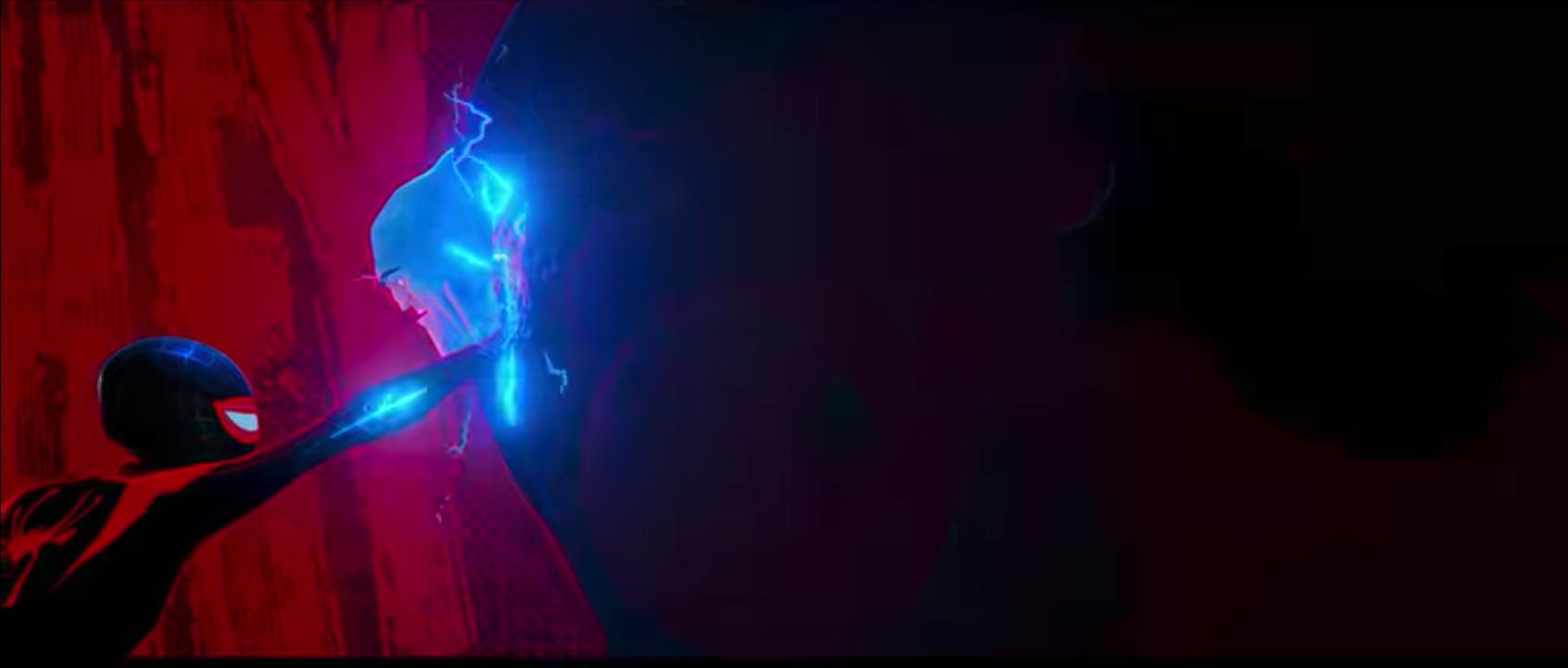
Finally, Miles’ primary colors permeate the screen during his final fight with Kingpin. Miles’ greatest power is on display just as his primary colors are displayed in their purest, most vibrant form, filling the entire “space” of the collider room.
Screen Shot 2019-12-12 at 2.44.05 PM

Screen Shot 2019-12-12 at 2.43.51 PM

Conclusion

Into the Spiderverse bombards the eyes of its viewers with the kinds of bright, robust colors one would see in a comic book. However, it does not do this for no reason. Other than honoring the medium from which the character Spiderman came from, color can be seen as a mechanism for differentiating good from evil, revealing a character’s emotions, and signifying character development.

Spider-Man: Into the Spider-Verse, A Masterclass in the Intersection of Sound and Animation

SPIDER-MAN: INTO THE SPIDER-VERSE

by Aditya
University of Chicago CMST 14400: Film and the Moving Image
Autumn 2019

Spider-Man: Into the Spider Verse hit cinemas with a storm in late 2018 as movie-goers of all ages came together to watch a new kind of Spider-Man film; not just because of the biracial protagonist, the presence of multiple spider-(wo)men, or the flawless comic-book styled animation, but because of how seamlessly all these pieces came together. It was a movie of many firsts, and it surpassed all expectations, later going on to win the Academy Award for Best Animated Film. I must confess, however, the first time I heard about the film and all the fanfare around it, I assumed it was just another super-hero movie being propped up by a loyal fanbase. It was only upon finally watching it that I realized how grossly mistaken I was; I noticed the enormous detail that went into both the animation as well as the plot, and how much the film was able to achieve through the intersection of animation and sound. All of this comes together in what is perhaps one of the most iconic scenes of the film, Miles’ “Leap of Faith,” embedded in full below.

There are so many aspects being brought together to make this scene what it is; the voices in the background representing Miles’ growth and arrival, the upbeat music broken up by moments of silence, the palpable fear and uncertainty in the air, the symbolism of his gliding over the same building he fell from before, and finally, the intersection of all of it incredible beauty of the animation itself.

The Opening

The scene begins with Miles sitting on the ledge of a building, lighting striking in the background matching the tempo of the music, both the animation and the music being dexterously used by the creators. The audience immediately gets a sense of what Miles is feeling in this scene, the adrenaline created by the music, the doubt in his mind conveyed by the height of the building, the enormous expanse of the city behind him, and the wariness in his face. We feel entirely in touch with Miles here and without a single word being spoken, which only serves to illustrate the enormous power of animation and music, and perhaps less expectedly here, the shot of the frame in moving from the bottom to the top of the building.

Immediately following this, the scene cuts to a flashback of the journey Miles made from Peter’s home to the ledge that he was sitting on, and the internal growth that the audience is able to witness. Here, the editors beautifully created a montage of things people have said to Miles that push away the doubt we previously saw. Rather than flashing back to each individual moment,  the editors chose to have the voices in the background and this tool further allowed the audience to put themselves in Miles’ shoes; to watch as Miles’ confidence grew with each voice that we heard.

“I see this spark in you…it’s amazing.”

“Whatever you choose to do, you’ll be great.”

“Our family doesn’t run from things.”

“You’re the best of all of us, Miles. You’re on your way.”

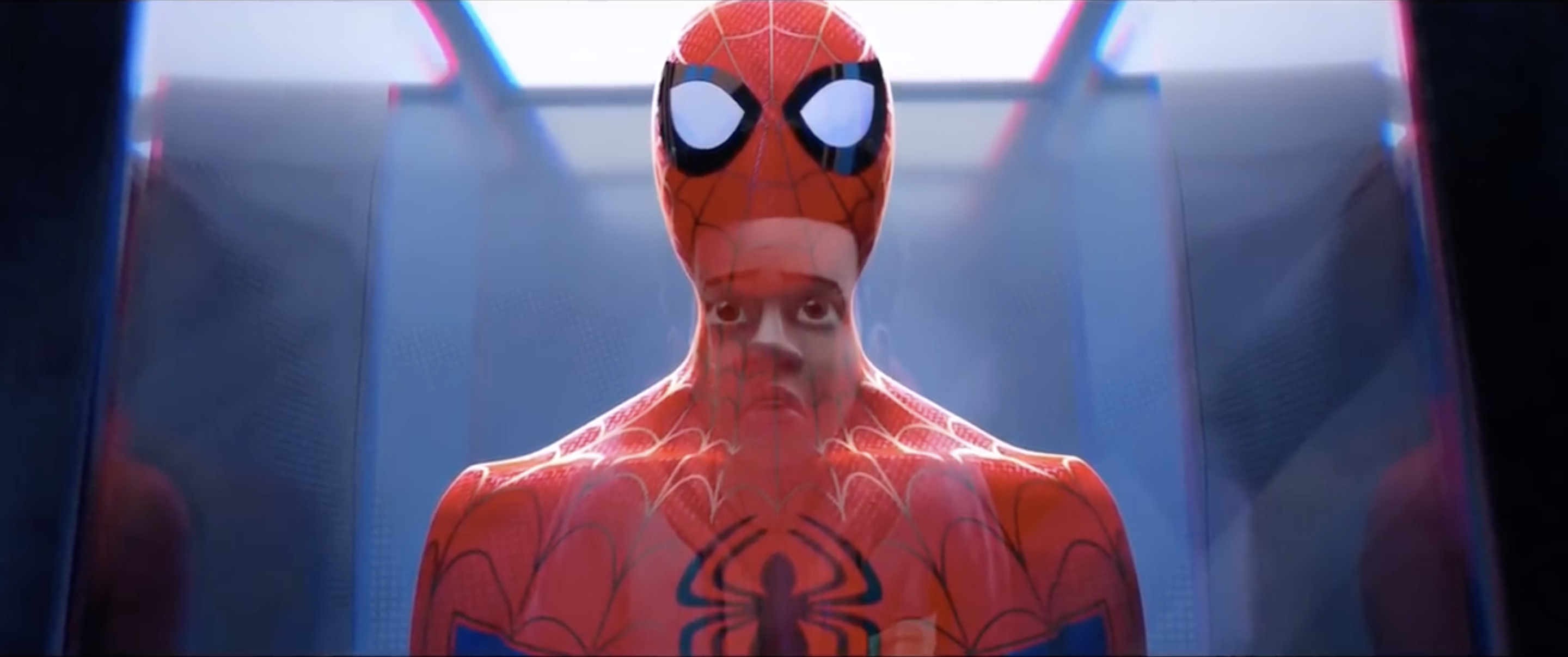
In addition to this, visually, this growth is also apparent in Miles looking at his reflection in Peter’s suit. While this scene alone (Figure 2) could have conveyed that Miles was finally ready for the battle that was waiting for him, what makes it far more poetic is the scene of Miles unable to see his reflection in Peter’s suit earlier in the film (Figure 1). In drawing back to that first scene, the film is able to highlight Miles overcoming his self-doubt and his development in finally becoming worthy of the suit. All of this is brought together, the music, the flashbacks, the voices in Miles’ head, his journey to the building he first attempted to leap from, in less than 1 minute, and yet it packs an enormous amount of tension and emotion into one short scene.

Screen Shot 2019-12-13 at 2.24.49 PM
Figure 1: Miles unable to see his reflection fit into Peter’s suit
Screen Shot 2019-12-13 at 2.23.40 PM
Figure 2: Miles seeing his full reflection in Peter’s suit towards the end

Music: Blackway and Black Caviar’s “What’s Up Danger”

The use of music in this clip is especially apt on several different levels, not only in the lyrics of the song itself as Miles is getting ready to face his fears, but also in the pauses within it that let us appreciate Miles’ internal struggle and hear the sounds of his steps and the glass breaking. As the flashback scenes take place, we hear the music build up until it finally breaks for a moment as we hear Peter’s voice saying, “That’s all it is, Miles, a leap of faith.” This one moment, although it only lasts for three seconds, brings together Miles’ finally moments in which he realizes that he must trust himself; the audience does not actually hear him say this in any dialogue, but the music becoming increasingly quiet and the animation showing him take a deep breath are enough to tell the us everything.

jump
Figure 3: The Leap of Faith

Whether we see it or not, Miles’ uncertainty in this scene is palpable, and it is further highlighted by two shots. The first is of the moment right before he jumps, where he is at the very edge of the frame with the enormous skyscraper beside him (The very beginning of Figure 3). This framing, in addition to the near silence of the music, accentuates Miles’ self-doubt and allows us to once again empathize with him; we understand that Miles is doing what he thinks is right, but not necessarily what he wants to do. Jennifer Scheurle, a veteran game designer, described the shot, saying,

“The building is so much larger than he is and dominates the screen. His environment leaves almost no room for him. He’s crushed by the weight of where he is and what he has to do next.”

Screen Shot 2019-12-13 at 4.02.39 PM
Figure 4: Miles’ fingertips holding on the glass

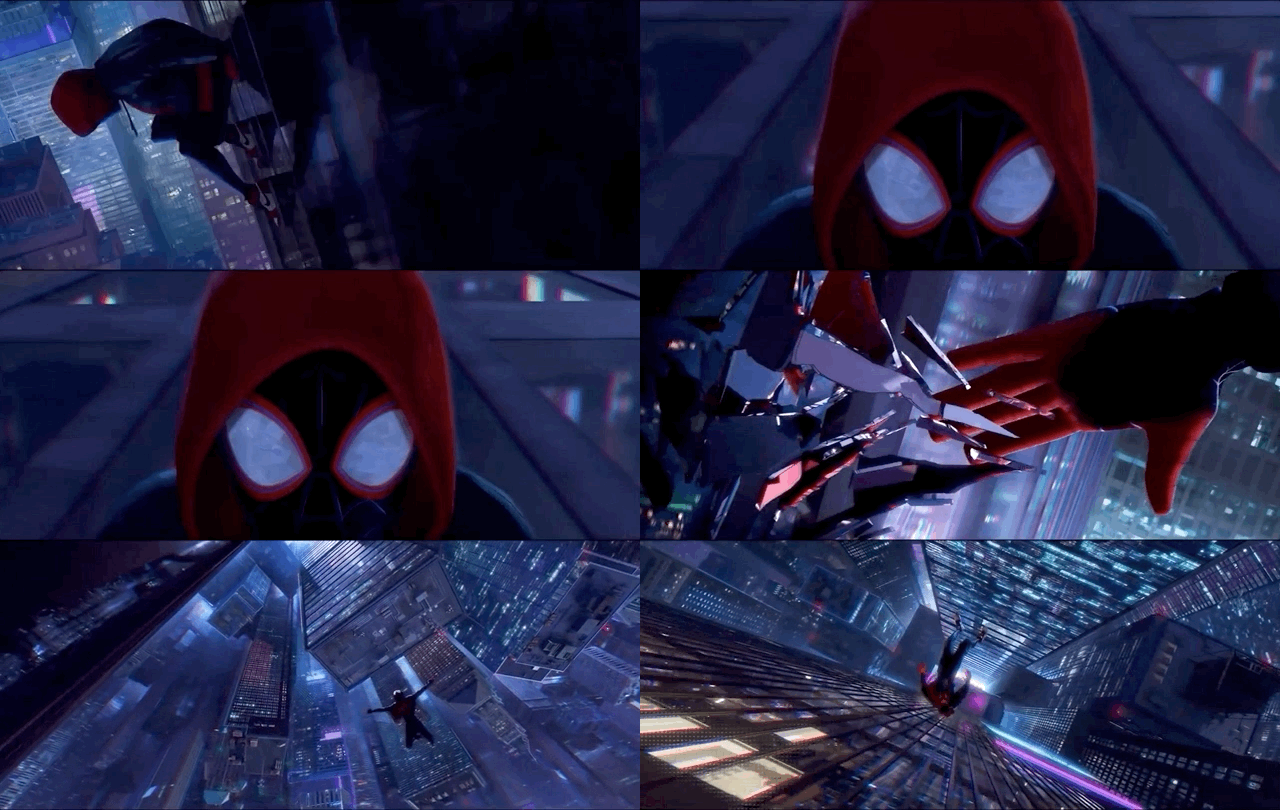
This sentiment continues in the beautiful animation of the next shot. As the music gets slightly louder and we hear the words, “Like what’s up danger?” Miles gracefully leaps off the building. We see Miles fingertips breaking the glass as he is unable to fully let go off the building, however, fear still clouding his mind as he pushes himself, nonetheless (Figure 4). It is in this moment that we are reminded of Miles’ age, that after all he is only a young boy afraid of the choices posed in front of him. Scheurle called this “the man infestation of his leap of faith: Miles is doing something necessary despite his fear, despite knowing how badly this could all go for him.” And as we arrive at one of the most beautiful shots of the scene, the extended silence allows us to take a moment and truly appreciate Miles’ feelings as well as the beauty of the animation.

Screen Shot 2019-12-13 at 4.01.31 PM
Figure 5: Miles rises on screen

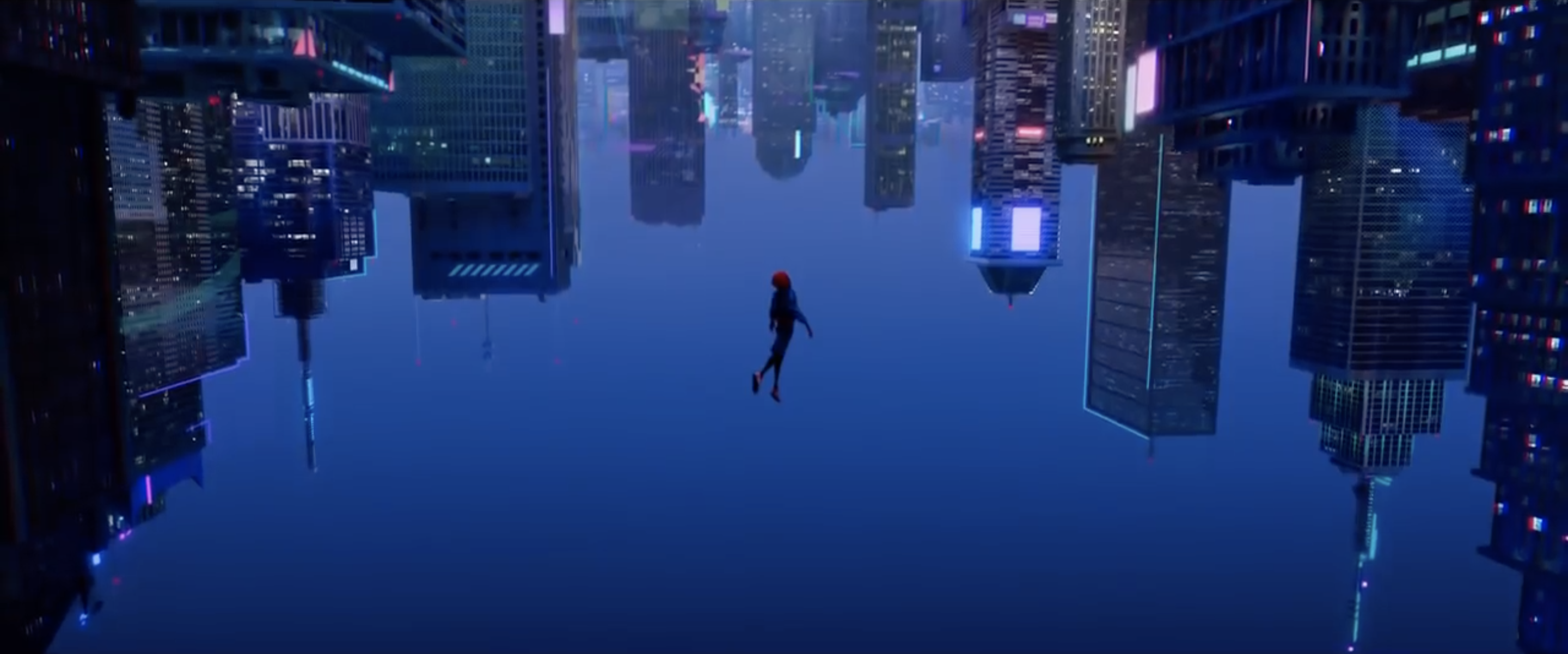
As the silence continues and some form of serenity kicks in, the shot shows Miles rising even as he is falling. And in this moment, we do not question it, for Miles has indeed risen to the occasion. This does not last long, however, even as the silence continues, suddenly we are reminded that Miles is indeed falling as the grace of the scene disappears and we watch Miles flutter around. Rather than sustaining the serenity of the previous shot, the silence now serves to heighten the sound of the wind clashing against his clothes, until it finally returns, bringing only tension and worry back with it. In these scenes, by combining long periods of silence with short bursts of music, and even longer lengths of silence with sounds of the glass breaking or the wind, the film is able to create a reality even as we have already agreed to suspend our disbelief. Because of the use of the sound in combination with the expert animation, the audience is able to feel every sentiment of Miles’ without ever having leapt off a building – and this is the beauty of the intersection that one cannot stop appreciating while watching these scenes.

approaching screen fall
Figure 6: Accentuated comic-book style animation

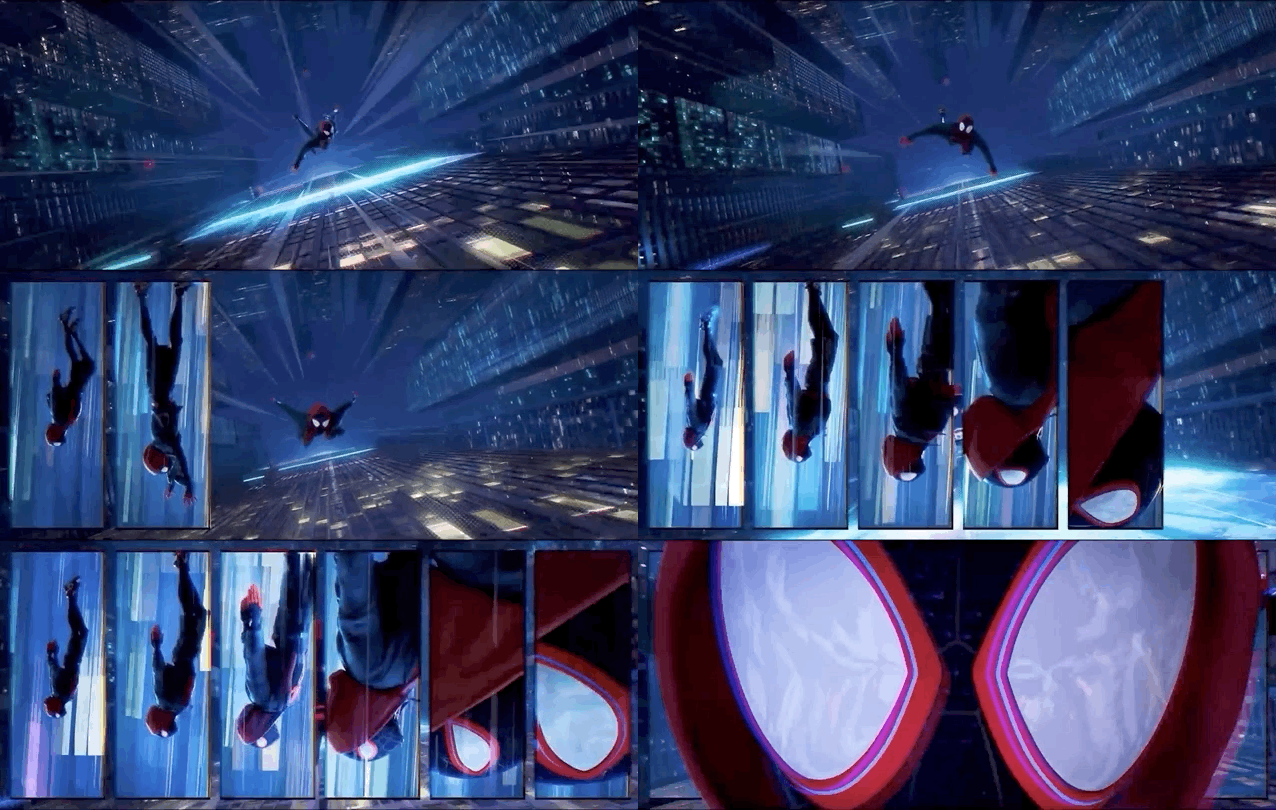
Although our logical minds keep telling us that Miles will survive the fall, the anticipation creates a certain uncertainty as the fall extends further and further. In this scene, as the music finally picks up and we hear the words, “Like what’s up danger?” again, we witness the animation that made this movie so notable in the first place – we see an accentuation of the comic-book style in the blocks breaking up Miles’ descent, and all of this comes together to build up more tension as the music gets faster and Miles gets closer to us.

Finally, we watch as the music becomes louder still and Miles launches his webs and glides across the city in triumph, highlighting what is possibly my favorite piece of symbolism in this scene, but something that I entirely missed initially. As Miles is swinging we a see a contrast in the red and orange lights on the ground and the lighter shades of blue around him in the sky. Scheurle suggested that this is representative of how Spider-Man views the world: “The sky is peaceful and blue. The ground is dangerous, metaphorically on fire. The floor is lava, and it’s better, safer, for him to be in the air.” I thought this, in addition to the more apparent symbolism and connections to earlier scenes, showed just how much thought clearly went into this short scene, and reminded me of what made the animation of this film so beautiful.

As we come to the end of the scene, we witness one last connection to an earlier scene that perfectly culminates Miles’ journey thus far. Swinging around, more sure of himself now, we see Miles glide across the building from which he first tried and failed to leap off from, and as the music beings to fade out, both Miles and the audience know that he has come full circle.

This entire scene is one that many recognize and many have expressed their opinion of, but I think more than anything, it represents how beautifully animation and sound can come together to create human sentiment. When one watches a scene like this, there is no question of animated films being secondary to live-action, for Spider-Man: Into the Spider Verse shows just how much animation can push the boundaries of what we expect from films. By not only developing intricate animation, with 177 animators working on the film at one point, but by combing it with varying volumes and tempos and moments of silence, this film illustrated exactly how to build emotion and develop characters, often without even saying a single word. And while this may only be one clip of the scene – and, certainly, one of the scenes that I felt was packed most with symbolism, call-backs, and possibly the most beautiful animation – it is representative of the entire film and the practices used to create this masterpiece.